World Maritime University
The Maritime Commons: Digital Repository of the World
Maritime University
World Maritime University Dissertations Dissertations
2000
Assurance of seafarer's quality : implementation of
the ISO 9002 quality system in a crew manning
agency
Jing Min Shi
World Maritime University
Follow this and additional works at:http://commons.wmu.se/all_dissertations
This Dissertation is brought to you courtesy of Maritime Commons. Open Access items may be downloaded for non-commercial, fair use academic
Recommended Citation
Shi, Jing Min, "Assurance of seafarer's quality : implementation of the ISO 9002 quality system in a crew manning agency" (2000).
World Maritime University Dissertations. 266.
WORLD MARITIME UNIVERSITY
Malmö, Sweden
ASSURANCE OF SEAFARER’S QUALITY
--Implementation of the ISO 9002 quality system
in a crew manning agency
By
SHI JING MIN
P. R. China
A dissertation submitted to the World Maritime University in partial fulfilment of the requirements for the award of the degree of
MASTER OF SCIENCE
in
SHIPPING MANAGEMENT
2000
Declaration
I certify that all the material in this dissertation that is not my own work has been identified. The contents of this dissertation reflect my personal opinions and are not necessary endorsed by the university.
Signature:
Date:
Supervised by: Name: Jan Horck Office: Lecturer
Institution/organisation: World Maritime University
Assessed by:
Name: Rajendra Prasad
Office: Lecturer / Research Associate.
Institution/organisation: World Maritime University
Co-assessed by: Name: Leif Jäger Office: Lead Auditor
Acknowledgements
I owe gratitude and sincere thanks to the Cosco Manning Cooperation Inc. for nominating me and for providing financial support for my studiesat World Maritime University in Malmö.
I would like thank Dr. Shuo Ma and Captain Jan Horck for providing me with guidance and experience in completing this dissertation. My thanks go once again to Cosco personified through Mr. Li Shan Min, the managing director of Cosco Manning Cooperation Inc., and Mr. Shen Zhao Qi, the senior advisor of Cosco Group and a visiting professor of WMU, for their unconditional support in the early stages of my career, before I was enrolled at WMU.
Abstract
Title of dissertation: Assurance of seafarer’s quality – Implementation of the ISO 9002 quality system in a crew manning agency.
Degree: MSc
With ever growing concern about the responsibility of management for safe ship operation and the size of the financial penalties now imposed for pollution of the environment, it is essential that more direct and/or indirect attention are given to the professional standards and qualifications of international seafarers. SOLAS, ISM Code and STCW’95 have been developed to ensure the quality and competence of seafarers. These instruments require government authorities, training centres, maritime academies, shipping companies, and ship managers to perform and carry out responsibilities to ensure the quality of seafarers.
Crew manning agencies play an important role in the employment chain of seafarers. About one third of seafarers are supplied by crew manning agencies to the international fleet. Nowadays, no mandatory rules and conventions exist for the crew manning agencies. How does the shipping industry ensure their quality? What important role is the playing in the industry? How do they ensure the qualification of seafarers and related services?
Table of content
Declaration………I Acknowledgements………..II Abstract………...III Table of content…………..………IV List of appendix, figures and tables…………..………...V
Chapter 1. Introduction……….1
Chapter 2. Demand and supply of international seafarers………4
Chapter 3. International conventions………8
Chapter 4. The crew manning agency………12
Chapter 5. ISO 9002 in crew manning agency………...20
Chapter 6. Quality manual………..26
Chapter 7. Quality procedures………44
Chapter 8. Recommendations and conclusion………64
List of appendices, figures and tables
1. Figure 4.1 Flow chart of crew employment………..……16
2. Table 4.1 Statistics of shipmanagers in the world………...17
3. Table 4.2 DNV certification of crew manning offices………18
4. Appendix 6.1 Sample of definitions of a quality system…….………… ...39
5. Table 6.1 Sample of a correlative list………..…40
6. Figure 6.1 Sample of an organisation chart of a crew manning agency…..41
7. Table 6.2 Sample of an interrelationship chart………42
8. Appendix 6.2 Sample of a quality policy of a crew manning agency….…43 9. Table 7.1 Sample of a contract review form……….…..….60
10.Table 7.2 Sample of a document list of a crew manning agency………....61
11.Table 7.3 Sample of a notice of internal audits………...62
12.Table 7.4 Sample of a report of non-conformities………..…63
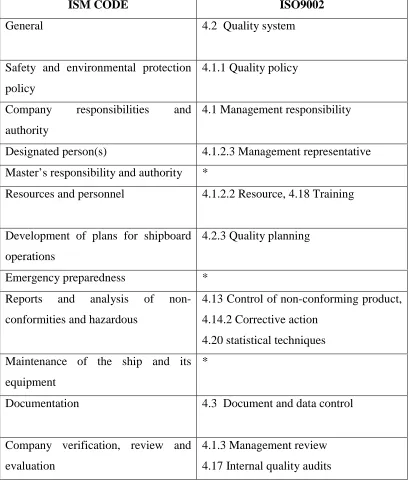
13.Table 8.1 Comparison chart of ISM/ISO 9002………...70
Chapter 1. Introduction
Since the fifties, some country’s shipowners, who were required to operate under restrictive legislation and/or union agreements covering the nationality of their crews, have been obliged to transfer their ships to more flexible regimes of the open registers if they were to stay in the business. As a result, the whole question of ownership, operation, management and the control of ships has become more complicated. These changes have introduced a new concept, ‘international seafarers’. One attraction of using international seafarers from newer sources of supply is the low cost and that seafarers’ unions tend to be more flexible.
International seafarers contributed to the development of the shipping industry from the fifties to the seventies, and then, as a consequences of lack of control of training and certification of international seafarers, the problems followed. With ever growing concern about the responsibility of management for safe ship operation and the size of the financial penalties now imposed for pollution of the environment, it is essential that more direct and/or indirect attention is given to the professional standards and qualifications of international seafarers employed onboard. The manning of ships has been a major topic for debate and concern over the past decades.
The quality of seafarers is a key factor for the safe operation of ships and the protection of the marine environment. SOLAS, ISM Code and STCW’95 have been developed to ensure the quality and competence of international seafarers. These instruments require government authorities, training centres, maritime academies, shipping companies, and ship managers responsible for ensuring the qualify of seafarers.
What about the crew manning agencies that supply a major part of seafarers for the world fleet? The fact is that no mandatory rules and conventions exist for crew manning agencies.
has been focusing on the international shipping industry as a major resource of seafarers. The possibilities presented and the success of this strategy depends upon the elementary education and the maritime education in China. China is one of the countries, which has restricted regulations and controlling functions in the aspect of certification of seafarers. China has tried hard to be in the first group of the white list of STCW’95.
The author has worked for Cosco Manning Cooperation Inc., which is a COSCO group member subsidiary in crew manning services for foreign ship owners. The company is the biggest seafarer supplier for the overseas market in China. Since 1996, a quality assurance system has been established and maintained which complies with ISO 9002-1994. The rules of the crew manning office, one of the series of rules issued by DNV, complies with the system. The author has been the representative of management and in charge of establishment of the system. The author considers that implementation of the ISO 9002 quality assurance system is one effective solution to assure the quality of seafarers supplied by crew manning agencies, especially in developing countries.
However, one sad situation that the shipping industry has to face is the shortage of qualified officers and ratings and the lack of professional education. Chapter 2 introduces the general situation of imbalance of supply and demand of seafarers worldwide based on BIMCO/ISF manpower reports. The essential factor affecting the qualification and competence of seafarers is education. The owners from traditional maritime nations have employed seafarers from countries where maritime and elementary education have not been very effective. Nobody doubts that this still is a big problem in the shipping industry. Chapter 2 also summarises the education and qualifications of seafarers today compared with high technical requirements.
What important role are the crew manning agencies playing? What are their responsibilities? Are the crew manning agencies qualified? Chapter 4 attempts to answer these questions.
Chapter 5 briefly introduces the ISO 9000 series international standards and considers why the crew manning agencies need to implement a quality system.
Chapter 6 and 7 concentrate on the establishment of the ISO 9002 quality system in a crew manning agency through the completing a quality manual and documented procedures. In accordance with the author’s experience, some specific activities are demonstrated. Some common activities affecting quality, such as quality record control and internal quality audits), are also briefly discussed in these chapters.
Finally chapter 8 gives some recommendations on the development of a quality system, and introduces the implementation of the ISM Code and the ISMA Code in crew manning agencies.
Chapter 2. Demand and Supply of International Seafarers
2.1 Demand and Supply of International Seafarers
From sixties to nineties, the increased productivity of containerships and cargo handling technology, the scale economies of very large vessels, and the growth of new shipping nations and labour supplying countries have totally changed the physical profile of the industry and its manpower requirements. Ship owners, especially from the OECD countries (Organisation for Economic Co-operation and Development), were aware of the difficulties of employment of seafarers with training establishments in the traditional maritime nations closing down. In contrast, seafarers in places like the Philippines, India, Taiwan, Hong Kong and South Korea were bursting at the seams but short of education resources.
In such a situation, Baltic and International Maritime Council (BIMCO) and International Shipping Federation (ISF) decided to investigate this unknown and somewhat confusing future, and commission an international maritime manpower survey, which was the first of its type and attracted considerable attention. In the final report in 1990, it was realised that there were totally 403,000 officers and 838,000 ratings available for the world merchant fleet.
The 1995 Manpower Update report by BIMCO/ISF was wide and deep. In accordance with this report, covering all countries of the world, there were 409,000 officers and 825,000 ratings available for the world merchant fleet. The 1995 report still showed that there was a shortage of 18,000 officers.
Some critical and profound changes have taken place and may affect the future of the industry. Ships have become bigger and bigger for the sake of economy of scale. The manning scale has become smaller and smaller due to advanced technology of navigation, cargo handling and engine room equipment etc. As a result of this tendency, the number of seafarers needed for each thousand DWT has been reduced very much during the past decades. Nobody doubts that this trend will continue in the decades to come.
Another difficulty that the ship-owners have to face is whether the existing seafarers, as stated in the BIMCO/ISF update 2000, can still meet the requirements of the future? Effective implementation of STCW’95 could well reduce the number of seafarers who are today issued with professional qualifications with reference to STCW’78, while, at the same time there is a decline in the number being promoted to the higher ranks.
However, to forecast seafarers’ supply is quite sensitive to a variety of factors such as growth in world trade and the development of new technology, re-regulations and de-regulations etc. Even on these somewhat conservative assumptions, the clear message is that the officer shortage will escalate unless corrective actions take place.
2.2. Quality of seafarers
“No ship is any better than her crew”(Peterson, S, S. 1999). This must be a common realisation by the shipping community. The qualifications of the personnel, who man the world fleet, is the single most important issue in achieving higher safety standards on board ship. The attention of the industry has been focused on “qualified seafarers”, rather than merely looking at the total availability of manpower since the beginning of 90’s.
incentives. The definition of qualified seafarers probably is very comprehensive and difficult to give. It is not enough to define a “qualified seafarer” that only holds a valid certificate and employed under an agreement.
The challenge today is multi-faceted, with modern technology and economics creating the paradoxical situation of requiring skilled seafarers who are experts in their particular field while also decreasing the number of seafarers on-board. A deck officer today does not need to use the sextant and to calculate the average error of a magnetic compass. He has to understand how to use the complex “ARPA” system, to operate the electronic chart and to be familiar with the GMDSS to send and receive integrated messages. A qualified container ship officer has not the same qualifications as a qualified bulk carrier or log carrier officer. The definition of “Qualified Seafarer”, from the point of view of the shipowner, should be a comprehensive concept which includes: valid licenses and certifications, good health, good maritime education and training, proper experiences and good acknowledgement background, initiative, co-ordination, disciplinarian, and with creativity.
How can young people become qualified seafarers? There are three essential steps: on elementary education, professional training, sea experience and re-training. The elementary education is very important and necessary before young people enter the industry. Poor elementary education normally causes a slow improvement and is a barrier to seafarers in renewing their knowledge and technical skills. It is difficult to train a junior officer who has not got enough education to be a master or chief engineer. This is a truth known by many, not only in the shipping industry, but in all other industries and businesses. If the primary and secondary education systems are not fully established, it is almost impossible to create a quality tertiary or professional education system. Maybe this is why more than 50% of senior officers of the world fleet are from OECD countries.
develop a master and chief engineer. And then a substantial period is required giving fresh hands on their new ranks, the necessary experience before they become a qualified master or chief engineer.
To be a qualified seafarer, it is not enough to have good education and rich experience. Training and retraining is also necessary, especially today where the technology is changing very fast. Seafarers need training and retraining in each step in their sea-life to renew their knowledge and skills. Clearly a high level training and continue training can be taken to indicate to the reduction of human error, the main reason for maritime casualties.
From the author’s point of view, the average level of education and training of seafarers, both officers and ratings, is not good enough. The weakness of elementary and theoretical education is one of the reasons. There is no inter-government co-operation in elementary education between the supplying countries and demand countries while some individual and private maritime academy programs have been established in Philippines, India, Vietnam, China and so on. Compared with the profit the owners make from their seafarers, the investment in the aspect of education and training of seafarers where their national governments could not provide good enough elementary education for them, can not be realised to be sufficient.
Chapter 3. International Conventions
3.1. Human error in the maritime industry
Qualified seafarers have become more and more valuable because ships have become bigger, faster and more complex to handle. An indication of the quality of seafarers today can be seen from the number of maritime incidents, accidents and disasters.
One of the most common understandings in the shipping industry is that most incidents/accidents are caused by human error. In accordance with “Shipping Casualty Statistics” issued annually by the International Underwriting Association, total losses are attributed to six different causes: collision or contact, fire or explosion, grounding, machinery failure, weather and other reasons. If a further analysis is made to find the real reasons, another generalisation will be exposed that about 80% of accidents at sea are caused by human error.
Another piece of significant evidence which gave eloquent proof of the above statement is an analysis made by the UK P&I club in 1996—“The Human Factor”, in which the main causes of major claims undertook by the club have been illustrated. 44% of the claims analysed are considered caused by seafarer’s error. The maritime accidents or incidents caused by seafarer error result in enormous damages to the safety of ship and cleaning of the sea, a huge pecuniary loss of the ship owners as well as the whole maritime community. Seafarers are also injured by mistakes or errors made by themselves.
“…Yet until fairly recently little has been done to try to determine why high skill, well-trained professional seafarers make mistake. We must concentrate of finding an answer at this puzzle.” Mr.William A. O´Neil, Secretary-General of IMO said in his millennium message (IMO NEWS, No.3, 1999).
3.2. STCW’95
In pace with the rise in free-flag tonnage, the “international seafarer” had become important in the years between the early ‘50s and the middle of the ‘70s as a new word for the industry. Before that, seafarers were either nationals of the Flag State or had a colonial or other long-standing relationship with it, so that there were no problems with differences of standards or unacceptable standards which the STCW’78 attempted to resolve. STWC’78, which set out to codify and standardise acceptable training and qualifications for the international seafarer. It was progressing successfully and it improved the qualifications of international seafarers, even national seafarers in past years. Unfortunately, some weaknesses also showed up in the different ways of complying with its requirements. Thus, the need for a revised convention, which for convenience is usually referred to as STCW’95. The first goal of STCW’95 is basically to internationally harmonise qualifications and standards. The second goal is more implicit than explicit - to raise the level upwards . The STCW’95 provides a useful starting point. It establishes considerable obligations for the administrations and also, for the first time, for the companies. A radical change from previous practices under STCW’78 is that the members will be subject to the approval of the IMO in this regard. This is really a progress to codify and harmonise the training and certification standards internationally.
modern shipping companies today and they must spend a lot of money and human resources on this.
3.3. The ISM Code
STCW’95 convention concentrates on keeping adequate harmonised qualifications of “international seafarers” by means of training and certification that are implemented by the administrations and the companies. The ISM Code is recognised as a good management practice for all the people in shipping companies.
Under the regime of the ISM Code, shipping companies are under increased pressure to demonstrate the situation of quality of their management system not only crew management. As a result of the adoption of the new chapter IX to the SOLAS convention, the ISM code requires the owner or “any other organisation or person” to develop, implement and maintain a safety management system (SMS) which covers a wide range of items. The companies must comply with the mandatory international requirements of the ISM Code at every level and in every department. Every human-element that the STCW’95 does not cover, concerning safety and quality, should be covered by SMS. This must affect to crew manning agencies.
All ships of the company have to meet the requirements of the ISM Code in order to obtain the document of compliance (DOC). Normally every major activity onboard concerning the safety and the prevention of pollution should be written in documentary procedures, especially in case of emergency. Nobody knows how a shipping company prepares so much paper works onboard and ashore. And all the documents including “the safety and quality manual”, the responsibilities, more than a hundred procedures and work instructions need to be understood by the seafarers. Furthermore, documented verification, reporting and auditing of the SMS on a regular basis is also required under the ISM Code.
Chapter 4. The Crew Manning Agencies
4.1 Crew manning agencies in the maritime industry
It is not known exactly how many crew manning agencies there are in the world. Nobody knows how many seafarers are supplied through crew manning agencies. There are several thousand agents supplying seafarers to the industry including shipping companies, ship management companies and crew management companies.
A crew manning agency is an independent agency which supplies seafarers or other maritime personnel with certain qualifications and under certain conditions to a principal. A crew manning agency is a pure agent compared with crew managers in the industry such as the crew department in a shipping company or a ship management company. This agency is also different from an independent crew manager who has a contract with the owner or ship manager.
If the owner operates his own ships, he may approach a crew manning agency to supply the crew and, usually employ the crew and carry out the responsibilities under the ISM Code, STCW’95 convention, and other international or national regulations for the competence and qualifications of the crew. Alternatively, the owner may pass the crew management to a crew manager and the crew manager may employ the crew through a crew manning agency and be regarded as the responsible person to supply according to the manning standards.
agency. As a result of the agency relationship, the crew manning agency is given considerable protection against civil claims from owners, the ship manager, and third parties. Meanwhile, a crew manager, according to the ISM Code, should be responsible for the safety management of the operation of ships and pollution prevention. In this paper, the author only intends to discuss the relative responsibilities concerning qualifications under the definition of pure agency. (See figure 4.1: The Flow Chart of Crew Employment)
Depending to the research of the UK P&I club, 30% of visited ships in the study employ their officers from crew manning agencies, and 46% of the ships employ their ratings from crew manning agencies. (The human factor, 1996, UK P&I club). If it is assumed that the proportion of officer and crew is 1: 1.2 onboard, we can also simply estimate that 38% of seafarers onboard come from crew manning agencies.
There are totally 631 ship managers in the “Ship Managers Guide” published by Fairplay in May 1998. Sixty eight of them provide pure manning services, one hundred and seventy provide ship management with manning and training services, one hundred and eighty seven engage as ship manager including manning services and two hundred six of them provide ship management services without manning services. Relying on these statistics, 36.6% of ship management companies find their crew from crew manning agencies (See Table 4.1: The Statistics of Ship manager in the World).
4.2 The qualifications of a crew manning agency
The agreement between a crew manning agency and the principals protects the agency from almost all responsibilities. All actions carried out by the agency in respect of crew recruitment and employment are on behalf of the principal. The principal of a crew manning agency is the company, organisation or other person as defined in the ISM Code which takes all or part of the duties and responsibilities imposed on it by both the Code and the STCW’95 convention. As a result, as shown in Figure 4.1: The Flow Chart of Crew Employment, such an international convention covers all the relevant organisations except the crew manning agency. This means that 30% --40% of seafarers are supplied to the international fleet through those organisations which are not subject to any mandatory international conventions concerning the competence of seafarers they provide.
In traditional seafarer supply countries, some national regulations have, of cause, been adopted to qualify crew manning agencies. For instance, in the Philippines, the crew manning agencies are licensed by POEA (the Philippine Overseas Employment Administration). This organisation also issues a quarterly listing of those licensed, which includes a list of suspended agencies and those banned from offering recruitment services (ISF Guide for International Maritime Labour, 1990, ISF). China has also adopted the regulation of license to the agency that provides crew manning services to overseas employers. By the end of 1999, there were total 41 agencies or organisations that have been approved by the Ministry of Foreign Trade and Economic Co-operation of China to engage in crew manning services for overseas employers. In other seafarer supply countries the situation is similar. This license means that the agency or organisation just satisfies the essential requirements of local government. Actually the government can not supervise all agencies to perform their work in a qualified way.
and what they shall not do. Secondly, some big principals maybe require their agency to comply with their specific regulations or other rules for their agencies, especially in the case of exclusive agencies. The principal could also supervise the qualification of crew manning agency through regularly visiting the office and by follow-up or by dispatching a representative when recruitment and selection interviews take place. The most common measure is to evaluate the seafarers supplied by the crew manning agency during and after their services. Finally, the principal requires the agent to establish and maintain a safety and quality management system to ensure the qualifications of the seafarers and the services regularly. The ISM Code, the ISMA code, the DNV rules of crew manning office and the ISO 9000 standards are all suitable for a crew manning agency. More and more people of the industry have realised that it is the most effective way to ensure the qualifications of the agency on a day-to-day basis. Due to evidence of improvement of quality, some Hull and Machinery underwriters have started to give discounts on premiums to ship managers, including crew manning agencies, who are associated members of ISMA. (The Human Factor, UK P& I CLUB, 1996).
On the other hand, the crew manning agencies also realise that to set up such a quality system is really helpful in improving their services and attracting their clients. By the end of 1999, totally 63 certificates had been issued to crew manning agencies that have complied with the ‘DNV rules of crew manning office’. (See Table 4.2 DNV Certification of Crew Manning Office)
Figure 4.1 Flow Chart of Crew Employment
Elementary Education
Professional Education
Available Employment Market
Crew Agency
(Employer)
Ship Manager Crew Manager
Shipping Company
Table 4.1: STATISTICS OF SHIPMANAGERS IN THE WORLD
(Source: Shipmanager Guide, Fairplay, 1998)
SERVICE TYPE STATE
MANGEMENT MANAGEMENT MANNING TRAINING
MANAGEMENT
MANNING MANNING
TOTAL
OECD STATES
128 97 111 14 350
EAST/CENT. EUROPE
18 8 11 21 58
FAR EAST STATES
23 32 26 18 99
INDIA SUB-CONT.
8 13 13 4 38
SOUTH AMERICA
2 0 2 1 5
OTHERS STATES
27 20 24 10 81
Table 4.2
DNV CERTIFICATION OF CREW MANNING OFFICES
REFERENCE LIST (Certificate issued or in process)
COMPANY LOCATION CERTIFICATE ISSUED
Acomarit Riga 95.09.05 (No. 001)
Acomarit Rijeka 96.08.07 (No. 005)
Acomarit Bombay
Acomarit Manila 96.08.07 (No. 004)
Acomarit Novorossiysk 97.01.29 (016)
D.S Marine (earlier Acomarit) Hong Kong 96.11.28 (013)
Acomarit (earlier UNICOM) Odessa 98.09.02 (035)
Bergesen dy Philippines, (former Havtor 96.06.26)
Manila 95.09.07 (No. 002)
New cert. issued 96.08.12, (007)
Havtor Riga (LAPA) 95.10.26 (No. 003)
Galanakis Piraeus
Unicom Cyprus
Acomarit (earlier Unicom) Odessa 96.08.07 (No. 006)
Unicom Novorossiysk 97.01.10 (014)
Unicom Riga 97.06.16 (021)
Unicom St.Petersburg 97.04.23 (018)
COSCO Manning Cooperation Inc. China 96.08.13 (No. 008)
COLEX Maritime Inc. Manila 96.11.18 (012)
Elvictor Shipping Co. SA Greece 96.10.28 (011)
Monsoon Maritime Singapore 98.06.22 (32)
Career Philippines Shipmanagement,Inc.
Manila 96.10.28 (010)
TMS Shipping (Phils) Inc. Manila 97.01.10 (015)
Norwegian Crew Management Oslo 97.09.16 (025)
Orient Ship Management Norway, Arendahl 97.09.30 (026)
Selandia Marine Services PVT.LTD Mumbai, India 97.04.14 (017)
PT Andhini Ekakarya Sejahtera Indonesia 97.07.25 (022)
Denholm Ship Management (IOM) Ltd. Isle of Man, UK 97.04.29 (019)
Seabound Maritime Services Inc. Manila 96.10.28 (009)
Nortrans Pte. Ltd. Mumbai 97.06.09 (020)
Table 4.2
REFERENCE LIST (Certificate issued or in process)
COMPANY LOCATION CERTIFICATE ISSUED
Grace Marine Shipping Corp. Manila 97.11.03 (027)
Naess Shipping Phils. Inc. Manila 97.08.21 (023)
SPA-TSM Ship Management Jakarta 98.01.19 (029)
COSCO QINGDAO Manning Co-operation Limited
Qingdao 97.12.23 (028)
Shanghai Ocean Economic and Technical Co-Operation Co. Ltd.
Shanghai 98.03.06 (31)
Herald Maritime Services Mumbai ISO 9002 99.01.26 (42)
Marine Management Services Pvt. Ltd Mumbai 98.02. (30)
Island Overseas Transport Corp. & Eastgate (Int’l) Maritime Agency
Manila 98.08.24 (34)
Chipoline Manning Service Co. China 98.07.07 (33)
Orient Ship Management Phils. Inc.
Philippines 98.09.09 (36)
Fescontract Vladivostoc 98.09.09 (37)
Wallem Manpower Int. Pte. Singapore 98.09.21 (38)
Pacific Shipmanagement Mumbai 98.12.23 (41)
Norteam Shipping Services Inc. Manila 98.12.15 (40)
P.T.Andhini Ekakarya Sejahtera Jakarta 98.09.22 (39)
Qingdao Pacific Oceaneering Co. Ltd. China 99.02.08 (43)
OSM Maritime Services Limited Hong Kong 99.03.08 (45)
ACOMARIT Hong Kong 99.03.01 (44)
China Marine & Seamen Service Corporation
Beijing 99.08.31 (46)
Fleet Personnel Pvt. Ltd. Mumbai 99.10.21 (47)
Killick Marine Services Ltd. Mumbai 99.11.09 (49)
Bergesen dy India Pvt.Ltd. Mumbai 99.11.09 (48)
Chapter 5. ISO 9002 in a Crew Manning Agency
5.1. ISO 9000 international standard series
the ISO 9000 series of standards is one of the many international standards issued by the ISO, International Organisation for Standardisation. The ISO is a world-wide federation of standard organisations. The scope of ISO involves almost all aspects in the industrial field except electrical and electronic engineering. When the technical committee of the ISO has drafted a standard and it has been approved by 70% of ISO members, a new international standard emerges.
Some of the standards can be equal to national standards. Some may be recommended to the industry. Most ISO standards concern the technical index physically or chemically, for example, the standard of socket of a light bulb socket, the standard of a container, the standard of a telephone card or credit card etc. These standards can be measured by a standard tool or specific equipment.
The ISO 9000 series are an exception to physical standards. It concerns “Quality”. It is a standard for quality, not for weight, length, intensity or strength. Hereby quality is defined as “the capability of the supplier to satisfy stated or implied needs” (ISO9002 standards). The supplier could be any organisation or firm, a manufacturer, an institute, a training centre, an agent, a hotel, a restaurant, even a government organisation. There are a number of standards or sub-standards including some guidelines in the ISO 9000 series. However the core consists of three international standards – ISO 9001, ISO 9002, and ISO 9003.
--ISO 9001, is the quality systems for quality assurance of the supplier who provides a product or service in design, development, production, installation and servicing aspects.
--ISO 9002, is the quality assurance system of the supplier who provides a product or service in production, installation and servicing.
--ISO 9003, is the quality system for quality assurance in final inspection and the test service aspect.
has established one of the three quality systems, has the capability to supply conforming products or services under the requirements of the standard. Normally, ISO 9001 applies to the manufacturing industries that are engaged in design, development, production, and installation and servicing. One example is the shipyards that design ship(s) to satisfy particular owner’s needs and then build the ship(s). Many types of service, including after sales services, are provided to ship owners and, of cause, they also need to develop the ship(s) and equipment after delivery. ISO 9002 applies to service industries and to the manufactories without design and development functions, for instance shipping companies, agencies, institutes, hotels etc. Finally, ISO 9003 applies solely to the supplier who provides final inspection and test services, for example petrol stations.
In conclusion, application of the ISO 9000 series standards depends on the particular function that the supplier supplies. If a shipping company provides logistic services to the customer, it probably applies ISO 9001 instead of ISO 9002 because some design functions are included.
5.2. ISO 9002 in crew manning agency
ISO 9002 is an international quality system for the purpose of external quality assurance applying to the service industries. It applies to crew manning agencies that supply crew-manning services to the shipping industry. In accordance with the manning agency agreement, a crew-manning agency provides relevant services to its clients. In general, these services could be stated briefly: to supply competent seafarers, as required by the principal, to be engaged on board ship(s) (Standard manning agreement of Cosco manning cooperation inc.). However, in fact, this statement can not be accomplished easily. To complete its services, a crew manning agency should conduct, but not be limited to the following activities:
4) To make a collective contract of employment with the principal on behalf of the seafarers.
5) To make individual contract of employment with the seafarers on behalf of the principal if necessary.
6) To arrange necessary joining documents, immigration documents, domestic transportation, and make any other necessary arrangements for seafarers to be ready for joining the vessel in the world wide.
7) To make immediate replacements if the principal requires for replacement of unsatisfied seafarers or in case of emergency.
8) To arrange home payment of seafarers on behalf of the principal.
9) To deal with claims and compensations on behalf of the seafarers or the principal in case of injury or death of seafarers.
10)To provide other relevant services to the principal and the seafarers.
All the above responsibilities of a crew manning agency should be explained in the quality manual. All the necessary actions of the agency should be written to document procedures to ensure that its services conform to the specified requirements of the ISO 9002 standard.
5.3. The purpose of implementing ISO 9002
Why does a crew-manning agency need the ISO 9002 quality system? What are the driving powers? Generally, there are two major driving powers for a crew manning agency to establish a quality system.
and the environment, little navigation and cargo handling knowledge and skills, are all the quality problems in which way cause a higher cost compared with salaries and travel. Sometimes a negative action and attend of a non-qualified seafarer may cause a serious accident. The ideal situation for a ship owner is probably that every seafarer is qualified at every position every time. But how could the ship owner be assured that the crew manning agency provides only qualified seafarers on a day-to-day basis?
Naturally the crew manning agencies would guarantee the principal that they provide qualified seafarers and services. The principal examines and verifies the competence of seafarers supplied by the agencies. Interviews with senior officers or significant ratings always take place through ship owners or managers before they depart on ships. Ship owners or managers also visit the office of the crew manning agency to examine their qualifications regularly and in order to improve their qualifications. Nevertheless, all these acts can not guarantee that the agencies are performing their duties at a high and stable level at every time. They also cannot guarantee that every non-conformity of the agencies can be found and corrected in their daily work and corrective and preventive action taken. Quality system provides such a guarantee to the external clients that the agency practises its necessary duties at a reasonable and stable level so that qualified seafarers and services are guaranteed under specified requirements. This guarantee is not provided by the crew manning agency themselves but by a third party – the accredited authority under a universally accepted quality standard. This principal applies to any kind of organisation.
Throughout establishing and maintaining the ISO 9002 quality system, a crew manning agency demonstrates its capability and guarantees the qualifications of their seafarers and related services. It must increase their ability to compete in the international market.
external driving powers, but the management still wants to improve their qualifications further. They find some problems, in the aspects of organisation, management, practice, and co-ordination that need to become smoother and more efficient. As a result, they decide to establish a quality system to improve the level of management.
5.4. Project plan of implementation of ISO 9002
The ISO 9002 is an international standard for quality assurance of the company that is engaged in production, installation and service. It specifies requirements, which determine what elements the quality system has to be involved in. Every company who wants to apply for an ISO 9002 certificate has to comply with these elementary requirements. “But it is not the purpose of these International Standards to enforce uniformity of quality system. They are generic and independent of any specific industry or economic sector” (ISO 9002, 1994). Depending on its particular objectives, products and services supplied, an organisation or company will design and implement a quality system complying with ISO 9002 in various ways. Even in the same specific industry or economic sector, the particular processes and specific practices are very different from one to another. Therefore, how to design and implement ISO 9002 in a crew manning agency should not be fixed. The following stages or actions should, however, be considered to make a project plan of the establishment of the ISO 9002 system in a crew manning agency:
1. Form a quality team and to design the management representative. 2. Define the Quality Policy and objectives.
3. Have a commencement meeting and training for general knowledge of ISO 9002 to all the employees.
4. Define the responsibility of each concerning functions and personnel. 5. Have a time schedule for the project plan.
7. Cut out the non-applicable requirements. 8. Find a suitable experienced consultant.
9. Learn from the successful experiences of other similar organisations. 10.Define the accredited authority.
11.Arrange written documentation including the quality manual and the procedures. 12.Distribute documents and collect suggestions and amendments.
13.Amend and complete the documentation. 14.Appoint competent internal auditors 15.Conduct inter-audit and corrective actions
16.Arrange the first visit, document review and initial audit employed by the accredit authority.
17.Correct the non-conformities found in the initial audit in time. 18.Have a budget for the project
19.Organise a party to celebrate the certification of ISO9002.
Chapter 6. Quality Manual
6.1. Introduction
The quality manual is the foundation of the documented quality system. “The supplier shall prepare a quality manual covering the requirements of this International Standard. The quality manual shall include or make reference to the quality system procedures and outline the structure of the documentation used in the quality system”(ISO 9002, 1994). In a quality manual, the quality system shall be completely described including the structure of the system, the scope of the system, the normative references, the definitions, the quality policy, the organisation and the descriptions of particular actions of the company. However, it is not necessary to describe all the actions of the company and all the details of a particular quality action in the quality manual. Nevertheless, all the requirements of the standard have to be mentioned in the manual and how the company complies with them. Details of the particular actions will be introduced later in the documented procedures.
If a relatively complete management system has been established in a company, the process of forming the quality manual could be considered as the process of establishing the quality system. Nevertheless, the interrelation and co-ordination between functions and departments must be reconsidered and refreshed carefully. Some extra positions, responsibilities and departments also need to be designated and rearranged if necessary.
The structure of the quality system in a crew manning agency shall be clearly shown throughout the process of writing the quality manual.
1) Foreword
To introduce a brief of the company, the category of the manual, the personnel
and departments concerned in the quality system, the date of issue of the manual,
and the full address of the company etc.
2) Chapter 1. Scope of Application
To introduce the specified products or services of the company.
3) Chapter 2. Normative Reference
To introduce which quality standards are applied by the quality system. It could
be ISO 9002, ISM Code, ISMA Code and/or other benchmarks.
4) Chapter 3. Definitions
To introduce the significant definitions used in the manual. (See appendix 6.1 ‘A
sample of definitions of quality system’ )
5) Chapter 4. Quality System Requirements
This chapter shall involve all requirements of the ISO 9002 standard that apply
to the system. The requirements that do not apply to the system have to be stated as
“these requirements do not apply”. The total requirements of ISO 9002 follow in table 6.2.
6) Appendix 1. List of Quality Document
All the documentation of the quality system shall be listed including the manual,
the documented procedures, and the working instructions etc.
7) Appendix 2. Correlative List
Sometimes the name of the chapters and sections of the quality manual can not
be the same as the relevant requirements in ISO 9002. For instance “control of
non-conforming product” (section 4.3 in ISO 9002) can not be used in a crew manning
agency. A proper title of this section in the manual should be “control of
non-conforming seafarers”. As a result a correlative list is necessary to illustrate the
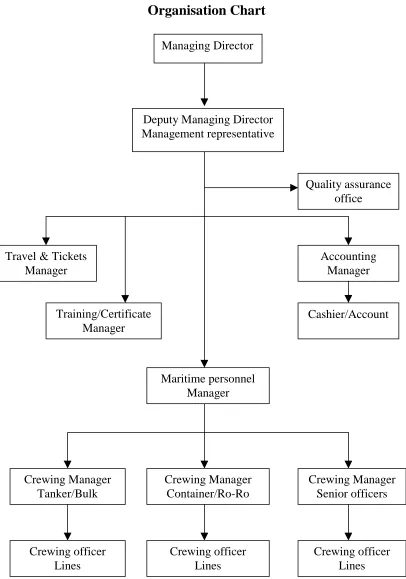
8) Organisation Chart
A chart of the organisations of the company is needed to show the structure
of the company. This is also very helpful to the external auditors. (See figure 6.1 ‘A
sample of an organisation chart of a crew manning agency’)
6.2. Management Responsibility
6.2.1. Quality policy
To set up a quality system, the management of a crew manning agency shall define and document its policy of quality, including its objectives of quality and its commitment to quality. The quality policy is to be relevant to its objectives and to the needs of its customers.
Commonly, the statement of objectives and policy are seldom more than one page. It should be short and easily understood by all the personnel affected. The policy should be signed by a senior decision maker (general manger or managing director) showing quality commitment from the top management. It is not enough to state objectives only in a quality policy. How the stated objectives are to be achieved also needs to be indicated. A sample of the quality policy of a crew manning agency is attached in appendix 6.2 .
6.2.2. Organisation and Responsibility
In the quality manual, the agency has to define and document the responsibilities, authorities and the interrelation of personnel or departments responsible for any part of selection, recruitment, training program, despatch process and other relevant services of seafarer supply. In accordance with ISO 9002, at least the following items have to be included:
2) Identify and record any deficiencies relating to a seafarer’s quality and relevant services.
3) Initiate, recommend or provide solutions of the deficiency through designated channels.
4) Verify the implementation of the solutions.
5) Control the further process until the deficiency has been corrected.
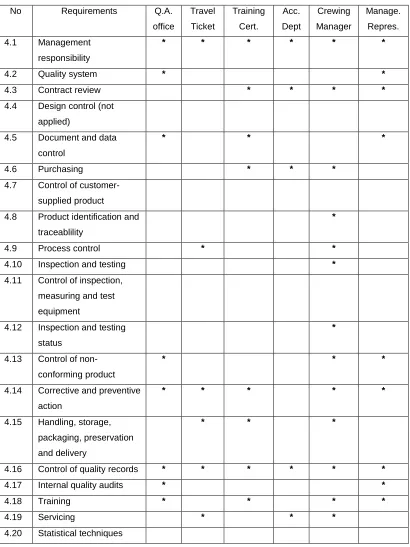
It must be possible to verify that the key personnel are qualified for their tasks. For example proper sea-experience is required for the crewing manager. Responsibility and authority should be defined on an organisational level, department level, and individual level. An organisation chart is a practical and effective way to describe the formal structure of the organisation. Meanwhile, an interrelation chart can also be used to describe the interrelation of functions and tasks internally and versus external parties. (See table 6.1 ‘A sample of correlative list’ and table 6.2 ‘A sample of interrelationship chart’).
6.2.3. Management Review
The management of the agency is required to review the quality system to ensure its continuing suitability and effectiveness in satisfying the requirements of ISO 9002 and its stated quality policy and objectives. Such a management review should be arranged at least once a year and the records maintained. Management reviews are carried out by the appropriate members of the management or by competent personnel decided on by the management. It is commonly planned and organised by the management representative.
The management review may consist of evaluations of the following items:
1) Policies and objectives
2) Any non-conformity of seafarers and related services.
3) Analyses of maritime accidents, incidents and hazardous situations relating to the agency.
4) Performance of the procedures, and the working instructions. 5) Complaints from customers.
6) The overall effectiveness of the system in achieving stated objectives.
7) Considerations for up-dating the system in relation to a change of market, new regulations, conventions and environmental conditions.
Plans, findings, conclusions and recommendations reached as a result of the management review need to be documented. The necessary improvement actions needed to be planned and implemented is required to follow the review.
6.3. Quality System
6.3.1 Quality system procedures
services supplied to the customers. The quality system is described in the quality documents including the quality manual, quality procedures and working instructions. The quality manual identifies the quality policy and objectives of the agency. It also outlines the quality system and the structure of the documentation used in the system. Depending upon the services conducted by the agency, the complexity of the work, the methods used, and the skills and training level of the employees, working procedures are written with a proper range and details.
6.3.2 Quality planning
Quality planning is a very important part of the quality system but people often ignore it. The management of the agency shall define and document how to meet specific requirements for seafarers and related services from customers. Because the quality system is likely to be a generic system, not specific to any particular project or contract other than the range of the services the agency supplies are concerned in the system. The quality documentation will not specify everything the agency needs to do for every job, especially new requirements, contracts and projects. So the quality plans are needed to deal with the particular or new requirements, projects and contracts. In a crew manning agency, maybe the quality system has regulated how to arrange recruitment and how to form the complement under the customer’s requirements. Quality planning shall be documented in a format to suit the operation of the agency. When a particular requirement is required, the management should react as follows:
1) Prepare the quality plans.
2) Organise the necessary personnel, training programmes, subcontractors or other resources to implement the plan.
6.4. Contract review
In general, each occurrence of the despatch of seafarer(s) to the customer shall be restricted and secured by an agreement. The crew manning agency agreement between the agency and the principals defines the responsibilities, authorities, obligations and services of both parties. In this section, the agency shall explain how the contracts have to be reviewed before signature. The details are described in Chapter 7.1, the procedures of contract review.
6.5 Document and data control
This section of the manual explains that all documents and data affecting the quality of seafarers and related services are under proper control. The agency identifies that the documented procedures have been established and maintained under ISO 9002, section 4.4. The details of these requirements are described in Chapter7.2, the procedures of document and data control.
6.6 Purchasing
In a crew manning agency, these requirements can be understood as the recruitment and employment of seafarers. The agency explains briefly how the seafarers are to be recruited or employed by the agency on behalf of the principal and how to verify the qualifications of the seafarers according to the requirements of the contract. The agency states that documented procedures of recruitment of seafarers have been established and maintained. The details are described in Chapter 7.3, the procedures of recruitment of seafarers.
6.7 Control of customer-supplied product
6.8 Product identification and tractability
Under these requirements, the agency shall establish and maintain documented procedures for identifying the seafarers by suitable means during selection, verification, recruitment, training, despatch, working onboard, repatriation and vacations. The identification of each seafarer must be unique during all stages. Obviously, a unique identification of the seafarer is his/her names and date of birth. The agency can use these to index and trace the individual seafarer during all stages.
It is not very complicated to identify the seafarers so that these requirements can be included in other procedures such as the procedures of recruitment of seafarers, the procedures of control of non-conformities or the procedures of control of quality record. In this case, procedures of seafarer identification and tractability are not needed. (See Chapter7.3, the procedures of recruitment of seafarers, Chapter 7.4, the procedures of control of non-conformities, and Chapter 7.7, the procedures of control of quality records).
6.9 Process control
Besides the requirements of ISO9002, other operational processes directly affecting the quality of seafarers and related services have to be identified and planned to ensure that those processes are carried out under controlled conditions. The agency shall explain what additional processes are particularly needed. Two critical processes in the agency need to identify specially. They are the process of communication and the process of emergency.
6.9.1. Communication
2) Training scheme, seminars etc.
3) Assessment reports or evaluation of seafarer forms 4) Emergency replacement
5) Other urgent cases
For this purpose, full addresses of customers, subcontractors, ships, even seafarers are to be listed and up-dated.
6.9.2. Emergency
The agency ensures that an emergency plan has been established. The purpose of this plan is to ensure that the crewing manager or other person in charge can respond to the emergencies in a co-ordinated and efficient way. The emergency plan shall include, but not be limited to the followed items:
1) The compositions, responsibilities and authorities of the emergency response team.
2) Procedures to assemble the emergency response team.
3) Procedures to set up contact between the ship and the crewing manager.
4) Procedures for establishing contact between the ship manager and the crewing manager.
5) Procedures for obtaining the details of seafarers onboard the vessel.
6) List of name, telephone and mobile-phone numbers, including the after hour numbers of personnel and organisations who must be notified.
7) Procedures for notifying and liasing with the next of kin for seafarers onboard ships.
8) An up-to-date list with personal details of all employed seafarers on board. 9) An up-to-date list with personal details (including full addresses) of all available
All the information the emergency treatment needs must be obtained easily by the member of the team. Emergencies an agency may encounter include:
• Incidences of the ships where the seafarers onboard
• Personal injury of seafarers onboard
• Sickness of seafarers onboard
• Injury and sickness of seafarers on the way to departure and repatriation
• Deserting
• Travelling troubles of seafarers
• Other emergencies
The agency shall make arrangement to protect and secure documents and data, including electronic data, of vital importance to the business, from theft, fire, water damage, failure to operate, and computer viruses.
6.9.3. Daily working procedures
defined and described. Another purpose of the daily working procedures is to implement the quality plans (see Chapter 6.3.2, quality planning).
6.10 Inspection and testing
These requirements especially apply to industrial activities such as production and installation. In a crew manning agency these requirements may be included in the procedures of the recruitment of seafarers to verify that they satisfy the specified requirements of the customers. In these procedures, verification records are to be retained in the personal record of the seafarer. The company does not need to establish such procedures separately (see Chapter 7.3.2, recruitment of seafarers).
6.11 Control of inspection, measuring and test equipment
These requirements do not apply to the crew manning agencies.
6.12 Inspection and testing status
These requirements are also included in the procedures of recruitment of seafarers. The verification status is to be defined by suitable means in the procedures. For example, when the ship manager accepts a crewmember, after prior processes of selection, personal document verification and interview, the crewing manager will put this crewmember’s name and details on the crew list for a particular ship(s). To be put on the final crew list, either on paper or in a computer database is the status for verification of the crewmember. If the above processes have been stated in the procedures of recruitment of seafarers, the company does not need to establish such procedures separately (see Chapter 7.3.2, recruitment of seafarer).
6.13 Control of non-conforming product
service process. The details will be described in Chapter 7.4, the procedures of control of non-conformities.
6.14 Corrective and Preventive action
The company shall explain how to perform the corrective and preventive actions in the quality system. The procedures of corrective and preventive action are to be established and maintained by the agency. The details are described in Chapter 7.5, the procedures of corrective and preventive action.
6.15 Handling, storage, packaging, preservation and delivery
These requirements are especially applicable for industrial production. To apply these requirements in a crew-manning agency, the management shall establish and maintain documented procedures for the despatch of seafarers. The details are described in Chapter 7.6, the procedures of despatch of seafarers.
6.16 Control of quality records
The agency shall explain how to control the records related to the quality system in order to verify that the system and procedures are followed and are according to the ISO 9002 international standard. The details are described in Chapter 7.7, the procedures of control of quality records.
6.17 Internal quality audits
6.18 Training
The company shall explain how to provide training to the employees and the seafarers to prevent unqualified personnel from performing activities affecting quality under these requirements. The details are described in Chapter 7.9, the procedures of training.
6.19 Servicing
These requirements only apply where the customer-supplier agreement includes post-delivery support for products or services.
The core business of a crew manning agency is to supply qualified seafarers to the customers to work onboard. In accordance with the contract between the agency and the principal, if the principal makes a demand on the agency to replace the seafarer(s) who are unfit for their duty or are lacking qualifications, the agency shall make immediately replacements available. These activities can be defined as “servicing” after delivery in ISO 9002 and have been identified in Chapter7.4, the procedures of control of non-conforming seafarers.
6.20 Statistical techniques
Appendix 6.1. Sample of the definitions of a quality system
Definitions of Quality System
The agency – a crew manning agency
The principal – the customers of the agency including ship owners, ship managers and crew managers.
The crewing manager – the leader of crewing department of the agency
The seafarers – the sea personnel supplied by the agency
Quality – the ability of the crew manning agency to satisfy the existing and/or implied requirements from the principal
Manning agreement – the agreement between the agency and the principal
Table 6.1 Sample of a correlative list
ISO 9002 Requirements and Correlative List
No. Requirements Activities
4.1 Management responsibility Organisations and responsibilities 4.2 Quality system Quality system and documentation 4.3 Contract review Manning agreement review
4.4 Design control (not applied) Not applied
4.5 Document and data control Document and data control 4.6 Purchasing Recruitment and employment 4.7 Control of customer-supplied
product
Not applied
4.8 Product identification and traceablility
Seafarers identification
4.9 Process control Communication and emergency 4.10 Inspection and testing Verification and evaluation 4.11 Control of inspection, measuring
and test equipment
Not applied
4.12 Inspection and testing status Verification status
4.13 Control of non-conforming product Control of non-satisfied seafarers 4.14 Corrective and preventive action Corrective and preventive action 4.15 Handling, storage, packaging,
preservation and delivery
Despatch of seafarers
4.16 Control of quality records Control of quality records 4.17 Internal quality audits Internal quality audits 4.18 Training Training for office staff and
seafarers
Figure 6.1 Sample of an organisation chart of a crew manning agency
Organisation Chart
Deputy Managing Director Management representative
Quality assurance office
Travel & Tickets Manager
Training/Certificate Manager
Accounting Manager
Cashier/Account
Maritime personnel Manager
Crewing Manager Tanker/Bulk
Crewing Manager Container/Ro-Ro
Table 6.2 Sample of an interrelationship chart of a crew manning agency
Interrelationship Chart
No Requirements Q.A.
office Travel Ticket Training Cert. Acc. Dept Crewing Manager Manage. Repres. 4.1 Management responsibility * * * * * *
4.2 Quality system * *
4.3 Contract review * * * *
4.4 Design control (not
applied)
4.5 Document and data
control
* * *
4.6 Purchasing * * *
4.7 Control of
customer-supplied product
4.8 Product identification and
traceablility
*
4.9 Process control * *
4.10 Inspection and testing *
4.11 Control of inspection,
measuring and test
equipment
4.12 Inspection and testing
status
*
4.13 Control of
non-conforming product
* * *
4.14 Corrective and preventive
action
* * * * *
4.15 Handling, storage,
packaging, preservation
and delivery
* * *
4.16 Control of quality records * * * * * *
4.17 Internal quality audits * *
4.18 Training * * * *
4.19 Servicing * * *
Appendix 6.2 Sample of a quality policy of a crew manning agency
QUALITY MANUAL XXX CREW MANNING COMPANY
QUALITY POLICY
To supply our customers with qualified and well-trained ship personnel
and relevant services to ensure the safe ship operation and protection of the
marine environment.
In order to achieve this objective the following goals have been defined by
the company.
1) To man vessels with qualified and skilled seafarers complying with the updated
international conventions and codes.
2) To plan and implement training programs as required by national and
international regulations and according to the specific requirements of the
customers.
3) To maintain a pool of seafarers for particular customers to secure the stability of
personnel.
4) To make arrangements for employees to improve and increase their professional
skills.
5) To plan crew complement in an efficient.
6) To maintain a good and professional relationship with all the relevant regulatory
bodies.
7) To maintain and continuously improve the co-operation with and services to
customers, existing and potential, and seafarers.
To manage these goals certain measures have been taken as
outlined and described in our quality system.
Chapter 7. Quality Procedures
7.1. The procedures of contract Review (ISO 9002 4.4)
In general, each occurrence of the dispatch of seafarer(s) to the principal shall be restricted and secured by an agreement. The crew manning agency agreement between the company and its principals defines the responsibilities, authorities, obligations and services of both parties. In order to ensure that the requirements are adequately defined and documented, differences between the parties are resolved, and the agency has the capability to meet the agreed requirements. Documented procedures for contract review has to be established and maintained. This is required by section 4.3 of ISO 9002. The procedures will ensure the following items form a crew manning agreement:
1) The language of the agreement must be acceptable by both parties.
2) The terms and conditions must be clear, i.e. selection, recruitment, training and despatch of seafarers.
3) For practical reasons, the terms and conditions of the seafarer’s working onboard may be stated in an Employment contract or Crew contract as an Appendix to the agreement.
4) Regulations of compensation of injury, death or loss of abilities have to be stated clearly in the Employment contract.
5) The laws and regulations of compliance and arbitration terms are agreed and clearly stated in the agreement.
6) The termination of employment due to a force majeure, new owners, vessel being sold or otherwise disposed of total loss, requisition by government authority etc. should be taken care of in the agreement.
7) Urgent employment of sea personnel or individual replacement due to sickness, injury, hospitalisation etc. should be taken into account in the agreement. 8) Contradictions and/or discrepancies versus the quality policy and objectives
9) The agreement should be prepared by appropriate functions, approved and signed by the person authorised by the top management.
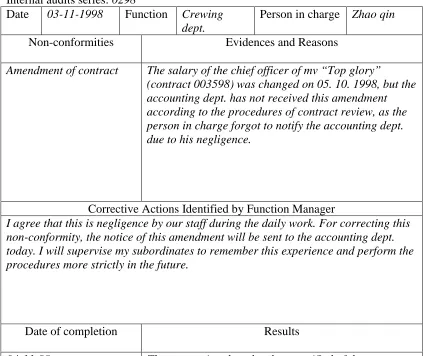
During the performance of the agreement, the agency may need to amend the agreement according to changes in the requirements of customers, or due to some internal changes. For example, the ship owner may ask to add one more oiler onboard a particular ship in the next replacement. This means that part of the original agreement, the rank list, needs to be changed. Relying on ISO 9002 section 4.3.3 amendment to a contract, this change has to be correctly transferred to the relevant personnel and functions such as the crewing managers and the accounting department. The process of amendment has to be identified in the contract review procedure. It is of equal importance to the identify the process of original contract. An identified process of amendment of contract prevents unauthorised changes being made to the agreed contracts. It also ensures that the required changes to seafarers or services are implemented promptly.
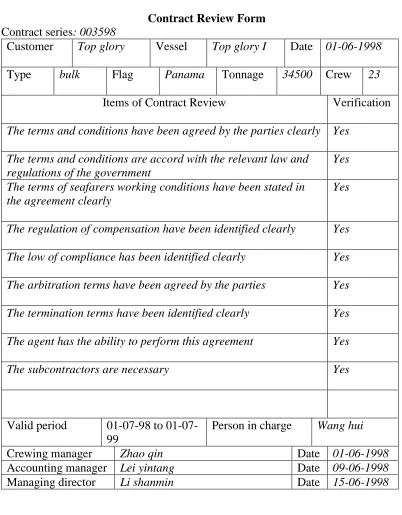
To conduct the procedures, the contract review forms are helpful to make sure that all the requirements have been verified and that the appropriate personnel have approved the contract. The forms are also the quality records of the procedures. The forms have to be maintained as well as the copies of the contracts. A sample of the contract review form of a crew manning agency is attached in table 7.1.
Every useful record of the procedures, such as telefax, phone call record, contract verification and approving forms, contract revision forms, original copy of contract and copy of contract have to be maintained and listed promptly.
7.2 The procedures of document and data control (ISO 9002 4.5)
1) Appropriate copy of documents are available at all locations where operators can use and read them easily.
2) Invalid and/or obsolete documents are promptly removed from all points of issue or use.
3) Changes to documents and data are reviewed and approved by the same functions or personnel, unless specifically designated otherwise.
4) The content of the changes is to be identified in the documentation or the appropriate attachments.
5) The invalid and/or obsolete documents and data are destroyed promptly.
6) Any obsolete documents or data retained by the operators in their working place for legal and/or knowledge-preservation purposes are properly identified.
The documents and data in a crew manning agency can be divided into two types. One is internal documents and data, including the quality manual, the quality procedures, the working instructions, the quality forms, the seafarers documents (C.V., employment forms, evaluation forms), the customer information, electronic data etc. The other is external documents and data, such as national and international regulations and conventions, requirements of manning of the flag states etc. The company is to maintain the updated external documents in order to understand and comply with crew manning services. A master list of the documents and data is necessary for the procedures (See table 7.2, sample of a list of internal documents).
The issue status is very important to the documentation to secure the masters of the documents, to identify the types of the documents, and to classify the documents. The date of issue, revision number, amendment status, name of the document, and series of the document need to be identified on every page of the documentation. For practical purposes, page of approving, page of distribution controls and page of amendment status is also useful.
The documentation must be polished and treated by the same pencil or person before it is issued. The structures and the manner of writing in the documents need to be consistent. The following items could be considered in each documented procedure:
1) Purpose 2) Scope
3) Responsibility and authority 4) Working procedures
5) Supporting documents 6) Quality record
7) Checklist and forms
7.3 The procedures of recruitment of seafarers (ISO 9002 4.6 purchasing)
7.3.1. Definition