IIIT-H at IJCNLP-2017 Task 4: Customer Feedback Analysis using
Machine Learning and Neural Network Approaches
Prathyusha Danda1 IIIT-Hyderabad Hyderabad, India
500032
Pruthwik Mishra1 IIIT-Hyderabad Hyderabad, India
500032
Silpa Kanneganti2 i.am+ LLC. Bangalore, India
560071
Soujanya Lanka3 i.am+ LLC. 37 Mapex building Singapore - 577177
Abstract
The IJCNLP 2017 shared task on Cus-tomer Feedback Analysis focuses on clas-sifying customer feedback into one of a predefined set of categories or classes. In this paper, we describe our ap-proach to this problem and the results on four languages, i.e. English, French, Japanese and Spanish. Our system im-plemented a bidirectional LSTM(Graves and Schmidhuber,2005) using pre-trained glove(Pennington et al., 2014) and fast-Text(Joulin et al., 2016) embeddings, and SVM (Cortes and Vapnik,1995) with TF-IDF vectors for classifying the feedback data which is described in the later sec-tions. We also tried different machine learning techniques and compared the re-sults in this paper. Out of the 12 partic-ipating teams, our systems obtained 0.65, 0.86, 0.70 and 0.56 exact accuracy score in English, Spanish, French and Japanese respectively. We observed that our tems perform better than the baseline sys-tems in three languages while we match the baseline accuracy for Japanese on our submitted systems. We noticed significant improvements in Japanese in later exper-iments, matching the highest performing system that was submitted in the shared task, which we will discuss in this paper.
1 Introduction
Customer feedback analysis is a dominant prob-lem, to the extent that there are companies whose principal purpose is to categorize feedback data. Classification of customer feedback would help companies gain a better perspective on the views of the customer. Comprehending customer
feed-back not only helps to understand the customer pulse better, but also to reply with an appropri-ate response. Hence, many companies understand-ably want an automated customer feedback anal-ysis system. A major hurdle while doing this is dealing with the multilingual environment that is existent in most of the countries.
Considering the above points, the aim of the IJCNLP shared task on Customer Feedback Anal-ysis is to classify real world customer feedback reviews into pre-defined set of classes. The goal is to achieve this by using data driven techniques in machine learning, which will help automate the classification process. The customer feedback are extracted, from Microsoft Office customers, in four languages, i.e. English, French, Spanish and Japanese. Since, there is no universal categoriza-tion for customer feedback, a set of six classes which would be applicable to all the entire set ir-respective of the language they belong to, are cre-ated. These six classes arecomment,request,bug,
complaint, meaningless andundetermined. Each feedback was tagged with one or more classes. The task was to use this annotated data and build a model using supervised techniques. The model should be able to categorize a given review in one of the four aforementioned languages, into one or more of the classes.
We used bi-directional LSTMs (Graves and Schmidhuber, 2005) for the classification task at hand. We also used simple Naive Bayes clas-sifier and SVM models as separate alternate ap-proaches to achieve the intended goal. We found that the accuracy of the SVM model was almost on par with the bi-directional LSTM for English. We used glove pre-trained embeddings1(
Penning-ton et al., 2014) for English while for the rest 1we used Common Crawl corpus with 840B tokens, 2.2M
vocab, case-sensitive, 300-dimensional vectors available on https://nlp.stanford.edu/projects/glove/
of the languages we used fastText2 (Joulin et al.,
2016) embeddings. The SVM model with TF-IDF as features performed better for French data compared to the bi-directional LSTM with fast-Text word embeddings. For Japanese and Span-ish language data, bi-directional LSTM with fast-Text models have performed better compared to the SVM with TF-df models respectively. Both these models made use of fastText word embed-dings of those particular languages. The Naive Bayes with TF-IDF (McCallum et al.,1998) mod-els on all four languages gave lesser accuracies compared to the SVM (Cortes and Vapnik,1995) and bi-LSTM models.
This paper is organized as the following - sec-tion 2 explains the related work and secsec-tion 3 de-tails about the corpus. Different approaches em-ployed are explained in the subsequent sections. Results constitutes sections 5 and Error Analysis & Observation are presented in section 6. We conclude our paper with the Conclusion & Future Work section.
2 Related Work
(Bentley and Batra,2016) dealt with Microsoft Of-fice users feedback, on which they applied var-ious machine learning techniques. They imple-mented classification techniques on labeled data and applied clustering approaches for unlabeled data. They had reported 0.5667 recall and 0.7656 precision on English data using logistic regression in a one-versus-rest setting. The text was lemma-tized, stop words were removed and POS tags and named entities were tagged in the pre-processing stage. They used n-grams up to 3 in a bag-of-words approach along with non-text features such as star rating, sentiment and the categorization that an agent gave to the feedback, from the pre-defined Agent Taxonomy. Another key point of this particular model is that the users have scope to label the already predicted data, thus making re-building and re-predicting feasible with newer and larger data, which can increase the precision of the model.
The 2017 GermEval task (Wojatzki et al.,2017) has been designed to extract opinions from the customer feedback on the services offered by a German public train operator Deutsche Bahn. The shared task included 4 subtasks - relevance predic-2https://github.com/facebookresearch/fastText/blob/master/
pretrained-vectors.md
tion, document polarity identification, aspect and category identification, target opinion extraction. SVM (Cortes and Vapnik, 1995) and CRF ( Laf-ferty et al.,2001) have been used to create baseline models3.
Sentiment analysis on customer feedback data by (Gamon, 2004) using linear SVM for classifi-cation had yielded satisfying results. They used feedback items from a Global Support Services survey and a Knowledge Base survey. Satisfac-tion scores were on a scale from 1(not satisfied) to 4 (very satisfied). Each feedback was given one of these 4 scores. They used surface level fea-tures like n-grams as well as linguistic feafea-tures like POS tagging. All the features were represented in a binary form (present or not present) except for the length of sentence. Feature reduction was done based on log likelihood ratio. F1 measure of 74.62 was reported for 1 versus 4 classification and 58.14 for 1 and 2 grouped together versus 3 and 4 grouped together, both using top 2k features.
3 Corpus Details
The statistics of the corpus used for this task is de-tailed in Table 1. A few examples extracted from the training set are given
below:-• The sentence “Some are fairly easy, but I def-initely get stuck.” is tagged as a “comment”.
• The sentence “The only thing that wasn’t that perfect was the internet connection.” is la-beled as “comment, complaint”.
• “All offered drinks and food at the restaurants and bars are too expensive.” is a sentence with tag “complaint”.
4 Approach
Many machine learning algorithms rely heavily on features designed by domain experts which makes the labeling task cost inefficient. So we have not used any language specific features like part-of-speech tag, morph features, dependency labels etc. for the task. We describe our approaches in the following subsections.
4.1 Machine Learning Approaches
We used Support Vector Machines (SVM), logis-tic regression(Log-Reg), k-Nearest Neighbor(k=3, 5 for our experiments) and Gaussian Naive
Lang Type #Tokens- Case-Sensitive
#Tokens-Lowercase
English TrainDev 54491848 46741663
Test 1788 1589
Spanish TrainDev 35241043 3119933
Test 1109 1015
French TrainDev 39301454 35151332
Test 1407 1306
Japanese TrainDev 1651282 1648281
Test 320 320
Table 1: Corpus Statistics for the Shared Task
Lang Tag Model MicroAvg
English
Table 2: Results on Test Data for English, Spanish and French using SVM with fastText features
Tag MicroAvg
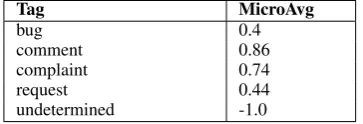
Table 3: Updated Test Results for Japanese. SVM model here used unigram-bigram tf-idf vectors as features
Bayes(NB) using sklearn library (Pedregosa et al.,
2011). In the ML approaches, we used TF-IDF (Sparck Jones,1972) vectors for the words(uni)4 present in the training corpus. We also experi-mented with TF-IDF vectors for bigrams(bi) and trigrams(tri). Sklearn uses count vectorizers to convert text input into a collection of tokens. It gives the flexibility of including higher n-grams in the vocabulary. This can prove to be helpful in the classification task. We used sklearn linear SVM library with the settings mentioned in Ta-ble 9. We employed the one-versus-one strategy for the classification task. We implemented Naive Bayes where all the features are assumed to follow Gaussian distribution. We also created a logistic regression model with maximum iteration of 100 and tolerance level of 0.0001.
4.2 Neural Networks
We implemented mainly two neural network models - bi-directional LSTM(bi-LSTM) (Graves and Schmidhuber, 2005), multi-layer perceptron (MLP) (Sparck Jones,1972) using (Chollet et al.,
2015). The accuracies of these models are re-ported in the subsequent sections. These neural network models used word embeddings as fea-tures. Glove embeddings were used for English and fastText embedding for other three languages. For encoding a sequence, bidirectional LSTM uses contextual information in both the directions - past and future word vectors. This enables them to have a better semantic representation of any se-quential data. The maximum length of the sample was set to 100. We used word embeddings of size 300 for all the languages. For MLP, we used a single hidden layer of 300 nodes. The sentences which have more than 100 tokens would be trun-cated and only the first 100 tokens take part in the learning. Adam optimizer (Kingma and Ba,2014) was used for learning with default learning rate of 0.001 and categorical cross-entropy loss function.
5 Results
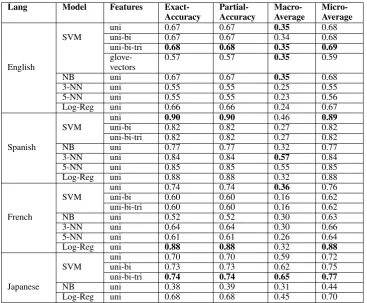
The experimental results on the development and test data for different languages are shown in Ta-bles 2-9. The highest performing system measures are marked in bold. From the tables 4, 6 and 7, it can be seen that SVM with a linear kernel and TF-IDF features outperforms all other machine learn-4All the keywords written in parenthesis are later used in
Lang Model Features
Exact-Accuracy Partial-Accuracy Macro-Average Micro-Average
English
SVM uniuni-bi 0.670.67 0.670.67 0.350.34 0.680.68
uni-bi-tri 0.68 0.68 0.35 0.69
glove-vectors 0.57 0.57 0.35 0.59
NB uni 0.67 0.67 0.35 0.68
3-NN uni 0.55 0.55 0.25 0.55
5-NN uni 0.55 0.55 0.23 0.56
Log-Reg uni 0.66 0.66 0.24 0.67
Spanish
SVM uniuni-bi 0.900.82 0.900.82 0.460.27 0.890.82
uni-bi-tri 0.82 0.82 0.27 0.82
NB uni 0.77 0.77 0.32 0.77
3-NN uni 0.84 0.84 0.57 0.84
5-NN uni 0.85 0.85 0.55 0.85
Log-Reg uni 0.88 0.88 0.32 0.88
French
SVM uniuni-bi 0.740.60 0.740.60 0.360.16 0.760.62
uni-bi-tri 0.60 0.60 0.16 0.62
NB uni 0.52 0.52 0.30 0.63
3-NN uni 0.64 0.64 0.30 0.66
5-NN uni 0.61 0.61 0.26 0.64
Log-Reg uni 0.88 0.88 0.32 0.88
Japanese
SVM uniuni-bi 0.700.73 0.700.73 0.590.62 0.720.75
uni-bi-tri 0.74 0.74 0.65 0.77
NB uni 0.38 0.39 0.31 0.44
Log-Reg uni 0.68 0.68 0.45 0.70
Table 4: Results on Development Data for English, Spanish, French and Japanese using ML Approaches. Updated models used for Japanese
Language Model Features Exact
Ac-curacy Micro-Average Partial Ac-curacy Macro-Average
English MLPSVM glovefastText 0.630.57 0.630.57 0.360.35 0.650.59
bi-LSTM glove 0.65 0.66 0.45 0.68
Spanish MLPSVM fastTextfastText 0.810.76 0.810.76 0.320.36 0.810.76
bi-LSTM fastText 0.86 0.86 0.42 0.86
French MLPSVM fastTextfastText 0.660.60 0.660.60 0.330.27 0.690.64
bi-LSTM fastText 0.71 0.71 0.38 0.74
Japanese MLPSVM fastTextuni 0.570.60 0.570.60 0.300.47 0.570.60
Table 5: Results on Development Data Using Neural Networks. SVM model here uses fastText vectors as features for English, Spanish and French, where as character unigrams for Japanese. Updated models used for Japanese
Language Model Exact
Ac-curacy Partial Ac-curacy Micro-Average Macro-Average
English bi-LSTM 0.65 0.65 0.68 0.36
SVM 0.65 0.66 0.68 0.34
Spanish bi-LSTM 0.86 0.86 0.86 0.44
SVM 0.85 0.85 0.85 0.45
French bi-LSTM 0.65 0.65 0.69 0.38
SVM 0.70 0.70 0.72 0.38
Japanese bi-LSTM 0.56 0.57 0.56 0.28
SVM 0.56 0.56 0.56 0.26
Lang Model Features
Exact-Accuracy Partial-Accuracy Macro-Average Micro-Average
Japanese SVM
uni 0.74 0.74 0.52 0.75
uni-bi 0.76 0.76 0.52 0.77
uni-bi-tri 0.75 0.75 0.51 0.76
Log-Reg uni 0.67 0.70 0.45 0.70
Table 7: Updated Test Results for Japanese
Parameter Value
Loss Squared Hinge Loss
Penalty L2
Iterations 1000
Tolerance 0.0001
Table 8: SVM Parameters
ing techniques. Naive Bayes’ classifier relying on the maximum likelihood estimates performed poor across languages. K-nearest neighbor algo-rithm which depends on the vector representation of feedback and the euclidean distance from other vectors also did not perform reliably which is ev-ident from the tables. From Table-5, we observed that bidirectional-LSTMs outperformed MLP and SVM when word vectors were considered as fea-tures. Bi-LSTMs represent a sequence better than the other two which in-turn increases the classifi-cation accuracy.
6 Error Analysis & Observation
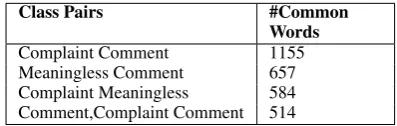
A major observation in the data is that many words overlapped between different classes. The maxi-mum overlap is observed between comment and complaints and this contributes to many false pos-itives. The meaningless tag adds to the confu-sion, as these sentences have a huge overlap with comment and complaint classes. As the “undeter-mined” tag was not present in the training data, the system was unable to predict it. The labels which are combinations of two atomic labels are also contentious ones. For example: the label “comment, complaint” gets confused with “com-ment” as well as “complaint”. The partial ac-curacy metric captures this whether one label is matched when the true label consists of two la-bels. The top four overlapping classes for English are shown in the Table 9. The statistics were got on English data as it had the maximum training samples. Examples of test
errors-• For the sentences “Lunch, they forgot one meal.”, the system wrongly predicts the tag as “comment” while the correct label corre-sponds to “complaint”.
Class Pairs #Common
Words
Complaint Comment 1155
Meaningless Comment 657 Complaint Meaningless 584 Comment,Complaint Comment 514
Table 9: Class Distribution of Overlapping En-glish Training Data
• The sentence “This editor is good, but could still use some Hot needed improvements!” is tagged as “comment, complaint”. Our system could only predict it as “comment”.
The bi-LSTMs outperform MLPs as MLPs d not take any positional information into account. We also experimented with POS tags as features but we found that they do not offer any advantage in neural networks, instead they introduce addi-tional noise to the data. The frequent classes ex-hibit better classification accuracy, as the model can classify them with high confidence. The ac-curacy was high for Spanish because it had rel-atively few labels compared to other languages. But the rare classes with low occurrence in the training data are ambiguous and difficult to clas-sify correctly. Japanese was different compared to the rest of the three languages because of its ag-glutinative nature. Segmentation is a major chal-lenge for Japanese language. So instead of tok-enizing words with white spaces, we considered characters as tokens and obtained significant im-provements in development and test data. For the improvements in the Japanese system, we used unigram TF-IDF vectors for SVM. No external tools were used for Japanese text segmentation. Our submitted Japanese system used whitespace-separated word vectors for SVM and bi-LSTM.
7 Conclusion & Future Work
data.
In the future, we intend to use character em-beddings along with the word emem-beddings to get better representation of a sentence. This will also help in getting a representation for out-of-vocabulary(OOV) words. We can explore multi-lingual embeddings where words in one language can be mapped to its equivalent in another lan-guage. This can also help improve the classifica-tion accuracy. We intend to include some linguis-tic regularization (Qian et al., 2016) while learn-ing the bi-LSTM to take advantage of intensi-fiers, negative words, positive words and other cue words.
Acknowledgements
We thank Vandan Mujadia and Pranav Dhakras for their valuable inputs and feedback for us on the paper.
References
Michael Bentley and Soumya Batra. 2016. Giving voice to office customers: Best practices in how
of-fice handles verbatim text feedback. In Big Data
(Big Data), 2016 IEEE International Conference on, pages 3826–3832. IEEE.
Franc¸ois Chollet et al. 2015. Keras. https://
github.com/fchollet/keras.
Corinna Cortes and Vladimir Vapnik. 1995. Support
vector machine. Machine learning, 20(3):273–297.
Michael Gamon. 2004. Sentiment classification on customer feedback data: noisy data, large feature vectors, and the role of linguistic analysis. In Pro-ceedings of the 20th international conference on Computational Linguistics, page 841. Association for Computational Linguistics.
Alex Graves and J¨urgen Schmidhuber. 2005. Frame-wise phoneme classification with bidirectional lstm and other neural network architectures. Neural Net-works, 18(5):602–610.
Armand Joulin, Edouard Grave, Piotr Bojanowski, and Tomas Mikolov. 2016. Bag of tricks for efficient text classification. arXiv preprint arXiv:1607.01759. Diederik Kingma and Jimmy Ba. 2014. Adam: A
method for stochastic optimization. arXiv preprint
arXiv:1412.6980.
John Lafferty, Andrew McCallum, and Fernando CN Pereira. 2001. Conditional random fields: Prob-abilistic models for segmenting and labeling
se-quence data. Proceedings of the 18th
Interna-tional Conference on Machine Learning, ICML-2001, pages 282–289.
Andrew McCallum, Kamal Nigam, et al. 1998. A com-parison of event models for naive bayes text
classi-fication. InAAAI-98 workshop on learning for text
categorization, volume 752, pages 41–48. Madison, WI.
Fabian Pedregosa, Ga¨el Varoquaux, Alexandre Gram-fort, Vincent Michel, Bertrand Thirion, Olivier Grisel, Mathieu Blondel, Peter Prettenhofer, Ron Weiss, Vincent Dubourg, Jake Vanderplas, Alexan-dre Passos, David Cournapeau, Matthieu Brucher, Matthieu Perrot, and ´Edouard Duchesnay. 2011.
Scikit-learn: Machine learning in python. J. Mach. Learn. Res., 12:2825–2830.
Jeffrey Pennington, Richard Socher, and Christopher Manning. 2014. Glove: Global vectors for word
representation. InProceedings of the 2014
confer-ence on empirical methods in natural language pro-cessing (EMNLP), pages 1532–1543.
Qiao Qian, Minlie Huang, and Xiaoyan Zhu. 2016. Linguistically regularized lstms for sentiment clas-sification.arXiv preprint arXiv:1611.03949. Karen Sparck Jones. 1972. A statistical interpretation
of term specificity and its application in retrieval.
Journal of documentation, 28(1):11–21.
Michael Wojatzki, Eugen Ruppert, Sarah Holschnei-der, Torsten Zesch, and Chris Biemann. 2017. Ger-meval 2017: Shared task on aspect-based sentiment
in social media customer feedback. InProceedings