1
Wireless Networking: A Review
Vasudha V.Patil
Assistant Professor, Department of Electronics & Telecommunication, Sharadchandra Pawar College of Engineering,Otur,Dist.-Pune
Email:[email protected]
Abstract-This paper introduces a review of the remote neighborhood (LANs) and remote individual
territory systems (PANs), with accentuation on the two most prominent norms: IEEE 802.11, and
Bluetooth. While there are numerous such overviews in the present inditing and on the web, we
endeavor here to present remote LANs and PANS in a bound together form as a practical distinct
option for wired LANs, while fixating on the remaining difficulties and constraints.
Index Terms- LANs, PANs, IEEE 802.11, Bluetooth.
1. INTRODUCTION
Remote interchanges keep on getting a charge out of exponential development in the cell telephony, remote Internet, and remote home networking stadiums. The remote systems checked on in this paper incorporate remote neighborhood (WLANs) and remote personal range systems (WPANs) [a rundown of correspondences acronyms is given in Table 1]. WPANs are separated from the WLANs by their littler zone of scope, and their specially appointed just topology. The main WPAN was presumably the Body LAN, coming about because of a DARPA venture in the mid-1990s. It was a little size, low-control, reasonable system, with unobtrusive data transmission, which associated individual gadgets inside of a scope of 2 m. Propelled by this venture, a WPAN bunch began in 1997 as a part of the IEEE 802 standardization bunch (1] [a rundown of interchanges associations is given in Table 2]. The IEEE 802.11 [2] bunch has been in charge of setting the gauges in remote LANs, concentrating on the last two layers of the Open System Interconnect (OSI) model (see Table 3). A comparable exertion is being led by IEEE 802.15 [3] for the wireless PANs (a rundown of IEEE 802 working gatherings is given in Table 4).
This paper endeavors to study and think about the condition of wireless systems administration (both WLANs and' WPANs). It is sorted out as takes after. Area 2 displays a background marked by remote correspondences and information. In Section 3, we talk about the difficulties of portability in interchanges frameworks, while Section 4 examines different network ideas and advances. Segment 5 exhibits our conclusions.
2. HISTORY
In this segment, we introduce a brief outline of the historical backdrop of remote correspondence, and we portray the improvement of the remote neighborhood and wide-region systems.The accompanying history is constructed primarily with respect to [4].
The historical backdrop of modem remote correspondences began in 1896 with Marconi, who showed remote telegraphy by sending and accepting Morse code, in light of long-wave (>> 1 km wavelength) radiation, utilizing high-control transmitters. In 1907, the primary business trans-Atlantic remote administration was started, utilizing colossal ground stations and 30 m x 100 m receiving wire poles. World War I saw the quick advancement of correspondences insight, catch innovation, cryptography, and different advances that later got to be basic to the coming of a modem remote framework.
In 1920, Marconi found shortwave (< 100 m wavelength) transmission. Such waves experience reflections, refractions, assimilation, and ricochet off the ionosphere making for considerably more productive transmission. The higher frequencies required were made conceivable by vacuum tubes, which be8: are accessible around 1906. In expansion, less expensive, littler, and better quality transmitters got to be accessible. In 1915, remote voice transmission between New York what's more, San Francisco was accomplished, and in 1920, the primary business radio show occurred in Pittsburgh, Pennsylvania. In 1921,squad cars in Detroit, Michigan, were outfitted with remote dispatch radios. In 1935, the main phone call the world over was made. Amid the World War I1 years, radio innovation created quickly to help with the war exertion.
2 Communications (GSM) was built up;at that point, in
1983, the FCC assigned 666 duplex channels for the Advanced Mobile Phone System (AMPS) (40MHz in an 800MHz band, every channel with a restricted data transmission of 30 kHz). In 1984, AT&T was separated, and the AMPS cell framework started conveying. In 1985, the FCC discharged the unlicensed ISM (worldwide, exploratory, and medicinal) groups, which were to gotten to be critical in the improvement of remote LANs. In 1989, the FCC allowed extra 166 channels (10MHz worth) to AMPS. In 1991, US advanced cell (USDC), or IS-54, which underpins three clients in every 30 kHz channel were discharged. This was later enhanced to oblige six clients for each channel. In 1993,1.8 GHz was discharged for the advanced Personal Communications Framework (PCS), followed in 1994 by the presentation of IS-95 code division various access (CDMA) [5]. Amid that year, roughly 16 million mobile phones were being used. With the approach of new advanced norms, remote information correspondence turned out to be more predominant [6]. Indeed, the GSM and IS-95 principles advanced, in the 1990s, to incorporate remote information transmission as a basic piece of their administration. At last, third-era (3G) remote frameworks, taking into account CDMA advancements, are being created and conveyed, with information and voice interchanges in tight joining. It is presently anticipated that remote information activity will really surpass that of voice movement. Also, the expense of remote information gadgets are currently sufficiently low to permit wide entrance in the home and office markets. Numerous colleges (Carnegie Mellon, Georgia Tech, University of Tennessee, and so on.) are as of now working a rapid (1 Mbps) remote system over their grounds.
2.2 Wireless Data
The first remote systems were implied for voice activity, what's more,accordingly, are not especially suitable for information movement. As the case, deferrals of under 100 ms are required for voice movement, with a specific end goal to stay away from undesirable reverberating impacts, however, bigger postponements might be endured for most if not all information. Then again, packetized discourse can endure some parcel misfortune and bit-mistake rates (BERs) of 0.001. This might bring about a slight quality misfortune, however, no significant outcome. A BER of < 0.00001 is required for information transmission, and no parcel misfortune is permitted. At long last, phone discussions keep going, on the normal, somewhere around three and 20 minutes, so a setup time of a couple seconds is satisfactory. Information transmissions can shift from a few moments for a short email to minutes for a substantial information exchange, so the setup time ought to be little. These distinctions incredibly influence remote
LANs and PANS, as they are intended to oblige both information and voice activity.
2.2.1 WLANs
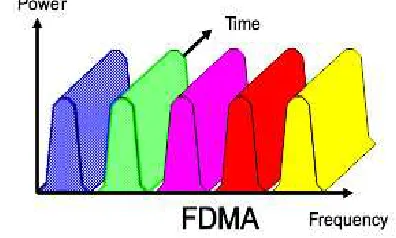
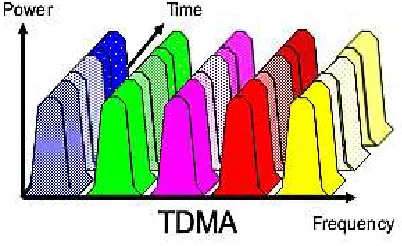
[image:2.595.310.508.352.471.2]Remote neighborhood utilizes high-recurrence electromagnetic waves, either infrared (IR) or radio recurrence (RF), to transmit data starting at one point then onto the next. It is by and large concurred that RF will be handier than IR in a home and office organizing, since it can engender through strong deterrents. Activity from numerous clients is regulated onto the radio waves at the transmitter, and removed at the beneficiary. Various radio bearers can exist together in the same physical space, and in the meantime, without transmitting so as to meddle with one another at various frequencies (recurrence division numerous entrance or FDMA, see Figure 1), in various time openings, (time-division numerous entrance or TDMA, see Figure 2), or utilizing particular codes for every message (code-division numerous entrance or CDMA, see Figure 3).
Fig.1.Frequency-Division Multiple Access (FDMA).
3 Fig. 2.Time-Division Multiple Access (TDMA).
'Remote RF systems can include an autonomous, peer-to-peer system, or a specially appointed system that interfaces correspondences gadgets with remote connectors working inside of a given recurrence extent, (for example, the ISM hands). Remote LANs have been institutionalized by the IEEE 802.11 models subgroup.
2.2.2 WPANs
WPANs use RF innovations like those of WLANs, however are implied for littler correspondence scope zones (10s of meters versus 100s). In 1998, the WPAN bunch distributed the unique usefulness necessity. Additionally in 1998, the same gathering welcomed investment from a few associations, for example, Bluetooth[7],Hiper LAN [SI, HomeRF [9],and others. Just the HomeRF what's more, Bluetooth gatherings reacted. In March 1998, the Home RF the gathering was framed. In May 1998, the Bluetooth advancement was, what's more, a Bluetooth-specific vested party (SIG) was framed inside of the WPAN bunch. Bluetooth has subsequent to been chosen as the base determination for IEEE 802.15 [3]. In March 1999, IEEE 802.15 was endorsed as a different subgroup inside of the IEEE 802 gathering, to handle WPAN institutionalization. The IEEE 802.15 WPAN bunch concentrates on creating models for short-separate remote systems. The resulting standard is proposed to exist together FDMA with different remote and wired systems inside of the ISM band.
3. Challenges of Mobility in Communications Systems
The most attractive normal for remote systems is their portability. This attractive trademark results in, and is impacted by, the numerous difficulties experienced in a remote medium. These difficulties occur at layers of the hypothetical OS1 correspondences model. The objective of dependable correspondence is, obviously, to ensure a specific nature of administration (QoS), as measured, for instance, by expedient and mistake free transmission. This spots different necessities on the different layers
of the hypothetical OS1 interchanges model, appeared in Table 3.
In specific, at the physical layer (PHY), a decision needs to he made with respect to the transmitting innovation (RF or R). At the information join layer, we need to represent the blurring radio channels, described by burst mistakes. This makes solid interchanges troublesome, as it gets to be influenced by needed.Because of the restricted data transfer capacity accessible in a remote channel proficient source coding is required at the presentation layer. At long last, at the application layer, one has to the cognizant about the area reliance of a specific application. Above all, in any case, the physical layer and the media-access-control (MAC) sub-layer of the information join layer need to the precisely composed, a vocation that has fallen on the IEEE 802.11 [12] and 802.15 [3] subgroups. As a particular case, remote gadgets need to settle a dynamic force control issue, so that a specific gadget is transmitting at the right power level: sufficiently high for solid transmission, cabin not really high as to meddle with adjacent gadgets (see, for instance, [13, 5]for an itemized talk of this issue). Furthermore, the different gadgets need to collaborate, so as to give framework wide availability [14]. At long last, thoughts from amusement hypothesis have as of late been acquainted with taking care of the force control issue in remote systems [15].
4. Systems, Concepts, and Technologies
Today, two noteworthy innovations are utilized for remote LANs what's more, PANS. The main innovation exists in the mechanical ISM hands: 2.4-2.4835 GHz, 5.15-5.35 GHz, and 5.725-5.825 GHz. The other innovation, accessible in Europe, is the Digital European Cordless Information transfers.(DECT) standard, ETS 300175. We will center in this paper on the ISM-band advances. To utilize the ISM recurrence hand, hardware should likewise be consistent with the European Telecommunication Standard, ETS 300 328, and FCC 15.247. Since the ISM band is utilized by other gear, (for example, carport entryway openers and microwave stoves), dodging obstruction from such gear is critical. The distinctive benchmarks stipulate that spread range must be utilized [16]. In a spread range framework, clients are multiplexed by doling out them distinctive spreading keys. Such a framework is known as a code-division various access (CDMA) framework. Nonetheless, generally remote LAN and PAN items are not actually CDMA frameworks, since clients having a place with the same remote system use the same spreading key. Rather, clients are isolated in time utilizing a carrier sense numerous entrance (CSMA) convention, like that utilized as a part of the Ethernet.
[image:3.595.82.283.100.223.2]4 two families: recurrence bouncing spread range
(FHSS) and direct succession spread range (DSSS). FHSS opposes impedance by bouncing from recurrence to recurrence in a pseudo-irregular manner. The accepting framework hops synchronously, utilizing the same pseudo-irregular grouping as the sender. DSSS opposes impedance by increasing quick pseudo-irregular bits of the genuine information. The recipient duplicates the same pseudo-irregular grouping (synchronized) by the got information, which produces the first information.
4.1 IEEE 802.11
The IEEE 802 benchmarks board of trustees shaped the 802.11 Wireless Neighborhood Standards Working Group in 1987. The 802.11 working gathering - which contains individuals from international organizations, colleges, and associations - first tackled the errand of building up a worldwide standard for radio hardware and systems working in the 2.4 GHz unlicensed recurrence band, for information rates of 1 and 2 Mbps. The 802.1 1 last endorsement was acquired in 1997. The standard does not indicate innovation or usage, be that as it may, essentially the particulars for the physical (PHY) layer and media-access-control (MAC) layer (see Table 3). The first the standard required a 2 Mbps information rate, utilizing direct-succession spread range or recurrence bouncing spread range. In 1999, IEEE 802.1 lb - the high-rate standard, with information rates of up to 11 Mbps - utilizing direct-grouping spread range was received. As of now, IEEE 802.11a is investigating considerably speedier rates (25 Mbps) in the 5 GHz band. The accompanying talk is taken principally from [12].
4.1 .1 Architecture
The IEEE 802.1 1 standard characterizes the convention for two sorts of systems: specially appointed and client-server systems. An impromptu system is a system where interchanges are built up between various hubs, without the requirement for an entrance point or server. The client-server system, then again, utilizes an entrance point that controls the distribution of remote assets for all hubs, and permits versatile stations to meander from cell to cell. The entrance point is likewise used to interface the versatile radio to the wired or remote the spine of the client-server system.
4.1.2 Media Access Control (MAC)
The access algorithm is based on carrier-sense multiple access (CSMA) with collision avoidance, or CSMMCA. The media-access control supports a variety of physical layers, data rates, and propagation characteristics, including infrared and radio frequency. The media-access-control layer specification for 802.1 1 has similarities to the 802.3 Ethernet wired-line standard. The protocol for 802.1 1 uses carrier-sense multiple access, collision avoidance (CSMMCA). This protocol prevents collisions instead of detecting them since collisions are bound to happen
on a wireless network unless the protocol attempts to avoid them a priori. The media-access-control layer, together with the physical layer, samples the energy over the wireless medium. The physical layer uses a clear channel assessment (CCA) algorithm to determine if the channel is clear. This is accomplished by measuring the RF energy at the antenna, and determining the strength of the received signal. This measured signal is commonly known as RSSI. If the received signal strength is below a specified threshold, the channel is declared clear, and the media-access-control layer is given a green light for data transmission. If the RF energy is above the threshold, data transmissions are deferred, in accordance with the protocol’s rules. The standard provides another option for clear channel assessment: carrier sense can be used to determine if the channel is available, by verifying that the channel contains a signal of the same carrier type as 802.1 1 transmitters, as opposed to simply being corrupted by other RF transmitters. The carrier-sense multiple access, collision avoidance protocol also has options to minimize collisions, by using request-to-send (RTS), clear-to-send (CTS), data, and acknowledge (ACK) transmission frames, as described next. Communications are established when one of the wireless nodes sends a short message request-to-send frame. The request-to-send frame includes the destination and the length of a message. The message duration is termed the network allocation vector (NAV). The network allocation vector alerts all other nodes in the cell to “back off’ for the duration of the transmission. The receiving station issues a clear-to-send frame, which echoes the clear-to-sender’s address and the network allocation vector. If the clear-to-send the frame is not received by the original sender, it is assumed that a collision occurred, and the request-to-send process starts over. After the data frame is received by the receiver node, an acknowledge frame is sent back to the sender, verifying successful data transmission.
A common limitation with wireless LAN systems is the hidden- node problem.This can disrupt communication in a busy wireless environment. This problem occurs when there is a station that cannot detect the transmissions of another station, and thus assumes it is OK to transmit. As an example, assume that stations A and B are within communication range. Station C is also within communication range of station B, but not of A. Therefore, bothstations A and C could try to transmit to station B at the same time. The use of request-to-send, clear-to-send, data, and acknowledge sequences help to prevent the disruptions caused by this problem.
5 priority. If a collision occurs, an exponential-back-off
algorithm is used to compete for the medium. Security provisions are addressed in 802.11, as an optional feature. Data security is accomplished by the Wired Equivalent Privacy algorithm (WEP). WEP is based on protecting the transmitted data over the RF medium using a 64-bit seed key and the RC4 encryption algorithm. WEP only protects the data-packet information and not the physical layer header, so that other stations on the network can listen to the control data needed to manage the system. At long last, control management is upheld at the media accesscontrol level for those applications requiring portability under battery operation. Procurements are made in the convention for the compact stations to go to a low-fueled "rest" mode amid a period interim characterized by the base station.
4.1.3 IEEE 802.1 I Physical Layer
The IEEE 802.1 1 standard gives information rates of 1 Mbps with double stage shift keying (BPSK) tweak [17], or 2 Mbps with quadrature stage shift keying (QPSK) regulation [ 171, for direct sequence spread range. To moderate impedance and particular blurring, five 26 MHz covering sub-bands circular segment characterized. The inside frequencies are 2.412, 2.427, 2.442, 2.457, and 2.470 GHz. For recurrence jumping spread range, information rates of 1 Mbps and 2Mbps are likewise characterized. The band is separated into 79 sub-bands, each with a transmission capacity of 1 MHz. Each sub-band bounces at a rate of 2.5 jumps/s. Sadly, BPSK and QPSK plans don't meet the requests of higher information rate transmission plan. To accomplish the higher velocities, distinctive adjustment systems ought to be actualized. The conceivable strategies considered by the IEEE 802.11 board are 1) M-array orthogonal keying (MOK), 2) integral code keying (CCK), 3) correlative code-shift keying (CCSK), 4) beat position regulation (PPM), 5) quadrature adequacy balance (QAM), 6) orthogonal code-division multiplexing (OCDM), and 7) orthogonal recurrence division multiplexing
(OFDM).IEEE 802.1 lb. choose the corresponding code keying plan, because of its imperviousness to multipath blurring [ 10, 113 for high information rates in the 2.4 GHz band. Corresponding code keying underpins both 5.5 Mbps and 11 Mbps balance, and it is in reverse good with the 1-2 Mbps plan. For the 5 GHz band, the
IEEE 802.11a assignment bunch required a particular in view of the orthogonal code division multiplexing balance plan. The RF the framework works in the 5.15-5.25, 5.25-5.35 and 5.725-5.825 GHz groups. The orthogonal code division multiplexing framework gives an information rate of 6-54 Mbps.
The IEEE 802.1 la and HiperLAN2 [8] physical layer will highlight basically the same physical layer. In the immediate arrangement spread range frameworks, differential twofold stage shift
keying (DBPSK) and differential quadrature stage shift keying (DQPSK) [ 171 are utilized. Recurrence jumping spread range utilizes 2-4 level Gaussian recurrence shift keying (FSK) as the regulation flagging technique. The emanated RF power is set by the principles governed by FCC section 15 for operation in the the United States. The radio wire increase is likewise restricted to 6 dBi most extreme. The transmitted force is constrained to 1 W for the United States, 10 mW per 1 MHz in Europa, and 10 mW for Japan.
The physical-layer information rates for recurrence jumping spread range and direct succession spread range frameworks are 1 Mbps furthermore, 2 Mbps, as expressed some time recently. The decision between recurrence bouncing spread range and direct-grouping spread range will rely on upon various elements identified with the client's application and nature in which the framework will be working. The direct sequence spread range physical layer uses a 1-bit Barker succession to spread the information before it is transmitted. Every piece transmitted is tweaked by the 1-bit grouping. The preparing addition of the framework is characterized as ten times the log of the proportion of the spreading rate (otherwise called the chip rate) to the information. The collector de-spreads the RF information to recoup the first information. This gives 10.4 dB of handling addition, which meets the base necessities for the FCC rules. The spreading design utilized as a part of the immediate succession physical layer is not to be confused with CDMA. Every one of the 802.11 consistent items uses the same pseudorandom code and, thusly, don't have an arrangement of codes accessible, as is required for CDMA operation. The recurrence jump physical layer has 22 bounce designs from which to pick. The recurrence jumping spread ranges physical the layer is required to jump over the 2.4 GHz ISM band, covering 79 channels. Every channel possesses 1 MHz of transmission capacity, and, must jump at the base rate indicated by the administrative assemblages of the expected nation. A base jump rate of 2.5 bounces for every second is indicated for the United States.
4.2 Bluetooth or IEEE 802.15
6 Bluetooth SIG considers three application situations.
The first is wire substitution, to associate a PC or portable PC to its peripherals. The second is the specially appointed systems administration of a few unique clients at short ranges in a little territory, shaping a "piconet," like however littler than an IEEE 802.1 1 cell. The third is to utilize Bluetooth as an entrance point to wide-territory voice and information administrations gave by a wired system or cell framework. The last two application situations are in direct rivalry with the expected utilization of IEEE 802.1 1. Bluetooth transmits at 1 mV1 (0dBm), utilizing cross breed direct succession spread range and recurrence jumping spread range advancements. It can suit up to three voice channels or seven information channels for every piconet, and an information pace of 721 Kbps per piconet. Its normal framework extent is around 10 m. It .can bolster up to eight gadgets for every piconet, and 10 piconets in a given scope range. It can give some security at the connection layer, and requires 2.7 V as a force source. At long last, a Bluetooth gadget devours 30pA in rest mode, 60 pA in hold mode, 300 pA in the standby mode, and 8-30 mA while transmitting.
4.2.1 Architecture
The topology of Bluetooth alludes to as a scattered specially appointed system. The system must be self-reconfigurable, with the goal that it can adjust to always showing signs of change clients and assets. To actualize this, the Bluetooth framework gives diverse states to interfacing to and separating from the system. What's more, Bluetooth stations have the capacity of existing together in different systems. The basic access technique permits the development of little, free specially appointed cells, and additionally the ability for associating with existing vast voice and information systems. Bluetooth additionally requires the interoperability of conventions (to suit heterogeneous gear) what's more, their re-use. The Bluetooth engineering characterizes a little cell, called a piconet, and distinguishes four states alter the stations: expert (M), slave (S), standby (SB), and stopped or hold (P). Every station can be in the expert or slave state. Slave stations can take part in one or more piconets. An expert station can deal with seven concurrent connections and up to 200 dynamic slaves in a piconet. On the off chance that gets to is not possible, a station enters the standby mode, holding up to join a piconet, however keeping its media access control address. A station can be in the stopped mode — that is, in a low-control association — however for this situation, it must discharge its media-access-control address. Up to 10 piconets can work in one territory.
The Bluetooth convention stack for voice, information, and control signaling comprises of the accompanying pieces: a RF layer, a baseband layer, a connection administration convention (LMP) layer, a
7 exchange convention) can be suited on top of the
current Bluetooth stack.
4.2.2 Media AccessControl
The media-access component in Bluetooth is a quick recurrence bouncing spread range/CDMA/time-division-duplexing framework that utilizes framework surveying to set up a connection. The 1600 bounces for every second permit brief time spaces of 625 ps (625 bits at I Mbps) for one parcel of transmission, which permits great performance in the vicinity of obstruction. Recurrence bouncing CDMA permits several piconets to cover in the same region, expert viding a compelling throughput that is more noteworthy than 1 Mbps. The entrance strategy in each piconet is time-space different access/time-division-duplexing. Time-area numerous entrance permits different voice and information stations to take an interest in a piconet. Time-division duplexing (TDD) dispenses with crosstalk between the transmitter and recipient. This permits a solitary chip execution, in which the radio substitutes in the middle of transmitter and collector modes. To share the medium among an expansive number of stations, at every opening, the expert station chooses and surveys a slave station. Surveying is utilizing rather than dispute techniques since conflict requires all the more overhead for the short bundles (625 bits) that were chosen for usage of a quick recurrence bouncing spread range framework.
Sound information can be exchanged between one or more Bluetooth gadgets. Different utilization models are conceivable, and sound information in synchronous association arranged (SCO) bundles is steered straightforwardly to and from the baseband layer, and it doesn't experience the intelligent connection control and adjustment convention. The sound model is moderately straightforward inside Bluetooth: any two Bluetooth gadgets can send and get sound information between one another just by opening a sound connection. The Bluetooth air interface is either a 64 kbps log beat code-adjusted (PCM) group (A-law or 9-law [4]), or a 64 kbps continuous variable-incline delta balance (CVSDM). The last format applies a versatile delta-regulation calculation with syllabic companding. The voice coding on hold interface ought to have a quality equivalent to or superior to the nature of 64 kbps log beat code balance.
The Bluetooth particulars accommodate client security and data secrecy. There are three techniques for operation: non-secure, administration level, and connection level security. Gadgets can likewise be characterized into trusted and questioned. Bluetooth security makes utilization of two mystery keys: it utilizes 128 bits for client validation and eight to 128 bits for information encryption. It additionally utilizes 128 bits for the random number era and for the 48-bit media-access-control location of gadgets.
Any pair of stations will make a session or connection key utilizing an installment key, the gadgets' media-access-control address, and an individual distinguishing proof number (PIN).
4.2.3 Physical or Baseband and RFLayers
8 at every recurrence). U the transmission experiences
obstruction, it sits tight for the following recurrence bounce, and re-transmits on another recurrence. Each piconet allowed a particular recurrence bouncing example. The example in dictated by the piconet personality and the expert clock of the expert station. The general bouncing example is partitioned into two 32. Bounce portions, odd and even. Each 32-jump design begins at a point in the range, and bounces over an example that covers 64 MHz. After culmination of every portion, the arrangement is modified, and the path is moved 16 frequencies in the forward bearing. The 32 bounce are connected, and the arbitrary determination of the record is change, for each new section. The baseband layer uses to request and paging procedures to synchronize the transmission jumping recurrence and clock of various Bluetooth gadgets. It gives two various types of physical connections with their relating baseband bundles, synchronous association situated (SCO) and non-concurrent connectionless (ACL), which can be transmitted in a multiplexed way on the same RF join. Offbeat connectionless bundles are utilized for information just, while the synchronous association situated parcel can contain sound just, or a mix of sound and information. All sound and information parcels can be given distinctive levels of forward mistake rectification or patterned repetition checked (CRC) mistake rectification, and can be encoded. Besides, the distinctive information sorts, including joint administration and control messages, are each dispensed an uncommon channel. The Bluetooth framework gives a point-to-point association (just two Bluetooth units included), or a point-to-multipoint association. In the point-to-multipoint association, the channel is shared among a few Bluetooth units. Two or more units having the same channel shape a piconet. One Bluetooth unit goes about as the expert of the piconet, while alternate unit(s) acts (act) as slave(s). Up to seven slaves can be dynamic in the piconet. In expansion, numerous more slaves can remain secured to the expert a purported stopped state. These stopped slaves can't be dynamic on the channel, however stay synchronized to the expert. Both for dynamic also, stopped slaves, the channel access is controlled by the expert. Various piconets with covering scope ranges shape a "scattered." Each piconet can just have a solitary expert. Be that as it may, slaves can partake in various piconets on a period division-multiplexed premise. Moreover, an expert in one piconet can be a slave in another piconet. The piconets are not to be time or recurrence synchronized. Each piconet has its own particular jumping channel. Two connection sorts might be characterized by an expert and slave(s): 1) synchronous connection orientedconnection oriented (SCO) connections and 2) offbeat association less (ACL) joins. The synchronous association situated connection is a point-to-point the join between an
expert and a solitary slave in the piconet. The expert keeps up the synchronous association situated connection by utilizing saved openings at normal interims, The non-concurrent connectionless connection is a point-to-multipoint join between the expert what not the slaves taking part on the piconet. In the openings not saved for the synchronous association oriented link(s), the expert can build up a non-concurrent association less connection on a for each space premise to any slave, including the slave(s) officially occupied with a synchronous association arranged connection.
4.3 Convergence Scenario
5. Conclusions
In this paper, we have exhibited a review of remote LANs and PANS, focusing on the two most regular gauges, IEEE 802.1 1 and Bluetooth. While constrained in extension, we have endeavored to give the peruse a snappy correlation between the two advancements, pushing a different issue, and answers for remote systems administration issues.
6. References
[1] IEEE 802 Group http://grouper.ieee.org/groups/802.
[2] IEEE 802.11 Group Web site: http://grouper.ieee.org/groups/802. /11.
[3] IEEE 802.15 Group Web site: http://grouper.ieee.org/groups/802115.
[4] T. S. Rappaport, Wireless Communications: Principles and Practice, Upper Saddle River, New Jersey, Prentice Hall, 2002.
[5] A. J. Viterbi, CDMA Principles of Spread Spectrum Communication, Reading, MA, Addison Wesley, 1995.
[6] V. K. Garg, Wireless Network Evolution: 2G to 3G, Upper Saddle River, New Jersey, Prentice Hall, 2002.
[7] Bluetooth SIG Web site:
http://www.bluetooth.org.
[8] HiperLAN2 Global Forum Web site: http://www.hiperlan2.com
Introducing the Author
Miss.Vasudha Vishwasrao Patil is working as an Assistant Professor in Sharadchandra Pawar College of Engineering, Otur, Dist.
completed M.Tech in VLSI Technology from North Maharashtra University. She has published number of research papers in national and international journals. She is member of digital wireless communication society, Hong-Kong.
In this paper, we have exhibited a review of g on the two most regular gauges, IEEE 802.1 1 and Bluetooth. While constrained in extension, we have endeavored to give the peruse a snappy correlation between the two advancements, pushing a different issue, and answers
issues.
[1] IEEE 802 Group Web site: [2] IEEE 802.11 Group Web site:
. /11.
[3] IEEE 802.15 Group Web site: 115.
Wireless Communications: Upper Saddle River, New CDMA Principles of Spread Reading, MA, Addison-Wireless Network Evolution: 2G to Upper Saddle River, New Jersey, Prentice Hall,
[7] Bluetooth SIG Web site:
[8] HiperLAN2 Global Forum Web site:
[9] HomeRF Web site: http://www.homerf.org. [10] W. C. Y. Lee,
Telecommunications Systems, Hill, 1989.
[11] M. Yacoub, Foundations Engineering, CRC Press, 1993.
[12] IEEE, Wireless Media Access Control (MAC) and Physical Layer (PHY) Specification, P802.11D6.2, July 1998.
[13] Aly ElOsery, Autonomous Power Control in CDMA Cellular‘Systems, PhD
Department, University of NewMexico, 2001.
[14] P. Gupta and P. Kumar, “The Capacity of Wireless Networks,” IEEE Transactions on Information Theory, IT-46, May 2000.
[15] A. B. MacKenzie and S. B. Wicker, “Game Theory and the Design of
Self-Wireless Networks,”
Magazine, 39, 11, November 2001, pp. 126
[16] R. Ziemer, R. Peterson, and D. Borth, Introduction to Spread Spectrum Communications Upper Saddle River, New Jersey,Prentice
[17] W. C. Y. Lee, Digital Communications, 4th Edition, New York, McGraw Hill, 2000.
[18] J. W. Norenberg, “Bridging Wireless Protocols,” IEEE Communications Magazine,
2001, pp. 90-97.
Miss.Vasudha Vishwasrao Patil is working as an Assistant Professor in Sharadchandra Pawar College of Engineering, Otur, Dist.-Pune.She is completed M.Tech in VLSI Technology from North Maharashtra University. She has published number of research papers in national and international journals. She is member of digital wireless communication society,
Kong.
9 [9] HomeRF Web site: http://www.homerf.org. [10] W. C. Y. Lee, Mobile Cellular
ecommunications Systems, New York, McGraw
Foundations of Mobile Radio CRC Press, 1993.
Wireless Media Access Control (MAC) and Physical Layer (PHY) Specification,
Autonomous Power Control in PhD dissertation, EECE Department, University of NewMexico, 2001.
[14] P. Gupta and P. Kumar, “The Capacity of IEEE Transactions on
May 2000.
enzie and S. B. Wicker, “Game -Configuring, Adaptive IEEECommunications 11, November 2001, pp. 126-131. [16] R. Ziemer, R. Peterson, and D. Borth, Introduction to Spread Spectrum Communications, Upper Saddle River, New Jersey,Prentice-Hall, 1995.
Digital Communications, 4th New York, McGraw Hill, 2000.