711
An Empirical Study on Fine-Grained Named Entity Recognition
Khai Mai1,∗ Thai-Hoang Pham1,∗ Nguyen Minh Trung1 Nguyen Tuan Duc1
Danushka Bolegala2 Ryohei Sasano3 Satoshi Sekine4 1)Alt Inc 2) University of Liverpool
3)Nagoya University 4)Riken AIP
{mai.tien.khai, pham.thai.hoang, nguyen.minh.trung, nguyen.tuan.duc}@alt.ai, [email protected], [email protected], [email protected]
Abstract
Named entity recognition (NER) has attracted a substantial amount of research. Recently, sev-eral neural network-based models have been proposed and achieved high performance. However, there is little research on fine-grained NER (FG-NER), in which hundreds of named entity cat-egories must be recognized, especially for non-English languages. It is still an open question whether there is a model that is robust across various settings or the proper model varies depend-ing on the language, the number of named entity categories, and the size of traindepend-ing datasets. This paper first presents an empirical comparison of FG-NER models for English and Japanese and demonstrates that LSTM+CNN+CRF (Ma and Hovy, 2016), one of the state-of-the-art methods for English NER, also works well for English FG-NER but does not work well for Japanese, a language that has a large number of character types. To tackle this problem, we propose a method to improve the neural network-based Japanese FG-NER performance by removing the CNN layer and utilizing dictionary and category embeddings. Experimental results show that the proposed method improves Japanese FG-NER F-score from 66.76% to 75.18%.
1 Introduction
Named entity recognition (NER) is a well studied topic in natural language processing. There have been many methods proposed for NER, including the conventional methods based on Conditional Random Fields (CRF) (McCallum and Li, 2003), Support Vector Machines (SVM) (Yamada et al., 2002; Takeuchi and Collier, 2002) and Hidden Markov Model (HMM) (Zhou and Su, 2002). Recently, neural net-work based methods, such as LSTM+CNN+CRF (Ma and Hovy, 2016) or BiLSTM/LSTM-CRF/Stack LSTMs (Lample et al., 2016; Misawa et al., 2017), have achieved state-of-the-art performance. How-ever, while most existing studies mainly focus on recognizing a relatively small number of named entity (NE) categories (e.g., ten or twelve categories) such as Person, Organization, Location, Artifact, etc., modern NLP applications often require domain-specific and fine-grained (FG) NER with hundreds of NE categories. For example, a movie recommendation system might require the recognition of movie names, but does not need to recognize Locations. Similarly, a chatbot software might require not only the recognition of Organization, but also the fine-grained classification to recognize a music band name to answer the question “Which band was Paul in”, from the information shown in Figure 1.
A fine-grained named entity recognition (FG-NER) model refers to a NER model that can recog-nize and classify a large number of entity categories (e.g., hundreds of NE categories). In classical coarse-grained named entity (NE) definition, often less than ten named entity categories are defined. For example, in the CoNLL-2003 Named Entity Recognition task, there are four NE categories: Person, Location, Organization and Miscellaneous (Sang and Meulder, 2003). Ritter et al. (2011) proposed a NER algorithm to recognize ten categories of entities from Twitter text. On the other hand, in FG-NER, there are hundreds of NE categories, which are fine-grained classification of coarse-grained categories.
*) Equally contributed to the paper
This work is licensed under a Creative Commons Attribution 4.0 International License.
Paul, a former member of The Beatles, known for "Let It Be”,
will be holding a concert at Carnegie Hall in New York.
Person Organization Artifact
Location Location
(a) Named entity recognition result
Paul, a former member of The Beatles, known for "Let It Be”,
will be holding a concert at Carnegie Hall in New York.
Person Org > Show_Org Product > Art > Music
Facilty > GOE > Theatre Location > GPE > City
(b) Fine-grained NER result
Figure 1: Example of NER and FG-NER
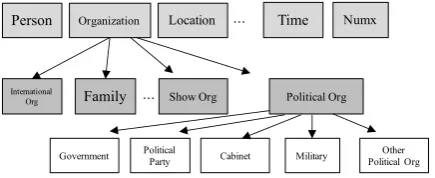
For example, Sekine (2008) divided the coarse-grained category Organization into the fine-grained cate-gories such as Political Party, Military, Sports Organization, Show Organization, as shown in Figure 2.
Person Organization Location ... Time Numx
International
Org Family ... Show Org Political Org
Political
Party Cabinet Military
Other Political Org Government
Figure 2: Sekine’s Extended Named Entity (ENE) hierarchy
FG-NER is still an open research domain, with little information concerning the state-of-the-art per-formance, the relation between training data size and perper-formance, and how to select the best model for different settings of training data size and target language. In FG-NER, because the number of NE categories is large, some categories might face with the data sparseness problem, whereas some other categories might have a large number of training samples in a dataset. Hence, it would be worth investi-gating the relation between dataset size and the performance of the system. The current state-of-the-art method for English NER (coarse-grained NER) is a neural network-based method, which uses convo-lutional neural network (CNN) to calculate the character level embeddings (Ma and Hovy, 2016). This leads to the question whether this method works well for languages with a large number of character types, such as Japanese.
In this paper, we first investigate the relationship between the F-score of various FG-NER algorithms with the size of training datasets for both English and Japanese. Second, we suggest the direction to choose an appropriate FG-NER algorithm for appropriate target language and training data size. We show that the state-of-the-art method for English NER also performs well for English FG-NER. On the other hand, for Japanese FG-NER, the state-of-the-art method does not work well. To solve this problem, we propose a method to significantly improve the neural network-based Japanese FG-NER performance by removing the CNN layer, as well as utilizing dictionary and category embeddings information. Ex-periments show that, the proposed method improves the F-score of the Japanese FG-NER system from 66.76% to 75.18%, which is a wide margin. We applied the proposed method to build an FG-NER system that can recognize 200 categories of named entities in the Sekine’s Extended Named Entity Hierarchy (ENEH) (Sekine, 2008). To the best of our knowledge, the proposed system achieves the state-of-the-art performance in the task of recognizing 200 NE categories in the Sekine’s ENEH. We publish the test dataset1and our FG-NER API on the Web to allow other researchers to freely use2.
The rest of this paper is organized as follows. In Section 2, we describe the fine-grained named entity tag sets and datasets. We present various algorithms for FG-NER and show our proposal to achieve high performance for Japanese FG-NER in Section 3. We present detailed experimental results to find out the relationships between models, training data size and target languages in Section 4. Finally, Section 5 concludes the paper.
1
2 Fine-Grained Named Entity Tag Sets and Datasets
2.1 FG-NER tag set
The first challenge in FG-NER is defining a comprehensive tag set with a very large number of entity cat-egories (Ling and Weld, 2012). There are two methods for defining a tag set (i.e., set of entity catcat-egories to recognize) in previous studies on FG-NER. The first method is to take the entity categories from a knowledge base such as Freebase (Bollacker et al., 2008) or YAGO (Suchanek et al., 2007), filtering out the categories with a small number of entities and merging the categories with similar semantic meaning into one FG-NER category (Ling and Weld, 2012; Yosef et al., 2012; Gillick et al., 2014). The second method is to manually build an entity hierarchy to cover important domains in the real world. Following the second method, Sekine et al. proposed an Extended Named Entity Hierarchy (ENEH), which con-tains 200 entity categories in a three-layer hierarchy, as shown in Figure 2 (Sekine et al., 2002; Sekine, 2008).
In this paper, we use the entity hierarchy described by Sekine (2008), which contains 200 NE cat-egories at the leaf-level, as our tag set3. At the top level of the hierarchy, there are about twenty coarse-grained named entity categories, such as Person, Organization, Location, Facility, Product, Event, . . . Each top-level categories is further divided into several second-level categories as shown in Figure 2. Each second-level category is in turn divided into several leaf-level categories.
We use this hierarchy because it is carefully designed by humans, it does not ignore important domains with small numbers of entities (e.g., Continental Region) and it includes a systematic categorization of date/time and number. Moreover, for subsequent applications such as search engines or chatbot platforms to easily utilize the FG-NER results, we want to classify an entity to exactly one category in the hierarchy based on the context in which the entity appears. Consequently, we need an entity category hierarchy that does not allow overlap between the categories (Sekine, 2008). For all experiments in this paper, we will build Fine-grained NERs to recognize the leaf-level categories in this hierarchy. The parent level categories can be easily inferred once we recognize the leaf-level categories.
2.2 FG-NER Dataset
We hired several human annotators to annotate two text corpora to create FG-NER tagged datasets for English and Japanese. The number of annotators for English is ten and the number of annotators for Japanese is seven. All of the annotators are native speakers of the corresponding language.
For each category in the Sekine’s Extended Named Entity (ENE) Hierarchy (Sekine, 2008), the human annotators are first asked to write down 100 entities that belong to each ENE category. We then search the Web for sentences that contain these entities. In the search result, we retrieve the sentences that include at least one entity of the corresponding category. The human annotators then tag the sentences with 200 ENE labels. For example, for the entity “Tokyo”, the Web search results might contain the sentence “Tokyo is the capital of Japan”. This sentence must then be tagged as “<City>Tokyo</City>
is the capital of<Country>Japan</Country>”. Consequently, we have 20,000 sentences for English and 20,000 sentences for Japanese (as the number of leaf-level categories defined in Sekine’s ENEH is 200). Note that the number of entities is larger than the number of sentences because in one sentence we might have multiple entities, of different NE categories.
After filtering out erroneous sentences (sentences with invalid tag format, e.g., without closing the tag</City>), we obtain totally 19,800 well-formed English sentences and 19,594 well-formed Japanese sentences. Each category has at least 100 sentences containing the entities of that category. We divided the dataset into three subsets: the training set (70% of the total data), development set (10%) and test set (20%), as shown in Table 1. We use the development set to check the stop condition while training our LSTM model.
To have an estimation of the difficulty of the FG-NER annotation task, we measured the coherence between the annotators by calculating two coefficients for some categories in the English dataset: the Fleiss’ kappa (κ) and the F-score of an annotator when assuming that another annotator created
Table 1: Statistics of the datasets
Dataset English Japanese
Sents Entities Sents Entities
Train 13,860 27,107 13,749 37,128
Dev 1,980 3,870 1,948 5,304
Test 3,960 7,739 3,897 10,485
Table 2: Agreement between annotators
Category Fleiss’κ F-score
Country 0.977 0.966
Dish 0.890 0.738
Car Stop 0.873 0.672
Organization Other 0.835 0.483
standard data4. The results are shown in Table 2. We choose these categories to calculate the coefficients because they represent typical categories in the dataset: a category with limited number of frequently used entities (Country), a category with entities that are often not proper nouns (Dish), a category with ambiguous and complicated location names (Car Stop) and a category that is ambiguously defined (
Or-ganization Other).
Theκcoefficient is calculated on tokens so it is only slightly different between the four categories in Table 2. This is because the ratio between the number of tokens with label “Other” is very large, com-pared against the number of tokens with specific NE category labels. We calculated Fleiss’κon tokens but not on entities because at entity level, there are some cases in which two annotators made overlap-ping tags, but not identical. For example, Annotator1 might tag “<City>Greater Tokyo Area</City>” and Annotator2 might tag “Greater <City>Tokyo</City>Area”. If we calculate on entity level then the score would be 0 but if we calculate on token level, the score is greater than 0. Consequently, we calculate theκbased on B/I/O tags at token level.
On the other hand, when calculating the entity-based F-score, the difference is very large between the category Country andOrganization Other. This is because the category Country is very easy to recognize, as there are only about 200 entities frequently used in this category, whereas, recognizing
Organization OtherorCar Stopis very difficult because of the ambiguity. This also indicates that the
performance of an FG-NER system tends to depend on the categories and we can confirm this in the experimental results in the next sections.
3 Fine-Grained Named Entity Recognition Methods
3.1 Dictionary and Rule-based FG-NER
The simplest method for FG-NER is using a dictionary and a set of rules. Sekine and Nobata (2004) presented a dictionary and rule-based Japanese FG-NER system that contains more than 1400 rules to recognize 140 entity categories.
In this work, we added 200 rules to the existing 1400 rules by Sekine and Nobata to create a rule set of 1600 rules to classify 200 NE categories in the Sekine’s Extended Named Entity Hierarchy. We then built a rule-based Japanese FG-NER model to recognize 200 NE categories based on these 1600 rules.
We use a Japanese FG-NER dictionary containing 1.6 million Wikipedia entities in this model. In the 1.6 million entities in the dictionary, only 70 thousand entities are assigned NE tags by human, the rest are assigned by an existing Wikipedia NE labeling algorithm (Suzuki et al., 2016), which gives a score for each (entity, NE category) pair. We created similar rules for English FG-NER and we translated the Japanese dictionary into English by looking up parallel entries in Wikipedia.
We use this method as a baseline for performance evaluation of FG-NER systems.
3.2 CRF+SVM hierarchical classifier for FG-NER
Hierarchical classifiers have been successfully used in previous research for FG-NER (Ling and Weld, 2012; Yosef et al., 2012). Ling and Weld proposed FIGER, an FG-NER system with the entity categories taken from Freebase tags (Ling and Weld, 2012). In FIGER, the entity category is represented as a path,
such as/location/cityororganization/company. FIGER divides the entity categories into
a hierarchy of two layers: the categories in the first layer corresponding to the categories in coarse-grained NER systems, whereas, the second layer (the leaf-layer) contains fine-coarse-grained entity categories. FIGER uses a hierarchical classifier that contains a CRF at the top layer for sequence labelling and then a Perceptron at the second layer for classification of the entities into fine-grained categories.
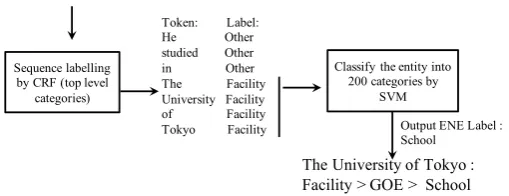
In this work, we propose a hierarchical classification method in which CRF is used for sequence labelling at top-level and SVM is used for named entity classification at leaf-level of the Sekine’s ENE Hierarchy, as shown in Figure 3. We use SVM at the leaf-level to classify an entity to fine-grained categories because SVM is good for classification tasks.
Input sentence : He studied in The University of Tokyo.
Sequence labelling
Figure 3: CRF+SVM based hierarchical classifier for FG-NER
Specifically, we use a training dataset (containing FG-NER tagged sentences) to train a CRF model to tag the input sentences with the top-level ENE categories in Figure 2. As illustrated in Figure 2, at the top level, we have only less than 20 categories of entities, thus using a CRF model here would achieve comparable performance with existing NER systems. We cannot directly use CRF for a large number of categories at leaf-level of the hierarchy, because with this number of classes, it would take a huge amount of memory and running time to train the CRF model. Actually, we have tried to use CRF for 200 classes, but the training process took a long time and did not finish. After tagging the sentences with the top-level categories, we can convert the FG-NER problem into a simple classification problem (not a sequence labeling problem anymore), thus we can use SVM to classify the extracted entities at the top level into leaf-level categories. Therefore, we have a CRF model to tag the input sentences with top-level categories, and several SVM models (each for a top-level category) to classify the entities into the leaf-level categories.
We use the following features for both SVM and CRF: bag-of-words, POS-tag, the number of digits in the word, the Brown cluster of the current word, the appearance of the word as a substring of a word in the Wikipedia ENE dictionary, the orthography features (the word is written in Kanji, Hiragana, Katakana or Romanji), is capital letter, and the last 2-3 characters. Those features are proved to be useful in previous work on named entity recognition (Ling and Weld, 2012; Yosef et al., 2012; Yogatama et al., 2015; Suzuki et al., 2016).
Once we have the sequence labelling result, we have already known the surfaces and the top-level categories of the entities in the input sentence. We then use SVM to classify the entities into leaf-level categories. Because the number of leaf-level categories in each top-level categories is also not too large (e.g., less than 15), SVM can achieve a reasonable performance at this step.
We also propose a method to incorporate dictionary information in both CRF and SVM step to improve the entire performance, as described in Section 3.4.
3.3 LSTM+CNN+CRF model for FG-NER
2016; dos Santos and Guimar˜aes, 2015; Chiu and Nichols, 2016). The model then concatenates the character level embeddings with word embeddings to create a feature vector for each token in the input sentence. The input sentence is then fed to a BiLSTM network (Bi-directional Long-Short Term Memory network). Finally, CRF is used at the top layer of the BiLSTM to explore the correlations between outputs and jointly decode the best sequence of labels (i.e., NE categories).
For both English and Japanese FG-NER task, we use pre-trained word embeddings as input for our models. Previous studies have shown that GloVe achieves the best performance for English NER task (Reimers and Gurevych, 2017). Consequently, we use the embeddings based on GloVe for English5. For Japanese, we use pretrained word2vec6 embeddings. The vector dimension is 300 for English and 200 for Japanese.
We use the default hyperparameters by Ma and Hovy (2016) in our model: learning rate = 0.01,
batch size= 10anddecay rate= 0.09.
3.4 Incorporating dictionary information
Dictionary information (gazetteer feature) has been proved to be efficient in many NER and FG-NER tasks (McCallum and Li, 2003; Sekine and Nobata, 2004; Yosef et al., 2012). While there are previous studies that use dictionary for CRF (McCallum and Li, 2003) or SVM (Yosef et al., 2012) in the NER/FG-NER tasks, we believe that dictionary information would be useful in both sequence labelling and entity category disambiguation phase in the CRF+SVM method. Furthermore, the dictionary information can also be used in LSTM+CNN+CRF method. Consequently, we propose a method that efficiently utilizes dictionary information in the method LSTM+CNN+CRF and in both sequence labelling (CRF) and entity category disambiguation (SVM) phase of the method CRF+SVM.
We search the dictionary and assign a label in the set{B, I, O}for each token in the input sentence
w1w2. . . wn, in which a tokenwiis assigned the labelBif it is a start token of an entity in the dictionary,
labelI if it is a token inside an entity in the dictionary, otherwise, it is assigned the labelO. If there is a conflict (e.g., overlapping with two different entities in the dictionary) then we take the entities with the largest number of tokens. This is because we want to tag the longest sequence that could be an entity (e.g., if we have “United States” and “United States Army” then we take “United States Army”). We do not directly use these labels as the final results of the sequence labelling phase since they are not reliable as we drop all context information while assigning labels. Instead, we use these labels as features for CRF model for sequence labelling the entire input sentence or we add it to the additional dimensions of the vector representation of a token in the method LSTM+CNN+CRF.
Other than features from previous research on entity disambiguation (Yosef et al., 2012; Suzuki et al., 2016), we propose to use the following feature derived from the dictionary. We tokenize all the entities in the dictionary and calculate the probability that a tokenwis contained in an entity of typec:
P(c|w) = count(w, c)
count(w,∗) (1)
in whichcount(w, c)is the number of occurences ofwin an entity of typec, whereas,count(w,∗)is the total number of times thatwappears. We then use this probability as a feature for SVM to classify the entities into leaf-level categories in the method CRF+SVM and we directly add this feature to the feature vector of a token in the LSTM+CNN+CRF method. This feature is helpful because it represents the likelihood that an entitye(which is a sequence of tokenswiwi+1. . . wi+m) is contained in the category
c.
We add these features to the CRF+SVM method to have the CRF+SVM+Dict method. Similarity, while using these features for LSTM+CNN+CRF, we obtained LSTM+CNN+CRF+Dict method.
3.5 Utilize entity category embeddings to improve Japanese FG-NER performance
For languages with a large number of character types such as Japanese, the CNN layer in the
LSTM+CNN+CRF+Dict network architecture might not work well. This is because with a large
5
https://nlp.stanford.edu/projects/glove/
number of character types (e.g., 2000 frequently used characters in Japanese), it is difficult to cal-culate high quality character embeddings. Consequently, we propose a modification to the existing LSTM+CNN+CRF network architecture to alleviate this problem: We remove the CNN layer from the LSTM+CNN+CRF+Dict method to have the LSTM+CRF+Dict method. Moreover, we add another ad-ditional information concerning the entity category, as described below.
In the spirit of taking advantage of available dictionaries to improve our model as in CRF+SVM, we propose to integrate statistical information from the dictionary to improve the word embeddings. Specifically, for a word, we form a vector in which each element is the probability that this word is contained in an entity category, as follows:
C(w) = (x1, x2, . . . , xn−1, xn) (2)
wherexi is the probability that wordwis contained inithcategory (ci) :
xi=P(ci|w) =
count(w, ci)
count(w,∗) (3)
We call these “entity category embeddings”. For new words or words that do not appear in any entity category in the dictionary, their entity embeddings are zero at all dimensions. We concatenate this entity category embedding vector with the original word embedding vector to form a new word embedding vector. We call theLSTM+CRF+Dictmethod that also utilizes entity category embeddings asLSTM+CRF+Dict+Cate.
4 Experiments
4.1 Performance comparison between FG-NER methods
We evaluated the performance of the FG-NER methods using the test dataset, as described in Table 1. We calculated the Precision, Recall and F1-score for each category and the micro-average Precision and Recall over all 200 entity categories. Finally, we derived the average F1-score from the average Precision and Recall.
(a) Average F-score of the FG-NER methods
Method English Japanese
(b) Average F-score of the FG-NER systems with and without entity category embeddings
(c) Precision, Recall, F-score of the method
LSTM+CNN+CRF+Dict on the English test dataset,
sorted by F-score
Table 3: Performance of FG-NER methods
entries in English Wikipedia, these entities do not appear in the English dictionary. Consequently, the F-score of EnglishRule+Dictis very low.
The methodFIGERis the CRF+Perceptron hierarchical classifier described by Ling and Weld (Ling and Weld, 2012). We use the published source code ofFIGER7and our training dataset (identical to the training dataset of other methods in this paper) to get an FG-NER model. We evaluated this model with the test dataset described in the previous section. We can only evaluateFIGERwith English because the source code ofFIGERcan only work with English (e.g., the feature extraction code can only work with English if we don’t modify it). Although the architecture of the methodFIGERis very similar to that ofCRF+SVM+Dict, the performance is very different (the F-score is 24.43%, compared to 72.58%). This is because of several reasons. First,FIGERis designed for classifying the two-layer hierarchy of named entities based on Freebase. This hierarchy is different from the three-layer hierarchy of Sekine’s Extended Named Entity Hierarchy (ENEH) that we use in this work. Second, we use SVM at the leaf-level, instead of Perceptron. We believe that SVM gives high performance than Perceptron in multi-class classification tasks. And finally, the training data size is not large enough for FIGER to work well.
FIGERuses millions of training samples (which are automatically extracted from Wikipedia) to train the system (Ling and Weld, 2012), whereas, in our method, we only have about 13 thousand sentences in the training dataset. Automatically creating the NE tagged data is a reasonable approach for FG-NER definitions that are derived from existing knowledge bases like Freebase or Wikipedia. For FG-NER definitions that are not based on existing knowledge bases, it is difficult to automatically extract the NE tagged data from a large text corpus like Wikipedia. Consequently, for FG-NER system working with these definitions, we must design an algorithm that requires only a small amount of training data.
We can observe that the state-of-the-art method for English NER (Ma and Hovy, 2016) also works
well with English FG-NER, as LSTM+CNN+CRF outperforms CRF+SVM+Dict by a wide
mar-gin (80.93%, compared to 72.58%). However, for Japanese FG-NER, the situation is different. The method CRF+SVM+Dict achieves the best performance, and it significantly outperforms the origi-nal LSTM+CNN+CRF model in (Ma and Hovy, 2016). Even when we add dictionary information,
CRF+SVM+Dict still outperforms LSTM+CNN+CRF+Dict for Japanese FG-NER (the F-score is 73.30 and 70.34, respectively). We measured the statistical significance of the F-score difference by an approximate randomization test (Chinchor, 1992) with significance levelα= 0.05and 99,999 iterations. The randomization test is used because we want to check the difference between the micro-average F-score over all ENE categories. The result of this test indicates that the difference in F-F-score is statistically significant (the p-value is10−5). The reason for this difference lies in the character level embeddings that
LSTM+CNN+CRF+Dictcreates in the CNN layer. For English, we only have less than 30 characters in the alphabet, whereas, in Japanese, we have more than 2,000 Hiragana, Katakana and Kanji characters that are frequently used (the total number of Japanese characters is above 10,000). Because the number of characters is large in Japanese, the CNN layer does not work well to create good quality character embeddings.
We verified the above reason by the following experiment: we removed the CNN layer from LSTM+CNN+CRF+Dict and we measured the performance on the test dataset. Removing the CNN layer means disabling the character level embedding features in the LSTM+CNN+CRF+Dict method. The re-sult of this experiment is shown in the last row of Table 3a. We can observe that, removing the CNN layer
boosts the performance of the neural network based method from 70.30% (LSTM+CNN+CRF+Dict)
to 73.05% (LSTM+CRF+Dict), making it comparable with the performance of CRF+SVM+Dict
(73.30%) for Japanese FG-NER. However, for English FG-NER, the performance decreased if we re-move the CNN layer. This proves that the CNN layer works well for English, but it does not work for Japanese.
We also verify the difference between CRF+SVM+Dict and LSTM+CRF+Dict using a
random-ization test as described previously. For Japanese, the difference between CRF+SVM+Dict and
LSTM+CRF+Dict is not statistically significant. This suggests that with enough amount of training data and dictionary information, we can use both CRF or LSTM for FG-NER problem.
4.2 Result of removing CNN and using entity category embeddings
To verify the effectiveness the proposed method for Japanese FG-NER, we compared the performance of the best neural network-based model for each language with and without the entity category embeddings. The results are shown in Table 3b.
Because removing the CNN layer does not improve the performance of English
FG-NER, we compared LSTM+CNN+CRF with the method LSTM+CNN+CRF+Dict and
LSTM+CNN+CRF+Dict+Cate for English. We observe that, by adding dictionary information, we can improve the F-score from 80.93% to 83.14%. This improvement is statistically significant under a randomization test (similar to the tests in Section 4.1). However, if we further add the entity category embedding information (inLSTM+CNN+CRF+Dict+Cate), the performance slightly decreased (from 83.14% to 82.29%, which is statistically significant under the randomization test). This is because the quality of the translated English dictionary is not good enough to have practical statistics information.
Table 3b also shows a series of improvements we made for Japanese FG-NER. First, if we add the dictionary information, we obtained a similar result with that of English FG-NER (we boost the perfor-mance from 66.76% to 70.34%, as shown in the 1st and 2nd row of Table 3b). Second, if we remove the CNN layer from the network, we improve the performance from 70.34% to 73.05%, as described in the previous section. Finally, if we add category entity embeddings, we further improve the performance
from 73.05% to 75.18%. This makes the methodLSTM+CRF+Dict+Cate significantly outperforms
the methodCRF+SVM+Dict(the randomization test result shows that the improvement is statistically significant). This proves the effectiveness of the newly added entity category embedding feature for Japanese FG-NER.
With this result, we can unify the FG-NER model for both English and Japanese: we don’t need to use
CRF+SVManymore, but we can utilize neural network-based models for both languages. We can have an identical system for both English and Japanese FG-NER by simply setting an option to enable/disable the CNN layer and the entity category embedding information to switch between English and Japanese. This makes the engineering of the system easier and helps to cut the maintenance cost of the FG-NER system.
4.3 Performance of each category
In the 200 NE categories in the Sekine’s ENEH (Sekine, 2008), there are several categories that can be recognized by rule-based method (such as URL or Email). There are also some categories that are actually not named entities, and difficult to recognize, such as Mollusk Arthropod (cellar spider, turbinidae,. . . ) or Art Other (e.g., “the Venus of Milo”, “Genji Monogatari Emaki”,. . . ). Consequently, the performance of the FG-NER models for each category will be different. In this section, we inves-tigate the performance some typical entity categories in the methodLSTM+CNN+CRF+Dict(the best method for English).
Table 3c shows the Precision, Recall and F-score of the LSTM+CNN+CRF+Dictmethod on some
specific categories as well as the average evaluation results of the entire 200 categories (in the last row). We achieved very high performance on the categories with a small number of known entities (such as Country) or the categories that the rules can capture almost all entities (such as Intensity, Volume, URL, and Email). For categories with free text names (e.g, printing names) or very short name (e.g., AK-47, a type of weapon) the system can not predict the NE tag very well because these names might appear in various contexts. This result is consistent with the difficulty of the tasks as described in Section 2.2 and in Table 2.
4.4 Training data size and performance
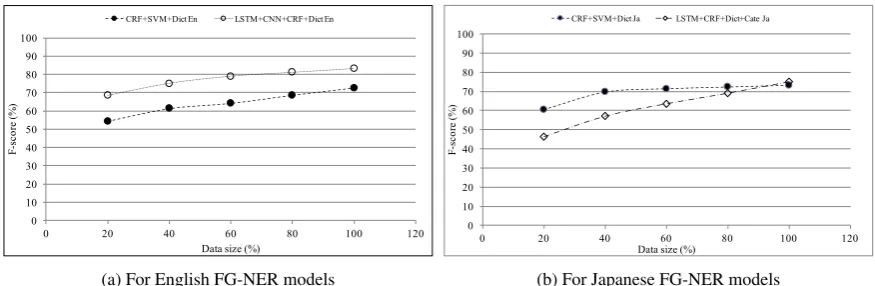
To find out the relation between the training data size with the FG-NER models, we varied the training data size and measured the F-score of each model on the test dataset.
0
Figure 4: Relation between training data size and F-score
Figure 4a and Figure 4b.
For English, we observe that the neural network-based method (LSTM+CNN+CRF+Dict) consis-tently outperforms the methodCRF+SVM+Dictby a wide margin, irrespective of the training data size. If we only use 20% of the training data (i.e., about 4000 training sentences), we can get the F-score of 68.49%, whereas, using the entire of the training dataset (100%), we get the F-score of 83.14%. How-ever, from 60% of the data size, the F-score increases gradually. This indicates that, we can still get a comparable performance even if we do not have a large amount of training data (an F-score of 78.68% for 60% of training data size).
For Japanese, the situation is totally different. When the training data size is small,CRF+SVM+Dict
outperforms LSTM+CRF+Dict+Cate by a wide margin (F-score of 60.60%, compared to 45.43%).
However, when the training data size is increased to 100%,LSTM+CRF+Dict+Cateis the best method (it achieves an F-score of 75.18%, compared to 73.30% of CRF+SVM+Dict). Therefore, if we only have a small amount of training data (e.g., 4,000 sentences), we must useCRF+SVM+Dict. If we have a larger amount of training data (e.g., 20,000 sentences), we can use the neural network-based model
LSTM+CRF+Dict+Cateto achieve the best performance. When the amount of training data is large enough, the LSTM layer can learn the relation between the NE tags and the underlying words (tokens) as well as the grammatical structures. Consequently, it can precisely model the NE tagging problem.
These comparison results give us a suggestion to choose the appropriate model for each setting of target language and training data size: if the target language is English then we should use the neural network-based methods; if the language is Japanese then we should useCRF+SVM+Dictif we only have little amount of training data and we use the neural network-based method when we have enough amount of training data.
5 Conclusion
References
Kurt D. Bollacker, Colin Evans, Praveen Paritosh, Tim Sturge, and Jamie Taylor. 2008. Freebase: A Collab-oratively Created Graph Database for Structuring Human Knowledge. In Proceedings of the ACM SIGMOD International Conference on Management of Data, SIGMOD 2008, pages 1247–1250.
Nancy Chinchor. 1992. The Statistical Significance of the MUC-4 Results. InProceedings of the 4th Conference on Message Understanding, MUC 1992, pages 30–50.
Jason P.C. Chiu and Eric Nichols. 2016. Named entity recognition with bidirectional LSTM-CNNs.Transactions of the Association for Computational Linguistics (TACL), 4:357–370.
Cicero dos Santos and Victor Guimar˜aes. 2015. Boosting named entity recognition with neural character embed-dings. InProceedings of the Fifth Named Entity Workshop, NEWS 2015, pages 25–33.
Dan Gillick, Nevena Lazic, Kuzman Ganchev, Jesse Kirchner, and David Huynh. 2014. Context-Dependent Fine-Grained Entity Type Tagging. CoRR, abs/1412.1820.
Guillaume Lample, Miguel Ballesteros, Sandeep Subramanian, Kazuya Kawakami, and Chris Dyer. 2016. Neural Architectures for Named Entity Recognition. InProceedings of The 2016 Conference of the North American Chapter of the Association for Computational Linguistics: Human Language Technologies, NAACL HLT 2016, pages 260–270.
Xiao Ling and Daniel S. Weld. 2012. Fine-Grained Entity Recognition. InProceedings of the Twenty-Sixth AAAI Conference on Artificial Intelligence, AAAI 2012, pages 94–100.
Xuezhe Ma and Eduard H. Hovy. 2016. End-to-end Sequence Labeling via Bi-directional LSTM-CNNs-CRF. InProceedings of the 54th Annual Meeting of the Association for Computational Linguistics, ACL 2016, pages 1064–1074.
Andrew McCallum and Wei Li. 2003. Early Results for Named Entity Recognition with Conditional Random Fields, Feature Induction and Web-Enhanced Lexicons. InProceedings of the Seventh Conference on Natural Language Learning, CoNLL 2003, pages 188–191.
Shotaro Misawa, Motoki Taniguchi, Yasuhide Miura, and Tomoko Ohkuma. 2017. Character-based Bidirectional LSTM-CRF with Words and Characters for Japanese Named Entity Recognition. InProceedings of the First Workshop on Subword and Character Level Models in NLP, SCLeM 2017, pages 97–102.
Nils Reimers and Iryna Gurevych. 2017. Reporting Score Distributions Makes a Difference: Performance Study of LSTM-networks for Sequence Tagging. InProceedings of the 2017 Conference on Empirical Methods in Natural Language Processing, EMNLP 2017, pages 338–348.
Alan Ritter, Sam Clark, Mausam, and Oren Etzioni. 2011. Named Entity Recognition in Tweets: An Experimental Study. InProceedings of the 2011 Conference on Empirical Methods in Natural Language Processing, EMNLP 2011, pages 1524–1534.
Erik F. Tjong Kim Sang and Fien De Meulder. 2003. Introduction to the CoNLL-2003 Shared Task: Language-Independent Named Entity Recognition. InProceedings of the Seventh Conference on Natural Language Learn-ing, CoNLL 2003, pages 142–147.
Satoshi Sekine and Chikashi Nobata. 2004. Definition, Dictionaries and Tagger for Extended Named Entity Hierarchy. InProceedings of the Fourth International Conference on Language Resources and Evaluation, LREC 2004, pages 1977–1980.
Satoshi Sekine, Kiyoshi Sudo, and Chikashi Nobata. 2002. Extended Named Entity Hierarchy. InProceedings of the Third International Conference on Language Resources and Evaluation, LREC 2002, pages 1818–1824.
Satoshi Sekine. 2008. Extended Named Entity Ontology with Attribute Information. InProceedings of the Sixth International Conference on Language Resources and Evaluation, LREC 2002, pages 52–57.
Fabian M. Suchanek, Gjergji Kasneci, and Gerhard Weikum. 2007. Yago: A Core of Semantic Knowledge. In
Proceedings of the 16th International Conference on World Wide Web, WWW 2007, pages 697–706.
Koichi Takeuchi and Nigel Collier. 2002. Use of Support Vector Machines in Extended Named Entity Recognition (in Japanese). InProceedings of the Sixth Conference on Natural Language Learning, CoNLL 2002, pages 119– 125.
Hiroyasu Yamada, Taku Kudo, and Yuji Matsumoto. 2002. Japanese Named Entity Extraction Using Support Vector Machine. Transactions of Information Processing Society of Japan (IPSJ), 43(1):44–53.
Dani Yogatama, Daniel Gillick, and Nevena Lazic. 2015. Embedding Methods for Fine Grained Entity Type Classification. In Proceedings of the 53rd Annual Meeting of the Association for Computational Linguistics, ACL 2015, pages 291–296.
Mohamed Amir Yosef, Sandro Bauer, Johannes Hoffart, Marc Spaniol, and Gerhard Weikum. 2012. HYENA: Hierarchical Type Classification for Entity Names. InProceedings of the 24th International Conference on Computational Linguistics, COLING 2012, pages 1361–1370.