Recovering Casing and Punctuation using Conditional Random Fields
Marco Lui, Li Wang NICTA VRL
Department of Computing and Information Systems University of Melbourne
[email protected], [email protected]
Abstract
This paper describes the winning entry to the ALTA Shared Task 2013. The theme of the shared task was recovery of cas-ing and punctuation information from de-graded English text. We tackle the task as a sequential labeling problem, jointly learning the casing and punctuation labels. We implement our sequential classifier ing conditional random fields, trained us-ing lus-inguistic features extracted with off-the-shelf tools with simple adaptations to the specific task. We show the improve-ment due to adding each feature we con-sider, as well as the improvment due to uti-lizing additional training data beyond that supplied by the shared task organizers.
1 Introduction
The ALTA Shared Task 20131 required partici-pants to recover casing and punctuation informa-tion from degraded English text. The task fo-cused specifically on English text where casing and punctuation were entirely absent (i.e. all characters had been reduced to lowercase, and all non-alphanumeric symbols had been omitted). Participants were required to submit word-level predictions, identifying on a word-by-word basis whether (1) the word in its original form has any characters in uppercase, and (2) whether the word is followed by one of a closed set of punctuation marks.
Our approach to the task treats the task as a se-quential labeling problem, a common technique in modern natural language processing (NLP). We implement a word-level sequential classifier us-ing conditional random fields (CRFs), a sequen-tial labeling technique that has been successfully
1http://www.alta.asn.au/events/ sharedtask2013
applied to a variety of NLP problems. We make use of a number of linguistic features extracted using off-the-shelf NLP tools, with some simple adaptations to the specific problem at hand. We also make use of additional training data beyond that supplied by the shared task organizers, and show that this has a large impact on the final re-sult. Overall, our approach was the most effec-tive in the shared task by a reasonable margin, performing 50 other participants (22 of which out-performed the organizer-supplied baseline).
2 Task Description
Participants were required to implement an auto-mated system that could accept as input a stream of words without any casing or punctuation. On the basis of this stream, participants were asked to infer which words in the stream should (1) have some form of casing, and (2) be followed by punc-tuation. The setting was meant to simulate scenar-ios whereby such information is missing, such as from audio transcriptions, or from user-generated content in social media.
The shared task was hosted on Kaggle2, a web platform for crowdsourced competitive data ana-lytics. Kaggle provides the infrastructure for run-ning a shared task, including user management, re-sults tabulation and discussion forums. For evalu-ation, the macro-averaged F-score across the two types of word-level labels (casing and punctua-tion) was used. Participants were able to submit two attempts daily and received immediate feed-back on the score obtained, which was also posted on a publicly-visible ranking known as the leader-board. The initial data released to participants consisted of a “basic” training set of≈66k words and a test set of≈64k words, with a further≈300k words from English Wikipedia. The source of the “basic” training data and the test data was not offi-cially revealed, but manual inspection showed that it was newswire data.
3 Methodology
Our main focus was to treat the task as a sequential labeling problem, which in recent NLP research has frequently been tackled using conditional ran-dom fields (Lafferty et al., 2001), a class of prob-abilistic graphical model that integrates informa-tion from multiple features, and has enjoyed suc-cess in tasks such as shallow parsing (Sha and Pereira, 2003). We apply CRFs to learn a se-quential labeler for the shared task on the basis of 4 automatically-extracted features: the surface form of the word (WORD), the part-of-speech of the word in context (POS), IOB tags for verb and noun phrases (CHUNK) and named entity recogni-tion with NE type such as person (NER).
POS, CHUNK and NER were extracted using
SENNA v3.0 (Collobert et al., 2011), an
off-the-shelf shallow parsing system based on a neural network architecture. We chose SENNA for this task due to its near state-of-the-art accuracy on tagging tasks and relatively fast runtime. One challenge in using SENNA is that it expects in-put to be segmented at the sentence level. How-ever, this information is obviously missing from the stream-of-words provided for the shared task. Restoring sentence boundaries is a non-trivial task, and automatic methods (e.g. Kiss and Strunk, 2006) typically make use of casing and punctua-tion informapunctua-tion (e.g. a period followed by a cap-italized word is highly indicative of a sentence boundary). In order to obtain POS, CHUNK and
2http://www.kaggle.com
NER tags from SENNA, we segmented the text using a fixed-size sliding window approach. From the original stream of words, we extracted pseudo-sentences consisting of sequences of 18 consecu-tive words. The start of each sequence was off-set from the previous sequence by 6 words, re-sulting in each word in the original appearing in three pseudo-sentences (except the words right at the start and end of the stream). SENNA was used to tag each pseudo-sentence, and the final tag assigned to each word was the majority label amongst the three. The rationale behind this over-lapping window approach was to allow each word to appear near the beginning, middle, and end of a pseudo-sentence, in case sentence position had an effect onSENNA’s predictions. In practice, for over 92% of words all predictions were the same. We did not carry out an evaluation of the accu-racy ofSENNA’s predictions due to a lack of gold-standard data, but anecdotally we observed that the POS and CHUNKoutput generally seemed sensi-ble. We also observed that for NER, the output appeared to achieve high precision but rather low recall; this is likely due toSENNAnormally utiliz-ing casutiliz-ing and punctuation in carryutiliz-ing out NER.
3.1 Sequence Labeler Implementation
To implement our sequence labeler, we made use ofCRFSUITEversion 0.12 (Okazaki, 2007).
CRFSUITEprovides a set of fast command-line
tools with a simple data format for training and tagging. For our training, we used L2-regularized stochastic gradient descent, which we found to converge faster than the default limited-memory BFGS while attaining comparable extrema. We also made use of the supplied tools to facilitate se-quential attribute generation. We based our feature template on the example template included with
CRFSUITEfor a chunking task. For WORD,
sin-gle words are considered for a (-2,2) context (i.e. two words before and two words after, as well as word bigrams including the current word. For POS, CHUNK and NER, we used a (-2,2) con-text for single tags, bigrams and trigrams. This means that for word bigrams, we also utilized fea-tures that captured (1) two words before, and (2) two words after, in both cases excluding the target word itself.
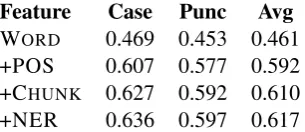
Feature Case Punc Avg
WORD 0.469 0.453 0.461 +POS 0.607 0.577 0.592 +CHUNK 0.627 0.592 0.610
[image:3.595.106.259.63.129.2]+NER 0.636 0.597 0.617
Table 1: F-score attained by adding each feature incrementally, using only the organizer-supplied
train data, broken down over the two
compo-nent tasks. The average of the two compocompo-nents is the metric by which the shared task was judged.
as certain punctuation strongly influences the cas-ing in the immediate context, e.g. a period often ends a sentence and thus a word followed by a pe-riod is expected to be followed by a capitalized word. We trained the labeler to output four distinct labels: (FF) the word should not be capitalized and should not be followed by punctuation, (FT) the word should not be capitalized and should be followed by punctuation, (TF) the word should be capitalized and should not be followed by punctu-ation, and (TT) the word should be capitalized and should be followed by punctuation.
We applied the same pseudo-sentence segmen-tation to the text that was carried out to pre-process the word stream for use withSENNA, and again the majority label amongst the three predictions was used as the final output.
Table 1 summarizes the effect of adding each feature to the system, using only the “basic” train-ing data. The result attained using only word features is marginally better than the organizer-supplied hidden Markov model baseline (0.461 vs 0.449). The biggest gain is seen by adding POS, and further improvements are achieved by using CHUNKand NER.
4 Additional Data Used
The feature set and labeler setup we outline above, combined with the “basic” training data provided by the shared task organizers resulted in a sys-tem that attained F-score of 0.617, comfortably ex-ceeding the organizer-posted baseline of 0.449 uti-lizing a hidden Markov model on the same training data. Adding the organizer-provided Wikipedia data further improved this result to 0.664.
Banko and Brill (2001) observed that for confu-sion set disambiguation, the performance of learn-ers can benefit significantly from increasing the training set size substantially. Confusion set
dis-0 1 2 3 4 5 6 7
x 106 0.62
0.64 0.66 0.68 0.7 0.72 0.74
a b
c d
e
f
Training data word counts
Macro−averaged F−score
Figure 1: Effect of adding training data. Left to right, each point represents the cumulative addi-tion of training data. (i.e.auses onlytrain, and
fuses all the data in Table 2.) Datasets are added in the order listed in Table 2.
ambiguation is representative of many NLP tasks, in that it relies on statistical models of word se-quences. Due to the large vocabulary, only a very small proportion of valid sequences is observed in any given dataset, and hence adding more data al-lows us to better estimate the parameters of the model. Our task suffers the same problem, and we thus expect that increasing the quantity of train-ing data will increase performance, a hypothesis is supported by the results obtained by adding the Wikipedia data to the “basic” training data.
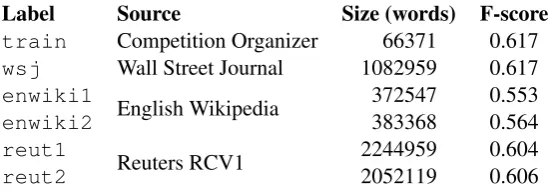
Table 2 summarizes the training data we used in our best-scoring system. As previously discussed, manual inspection of the training data suggested that it was derived from a newswire source. We thus sought additional training data from newswire sources. We made use of all the treebanked Wall Street Journal (WSJ) data from the Penn Treebank (Marcus et al., 1993), as well as a sample of data from RCV1 (Lewis et al., 2004). We opted not to use the organizer-supplied sample of English Wikipedia in our further experiments, instead uti-lizing our own sample which gave us access to a larger number of documents. For purposes of dis-cussion, we divide the Wikipedia and Reuters data into two partitions each.
[image:3.595.310.514.71.242.2]Label Source Size (words) F-score
train Competition Organizer 66371 0.617
wsj Wall Street Journal 1082959 0.617
enwiki1
English Wikipedia 372547 0.553
enwiki2 383368 0.564
reut1
Reuters RCV1 2244959 0.604
[image:4.595.161.437.62.158.2]reut2 2052119 0.606
Table 2: Datasets used in our best-scoring system. F-score is the macro-averaged F-score for the task attained by using each dataset individually as training data, using the full feature set.
high score despite having a relatively low word count. An interesting comparison can be made with the wsj result, where much more data is required to attain the same score. Figure 1 il-lustrates the effect of training models on succes-sively greater amounts of training data. The order in which data was added for Figure 1 was largely arbitrary, though several trends can be observed: adding each successive dataset reduces the im-provement obtained per word added, and for each of Wikipedia and RCV1, adding the same amount of data results in a near-linear increase in perfor-mance.
5 Negative Results
CRFSUITEis not able to train a model
incremen-tally, and so adding additional training data re-quired retraining the entire model from scratch. We attempted to circumvent this problem by im-plementing a voting system over models from dif-ferent partitions of the training data, but found that the performance was not competitive with the monolithic model.
We also tested crfsgd,3 but found that
CRFSUITEwas faster and attained slightly better
F-score for comparable setups. We believe that the default parametrization of the CRF model differs slightly between tools, but did not investigate.
Much of the additional training data we used was pre-tokenized in Penn Treebank format, which utilizes special sequences to represent dif-ferent types of brackets. As the organizer-supplied data did not follow this convention, we tested “de-escaping” the Penn Treebank brackets (e.g. con-verting-LCB-back to{). Surprisingly, we found that this actually reduced our F-score, though the reasons for this remain unclear.
We introduced gazetteer features on the basis of observing that despite low recall, the NER
fea-3http://leon.bottou.org/projects/sgd
tures produced bySENNAhad an overall positive impact on our task score. Our gazetteer features are based on word lists of common named entities. For place names, we used data from GeoNames,4 and for first names we used a wordlist included with Apple’s OS X. We used each wordlist to pro-duce a single Boolean feature indicating whether the word was present in the given wordlist. This approach showed some promise in internal cross-validation, but was abandoned as we found that it did not improve our score on the leaderboard.
6 Further Work
The CRF feature template (i.e. the set of rules for generating sequential features) that we used was derived with minimal modification from a tem-plate for a chunking task. Tuning the temtem-plate to this task may yield further improvements. Fur-thermore, CRFs are able to provide a probability distribution over labels, and this information may be useful in weighting a voting approach to model combination. Finally, the amount of data we used was primarily limited by computation resources available, so it is likely that increasing data quan-tity will further improve performance.
7 Conclusion
In this paper we detailed the winning entry to the ALTA 2013 Shared Task. We treat the task as a sequence labeling problem, jointly learning the casing and punctuation labels. We implemented a classifier using conditional random fields, trained using linguistic features extracted using off-the-shelf tools, using a simple windowing approach to generate pseudo-sentences. We find that the lin-guistic features out-perform simple word features, and that further improvements can be made by fur-ther adding training data. We briefly discussed
negative results in our development process, and outlined some avenues for further work.
Acknowledgments
NICTA is funded by the Australian Government as represented by the Department of Broadband, Communications and the Digital Economy and the Australian Research Council through the ICT Centre of Excellence program.
References
Michele Banko and Eric Brill. 2001. Scaling to very very large corpora for natural language dis-ambiguation. InProceedings of the 39th Annual Meeting of the ACL and 10th Conference of the EACL (ACL-EACL 2001), pages 26–33. Associ-ation for ComputAssoci-ational Linguistics, Toulouse, France.
Ronan Collobert, Jason Weston, L´eon Bottou, Michael Karlen, Koray Kavukcuoglu, and Pavel Kuksa. 2011. Natural language processing (al-most) from scratch. The Journal of Machine Learning Research, 12:2493–2537.
Tibor Kiss and Jan Strunk. 2006. Unsuper-vised multilingual sentence boundary detection. Computational Linguistics, 32(4):485–525.
John Lafferty, Andrew McCallum, and Fernando Pereira. 2001. Conditional random fields: Prob-abilistic models for segmenting and labeling se-quence data. InProceedings of the 18th Interna-tional Conference on Machine Learning, pages 282–289. Williamstown, USA.
David D Lewis, Yiming Yang, Tony G Rose, and Fan Li. 2004. Rcv1: A new benchmark collec-tion for text categorizacollec-tion research. The Jour-nal of Machine Learning Research, 5:361–397.
Mitchell P. Marcus, Beatrice Santorini, and Mary Ann Marcinkiewicz. 1993. Building a large annotated corpus of English: the Penn treebank. Computational Linguistics, 19(2):313–330.
Naoaki Okazaki. 2007. Crfsuite: a fast implementation of conditional random fields (crfs). URL http://www.chokkan.org/
software/crfsuite/.
Fei Sha and Fernando Pereira. 2003. Shallow pars-ing with conditional random fields. In Proceed-ings of the 3rd International Conference on Hu-man Language Technology Research and 4th