E x t r a c t i o n of V - N - C o l l o c a t i o n s from Text Corpora:
A Feasibility S t u d y for G e r m a n
Elisabeth Breidt" Seminar fiir Sprachwissenschaft
University of Tiibingen
Kleine Wilhelmstr. 113, D-72074 Tiibingen breidt~arbuckle.sns.neuphilologie.uni-tuebingen.de
A b s t r a c t
The usefulness of a statistical approach suggested by Church and Hanks (1989) is evaluated for the extraction of verb-noun (V-N) collocations from Ger- man text corpora. Some motivations for the extraction of V-N collocations from corpora are given and a couple of differences concerning the German language are mentioned that have implications on the applicability of extraction methods developed for English. We present precision and recall results for V-N collo- cations with support verbs and discuss the consequences for further work on the extraction of collocations from German corpora. Depending on the goal to be achieved, emphasis can be put on a high recall for lexicographic purposes or on high precision for automatic lexical acquisition, in each case leading to a decrease of the corresponding other variable. Low recall can still be accept- able if very large corpora (i.e. 50 - 100 miUion words) are available or if corpora are used for special domains in addition to the data found in machine readable (collocation) dictionaries.
1
I n t r o d u c t i o n
Collocations present an area t h a t is i m p o r t a n t b o t h for lexicography to improve their coverage in m o d e r n dictionaries as well as for lexical acquisition in c o m p u t a t i o n a l linguistics, where t h e goal is to build either large r e u s a b l e lexical d a t a b a s e s (LDBs) or specific lexica for specialized NLP-applications. We have t e s t e d the statistical approach M u t u a l I n f o r m a t i o n (MI), brought up by Church and H a n k s (1989) for linguistics, for a (semi- ) a u t o m a t i c extraction of verb-noun (V-N) collocations from u n t a g g e d G e r m a n t e x t corpora. We try to answer the question how m u c h can be done with an untagged c o r p u s and w h a t might be gained by l e m m a t i z i n g , P O S - t a g g i n g or even superficial parsing.
"binding degree' on how strong tile words of a collocation attract each other, which would be similar in spirit to what is calculated with MI. The work described in Smadja and McKeown (1990) and Smadja (1991a.b) is along the same lines as ours, though he uses a different statistical calculation, a z-score, and tagged, lemmatized corpora. Some properties specific to German, however, lead to a type of problem that needs different t r e a t m e n t (section a.a). Calzolari, Bindi {1990) use MI to extract compounds, fixed expressions and collocations fl'om an Italian corpus, but to our knowledge have not evaluated their results so far.
2
D o m a i n of Investigation
2.1 W h a t D o W e M e a n by ' C o l l o c a t i o n ' ?
Collocations in the sense of 'frequently cooccurring words' can quite easily be extracted from corpora by statistic means. From a linguistic point of view, however, a more re- stricted use of the term is preferable which takes into account the difference between what Sinclair (1966) called casual vs. signiticant collocations. Casual word combina- tions show a normal, free syntagmatic behaviour. In this paper, collocations shall refer only to word combinations that have a certain affinity to each other in that they follow combinatory restrictions not explainable with syntactic and semantic principles (e.g. h a m m e r a nail into sth. rather than "beat a nail into sth.).
For collocations that are based on a verb and a noun (preferably an object argument, sometimes however the subject of an intransitive verb), three types of V-N combina- tions are distinguished for German in the literature: verbal phrasemes (idioms) (e.g. B r u n d a g e et al. 1992), support verb constructions (SVCs) (v.Polenz 1989 or Danlos 1992) and collocations in the narrower sense (Hausmann 1989). As Brundage et al. (1992:7) and Barkema (1989:24) point out, the differences between these three types are gradual and "it is hard to find criteria of good selectivity to distinguish collocations from phrasemes". Although our main interest lies in SVCs we will in the following not distinguish between i) SVCs (e.g. to take into consideration), ii) lexicalized combina- tions with support verbs where the noun has lost its original meaning and which belong to phrasemes (e.g. to take a [ancy), and iii) collocational combinations of support verbs with concrete or non-predicative nouns (e.g. to ta/,'e a seat); we will refer to all these cases as V-N collocations.
2.2 W h y V - N C o l l o c a t i o n s ?
for SVCs and phrasemes due t o their (parlly) non-compositional semantics.
In German, common nouns, proper names and abbreviations of names starl with an uppercase letter (sentence beginnings are changed to lowercase in the corpus). So the verb-noun pattern was chosen for our sludv instead of possible others, because the uppercase makes it possible to extract V-N collocations even from untagged corpora if the verb is used as the key-word. T h e results of extracting V-N collocations give good indications how promising the retrieval of collocations would be with POS-tagged corpora. Besides, N-N combinations in German are mainly restricted to proper names, and Adj-N collocations are not as extensive in our corpus due to t h e small n u m b e r of frequent and interesting adjectives.
3
R e s o u r c e s and M e t h o d s U s e d in t h e S t u d y
Two untagged corpora were used for our study', kindly supplied by the 'Institut f/Jr deutsche Sprache' (IdS), Mannheim: the 2.7 million words ' M a n n h e i m e r Korpus I' (MK1) which contains approx. 73% fiction and scientific/philosophical literature and about 27% newspaper texts, and the 'Bonner Zeitungskorpus' (BZK), a 3.7 million words newspaper corpus. Except for the test how results could differ for larger corpora described in section 4.5, where the MK1 was combined with the BZK, the investigation was based on the MK1 on its own, for technical reasons and also because verbs occur more often on average in t h e MK1 than in the BZK (cf. Breidt 1993).
3.1 S t a t i s t i c a l M e t h o d a n d T o o l s
MI is a function well suited for the statistical characterization of collocations because it compares the joint probability p(wl,w2) that two words occur together within a predefined distance with the independent probabilities p(wI) and p(u,~) t h a t the two words occur at all in the corpus (for a more detailed description see Church et al. (1991:120) or Breidt (1993:18)):
p(2-..v)
MI(x, y) = log 2 p(x)p(y)
Several m e t h o d s are possible for the calculation of probabilities (cf. Gale and Church 1990); for our purposes we use the simplest one. where t h e frequency of occurrence in the corpus is divided by the size N of the corpus, p(z) = f(x)/N. Distance will be defined as a window-size in which bigrams are calculated.
were performed together with N\VIC queries and the creat.ioxl of bigrams using tools available at the "Institut f/.ir Maschinelle Sprachverarbeitung', University of S t u t t g a r t ). 3.2 T h e ' S t a n d a r d ' M e t h o d
Verbs that can occur in SVCs are in t h e centre of our study because the5' provide examples for all three types of V-N collocations; besides, the chosen ' p o t e n t i a l ' sup- p o r t verbs belong to the most frequent verbs in the corpus anyway. V-N collocations were extracted for the following 16 verbs (no translations are given because they dif- fer d e p e n d i n g on the N argument):
bleiben, bringen, erfahren, finden, geben, gehen,
gelangen, geraten, halten, km72men, nehmen, setzen, stehen, stellen, treten, ziehen.
Bigram tables of all words t h a t occur within a certain distance of these verbs, to- gether with their cooccurrence fi'equencies, form the basis for the calculation of MI. Bigram calculations were restricted to words occurring within a 6-word window to the
left
(cf. next. section), inclusive of t h e verb, a span which captures 95% of significant collocations in English (Martin et al. 1983). We will refer to these with BI6. For c o m b i n a t i o n s that occur at. least 3 times, MI was calculated together with a t-score. From these, candidates for V-N collocations were automatically extracted, sorted by MI. All of these were checked by m e a n s of NWIC-listings and classified w.r.t, their col- locational status by the author. T h e classification was in most cases very obvious. If a combination potentially formed a collocation but was not used as such in t h e corpus it was not counted; a couple of times, where some of the usages were indeed collocations and others not, the decision was m a d e in favour of the predominant case.3 . 3 A p p l i c a t i o n for G e r m a n C o r p o r a : S o m e P r o b l e m s
Some properties of the German language make the task of extracting V-N collocations from German text corpora more difficult t h a n for English corpora. A minor difference concerns the strong inflection of G e r m a n verbs. Whereas in English a verb lexeme appears in 3 or 4 different forms plus one for the present participle, G e r m a n verbs have 7 to I0 verb forms (without s u b j u n c t i v e forms) for one lexeme and additional 4 for t h e present participle. This has to be considered for the evaluation of queries based on single inflection forms, because in English more usages are covered with one verb form t h a n in German.
in verb-final position. To find the correct argument to the right of the verb is difficult in an unparsed corpus because of the variable number of intervening constituents.
As illustrated in the la.,~t paragraph the assumption that a "semantic agent [...] is principally used before the verb" and a "'semantic object [...] is used after it" as described in Smadja (1991a:180) does not hold for German. Therefore, complicated parsing is necessary to distinguish subject-verb from object-verb combinations. The results of V-N extractions reflect this problem. In many if not in most of the uninter- esting combinations extracted, the noun to the left of the verb is the subject rather than a complement of the verb (cf. section 4.6).
4
E v a l u a t i o n o f t h e R e s u l t s
Below, the top bigrams with kommen (come) are shown, and some of the nonsignificant ones (t < 1.65), to illustrate MI and t-scores. Bigrams with the infinitive form give best results compared to other inflection forms, possibly because this form covers l s t / 3 r d pers. pl. present tense, the infinitive and the nonfinite main verb of complex tenses (modals, conditional, future) at the same time. Also, the latter two always occur in verb-final position.
N + kommen Translation (zur) Geltung k.
(in) Betracht k. (in) Beriihrung k. (zur) Anwen<hmg k. (zu) Trgnen k. (zur) Ruhe k.
(auf den) Gedanken k. (in den) Himrnel k. (zu) Hilfe k.
(zu) Wort k. Vernunft (in) Frage k. ~z.ur) Welt k. :fie
show to advantage to be considered come into contact to be used
come to tears get some peace get the idea go to heaven come to aid
get a chance to speak reason
to be possible
to be born
You
f(x,y) f(y) MI t-score V-N-Coll.
27 96 9 . 8 6 5.19 +
9 42 9.47 2.99 +
4 41 8.33 1.99 +
4 126 6.71 1.97 +
3 107 6.53 1.70 +
4 216 5.93 1.95 +
7 403 5.84 2.58 +
3 270 5.20 1.66 +
4 477 4.79 1.89 ÷
3 647 3.94 1.57 +
3 736 3.75 1.55 -
4 1054 3.65 1.77 +
4 1900 2.80 1.60 +
3 2414 2.04 1.17 -
4.1 P r e c i s i o n a n d R e c a l l
collocations found in the corpus are not a subset of those mentioned in the dictionaries. Only 22 of the .-1:3 collocations found with the lemma
bring-
in the MKI (BI6) belong to the 135 combinations mentioned in the lexical entry forbringen
in Agricola (1970). Of the remaining 21 in the M K I , 9 can be found in the corresponding noun entries, and 12 do not appear at all though they are 'significant' collocations, e.g.Klarheit
bringen (clarify). zur Entfaltung hr. (develop), zur Wirkung hr. (bring the effect), in
Schwierigkeiten br. (create difh'culties), ins Gespr~:ch br. (bring into discussion).
Thus, we decided to use instead the number of collocations with the infinitive as determined by the standard method (BI6) as the basis for recall comparisons, i.e. 100% recall is set to this number.4 . 2 R e s u l t s o f t h e S t a n d a r d M e t h o d
Frequencies for the infinitives of the 16 verbs range from 832
(kommen)
to 117(gelan-
gen).
The number of V-N combinations varies from 46(bringen)
to 6(erfahren,
gelan-gen, geraten, treten),
precision fiom 100%(geraten, ziehen)
to 33%(eHa hren).
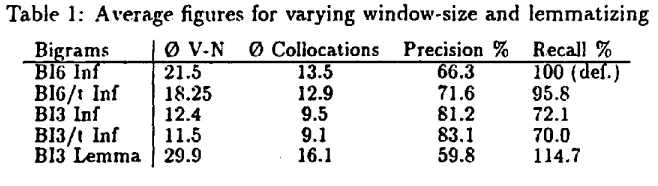
Average figures are presented in table 1 below, labeled BI6 I n f . If non-significant combinations are omitted with a t-test ( B I 6 / t I n f ) , the average of collocations among the extracted V-N combinations is only 95.8% of those found without a significance boundar.v, but precision rises slightly. With a threshold of MI > 6, precision would go up to 82.1% with a still acceptable loss in recall of approximately 10%.4 . 3 E x p e r i m e n t 1: V a r i a t i o n o f W i n d o w - S i z e
To see whether the collocational nouns could be better located directly to the left of the verb rather than within a couple of words, we reduced window-size to 3 words
including
the verb (this allows one word in between, e.g. 'zu' (to) in infinitival constructions). As shown in table 1 for BI3 In:f, precision rises about 10%, but with a recall of 72.1%, because those collocations where other arguments or post modifiers occur between N and V are no longer captured. Taking again only significant combinations (BI3/'t In:f) precision rises again slightly. This leads to the conclusion that for German, unless syntactic relations can be determined, a smaller window is preferable to improve a correct detection of preceding object arguments and to exclude unrelated nouns.
Table 1: Average figures for varying window-size and lemmatizing
Bigrams BI6 Inf Bl6/t Inf BI3 Inf Bl3/t Inf BI3 Lemma
O V-N O Collocations Precision % Recall %
21.5 13.5 66.3 100 (def.)
18.25 12.9 71.6 95.8
12.4 9.5 81.2 72.1
11.5 9.1 83.1 70.0
29.9 16.1 59.8 114.7
4 . 4 E x p e r i m e n t 2: S i m u l a t i n g L e m m a t i z i n g
[image:6.612.118.447.488.581.2]we restricted search to a 3-word window to the left. V-N combinations that occurred less t h a n two times with a single inflection forth of the verb were sorted out. T h e inflection forms for the infinitive (also l s t / 3 r d pers. pl.), 3rd pers. sg. present and past tense, l s t / 3 r d pets. pl. past and past participle were added up; 1st pers. sg. and 2nd pers. sg./pl, were so rare thai they could be ignored. The average results are again presented in table 1 (BI3 3.emma); the n u m b e r of extracted collocations is maximal, but precision is the lowest of all. Precision ranges from 33.3%
(gehen)
to 88.2%(setzen),
recall from 50%(erfahren)
to 166.7%(setzen).
Recall figures are above 100% because t h e absolute n u m b e r of collocations found is higher than for BI6 In:f, the basis for t h e recall calculations. Regarding l e m m a t i z a t i o n our study shows that one gets more collocations, but at the expense of more uninteresting combinations as well. One e x p l a n a t i o n for this is that 3rd pers. sg. p r e s e n t / p a s t and l s t / 3 r d pers. pl. past only occur to t h e right of their noun argument in s u b o r d i n a t e clauses, whereas l s t / 3 r d pers. pl. present are identical with the nonfinite form which additionally occurs in verb-final position in main clauses with a finite auxiliary or modal verb and in infinitive clauses. 4 . 5 E x p e r i m e n t 3: V a r y i n g C o r p u s S i z eFor infinitive
bringen
and lexemebring-,
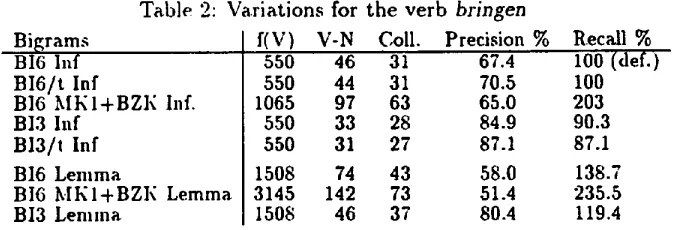
V-N combinations were also calculated with BI6 for a larger corpus consisting of the MK1 and BZK together. For MK1 alone, 31 of 46 c o m b i n a t i o n s are collocations, a precision of 67.4% (recall is set to 100%). With the larger corpus the number of found V-N collocations is more than twice as big, with only a slightly lower precision 2. Thus, larger corpora would improve results considerably. Results for the ]exeme with the highest n u m b e r of collocations at all (73) are along t h e s a m e lines; however almost, every second V-N combination is no V-N collocation in t h e sense defined in section 2, i.e. results are much better overall for t h e infinitive separately. T h e complete data forbringen
are listed below.Table 2: Variations
for
Bigrams f(V) V-N
BI6 Inf 550 46
BI6/t Inf 550 44
BI6 MKI+BZK Inf. 1065 97
BI3 Inf 550 33
BI3/t
Inf 550 31BI6 Lemma 1508 74
BI6 MKI+BZK Lemma 3145 142
BI3 Lemma 1508 46
4 . 6 E x p e r i m e n t 4: S i m u l a t i n g S y n t a e t l e In order to see how much the precision could
the verb
bringen
Coll. Precision % Recall % 31 67.4 100 (def.)
31 70.5 100
63 65.0 203
28 84.9 90.3
27 87.1 87.1
43 58.0 138.7
73 51.4 235.5
37 80.4 119.4
Tagging
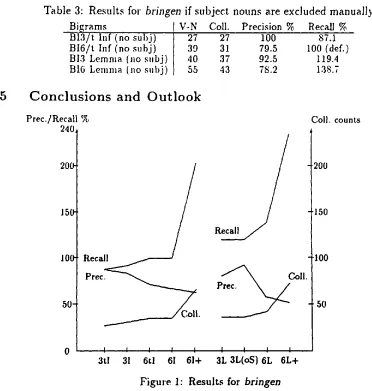
[image:7.612.149.486.417.532.2]the two window-sizes, infinitive and lexeme, are shown in table 3. Precision would rise up to 100t?~, with still a good recall of S7.1t~. if one could consider syntactic/'elations for the extraction of V-N collocations. Tile best recall of 43 collocations within 5 words to the left of the lexeme would then still correspond to 78.2c70 precision as compared to 587~, if subjects can/rot be detected. These results point in the same direction as Smadja's who reports an improvement fi'om 40 to 80% precision if syntactic relations are considered, with a 94% recall of all collocations that had been found regardless of syntactic/'elations. However, this cannot as easily be achieved in a large scale for German due to the complicated parsing techniques necessary for the varying word order.
Table 3: Results for
bringen
if subject nouns are excluded manually .Bigrams V-N Coll. Precision % Recall %Bl3/t Inf (no sub j) 27 27 i00 87.1 BI6/t Inf ('no sub j) 39 31 79.5 100 (def.) BI3 Lemma (no subj) 40 37 92.5 119.4 BI6 Lemma (no subj) 55 43 78.2 138.7
5
C o n c l u s i o n s a n d O u t l o o k
Prec./Recall % Coll. counts
240
200-
150"
10(
50
Recall
Recall
P r e c . ~
I I I I I ,l I 1 I
3tl 31 6tl 6I 6I+ 3L 3L(oS) 6L 6L+ 200
150
I00
50
Figure 1: Results for
bringen
[image:8.612.76.448.197.588.2]with t-threshold (3tl), 3-word window without t (3I), 6-word window with t (6tl) and without (6I), 6-word window for the enlarged corpus (6I+). 3L stands for '3- word window, lexeme', 3L(oS) means the exclusion of subject nouns; 6L and 6L+ are analogous to the infinitive version.
The result for '61+' implies that larger corpora will improve recall without a serious decline of precision compared to the same method used with the smaller corpus (6I; see also footnote 2). Whether the recall number should at the cost of a bad precision be pushed even higher by calculating MI for lexemes (6L vs. 6L+) can be decided in view of the application the data are extracted for. Once the number of V-N collocations is generally big enough, higher significance and MI thresholds can be used in order to improve precision again. MI sorts the extracted combinations in such a way that the collocations are the better the higher the MI-score is (with a few exceptions which often reflect highly significant, but linguistically uninteresting word combinations from one of the texts; this could hopefully be avoided with a more balanced corpus).
In general, a trade-off has to be found between the number of extracted collocations (recall) and the number of uninteresting items in between (precision), depending on the application. The described approach seems to be a good method for corpora with texts from restricted domains, where a special terminology is used which will thus show up strongly against 'normal' combinations.
Very high precision rates, which are an indispensible requirement for lexical acqui- sition, can only realistically be envisaged for German with parsed corpora (3L(oS) has the best recall-precision ratio in figure 1); otherwise the main advantage lies in a better lexicographical support, which should not be underestimated both for manually built NLP lexica and for printed dictionaries. Lemmatizing does not seem to be always useful, as a comparison of 61+ and 3L shows. Possibly the data are blurred because as mentioned on p. 6 the various inflection forms are distributed differently in verb-final and verb-second clauses, at least in the investigated corpus. Restricted lemmatizing with infinitive (lst/3rd pers. pl.) and past participle for a search to the left, and with 3rd pers. sg. pres./past and l s t / 3 r d pers. pl. past for a search to the right (which is problematic, though) promises to give more precise results, as long as search strategies cannot take into account, the syntactic structure of a sentence.
Work is currently in progress to calculate trigrams to check for prepositions in SVCs or for specific (or no) determiners for phrasemes. This will give indications to distin- guish SVCs and lexicalized, phraseological SVCs from other collocations. In addition, we plan to consider the variation in span position of the noun within the searched window in order to distinguish fixed phrasemes from flexible ones.
References
Agricola, E., H. Garner, R. Kiifner (eds.) (1962/1970). W~rter uad Wendungen. W~rterbuch
zum deutschen Sprachgebrauch. Leipzig: Verlag Enzyklop~die; Mfinchen.
Breidt, E. (199:1). Extraklio, van ~k'rb-Nomen-Verbindungell aus tlem Mannheimer Korpus I. SfS-Report 03-93. University of Tiibingen.
Brundage, J., M. Kresse, U. Schwall, A. Storrer (1992). Multi~'ord /exemes: a monolin- gual and contrastive typology for A'LP and MT. IWBS-Report 232, September 1992. IBM Germany, Scientific Centre Heidelberg.
Calzolari, N., R. Bindi (1990). Acquisition of iexical information from a large textual italian corpus. 13th COLING 1990, Helsinki. 54-59.
Choueka, Y. (1988). Looking for needles in a haystack, or: locating interesting collocational expressions in large textual databa.~es. Proceedings of the RIAO. 609-623.
Church, K. W., P. ltanks (1989). Word Association Norms, Mutual Information and Lexi- cography. 27th ACL, Vancouver. 76-83.
Church, K. W., W. A. Gale, P. Ranks, D. M. Hindle (1991). Using statistics in lexical analysis. In: Zernik, U. (ed.). Lexical acquisition: exploring on-line resources to build a lexicon. Hillsdale, NJ.
Danlos, L. (1992). Suppor! verb constructions. Linguistic properties, representation, trans- lation. Journal of French Linguistic Stud); Vol. 2, No. I. CUP.
Drosdowski, G. et al. (eds.) (1970). sl Duden Stilw6rterbuch der deutschen Sprache: Die Verwendung der W6rter im Satz. 6th completely revised and extended edition. Mannheim. Fieischer, W. (1982). Phraseologie der deutsche11 Gegenwartssprache. Leipzig.
Gale, W., K. W. Church (1990). Whets wrong with adding one? I E E E Transactions on Acoustics, Speech and Signal Processing.
Hatch, E., H. Farhady (1982). Research design and statistics for applied linguistics. Rowley. Hausmann, F. J. (1989). Le dictionnaire de collocations. In: Hausmann, F. J. et a.l. (eds.). Dictionaries: an international handbook for lexicography. Part I. HSK 5.1. 1010-1019. Ma.rtin, W., B. Al, P. van Sterkenburg (1983). On the processing of a text corpus. In: Ha.rtmann, B.. R. K. (ed.). Lexicography: principles and practice. London. 77-87.
v.Polenz, P. (1989). Funktionsverbgefiige im allgemeinen einsprachigen W6rterbuch. In: Hausmann, F. J. et el. (eds.). Dictionaries: an international handbook for lexicograph): Part I. HSK 55.1. 882-887.
Sinclair, J. M. (1966). Beginning the study of lexis. In: Ba~,el.l, C. E. et el. (eds.) (1966). In memory of J. R. Firth. London. 410-430.
Smadja., F. A., K. R. McKeown (1990). Automatically extracting and representing colloca- tions for language generation. 28th ACL 1990. 252-259.
Smadja, F. A. (1991a). Macrocoding the lexicon with co-occurrence knowledge. In: Zernik, 13. (ed.). Lexical acquisition: exploring on-line resources to build a lexicon. Hillsdaie, NJ. Smadja., F. A. (1991b). From n-grams to collocations: an evaluation of Xtra.ct. 29th ACL, Berkeley, CA. 279-284.