University of Windsor University of Windsor
Scholarship at UWindsor
Scholarship at UWindsor
Electronic Theses and Dissertations Theses, Dissertations, and Major Papers
2014
The Metaphor Interpretation Test: Cognitive Processes Involved
The Metaphor Interpretation Test: Cognitive Processes Involved
and Age Group Differences in Performance
and Age Group Differences in Performance
Sam Iskandar University of Windsor
Follow this and additional works at: https://scholar.uwindsor.ca/etd
Recommended Citation Recommended Citation
Iskandar, Sam, "The Metaphor Interpretation Test: Cognitive Processes Involved and Age Group Differences in Performance" (2014). Electronic Theses and Dissertations. 5087.
https://scholar.uwindsor.ca/etd/5087
This online database contains the full-text of PhD dissertations and Masters’ theses of University of Windsor students from 1954 forward. These documents are made available for personal study and research purposes only, in accordance with the Canadian Copyright Act and the Creative Commons license—CC BY-NC-ND (Attribution, Non-Commercial, No Derivative Works). Under this license, works must always be attributed to the copyright holder (original author), cannot be used for any commercial purposes, and may not be altered. Any other use would require the permission of the copyright holder. Students may inquire about withdrawing their dissertation and/or thesis from this database. For additional inquiries, please contact the repository administrator via email
The Metaphor Interpretation Test: Cognitive Processes Involved and Age Group Differences in Performance
By
Sam Iskandar
A Dissertation
Submitted to the Faculty of Graduate Studies Through the Department of Psychology in Partial Fulfillment of the Requirements for
the Degree of Doctor of Philosophy at the University of Windsor
Windsor, Ontario, Canada 2014
© 2014 Sam Iskandar
The Metaphor Interpretation Test: Cognitive Processes Involved and Age Group
Differences in Performance
by
Sam Iskandar
APPROVED BY:
__________________________________________________ Dr. L. Monetta, External Examiner
Université Laval
__________________________________________________ Dr. L. de Witt
Faculty of Nursing
__________________________________________________ Dr. C. Abeare
Department of Psychology
__________________________________________________ Dr. J. Casey
Department of Psychology
__________________________________________________ Dr. A. Baird, Advisor
Department of Psychology
iii
DECLARATION OF ORIGINALITY
I hereby certify that I am the sole author of this thesis and that no part of this thesis has been published or submitted for publication.
I certify that, to the best of my knowledge, my thesis does not infringe upon anyone’s copyright nor violate any proprietary rights and that any ideas, techniques, quotations, or any other material from the work of other people included in my thesis, published or otherwise, are fully acknowledged in accordance with the standard referencing practices. Furthermore, to the extent that I have included copyrighted material that surpasses the bounds of fair dealing within the meaning of the Canada Copyright Act, I certify that I have obtained a written permission from the copyright owner(s) to include such material(s) in my thesis and have included copies of such copyright clearances to my appendix.
iv
ABSTRACT
It is well known that aging affects fluid cognitive processes while leaving
crystallized processes largely intact. When it comes to language abilities, figurative
language tends to be more associated with fluid abilities and literal language with more
crystallized abilities. Fluid abilities involve short-term storage of information and mental
manipulation, which are associated with metaphor interpretation. Eighty participants (40
adults over fifty years old, and 40 young adults) completed the Metaphor Interpretation
Test (Iskandar & Baird, 2013). The test includes 17 items chosen from a list of metaphors
by Katz et al. (1988). Answers were coded as abstract complete (AC), abstract partial
(AP), concrete (CT), or other/unrelated (OT) response. On a multiple choice version of
the test, each option represented one of these categories. Participants also completed
cognitive tests measuring estimated verbal IQ, short-term memory, working memory,
processing speed, mental flexibility, verbal abstraction, and visual abstraction. Overall,
younger adults produced a greater number of and chose more AC responses on free and
multiple-choice formats of the test, respectively, than older adults. Conversely, older
adults produced a greater number of and chose more CT responses on free and
multiple-choice formats, respectively, than younger adults. Several measures were associated with
aspects of performance on the Metaphor Interpretation Test Verbal short-term memory
span most often emerged as a predictor in these analyses. Co-varying on verbal
short-term memory span eliminated age-group effects, while co-varying on estimated verbal IQ
increased age group differences. Results suggest that aging adversely affects novel
metaphor interpretation through age-related limitations in the ability to hold information
v
ACKNOWLEDGEMENTS
First and foremost, I would like to thank my advisor, Dr. Anne Baird, who has mentored me throughout my graduate school career. I am so fortunate to have had such a brilliant, kind, knowledgeable, and effective advisor. Dr. Baird has been the voice of reason and balance that has pushed me further while ensuring that I am not taking on too much. She fostered my creativity and encouraged me to channel it in a scientific, clear, and well thought-out endeavour. Much of what I have learned from Dr. Baird has been through observing her model balancing academia and clinical work with a sense of purpose and drive that I aspire to live up to.
I would like to also thank my committee members: Dr. Chris Abeare, for showing interest in my work and for being a supportive and guiding presence throughout my graduate school career; Dr. Joe Casey, for instilling in me a passion for
neuropsychological assessment; and Dr. Lorna de Witt, for helping me see my work with older adults through a broader positive and compassionate lens. You have helped me design, run, and write a project that I can be proud of.
I am also grateful for my labmates: Jenny, Jordan, Michelle, Kelly, and Laura for listening and offering their input when this project was just an idea floating in my head. I am indebted to Jessica Menard, Amanda Levine, and Andrea Coppens for being a
constant and (almost) instant source of support and reassurance that this dissertation will indeed be complete some day.
Special thanks are also owed to my highly dedicated and gifted research assistants: Emilee Winter and Allison Chandler. I am so grateful for you volunteering your time on evenings and weekends; this project would not be complete without your help. Your enthusiasm and eagerness reminded me that research is a fun and rewarding process!
vi
TABLE OF CONTENTS
DECLARATION OF ORIGINALITY ...iii
ABSTRACT...iv
ACKNOWLEDGEMENTS ...v
LIST OF TABLES ...vii
LIST OF FIGURES ...viii
CHAPTER 1: Introduction...1
What are Metaphors?...2
Neuropsychology of Figurative Language...14
Metaphorical Processing Across the Lifespan...45
CHAPTER 2: The Present Study ...51
CHAPTER 3: Methods ...55
Participants...55
Materials and Procedures...57
Statistical Analysis...64
CHAPTER 4: Results...65
Preliminry Analysis...65
Hypothesis 1: Age Differrences on the Metaphor Interpretation Test...67
Hypothesis 2/Correlational Analyses...69
Hypothesis 3/Regression Analyses...73
Hypothesis 4/Covariance Analyses...77
Hypothesis 5: Effects of Perceived Familiarity...79
CHAPTER 5: Discussion...81
REFERENCES/BIBLIOGRAPHY...95
APPENDICES ...118
Appendix A...118
Appendix B ...128
vii
LIST OF TABLES
TABLE 1: Sample Demographics ...55
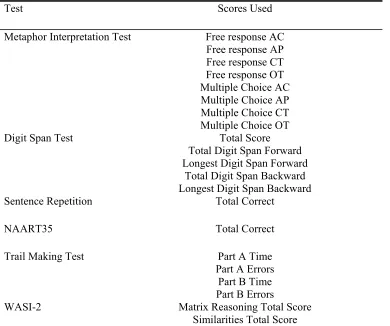
TABLE 2: Tests and Test Scores ...64
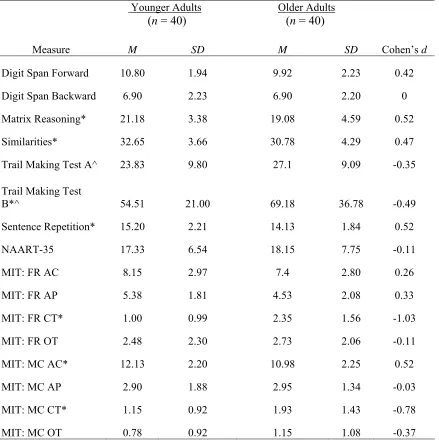
TABLE 3: Neuropsychological Test and Metaphor Interpretation Test Age Differences .66
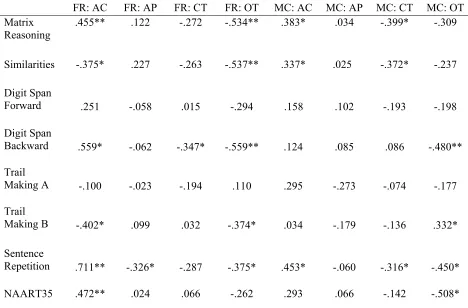
TABLE 4: Correlations of MIT Response Type with Neuropsychological Measures in Older Adults ...70
TABLE 5: Correlations of MIT Response Type with Neuropsychological Measures in Younger Adults ...71
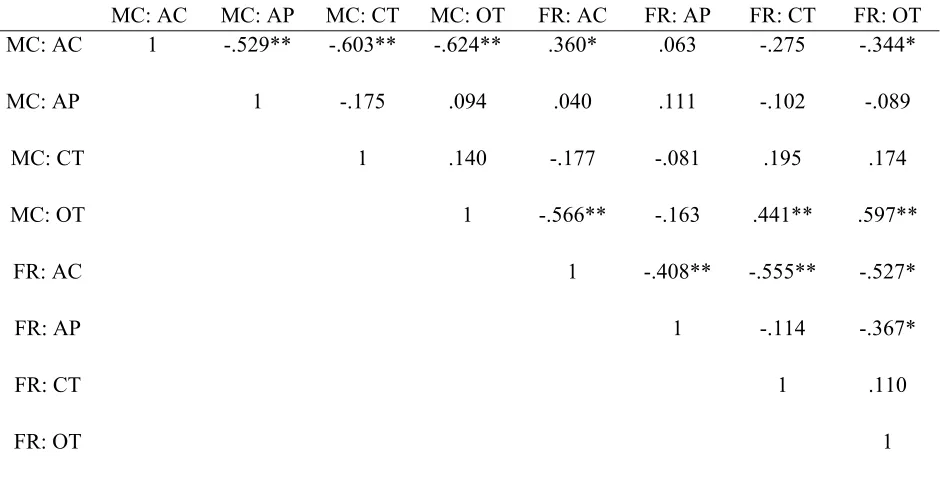
TABLE 6: Correlations of MIT Response Type in Older Adults ...72
TABLE 7: Correlations of MIT Response Types in Younger Adults ...72
TABLE 8: Regression Analyses for Variables Predicting Free Responses in Younger Adults ...74
TABLE 9: Regression Analyses for Variables Predicting Multiple Choice Responses in Younger Adults ...75
TABLE 10: Regression Analyses for Variables Predicting Free Responses in Older Adults ...76
viii LIST OF FIGURES
FIGURE 1: Number of Abstract Complete Answers Provided by Younger and Older Adults in Free Response Versus Multiple Choice Formats ...68
FIGURE 2: Number of Concrete Answers Provided by Younger and Older Adults in Free Response Versus Multiple Choice Formats ...69
FIGURE 3: Number of Abstract Complete Answers Provided by Younger and Older Adults in Free Response Versus Multiple Choice Formats with Sentence
Repetition Total Score Co-varied ...79
FIGURE 4: The Effect of Estimated Premorbid Verbal IQ (Estimated by NAART35) on Production of Abstract Complete Responses on the MIT- Free Response ...79
FIGURE 5: The Effect of Perceived Familiarity on Abstract Complete Response
1
CHAPTER 1
Introduction
In fields emphasizing technical writing, researchers are encouraged to be as literal
as possible in describing and explaining natural phenomena. In the course of daily life,
however, we often use figurative language that leaves much room for interpretation.
Figurative language usages linking physical sensations with abstract concepts, such as
credit freeze, credit squeeze, and credit crunch were dominant in the 20th century
(Glucksberg, 2011). In fact the term credit crunch was used in over 400 New York Times
articles published between 1981 and 2008 (Ahmad, 2011). Not until recently has
cognitive neuropsychology focused on brain areas and functions that relate to the
understanding and production of figurative language rather than literal language. The
study of metaphorical thinking as related to other cognitive functions is becoming more
popular as computer models become more sophisticated, neuropsychological cases of
impaired metaphorical processing arise, and different styles of interpreting metaphors are
found.
In the present study, an expansion of this research area was attempted by assessing how
responses on a newly-created English-language test of metaphorical processing with free
response and multiple choice components (Iskandar & Baird, 2013) were associated with
performance on clinical neuropsychological tasks tapping working memory, visual
abstraction, verbal abstraction, processing speed, and attention switching in older and
younger adults. Iskandar and Baird showed that the success of university students in
providing abstract interpretations of metaphors was associated with working memory,
2
for a semantic comparison or link to be made. The purpose of the present study was to
build on these findings and consolidate them with work showing that older adults tend to
exhibit difficulties with complex and ambiguous language comprehension more generally
(Hasher & Zacks, 1988; Just & Carpenter, 1992), and with abstract thinking in figurative
language specifically (Nippold, Uhden, & Schwarz, 1997; Uekermann, Thoma, and
Daum (2008).
What Are Metaphors?1
A metaphor can be defined in several ways. The term metaphor comes from the
Greek metapherein, which means to transfer (Gove, 1966). The etymology of the word is
in itself interesting in that it implies that a property of one item is conceptually
transferred to another. In philosophy, the classical view of metaphors is that “a metaphor
is an elliptical simile useful for stylistic, rhetorical, and didactic purposes, but which can
be translated into a literal paraphrase without any loss of cognitive content” (Johnson,
1981, p. 4). This view of metaphor dismisses it as a linguistic tool that can enhance
understanding, but that is easily replaceable by an alternative literal statement such as a
simile. Similarly, according to traditional psycholinguistic models (see Ortony, 1993), a
metaphor is construed as a similarity between a vehicle and a topic. That is, in a metaphor
such as love is a battlefield1, battlefield is the vehicle and love is the topic. The similarity
that the reader infers between these two concepts is the ground on which the metaphor is
based.
These models fail to take into account what seems to be the most important role
of metaphors: metaphors link disjointed domains of experience; a role which was
3
highlighted in the etymology of the word and has resurfaced in more modern cognitive
linguistic models Dent-Read and Szokolszky (1993) argued that metaphorical processing
involves “seeing or understanding one kind of thing as if it were a different kind of thing
and that this process is fundamentally perceptual” (p. 227). This indicates that
metaphorical processing involves an integration of language information with perceptual
experiences. Dent-Reed and Szokolszky believed that the scope of metaphor can be
expressed and understood in action and pictures as well as language. For example, one
can make one’s fingers walk and the headlights of a car can be seen as eyes.
Additionally, metaphors can be interpreted differently in different languages. For
example “Carloè un coniglio,” a metaphor used in an Italian study (Papagno & Vallar,
2001), literally means “Charles is a rabbit” (p. 516) but metaphorically means that he is a
coward. In other languages, it may be interpreted as him being promiscuous or quick. On
the other hand, university students with English as a Second Language (ESL) show the
same level of cognitive sophistication in metaphor interpretation as native English
speakers despite scoring lower on academic measures of English proficiency (Johnson &
Rosano, 1993). That is, metaphors may enhance understanding for ESL students.
A metaphor also can be defined through its function. That is, metaphors function
as bridges (metaphorically speaking) between two concepts and create new ideas that
transcend what these concepts mean individually (Muran & DiGuiseppe, 1990). Muran
and DiGuiseppe posit that metaphors have several necessary properties including novelty,
incongruity, similarity, relation, and integration. From a neuropsychological perspective,
metaphorical processing depends on more than an intact language system. It also requires
4
knowledge, the context of the conversation, and social cues from the co-conversant or
author (Martin & McDonald, 2003). These abilities also involve integrating information
from various cognitive and at times sensory-perceptual domains to generate novel
inferences about what is meant. This may also be related to the neuropsychological
process of concept formation, which is defined as the ability to integrate seemingly
dissimilar stimuli and acquire a common response to both (Kendler, 1961; Sweetland &
Childs-Quay, 1957).According to Schnitzer and Pedreira (2005), an explicit metaphor of
the form “X is (a) Y” may be interpreted as an instruction for the listener or reader to link
one connectionist network to another. It follows then that if networks between two
concepts are already linked, an expression connecting them may no longer be perceived
as metaphorical. For example, life is a journey will not seem metaphorical to most
readers, because the links between networks representing “life” and “journey” are
pre-connected. Such metaphors are quite common in everyday life. We may also encounter
several novel metaphors in the course of a day. For example, Lloyd Bentsen, a U.S.
vice-presidential candidate belittled his opponent by stating “you, sir, are no John Kennedy”
(in Glucksberg, 2011, p. 11). Such a statement, if interpreted literally, would seem
obvious and purposeless; on the other hand, it can be quite meaningful figuratively.
Similarly, when the media refers to company X is referred to as “the next Enron,” the
listener must decipher the metaphorical meaning in order to understand the reference
(Glucksburg, 2011).
Furthermore, it is important to state that non-literal or figurative language does
not necessarily involve metaphors, and in the present paper, I will be discussing
5
idioms, irony, sarcasm, and metonymy. Although these processes are related, there is
evidence to suggest that they are somewhat dissociable (e.g., the types of errors typically
made in interpreting metaphors are different from those made in interpreting idioms,
Papagno, 2001).
Models in Metaphorical Processing
Sequential approach. There are two main models of metaphorical processing.
The first, more traditional, model was alluded to by philosophers as early as Aristotle and
established by John Searle (1979). This model suggests that understanding metaphors
occurs in a series of steps. That is, all phrases are first processed literally, and then the
meaning of the statement is judged for accuracy. If the literal meaning is found
inaccurate, it is sent to a non-literal processing centre for decoding. This model assumes
that understanding metaphorical language would always be more effortful than
understanding of literal language. It is sometimes referred to as the sequential approach
or the indirect approach to metaphorical processing. This suggests that it takes more
mental effort to recognize two metaphorically-related concepts as going together than
two literally-related concepts. In this model, literal interpretations would always take
priority as that is the first step of processing. Further, the literal interpretation must be
judged as defective before a figurative one is derived. As will be discussed in the
following sections, these assumptions have been shown not to be true.
Direct approach. The second model of the way metaphors are understood is
referred to as the direct approach or the parallel processing approach (see Honeck &
Hoffman[1980] for a review of this literature). In support of this theory, Ortony et al.
6
language processing of metaphors. They found that the level of processing of
metaphorical language is largely dependent on context (e.g., the sentence “let the cat out
of the bag” is automatically understood as figurative when preceded by “Dean spoiled the
surprise that Joan had been planning for their mother’s birthday party,,”( p. 471).
Furthermore, metaphorical interpretations of expressions have been shown to
occur automatically, and are not optional or dependent on a failure to understand the
literal meaning of the expression. For example, Glucksberg, Gildea, and Bookin (1982)
constructed a test in which sentences were presented with a target word and participants
were told to judge if the literal meaning is true or false while ignoring the figurative
meaning. Using this logic, an incongruent sentence would be one that is literally false but
metaphorically true (e.g., “some offices are icebergs”). Four types of sentences were
used: literally meaningful (e.g., “some fruits are apples”), literally meaningless (e.g.,
“some fruits are tables”), metaphorically meaningful (e.g., “some jobs are jails”), and
scrambled metaphors that were metaphorically and literally meaningless (e.g., some jobs
are butchers,” p. 88). This test is based on the Stroop (1935) colour-word interference test
on which subjects must name the colour of the font of a word that denotes a different
colour (a more difficult task that reading out the word or naming the ink colour of word
that denotes the same colour). Glucksberg et al. proposed that if participants were truly
able to ignore metaphorical meanings, the metaphorically meaningful sentences would
take the same amount of time to reject as literally false as the scrambled metaphors. This
was not the case. They found that metaphorically meaningful sentences showed an
interference effect, taking longer to be judged as literally false than their scrambled
7
understanding metaphors occurs automatically and that participants have trouble
inhibiting this understanding.
In a variation of the study by Glucksberg et al., Keysar (1989) also showed that
metaphors were difficult to ignore. In this study, a target word would make the statement
either metaphorically true and literally false or metaphorically false and literally true. The
interference effect would occur when the target word would be both metaphorically true
and literally false. Reaction times were slower for the interference condition than the
valid condition. That is, participants were unable to ignore the figurative meaning despite
being able to focus on the literal meaning. This supports the idea that both meanings are
processed by a parallel rather than a sequential system. According to Paivio (1978),
language processing involves two processes (a verbal process and an imagery process)
that “represent the activity of independent but interconnected systems that are specialized
for picking up, storing, organizing, retrieving, and manipulating stimulus information” (p.
163).
Additionally, reaction time studies (e.g., Johnson, 1996) have found that
participants respond quicker to metaphorical sentences such as cigarettes are timebombs
rather than the simile counterpart (cigarettes are like timebombs). This finding suggests
that metaphorical sentences are not necessarily converted into similes in order to be
understood.
Cognitive view. Goodman (1976) pioneered the cognitive view of metaphorical
processing. According to this view, understanding metaphors requires the transfer of
properties across symbol systems. That is, my earlier example, X is a warm person,
8
being warm to a warm personality attribute. According to Seitz (1997), examples of
symbol systems include language, music, and visual arts. Metaphors transfer properties of
features or events from one symbol system to another. Therefore, I would posit that
models that address the underlying cognitive mechanisms involved in processing
metaphors should not focus solely on the linguistic aspects of the metaphor.
Alignment theory of metaphor processing. The alignment theory is concerned
with the order in which people process a metaphorical expression. That is, there are two
potential modes of processing metaphors: a mode that involves deriving an abstraction
from a base word to a target word, and a mode that involves aligning the terms to a
representation and then projecting inferences from the base to the target (Gentner &
Wolff, 1997). The first mode is referred to as an abstraction-first model. Given the
metaphor “life is a journey,” the base (journey) is used to identify the category of which
it is a prototypical member (e.g., an eventful period of time in which one passes from one
stage or place to another). These properties are then conveyed to the target (life), by
assigning it as a member of the same category as “journey.” The second mode is referred
to as the alignment-first model. In this mode, the relations between the elements and a
representational structure are made. That is properties of both “life” and “journey” are
aligned to overarching properties. Gentner and Wolff compared these two models by
recording participants’ time to interpret metaphors primed by either the base term or the
target term. They also included conditions in which they were not primed by either of the
words, or primed by both words. Alignment theory would predict that there would be no
difference between the priming conditions, whereas abstraction theory would predict an
9
Metaphors included were taken from four conditions: high conventionality/high
similarity (“that argument is a war”), high conventionality/low similarity (“that
conversation is a war”), low conventionality/high similarity (“that philanthropist is a
fountain”), and low conventionality/low similarity (“that developer is a fountain;;” p.
351). It was found that in metaphors with high conventionality and low similarity, a base
advantage did exist. However, in all other conditions, there was no base advantage.
Gentner and Wolff (1997) took this to suggest that conventional metaphors are
understood by abstraction, but that novel metaphors are understood by alignment. The
abstraction model also can be shown not to be complete, because the same base can have
different meanings depending on the target.
The class-inclusion theory. The class-inclusion theory was proposed by
Glucksberg and Keysar (1990). The theory was developed in order to show that
metaphors such as cigarettes are timebombs are not simply comparisons between the
topic (i.e., “cigarettes”) and a vehicle (i.e., timebombs). That is, saying "cigarettes are
timebombs” is not the same as saying “cigarettes are like timebombs” (Gucksberg &
Keysar, p.10). According to this theory, metaphors are class-inclusion assertions, in
which the topic of the metaphor “is assigned to a diagnostic category” (p. 3). That is, in
another example“my job is a jail” (Gucksberg & Keysar, p.10), a jail refers to the
category of entities that confine one against one’s will, are unpleasant, and are difficult to
escape from. The topic (job) would then be a part of that category. Similarly, in the
metaphor “my lawyer is a shark,” the word shark refers to the super-ordinate category of
predatory creatures (Glucksberg, 2011). This predatory property subsumes both lawyers
10
reference is similar to that used in such statements as “boys will be boys,” where the first
“boy” refers to young males, and the second to the stereotypically bad behaviours that are
typical of boys (Glucksberg, 2011).
In the following example, Glucksberg and Keysar (1990) demonstrate that
comparisons and class–inclusions are quite different. Consider the comparison “Canada
is like the United States.”In comparisons, the predicate (United States) is more salient
than the subject (Canada). Therefore, for most residents of the United States, this form of
the statement is considered best because the United States is considered the prototype.
For residents of Canada, the statement would be more apt as “the United States is like
Canada..” In either case, both statements are easily interpretable. Now if we were to
consider the metaphor “my job is a jail,,” we would see that “my job is like a jail” would
work, but “a jail is like my job” would not be easily interpretable. Similarly, “Chicago’s
linebackers are like tigers” is not as easily interpretable as “Tigers are like Chicago’s
linebackers” (Glucksberg & Keysar, p. 5). Therefore, it appears that metaphoricity in
language is mainly concerned with showing that one object fits into the same abstract
category of another. In these cases, metaphors are not equivalent to similes and are more
likely to be used in everyday language and literature.
Glucksburg and Catrinel (2006) asked university students to paraphrase
statements in either metaphor (X is Y) or simile (X is like Y) format. It was found that
when the statements were phrased as metaphors, students came up with more abstract
explanations; contrastingly, they were more likely to come up with concrete explanations
for similes. For example, the metaphor “some ideas are diamonds” elicited responses
11
responses alluding to value. It was also found that similes tended to elicit more negative
responses than metaphors. For example, the statement “my lawyer was an old shark”
tended to be interpreted as meaning experienced and competent; on the other hand, “my
lawyer was like an old shark” tended to be interpreted as meaning ineffectual and
toothless. These results are also in favour of the direct approach to understanding
metaphorical language. I would this argue that understanding metaphors does not depend
on the rejection of a literal meaning, and literal meanings of statements do not appear to
have priority over figurative meanings. Instead, this understanding depends on a process
of categorization that occurs in parallel to that used in understanding literal language.
Further support for the class-inclusion theory comes from a study by Gernsbacher,
Keysar, Robertson, and Werner (2001). In this priming study, it was predicted that the
vehicle in a metaphor would be better understood in terms of the super-ordinate category
that it belongs to rather than for its basic-level meaning. Four types of primes were used.
The first type was a metaphorically meaningful sentence, such as “That defense lawyer is
a shark;” the second type was a literally meaningful sentence, such as “That hammerhead
is a shark;” the third type was a nonsensical sentence, such as “His English notebook is a
shark;” and the fourth type was a meaningful but unrelated sentence, such as “That new
student is a clown” (p. 434). After being presented with the prime sentence, participants
were asked to indicate whether a target property statement made sense. Two types of
target property statements were provided: those that were relevant to the metaphorical
super-ordinate category (e.g., Sharks are tenacious), and those that were not relevant to
the metaphorical meaning but were meaningful at a basic level of the vehicle (e.g.,
12
it took for participants to respond) following each type of prime-target combination. It
was found that participants had slower verification latencies for property statements that
were true but not relevant to the super-ordinate category of the vehicle following the
metaphorical-sentence prime than the literally meaningful prime sentence, producing a
suppression effect. On the other hand, participants had faster verification latencies for
property statements that were relevant to the super-ordinate category of the vehicle
following the metaphorical-sentence prime than the literally meaningful sentence prime,
producing an enhancement effect. These results provide further credence to the
class-inclusion theory in that metaphors appear to activate the super-ordinate categories that the
two items being compared share (Gernsbacher et al., 2001).
The conceptual metaphor theory. According to Gibbs and Beitel (1995), when
people process metaphors or proverbs, the literal meaning is bypassed altogether and the
figurative meaning is accessed immediately. That is, people are equipped with cognitive
maps of metaphorical information from various domains. More familiar source domains
map on to less familiar or vaguer target domains in order to create meaning. Similar to
the class-inclusion theory, these mappings are thought to be unidirectional (i.e., one
domain of knowledge is used to structure another, but not the reverse). For example, in
the metaphor love is a journey, one must understand one domain of experience (i.e., love)
in terms of a very different and more concrete domain of experience (i.e., journeys). The
experience of journeys is then mapped on to the target domain of love in order to enhance
the meaning of this domain for that person. Note how the reverse “a journey is love” is
not a helpful metaphor. This idea of conceptual mapping also extends to our collective
13
plays some role in the historical evolution of what words and expressions mean” (p. 93).
For example, the root word “gen-,” which means to give birth, has been used
metaphorically as a root of several words including “generate,” “genocide,” “gene,”
“degenerate,” “engender,” etc. I would imagine that such words required making new
connections at some point in history, but that they became better integrated with time,
losing their figurativeness and becoming more literal.
Graded-saliency hypothesis (Giora, 1997). Although these models are helpful in
comparing literal and figurative language, they are not sufficient in explaining how
figural language is processed. An important step in doing so appears to be recognizing a
similarity between two concepts. The similarity may involve cross-modal association
(e.g., between emotional and logical centres). For example, Fodor (1981) described that
the brain’s capacity to process relationships between two concepts may rely on a
cognitive mechanism specialized in relating concepts across different cognitive domains
and corresponding brain areas. Complicating the matter is that not all metaphors are
processed in the same way. For example, Blasko and Connine (1993) have shown that
metaphors that were rated as highly familiar are understood more quickly than those rated
as novel. In fact, highly familiar metaphors are processed figuratively first. That is,
metaphors such as “X is a warm person” and “Y is a cold person” are more easily
understood as personality traits rather than temperatures. This suggests that once a person
encodes the meaning of a metaphor and stores it in long-term memory, the cognitive
mechanism responsible for finding a similarity between the two concepts in a metaphor
may not be activated when the person encounters that metaphor subsequently. Giora
14
novel. That is, it is not the type of language used but rather the saliency of the expression
that determines how easily it is processed. This is referred to as the graded-saliency
hypothesis, in which saliency depends on conventionality, frequency, familiarity, and
prototypicality (Giora, 1997). The differences between these factors and how they
interact has not been well established in the literature. This hypothesis is also in line with
the Goldberg & Costa (1981) model of language acquisition, which states that newly
acquired descriptive systems are processed separately (in the right cerebral hemisphere)
from those utilizing well-routinized codes (in the left cerebral hemisphere).It is
noteworthy that saliency also depends on the individual, and one metaphor may be very
salient to one participant and completely novel to another. Due to this, most recent
research in metaphors tends to include a familiarity rating for each metaphor in question.
Neuropsychology of Figurative Language
The idea that novel items are processed differently than familiar items is related to
the neuropsychological concept of executive functioning. According to Stuss &
Alexander (2000), the concept refers to the abilities involved in performing actions that
require the effortful control of more routine automatic processes. Executive functions are
typically tested in one or more of these situations: (1) when the level of complexity of a
task requires more than automatic processing, (2) when old information must be thought
about in new ways, or (3) when the information to be processed is novel. Processing
novel metaphors is therefore expected to load highly on these abilities. That is, the less
familiar a metaphor is, the more executive control is needed to comprehend it. More
conventional metaphors, therefore, may be processed automatically without necessarily
15
Neuropsychologically, an important question relating to metaphorical processing
is whether it fits more closely within the language domain or the executive functioning or
working memory domain. For example, although it is known that children under four
years of age are unable to comprehend and rarely produce metaphors (Vosniadou, 1987),
it is less clear why this is the case. I would argue that this may be due to developing
knowledge of concepts, developing linguistic facility, or developing executive
functioning. From a Piagetian framework, children who produce poor interpretations of
metaphors tend to be at the concrete or preoperational stages of cognitive development,
and children who produce accurate interpretations tend to be at the formal operations
stage (Smith, 1976). Furthermore, given the graded-saliency hypothesis, one would
expect that neuropsychological processes such as verbal reasoning and executive
functioning (abstraction and working memory) would be more taxed when the metaphor
is novel. Neuroanatomically, such tasks are typically associated with the functioning of
the prefrontal cortex (Stuss & Alexander, 2000).
The importance of understanding non-literal language for social interaction
becomes evident when considering the clinical syndromes in which this ability is
impaired ranging from autism to neurodegenerative diseases to schizophrenia (Thoma &
Daum, 2006). Clinically, there is currently no English-language test of metaphorical
processing specifically, and tests of figurative language generally consist of proverbs
tests. The most commonly used test is Gorham’s proverb test (Gorham, 1956). Also used
is the Proverb subtest of the Delis-Kaplan Executive Function System (D-KEFS; Delis,
Kaplan, & Kramer, 2001), which consists of only eight sayings that are presented in
16
The utility of metaphorical processing tasks as tools in the differential diagnosis
of neuropsychological disorders in adulthood remains largely unknown. Child
neuropsychologists and speech-language pathologists have available the Test of
Language Competence (Wiig & Second, 1985) to diagnose disorders of higher-level
language disorders in children. On the other hand, a standardized measure to specifically
evaluate metaphorical language in adults is not available. In adults, non-literal tasks
(mainly proverbs) have been mainly been used in diagnosis is schizophrenia, followed by
the differential diagnosis of dementia (Rapp & Wild, 2011). Research has shown that
metaphorical processing can be specifically and differently affected by different lesions
and syndromes. Therefore, it is important to develop a task of metaphorical processing of
potential use in clinical settings.
Evidence from lesion studies. Neuropsychological studies of metaphorical
processing suggest that figurative language processes involve different brain areas than
literal language processes. For example, the first neuropsychological study of metaphors
compared patients with left-hemisphere damage, patients with right-hemisphere damage,
patients with bilateral damage, and healthy participants (Winner & Gardner, 1977). They
presented participants with a figurative sentence (e.g., “he has a heavy heart”, p. 719) and
then they performed two tasks. One involved matching the sentence to one of four
pictures: one showing a literal representation (i.e., a man carrying a heart), one showing a
metaphorically correct representation (i.e., a man crying), one showing a quality of the
adjective in the sentence (i.e., a 500lb weight), and one showing the noun (i.e., a heart).
The second task required them to verbally explain their choice. It was found that
17
correct representation than those with left-hemisphere damage. However, when asked to
explain their choice, those with right-hemisphere were able to explain their choices,
whereas those with left-hemisphere damage had more trouble doing so. These findings
suggest that literal language and figurative language are processed in parallel networks
that can be dissociated. Alternatively, the right hemisphere may be responsible for linking
imagery with language. Needless to say, these findings are not conclusive. That is, those
with left-hemisphere damage may have had more difficulty with expressive language in
general, and that may have caused them not to be able to verbalize their choices.
Additionally, those with right-hemisphere damage may have had trouble processing
visual information in general, not necessarily as they related to metaphors.
However, Brownell, Simpson, Bihrle, Potter, and Gardner (1990) showed that
patients with right-hemisphere lesions performed poorly on a metaphoric task that did not
involve visual stimuli. In this study, two groups were compared, an aphasic group with
left-hemisphere stroke and a non-aphasic group with right-hemisphere stroke. The
participants were asked to sort words that had two potential meanings. Some of the words
were adjectives (e.g., “warm,” which has the alternative meaning loving) and some were
nouns (e.g., “pen,” meaning writing utensil or cage). Stimuli were presented in triads (e.g,
deep-wise-lake, crooked-deceitful-path, down-sad-elevator) and participants were asked
to pick the two cards that would go together. The task is referred to as the Metaphor
Triads Task, and several studies have adapted this task (discussed below). Patients with
left-hemisphere lesions performed better on this task than those with right-hemisphere
lesions. This study showed that metaphorical meanings of words are relatively spared
18
metaphorical and concrete reasoning, with metaphorical reasoning being apparently more
related to right-hemisphere functioning.
Giora, Zaidel, Soroker, Batori, and Kasher (2000) used highly conventional
clichéd metaphors (e.g., “broken heart,” “lend a hand,” “warm heart”) and asked
participants to provide an oral verbal explanation of four metaphors. Participants included
people with left-brain damage, right-brain damage, and controls. It was found that for
these types of metaphors, participants with right-brain damage performed as well as
controls, whereas participants with left-brain damage performed worse than both groups.
Among patients with left-brain damage, the extent of damage to the left middle temporal
gyrus and the junctional area of the superior temporal and supramarginal gyri were
negatively correlated with performance on the metaphor comprehension task. Damage to
different areas in the right hemisphere was not correlated with performance on this task.
These results suggest that the left-hemisphere is dominant when it comes to
understanding highly familiar metaphors.
Overall, lesion studies seem to show that both the right and left hemispheres are
involved in metaphorical processing to a certain extent. The differences in methodology,
types of tasks used and patient groups likely influence the varying results of these studies.
It is also clear that both familiarity and complexity play important parts in whether or not
a metaphor is accurately understood, and these factors were not always controlled for in
these studies.
Evidence from clinical syndromes. Neuropsychologists typically use figurative
language tests to assess a patient’s abstract thinking abilities. However, there is currently
19
when it comes to different brain disorders or in cognitive processes. In the following
studies, I will outline current research showing the potential benefits of a measure of
metaphorical processing that does not place a demand on expressive language skills.
Alzheimer’s Disease. One clue about the nature of metaphors and their
relationship with literal language can be found in studying patients with early stage
Alzheimer’s disease (Papagno, 2001). In this type of dementia, verbal communication
difficulty is a frequent and early symptom. Specifically, phonemic structures of language
are generally preserved whereas semantic structures may be affected. Papagno (2001)
used an Italian metaphor comprehension test in which a metaphor is presented (e.g.,
“Marco e un leone,” Mark is a lion) and participants are asked to offer a verbal
explanation. These metaphors were selected to be familiar, with the presumption that
patients with Alzheimer’s disease would have known the meaning at some point, but
have lost it due to the disease process. Their performance on this task was then compared
to a normative group and performance on a test of (literal) verbal comprehension.
Additionally, errors were then classified as a “concrete/literal interpretation” (25.59%),
“opposite interpretation” (6.8%), “wrong/insufficient interpretation” (58.3%), and no
response (9.2%; p. 1455). Interestingly, these patients showed impairment on the literal
comprehension task but showed no impairment on the metaphors task. It is possible that
the metaphorical nature of the sentences in the figurative task may have provided a
context that helped activate different pathways to meaning for these patients. This shows
that metaphorical reasoning is not done in a step-wise progression, as would be predicted
20
one understands the literal meaning of a phrase before rejecting it and examining its
figurative meaning.
Amanzio, Geminiani, Leotta, and Cappa (2008) used the same stimuli as Papagno
(2001) along with some novel metaphors in a sample of 20 patients with Alzheimer’s
disease. Consistent with Papagno’s findings, Alzheimer’s patients did not differ from
age-matched in the conventional metaphors task. However, they were significantly
impaired on the novel-metaphors task. This is likely due to the fact that executive
dysfunction is present fairly early on in the course of Alzheimer’s disease. In fact, the
impairment in comprehension of novel metaphors was found to be related to performance
on executive functioning tasks, but not to overall cognitive abilities. Furthermore, there
was no relationship between performance on the conventional metaphors task and the
executive functioning tasks used in this study (Behavioural Assessment of the
Dysexecutive Syndrome, BADS; Wilson, Alderman, Burgess, Emsile, & Evans, 1996).
The results of this study were interpreted to support the graded-salience
hypothesis.
Greene, Hodges, and Baddeley (1995) argue that the deficits in autobiographical memory
in Alzheimer’s disease are in part due to retrieval processes linked to executive
functioning. It is also noteworthy that although one could argue that novel metaphors are
simply more difficult, this is likely not the only explanation. In fact, normal controls
performed equally well on the novel and conventional metaphors (Amanzio et al., 2008).
This is likely because patients with Alzheimer’s disease may have difficulty inhibiting
the literal interpretation or coming up with a problem solving strategy for processing the
21
theoretically show less impairment on a task of metaphorical processing than patients
with fronto-temporal dementias, in which prefrontal functions are one of the first to show
a decline. Unfortunately, this type of study has yet to be conducted.
Parkinson’s Disease. Patients with Parkinson’s disease have also been shown to
have difficulties with metaphorical language processing (Monetta & Pell, 2007). Further
this appears to be due to dysfunction of the fronto-striatal systems. Monetta and Pell
administered a series of neuropsychological tests as well as a test of metaphor
comprehension to patients with Parkinson’s disease as well as healthy controls. This test
included prime-target sentence pairs with prime sentences being either metaphorical or
literal, and target sentences either metaphor-relevant or metaphor-irrelevant. It was found
that not all patients were impaired on metaphorical processing relative to controls.
However, those patients with impaired verbal working memory were also impaired in
metaphorical processing. Because verbal working memory is highly dependent on intact
fronto-striatal systems, it was posited that metaphorical processing is also dependent on
the functioning of this system. Furthermore, it was shown that fronto-striatal systems for
working memory are often, but not always, affected during the early course of
Parkinson’s disease.
Down Syndrome. Papagno and Vallar (2001) investigated the pattern of cognitive
impairment in a woman with Down syndrome, who had been able to acquire three
languages including Italian, English, and French. Neuropsychologically, she had
difficulty with visuospatial processing, abstract reasoning, and executive functioning; but
she had average linguistic skills, including oral and reading comprehension as well as
22
normal limits on a task of literal language comprehension and in the impaired range on a
task of metaphor comprehension and a task of idiom comprehension. Although not many
conclusions can be drawn from case-study evidence, it appears that processing of literal
and non-literal language involves dissociable brain mechanisms. I would argue that in
order for a double dissociation to be made, however, it must be possible to have impaired
literal processing and intact non-literal processing (i.e., a patient showing the opposite
pattern). It is also unclear which neuropsychological process was responsible for inability
to comprehend non-literal language in Papagno and Vallar’s case.
Learning Disabilities. Research has shown that children and adolescents with
language-based learning disabilities tend to have more trouble with figurative language
than literal language. For example, in a study examining metaphorical comprehension of
adolescent boys (ages 16 to 18 years), Jones and Stone (1989) found that participants
with a learning disability provided fewer correct metaphor interpretations than normal
controls. In this study, there were two types of response modes: verbal explanation and
paraphrase selection. An example of a metaphor used in this study was “A butterfly is a
flying rainbow” (p. 252), for which the selections were: appropriate metaphorical (i.e., a
butterfly is colourful), irrelevant factual (i.e., a butterfly is an insect), inappropriate
perceptually based (i.e., a butterfly is wide), and inappropriate perceptually based in a
different modality (i.e., a butterfly is fuzzy). It was found that paraphrase selection was
significantly easier for both groups, but that adolescents with a learning disability
performed worse on both tasks. Furthermore, this was not related to general vocabulary
knowledge or to knowledge of task-specific vocabulary. Therefore, it was concluded that
23
inferential skills rather than a deficiency in the amount of semantic knowledge or
semantic memory.
Such differences are also found in younger children. Lee and Kamhi (1990)
examined metaphoric processing in two groups of children (9 years 0 months to 11 years
0 months of age) with learning disabilities (one group with a history of speech difficulties
and one group without) and a group of children without a learning disability. All
participants were asked to complete three verbal metaphor processing tasks: metaphor
comprehension, metaphor preference, and metaphor completion. They were also asked to
complete a visual metaphor task (the Metaphor Triads Task; Brownell et al., 1990). As
expected, the group with a history of expressive language impairment performed worst,
and both groups with learning disabilities were worse than the group without a learning
disability on all four metaphor tasks. Lee and Kamhi argued that the implications of this
study are that children with a history of learning disabilities continue to have difficulty
understanding metaphors even after they gain some competence in literal comprehension.
Additionally, whereas giving context helped children without a learning disability
understand metaphors, it did not help children with a learning disability. This occurred
despite context helping children with learning disabilities understand literal meanings.
Nippold and Fey (1983) predicted that young children, who experience difficulty
with literal language attainment as pre-schoolers, would later go on to have difficulty
with figurative language attainment as adolescents (9- to 11-years-old). Twelve
adolescent children with a history of language acquisition difficulties and 12
pre-adolescent children with normal language acquisition completed literal language tasks,
24
the same list of metaphors as Billow (1975). Interestingly, it was found that these
children showed a deficiency in their understanding of metaphorical sentences while
performing as well as controls on measures of literal language comprehension and
non-verbal intelligence.
Taken together, these findings suggests that tests of metaphorical comprehension
may be more sensitive than commonly used language measures at detecting those
difficulties that tend to linger in children with a history of language impairment.
Autism. Understanding metaphors is also challenging for individuals with autism,
and this is thought to be related to impairment in theory of mind (Happe, 1995). Theory
of mind can be thought of as the ability to accurately guess another person’s mental state,
which is an essential cognitive process underlying people’s ability to engage in complex
social interactions (Stone, Baron-Cohen, & Knight, 1998). It is assessed with several
social reasoning tests of varying levels of complexity. It then follows that such a skill is
needed when decoding a figurative expression. That is, the listener must interpret
figurative expressions as clues to the speaker’s intended thought (Happe, 1995).
Happe (1993) conducted a study examining the relationship between theory of
mind and metaphorical processing. Participants included three groups of children and
adults with autism (based on theory of mind performance) and one group with an
intellectual disability not caused by autism. One group of autistic patients failed all theory
of mind tasks (as is the case with the majority of autistic individuals), one group passed
first-order theory of mind tasks only, and one group passed all theory of mind tasks. The
group of participants with an intellectual disability not caused by autism also passed all
25
(e.g., “father was very cross, he really was... angry”), simile (e.g., “father was very cross,
he really was like... a volcano”), and metaphor (e.g., “father was very cross, he really
was... a volcano”, p. 108).
On this task, only those participants with autism who failed all the theory of mind
tasks were impaired on the metaphorical processing task, performing at chance (Happe,
1993). These participants were not impaired on the synonym and simile conditions. The
findings of this study suggest that just as there may be different levels of theory of mind,
there are different levels of figurativeness and that patients may show impairment at
some levels but not others. Furthermore, the group with an intellectual disability but no
autism performed significantly better on this task than participants with autism. Given
that the only difference between the conditions was replacing “really was like” with
“really was,” it seems that lower VIQ in itself does not explain autistic participants’ poor
performance on metaphorical comprehension tasks but not the simile comprehension
tasks.
Patients with Asperger’s disorder also do not display the right hemisphere
superiority typically seen when processing metaphors on a divided visual field task (Gold
& Fust, 2010). In this experiment, participants with Asperger’s disorder and matched
controls were presented with four types of word pairs: literal, conventional metaphors,
novel metaphors, and unrelated. They were required to make a semantic judgement on
whether or not the pair makes sense. When novel metaphors were presented to the right
hemisphere (left visual field), control participants responded more quickly and were less
26
right hemisphere advantage as compared to the left hemisphere, and were less accurate
and slower than the control group in all conditions.
These findings have not gone unchallenged (see Gernsbacher & Pripas-Kapit,
2012). Norbury (2005) showed that semantic ability rather than theory of mind best
predicted performance on a metaphor comprehension task. That is, only children with
language impairment, with or without concurrent autistic features, were impaired on the
metaphor comprehension task. However, it is important to note that although this study
included children with pragmatic language impairment, pervasive developmental disorder
not otherwise specified, high functioning autism, and Asperger’s disorder, participants
were not grouped according to these diagnostic categories. Instead, they were grouped
into the following categories: language impaired only, language impaired with autistic
features, autism spectrum only, and typically developing controls. The metaphor
comprehension task used in this study was the same as that used by Happe (1993). It was
found that possessing higher theory of mind did not predict performance on the metaphor
task. This study’s results suggest that theory of mind development in early childhood may
be necessary but not sufficient in later years.
In a recent article, Giora, Gazal, Goldstein, Fein, and Stringaris (2012) attempted
to further support their graded-salience hypothesis (Giora, 1997) by comparing the
interpretation of metaphorical and literal language in young adults diagnosed with
Asperger’s disorder as well as in healthy controls. Participants were asked to decide
whether word pairs from five conditions were meaningful or not. The conditions were:
familiar metaphorical (e.g., flower bed), novel metaphorical (e.g., dying star), familiar
27
bunny laundry). It was found that participants with Asperger’s disorder generally
performed worse than typically developing young adults on both the literal and
metaphorical processing tasks. That is, both groups showed a similar pattern of
performance, in which the degree of saliency improved performance. However, unlike
what is generally reported about Asperger’s disorder, the group in this study processed
both literal and figurative language at a lower level, showing no advantage in literal
processing. Given that individuals with Asperger’s disorder must not show a clinically
significant delay in language or cognitive development to be diagnosed (APA, 2000), it is
likely that the overall worse performance on these tasks was due to difficulties acquired
after childhood.
The conclusions of this study diverge from the widely held view that those with
Asperger’s disorder fail to make sense of non-literal language. However, the level of
abstraction or figurativeness required in metaphorical word-pairs may be lower than that
required in a direct metaphor in the form X is Y. It is also worth noting that complex
theory of mind tasks are difficult for patients with Asperger’s syndrome as well as for
patients with bilateral damage to the orbito-frontal cortex, but not for patients with
lesions affecting the left dorso-lateral prefrontal cortex (Stone et al., 1998). Additionally,
in a functional Magnetic Resonance Imaging(fMRI) study examining brain activation in
healthy adults, Gallagher et al. (2000) showed that the medial prefrontal cortex was more
activated while participants read theory of mind stories or watched theory of mind
cartoons than when shown control stories and cartoons. As will be discussed in the
review of brain imaging literature subsequently presented, the prefrontal cortex has been
28
neuropsychological tasks typically impaired with prefrontal damage (those requiring
executive control and working memory) may be related to theory of mind as well as
metaphorical processing.
Schizophrenia. Patients with schizophrenia have long been known to have
difficulties interpreting figurative language, with several studies examining these
patients’ understanding of proverbs (Benjamin, 1944; Goldstein, 1959). More recently,
authors have specifically examined metaphorical processing within this population, and
have shown that concreteness is a main feature of thought and language disturbance in
schizophrenia. Cutting and Murphy (1990) compared the performance of patients with
schizophrenia, depression, and mania on a task of metaphorical processing in which they
were asked to select a pair of words from three cards that went together best. This method
was first used by Brownell and colleagues (1990; see Evidence from Lesion Studies
section above for a detailed description). Patients with schizophrenia were more likely to
choose antonym pairs (e.g., cold and warm) as going together than patients with
depression or mania. Those patients were more likely to choose metaphor pairs (e.g., cold
and hateful) than patients with schizophrenia. Because it was assumed that metaphorical
processing is a right-hemisphere process, the authors took these results to mean that
patients with schizophrenia rely more on their left-hemisphere when processing language
than other psychiatric patients. However, it is now clear that this right-left distinction of
metaphorical processing does not account for the complexity of this process.
Using different methodology, Iakimova, Passerieaux, and Hardy-Bayle (2006)
compared the performance of patients with schizophrenia with that of patients with
29
of matched-samples of patients with major depression, schizophrenia, and healthy
controls were compared on a task consisting of 10 metaphorical sentences. Overall, both
patient groups performed worse than normal controls on this task, with patients more
likely to provide literal or concrete responses. It was also found that severity of the
formal thought disorder in patients with schizophrenia was associated with more
erroneous responses on the metaphors task. For those with depression, severity of
depressive symptomatology and psychomotor retardation were associated with more
erroneous responses.
Using a more open-ended approach, Drury, Robinson, and Birchwood (1998)
compared the performance of patients with schizophrenia, patients with delusions caused
by other psychiatric disorders, and depressed patients on a metaphor comprehension task.
In this study, patients were presented with passages (e.g. about two boys arguing), and
then were given a statement about each passage (e.g., the boy’s mother said “Bill you
really are a steam roller sometimes!”). Participants were then asked what the statement
means. Interestingly, the test battery was performed once during the acute phase of
schizophrenia and once following recovery. It was found that patients with schizophrenia
performed worse than the other two groups during the acute episode. However, there was
no significant difference in performance between groups on this task at recovery. In both
cases, impairment in metaphorical processing was related to difficulties interpreting
interpersonal contexts. Furthermore, these differences are considered state- rather than
trait-dependent impairments.
The neural basis of this impairment in metaphorical comprehension was
30
fMRI study, participants read sentences silently while in the scanner, and were asked to
judge whether each sentence had a positive or negative connotation by pressing one of
two buttons. Thirty short metaphorical sentences (e.g., “Die Worte des Liebhabers sind
Harfenklänge” [the lovers words are harp sounds]) and their literal counter parts (e.g.,
(“Die Worte des Liebhabers sind Lügen” [the lovers words are lies]) were presented (p.
144). Participants were 12 patients with schizophrenia and 12 healthy controls. It was
shown that the healthy controls showed the typical pattern when responding to
metaphorical sentences, which is activation in the left inferior frontal gyrus (discussed in
subsequent sections). Patients with schizophrenia had a weaker signal in this area and in
the right superior/middle temporal gyrus than healthy controls. Additionally, activation of
this area was negatively correlated with a measure of schizophrenia severity. This
suggests that patients with schizophrenia show hypoactivation of areas necessary in
metaphor comprehension.
Improving metaphorical processing in clinical populations. Lundgren, Brownell,
Roy, and Cayer-Meade (2006) were the first to show evidence of improving metaphorical
processing in one patient with a right hemisphere lesion caused by a stroke. The
intervention program was based on Thinking Maps (Hyerle, 1995), which is a tool
typically used for children. Its main goal is to help the user represent semantic relations in
words and narrative by making connections with visual representations of the features
shared between words. In the case of metaphors, the two words shown can be linked
through their figurative visual representations. The authors showed that this patient
displayed improved performance on a metaphor comprehension task. This occurred
31
visuo-spatial skills, indicating that the improvement in metaphorical processing was not
due to general recovery.
More recently, researchers such as Mashal and Kasirer (2011) have attempted to
improve metaphorical processing in children with autism and learning disabilities. In this
Hebrew-language study, researchers also used Thinking Maps in order to draw explicit
connections between words that are metaphorically related. It was noted that such an
exercise would encourage flexible thinking and switching from one semantic feature to
another, therefore enhancing the development of these children. After this training
program, participants were presented with a list of conventional metaphoric pairs (e.g.,
defense line), novel metaphoric pairs (e.g., transparent moment), and unrelated pairs
(e.g., sport lemon). They were then asked to choose from four interpretations: correct
metaphorical, literal, unrelated, and a final choice stating “this expression is
meaningless.” They also completed semantic and letter fluency tests to assess executive
functioning. In the pre-intervention testing, it was shown that children with learning
disabilities or with autism both performed worse than typically developing children on
the metaphor interpretation task. This is consistent with previous research discussed in
earlier sections of this paper (e.g., Happe, 1993, 1995; Jones & Stone, 1989; Lee &
Kamhi, 1990).
Following intervention (Mashal & Kasirer, 2011), it was found that both groups
improved overall. However, only the learning disability group improved on metaphors
not previously encountered. It was also found that letter fluency performance predicted
improvement after intervention, suggesting that executive functions are closely related to