19
DESIGNING EDUCATIONAL SIMULATION
FOR IMPACT TEST MACHINE
Ahmed Hadi Shubber
1,2,
Amirmudin Bin Udin
1,
Asnul Bin Minghat
11
Universiti Tecknologi Malaysia
2Al-Furat Al-Awsat Technical University of Iraq
[email protected], [email protected], [email protected]
ABSTRACT. We report the simulation models for enhancing the metacognitive skills. Mechanical Engineering students of Babylon Institute in Iraq are chosen for case study. The design of model and Impact Test Simulations (ITS) for Metallurgy subject is addressed. The simulation software developed using Microsoft Studio 2010 includes tutorials to explain all necessary theoretical background and formulas. Step-by-step computerized procedures and numerical examples are rendered in a simple user-friendly, visual and interactive environment to enhance metacognitive skills and students' learning. Before starting the design process, objectives and the salient features of simulation are clearly identified. Subsequently, real laboratory experiments are conducted for collecting data and coding them in computer language. Despite the existence of numerous module embedded graphical simulation, the developed software package is expected to provide valuable tool for both students and instructors. Furthermore, the same package in the form of a bi-product can also be used as a "research tool" together with the application for engineering education.
Keywords: : ITS, education simulation, impact test, metallurgy.
1. Introduction. Modelling and simulation go hand in hand. Definitely, model building is a well-recognised way towards the understanding of the real world. Truly, it is a simplification of some complex structure or a system. Conversely, it may be for prediction, a substitute for experiential learning or simply for entertainment. The major difference between simulation and experimentation must be mentioned. In simulation, one experiments with a model and not with a phenomenon. The use of simulations represents the natural way of “learn by doing”. Alike students’ role playing we use computer simulations to understand intricate systems, real situation or dynamic processes. Computer simulations allow us to mimic situations or processes that would be difficult, impossible, dangerous, too long or too expensive to perform in reality [1].
Undoubtedly, the purpose of an educational simulation is to motivate the learner to engage in problem solving, hypothesis testing, experiential learning, scheme construction and development of mental models [2, 3]. Lately, this new information technology tools is changing the learning environment in engineering education from primarily teacher-centric to student-centric. Unfettered access to web-based or computer educational materials are highly useful [4].
20 etc. [5] are developed.The two-fold objective of this ongoing transformation is: (i) to improve the quality of instruction with innovative course materials that cater to the learning styles of present generation students, and (ii) to provide students exposure to computer problem solving tools so as to facilitate their transition from academia to industry [6].
In this research we attempt to design and evaluate a simulation model for impact test machine of metallurgy lesson for mechanical engineering students of Iraq. The model is tested, implemented, analysed and the results are compared and understood.
2. Theoretical Background. In the past, overall education in Iraq has suffered from severe deterioration due to the decrease in spending, lack of supplies, collapse of infrastructure and overcrowded schools. These are compounded by the continuing prevalence of classical teaching methods that focus on lectures and memorization. The stress analysis and deductive skills, the spirit of initiative and creativity are all failed to optimally encourage student engagement. Much educational necessity such as libraries, laboratories, modern teaching techniques, smart-boards, roving laboratories, electronic library, computers and their accessories to a considerable percentage of schools and institutions of higher education are already rendered. Despite many efforts since 2003 to develop courses for all levels of education, there is still a need to develop study courses and provide additional supports to maintain international standards [7–9].
Metallurgy is considered as one of the most important branches of engineering materials. The emergence of various metal industries enforced the students teaching more significant for their work. Particularly, technicians in factories producing various types of engineering materials require knowledge of integrated types of metallic materials. In addition to their knowledge on physical, thermal, chemical and properties they must be aware of the conditions for the manufacturing process [10]. Metallurgy is always considered as one of the hardest lessons taught in the Department of Mechanics in Iraq because many students fail to succeed in the first attempt [11]. Consequently, Metallurgy is proven as a difficult subject for many students [12]. The present research aims to find ways that may transform the engineering curriculum of Department of Mechanics in Babylon Technical Institute into simulation enhanced engineering curricula. It emphasizes on the incorporation of simulation based interactive modules to enhance student learning. The pedagogy of “learning-by-doing in virtual environments” is being employed in the development of modules. In fact, one of the practical and efficient ways engineers can learn is through hands-on activities in computer laboratories. The Impact Test module being a part of the Metallurgy lesson is expected to complement student learning achieved through computer laboratories and conventional classroom instruction. However, our emphasis is not directed towards distance learning. It is rather focused for on-campus classes in enhancing the quality of student learning by embedding computer simulation in conventional mode of teaching and learning processes.
3. Impact Test: A standardized high strain-rate test which determines the amount of energy absorbed by a material during fracture. This is used to define the resistance of a material towards sudden applied loads.
Toughness: In materials science and metallurgy, toughness is the ability of a material to absorb energy and plastically deform without fracturing. This is the amount of energy per unit volume that a material can absorb before rupturing. A property that determines the capacity of a material to resist fracture, (crack propagation), when subjected to impact. The machine measures the amount of energy (in Joule) absorbed by the specimen for the rupture unit. The amount of energy absorbed often indicates the toughness of the materials and classify them as brittle or ductile materials.
Pendulum Impact Test: This is a standardized high strain-rate test which determines the amount of energy absorbed by a material during fracture. In this test the specimen is positioned across the lowest point in the path of a striker mounted at the end of a pendulum as shown in Figure 1. The striker, having been initially lifted to an initial specific height (ho) and then released, swings against the specimen and breaks it.
The striker continues its swing to the other side of the specimen to a final height (hf).
Clearly, the difference between the two heights multiplied by the weight of the striker corresponds to the amount of energy that is absorbed during fracture.
The purpose of the test being the determination of the amount of energy absorbed by a material during impact/fracture often results,
21 2. Qualitative (fracture face can be analysed to provide insight on the ductile/brittle properties of
materials).
4. Methodology
4.1 Objectives of ITS. The identification of goals for the construction of lesson is considered as the important standard to determine their contents, nature, activities and exercises accompanying the methods. Furthermore, the modes of using particular teaching methods and the goals for lessons are categorized into general and specific one. General goals primarily focus to enhance Engineering Education and improve the metacognitive skills in the metallurgy lesson. Conversely, special goals intend to administer students having following perspectives:
a. Students identify when, where and how to use Impact Test. b. Students identify how to tests’ specimen designing.
c. Students identify the parts and components of an Impact Test. d. Students identify sequence of steps involved in Impact Test. e. Students identify advantages and disadvantages of Impact Test f. They identify how to safely use machines.
g. They identify how to measure machine toughness correctly.
4.2 Simulation Development. The simulation process is developed for ITS models in the metallurgy lesson as described hereunder.
4.2.1 Simulation Development Process. The development processes of ITS are illustrated in Fig. 1 [13, 14]. The computer language Microsoft Studio 2010 is used to design and develop the ITS model. An evaluation of the proposed model is carried out to identify their strengths and weaknesses through pilot test. A group of experts with mechanical engineering and teaching methods background are chosen to get their consensus and confirm the content validity.
Figure 1 Block diagram for the simulation development processes.
ITS development involves the underlined steps:
1. Identification of general and special goal of the model.
2. Use of metals group such as Stainless Steel, Mild Steel, Steel, Brass and Aluminium in conducting the real test.
22 4. Conducting the test on real apparatus. In addition to the registration of the real data and results during the
test, capturing pictures of each step, movement and reading of apparatus are also considered.
5. Modification and calibration of pictures for the measurements are performed with the real equipment and specimen using a set of computer programs such as Photoshop and other image processors.
6. Designing a computer program using Microsoft Studio 2010 to simulate the model and conversion of data and images to the software codes. Devising the computer interfaces representing the real test steps. 7. Acquiring data from the program alike a real machine when running the simulation or executing the
program.
The user is responsible for checking the statement true or false with the possibility of re-trying it several times, data collection, and storage in specific places to be audited.
4.2.2 Simulation Characteristics. Stančić and Yilmaz have identified the main characteristics of simulation which are fit for engineering education [1, 15]. The following attributes of simulation are considered in the entire process of designing the model:
1- Simulation program offers a series of clear events to the students allowing them the opportunity to participate actively in the program.
2- It offers the learner many suitable choices.
3- It helps the students to learn by using the sound, images and animation drawing.
4- It directs the students by using the proper guidance to the study depending on their control in the learning environment.
5- It provides a large base of information to the learner useful in understanding the subject matter under consideration.
6- The simulation program assists the learner to understand the reality, thought, and emotions. 7- It allows the learner to commit mistakes without affecting the results adversely.
8- It permits the learner to achieve great freedom in the learning process.
9- It proffers a new style to the learner which is very different from traditional approaches. 10-It grants a chance to the learner to apply some of the learned skills.
11-It generally creates appropriate conditions for learning and skills training with the computer which are very similar for the real world.
4.3 Simulation Design The ITS designed by Chang, Heath, Hill, Scheinman, is performed using the following stages[13, 14, 16]:
A. Design of Screen 1 as depicted in Fig. 2-a is comprised of the following options: 1. ABOUT IMPACT TEST: Review the information related to the Impact Test.
2. ABOUT SIMULATION: Review the information relating how can you use the simulation? 3. TEST STEPS: Review the information related of test step.
4. SIMULATION TEST: Move to the next screen to use simulation for Impact Test. 5. EXIT: End of program.
B. Design of Screen 2 as shown in Fig. 2-b includes the following options: 1. Aluminium Al: Use Aluminium specimen and next screen.
2. Steel: Use Steel specimen and move to the next screen. 3. Brass: Use Brass specimen and move to the next screen.
4. S-Steel: Use Stainless Steel specimen and move to the next screen. 5. EXIT: End of program.
6. Back: Back to the previous screen.
C. Design of Screen 3 as illustrated in Fig. 2-c to -f contains the following choices: 1. Horizontal Scroll Bar: To latch the hammer (Pendulum).
2. Vertical Scroll Bar: To raise the hammer (Pendulum). 3. EXIT: End of program.
4. Back: Back to the previous screen.
5. Animation Image: To touch friction pointer with hammer pointer 6. Image: The test specimen
23 10.Other View: To show real test from other view
11.Image :To explain the amount of absorbed striking energy (Joule)
12.Input Text (amount of absorbed energy ):To Input the absorbed striking energy value (Joule) 13.Key (Enter): To show value the absorbed energy and impact resistance are true or false 14.Label: To explain the impact resistance equation.
15.Label: To explain the specimen area on fracture surface in (mm2). 16.Label: To explain value of impact resistance.
17.Label: To explain if true or false answer.
4.4 ITS Procedures
1. In the screen 1, click on (SIMULATION TEST (4)) to move to the next screen to use simulation for Tensile Test.
2. In the screen 2, click on one of options (Aluminium Al(1), Steel(2), Brass(3), S-Steel(4)) to choose material and move to the next screen.
3. In the screen 3, follow the following options:
a. Use horizontal scrollbar (1) to latch the hammer (Pendulum). b. Use vertical scrollbar (2) to raise the hammer (Pendulum).
c. Wait few times to show automatically touch friction pointer with a hammer pointer (5). d. Drag and Drop the test specimen (6) from its location to the anvil location.
e. Click on (Start Test (8)) to show the real test video (9).
f. Click on (Other View (10)) to show real test from other view (9). g. Read Friction pointer (amount of absorbed striking energy (Joule) (11)). h. Input the reading of absorbed striking energy (Joule) in textbox (12).
i. Click on (Enter (13)) to show the absorbed energy and impact resistance are true or false.
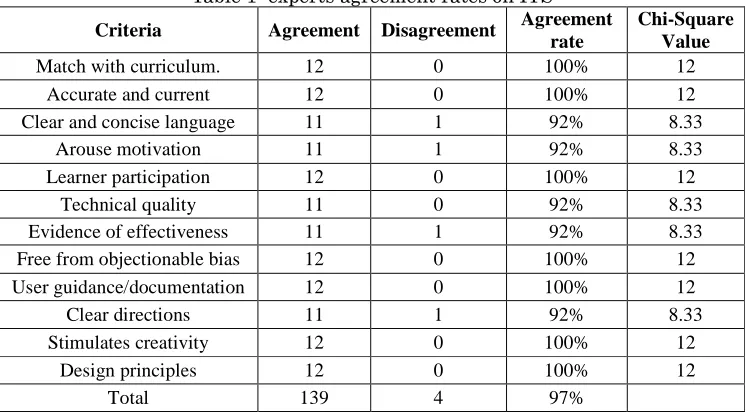
4.5 Evuation of ITS. The expert’s Checklist is employed to evaluate the simulation (ITS) which in turn increases the validity of the study instrument in identifying the presence of possible deficiencies during actual implementation Tokmak [17] .The checklist has twelve main parts:Match with curriculum, accurate and current, clear and concise language, arouse motivation/maintain interest, learner participation, technical quality, evidence of effectiveness, free from objectionable bias, user guidance/documentation, clear directions, stimulates creativity and design principles. The twelve experts evaluated the selected educational and mechanical separately. During the evaluation process, each expert defined detailed criteria relevant to each main criterion in Tokmak checklist. Furthermore, checklist responses from experts are combined to modify the formulation of the formulation of paragraphs and contents fitting the general and specific objectives of the study. The opinions and views of experts and specialists are considered in modifying, deleting and adding some paragraphs to ITS.
5. Results and Discussion. This study focused on design and evaluating a educational simulation (ITS) in the Mechanical engineering field. To evaluating ITS, the Researchers using Tokmak [17] Educational Software Evaluation Checklist. Expert scores on checklist were analysed by Chi-square Test to assess score compatibility in terms of the degree of consistency and percentage distribution of standards.
24 Table 1: experts agreement rates on ITS
Criteria Agreement Disagreement Agreement rate
Chi-Square Value
Match with curriculum. 12 0 100% 12
Accurate and current 12 0 100% 12
Clear and concise language 11 1 92% 8.33
Arouse motivation 11 1 92% 8.33
Learner participation 12 0 100% 12
Technical quality 11 0 92% 8.33
Evidence of effectiveness 11 1 92% 8.33
Free from objectionable bias 12 0 100% 12
User guidance/documentation 12 0 100% 12
Clear directions 11 1 92% 8.33
Stimulates creativity 12 0 100% 12
Design principles 12 0 100% 12
Total 139 4 97%
6. Conclusion. The influences of Impact Test Machine Simulation (ITS) in achieving enhanced metacognitive skills are inspected. The researcher designed ITS relying on established approaches are clearly able to identify striking simulation characteristics. Researchers are expected to employ the simulation design to evaluate the increased reliability and validity of the study instrument in identifying the presence of possible deficiencies during actual implementation [18, 19]. The simulation is executed to determine the effectiveness of metacognitive skills on mechanical engineering students of Iraq as test sample. Simulation design suggests that the developed model may serve as a research tool for both students and instructors in metallurgy lesson to improve their metacognitive skills. Laboratory experiments are carried out, data are collected and computer algorithms are developed using Microsoft Studio 2010. Relevant theoretical background and formulas related to the ITS are designed via user-friendly approach. The simulation model contains meticulously executed steps including the generation of metacognitive tasks, its goals and effective tools that promote overall ability and efficiency in education. It is hoped that the capability of students’ in understanding metallurgy lesson will improve via the acquisition of metacognitive skills. It may also enable learners in controlling their cognition, emotion, and motivation in addition to solve complex problems in mechanical engineering. The present model simulation is highly instructive for successful process of cognition and learning. This simulation will definitely enhance the susceptibility of students to understand and solve multifaceted problems in metallurgy.
25
c: Screen 3
b: Screen 2
e: Screen 3
a: Screen 1
d: Screen 3
f: Screen 3
Figure 2 (a-f) Schematic diagram displaying the design of screens for ITS.
REFERENCES
[1] Stančić, H., Seljan, S., Cetinić, A., & Sanković, D. (2007). Simulation Models in Education. In Međunarodna znanstvena konferencija The Future of Information Sciences, (Digital Information and
Heritage (1; 2007)).
[2] Winn, W. (2003). COGNITIVE PERSPECTIVES IN PSYCHOLOGY. In D. Jonassen (Ed.), Handbook of research on educational communications and technology (pp. 79–112). Routledge/Taylor & Francis Group.
[3] Duffy, T., & Cunningham, D. (1996). Constructivism: Implications for the Design and Delivery of Instruction. In D. & Jonassen (Eds.), Handbook of research on educational communications and technology. New York: Simon & Schuster.
[4] Donovan, M. S., & Bransford, J. D. (1999). How People Learn: Bridging Research and Practice. National Academy of Sciences, 88. Retrieved from http://www.nap.edu/catalog/9457.html
[5] Chaturvedi, S. K., & Akan, O. (2006). Simulation and Visualization Enhanced Engineering Education. In International Mechanical Engineering Education (pp. 1–8). China: ASME and CMES.
26 [7] Ministry of Higher Education & Scientific of Iraq. (2012). The strategic framework and the general policies
of Technical and Vocational Education in Iraq. In Third International Congress on Technical and Vocational Education and Training (pp. 2–12). China. Retrieved from
www.tvetoman.net/PDF/PDF_AR_7.pdf?
[8] Ministry of Planning Republic of Iraq. (2010). National Development Plan 2010-2014. Baghdad. Retrieved from http://www.mop.gov.iq/mop
[9] United Nations Human Settlements -UNHABITAT. (2009). Country Programme Document 2009-2011 :Iraq. Iraq.
[10] FTE. (2010). Metallurgy Curriculum, Mechanics Depart (Iraq.). Foundation of Technical Education. [11] Al-Mosawi, A. (2013). Learning difficulties in metallurgy lesson: a case study in Technical Institute of
Babylon. Educational Research International, 2(1), 116–119.
[12] Black, P., & Harrison, C. (2004). Science inside the black box: Assessment for learning in the science classroom. London: NFER Nelson.
[13] Scheinman, D. E. (2009). Discrete event simulation and production system design for Rockwell hardness test blocks. California.
[14] Heath, B., Hill, R., & Ciarallo, F. (2009). A survey of agent-based modeling practices (January 1998 to July 2008). Journal of Artificial Societies and Social Simulation, 12(4), 9.
[15] Yilmaz, L., Davis, P., A., P., Fishwick, Hu, X., Miller, J. A., … Tolk, A. (2008). What Makes Good Research in Modeling and Simulation (M&S): Sustaining the Growth and Vitality of the M&S Discipline. In Winter Simulation Conference 2008 (pp. 671–676). IEEE/ACM.
[16] Chang, G. C. (2008). Strategic planning in education: some concepts and methods. In DIRECTIONS IN EDUCATIONAL PLANNING: SYMPOSIUM TO HONOUR THE WORK OF FRANÇOISE CAILLODS. [17] Tokmak, H. S., Incikabi, L., & Yelken, T. Y. (2012). Differences in the educational software evaluation
process for experts and novice students. Australasian Journal of Educational Technology, 28(8), 1283–1297.
[18] Cooper, D. R., & Schindler, P. S. (2000). Business research method (7th ed.). New York: McGraw- Hill. [19] Hair, J. F. J., Black, W. C., Babin, B. J., Anderson, R. E., & Tatham, R. L. (2006). Multivariate Data