University of Windsor University of Windsor
Scholarship at UWindsor
Scholarship at UWindsor
Electronic Theses and Dissertations Theses, Dissertations, and Major Papers
2016
Continuous Process Auditing (CPA): an Audit Rule Ontology
Continuous Process Auditing (CPA): an Audit Rule Ontology
Approach to Compliance and Operational Audits
Approach to Compliance and Operational Audits
Numanul Hoque Subhani University of Windsor
Follow this and additional works at: https://scholar.uwindsor.ca/etd
Recommended Citation Recommended Citation
Subhani, Numanul Hoque, "Continuous Process Auditing (CPA): an Audit Rule Ontology Approach to Compliance and Operational Audits" (2016). Electronic Theses and Dissertations. 5767.
https://scholar.uwindsor.ca/etd/5767
This online database contains the full-text of PhD dissertations and Masters’ theses of University of Windsor students from 1954 forward. These documents are made available for personal study and research purposes only, in accordance with the Canadian Copyright Act and the Creative Commons license—CC BY-NC-ND (Attribution, Non-Commercial, No Derivative Works). Under this license, works must always be attributed to the copyright holder (original author), cannot be used for any commercial purposes, and may not be altered. Any other use would require the permission of the copyright holder. Students may inquire about withdrawing their dissertation and/or thesis from this database. For additional inquiries, please contact the repository administrator via email
Continuous Process Auditing (CPA):
an Audit Rule Ontology Approach to Compliance
and Operational Audits
by
K M Numanul Hoque Subhani
A Dissertation
Submitted to the Faculty of Graduate Studies
through theSchool of Computer Science
in Partial Fulfillment of the Requirements for
the Degree of Doctor of Philosophy at the
University of Windsor
Windsor, Ontario, Canada 2016
c
Continuous Process Auditing (CPA): an Audit Rule Ontology Approach to Compliance and Operational Audits
by
K M Numanul Hoque Subhani
APPROVED BY:
Dr. Kumaraswamy Ponnambalam, External Examiner
Department of Systems Design Engineering, University of Waterloo, Ontario, Canada
Dr. Eksa Kilfoyle, External Reader
Department of Accounting, Odette School of Business
Dr. Scott Goodwin, Internal Reader School of Computer Science
Dr. Jianguo Lu, Internal Reader School of Computer Science
Dr. Robert Kent, Advisor School of Computer Science
Declaration of Co-Authorship /
Previous Publication
I. Co-Authorship Declaration
I hereby declare that this thesis incorporates material that is result of joint research, as follows:
This thesis also incorporates the outcome of a joint research under the supervi-sion of professor Dr Robert Kent. In all cases, the key ideas, primary contributions, experimental designs, data analysis and interpretation, were performed by the au-thor, and the contribution of co-authors was primarily through the provision of guidance corrections and constructive criticism.
I am aware of the University of Windsor Senate Policy on Authorship and I certify that I have properly acknowledged the contribution of other researchers to my thesis, and have obtained written permission from each of the co-author(s) to include the above material(s) in my thesis.
I certify that, with the above qualification, this thesis, and the research to which it refers, is the product of my own work.
II. Declaration of Previous Publications
This thesis includes two original papers that have been previously published/sub-mitted for publication in peer reviewed journals (see next page - Table I):
I certify that I have obtained a written permission from the copyright owner(s) to include the above published material(s) in my thesis. I certify that the above material describes work completed during my registration as graduate student at the University of Windsor.
I declare that, to the best of my knowledge, my thesis does not infringe upon anyone’s copyright nor violate any proprietary rights and that any ideas,
Table 1: Declaration of Previous Publications
Thesis Chapter Publication title/full citation Publication status
Chapters 6, 7 N. Subhani, R. Kent: Novel design approach to build audit rule ontology for healthcare decision support systems. Intl Conf. e-Learning, e-Bus., EIS, and e-Gov. (EEE14). 133–138, 2014
Published
Chapters 6, 7 N. Subhani, R. Kent: Incorporat-ing policy-based authorization framework in audit rule ontology for continuous pro-cess auditing in complex distributed sys-tems. Intl Workshop on Info. Sys. in Distributed Environment (ISDE14), LNCS 8842:367–376, 2014
Published
Chapters 10 N. Subhani, R. Kent: Continuous
Process Auditing (CPA): an audit rule ontology approach to Audit-as-a-Service. IEEE International Systems Conference (SysCon15):832–838, 2015
Published
niques, quotations, or any other material from the work of other people included in my thesis, published or otherwise, are fully acknowledged in accordance with the standard referencing practices. Furthermore, to the extent that I have included copyrighted material that surpasses the bounds of fair dealing within the meaning of the Canada Copyright Act, I certify that I have obtained a written permission from the copyright owner(s) to include such material(s) in my thesis.
Abstract
Continuous Auditing (CA) has been investigated over time and it is, somewhat,
in practice within financial and transactional auditing as a part of continuous
assurance and monitoring. Enterprise Information Systems (EIS) that run their
activities in the form of processes require continuous auditing of a process that
invokes the action(s) specified in the policies and rules in a continuous manner
and/or sometimes in real-time. This leads to the question: How much could
continuous auditing mimic the actual auditing procedures performed by auditing
professionals? We investigate some of these questions through Continuous Process
Auditing (CPA) relying on heterogeneous activities of processes in the EIS, as well
as detecting exceptions and evidence in current and historic databases to provide
audit assurance.
In this dissertation research, we propose a shared vocabulary, which defines
the processes, and the audit rule ontology for process (AROP) that would be
used to detect exceptions in a process. Both of these are integrated to form a
hybrid ontology that supports the audit rule acquisition and the evolution of
on-tologies. We also devised a semi-automatic mechanism to construct a common
ontology by coupling to an expert system. These CPA methodologies are subject
to experimental testing in three different pervasive environments, including
uous assurance and monitoring of healthcare decision support, e-commerce, and
production system processes. A direction of various applications of audit rules,
Dedication
To my mother whom I loved most,
for her unconditional love,
support and years of expectation ...
To my departed father,
for immortal inspirations
and endless encouragements ...
Acknowledgements
Firstly, I would like to express my deepest appreciation and gratitude to my advisor
Dr. Robert D. Kent for his encouragement, support and invaluable suggestions
in guiding me towards the successful completion of this research work. Without
his generous funding and advice, it would have been hard for me to achieve
publications from this work. His guidance has constantly encouraged me in both
personal and academic life to build my personality as a young research professional.
I would like to express my gratitude to all members of my doctoral committee:
Dr. Kumaraswamy Ponnambalam, Dr. Scott Goodwin, Dr. Jianguo Lu, and Dr.
Eksa Kilfoyle. They sacrificed a lot of valuable time in reviewing my
disserta-tion, giving me constructive feedback, and attending my seminars, comprehensive
examination, proposal, and defense.
I also acknowledge scholarships I have received from Ontario Graduate
Schol-arship in Science and Technology (2010-2011), Ontario Graduate ScholSchol-arships
(2011-2012, 2014-2015), Postgraduate Scholarship - Doctoral (PGSD)
(2012-2014) from The Natural Sciences and Engineering Research Council (NSERC)
of Canada, and tuition scholarships (2010-2013) from The University of Windsor
and conference travel grants for Enterprise Information Systems (EEE’14), IEEE
System Conference (SysCon’15) conferences.
I would like to express my gratitude for the financial assistance I have received
through my supervisor’s research grants. In particular, I acknowledge ongoing
support from the Canadian Institutes for Health Research (CIHR) team grant in
Traffic and Road Injury Prevention (TRIP) (2011-2016), with PI’s Dr. Anne W.
Snowdon (UWindsor) and Dr. Andrew Howard (SickKids Hospital, Toronto), and
the Cross Border Institute (CBI) at the University of Windsor (2013-2014), with
PI Dr. William Anderson (UWindsor).
I would like to thank my parents. Without their encouragement, support and
love, it would not have been possible for me to pursue so many great achievements
in my life.
Many thanks to Amar Bou for her support, co-operation, sacrifice and being
patient with me ... ... ... :)
Finally, I want to extend my gratitude to my friends, the faculty members and
staff of the School of Computer Science for their friendly suggestions and support
Contents
Declaration of Co-Authorship / Previous Publication iii
Abstract v
Dedication vii
Acknowledgements viii
List of Figures xvi
List of Tables xviii
Acronyms xix
1 Introduction 1
1.1 Research Questions and Contributions . . . 4
1.1.1 Research Questions . . . 4
1.1.2 Contributions . . . 6
1.2 Readers Guide. . . 7
CONTENTS xi
I Background and Foundations
10
2 Auditing 11
2.1 External Auditing. . . 13
2.2 Internal Auditing . . . 13
2.2.1 Transactional Auditing . . . 14
2.2.2 Process Auditing . . . 14
2.2.3 Continuous Auditing . . . 15
2.3 Service-Oriented On-Demand Auditing . . . 15
3 Taxonomic Analysis of Continuous Auditing 17 3.1 Introduction to Continuous Auditing . . . 18
3.2 Previous Works . . . 20
3.3 Categorical Review of Internal Auditing . . . 22
3.3.1 Periodic Auditing . . . 22
3.3.2 Continuous Auditing . . . 24
3.3.3 Periodic Continuous . . . 27
4 Continuous Process Auditing (CPA) 30 4.1 Continuous Auditing vs Continuous Monitoring . . . 31
4.2 Necessity of CPA in Compliance and Operational Audit. . . . 34
5 Existing Technologies and Approaches 36 5.1 Continuous Auditing System Models and Frameworks . . . 37
5.1.1 Theoretical/Conceptual Research Framework: . . . 37
5.1.2 Generalized Approach: . . . 38
CONTENTS xii
5.1.4 Trust Services Framework: . . . 41
5.2 Comparative Analysis of Continuous Auditing Methodologies. 43 5.2.1 Research Methodologies in Practice:. . . 45
5.2.2 Potential Research Methodologies:. . . 50
5.3 Open Issues . . . 51
5.4 Challenges of Continuous Process Auditing (CPA) . . . 53
II Methods for Continuous Process Auditing
57
6 Domain Knowledge and Process Ontology 58 6.1 Introduction . . . 596.2 Knowledge Representation and Ontologies . . . 60
6.2.1 Common Ontology or Shared Vocabulary . . . 61
6.2.2 Process Ontology . . . 61
6.2.3 Process Ontology Example . . . 62
6.3 Conclusion and Outcome . . . 63
7 Audit Rule Ontology of a Process (AROP) 68 7.1 Audit Rules . . . 69
7.2 Audit Rule Ontology of a Process (AROP) . . . 70
7.2.1 Semantics of AROP. . . 70
7.2.2 Audit Rule: Use Case and RDF Triples . . . 72
7.3 Ontology Design: A Hybrid Layered Model . . . 74
7.4 Proposed Hybrid Layered Approach . . . 74
7.5 Development of Healthcare Common Ontology . . . 78
CONTENTS xiii
7.5.2 Healthcare Common Ontology Construction . . . 80
7.5.3 Healthcare Common Ontology Operation . . . 81
7.6 Mappings Between Domain and Process Ontology . . . 82
7.7 Conclusion and Outcome . . . 83
III Evaluation and Applications
84
8 Evolution of Ontology and Methodologies 85 8.1 Ontology Evolution . . . 868.1.1 Evolution Methodology . . . 86
8.1.2 Healthcare Common Ontology Evolution . . . 87
8.2 Conclusion and Outcome . . . 88
9 Evaluation of CPA Methodologies 89 9.1 Introduction . . . 89
9.2 Description of Datasets . . . 90
9.2.1 Healthcare Decision Support System (HDSS). . . 90
9.2.2 E-commerce Management System (EMS) . . . 91
9.2.3 Production Management System (PMS) . . . 91
9.3 Accessibility of Distributed Heterogeneous Data Sources . . . 96
9.4 Audit Rules and Continuous Process Auditing . . . 98
9.4.1 Hypotheses and Design of Experiments . . . 98
9.4.2 Experimental Approach and Settings . . . 100
9.4.3 Results and Interpretations . . . 126
CONTENTS xiv
IV Conclusion
135
10 Reformulation of the Continuous Process Auditing (CPA)
Problem 136
10.1 Defeasible Logic and Facts . . . 137
10.2 Towards Audit Rule to AROP Generation and Stemming of
AROPs . . . 138
10.3 Knowledge Acquisition and Engineering . . . 139
10.4 Rule Automation . . . 139
10.5 Evidence Evaluation and Predicting Recommendations . . . . 140
10.6 Process Mining in Continuous Process Auditing . . . 141
10.7 Continuous Process Auditing-as-a-Service . . . 141
10.8 Big Data and Transforming to the Predictive Auditing Analytics142
10.9 Summary . . . 143
11 Summary and Conclusion 145
11.1 Summary . . . 145
11.1.1 Background and Foundations (Part I): . . . 145
11.1.2 Methods for Continuous Process Auditing (Part II): . . 146
11.1.3 Evaluation and Applications (Part III): . . . 147
11.1.4 Reformulation of the CPA Problem and Conclusion (Part
IV): . . . 148
11.2 Conclusion . . . 150
A : Meaning of Concepts and Propositions 153
CONTENTS xv
B.1 Process Map and Description of Healthcare Decision Support
System Processes . . . 159
B.2 Process Map and Description of E-commerce System Processes 160
B.3 Process Map and Description of Production Monitoring System
Processes . . . 160
C : Description of Diagnosis of Patients 172
D : Tools and Technologies 177
Bibliography 182
List of Figures
3.1 Taxonomy of Auditing Principles . . . 23
6.1 Common Ontology of Dutch Academic Hospital [75]. . . 64
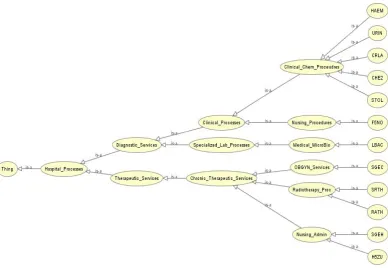
6.2 Common Ontology of Dutch Academic Hospital of Therapeutic Services . . . 65
6.3 How a Process is traversing in a Macro System (M). For example, Process P2 traversed through µ6, µ5, µ4 respectively then termi-nated at µ3. . . 66
6.4 DFD of generalized form of Order Processing . . . 66
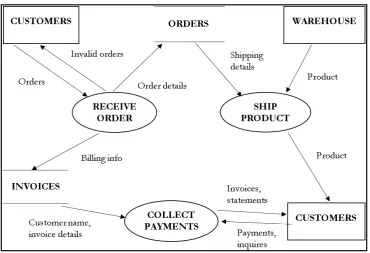
6.5 Workflow of procedures undergone by a “Cervical Malignancy” patient at the Dutch Academic Hospital . . . 67
6.6 Process Ontology of a “Cervical Malignancy” patient at the Dutch Academic Hospital . . . 67
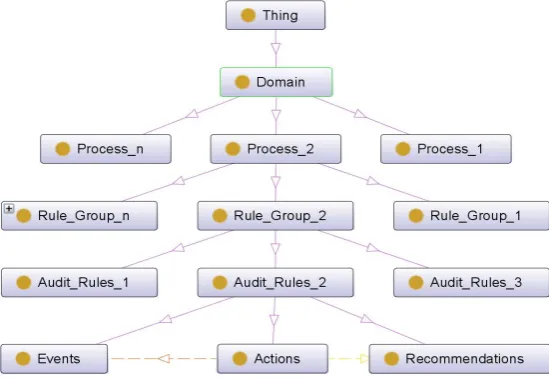
7.1 Conceptual Model of Hybrid Audit Rule Ontology [71]. . . 76
7.2 Abstract Relational view of AROP . . . 77
7.3 Abstract Semantic view of AROP . . . 77
7.4 Semantic view AROP example with ”Verify” Audit rule expanded 78
LIST OF FIGURES xvii
7.5 Mapping between ontologies (domain, process and AROP) . . . . 82
9.1 Dutch Financial Institute [76] - personal loan application Process
Tree . . . 93
9.2 Dutch Financial Institute - personal loan application Process Maps 134
10.1 Architecture of a Continuous Process Audit-as-a-Service (AaaS). . 144
B.1 Dutch Academic Hospital -Process Map of cervical cancer patient
in Gynaecology department [75] . . . 162
B.2 Dutch Academic Hospital -Process Map of cervical cancer patient
in Gynaecology department [75] (expanded) . . . 165
B.3 Dutch Financial Institute -Process Mapof application for personal
loan or overdraft [76] . . . 166
B.4 Dutch Financial Institute -Process Mapof application for personal
loan or overdraft [76] (expanded) . . . 169
B.5 Volvo IT Belgium -Process Map of VINST incidents management
sub-system [70] . . . 170
B.6 Volvo IT Belgium - Process Map of VINST open problems
List of Tables
1 Declaration of Previous Publications . . . iv
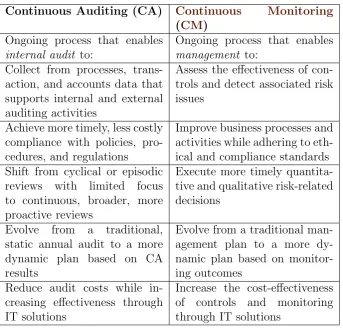
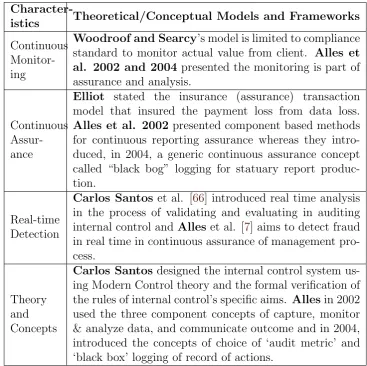
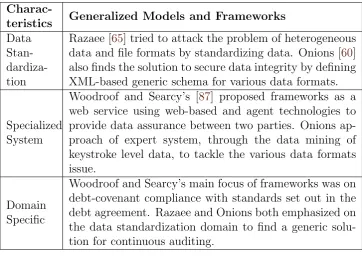
4.1 Difference between Continuous Auditing and Continuous Monitoring 33 5.1 Characteristics of Theoretical/Conceptual Models and Frameworks 39 5.2 Characteristics of Generalized Models and Frameworks . . . 41
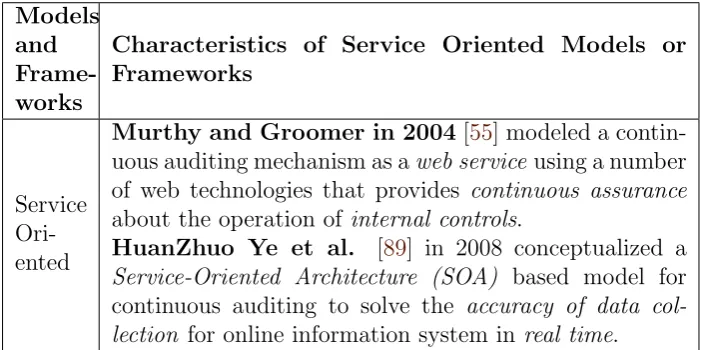
5.3 Characteristics of Service Oriented Models and Frameworks . . . 42
9.1 Dutch Financial Institute - All events . . . 92
9.2 Dutch Financial Institute - Start and End events . . . 94
9.3 Impact and urgency levels of the incident management processes. 94 9.4 Urgent processes diagnosed with M13 and whose treatment code is 803. . . 129
9.5 Users that accepted the Wait-User substatus. . . 131
A.1 Meaning of Concepts and Propositions . . . 154
C.1 Diagnosis Code and Description of Diagnosis of Patients. . . 173
Acronyms
AICPA American Institute of Certified Public Accountants. 18, 42
AROP Audit Rule Ontology of a Process. 7, 69,70, 146, 147
BCM Business Continuity Management. 52
CA Continuous Auditing. 8, 18,31, 145, 146, 151
CAAT Computer Assisted Audit Tools. 21
CAWS Continuous Auditing Web Service. 41
CCM Continuous Control Monitoring. 6, 8, 31, 132, 133
CDA Continuous Data Assurance. 6, 31
CEP Complex Event Processing. 35
CICA Canadian Institute of Chartered Accountants. 18,42
CM Continuous Monitoring. 33,145,151
CO Common Ontology. 61, 63,146, 150
ACRONYMS xx
CPA Continuous Process Auditing. 3, 5, 6, 8, 9, 30, 59, 62, 68, 69, 85, 90,
132, 133, 136, 138, 140, 141, 143, 145–151
CPAS Continuous Process Auditing System. 20, 27
DAG Directed Acyclic Graph. 62
DFD Dataflow Diagram. 62
DL Descriptive Logic. 137, 139, 148, 155
EAM Embedded Audit Module. 20
ECA Event-Condition-Action. 35
ECAP Event-Condition-Action-Postcondition. 35
EIS Enterprise Information System. 78
ERP enterprise Resource Planning. 78
GAAP Generally Accepted Accounting Principles. 11, 17
GAAS Generally Accepted Auditing Standards. 50
GTAG Global Technology Audit Guide. 18
ISACA Information Systems Audit and Control Association. 19
KR Knowledge Representation. 35
ACRONYMS xxi
MTSM Multivariate Time Series Model. 45
NLP Natural Language Processing. 139
OWL Wen Ontology Language. 79, 81
PAA Predictive Auditing Analytics. 143, 149, 150
PO Process Ontology. 63, 74, 98–100,146
RDFS Resource Description Framework Schema. 79, 81
RIF Rule Interchange Format. 80
RuleML The Rule Markup Language. 126, 154, 155
SAS Statement on Auditing Standards. 43
SEM Simultaneous Equation Model. 45
SOA Service-Oriented Architecture. 16
SOX Sarbanes-Oxley Act. 21
URI Uniform Resource Identifier. 81
XBRL eXtensible Business Reporting Language. 22
Chapter 1
Introduction
Over the last few decades, Information Technologies have provided an
im-portant means for business process interchange and integration. To assure
better corporate and system accountability, traditional periodic auditing that
adopts a backward-looking approach, whereby key activities and events are
often identified long after their occurrence or simply undetected, has been
im-plemented for the most part. Continuing changes and innovations in corporate
culture, and recent developments and advances in information technology in
conjunction with real-time approaches to conducting business, are challenging
the auditing profession.
In straightforward terms, auditing encompasses a variety of methods used
to measure the compliance of a system to defined rules and guidelines.
Au-diting is just one facet of a more extensive set of processes, often based on
accounting, but extending to support assurance that the system is working
as intended. Clearly, auditing is applied in many domains, from government
to business, education and health care, among many others. Underscoring
CHAPTER 1. INTRODUCTION 2
the breadth of auditing applications is the fact that most auditing is still
performed by human agents, professionally trained and experienced in many
aspects of evidence gathering, interpretation of rules and guidelines, and
clar-ifying of final reports in respect of limitations.
Increasingly, complex systems have grown beyond the capacities of
hu-man driven auditing to perform meaningful audits in a timely fashion that
serves stakeholders and oversight bodies. Such systems encompass networks
of human agents and also highly automated software systems with
semi-autonomous sub-systems, all of which are assumed to be imperfect or
vul-nerable to risk. To this end, researchers have focused attention on the notion
of automating significant parts of auditing, both as embedded components
within systems working autonomously, and as decision support components
serving human analysts.
One vital element throughout auditing concerns knowledge, namely, its
acquisition, interpretation and uncertainty, or vagueness, in reasoning. From
the outset, auditing practice dictates that meaningful definitions must be
de-termined and documented, for the system to be audited, components and
processes within the system, evaluation measures, rules and actions to be
ap-plied, and limitations or constraints. In all aspects, auditors must work with
suitable knowledge expressed in natural language terms for human
consump-tion, but also expressed in terms appropriate for application and reasoning
through logic, using computational techniques in particular.
Knowledge is an essential part of most Semantic Web applications and
ontology, which is a formal explicit description of concepts or classes in a
CHAPTER 1. INTRODUCTION 3
knowledge from text in a semi-automatic way and identifying effective
pro-cedures for achieving useful and reliable results are challenging and daunting
scientific research areas. In the auditing field, most audit rules are defined in
the context of human understanding and language and can be used to
sup-port human cognitive reasoning. Inference based on interpretations of those
audit rules are as essential to the Semantic Web as application domain
on-tologies. Ontology-based reasoning has known shortcomings and limitations
compared with rule-based reasoning [38]. To represent inferential knowledge,
ontology alone is insufficient [37]; but, inferential rules are an essential part of
the knowledge in an audit rule ontology for a process or module inContinuous
Process Auditing (CPA) for real-time Decision Support systems [13].
Berners-Lee [14] defined the semantic web as an extension of the current
content-based web, in which information is given well-defined meaning. An
ontology is usually defined as a formal specification of domain knowledge
con-ceptualization. Ontology learning by application of semi-automatic methods
has been studied and most techniques are from free natural language text.
Though chronological, topological, and other types of semantic relations
al-ready exist [74], in these methods only hierarchical concepts are extracted and
reduced sets of semantic relations are in use.
In Continuous Process Auditing methodology, an audit rule sheet is
de-fined for each process or module. The matter of continuity of application in
CPA ranges from continuous time-dependent modeling to discrete time steps
of audit application adapted to application requirements. For approaches with
small time steps, the sheer magnitude of computational tasks to supportCPA
tech-CHAPTER 1. INTRODUCTION 4
niques based on limited rule sets. This consideration is used to determine the
degree of conceptualization as knowledge, audit measures using sensors and
reasoning through rules and inference.
1.1
Research Questions and Contributions
In the following, we will give an overview of our work in terms of research
chal-lenges and contributions. Section1.1.1discusses the most important questions
that we will try to answer in this thesis. A summary of our contributions with
respect to these research questions is listed in Section 1.1.2.
1.1.1
Research Questions
I - Heterogeneous Accessibility: Information systems are complex
and heterogeneous in nature and their data sources are semantically
hetero-geneous as well. Continuous Process Auditing requires accessing to
heteroge-neous data sources in various and/or multiple locations.
(a) A common ontology approach is straightforward for dealing with
heteroge-neous semantic data sources. Hybrid approaches and multiple ontologies
to the heterogeneity problem of ontologies have been discussed [85, 46].
Recently, we have proposed a hybrid audit rule ontology approach that
coupled with an expert system to infer new relations from the existing
concepts [71].
(b) In any autonomous pervasive distributed systems (like hospitals,
set-CHAPTER 1. INTRODUCTION 5
tings), accessing authorized data in real-time and enforcing data security
as highly encrypted-sensitive data are transported from one layer to
an-other in various (may be different geographic) locations are very important
and obvious issues to handle before CPA is deployed for actions in audit
rule ontology.
II - Semi-Automatic Hybrid Ontology Development: Many
rea-soning based applications demand for quality standards that are unattainable
by automated ontology development methods. Developing ontology from
mul-tiple data sources through complex axioms in a fully automatic manner is often
not feasible. In addition, certain level of expert knowledge is required through
out the refinement and validation of ontology development process.
(a) We present a semi-automatic hybrid ontology development approach that
combines the common ontology (shared vocabulary) with multiple,
inte-grated and mapped Process Ontologies. This common ontology would be
the top-most layer in topological semantic relations.
(b) Constant changes of business activities requires the change of business
rules as well as audit rules for Continuous Process Auditing (CPA). The
evolutionary process, a crucial part of the ontology lifecycle, creates newer
versions with added stemming down the tree from the original ontology.
Since the uniformity and coherence of the ontology must be respected, the
evolution process is difficult to implement semi-automatically and should
CHAPTER 1. INTRODUCTION 6
Rule Ontologies for Processes (AROPs) would be stemmed as the second
layer, under the common ontology layer in CPA, to infer the audit rules.
III - Audit Rules and Audit Assurance: As evolving business rules
develop for incremental business needs, audit rules are usually written in
ab-stract and human readable format. These audit rules are transformed into
RuleML form which need to be inferred by rules engine for the part of
au-dit assurance process. Inferring the auau-dit rules and taking action accordingly
are the two significant steps towards Continuous Control Monitoring (CCM)
and Continuous Data Assurance (CDA). We investigated the uses of rule
en-gines to process audit rules for CCM and we also devised a methodology for
providing CDA.
1.1.2
Contributions
So far, Continuous Process Auditing (CPA) has been limited to the
audit-ing professional communities and/or corporate world. In some cases, those
approaches have barely scratched the surface of CPA potential, especially, in
autonomous pervasive distributed systems that deal with heterogeneous data
sources. This thesis introduces a benchmark to augment auditing professionals
in Continuous Process Auditing by presenting methods and tools for
• accessing distributed data sources in way that eliminates the hurdle of
data heterogeneity, i.e. semantically by hybrid ontology of domain and
CHAPTER 1. INTRODUCTION 7
• developing hybrid layered ontology semi-automatically that coupled with
expert system for refinement (IIa), and
• developing rule-based approach that ensures the continuous auditing of a
process seamlessly, i.e. Audit Rule Ontology of Process (AROP) (IIb).
Finally, this thesis also investigates the uses of rule engine to process audit
rules for CCM and the uses of predicting methodologies for CDA to provide
audit assurance (III). In conclusion, we can state that: a CPA system is one
that detects and obtains evidence associated with a process for the purpose
of augmenting and assisting audit professionals in operational and compliance
auditing in any EIS, and which invokes actions specified by and derived from
policies and rules in a continuous manner. This dissertation research has
produced a coherent framework design with implemented software modules
that clearly demonstrate our successful outcomes.
1.2
Readers Guide
In the section, we give a brief overview of this dissertation. We organized the
whole dissertation into four content Parts and appendices, and in the following
we provide the reader with some basic orientation to our organization.
Background and Foundations (Part I):
In the first part of this dissertation, we lay the conceptual foundations for
what follows, focusing on emerging concepts and methodologies for
CHAPTER 1. INTRODUCTION 8
and background review of CA in Chapter 2, we give a taxonomic analysis of
Continuous Auditing and how the Continuous Process Auditing (CPA) has
emerged in the research communities in Chapter3. In Chapter4, we provide
a comparative analysis of CPA and the “Necessity of CPA in Compliance and
Operational Audit”. We review the relevant approaches and existing
tech-nologies to the Continuous Auditing (CA), Continuous Control Monitoring
(CCM), and Continuous Process Auditing (CPA) in Chapter 5. Finally, we
conclude this part by introducing a mixed of open issues in CA and varieties
of “Challenges of Continuous Process Auditing (CPA)”
Methods for Continuous Process Auditing (Part II):
In Part II, we present in details the approaches that we proposed for accessing
heterogeneous distributed data sources and for rule-basedContinuous Process
Auditing(CPA). Chapter6introduces a novel way of accessing heterogeneous
distributed data sources. It also introduces an approach to represent process
in a distributed environment. In Chapter 7, we presented a mechanism to
construct audit rules that are defined by audit professionals and a mechanism
to construct their AROPs. The development cycle (from conceptualization
to construction to operation) of Hybrid Layered Ontology is also presented
in the context of Healthcare system. An approach to map between Domain
and Process ontologies, and Audit Rule Ontology of a Process (AROP) is also
CHAPTER 1. INTRODUCTION 9
Evaluation and Applications (Part III):
In Part III, we introduce an algorithmic approach to the evolution our
pro-posed ontologies and evaluate our approaches in Chapters6and7. In Chapter
8, we describe an algorithmic approach to identify either conceptual or
ap-plication types of changes and to edit the identified changes in three ways to
linking the conceptual and semantic relations in ontologies. All three layers
of ontologies - Common Ontology, Process Ontology, and AROP were
encap-sulated by the obtained knowledge base that described in ontology operation.
Chapter 9 demonstrates the evaluation and usefulness of approaches to the
Continuous Process Auditing(CPA) using three different datasets from three
different pervasive environments. It also present the experiments, results and
analysis of outcome. We conclude Chapter 9 with a discussion of results and
concluding remarks.
Conclusion (Part IV):
In Part IV, we round up this dissertation by an overall summarization and
an outlook to future work. In Chapter 10, we discuss some thoughts and
directions that have arisen directly from our research. These thoughts require
substantially more work beyond the scope of this dissertation; rather, we
present them as problems that are open for future research opportunities.
Chapter 11 summarizes this dissertation and we conclude with some final
Part I
Background and Foundations
Chapter 2
Auditing
The word ‘Audit’ originated from the Latin word ‘audire’ which means ‘to
hear’. According to Merriam-Webstera dictionary: auditing is a formal
exam-ination of an organization’s or individual’s accounts or financial situation.
An audit is a professional, independent opinion about a company’s
utiliza-tion ofGenerally Accepted Accounting Principles(GAAP) when preparing its
financial statements. In the modern world’s perspective, auditing is not just
related to accounts or financial transactions. More precisely, it is a
system-atic, formal and disciplined process of objectively obtaining and evaluating
evidence regarding assertions about economic actions and events to ascertain
the degree of correspondence between those assertions and established
crite-ria and communicating the results to interested users. In a financial audit,
the assertions about which the auditor seeks objective evidence relate to the
reliability and integrity of financial and, occasionally, operating information.
The examination of the objective evidence underlying the financial data as
a
http://www.merriam-webster.com/dictionary/auditing
CHAPTER 2. AUDITING 12
reported is called an audit.
Auditing is governed by professional standards, completed by
individu-als, normally certified professionindividu-als, independent of the process being
au-dited. Formal review of professional standards; lawful communication with
recommendations and corrective action measures; systematic and structured
approach involving with planning, sampling, testing and validating &
doc-umented follow-up of corrective actions are a few typical characteristics of
an Audit. It can be done internally (by employees of the organization) or
externally (by a recommended or certified agency).
Using straightforward terms, auditing encompasses a variety of methods
used to measure the compliance of a system to defined rules and guidelines.
Auditing is just one facet of a more extensive set of process, often based on
accounting, but extending to support assurance that the system is working
as intended. Clearly, auditing is applied in many domains, from government
to business, education and health care, among many others. Underscoring
the breadth of auditing applications is the fact that most auditing is still
performed by human agents, professionally trained and experienced in many
aspects of evidence gathering, interpretation of rules and guidelines, and
clar-ifying of final reports in respect of limitations.
Increasingly, complex systems have grown beyond the capacities of
hu-man driven auditing to perform meaningful audits in a timely fashion that
serves stakeholders and oversight bodies. Such systems encompass networks
of human agents and also highly automated software systems with
semi-autonomous sub-systems, all of which are assumed to be imperfect or
CHAPTER 2. AUDITING 13
of automating significant parts of auditing, both as embedded components
within systems working autonomously, and as decision support components
serving human analysts.
2.1
External Auditing
External auditing is the examination of an organization’s financial statements
by a qualified, independent accountant. The primary purpose of an external
audit is to test the validity of the documents used to support the amounts
and disclosures provided in an organization’s financial statements. In other
words, an individual outside of the organization that objectively assesses the
effectiveness of the organization’s quality system. Usually, periodic or specific
purpose (ad hoc) audits are conducted by external, independent, qualified
and/or certified accountants or auditors.
2.2
Internal Auditing
The Institute of Internal Auditors defines internal auditingb as, “an
indepen-dent, objective assurance and consulting activity designed to add value and
improve an organization’s operations”. An internal audit includes, but is not
limited to, examining the effectiveness of an organization’s risks and internal
control procedures, analyzing and testing these controls, and recommending
any necessary changes for improvement. An internal audit can be categorized
in terms of the following three types:
b
CHAPTER 2. AUDITING 14
2.2.1
Transactional Auditing
A transaction is any activity in business that occurs when something of value
is exchanged with something else of value. Auditing procedure related to
examining specified transactions and supporting documentation used by the
auditor to check internal-controls reliability of an organization. As an
exam-ple, a customs personnel audits to confirm the accuracy of individual import,
export, and excise declarations made by traders to customs. Normally a
se-lected number of specific transactions are tested by auditors to see if controls
are performing properly and it also helps to determine the scope of audit work.
2.2.2
Process Auditing
A process audit is used to verify that processes are operating within specified
limits and achieving targets or objectives. Process audits examine one or more
processing steps. A process audit is an evaluation of the sequential steps and
interactions of a process within a system. Process auditing provides value by
evaluating processes, their controls, risks, and the achievement of objectives.
They may also provide information on the ability of the process to produce a
quality output. A properly done process audit is much more than verification
that processing steps are being followed.
Auditors and management can benefit by conducting process audits and
using process techniques to better test and evaluate system controls. Needs
for process auditing and its uses, opportunities, technological support and
existing & potential new methodologies are more elaborately discussed in
CHAPTER 2. AUDITING 15
2.2.3
Continuous Auditing
In Internal Auditing, there are multiple ways of performing audit continuously
for various auditable tasks and controls. We divided the whole continuous
au-diting, mainly in four categories: Mathematical Continuity, Real-time,
Pro-cedural, and Functional. In the aspect of implementation, it is a combination
of Continuous Data Assurance plus Continuous Control Monitoring [6].
We will continue this discussion of continuous auditing (CA) in the form
of taxonomy and the necessity of continuous process auditing (CPA) in the
next two Chapters 3 and 4, respectively.
2.3
Service-Oriented On-Demand Auditing
In a service oriented computer audit system, agent technologies are used and
a set of components, which have logical functions and are interactive as well
as autonomous, are integrated together to form a system framework. The
majority of service oriented audit systems adopt the pattern of auditing on
the spot, performing the collection of audit data based on data file exchange
systems and local area network transport systems. Service oriented audit
sys-tems can perform specific functions and are adopted in the audit process. As
an assistant tool, a computer audit system can perform such tasks on audit
data as collecting, cleaning up, computing, counting, querying and generating
report, providing the actual auditor, who also performs all kinds of
examina-tions and collects audit proof, with help accessing various systems and using
appropriate technologies.
CHAPTER 2. AUDITING 16
the external environment that exchanges data over secure networks, then
gets auditing services under Service-Oriented Architecture (SOA)
environ-ment techniques when the service is needed. This is also called on-Demand
Chapter 3
Taxonomic Analysis of Continuous
Auditing
An audit is a professional, independent opinion about a company’s
utiliza-tion of Generally Accepted Accounting Principles (GAAP) when preparing
its financial statements. In the modern perspective, auditing is a
system-atic, formal and disciplined process of objectively obtaining and evaluating
evidence regarding assertions about economic and other kind of actions and
events to ascertain the degree of correspondence between those assertions and
established criteria and communicating the results to interested users. Thus,
modern auditing is much more than just relating to accounting or financial
transactions.
CHAPTER 3. TAXONOMIC ANALYSIS OF CONTINUOUS AUDITING 18
3.1
Introduction to Continuous Auditing
Continuous Auditing (CA) is a type of auditing which produces audit results
simultaneously with or closely proximate to the occurrence of relevant events.
According to The IIA’s Global Technology Audit Guide (GTAG) Continuous
Auditing: Implications for Assurance, Monitoring, and Risk Assessment,
con-tinuous auditing is defined as the automatic method used to perform control
and risk assessments on a more frequent basis. Technology plays a key role in
continuous audit activities by helping to automate the identification of
excep-tions or anomalies, analyze patterns within the digits of key numeric fields,
review trends, and test controls, among other activities.
The most common definition used for CA, as proposed by the 1999CICAa/
AICPAb committee is: “A continuous audit is a methodology that enables
independent auditors to provide written assurance on a subject matter, for
which an entity’s management is responsible, using a series of auditors’
re-ports issued virtually simultaneously with, or a short period of time after, the
occurrence of events underlying the subject matter” [56,57]. Most up-to-date
version of the CA definition is discussed in Section4.1 of Chapter 4.
By analyzing the above two definitions, we note that Continuous
Audit-ing is a methodology or framework that enables auditors to provide written
assurance on the subject matter using one or a series of reports issued
si-multaneously. They are usually technology driven and designed to automate
error checking, detecting anomalies, finding misconduct and data verification,
aCICA - Canadian Institute of Chartered Accountants. As of January 01, 2013,
Char-tered Professional Accountants of Canada (CPA Canada) was established by CICA and CMA Canadawww.cpacanada.ca
CHAPTER 3. TAXONOMIC ANALYSIS OF CONTINUOUS AUDITING 19
and so on, in real time, then they generate alarm triggers for appropriate
stakeholders. Therefore, continuous auditing is designed to enable auditors
to report on subject matter within a shorter period of time than under the
traditional auditing practices.
Although there are many definitions of CA, it is the constant collection of
evidence as it occurs and prompt evaluation of the collected evidence which
identify the primary aspects of CA [48]. There are two facets common to all
definitions: i) aim to provide any sort of assurances and ii) the evaluation
reports are produced as soon as possible after the evidence occurs and is
collected. CA is suggested to only internal auditors but Alles et al. 2004
[6] referred to applying CA to the external audit process. ISACA Standards
describe that CA may be viewed to encompass both internal and external
auditing.
In order to produce evaluation reports promptly, it is desirable that a CA
system should be a highly automated electronic system. A CA system must
rely on feeding the reliable flow of information or evidence in a fully automated
process. Thus, information technology plays a vital role in the processing of
reliable information continuously [8] in continuous auditing.
One of the main purposes of CA is to assist auditors in providing assurances
on collected evidence or information by verifying evidence or information
in-tegrity [29]. Technology must be implemented in order to collect accurate and
reliable evidence and information. Therefore, demands for Continuous
Audit-ing and Assurance are originated from the organizations’ necessity and
require-ment for more reliable and relevant information. Basic economic changes in
CHAPTER 3. TAXONOMIC ANALYSIS OF CONTINUOUS AUDITING 20
right now different industry require to ensure wave of disclosures, set of legal
procedures and improper accusations; increased risks of human and system
instability; internal rules in the industry and legislative enforcement (Section
404 of the Sarbanes-Oxley Act 2004) to improve reporting accuracy and
trans-parency; adapting to the new technologies to cope up with the competition;
and finally increasing the efficiency and profitability are the few major facets
of CA to be required and hence be implemented in any organization.
3.2
Previous Works
TheEmbedded Audit Module(EAM) approach introduced by Groomer et al.
in 1989 that a series of auditor-developed master files are instantiated in the
live client system and test transactions are entered as desired by the auditor.
But the Continuous Auditing methodology first introduced at AT&T Bell Lab
in 1989 and then again in 1991 by Vasarhelyi and Halper [80]. Bell developed
aContinuous Process Auditing System (CPAS) for the internal audit
organi-zation to deal with the problem of auditing large paperless database systems.
The system was just monitoring the databases rather auditing continuously.
In 1999 Kogan et al. [48] viewed CA as a type of auditing that produces audit
results simultaneously with, or a short period of time after, the occurrence of
relevant events.
In 1999 CICA and AICPA Research Report on Continuous Auditing
con-cluded that continuous audits are viable under certain conditions and that
automated “alarm triggers” would be needed to signal anomalies and errors.
sophis-CHAPTER 3. TAXONOMIC ANALYSIS OF CONTINUOUS AUDITING 21
ticated automated audit tools. Enabling new emerging technologies, surge
in corporate scandal (i.e. Enron) & malpractices, detection of security and
technological risks & human errors in a Process, and periodic adaptation to
new legislative acts and regulations have put currently “Auditing” at a
crit-ical point. Specifcrit-ically, passage of the Sarbanes-Oxley Act (SOX) in 2002
imposed sweeping changes on publicly traded companies and the accounting
profession. SOX emphasized that assurances about internal control practices
and operations.
The technological aspects of CA is the primary concern prior to continuous
auditing research. Prototypes CA system design were introduced by Groomer
and Murthy in 1989, Vasarhelyi and Halper in 1991, Woodroof and Searcy in
2001 and Santos et al. in 2008[33, 80, 87, 66]. Alles et al. 2002[5], Razaee
et al. 2002[65] and Flowerday et al. 2006[28] have discussed the CA enabling
technologies whereas Dull et al. 2006[25], Alles et al 2008[8] and Pedrosa et al.
2012[62] discussed in the context of Computer Assisted Audit Tools (CAAT)
and Techniques in various form of real world applications. Directions for
future research in CA have given in Kogan et al. 1999[48], Elliott 2002[27]
and Brown et al. 2006[17] and research studies on other aspects of CA have
emerged (Kuhn et al. 2010[49], Omoteso et al. 2010[59], Chan et al. 2011[24],
Vasarhelyi et al. 2012[79,78]) recently.
A social & economic perspective of CA and a feasibility study were
ad-dressed in Alles et al. 2002[5]. A behavioral perspective from the perceptional
view-point of management was discussed Searcy et al. 2003[67]. Vasarhelyi
et al 2004[77], Verschoor 2006[84], Shing-Li et al. 2007[51] provide various
CHAPTER 3. TAXONOMIC ANALYSIS OF CONTINUOUS AUDITING 22
monitoring in CA. Bovee et al. 2005[16] have introduced the agent based
re-porting and auditing framework with net knowledge and XBRL. Alles et al.
2006 describe a pilot project CA system at Siemens to audit business process
controls and then used the experiences gained at Siemens on the
implemen-tation of CA in Brazil[11] in 2006.
At the end of 2012, AICPA discussed the evolution of auditing in the
perspective of future audit[19] and also discussed the current state of CA
and continuous monitoring with the intent of offering companies insight[20]
in their two white papers.
3.3
Categorical Review of Internal Auditing
Researchers have explored the concepts of continuous auditing mainly in
inter-nal auditing. Based on well-practiced trend in the financial industry, interinter-nal
auditing can be distinguished in three different sub-groups: periodic,
con-tinuous and mixed of both concon-tinuous and periodic. Figure 3.1 depicts the
principles of auditing and its sub-groups.
3.3.1
Periodic Auditing
A process audit is used to verify that processes are operating within specified
limits and achieving targets or objectives by examining one or more processing
steps. It is an evaluation of the sequential steps and interactions of a process
within a system that provides value by evaluating processes, their controls,
CHAPTER 3. TAXONOMIC ANALYSIS OF CONTINUOUS AUDITING 23
Figure 3.1: Taxonomy of Auditing Principles
Process:
A process audit is an evaluation of the sequential steps and interactions of a
process within a system. Fig. 6.3 depicts the discovery of a process in a
sys-tem. Process auditing provides value by evaluating processes, their controls,
risks, and the achievement of objectives. They may also provide information
on the ability of the process to produce a quality output. A properly done
process audit is much more than verification that processing steps are being
followed.
Transactional:
A transaction is any activity in business that occurs when something of value
is exchanged with something else of value. Auditing procedure related to
examining specified transactions and supporting documentation used by the
exam-CHAPTER 3. TAXONOMIC ANALYSIS OF CONTINUOUS AUDITING 24
ple, a customs personnel audits to confirm the accuracy of individual import,
export, and excise declarations made by traders to customs. Normally a
se-lected number of specific transactions are tested by auditors to see if controls
are performing properly and it also helps to determine the scope of audit work.
System or sub-system (module):
It is an approach to auditing. A system audit to assess the internal control
system of an organization, possibly, to assess the quality of many different
kind of system or sub-system (i.e. the quality of accounting system and the
level of testing required from the financial statements; the process of collecting
and assessing evidence of Information System to show that safeguards to
pro-tect against abuse, safeguards assets maintains data integrity and allows the
organization to continue successfully) to determine the organization’s system
is adhering or able to adhere to regulatory requirements. A System could be
constituted with one or more modules (sub-systems).
Periodic auditing can be done internally by the organization’s auditing
and monitoring team or externally by the industry accepted certified auditing
professionals.
3.3.2
Continuous Auditing
Continuous auditing is defined as the automatic method used to perform
con-trol and risk assessments on a more frequent basis. Most common definition as
CHAPTER 3. TAXONOMIC ANALYSIS OF CONTINUOUS AUDITING 25
continuous audit is a methodology that enables independent auditors to
pro-vide written assurance on a subject matter, for which an entity’s management
is responsible, using a series of auditors’ reports issued virtually
simultane-ously with, or a short period of time after, the occurrence of events underlying
the subject matter.” By analyzing above two definitions, we see that
Continu-ous Auditing is a methodology or framework that enables auditors to provide
written assurance on the subject matter using one or a series of reports issued
simultaneously. Technology plays a key role in continuous audit activities by
helping to automate the identification of exceptions or anomalies, analyze
pat-terns within the digits of key numeric fields, review trends, and test controls,
among other activities.
Mathematical Continuity:
An auditing objective that will be automatically done based on the continuity
of one or more auditing related functionality/elements/controls.
Real-time:
After completion of (and/or within) the certain period of time an auditing
ob-jective to be completed/detected automatically. How short time-frame could
be is the mostly considerable components for this type of auditing. Depending
on the industry, system and environment time-frame could be from min (i.e.
Blood pressure machine) to sec (i.e. heart monitoring device at an intensive
CHAPTER 3. TAXONOMIC ANALYSIS OF CONTINUOUS AUDITING 26
Procedural:
Procedural auditing normally consists of several sequence of steps that include
preparation, conduct and completion of a task, which are usually administered
by a continuous audit manager. Each step can be a sequence of activities and
each activity is a sequence of actions. The sequence of steps is critical to
whether a statement or document is a procedure or something else. Auditors
always know about these sequence of steps to better monitor the continuous
procedure. They also provide results either as a form of recommendations
or assurance for its improvement, if needed. Continuous procedural audit is
also part of continuous monitoring that ensures the organization’s procedures
operation effectively.
Functional:
To assure the business is running effectively and efficiently, management team
normally monitors some business function continuously. Functional audit does
not provide independent assurance of a function for the stakeholders rather it
does assure the smooth and effective running of a business function which is
also part of continuous monitoring.
A major challenge of implementingcontinuous auditing systems is
combin-ing Continuous Data Assurance (CDA) and Continuous Control Monitorcombin-ing
CHAPTER 3. TAXONOMIC ANALYSIS OF CONTINUOUS AUDITING 27
3.3.3
Periodic Continuous
Continuous Process auditing:
A process audit is, elaborately, an evaluation of outcomes to determine whether
the activities, resources and behaviors are being done and/or managed in an
effective and efficient way. It is not simply following a path through the
de-partments from actions to outcomes - which is actually a form of transition
audit. Since a process always generates outcomes/results, therefore it may be
subject to a process audit. Now the question is - whether process auditing
should be done in a traditional way or continuously? Continuous process
au-dits evaluate the results/outcomes of a process continuously whether or not
they are being generated by an effectively completed/managed process. It
can be achieved either by auto-generated triggers or by a designated software
tool to perform the audit in a specific time-delay or upon the completion of a
process. One of the early models implemented that formed the basis for the
later models was theContinuous Process Auditing System (CPAS), which was
developed at AT&T Bell Laboratories for internal auditing of large ’paperless’
real-time systems [80].
Continuous Transaction auditing:
In financial auditing, vouching is a term that refers to the inspection of
docu-mentary evidence supporting and substantiating a transaction. The objective
of establishing the authenticity of the transactions recorded in the primary
books of account is followed in a transactional audit. Vouching is considered
CHAPTER 3. TAXONOMIC ANALYSIS OF CONTINUOUS AUDITING 28
industries/institutions emerging to the evolving technologies, transaction
au-diting performs automatically on a continuous basis.
Continuous Data Assurance:
Continuous Data Assurance (CDAssurance) verifies the integrity of data
flow-ing through the information systems. Continuous Assurance in audit practices
is moving towards the maximum possible degree of audit automation as a way
of taking advantage of the technological basis of the modern systems for
anal-ysis at the transactional level to provide more detailed assurance and increase
audit automation. The development of Continuous Assurance requires a
fun-damental rethinking of all aspects of auditing, from the way in which data
is made available to the auditor, to the kinds of tests the auditor conducts,
how alarms are dealt with, what kinds of reports are issued, how often and
to whom they are issued, and many other factors, the importance of some of
which will only become apparent as Continuous Assurance is implemented.
It is important for the profession and other stakeholders to start thinking
about the impact of Continuous Assurance on auditing now, when it is easier
to put in place the foundations for this change, rather than when
technolo-gies and practices have already become established [6, 79] in a piece-meal
fashion. Continuous Data Auditing (CDAuditing) is also a subset of tasks
under the hood of Continuous Data Assurance [47]. Though auditing
pro-fessionals interchangeably used the terms CDAssurance and CDAuditing for
same the purpose but CDAuditing, that verifies the data integrity, is part of
CDAssurance that provides not only the data integrity assurance to
CHAPTER 3. TAXONOMIC ANALYSIS OF CONTINUOUS AUDITING 29
of data flowing mechanisms through the EIS.
Continuous Control Monitoring:
The Institute of Internal Auditors described Control Monitoring as the
In-dependent control review mechanism to help organizations assure the
effec-tiveness of Internal controls, reduce operational risks, minimize profit erosion,
and mitigate the risk of fraud, while meeting regulatory requirements.
Ad-hoc control progresses from basic level in the direction of audit contribution,
and analytic sophistication in a linear way to the level of applied, managed,
automated, and in the final stage it becomes Continuous Control Monitoring.
There are a few vendors already providing to industry specific kinds of
Con-tinuous Control Monitoring services [22] or software toolsc. Sometimes their
interpretation of these kind of tools or services are attributed to Continuous
Auditing; but, they all lack basic fundamental aspects of Continuous Auditing
[65, 4].
Continuous Risk Monitoring and Assessment:
Continuous Risk Monitoring and Assessment (CRMA) is used to dynamically
measure risk and provide input for audit planning [24]. CRMA is a real-time
integrated risk assessment approach, aggregating data across different
func-tional tasks in organizations to assess risk exposures [1] and provide reasonable
assurance on the firms risk assessments [78, 20,19].
c
Chapter 4
Continuous Process Auditing
(CPA)
Most processes are unique to the organization which employs them and they
are defined by either the management team or the internal auditing team of
the organization. This point differentiates between process definitions
local-ized to an organization as opposed to those definitions that apply to ”off the
shelf” process components (e.g. technology components). A process that is
being audited continuously with the help of technology underscores the
ap-plicative sense of Continuous Process Auditing (CPA). The concept of CPA
was introduced by Vasarhelyi and Halper in 1991 at AT&T Bell Laboratories
for internal auditing of large ’paperless’ real-time systems [80]. Continuous
analytical monitoring of business processes [10], process based auditing [12]
and conceptual model of web-based online auditing [2] have been introduced
and in practice for several years now.
CHAPTER 4. CONTINUOUS PROCESS AUDITING (CPA) 31
Process based auditing of all the four types of continuous auditing that
were discussed in Section 3.3.2 are commonly known as Continuous Process
Auditing (CPA). It is the Compliance and operational part of Continuous
Pro-cess Auditing that is our prime interest and addressable problems are
identi-fied and defined throughout Chapter 4. However, we begin by distinguishing
what are the similarities and differences between Continuous Auditing (CA)
and Continuous Monitoring?
4.1
Continuous Auditing vs Continuous
Monitor-ing
By analogy with conventional auditing, continuous audit procedures can be
designed either to test internal controls (continuous control monitoring) or to
execute substantive testing (continuous data assurance). From the procedural
point of view, Alles et al. 2008 [9] divides continuous auditing into two distinct
aspects:
Continuous Auditing (CA) = Continuous Control Monitoring (CCM)
+ Continuous Data Assurance (CDA)
The essence of both Continuous Auditing and Continuous Monitoring is to
provide a radically improved level of assurance on operations. There are
simi-larities between them, but they are not quite the same processes. Continuous
audit performs auditing activities on a frequently repeated schedule to provide
ongoing assurance and more timely insight into risk and control issues. On
CHAPTER 4. CONTINUOUS PROCESS AUDITING (CPA) 32
the management’s responsibility, in which key business process transactions
and controls are constantly assessed. This permits ongoing insight into the
effectiveness of controls and the integrity of transactions running within them.
Though both processes tend to produce similar outcomes, the primary
difference between them is related to ownership of the process. Continuous
audit is owned by the audit function and can include any audit process that
is repeated regularly, whereas management owns the continuous monitoring
process. Monitoring the effectiveness of controls systems is the management’s
primary responsibility that benefits them by getting timely insight into
trans-actions that are the result of fraud, error or abuse.
Deloitte published a whitepaper [63] in 2010 on how Continuous
Audit-ing idea to implementation. They have provided a differential list between
continuous auditing and continuous monitoring as shown in Table4.1.
Vasarhelyi, Alles, and Williams [79] suggested the addition of Continuous
Risk Monitoring and Assessment (CRMA) into the CA schema where: CA=
CDA+CCM +CRM A. The assurance process must be coherent with the
components of CA to be useful and effective. Figure 1-4 of [35] expands
Vasarhelyi, Alles, and Williams components to add an element of compliance
monitoring, expanding the scope of the CA and CM effort. The authors
also contend that CRMA should ideally be fully integrated within a structure
that includes both Continuous Controls Monitoring (CCM) and Continuous
Data Assurance (CDA) such that a robust system of continuous auditing is
ultimately achieved [82].
The Compliance Monitoring (COMO) approach (see page 11-12 of [35])
pro-CHAPTER 4. CONTINUOUS PROCESS AUDITING (CPA) 33
Continuous Auditing (CA) Continuous Monitoring
(CM)
Ongoing process that enables
internal audit to:
Ongoing process that enables
management to: Collect from processes,
trans-action, and accounts data that supports internal and external auditing activities
Assess the effectiveness of con-trols and detect associated risk issues
Achieve more timely, less costly compliance with policies, pro-cedures, and regulations
Improve business processes and activities while adhering to eth-ical and compliance standards Shift from cyclical or episodic
reviews with limited focus
to continuous, broader, more proactive reviews
Execute more timely quantita-tive and qualitaquantita-tive risk-related decisions
Evolve from a traditional,
static annual audit to a more dynamic plan based on CA results
Evolve from a traditional man-agement plan to a more dy-namic plan based on monitor-ing outcomes
Reduce audit costs while in-creasing effectiveness through IT solutions
Increase the cost-effectiveness
of controls and monitoring
through IT solutions
Table 4.1: Difference between Continuous Auditing and Continuous Monitor-ing
gressive updates for regulatory changes acknowledged by geography, area of
activity, and the nature of compliance rule (qualitative, quantitative, mixed,
or other). This would reformulate the definition of the CA to: CA=CDA+
CCM+CRM A+COM O which would open the doors for the potential usage
CHAPTER 4. CONTINUOUS PROCESS AUDITING (CPA) 34
4.2
Necessity of CPA in Compliance and
Opera-tional Audit
For Compliance Audit: Compliance Control and Monitoring enhance
ca-pabilities for ensuring various standards and compliances across physical and
virtual components like data centers, databases, security monitoring devices
etc.
Policy: automating policy definition and policy life cycle management
with new contents and new policy, automating the assets to controls mapping,
periodic delivering and updating the content and standards.
Risk: aligning compliance operations and security with defined risks,
pri-oritizing resource allocation according to risk factor.
Managing expensive and labor-intensive compliance and audit
require-ments. Determining the appropriate set of IT policies and controls to manage
IT risk and compliance. Consistently implementing and enforcing IT policies
and controls. Quickly responding to IT auditors and other management
re-quests to demonstrate compliance. Determining vulnerabilities based on the
security policy, compliance, and risk management.
For Operational Audit: To evaluate the operational activities of a given
company or other organization that gives much more understanding and
in-depth review of the business processes. To verify the components of the audit
and the associated concerns with in control of high risk areas and control
activities.
Data auditing and analytics: In terms of data dimensions such as volume,
CHAPTER 4. CONTINUOUS PROCESS AUDITING (CPA) 35
auditing in consistency, integrity, identification, aggregation and
confidential-ity.
Control matrix: validation of control matrix to improve the better in
con-trol of whole operational process. Continuous validation of test procedures
for each key control and automated report of the findings.
Opinions: Generating real-time opinions of components’ behavior to make
better in-time decision to improve over all control systems as well as the
operational processes.
Rule based operational audit: Reaction RuleMLa for action and/or
reac-tions. Reaction rules subsume Complex Event Processing (CEP) and
Knowl-edge Representation (KR) rules, as well as Event-Condition-Action-Postcondition
(ECAP) rules. ECAP rules specialize to Event-Condition-Action (ECA) rules,
which themselves specialize to Condition-less Trigger (EA) rules and to the
rule subfamily of Event-less Production (CA) rules.
a


![Figure 7.1: Conceptual Model of Hybrid Audit Rule Ontology [71].](https://thumb-us.123doks.com/thumbv2/123dok_us/1390096.1171715/98.595.108.503.296.555/figure-conceptual-model-hybrid-audit-rule-ontology.webp)