University of Windsor University of Windsor
Scholarship at UWindsor
Scholarship at UWindsor
Electronic Theses and Dissertations Theses, Dissertations, and Major Papers
2016
Speeding up Reliability Analysis for Large-scale Circuits
Speeding up Reliability Analysis for Large-scale Circuits
Jinchen Cai
University of Windsor
Follow this and additional works at: https://scholar.uwindsor.ca/etd
Recommended Citation Recommended Citation
Cai, Jinchen, "Speeding up Reliability Analysis for Large-scale Circuits" (2016). Electronic Theses and Dissertations. 5804.
https://scholar.uwindsor.ca/etd/5804
This online database contains the full-text of PhD dissertations and Masters’ theses of University of Windsor students from 1954 forward. These documents are made available for personal study and research purposes only, in accordance with the Canadian Copyright Act and the Creative Commons license—CC BY-NC-ND (Attribution, Non-Commercial, No Derivative Works). Under this license, works must always be attributed to the copyright holder (original author), cannot be used for any commercial purposes, and may not be altered. Any other use would require the permission of the copyright holder. Students may inquire about withdrawing their dissertation and/or thesis from this database. For additional inquiries, please contact the repository administrator via email
Speeding up Reliability Analysis for Large-scale Circuits
By
Jinchen Cai
A Thesis
Submitted to the Faculty of Graduate Studies through Electrical and Computer Engineering in Partial Fulfillment of the Requirements for
the Degree of Master of Applied Science at the University of Windsor
Windsor, Ontario, Canada
2016
Speeding up Reliability Analysis for Large-scale Circuits
By
Jinchen Cai
APPROVED BY:
______________________________________________ Dr. Nader Zamani
Department of Mechanical, Automotive & Materials Engineering
______________________________________________ Dr. Rashid Rashidzadeh
Department of Electrical and Computer Engineering
______________________________________________ Dr. Chunhong Chen, Advisor
Department of Electrical and Computer Engineering
DECLARATION OF ORIGINALITY
I hereby certify that I am the sole author of this thesis and that no part of this thesis
has been published or submitted for publication.
I certify that, to the best of my knowledge, my thesis does not infringe upon anyone’s
copyright nor violate any proprietary rights and that any ideas, techniques, quotations, or
any other material from the work of other people included in my thesis, published or
otherwise, are fully acknowledged in accordance with the standard referencing practices.
Furthermore, to the extent that I have included copyrighted material that surpasses the
bounds of fair dealing within the meaning of the Canada Copyright Act, I certify that I have
obtained a written permission from the copyright owner(s) to include such material(s) in
my thesis and have included copies of such copyright clearances to my appendix.
I declare that this is a true copy of my thesis, including any final revisions, as approved
by my thesis committee and the Graduate Studies office, and that this thesis has not been
ABSTRACT
Reliability of logic circuits is becoming one of important concerns in the modern
integrated circuit design. A large number of inputs and signal correlations make reliability
analysis of logic circuits computationally expensive. Many reliabilities analysis
approaches have been proposed. Monte-Carlo simulation usually requires hours to obtain
a high precision result. Probabilistic gate models (PGM) just work perfectly for small
circuits or correlation-free circuits. Probability transfer matrices (PTM) and Bayesian
network techniques can give the accurate evaluations, but may become very
time-consuming and intractable for larger circuits. This thesis presents three new methods of
reliability analysis for large-scale circuits: (1) The improved equivalent reliability model
(2) Three-point method (3) The improved Monte Carlo simulation. They can increase the
evaluation efficiency and accuracy compared to the other existing approaches. These
ACKNOWLEDGEMENTS
Firstly, I appreciate my supervisor, Dr. Chunhong Chen, for his encouragement and
wise suggestions to my study and life. I have learned many things since I became Dr.
Chunhong Chen’s student. He spends very much time instructing me how to do research
and how to write papers.
I would like to thank Dr. Nader Zamani, the Outside Department Reader, for his
valuable time on reading and reviewing this thesis and coming up with valuable
suggestions.
I would like to appreciate Dr. Rashid Rashidzadeh, the Department Reader, for his
time and effort on reviewing this thesis with constructive comments.
Also, I wish to acknowledge the Department of Electrical and Computer Engineering.
Most of my theoretical foundations are built in here.,
Next, I am grateful to the help of Ran Xiao. Without his previous work on reliability
analysis, this master thesis would not be completed successfully.
Finally, I would like to show my deepest gratitude to my parents, Zhiyong Cai and
Min Zhang, for giving me a chance to study at the University of Windsor, financially
TABLE OF CONTENTS
DECLARATION OF ORIGINALITY ... III
ABSTRACT ... IV
ACKNOWLEDGEMENTS ... V
LIST OF TABLES ... VIII
LIST OF FIGURES ... IX
LIST OF ABBREVIATIONS ... X
CHAPTER 1 ... 1
INTRODUCTION ... 1
1.1 Motivations ... 1
1.2 Background and Prior Works ... 2
1.3 Organization of this thesis ... 3
CHAPTER 2 ... 5
THE IMPROVED EQUIVALENT RELIABILITY MODEL ... 5
2.1Previous Works ... 5
2.2ER Model ... 6
2.3 Improved ER Model ...11
2.4Simulation Results ... 14
CHAPTER 3 ... 17
THREE-POINT METHOD... 17
3.1 Previous Works ... 17
3.2 Three-point Method ... 18
3.3 Modified Model for Reliability Estimation ... 22
3.3.1 Q is close to A ... 22
3.3.2 Q is close to B ... 23
3.4 Simulation Results ... 25
THE IMPROVED MONTE CARLO SIMULATION ... 28
4.1Monte Carlo Simulation ... 28
4.2 Improved Monte Carlo Simulation ... 32
4.3Simulation Results ... 34
CHAPTER 5 ... 41
CONCLUSION AND FUTURE WORK ... 41
5.1 Conclusion ... 41
5.2 Future Work ... 42
REFERENCES ... 43
APPENDIX ... 46
LIST OF TABLES
Table I Output reliability vector R for different gates ... 9
Table II Computation of equivalent reliability pair at output for 2-input gates ... 10
Table III Computation of improved ER model and original ER model for performance
oniscas85 benchmark with 𝑟𝑔𝑎𝑡𝑒= 0.9 ... 15
Table IV Computation of improved ER model and original ER model for performance
oniscas85 benchmark with 𝑟𝑔𝑎𝑡𝑒= 0.95 ... 15
Table V Performance of the unmodified three-point Model on ISCAS’85 Benchmark
Circuits with 𝑟𝑔𝑎𝑡𝑒= 0.9 ... 21
Table VI Comparison of modified three-point model, three-point model and PGM on
ISCAS’85 Benchmark Circuits with 𝑟𝑔𝑎𝑡𝑒= 0.9 𝑃𝑖𝑛 = 0.5 ... 25
Table VII Comparison runtime of MTP and PGM on ISCAS’85 Benchmark Circuits
with 𝑟𝑔𝑎𝑡𝑒= 0.9 𝑃𝑖𝑛 = 0.5 ... 27
Table VIII 10 sets of random primary inputs with 𝑃𝑖𝑛 = 0.5 ... 31
Table IX 10 sets of error-free and measured value of primary output 1 and 2 ... 31
Table X Comparing the standard deviation when setting M=5000,1000,500,100, N
always be 1 of C499 circuit with 𝑟𝑔𝑎𝑡𝑒= 0.9 𝑃𝑖𝑛 = 0.5 ... 36
Table XI Comparing the error rate when setting M=5000,1000,500,100, N always be
LIST OF FIGURES
Fig 2 1 Equivalent reliability structure of a 2-input gate ... 6
Fig 2 2 Schematic of benchmark circuit C17... 12
Fig 2 3 The joint reliability 𝑟𝑎𝑏 of signals 6 and 8 in C17 ... 13
Fig 2 4 The joint reliability 𝑟𝑎𝑏 of signals 8 and 9 in C17 ... 13
Fig 3 1 The slope of tangent which passes through Q ... 19
Fig 3 2 Modified model for the case of PQ* ≥ α ... 23
Fig 3 3 Modified model for the case of PQ* ≤ β ... 24
Fig 4 1 Schematic of benchmark circuit C17... 30
LIST OF ABBREVIATIONS
CMOS – Complementary Metal Oxide Semiconductor
MCs – Monte-Carlo simulations
PGM – Probabilistic Gate Models
PTM – Probability Transfer Matrices
BDEC – Boolean Difference-based Error Calculator
ER – Equivalent Reliability
CHAPTER 1
INTRODUCTION
1.1 Motivations
As CMOS technology has been relied on shrinking dimension of the electrical device
for years, it has entered the nanometre regime. However, nanometer-scale electronic
components have less reliability than previous COMS devices due to their lower operating
temperature and higher sensitivity to random noises. At the same time, it puts forward
higher requirement in CMOS fabrication process. For instance, manufacturing imprecision
and interferences of impurities will degrade circuit reliability behavior. Therefore,
reliability issues have become challenges in current circuits and system design. So it draws
people’s great interest in reliability analysis.
Due to the exponentially growing number of circuit components and their complex
signal correlations, the complexity of reliability analysis for integrated circuit can be
prohibitively high. In order to address this issue, many approaches of reliability analysis
have been proposed. As a typical statistical method, Monte-Carlo simulation (MCs) has
been widely used for reliability evaluation [4]. Although accurate, the MCs would be very
time-consuming for the large circuit. Many analytical methods have also been proposed,
such as probabilistic gate models (PGM) [1], probability transfer matrices (PTM) [2],
Boolean difference-based error calculator (BDEC) [3] and so on. Although these
1.2 Background and Prior Works
Reliability of a logic signal is the probability that its value is correct [5]. Because of
possible errors with its driving gate, the signal may become unreliable. In 1956, Von
Neumann proposed there will be the same independent probability of error ε, that gate
output will appear a bit flip (from 0 to 1 or from 1 to 0) with by a binary symmetric channel
[6]. The error probability ε should belong to the range between 0 and 0.5. When ε equals
to 0, it means the gate is error-free. ε = 0.5 means the gate behavior is totally random. Since
the probability of failure should not be more than the probability of correctness in logic
circuit design, its value should not larger than 0.5. This assumption works well for the most
conventional circuits [5].
If gates in a circuit are assumed to error-free and only the primary inputs cause the
error, using simple algorithms can solve the problem of the reliability analysis. However,
the gates failure cannot be ignored in the real circuit. When considering the gate failure, the
reliability analysis seems more complicated because of the exponential number of
combinations. At the same time gates in the circuit are usually multiple inputs gates rather
than single input gates, so it is not independent between each gate. These factors cause
reliability analysis extremely complex [7].
Monte-Carlo simulation is a statistical approach to solve the problem of reliability
analysis. Reliability evaluation can also be achieved through some analytical approaches
Bayesian network [8]. The PGM method can provide accurate evaluation results for small
circuits with some certain probabilities of primary input but it may not work well for
correlation circuits. The PTM can also give the accurate evaluations but the runtime will
increase exponentially with the number of reconvergent fanouts. Furthermore, the
probability of occurrence of every input-output vector pair should be stored, which needs
a tremendous data storage. These problems also exist in Bayesian network approach and
more intractable to be solved. Alternatively, many hybrid analysis approaches have been
proposed. However, they may lose much in accuracy even on small circuits [5].
1.3 Organization of this thesis
This thesis is organized as follows.
Chapter 2 proposes the improved equivalent reliability model, introduces some
concepts of reliability and probability for reliability analysis, and explains the original ER
model and its drawback. Simulation results are provided to show the accuracy improvement
with improved method.
Chapter 3 presents a new approach which is named three-point method and explains
how to derive it. We will compare simulation results on benchmark circuits with existing
methods to provide the advantages of the proposed method in terms of either efficiency or
accuracy.
improved model which can estimate a simulation running times according to the setting of
error. Simulation results are shown to verify the validity of predicted times.
Chapter 5 concludes the thesis along with some future research works. The appendix
CHAPTER 2
THE IMPROVED EQUIVALENT RELIABILITY MODEL
In this section, the proposed method is improved equivalent reliability model, which
is also based on the concept of equivalent reliability. We improve the algorithm of the joint
reliability 𝑟𝑎𝑏 and the signal correlation coefficient in order to determine the reliability of
a circuit more accurately. But the main idea is not changed, which is still using the reliability
and probability information of inputs signal and gate information to estimate the equivalent
reliability of outputs. Equivalent reliabilities are propagated throughout the circuit base on
circuits’ topology. In this way, reliability of outputs actually shows the information of the
whole propagation path. So it ensures the accuracy of the method.
2.1Previous Works
We first introduce some concepts of reliability and probability. Normally, we use a
probability to represent the reliability, which does not distinguish two types of situations:
the signal of output equal to 0 or 1. So we proposed the concept of equivalent reliability.
Using the reliability pair instead of a single signal reliability. So any signal of a circuit is
associated with a reliability pair {req0, req1}, where req0 (or req1) represents the probability
of actual signal value and error-free signal value are both “0” (or “1”) over its error-free
value is “0” (or “1”). When the circuit is reliable, the output value is error-free, when the
correct. Specifically, for signal s, req0 = P {(s=s*)/(s*=0)} and req1= P {(s=s*)/(s*=1)},
where s* represents error-free version of s. The symbol “*” symbolizes “error-free”
(“reliable” or “correct”) in the thesis. 𝑃𝑠(P{s=”1”}) is used to express the probability of
actual signal s (the probability of signal being logic “1”). So P{s=”0”} indicates the
probability of actual signal being logic “0”, which is equal to 1-𝑃𝑠. [1] 𝑃𝑠∗ (P{s*=”1”}
denotes the probability of signal s be logic “1” when the circuit is error-free, thus P{s*=”0”}
represents the probability of error-free signal s be logic “0” [5].
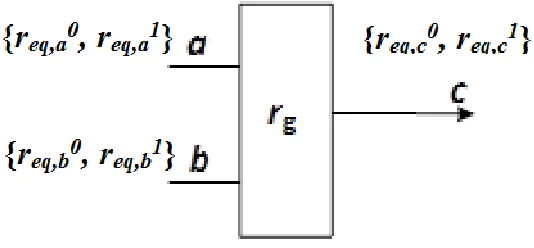
Consider a 2-input gate with reliability of 𝑟𝑔, where {req,a0, req,a1} and {req,b0, req,b1}
denote the equivalent reliability pairs for input signals a and b respectively, where {req,c0,
req,c1} is the equivalent reliability pair for the output c,as shown in Fig. 2.1.
2.2ER Model
The problem of reliability analysis can be simply express as follow: using the
equivalent reliability pairs {req,a0, req,a1} and {req,b0, req,b1} of inputs and individual gate
reliability 𝑟𝑔 to find the {req,c0, req,c1} and probability information 𝑝𝐶∗ for output, the
average reliability of the output can be expressed by[5]
𝑟𝑐 = 𝑝𝑐∗𝑟
𝑒𝑞,𝑐1 + (1 − 𝑝𝑐∗)𝑟𝑒𝑞,𝑐0 (2.1)
So the actual probability of the output can be represented as
𝑝𝑐 = 𝑝𝑐∗𝑟𝑒𝑞,𝑐1 + (1 − 𝑝𝑐∗)(1 − 𝑟𝑒𝑞,𝑐0 ) (2.2)
The error-free input probability vector P* is defined as a 1×4 matrix where each
element represents a joint probability of error-free signals a* and b*, i.e., [5]
𝑃∗ = [𝑃
00∗ 𝑃01∗ 𝑃10∗ 𝑃11∗ ]
= [P{𝑎∗𝑏∗ = 00} P{𝑎∗𝑏∗ = 01} P{𝑎∗𝑏∗ = 10} P{𝑎∗𝑏∗ = 11}] (2.3)
And the actual input probability P of actual signal a and b, i.e.,
𝑃 = [𝑃00 𝑃01 𝑃10 𝑃11]
= [P{𝑎𝑏 = 00} P{𝑎𝑏 = 01} P{𝑎𝑏 = 10} P{𝑎𝑏 = 11}] (2.4)
The relationship between 𝑃∗ and P can be written as [5]
𝑃 = 𝑃∗𝑀 (2.5)
Where M is a 4×4 probability transfer matrix given by
11 11 10 11 01 11 00 11 11 10 10 10 01 10 00 10 11 01 10 01 01 01 00 01 11 00 10 00 01 00 00 00 p p p p p p p p p p p p p p p p M (2.6)
where each element 𝑃𝑖𝑗𝑘𝑗 represents a conditional probability for ab = kl given a*b*=
For a logic gate with two inputs signal a and b, the output reliability vector R is a 4×1
matrix where each element is a conditional probability for its output c being a specific value
k0 given ab = 00, 01, 10 or 11, i.e.,
R = [P{c = k0 | ab = 00} P{c = k0 | ab = 01} P{c = k0 | ab = 10} P{c = k0 | ab = 11}]T
where k0 = 0 for AND, NOR and XNOR gates, and k0 = 1 for NAND, OR and XOR gates.
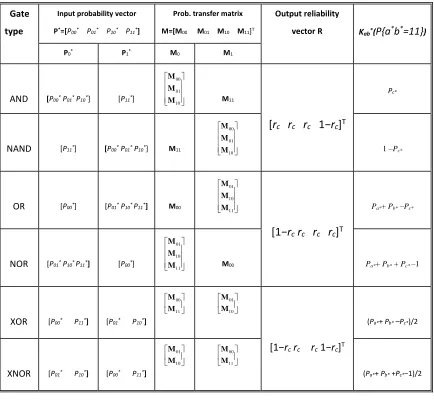
Probability vector P* of Eq. (2.3) and vector M of Eq. (2.6) both can split into
sub-vector 𝑃0∗ , 𝑃1∗ and M0 ,M1 according to the combination of 𝑎∗ and 𝑏∗[5].
Let 𝐾𝑎𝑏∗ {aa*b* 11}. The error-free input probability vector P* of (2.3) can be
rewritten as:
] 1
[ * * * * * * * *
*
ab ab
a ab b
ab b
a P K P K P K K
P
P (2.7)
The vector 𝐾𝑎𝑏∗ , R, 𝑃0∗, 𝑃1∗, M0 and M1 for different gates are different, which is
Table I Output reliability vector R for different gates
Gate
type
Input probability vector
P*=[P
00* P01* P10* P11*]
Prob. transfer matrix
M=[M00 M01 M10 M11]T
Output reliability
vector R Kab*(P{a*b*=11})
P0* P1* M0 M1
AND [P00* P01* P10*] [P11*] 10 01 00 M M M M11
[rc rc rc 1−rc]T
Pc*
NAND [P11*] [P00* P01* P10*] M11 10 01 00 M M M
1 –Pc*
OR [P00*] [P01* P10* P11*] M00 11 10 01 M M M
[1−rc rc rc rc]T
Pa*+ Pb* –Pc*
NOR [P01* P10* P11*] [P00*] 11 10 01 M M M
M00 Pa*+ Pb* + Pc*–1
XOR [P00* P11*] [P01* P10*]
11 00 M M 10 01 M M
[1−rc rc rc 1−rc]T
(Pa*+ Pb* –Pc*)/2
XNOR [P01* P10*] [P00* P11*]
10 01 M M 11 00 M M
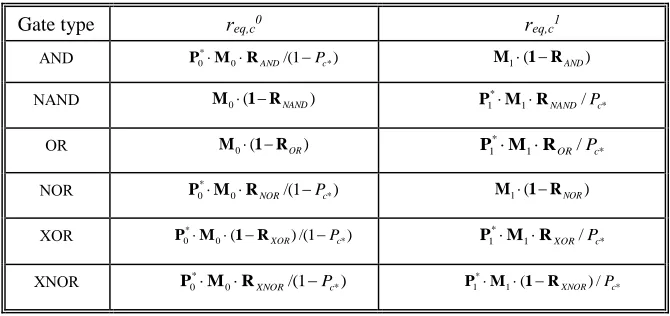
Table II shows the computation of equivalent reliability pair {req,c0, req,c1} for different
gates. Computation of equivalent reliability pair at output for 2-input gates
Table II Computation of equivalent reliability pair at output for 2-input gates
Gate type req,c0 req,c1
AND 0 /(1 *)
*
0M RAND Pc
P M1(1RAND)
NAND M0(1RNAND) 1 *
*
1 M RNAND/Pc
P
OR M0(1ROR) * 1 *
1 M ROR/Pc
P
NOR * 0 /(1 *)
0M RNOR Pc
P M1(1RNOR)
XOR 0 ( )/(1 *)
*
0M 1RXOR Pc
P * 1 *
1 M RXOR/Pc
P
XNOR * 0 /(1 *)
0M RXNOR Pc
P 1 *
*
1 M (1 RXNOR)/Pc P
Normally, the {req,a0, req,a1} and {req,b0, req,b1} of inputs are correlated, in order to reflect
the reliability correlation between them. We proposed a joint reliability as the conditional
probability which the actual input signals a and b are both correct.
So M of Eq. (2.6) becomes
ab ab a ab b ab b a ab a ab ab b a ab b ab b ab b a ab ab a ab b a ab b ab a ab r r r r r r r r r r r r r r r r r r r r r r r r r r r r r r r r 1 1 1 1 ' M (2.8)
As we known, using Monte-Carlo simulation to estimate the joint reliability 𝑟𝑎𝑏 is a
very time-consuming work for large circuits. Therefore, we proposed an efficient method
to estimate the 𝑟𝑎𝑏 . The signal correlation coefficient between a*and b* of previous
1 0 , , )] ( 1 )[ ( )] ( 1 )[ ( ) ( ) ( } { θ * * * * * * * * previous j) (i, or j i j b P j b P i a P i a P j b P i a P ij b a P (2.9)
And the joint reliability 𝑟𝑎𝑏(𝑖,𝑗)of previous method is:
(2.10)
It can be seen that the signal correlation coefficient between a* and b* and the joint
reliability 𝑟𝑎𝑏(𝑖,𝑗) of original one is changed base on the different pairs (i, j). But we spotted
that the signal reliability correlation coefficient should use average value to meet all the
conditions, so Eq. (2.9) and (2.10) would lead to the large margin of error in some cases.
2.3 Improved ER Model
Thereby, we introduce the average sign correlation coefficient 𝑄∗ and the average
joint reliability 𝑟𝑎𝑏.In this case, the error bound of them will decrease. Improved method
requires 𝑟𝑎 and 𝑟𝑏 which value of reliability of inputs signal a and b, and the probability
of error-free signals a* and b*. The relationship between them as follows:
𝑃𝑎𝑏∗ 𝑟𝑎𝑏− 𝑃𝑎∗𝑟
𝑎𝑃𝑏∗𝑟𝑏= 𝑄∗• [2•min (𝑟𝑎, 𝑟𝑏)• 𝑟𝑔− 𝑟𝑔2+ max (𝑟𝑎, 𝑟𝑏) •{𝑟𝑔 − min (𝑟𝑎, 𝑟𝑏)}]
the signal correlation coefficient between a*and b* is
𝑄∗ = 𝑃
𝑎𝑏∗ − 𝑃𝑎∗𝑃𝑏∗ (2.11)
So 𝑟𝑎𝑏 as follows:
𝑟𝑎𝑏=
𝑄∗• [2•min (𝑟𝑎,𝑟𝑏)• 𝑟𝑔−𝑟𝑔2+max (𝑟𝑎,𝑟𝑏) •{𝑟𝑔−min (𝑟𝑎,𝑟𝑏)}]+𝑃𝑎∗𝑟𝑎𝑃𝑏∗𝑟𝑏
𝑃𝑎𝑏∗ (2.12)
)
1
(
)
1
(
θ
( , ) , , , , r , , ) , ( j b eq j b eq i a eq i a eq j i j b eq i a eq j iab
r
r
r
r
r
r
r
Where 𝑃𝑎𝑏∗ is the maximum of (P {𝑎∗𝑏∗ = 00}, P {𝑎∗𝑏∗ = 01}, P {𝑎∗𝑏∗ = 10}, P
{𝑎∗𝑏∗ = 11}),𝑃
𝑎∗ 𝑎𝑛𝑑 𝑃𝑏∗ are corresponding values. For instance, if 𝑃01∗ is the maximum,
then let
𝑃𝑎∗ = 𝑃0∗ and 𝑃𝑏∗ = 𝑃1∗, so 𝑄∗=𝑃01∗ − 𝑃
0∗𝑃1∗.
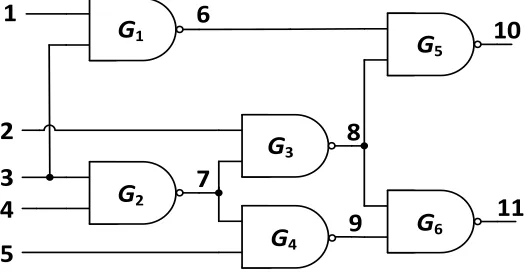
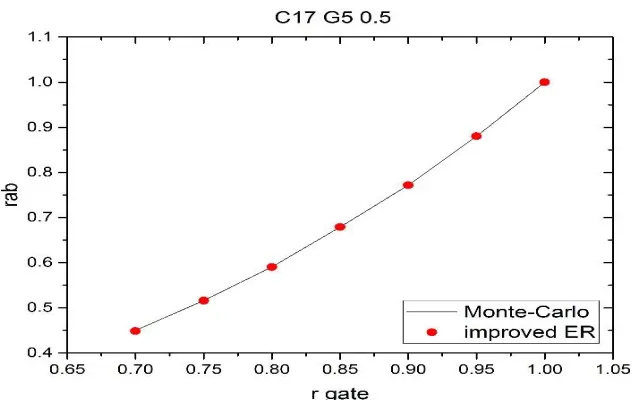
In order to verify the effects of Eq. (2.12), we took the circuit C17 as an example, as
shown in Fig. 2.2. Gate 5 has two correlated input signals 6 and 8. Gate 6 has two correlated
input signals 8 and 9. We compare the estimated values based on Eq. (2.12) with the
accurate 𝑟𝑎𝑏 values which from Monte-Carlo simulation. Assuming primary input
probabilities is set to 0.5, and gate reliabilities 𝑟𝑔 arrange from 0.7 to 1. The results of the
joint reliability of signal 6 and signal 8 is shown in Fig. 2.3, the joint reliability of signal 8
and signal 9 is shown in Fig. 2.4. It can be seen that the estimate results of the joint
reliability 𝑟𝑎𝑏 are consistent with the accurate value.
1
2
3 4
5
G1
G2
G4
G3
G6
G5
6
7
8
9 11
10
Fig 2 3 The joint reliability 𝑟𝑎𝑏 of signals 6 and 8 in C17
The procedure of the improved equivalent reliability model can be summarized as
follows:
Input: Probability of primary inputs, gate reliabilities
Output: Reliability of primary outputs
Setp1: Sort gates base on circuits’ topology;
Calculate probabilities of all signal for error-free circuit;
Stpe2: For any gate as Fig. 2.1, obtain reliabilities 𝑟𝑎 and 𝑟𝑏 of inputs a and b
Find 𝐾𝑎𝑏∗ , R, 𝑃0∗, 𝑃
1∗ from Table I;
Find M0 and M1 from Eq. (2.8) and Table I;
Calculate {req,c0, req,c1} of output c from Table II;
Step3: Calculate the overall reliability 𝑟𝑐 of output c by Eq. (2.1);
Propagate it to the next gate.
2.4 Simulation Results
Simulations are all implemented in MATLAB with 2.40 GHz processor and 8GB
RAM. Setting the accurate reliability values are calculated by Monte-Carlo reliability
analysis.
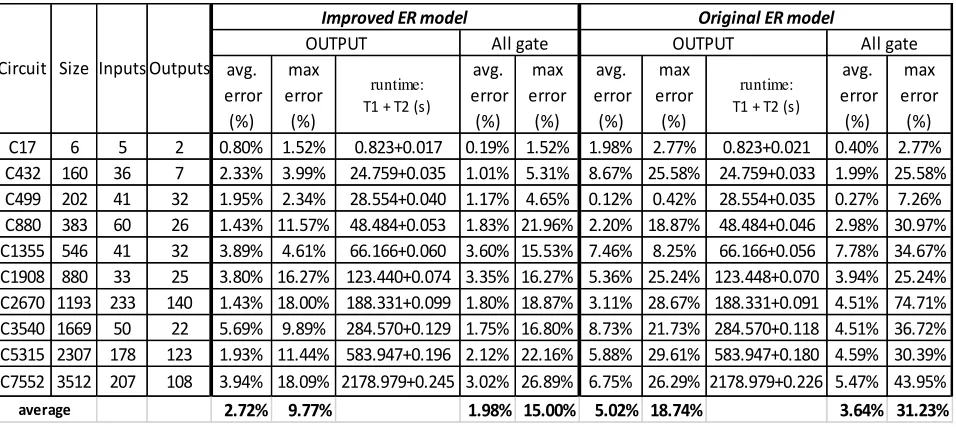
We also took ISCAS85 benchmarks as an example to verify the performance and
computational efficiency of improved equivalent reliability model on large circuits in
probabilities is 0.5 with 𝑟𝑔 =0.9 (Table III) and 0.95(Table IV). avg. error (%) max error (%) runtime:
T1 + T2 (s)
avg. error (%) max error (%) avg. error (%) max error (%) runtime:
T1 + T2 (s)
avg. error (%) max error (%) C17 6 5 2 0.48% 0.78% 0.906+0.017 0.10% 0.78% 1.17% 1.56% 0.906+0.017 0.22% 1.56% C432 160 36 7 3.59% 6.50% 29.494+0.036 1.05% 7.70% 8.46% 25.39% 29.494+0.035 1.63% 25.39% C499 202 41 32 2.94% 3.31% 35.805+0.038 1.36% 5.13% 0.20% 0.61% 35.805+0.036 0.24% 5.92% C880 383 60 26 1.88% 19.23% 55.644+0.049 1.54% 21.47% 3.33% 29.30% 55.644+0.047 2.75% 32.62% C1355 546 41 32 1.27% 1.57% 75.024+0.061 4.11% 22.70% 5.13% 5.53% 75.024+0.058 8.83% 49.39% C1908 880 33 25 4.39% 22.37% 132.049+0.075 4.15% 24.04% 6.28% 30.83% 132.049+0.071 5.30% 31.75% C2670 1193 233 140 1.61% 23.99% 194.606+0.100 1.97% 26.59% 3.21% 52.60% 194.606+0.094 4.57% 80.69% C3540 1669 50 22 11.20% 19.47% 295.022+0.140 2.29% 21.40% 13.91% 24.46% 295.022+0.124 5.46% 38.39% C5315 2307 178 123 2.73% 16.72% 599.330+0.2 2.50% 34.62% 6.23% 36.21% 599.330+0.205 4.92% 44.25% C7552 3512 207 108 5.26% 18.21% 2302.170+0.248 3.28% 34.51% 8.77% 26.77% 2302.170+0.232 5.81% 50.35%
3.54% 13.22% 2.23% 19.89% 5.67% 23.33% 3.97% 36.03%
Average
Circuit Size Inputs Outputs
Improved ER model Original ER model
OUTPUT All gate OUTPUT All gate
avg. error (%) max error (%) runtime:
T1 + T2 (s)
avg. error (%) max error (%) avg. error (%) max error (%) runtime:
T1 + T2 (s)
avg. error (%) max error (%) C17 6 5 2 0.80% 1.52% 0.823+0.017 0.19% 1.52% 1.98% 2.77% 0.823+0.021 0.40% 2.77% C432 160 36 7 2.33% 3.99% 24.759+0.035 1.01% 5.31% 8.67% 25.58% 24.759+0.033 1.99% 25.58% C499 202 41 32 1.95% 2.34% 28.554+0.040 1.17% 4.65% 0.12% 0.42% 28.554+0.035 0.27% 7.26% C880 383 60 26 1.43% 11.57% 48.484+0.053 1.83% 21.96% 2.20% 18.87% 48.484+0.046 2.98% 30.97% C1355 546 41 32 3.89% 4.61% 66.166+0.060 3.60% 15.53% 7.46% 8.25% 66.166+0.056 7.78% 34.67% C1908 880 33 25 3.80% 16.27% 123.440+0.074 3.35% 16.27% 5.36% 25.24% 123.448+0.070 3.94% 25.24% C2670 1193 233 140 1.43% 18.00% 188.331+0.099 1.80% 18.87% 3.11% 28.67% 188.331+0.091 4.51% 74.71% C3540 1669 50 22 5.69% 9.89% 284.570+0.129 1.75% 16.80% 8.73% 21.73% 284.570+0.118 4.51% 36.72% C5315 2307 178 123 1.93% 11.44% 583.947+0.196 2.12% 22.16% 5.88% 29.61% 583.947+0.180 4.59% 30.39% C7552 3512 207 108 3.94% 18.09% 2178.979+0.245 3.02% 26.89% 6.75% 26.29% 2178.979+0.226 5.47% 43.95%
2.72% 9.77% 1.98% 15.00% 5.02% 18.74% 3.64% 31.23%
average
Circuit Size Inputs Outputs
Improved ER model Original ER model
OUTPUT All gate OUTPUT All gate
Table III Computation of improved ER model and original ER model for performance oniscas85 benchmark with 𝑟𝑔𝑎𝑡𝑒= 0.9
It should be mentioned that the above error estimations of all methods in this thesis
are based on calculation of the absolute error, rather than calculating the relative error.
When calculating the relative error, errors will be offset by the positive and negative value,
thereby its value looks smaller than the absolute error. But it cannot really reflect the
performance of methods. So we used the absolute error to show the error.
It can be seen from both tables that the average error of improved ER model is around
3%, compared to the approximately 5% for the previous ER model, which decrease 2%
error of reliability. And the average value of maximum error drops significantly at the same
time. So the improved ER method can keep a better accuracy of reliability analysis than
the original one. The runtimes of two methods are barely changed, as shown in both tables,
which includes T1 that spent on calculating probabilities of all signals for error-free circuit
and T2 that spent on reliability analysis. Calculating probabilities of all signals is
time-consuming, but it is required only once with gate reliability change. Any change in the
circuit just requires an extra linear time for reliability analysis. So improved ER method
CHAPTER 3
THREE-POINT METHOD
In this section, the three-point method is presented for evaluating the reliability of
integrated circuit. Using the probability information (𝑃𝐹 ,𝑃𝐹∗ ) for three points of same
output with different 𝑃∗ and building a curve of their relationship. By evaluating
equivalent reliabilities through the information of curves, reliability analysis can be done
efficiently, while keeping a high level of accuracy.
3.1 Previous Works
In order to better analyze reliability, we also use the equivalent reliability of signal as
ER method. So any signal of a circuit is associated with a reliability pair {L, K}, as well as
reliability pair {req0, req1} of ER method. So for signal s, 𝐿 =P {(s=s*)/(s*=0)} and 𝐾= P
{(s=s*)/(s*=1)}. As above ER model, using three-point method to analyze circuit reliability,
we still need to know the probabilities of primary inputs and each gate reliabilities of circuit
at first. If the reliabilities pair {L, K} for the output could be found, the average reliability
for this output can be calculated as [5]
𝑟 = 𝑃∗𝐾 + (1 − 𝑃∗)𝐿 (3.1)
At the same time, the single signal reliability can be defined as another reliability pair
{𝑟0, 𝑟1}. 𝑟0 (or 𝑟1) is defined as the probability that the actual signal and error-free signal
reliability pair for the output signal F is derived as
𝑟𝐹0 = (1 − 𝑝𝐹∗)𝐿
𝐹
𝑟𝐹1 = 𝑃𝐹∗𝐾𝐹 (3.2)
Therefore, we need to find the reliabilities pair {L, K} at first. As probabilities of
primary inputs and each gate reliabilities of the circuit are given. P and P* can be calculated
by Monte-Carlo simulation or PGM, which P is the probability of actual output signal F
(when the circuit is unreliable), whereas P* is the probability of error-free output signal F
when the circuit is reliable [9]. So the equation between 𝑃𝐹∗ and 𝑃
𝐹 can be expressed as
𝑃𝐹 = 𝑟𝐹1+1 − 𝑃𝐹∗−𝑟𝐹0
= 𝑃𝐹∗𝐾
𝐹+ 1 − 𝑃𝐹∗− (1 − 𝑃𝐹∗)𝐿𝐹 (3.3)
3.2 Three-point Method
In what follows, we show how to the reliability pair {L, K}, first we assume the 𝐾𝐹
and 𝐿𝐹 is linear equation of 𝑃𝐹∗, so
𝐾𝐹 = 𝛼1𝑃𝐹∗+𝛽1
𝐿𝐹 = 𝛼2𝑃𝐹∗+𝛽2 (3.4)
Where 𝛼1, 𝛼2, 𝛽1, 𝛽2 are all constant, then we put Eq. (4) into Eq. (3) becomes
𝑃𝐹 = (𝛼1+ 𝛼2)𝑃𝐹∗2+(𝛽1+ 𝛽2− 1 − 𝛼2)𝑃𝐹∗− 𝛽2+ 1
It can be seen that 𝑃𝐹 is quadratic equation of 𝑃𝐹∗, it can be rewritten as
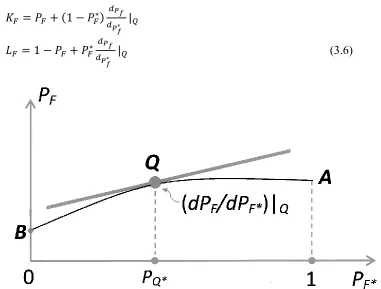
We can see that 𝑃𝐹 is a quadratic curve, as shown in Fig. 3.1. (setting 𝑃𝐹∗ as X axis
and 𝑃𝐹 as Y axis) Therefore, we need at least 3 points to determine it. They are check point,
𝑃𝐹∗ = 0 point and 𝑃𝐹∗ = 1 point respectively. In order to analyze conveniently, check point
is defined as Q, 𝑃𝐹∗ = 0 𝑎𝑛𝑑 𝑃
𝐹∗ = 1 are defined as B, A respectively. As shown in Fig.
3.1, the slope of tangent which passes through Q is 𝑑𝑃𝐹
𝑑
𝑃𝐹∗
|𝑄, and it is equal to the ratio of
𝑃𝐹 variation to 𝑃𝐹∗ variation ( ∆𝑃𝐹
∆𝑃𝐹∗). Therefore, the reliabilities pair {𝐿𝐹, 𝐾𝐹} of signal F can
be expressed by 𝑃𝐹 and 𝑃𝐹∗
𝐾𝐹 = 𝑃𝐹+ (1 − 𝑃𝐹∗) 𝑑𝑃𝑓
𝑑𝑃𝑓∗ |𝑄
𝐿𝐹 = 1 − 𝑃𝐹+ 𝑃𝐹∗ 𝑑𝑃𝑓
𝑑𝑃𝑓∗ |𝑄 (3.6)
Fig 3 1 The slope of tangent which passes through Q
When the probability of primary inputs and gate reliabilities are set, 𝑃𝐹 and 𝑃𝐹∗ of
outputs could be achieved by the method of PGM. In order to get more accurate value, we
Pf* cannot always be 0 or 1[10]. For seeking out 𝑃𝐹∗=0 and 𝑃
𝐹∗=1 points, we set signals of
inputs as permanent signals rather than a probability. In this way, the point which PF* is
equal to 0 or 1 will be found. Then we change the input signal with other permanent signals,
until we find A and B two points of each outputs. When 𝑃𝐹 𝑎𝑛𝑑 𝑃𝐹∗ of A, B, Q are found,
building a ternary linear equation, factors a, b and c can be figured out from Eq. (5). 𝑑𝑃𝐹
𝑑
𝑃𝐹∗
|𝑄
is obtained by taking the derivative of this Eq. (3.5) as follows:
𝑑𝑃𝐹 𝑑
𝑃𝐹∗
|𝑄 = 2𝑎𝑃𝐹∗+ 𝑏 (3.7)
By using Eq. (3.7), Eq. (3.6) can be rewritten as
𝐾𝐹 = 𝑃𝐹− 2a𝑃𝐹∗2+ (2a − b)𝑃𝐹∗+ 𝑏
𝐿𝐹 = 1 − 𝑃𝐹+ 2a𝑃𝐹∗2+ 𝑏𝑃𝐹∗ (3.8)
We obtain the value of reliabilities pair {L, K} of each output from Eq. (3.8) and put
it into Eq. (3.1). Finally, the reliability of each gate Eq. (3.1) becomes
𝑟𝐹 = 2𝑃𝐹𝑃𝐹∗2− 4𝑎𝑃
𝐹∗3+ (4𝑎 − 2𝑏)𝑃𝐹∗2+ (2𝑏 − 1)𝑃𝐹∗+ 1 − 𝑃𝐹 (3.9)
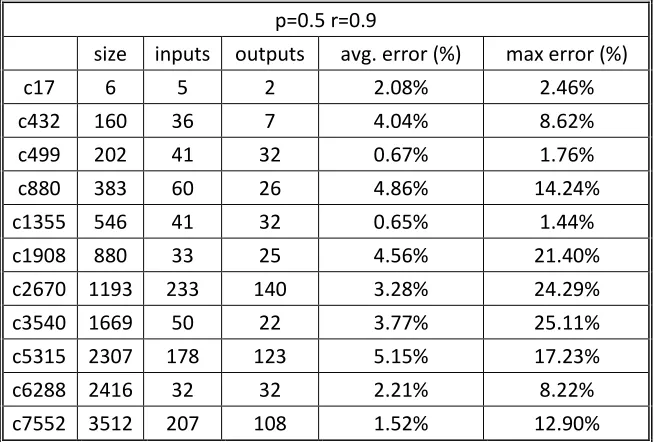
We took ISCAS85 benchmarks to test the performance of the three-point method on
large circuits. The proposed three-point was implemented in MATLAB. The value of
Monte-Carlo reliability estimation is accurate value. Assuming the primary input
probability is 0.5 and all gate reliability is 0.9, simulation results are shown in Table V. The
average error and maximum error are both got from all primary outputs of circuits. Here,
the average (or maximum) error is defined as an average (or maximum) of (|𝑟𝐹.𝑒𝑠𝑡− 𝑟𝐹.𝑎𝑐𝑐|
accurate reliability values. It can be seen that the average error of it is around 1-4% in most
cases. For the worst case, maximum error would up to 25%.
Table V Performance of the unmodified three-point Model on ISCAS’85 Benchmark Circuits with 𝑟𝑔𝑎𝑡𝑒= 0.9
p=0.5 r=0.9
size inputs outputs avg. error (%) max error (%)
c17 6 5 2 2.08% 2.46%
c432 160 36 7 4.04% 8.62%
c499 202 41 32 0.67% 1.76%
c880 383 60 26 4.86% 14.24%
c1355 546 41 32 0.65% 1.44%
c1908 880 33 25 4.56% 21.40%
c2670 1193 233 140 3.28% 24.29%
c3540 1669 50 22 3.77% 25.11%
c5315 2307 178 123 5.15% 17.23%
c6288 2416 32 32 2.21% 8.22%
c7552 3512 207 108 1.52% 12.90%
After analyzing, these worst case always happen when 𝑃𝐹∗ close to 0 or 1 in specific
circuits. Due to the variations of 𝑃𝐴 and 𝑃𝐵,it will cause the tangent passes through point
Q which closes to B and A extremely unstable and the slope will change in a large rang,
thereby rising errors in estimating reliability. Strictly speaking, if 𝑃𝐴 and 𝑃𝐵 could be
chosen as an average of the output probabilities over all inputs vectors which lead to PF*
= 1 and PF* = 0, it can completely eliminate this problem. But it is very high
time-consuming. In the following, we deal with these issues by modifying previous reliability
3.3 Modified Model for Reliability Estimation
In order to reduce the impact of variations of 𝑃𝐴 and 𝑃𝐵 on the reliability estimation
(when the point Q locates near to B or A), we take a straight line from Q to B (or A) instead
of using Eq. (3.5) to estimate 𝑑𝑃𝐹
𝑑𝑃𝐹∗ |𝑄(the slope of tangent which passes through Q). The
following two cases will be discussed in details.
3.3.1 Q is close to A
If Q is close to A, then a straight line which through B and Q will be used to estimate
𝑑𝑃𝐹
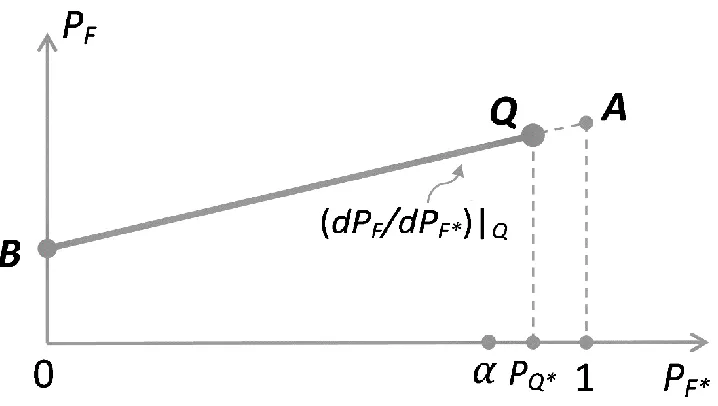
𝑑𝑃𝐹∗ |𝑄. In order to define what situation is Q close to A, value α which is a threshold value
close to 1 is proposed. So 𝑃𝑄∗ ≥ α is meaning Q locates close to A, as shown in Fig. 3.2. By
using a=0, the Eq. (3.5) translates to 𝑃𝐹 = 𝑏𝑃𝐹∗+ 𝑐, so 𝑏 = 𝑑𝑃𝐹
𝑑
𝑃𝐹∗
|𝑄 =(𝑃𝑄 ─ 𝑃𝐵)/ 𝑃𝑄∗ and
c = 𝑃𝐵.This along with Eq. (3.6) can be rewritten as
𝐾 ≈ (𝑃𝑄+ 𝑃𝐵𝑃𝑄∗− 𝑃𝐵)/𝑃𝑄∗
𝐿 ≈ 1 − 𝑃𝐵
According to Eq. (3.1), it becomes
𝑟𝐹 ≈ 𝑃𝑄+ (1 − 𝑃𝑄∗)(1 − 2𝑃𝐵) (3.10)
𝑃𝐵 may be unavailable in sometimes, especially when 𝑃𝑄∗ is very close to 1. We
assume 𝑃𝐵 ≈ 1 − 𝑟𝐹.Thus , Eq. (3.10) can be modified as
Fig 3 2 Modified model for the case of PQ* ≥ α
3.3.2 Q is close to B
If Q is close to B, then a straight line which through Q and A will be used to find
𝑑𝑃𝐹
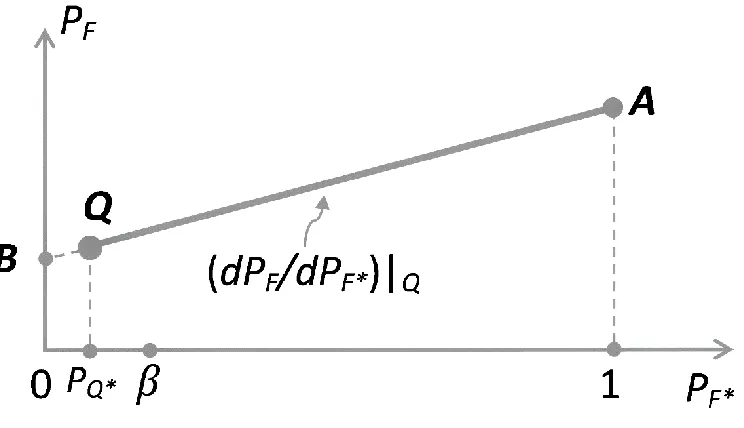
𝑑𝑃𝐹∗ |𝑄. As same as the threshold value α, value β is a threshold value close to 0. So 𝑃𝑄
∗ ≤
β and Q locates close to B have the same meaning, as shown in Fig. 3.3. By using a=0, the
Eq. (3.5) becomes 𝑃𝐹 = 𝑏𝑃𝐹∗+ 𝑐 again, but 𝑏 = 𝑑𝑃𝐹
𝑑𝑃𝐹∗ |𝑄=(𝑃𝐴 ─ 𝑃𝑄)/ (1 − 𝑃𝑄
∗) and c =
(𝑃𝑄 ─𝑃𝐴𝑃𝑄∗ )/ (1 − 𝑃𝑄∗). This along with Eq. (6) can be rewritten as
𝐾 ≈ 𝑃𝐴
𝐿 ≈ (1 − 𝑃𝑄+ 𝑃𝐴𝑃𝑄∗− 𝑃𝑄∗)/ (1 − 𝑃𝑄∗)
According to Eq. (3.1), it becomes
𝑟𝐹 ≈ 1 − 𝑃𝑄− 𝑃𝑄∗(1 − 2𝑃𝐴) (3.12)
𝑃𝐴 may be unavailable in sometimes, especially when 𝑃𝑄∗ is very close to 0. At this
point, we assume 𝑃𝐴 ≈ 𝑟𝐹.Thus , Eq. (3.10) can be modified as
Fig 3 3 Modified model for the case of PQ* ≤ β
It can be seen that Eq. (3.11) and Eq. (3.13) are exactly same. So when Q is very close
to B (or A), 𝑟𝐹 is used the Eq. (11) or Eq. (13) to estimate. The 𝑟𝐹 variation of Eq. (3.12)
and Eq. (3.14) is given approximately by ∆𝑟𝐹= 2𝛿𝑚(1 − 𝑃𝑄∗)𝑃𝑄∗ . where 2𝛿𝑚 is 𝑟𝐹
variation under the worst case. Thus, when 𝑃𝑄∗ is close 1 or 0, 𝑟𝐹 variation is minimum.
For example, if 𝑃𝑄∗ equal to 0.9, 𝑟𝐹 variation is 9% of 2δm.
In summary, when Q locates in between (β< 𝑃𝑄∗< α), we still use previous equation
(3.9) to estimate reliability 𝑟𝐹.When Q is close to B (𝑃𝑄∗ ≤β) or A (𝑃𝑄∗ ≥ α), Eq. (3.11) and
Eq. (3.13) are used to estimate output reliability 𝑟𝐹 instead of Eq. (3.9). It should be
3.4 Simulation Results
After the change, we still took ISCAS85 benchmarks to verify the performance of the
modified three-point method on large circuits. It was also implemented in MATLAB with
𝑟𝑔𝑎𝑡𝑒 = 0.9 and 𝑃𝑖𝑛 = 0.5. Simulation results are shown in Table VI. The average error
and maximum error are still got from all primary outputs of circuits and Error algorithm
does not change. After comparing with the previous three-point method, it can be seen that
the average error of modified three-point method drops obviously.
Table VI Comparison of modified three-point model, three-point model and PGM on ISCAS’85 Benchmark Circuits with 𝑟𝑔𝑎𝑡𝑒= 0.9 𝑃𝑖𝑛= 0.5
𝑟𝑔𝑎𝑡𝑒= 0.9 and 𝑃𝑖𝑛 = 0.5
circuit size inputs outputs avg. error (%)
modified unmodified PGM
c17 6 5 2 2.08% 2.08% 33.15%
c432 160 36 7 2.88% 4.04% 4.37%
c499 202 41 32 0.62% 0.67% 34.21%
c880 383 60 26 1.83% 4.86% 8.63%
c1355 546 41 32 0.65% 0.65% 21.53%
c1908 880 33 25 4.56% 4.56% 17.31%
c2670 1193 233 140 2.83% 3.28% 17.80%
c3540 1669 50 22 2.74% 3.77% 19.57%
c5315 2307 178 123 4.81% 5.15% 7.94%
c6288 2416 32 32 0.95% 2.21% 4.21%
c7552 3512 207 108 1.23% 1.52% 20.73%
In order to further demonstrate the efficiency of the modified three-point method(MTP)
on large circuits, we took ISCAS85 benchmarks as examples. It is well known that
Monte-Carlo is the most time-consuming method, so the runtime of it does not show in the table.
We only compare the runtime with PGM. We took 103 samples of input vectors for PGM
simulation. The runtimes of MTP can be divided into two parts T1 and T2. T1 is the time
which spends on estimate 𝑃𝐹 𝑎𝑛𝑑 𝑃𝐹∗ of check point, 𝑃𝐹∗ = 0 point and 𝑃𝐹∗ = 1 point.
T2 is the time which is spent on using Eq. (3.13) to calculate the reliability of outputs. It
can be seen from the table VII, T2 is too small relative to T1 and just take linear time for
any large circuits. It is the key to improving efficiency, rather than exponential growth with
the growing number of gates for some other method. T1 is extremely big in runtime,
because we used Monte-Carlo method to simulate the 𝑃𝐹 𝑎𝑛𝑑 𝑃𝐹∗ of three points. 𝑃𝐹∗=
0 point and 𝑃𝐹∗ = 1 point of each output is not easy to be found in a small number of
simulation times. For reducing T1, there are many efficient approaches have been available
to find 𝑃𝐹 𝑎𝑛𝑑 𝑃𝐹∗ of three points instead of MC method. If using PGM, the total runtime
Table VII Comparison runtime of MTP and PGM on ISCAS’85 Benchmark Circuits with 𝑟𝑔𝑎𝑡𝑒= 0.9 𝑃𝑖𝑛= 0.5
𝑟𝑔𝑎𝑡𝑒= 0.9 and 𝑃𝑖𝑛 = 0.5
circuit size inputs outputs
Modified three-point
method PGM
Runtime(s): T1+T2 Runtime(s)
c17 6 5 2 0.366+0.01 0.030
c432 160 36 7 23.826+0.012 4.920
c499 202 41 32 38.208+0.01 4.970
c880 383 60 26 83.363+0.02 9.820
c1355 546 41 32 58.385+0.06 13.140
c1908 880 33 25 131.967+0.01 18.340
c2670 1193 233 140 515.582+0.016 27.020
c3540 1669 50 22 352.090+0.067 38.800
c5315 2307 178 123 1022.658+0.02 62.110
c6288 2416 32 32 423.271+0.012 50.340
CHAPTER 4
THE IMPROVED MONTE CARLO SIMULATION
Monte-Carlo simulation (MCs) is a computational algorithm which relies on random
sampling to obtain numerical results. It has been widely used for integrated circuit
reliability evaluation. However, it needs a common large number of analyses for any circuit,
which causing excessively time consuming. we presented a new method for calculating the
reliability of integrated circuit within the margin of setting error by improved Monte Carlo
simulation that can evaluate a simulation times according to different confidence levels and
different circuits, rather than previous MCs uses a large common simulations times for any
circuit. It can decrease unnecessary calculation time and increase the efficiency of
simulation dramatically.
4.1Monte Carlo Simulation
Monte Carlo technique is a sampling technique that is based on the probabilities to
solve stochastic problems. It also can be applied for sampling random variables from
probability distributions, so it has been widely used for reliability evaluation.
In the MCS, the binary bit streams are randomly generated by probabilities of the
signal. Bernoulli sequences are often used as binary bit streams in stochastic computation
[11, 12]. It independently generates a sequence of bits with the probability 𝑝 [13]. For
(20% to be logic “0”).
Consider a 2-input NAND gate. Which has two inputs a and b and one output c.
Assuming these two inputs are not correlated, the signal of input a and b random become
logic “0” or logic “1” base on 𝑃. If this gate is error-free, output signal C can be calculated
by the Boolean operation. Using C* to indicate the error-free version of sign C. If this gate
has a probability of error ε (the reliability of this gate is 1-ε), so the output c could be error
with probability ε. For example, if the input vector ab is “10”, when the gate is error-free,
the output signal c will be “1” (C*=1). When the gate is unreliable, the output signal C will
have probability ε to make it equal to “0”.
In Fig.4.1, a general stochastic model of NAND is used to illustrate this situation.
As a circuit, if probabilities of primary inputs and reliabilities of all the individual
gates are known, then the reliabilities of individual primary outputs could be calculated.
When this circuit has n inputs and m outputs, 𝐼1, 𝐼2… 𝐼𝑛 stand for primary inputs and
𝑂1, 𝑂2… 𝑂𝑚 stand for primary outputs. N independent sets of values 𝐼1, 𝐼2… 𝐼𝑛 are
generated based on the probability of primary inputs. Assuming all gates in the circuit are
reliable, N sets of complete correct primary output 𝑂1∗, 𝑂2∗… 𝑂𝑚∗ can be calculated. There
N sets prime inputs 𝐼1, 𝐼2… 𝐼𝑛 are taken as input of measured circuit at the same time. Then
N sets of outputs signals 𝑂1, 𝑂2… 𝑂𝑚 of measured circuit will also be obtained. For output
o, comparing each set of error-free signal 𝑂𝑜∗ with corresponding actual signal 𝑂
𝑜, 𝑁𝑜 is
𝑃𝑜 = 𝑁𝑜 𝑁
Fig 4 1 Schematic of benchmark circuit C17
So the reliability of this output o is 𝑟𝑜= 1 − 𝑃𝑜.
We took the C17 as an example, as shown in Fig. 1. The probability of primary inputs
𝑃 and reliability of gates r are assumed as 0.5 and 0.9 respectively. Table VIII is 10 sets of
signals of random primary inputs according to 𝑃. Table IX is 10 sets of signals of two
primary outputs for error-free circuit and measured circuit. The reliability of output can be
achieved from the Table IX. Taking Output2 as an example, there are 2 times that 𝑂𝑜𝑢𝑡𝑝𝑢𝑡2∗
and 𝑂𝑜𝑢𝑡𝑝𝑢𝑡2 is not equal. So the failure probability of Output2 is 𝑃𝑜𝑢𝑡𝑝𝑢𝑡2= 2 10 ,
reliability of Output2 𝑟𝑜𝑢𝑡𝑝𝑢𝑡2 = 0.8. It is the general theory of Monte Carlo simulation.
Normally, MCS requires a large number of sets of random variables. So 10 sets of
random variables are completely sufficient. Therefore,𝑟𝑜𝑢𝑡𝑝𝑢𝑡2 = 0.8 is not strictly true.
pseudo-random numbers are required to cover as much as possible situations, which will
lead a large number of analysis running times needed to be operated for the stable outputs.
Therefore, the calculation time will increase exponential with the growing numbers of gates.
Table VIII 10 sets of random primary inputs with 𝑃𝑖𝑛= 0.5
Table IX 10 sets of error-free and measured value of primary output 1 and 2
Output Version 1 2 3 4 5 6 7 8 9 10
Output1 𝑂𝑜𝑢𝑡𝑝𝑢𝑡1
∗ 1 0 0 0 1 1 1 1 1 1
𝑂𝑜𝑢𝑡𝑝𝑢𝑡1 1 0 0 0 1 1 1 1 1 1
Output2 𝑂𝑜𝑢𝑡𝑝𝑢𝑡2
∗ 1 0 0 1 0 1 0 1 0 1
𝑂𝑜𝑢𝑡𝑝𝑢𝑡𝑠2 1 0 1 1 0 0 0 1 0 1
Set
Input 1 2 3 4 5 6 7 8 9 10
Input1 0 0 1 0 1 1 1 1 1 1
Input2 1 0 0 0 1 1 0 1 0 0
Input3 0 1 0 0 1 0 1 0 1 1
Input4 0 0 1 0 1 0 1 0 1 0
4.2 Improved Monte Carlo Simulation
In order to improve the efficiency of Monte Carlo simulation, we proposed the
improved Monte Carlo simulation. From the previous paper, there are still 1% - 5% error
when many existing analytical approaches could work well. While calculation precision of
previous Monte Carlo simulation cannot be controlled. One million simulation runs could
achieve 99.9% precision, but this number is so abstract for different size circuits. For C17
circuit which has five inputs, so there are total 25 different input combinations [14]. In this
case, one million simulation runs are too large. Many unnecessary computations consume
large time. While C7552 circuit has 207 inputs, so 2207 inputs combinations can cover all
the possibilities. Therefore, one million runs are too small for this circuit.
It is well known that the higher precision of reliability analysis is better, but higher
precision will consume more time. When the precision reaches one certain level, the
required running times that can increase 0.1% precision may need more than total previous
running times. In this paper, Improved Monte Carlo simulation is proposed. It could adjust
the number of simulation runs base on the size and complexity of the circuits when the
accuracy has been determined.
The convergence rate for each output of the same circuit is different, which can be
influenced even by the variance of the probability of primary inputs and individual gate
reliabilities [15]. Therefore, preliminary testing on convergence rate before the formal
the confidence interval of reliability 𝑟 could be estimated, is
(𝜇 − t ∙ 𝜎
√𝑁𝑠, 𝜇 + t ∙
𝜎
√𝑁𝑠) (4.1) [16]
Where t is the value based on a certain confidence level α.
Eq. (4.1) can be rewritten as
𝜇 − t ∙ 𝜎
√𝑁𝑠< 𝑟 < 𝜇 + t ∙
𝜎
√𝑁𝑠
Once the error tolerance ɛ is set, the total number of simulation 𝑁𝑠 can be calculated
as
{
|𝜇 − 𝑟| < t ∙ 𝜎
√𝑁𝑠
𝑟 < 𝜇 + t ∙ 𝜎
√𝑁𝑠
ɛ >|𝜇−𝑟|
𝑟
⇒ 𝜇∙ɛ
1−ɛ> t ∙ 𝜎 √𝑁𝑠
⇒ 𝑁𝑠 > {t∙𝜎∙(1−ɛ)
𝜇∙ɛ } 2
(4.2)
Through the previous experiments, an empirical theory can be obtained. The
procedure can be summarized as follows:
Input: Probability of primary inputs, gate reliabilities and error tolerance
Output: Number of simulation
Step1: Randomly generate one set of input signal according to the probability of
primary inputs;
Step2: Put the above one set of input signal into the error-free circuit and the actual
Find out the reliability of outputs for running N times.;
Step3: Repeat step 1 and 2 M times. Each output will have M values of reliability;
(Note: This is different from previous Monte Carlo approach, which needs randomly
generate n sets of different inputs.)
Get the running times of the test is N*M;
Step4: Analyze the Gaussian distribution of M sets of reliability;
Calculate the standard deviation 𝜎 and mean μ of each output.
Step5: Obtain the value of t base on confidence level α from the probability table;
Compute the total simulation times 𝑁𝑠 using Eq. (4.2).
4.3Simulation Results
The proposed IMCS approach was implemented in MATLAB. The result from
previous MCS runs one million is used as the standard result. Assuming N equals to 1000,
100, 10, 1 separately and increasing the value of M gradually. Through equation 1, 𝑁𝑠 has
a linear relationship with variance (𝜎2). So the variance of standard deviation plays an
important impact on 𝑁𝑠. According to the tests results, when N equals to 100, 𝜎 of some
outputs will change twice times with M increasing. When N equals to 1000, this
phenomenon will occur more obviously and the value of 𝜎 even have 7 times of change
with the increasing value of M. But when N=1, the value of the standard deviation σ hardly
We adopt C499 circuit of ISCAS85 benchmark as simulation object (assuming
primary input probabilities is 0.5 and all gates reliabilities are 0.9) and set 𝜎 which is
achieved from 104 text times (M=104 , N=1) as standard 𝜎(𝜎
10000) .Using it compares
with other standard deviations when setting M=5000,1000,500,100, N always be 1. It can
be seen that from the table X, each ratio of standard deviation 𝜎 to 𝜎10000 is trend to 1,
which means when N=1, the standard deviation 𝜎 is nearly unchanged with M increasing.
M=10000 N=1
σ σ σ σ σ
724 0.433 0.430 0.995 0.421 0.973 0.429 0.991 0.469 1.084 0.443 1.024
725 0.430 0.426 0.992 0.419 0.975 0.421 0.980 0.394 0.917 0.418 0.973
726 0.431 0.421 0.977 0.426 0.988 0.411 0.952 0.441 1.022 0.404 0.937
727 0.427 0.422 0.988 0.424 0.993 0.420 0.983 0.446 1.045 0.443 1.037
728 0.430 0.430 0.999 0.433 1.006 0.426 0.991 0.423 0.983 0.485 1.127
729 0.425 0.434 1.021 0.433 1.021 0.436 1.026 0.409 0.964 0.404 0.952
730 0.428 0.425 0.992 0.434 1.015 0.428 0.999 0.461 1.076 0.463 1.082
731 0.425 0.421 0.990 0.431 1.013 0.417 0.982 0.402 0.945 0.471 1.108
732 0.423 0.436 1.031 0.424 1.002 0.419 0.991 0.409 0.969 0.443 1.048
733 0.429 0.426 0.994 0.424 0.988 0.423 0.986 0.465 1.084 0.388 0.905
734 0.427 0.430 1.007 0.422 0.987 0.420 0.983 0.441 1.032 0.443 1.037
735 0.427 0.426 1.000 0.429 1.006 0.417 0.978 0.409 0.960 0.404 0.947
736 0.430 0.421 0.979 0.427 0.992 0.420 0.976 0.423 0.983 0.443 1.030
737 0.429 0.431 1.005 0.435 1.014 0.433 1.011 0.402 0.937 0.418 0.976
738 0.425 0.423 0.995 0.426 1.002 0.416 0.978 0.429 1.009 0.443 1.042
739 0.430 0.428 0.996 0.430 1.002 0.446 1.039 0.435 1.013 0.418 0.974
740 0.425 0.420 0.989 0.437 1.030 0.437 1.029 0.429 1.011 0.454 1.068
741 0.430 0.427 0.993 0.419 0.974 0.412 0.957 0.394 0.916 0.404 0.939
742 0.430 0.434 1.010 0.436 1.013 0.394 0.917 0.409 0.952 0.485 1.128
743 0.426 0.430 1.011 0.416 0.977 0.399 0.937 0.409 0.962 0.388 0.912
744 0.428 0.426 0.995 0.419 0.980 0.425 0.993 0.456 1.066 0.404 0.944
745 0.430 0.430 0.998 0.433 1.007 0.406 0.944 0.465 1.080 0.454 1.054
746 0.429 0.430 1.003 0.434 1.012 0.436 1.016 0.441 1.028 0.418 0.976
747 0.429 0.431 1.003 0.429 0.999 0.430 1.001 0.429 1.000 0.431 1.005
748 0.430 0.429 0.999 0.429 0.998 0.439 1.022 0.423 0.985 0.328 0.764
749 0.428 0.430 1.005 0.422 0.985 0.432 1.010 0.429 1.003 0.471 1.101
750 0.427 0.432 1.011 0.419 0.981 0.430 1.007 0.416 0.975 0.463 1.084
751 0.425 0.430 1.012 0.422 0.993 0.412 0.970 0.394 0.928 0.418 0.985
752 0.427 0.425 0.993 0.436 1.020 0.444 1.040 0.402 0.940 0.463 1.083
753 0.426 0.432 1.013 0.438 1.027 0.448 1.053 0.465 1.091 0.431 1.013
754 0.429 0.422 0.985 0.437 1.020 0.435 1.014 0.409 0.955 0.485 1.131
755 0.429 0.426 0.994 0.429 1.001 0.447 1.044 0.409 0.955 0.454 1.058
output M=5000 N=1 M=1000 N=1 M=500 N=1 M=100 N=1 M=50 N=1
𝜎10000 𝜎/𝜎10000 𝜎/𝜎
10000 𝜎/𝜎10000 𝜎/𝜎10000 𝜎/𝜎10000
Through the Eq. (4.2), 𝑁𝑠 is inversely proportional to 𝜇2. Therefore 𝜇 also plays an
important role in 𝑁𝑠 . Whereas the precision of 𝜇 is determined by M. Since N=1 and
running times equals to N multiplied by M, so the test times equal to M. The value of M
could not be too large, otherwise test times would cost too long time and lose its
significance. The experience of test shows the precision of µ belongs to 2-3% could work
well and it does not need too many simulation times.
In order to compare the error of reliability of different M test times, we take C499
again for example and still assume all gate reliabilities are 0.9 and input probabilities is
0.5(Table XI). When M=500, the average error of output reliability is 2.32%, it means 500
test times can meet our required precision of 𝜇. When M=1000, the error of each output
reliability is less than 1.5%, in this case more accurate formal simulation times 𝑁𝑠 could
get. In other words, more M test times can get more accurate 𝜇 and more accurate times
of formal simulation. For C432 circuit which has 160 gates, only 500 test times can achieve
the expected precision. But for C7552 circuit which includes 3512 gates needs 1000 test
times. Though test times will grow with the size of a circuit to get the expected precision