Randomly Carrier Detection based Data
Hiding Using Two LSB Bits
Prof. Ram B. Joshi,
Anuja T. Bhondve.Ph.D Scholar, Dept. of Computer, JJT University, Rajasthan, India
M.E Student, Dept. of Computer, Indira college of Engineering and Management, SPPU, Pune, India
ABSTRACT: In this paper we present a Random Pixel Prediction approach to increase the security of the data hidden in a cover RGB image. Here we have used LSB insertion method that hides the bits of a secret message into the last two least significant of the pixels within a cover image. The pixels are selected by using a random number generator. It is commonly seen that the changes in the LSB cannot be detected due to noise that is presents in the digital images by the human visual system. The central idea of the proposed method is to increase security, embedding capacity as well as maintain quality of image. We have also explained the method that extracts the hidden message at the receiving end using a key. The main objective of the paper is to combine both the preferences and the resistance to the visual and statistical attacks for a large amount of the data to be hidden in a cover image.
KEYWORDS: Steganography, Least Significant Bit (LSB), RGB image, cover-image, stego-image, Random Pixel Prediction (RPP), key, PSNR, MSE.
I. INTRODUCTION
Steganography and cryptography are two different data hiding techniques. Steganography hides messages inside some other digital media. In the process a message is first encrypted using transposition cipher method and then the encrypted message is embedded inside an image using LSB insertion method.Data hiding ensures exclusive data access to class members and protects object integrity by preventing unintended or intended changes.Data hiding technique involves putting sensitive information in host image with minimum changes in the image. In most of data hiding techniques, image becomes more distorted and we are unable to retrieve its original format. The cover media are permanently distorted due to the data embedding. In sector such as military or medical it is necessary to retrieve original cover image without any loss of information.Data hiding technique involves putting sensitive information in host image with minimum changes in the image. In most of data hiding techniques, image becomes more distorted and we are unable to retrieve its original format. The cover media are permanently distorted due to the data embedding. In sector such as military or medical it is necessary to retrieve original cover image without any loss of information. There are different characteristics of data hiding technique such as: perceptibility, capacity, authentication, Security, Finger print and secret communication, [1] [2], Etc. that all can be achieved by using data hiding techniques. In data hiding technique the information is embedded into image, after that original image gets distorted and cannot be restored to its original format. With the help of (RDH)[4][5]it is possible to extract cover image as well as embedded message from the embedded image This technique is more needful in sensitive areas such as military , medical where recovery of original content is mandatory. Most of the proposed data hiding schemes are not based onpixel prediction and feature extraction.
II. RELATEDWORK
A. INTEGER TRANSFORM TECHNIQUE:
only.
B. DIFFERENCE EXPANSION:
To overcome drawback of previous system, for difference expansion Yongjian Hu [7] uses the predicted image pixel error instead of the pixel-pair difference. The recovery process contains two steps of manipulations. First in the inner/embedded region, and then the embedded/hidden bit is extracted from it. Original pixel value is resumed in shifted regions. For difference expansion which is based on reversible data hiding, contains two parts, first part is used to convey secret message and second part hold binary location map and header file.
C. HISTOGRAM MODIFICATION:
In histogram modification technique [6], neighbour pixels are strongly correlated so there is difference is expected to be very close to zero so this difference is utilized rather than simple pixel value. To complete the data hiding and extraction process at the sending side, first scan the image in an inverse s-order and calculate the pixel difference d between pixels x-1 and xi. Is completes the data hiding and extraction process in which only one peak point is used. With same data hiding techniques we can achieve large hiding capacities as well. However without knowledge of peak points of every hiding pass recipients may not be able to retrieve the embedded message and the original.
III.SYSTEMDESIGN
Fig1: System design.
green, and blue color intensities to create a generic average image. PSNR is then calculated on the average image. The result is a single-point metric (one result per frame) represented in dB. Typical values for an image with 8-bit color depth may fall between 30 dB and 50 dB and, in general, a higher PSNR value corresponds to a better quality image. However, the PSNR result is unbounded and the range of the results will vary with different images. To use PSNR as a test of image quality, it is recommended that you perform testing to see the typical and expected values for your test signal, in order to set meaningful test limits for PSNR. If you select the multipoint metric result for PSNR, PQA shows a difference spectrum histogram for each frame. The histogram represents the frequency of differences in intensity between the two compared images. If the images are the same, the difference in intensity is zero, and the histogram will show a single spike at 0 (meaning that all pixels in the frame fall in this category). If, for example, one image is darker than the other, then the whole histogram will be shifted to one side (asymmetrical). PSNR measurements can only be performed with NI Picture Quality Analysis, not with NI image Measurement Suite (VMS). Additionally, for new PQA configurations, NI recommends using the structural similarity index measurement (SSIM). SSIM is more robust and returns a result bounded from 0 (no match) to 1 (perfect match), unlike the unbounded and variable result from PSNR.
IV.PSEUDO CODE
Random Pixel Prediction:
Random Pixel Prediction algorithm involves embedding of information into image and stegoanalysis reveals thepresence of data. This is technique for random pixelprediction which is based on randomizing the sequenceof cipher bits. First we calculate measure of all possiblerandom sequences of cipher bits and then select one ofrandom sequence which is close to image.Random sequences are generated by computing sequencewhich is based on seed pixel, and then with the helpof this random sequence of cipher bits, information isembedded into cover image. These technique is prioritizebecause it does not contain one-to-one mapping betweena given cipher text and a Cover image, and for cryptographyanalysis, even if successful attack on encryptionsystem, attacker need to get information of seed which ishelp to generate this random sequence.
Step 1)
• Determine the length of the encrypted data (n).
• Choose a cover image where it has more pixels than n+p,where n is the length of encrypted data and p is the length needed to embed the encrypted information of string
• Set initial value of seed pixel.
• Choose pixel randomly and Segment that pixel into three blocks, each of 8 bits. • Take one block and consider it as m.
Step 2) Calculate pixel prediction (PP) bit length (m) such that 2m>n.
Step 3) Consider an m-bit length and represent the same in binary notation (one indicates bit location is tabbed and zero indicates otherwise)
Step 4)
Each bit of permuted encrypted data is embedded in to the last two least significant bits of pixel bytes of the cover image for which the suitability is above the threshold. If suitability is below the some fixed threshold.
Step 5)
• Using this (PP,seed) generates random permutation of f1,2,...ng as f11,f12,...lng.
• Permute the encrypted data using the permutation obtained above, to obtain a Permutation string Step 6) Output of RPP is stego image containing information in encrypted format.
Least Significant Bit
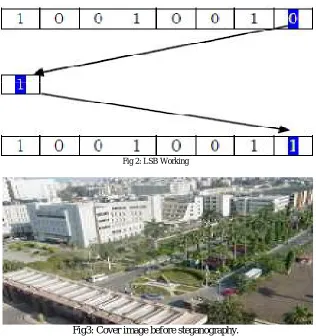
embed data into an image on any bit-plane, LSB embedding is performed on the least significant bit(s).This minimizes the variation in colors that the embedding creates. For example, embedding into the least significant bit changes the color value by one. Embedding into the second bit-plane can change the color value by 2. If embedding is performed on the least significant two pixels, the result is that a color in the cover can be any of four colors after embedding. Steganography avoids introducing as much variation as possible, to minimize the likelihood of detection. In a LSB embedding, we always lose some information from the cover image. This is an effect of embedding directly into a pixel. To do this we must discard some of the cover’s information and replace it with information from the data to hide.LSB algorithms have a choice about how they embed that data to hide. They can embed lossless, preserving all information about the data, or the data may be generalized so that it takes up less space.The cover image and secret data are passed as an input to the system, which is illustrated by fig 2, then over a cover image system performs RPP to embed secret data into the image.
Embedding operation shown in Algorithm 1 and to locate the exact position of pixel to store data shown in Algorithm 2 Least significant bit is the simplest form of steganography method in use, and therefore it is most vulnerable among all methods available. In this method embedding process consists of sequential substitution of each Least Significant Bit (LSB-1) of image pixel for bit message. The following steps illustrate that how this (LSB-1) isused to hide the secret data ”A” in cover image named as”Mansoura.bmp ”.
1) This step includes converting the data from decimal to binary.
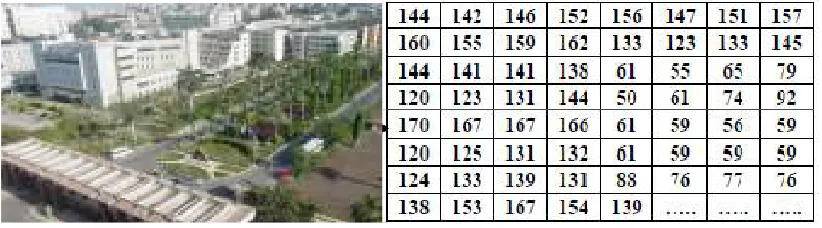
2) This step includes reading the Cover image ”Mansoura. “bmp” as shown in following fig: 3) This step converts the Cover Image from decimalformat to binary format.
Table 1: Binary data.
4) This step includes conversion of byte code into bits. Thus [10000001] is divided into 8 bits. 5) In this step, take first eight byte of original data.
Take the first byte of original data from the cover Image.
It’s very first bit of the data to be hidden:
Then replace the least significant bit:
7) Repeat this process of replacing for all bytes of cover Image: - And finally the cover image before and after steganography is shown in figure.
Fig 2: LSB Working
Fig3: Cover image before steganography.
Fig 4: Cover image after steganography.
Fig 4, shows that cover image after data encryption and embedding. In this image we have first encrypt the data using AES algorithm and then we have embedded data into image using RPP and LSB technique. This image should ensure that the quality of image should contain minimum of difference. So that attacker will not able to identify that this is stego image.
V. SIMULATION RESULTS
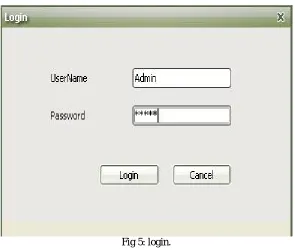
Fig 5: login.
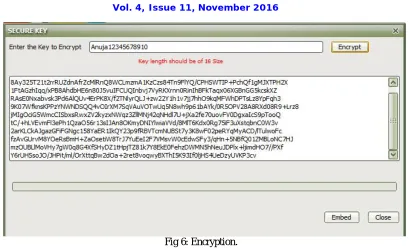
Fig 6: Encryption.
Fig 6, shows encryption screen, in this I have entered “Anuja12345678910” as a key and then I have encrypted data using that key. So this is one way of protecting data. In this receiver also contain same key to decrypt the data. For this encryption and decryption, I have used AES algorithm.
Fig7: Embedding of message into image.
the text file in which we can specify the data for hiding, same data will display in the following block. So that we can ensure the text. After continuing “Stego image” will be created.
Fig8: Image before and after message embedding.
Fig 8, illustrate that cover image before and after message embedding.it also contains value of PSNR. If the value is between 28DB to 52DB it will give assured that image is having good quality, below to that Actual data length and data embedded is specified.
Fig 9, illustrate that decoding status at receiver end. For the decoding the receiver should contain same algorithm as well as the same key which is used for the encryption.
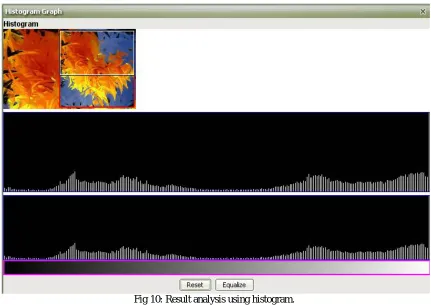
Fig 10: Result analysis using histogram.
In above simulation result analysis, system ensures security in two way, one way is to encrypt the data before embedding. And another is through embedding information in an image. Fig 2 and 5, showing encoding and decoding respectively. So at both end, sender and receiver need the same key for encryption and decryption process. Another way of security is achieved through, embedding of message, in fig 3, left hand shows image and right hand shows encrypted information which we need to embed. The quality of image is ensured by histogram and PSNR which is shown fig 4 and fig 6
.
Result set also outputted in PSNR that proves the quality, which must be between 28dB to 52dB.VI.CONCLUSION AND FUTURE WORK
This work deal with secure transmission of data. This system deals with implementation of security using stenography i.e. Hiding large amount of info in an image without disturbing the image clarity and quality. Our results indicates that the LSB insertion using random pixel prediction are best in case of lossless compression.The outcome of paper is to create a method that can effectively hide a message inside a digital image file.The paper focuses on the approach like increasing the security of the message, increase embedding capacity and reducing the distortion rate.
REFERENCES
1. Xiaocheng Hu, Weiming Zhang, Xiaolong Li, and Nenghai Yu Minimum Rate Prediction and Optimized Histograms Modification for ReversibleData Hiding IEEE Transactions On Information Forensics And Security, Vol. 10, No. 3, March 2015.
2. Wei-Liang Tai, Chia-Ming Yeh and Chin-Chen Chang,(2009), Reversible Data Hiding Based on Histogram Modification of Pixel Differences,IEEE Transaction on circuits and systems for video technology, Vol. 19, No. 6, pp. 906-910
4. ShaoweiWeng, Yao Zhao, Jeng-Shyang Pan and Rongrong Ni,(2008),Reversible Watermarking Based on Invariability and Adjustment onPixel Pairs, IEEE signal processing letters, Vol. 15, pp. 721-724.
5. B. Macq, Lossless multiresolution transform for image authenticatingwatermarking, in Proc. EUSIPCO, Sept. 2000, pp. 533536.
6. ZhenfeiZhaoa, HaoLuoc,, JengShyangPand, Reversible data hidingbased on multilevel histogram modification and sequential recovery
International Journal of Electronics and Communications, 2010.
7. J. Tian, Reversible data embedding using a difference expansion, IEEETrans. Vol. 13, No. 8, pp. 890896, Aug.2003.
8. Sunil Lee, Chang D. Yoo, Reversible Image Watermarking Based onInteger to integer wavelet transform 2007.
9. ]R. Caldelli, F. Filippini, and R. Becarelli, Reversible watermarkingtechniques: An overview and a classification, EURASIP J. Inf. Security,vol.
2010, Jan. 2010.
10. Miss AnujaBhondve, Prof. Swapnaja Suryawanshi ” Minimum rate prediction and optimized histograms modification for efficient data
hiding.” International Journal of Innovative Research in Computer and Communication Engineering(IJIRCCE) ISSN: 2320-9801 Vol. 3, Issue 11, November 2015
11. ShaoweiWeng, Yao Zhao, Jeng-Shyang Pan and Rongrong Ni,(2008), “Reversible Watermarking Based on Invariability and Adjustment on
Pixel Pairs”, IEEE signal processing letters, Vol. 15, pp. 721-724.
12. M. Wu, H. Yu, and B. Liu, “Data hiding in image and video .II. designs and applications,” IEEE Trans. Image Process., vol. 12, no. 6, pp. 696–
705, Jun. 2003.
13. I. Cox, M. Miller, J. Bloom, J. Fridrich, and T. Kalker, Digital Watermarking Steganography, 2nd ed. San Francisco, CA, USA: Morgan