
3D Model base Tracking and Recognition of
Human Movement: A Multiview Approach
Yogita G. Kothari1, Dr. Avinash D. Gawande2, Prof. Ketki R. Ingole3
M.E. Student, Department of Computer Science and Engineering, Sipna College of Engineering and Technology,
Amravati, India1
Professor & HOD, Department of Computer Science and Engineering, Sipna College of Engineering and Technology,
Amravati, India 2
Professor, Department of Computer Science and Engineering, Sipna College of Engineering and Technology,
Amravati, India 3
ABSTRACT: One of the most imperious research area is augmented reality .Augmented Reality (AR) is a technology which provides a communication between a computer-generated information and the real world of a viewer while establishing 3D registration and real time interaction. . The extensive range of application of AR and its use in various fields from games to virtual reality. As part of a wider research aiming at understanding the impact of AR on consumer psychology, this work presents a demo platform application developed for a real-time shopping experience for ornaments and attempts to define a ground base for posterior marketing research in the field. This platform will assist in exploring the previous circumstances of consumer purchase intention and in defining the way for shopping experiences with AR.
KEYWORDS: kinect device, augmented reality, NUI, virtual try-on.
I. INTRODUCTION
Trying on jwellery in stores today is one of the most time-consuming tasks. additional time is lost when taking jwellery on and off. Reducing this time and helping people to put on a large collection of ornaments in reduced time was a relevant motivation for this paper. Using modern technology - hardware as well as software - the try-on experience can be drastically improved. Even in web shops people are very specific buying jwellery because a try-on of jwellery is not possible. The techniques discussed in this paper can enhance the shopping experience. It even offers customers a more precise representation than 3D images of the jwellery they are willing to buy and therefore this may also reduce the amount of goods the buyers return.
In this paper we will introduce a Virtual try on, which offers a solution for the mentioned aspects. The application is based on a mirror, represented by a display that outputs the image of the camera. If a person is standing in front of this virtual mirror, the person will be able to select desired jwellery. The selected ornament is then virtually superimposed with the image recorded by the camera. In general, this technique can be categorized under augmented reality (AR), where a real-time view of the reality is extended and furthermore overlaid with additional information. This paper mainly focuses on the applications in jwellery stores although a home setup is possible as well.
II. RELATED WORK Kinect
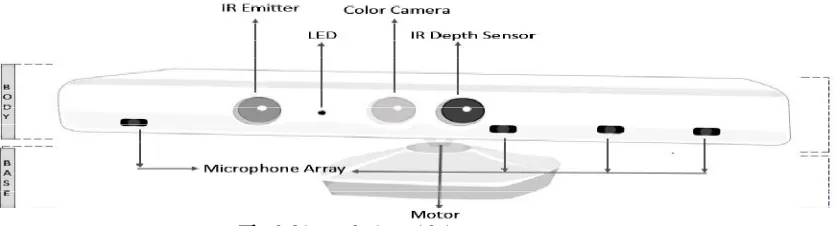
Kinect is a motion sensing input device developed by Microsoft in early 2010 [3]. Kinect is mainly used in Xbox 360 console and for Windows PCS [3]. For Windows, a Kinect sensor consists of an RGB camera which can store up to three channel data of resolution 1280×960. It has an IR (infrared) emitter which emits lights beams and an IR depth sensor that reads the reflected beams and process the information to measure the distance between the object and the sensor. It also has multi-array microphone that can capture sound and detect the location of the source and direction of the audio wave. It has a practical ranging limit of 40cm – 3.5m for Windows and the frame rate is 30 FPS (Frames per Second) [5]. Figure 1 depicted a picture of a Kinect.
Fig 1: kinect device with its components
Kinect SDK
Kinect SDK is developed to enable developers to develop applications in C# by using Microsoft Visual Studio [2]. It is capable of capturing front body 3D motion, gesture, facial and voice recognition [3], skeletal tracking and advanced audio capabilities [6]. To setup virtual mirror we need Kinect sensor to record skeleton and depth data and capture the RGB video stream.
Core of the Kinect for the set of Windows API, supports fundamental image and device management features like access to the Kinect sensors that are connected to the computer, access to image and depth data streams from the Kinect image sensors and delivery of a processed version of image and depth data to support skeletal tracking. Figure 2 shows interaction method of sensor Hardware with software of an application.
III. PROPOSED WORK
System Design
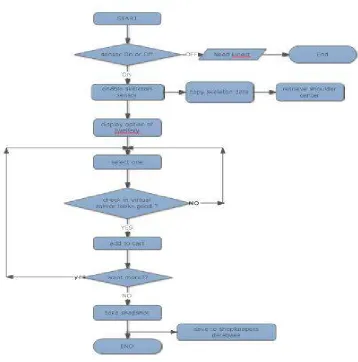
The camera continuously captures the image of the user and displayed on the desktop screen. Once the skeleton or body tracing by the kinect it get stress in data base till the application ends. Then user is allowed to select the jwellery model from the given database. Using the lower body detection algorithm is shoulder center points are detected and positioned the 3D jwellery model on the user’s body. Then scale the jwellery model as required by using Euclidian distance between body joints and distance of the user from camera. Then superimposition of the jwellery model takes place on the user’s image. After that the superimposed image is displayed on the screen. If the user selects that model to buy, then remove that jwellery model from the database and keep the user’s record. The system architecture of real time virtual mirror is shown in the fig.
System Implementation
Color Stream
Color Stream is mainly used to display the view of the camera from the Kinect to the display or screen. Kinect provides color image data in different formats and resolutions. The color stream is displayed in an image on WPF which is continuously updated by each color stream packet.
Color Format Description
RGB 32-bit, linear X8R8G8B8-formatted color bitmaps RgbResolution640x480Fps30 or RgbResolution1280x960Fps12 or
YuvResolution640x480Fps15 color formats
YUV 16-bit, gamma-corrected linear UYVY-formatted color bitmaps RawYuvResolution640x480Fps15 color data formats YUV data is available only at the 640x480 resolution and only at 15 fps.
Bayer 32-bit, linear X8R8G8B8-formatted color bitmaps RawBayerResolution1280x960Fps12 or RawBayerResolution640x480Fps30 color formats
The format defines whether the data stream in encoded as RGB, YUV, and Bayer. Resolution is about how the bandwidth is used. Through USB connection Kinect sensor provides a specific range of bandwidth for passing data. High- resolution images send more data per frame and update less frequently, while lower-resolution images update more frequently, with some loss in image quality due to compression [3]. Table specifies available formats for color stream data [4].To display the sensor camera view to screen we have used Color Frame class. All the image data and format are present in this class. We have used RgbResolution640x480Fps30 as the color format to achieve maximum display output. The image data is stored as a pixel array. Then a Writeable Bitmap is declared to store the pixel data and displayed through display source.
Tracking (Skeleton)
Fig4: 20 joints track by kinect
Gesture Recognition
In our final system we have used Gesture Recognition technology in the user interface. This gesture recognition enables the user to change the jwellery the by swipe of their hand. It is very efficient as the user stands in a little distance from display or screen and cannot use touch-screen or other technology to change the jwellery.
To gesture recognition work successfully we have used a built-in class called Recognizer. This class recognizes the left Swipe and right Swipe when the user’s left hand and right hand is swiped over the Kinect sensor. When right hand swipe is detected then next is shown in screen. And when left hand swipe is detected then previous jwellery.
User Interface
As this is a virtual mirror and it can be implemented anywhere from jwellery store to personal mirror at home, there is no need of external display for the application interface. The virtual mirror is used to show the interface for the customer and it is controlled by gesture recognition feature of Kinect. Particularly swipe gesture will be implemented and will be distinguished by right and left swipe method. This swipe method can be tracked by kinect sensor and also implemented by using the Kinect sensor. By using this feature user will be able to choose their desired jwellery to display.
3D Interaction Components
IV. EXPRIMENTAL RESULT
(a) (b)
Fig5: (a) kinect and laptop setup (b) virtual necklace on human body
Above fig shows the result of proposed work. Figure (a) shows the setup or we can say the position of laptop and the position of kinect device and also where we have to place the device so that we can get the result. Kinect device first track the whole body as given above using skeleton tracking technique. Device tack all the points to verify the human body. at one time only one body get track by kinect in this project after tracking the body the program search for the neck and after that the selected necklace placed on neck virtually. As shown in fig 5 (b).
V. CONCLUSION
VI. FUTURE WORK
There are many possible implementations using kinect regarding the model used for fitting. It is possible to apply a homographic transformation to the images rather than the simple scale-rotate technique in order to match multiple joints altogether although it would require more computation.
This can also result in an additional feature for a web shop, for instance. It would allow a virtual try-on of jwellery before people are buying it online, taking a closer look at the ornaments and even conveying the actual behavior of the real jwellery. This demonstrates a huge advantage over the common web shopping experience.
Second approach would also make it possible to implement a physics engine to go along with the model. Regarding future work, the Virtual mirror enhanced in some points. Primarily taking a look at the RGB camera of the Kinect sensor, an improvement concerning its resolution can be meaningful. The current resolution of 640x480 is quite low which results in a bad quality of the recorded scene.. Of course, this would need a careful calibration, also implicating the position of the camera regarding the Kinect’s depth sensor.
Other one improvement could be the implementation of a complete scanning procedure of the body that is executed prior to the tracking process. This would result in a more precise adaption of the cloths and can further include the depth/size measurements of a body.
REFERENCES
[1] A.B. Habib, A. Asad, W.B. Omar, “Magic Mirror Using Kinect,” BRAC University (2015).
[2] S. Giovanmi, Y.C. Choi, J. Huang, E.T. Khoo, K. Yin, “Virtual try-on using Kinect and HD Camera,” MIG-2012, vol. 7660, pp. 55-65, (2012). [3] [online] http://www.dmi.unict.it/~battiato/CVision1112/Kinect.pdf.
[4] Ashvini G.Bais, Yogita G. Kothari, Sarika U. Aswar “ Kinect: Platform for Augmented Reality” IJEREEE Vol 3, Issue 2, February 2017 [5] [online] https://msdn.microsoft.com/en-us/library/jj131033.aspx.
[6] H. Fairhead, “All About Kinect,”. Retrieved from http://www.i-programmer.info/babbages bag/2003-kinect-the-technology-.html.
[7] G. Yolcu, S. Kazan, and C. Oz, “Real Time Virtual Mirror Using Kinect,” Baikan journal of Electrical & Computer Engineering, vol. 2, no. 2, pp. 75-78, (2014).
[8] [online] http://home.hit.no/~hansha/documents/microsoft.net/tutorials/ introduction%20to%20visual%20 studio/Introduction% 0to%20Visual%20Studio%20and%20CSharp.pdf.
[9] Md. Moniruzzaman Monir , Md. Nafis Hasan Siddique, Afsana Pervin Tanni, Md. Nahyan Ebn Hashem “Design and Implementation of a Magic Mirror Using Kinect” BARC university2016.
[10] [online]https://msdn.microsoft.com/en-us/library/dn188678.aspx
[11] A. Sur, Visual Studio 2012 and .NET 4.5 Expert Development Cookbook, vol.1, Chapter No. 1 “Introduction to Visual Studio IDE Features ”( 2013).
[12] Y.G.Kothari A.D. Gawande, K.R. Ingole “Digital interaction with kinect :review” International Conference On Emanations in Modern Technology and Engineering (ICEMTE-2017) ISSN: 2321-8169 Volume: 5 Issue: 3 262 – 265 (2017).
BIOGRAPHY
.
Dr. Avinash D. Gawande is a professor and Head of Compute Science and Engineering department of Sipna College of engineering and technology, Amravati. He has 21 year teaching experience. His research interests are signal processing, Information storage and data recovery.
![Figure 4 shows the joint points of a human body detected by Kinect [8]. This method can recognize or locate or track 20 joint points as skeleton of the person](https://thumb-us.123doks.com/thumbv2/123dok_us/1397433.1172442/4.595.76.521.273.453/figure-points-detected-kinect-method-recognize-locate-skeleton.webp)
