Scholarship at UWindsor
Scholarship at UWindsor
Electronic Theses and Dissertations Theses, Dissertations, and Major Papers
2018
Simple and Complex Human Action Recognition in Constrained
Simple and Complex Human Action Recognition in Constrained
and Unconstrained Videos
and Unconstrained Videos
Eman Mohammadi Nejad University of Windsor
Follow this and additional works at: https://scholar.uwindsor.ca/etd
Recommended Citation Recommended Citation
Mohammadi Nejad, Eman, "Simple and Complex Human Action Recognition in Constrained and Unconstrained Videos" (2018). Electronic Theses and Dissertations. 7383.
https://scholar.uwindsor.ca/etd/7383
This online database contains the full-text of PhD dissertations and Masters’ theses of University of Windsor students from 1954 forward. These documents are made available for personal study and research purposes only, in accordance with the Canadian Copyright Act and the Creative Commons license—CC BY-NC-ND (Attribution, Non-Commercial, No Derivative Works). Under this license, works must always be attributed to the copyright holder (original author), cannot be used for any commercial purposes, and may not be altered. Any other use would require the permission of the copyright holder. Students may inquire about withdrawing their dissertation and/or thesis from this database. For additional inquiries, please contact the repository administrator via email
in Constrained and Unconstrained Videos
By
Eman Mohammadi Nejad
A Dissertation
Submitted to the Faculty of Graduate Studies
through the Department of Electrical and Computer Engineering in Partial Fulfilment of the Requirements for
the Degree of Doctor of Philosophy at the University of Windsor
Windsor, Ontario, Canada
2018
c
Videos
by
Eman Mohammadi Nejad
APPROVED BY:
G. Fortino, External Examiner University of Calabria
J. Lu
School of Computer Science
K. Tepe
Department of Electrical and Computer Engineering
B. Shahrrava
Department of Electrical and Computer Engineering
M. Saif, Co-advisor
Department of Electrical and Computer Engineering
J. Wu, Advisor
Department of Electrical and Computer Engineering
I. Co-Authorship
I hereby declare that this thesis incorporates material that is result of joint research, as
follows: This dissertation incorporates the outcome of a joint research undertaken in
col-laboration with Dr. Yimin Yang under the supervision of professors Jonathan Wu and
Mehrdad Saif. The collaboration is covered in Chapters 3, 4, 5 and 6 of the dissertation.
In all chapters, the key and primary contributions, experimental designs, data analysis and
interpretation, were implemented by the author, and the contributions of the co-authors
were primarily through the provision of proof reading and reviewing the research papers
regarding the technical and vocabulary contents.
I am aware of the University of Windsor Senate Policy on Authorship and I certify that
I have properly acknowledged the contribution of other researchers to my thesis, and have
obtained written permission from each of the co-author(s) to include the above material(s)
in my thesis.
I certify that, with the above qualification, this thesis, and the research to which it refers,
is the product of my own work.
II. Previous Publication
This thesis includes 6 original papers that have been previously published/submitted for
Chapter status
Chapter 3 E. Mohammadi, Q.M. Jonathan Wu, M. Saif, ”Human
Activity Recognition Using an Ensemble of Support
Vec-tor Machines,” Proceedings of International Conference
on High Performance Computing and Simulation (HPCS),
Innsbruck-Austria, 2016.
Published
E. Mohammadi, Q.M. Jonathan Wu, M. Saif, ”Human
Ac-tion RecogniAc-tion by Fusing the Outputs of Individual
Clas-sifiers,” Proceedings of Computer and Robot Vision (CRV),
Victoria-BC, 2016.
Published
Chapter 4 E. Mohammadi, Q.M. Jonathan Wu, M. Saif, Y. Yang,
”Ef-fect of Wavelet and Hybrid Classification On Motion Based
Features,” Proceedings of International Conference on
Im-age Processing (ICIP), Beijing-China, 2017.
Published
Chapter 5 E. Mohammadi, Q.M. Jonathan Wu, M. Saif, ”Improved
Rank Pooling Strategy for Complex Action Recognition,”
IEEE International Conference on Systems, Man, and
Cy-bernetics (SMC), Banff-AB, 2017.
Published
E. Mohammadi, Q.M. Jonathan Wu, Yimin Yang, M. Saif,
”Hierarchical Feature Representation for Unconstrained
Video Analysis,” Neurocomputing Journal.
Accepted
with
Revi-sion
Chapter 6 E. Mohammadi, Q.M. Jonathan Wu, M. Saif, Yimin Yang,
”Key Action Perception for Constrained and Unconstrained
Video Analysis,”IEEE Transactions on Circuits and
Sys-tems for Video Technology.
Under
Re-view
I certify that I have obtained a written permission from the copyright owner(s) to include
the above published material(s) in my thesis. I certify that the above material describes
I declare that, to the best of my knowledge, my thesis does not infringe upon anyone’s
copyright nor violate any proprietary rights and that any ideas, techniques, quotations, or
any other material from the work of other people included in my thesis, published or
oth-erwise, are fully acknowledged in accordance with the standard referencing practices.
Fur-thermore, to the extent that I have included copyrighted material that surpasses the bounds
of fair dealing within the meaning of the Canada Copyright Act, I certify that I have
ob-tained a written permission from the copyright owner(s) to include such material(s) in my
thesis. I declare that this is a true copy of my thesis, including any final revisions, as
ap-proved by my thesis committee and the Graduate Studies office, and that this thesis has not
Human action recognition plays a crucial role in visual learning applications such as video
understanding and surveillance, video retrieval, human-computer interactions, and autonomous
driving systems. A variety of methodologies have been proposed for human action
recogni-tion via developing of low-level features along with the bag-of-visual-word models.
How-ever, much less research has been performed on the compound of pre-processing, encoding
and classification stages. This dissertation focuses on enhancing the action recognition
per-formances via ensemble learning, hybrid classifier, hierarchical feature representation, and
key action perception methodologies.
Action variation is one of the crucial challenges in video analysis and action
recog-nition. We address this problem by proposing the hybrid classifier (HC) to discriminate
actions which contain similar forms of motion features such as walking, running, and
jog-ging. Aside from that, we show and proof that the fusion of various appearance-based and
motion features can boost the simple and complex action recognition performance.
The next part of the dissertation introduces pooled-feature representation (PFR) which
is derived from a double phase encoding framework (DPE). Considering that a given
uncon-strained video is composed of a sequence of simple frames, the first phase of DPE generates
temporal sub-volumes from the video and represents them individually by employing the
proposed improved rank pooling (IRP) method. The second phase constructs the pool of
features by fusing the represented vectors from the first phase. The pool is compressed and
then encoded to provide video-parts vector (VPV). The DPE framework allows distilling
the video representation and hierarchically extracting new information. Compared with
recent video encoding approaches, VPV can preserve the higher-level information through
standard encoding of low-level features in two phases. Furthermore, the encoded vectors
from both phases of DPE are fused along with a compression stage to develop PFR.
The real-world long-shot video streams contain complicated contents and editing
analyz-action perception (KAP) along with a robust video analyz-action clustering for unconstrained and
constrained video analysis. The KAP includes two classifiers: the former detects the key
action among multiple temporal clusters, and the latter recognizes the key action which is
obtained by the former classifier. The video action clustering is the essential pre-processing
step for KAP implementation. The sequential relationship of the video frames and
com-plexity of motion representations provide challenges in video action clustering. We propose
two novel multi-layer subspace video action clustering (ML-VAC) techniques to encode the
sequential relationships of constrained and unconstrained video frames without having any
prior knowledge about the number of temporal clusters in a given video.
We evaluate the proposed techniques on simple and complex datasets, such as UCF50,
HMDB51, Hollywood2, KTH, Weizmann, URADL, UCF101, Olympic Sports, and Keck
Gestures. The employed datasets contain constrained and unconstrained video samples to
to my
I would like to express my special appreciation and thanks to my advisor, Dr. Q.M.
Jonathan Wu and co-advisor, Dr. Mehrdad Saif for giving me the opportunity to work
under their supervision as well as for their guidance and support in my research.
Addi-tionally, I like to thank the committee members, Dr. Behnam Shahrrava, Dr. Jianguo Lu,
and Dr. Kemal Tepe for taking time out of their busy schedule to come over and help me
with their insightful comments and encouragement. I like to convey my sincere gratitude to
Dr. Louise Rueda, who helped me to learn the fundamental items of the machine learning
domain through his course on pattern recognition. Furthermore, I sincerely appreciate the
department graduate secretary Ms. Andria Ballo for all her support and guidance. I like to
convey my sincere thanks to Dr. Yimin Yang who has continuously spent time and energy
in reviewing my papers. I sincerely thank my beloved wife, Atefeh, who continuously
mo-tivated me and stayed beside me throughout my Ph.D. program. I thank my fellow labmates
for the stimulating discussions and for all the fun we have had in the last few years. Words
cannot express how grateful I am to my mother, father, my mother-in-law, and father-in-law
for all of the sacrifices that they have made on my behalf. Their prayer for me was what
sustained me thus far. Finally, I convey my sincere thanks to Wikipedia, Google, and the
researchers around the world, helping me to grow my knowledge and figure out the right
Declaration of Co-Authorship and Previous Publication III
Abstract VI
Dedication VIII
Acknowledgements IX
List of Tables XIII
List of Figures XIV
List of Abbreviations XVIII
1 Introduction 1
1.1 Video Action Recognition . . . 1
1.2 Motivation . . . 2
1.2.1 Applications . . . 3
1.3 Research Challenges . . . 5
1.4 Objective and Contributions . . . 10
1.5 Organization of Thesis . . . 12
2 Related Work and Datasets 14 2.1 Overview . . . 14
2.2 Holistic Representations . . . 15
2.3 Local Representations . . . 18
2.3.1 Feature Detectors . . . 18
2.3.2 Feature Descriptors . . . 20
2.3.3 Feature Encoding . . . 22
2.4 Higher-level Representations . . . 24
2.5 Classification Modules . . . 26
2.6 Video Action Clustering . . . 28
2.7 Video Datasets . . . 30
2.8 Summary . . . 33
3 Effect of Ensemble Learning on Simple and Complex Action Recognition 38 3.1 Overview . . . 38
3.2 Ensemble Learning Framework for Action Recognition . . . 39
3.2.1 Dempster-Shafer Fusion . . . 40
3.2.2 Algebraic Combiners . . . 43
3.2.3 Classification . . . 44
3.3 Experiments . . . 44
3.3.1 Experimental Setup . . . 45
4 Effect of Hybrid Classifier on Action Recognition Performance 50
4.1 Overview . . . 50
4.2 Proposed Framework . . . 51
4.2.1 Preprocessing and Feature Extraction . . . 51
4.2.2 Hybrid Classification . . . 53
4.3 Experiments and Results . . . 58
4.3.1 Datasets . . . 58
4.3.2 Effect of motion saliency map on action recognition . . . 59
4.3.3 Evaluation of hybrid classifier . . . 59
4.3.4 Results . . . 60
4.4 Summary . . . 61
5 Hierarchical Feature Representation for Complex Action Recognition 63 5.1 Overview . . . 63
5.2 Proposed Framework . . . 65
5.2.1 Improved Rank Pooling . . . 65
5.2.2 Double Phase Encoding . . . 69
5.2.3 Pooled-Feature Representation . . . 78
5.2.4 Classification Strategy . . . 80
5.3 Experiments and Results . . . 83
5.3.1 Evaluation of Improved Rank Pooling . . . 83
5.3.2 Evaluation of Pooled-Feature Representation . . . 88
5.4 Summary . . . 97
6 Key Action Perception for Constrained and Unconstrained Video Analysis 100 6.1 Overview . . . 100
6.2 Video Analysis with Key Action Perception . . . 101
6.2.1 Key Action Perception (KAP) . . . 101
6.2.2 Video Action Clustering . . . 102
6.3 Experimental Results . . . 111
6.3.1 Datasets . . . 112
6.3.2 Evaluation of Video Action Clustering Algorithms . . . 112
6.3.3 Evaluation of KAP Performance . . . 115
6.3.4 Discussion . . . 121
6.4 Summary . . . 123
7 Conclusion and Perspectives 124 7.1 Contributions and Limitations . . . 124
7.1.1 Ensemble Learning for Action Recognition . . . 125
7.1.2 Hybrid Classifier . . . 125
7.1.3 Hierarchical Feature Representation . . . 126
7.1.4 Key Action Perception . . . 127
7.1.5 General Summary . . . 128
2.7.1 Specification of the employed benchmark datasets to evaluate the proposed
methods in this dissertation . . . 31
3.3.1 Accuracies of Action Recognition using Single Classifiers . . . 46
3.3.2 Accuracies of Action Recognition using Ensemble of Classifiers . . . 48
4.3.1 Comparison of our results based on hybrid classifier to the state-of-the-arts . 61
5.2.1 Notations to be used in the proposed video analysis framework . . . 75
5.3.1 Actual thresholding values for the similarity detection and elimination based
on cosine and correlation distance metrics . . . 85
5.3.2 Comparison of our results, based on IRP, to the state-of-the-arts . . . 87
5.3.3 Defining the best number of temporal sub-volumes to yield feature sets in
the first phase of DPE. . . 90
5.3.4 Comparison of sigmoid and sine activation functions in LSN over six
bench-mark datasets. . . 95
5.3.5 Comparison of our results, based on PFR, to the state-of-the-arts . . . 98
6.3.1 Comparison of proposed ML-VAC to the state-of-the-arts . . . 115
6.3.2 KAP evaluation based on different similarity scores for merging the
conse-quent identical temporal blocks. . . 118
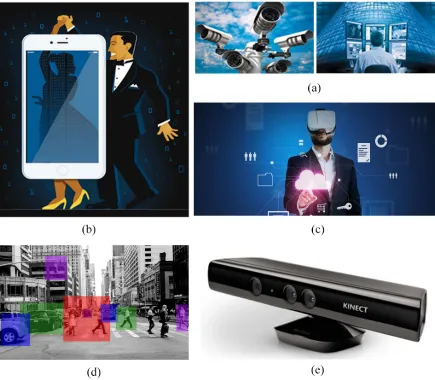
1.2.1 The important samples of applications based on human action recognition
frameworks. The (a) refers to video surveillance systems; (b) refers to
tele-immersion application; (c) shows the human-computer interaction; (d)
refers to the advanced deriving systems; and (e) shows the Kinect sensor. . . 6
1.3.1 The frame samples of a video stream to demonstrate the overall challenges
in the action recognition domain. . . 9
2.2.1 The motion energy image and motion history image for temporal template
matching [1]. . . 16
2.2.2 (a) demonstrates the three-dimensional shapes using silhouettes [2], (b)
shows the solution to the Poisson equation on space-time shapes [2], (c)
depics the local space-time saliency features [2]. . . 17
2.3.1 The general framework of bag of visual words model for video action
recognition. . . 18
2.3.2 Detection of spatio-temporal interest points from the movements of the legs
while performing walking action [3]. . . 19
2.3.3 The results of Hessian3D detector with different thresholding values to
ex-tract sparse and dense sets of interest points [4]. . . 20
2.3.4 The dense trajectory structure including HOF, HOG, and MBH feature
de-scriptors [5]. . . 21
2.3.5 The results of the MBH descriptor for ignoring the irrelevant moving
ob-jects from cluttered background [5]. . . 22
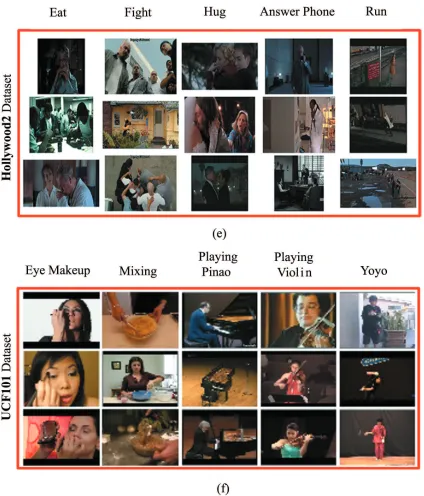
2.7.1 The samples of video frames from six benchmark datasets to evaluate the
spectives. . . 41
3.2.2 The form of the decision profile in DS fusion method. . . 43
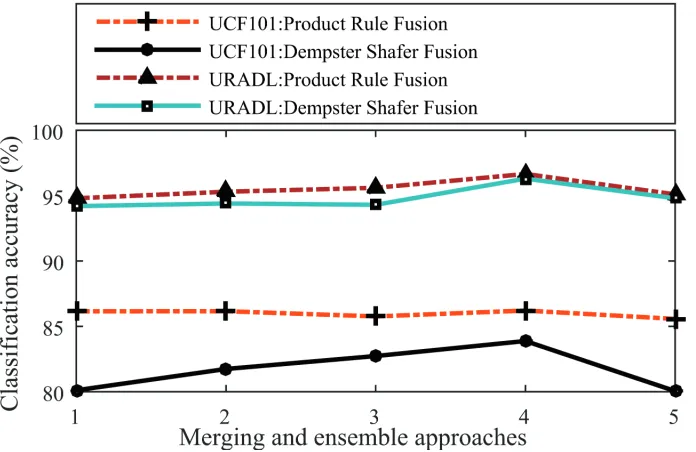
3.3.1 The attained accuracies using five types of merging and ensemble approaches
for UCF101 and URADL datasets . . . 47
4.1.1 The enhanced action recognition framework by adding the pre-processing
and hybrid classifier stages to the BoVW model. . . 52
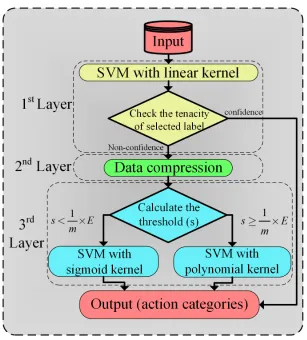
4.2.1 The proposed hybrid classifier for action classification. . . 54
4.2.2 Structure of DL-SNN for compressing the encoded features at the second
layer of hybrid classifier. The (a) is the feature mapping layer; (b) and (c)
refer to the networks with feature mapping and learning layers; (d) shows
the double layer network with sub-network nodes including two feature
mapping and single learning layer. . . 56
4.3.1 The recognition performance of HOF and W-HOF based on the traditional
linear SVM and proposed hybrid classifier on three employed datasets. The
horizontal axis refers to the percentages of action recognition accuracy over
three datasets. . . 59
4.3.2 Evaluation of a set of dimensions for compressing the features at the second
layer of hybrid classifier. . . 60
5.2.1 Protracted and consequent removal schemes over an example. (a) and (b)
show the original and clean feature sets based on the protracted scheme.
(c) and (d) show the original and clean feature sets based on the consequent
scheme. . . 68
5.2.2 The proposed double phase encoding (DPE) framework for unconstrained
video analysis. . . 70
5.2.3 Video action recognition framework based on the first and second DPE
phases and standard Fisher encoding. . . 72
5.2.4 Different layers of the Double-Layer Net with Sub-Network Nodes. (a)
5.2.6 The first and second PFR options to obtain the PFR-LF and PFR-EF. . . 79
5.2.7 (a) LSN with one sub-network hidden node. (b) The sub-network hidden
node can be considered as a standard SLFN withmhidden nodes. . . 82
5.3.1 Action recognition performance using the improved rank pooling algorithm
based on cosine (a) and correlation (b) distance metrics. . . 84
5.3.2 The action recognition performance on individual classes of Hollywood-2
dataset . . . 87
5.3.3 The effect of different codebook dimensions while encoding the features
for six employed datasets. . . 91
5.3.4 Evaluation of different compression rates at the second phase of DPE for
the employed datasets. . . 92
5.3.5 Evaluation of compression rates to create PFR-EF and PFR-LF feature
vec-tors over six benchmark datasets. . . 94
5.3.6 The effect of video length on IRVs and VPV performances over UCF50
dataset. . . 95
5.3.7 Compare the action recognition performances using VPV, IRVs, SFV,
PFR-EF, and PFR-LF. . . 96
6.2.1 Proposed key action perception framework including unsupervised and
su-pervised sections. . . 101
6.2.2 Proposed ML-VAC for unconstrained video action clustering (UVAC). . . . 103
6.2.3 The framework of coding matrix generation for constrained video action
clustering (CVAC). . . 107
6.2.4 The affinity graph (G) which is derived from the generated coding matrix
(Z). . . 109
6.3.1 (a) The affinity graphGbased on combination of 5 actions from Weizmann
dataset. (b) The affinity graph of the sample from Hollywood2 dataset
ception. . . 119
6.3.3 Effect of different coding matrix dimensions on video action clustering and
key action perception algorithms. . . 119
6.3.4 The high peaks on the smoothed 1-D signal show the starting and ending
frame indexes for each temporal cluster. . . 120
6.3.5 Effect of the video length on the clustering approaches and KAP
HC: Hybrid Classifier
PFR-EF: Pooled Feature Representation with Early Fusion
PFR-LF: Pooled Feature Representation with Late Fusion
DPE: Double Phase Encoding
IRP: Improved Rank Pooling
VPV: Video Parts Vector
KAP: Key Action Perception
ML-VAC: Multi-layer Subspace Video Action Clustering
UCAV: Unconstrained Video Action Clustering
CVAC: Constrained Video Action Recognition
HOG: Histogram of Oriented Gradients
HOF: Histogram of Oriented Flows
MBH: Motion Boundary Histograms
IRV: Individual Represented Vectors
LSN: Learning Strategy with Sub-Network Nodes
SVM: Support Vector Machine
ELM: Extreme Learning Machine
IDT: Improved Dense Trajectory
DS: Dempster Shafer
PCA: Principal Component Analysis
GMM: Gaussian Mixture Model
FVE: Fisher Vector Encoding
RSS: Random Subset Selection
DL-SNN: Double Layer Net with Sub-Network Nodes
Introduction
In this chapter, we introduce the topic of this Ph.D. dissertation, simple and complex action
recognition in constrained and unconstrained videos in Section 1.1. Next, we present the
motivation of enhancing the action recognition performances in Section 1.2. Then, we
clar-ify the research challenges related to simple and complex action recognition in Section 1.3.
The objective and major contributions of our work are presented in Section 1.4. Finally, we
explain the structure of this dissertation in Section 1.5.
1.1
Video Action Recognition
Nowadays, video streams and video cameras are considered as crucial parts of human life.
The video cameras are utilized in different public and private places such as homes, banks,
schools, hospitals, and many other locations. The required hardware for capturing and
storing the videos is becoming more and more available among societies. Mobile phones,
tablets, computers, laptops, and on-the-shelf cameras can capture, save, and distribute video
streams. The captured video streams are considered as valid forms of transferring
informa-tion in different real-world scenarios such as video surveillance and healthcare applicainforma-tions.
However, monitoring of captured videos is a tough task due to the lack of human resources
and privacy issues. Instead of human resources, intelligent systems can be employed to
monitor and analyse video streams. The affordable, powerful, and rapidly evolving
sys-tems can analyse video streams much faster than human resources.
Human action recognition plays a prominent role in video analysis and visual learning
frameworks. The goal of human action recognition is to automatically analyse ongoing
more extreme and continuous scenario, the starting and ending frames of all activities from
an input video must be detected and followed by an action recognition framework.
Sim-ple actions have the property of simplicity and periodicity such as walking, boxing, and
running. Therefore, they can be easily recognized due to their simplicity and limited
view-points. However, complex action recognition is considered as a challenging task due to
viewpoint changes, cluttered backgrounds, and motion speed variations. Furthermore, the
same class of a complex action may contain a huge intra-class appearance and motion
vari-ations. Consequently, complex actions contain longer and sophisticated temporal structures
compare to the simple actions. The constrained videos are captured with the stable cameras
and backgrounds. In other words, the camera is not moving while capturing the constrained
videos. However, unconstrained videos are captured with the dynamic cameras and
back-grounds. A given unconstrained video may contain complex contents including numerous
human actions. Thus, analysis of an unconstrained video is a very challenging task and
requires sophisticated algorithms compare to the constrained video analysis.
We believe that different types of frameworks with a variety of complexities can be
applied to recognize human actions in constrained and unconstrained videos. These
frame-works are applied to different applications with a prior knowledge about the video types.
For instance, the video surveillance and entertainment applications usually deliver
con-strained videos since the cameras and backgrounds are stable. In this dissertation, we
en-hance the simple and complex action recognition in constrained and unconstrained videos
via supervised learning. Our ultimate goal is to boost the action recognition performances
in constrained and unconstrained videos by learning actions from training video samples
and recognizing them in unseen and realistic video settings. It is worth pointing out that
we learn action models using training video samples and their labels. Then, we apply the
unseen videos into the trained models to recognize actions.
1.2
Motivation
Many of the video analysis approaches are dependent on the action recognition
building blocks in diverse applications such as video retrieval, healthcare monitoring,
nat-ural human-machine interaction, video surveillance, autonomous driving platforms,
tele-immersion systems, and digital entertainment [6, 7, 8, 9]. We believe that boosting the
action recognition performances aims to design and develop powerful video analysis
sys-tems in different industrial domains. This section describes the most important applications
which can benefit from action recognition algorithms (see Figure 1.2.1).
1.2.1
Applications
Video Retrieval. Nowadays, people pay more attention to record their daily activities
using digital cameras and upload the video streams on the internet. The rapid growing of
the video streams leads to having problems of categorizing the available videos according
to their contents and existing human actions in videos. Furthermore, the developments of
social and semantic web applications have inspired the advancement of video retrieval and
annotation tools using action recognition frameworks. Manual classification of uploaded
videos into a variety of groups is a tremendously time-consuming and impossible task. The
field of video action recognition has attracted considerable attention to addressing the issue
of video retrieval in an automatic format. Previous video retrieval approaches aimed to
solve this problem via a pattern recognition framework which is trained using the features
from training videos and enables the intelligent system to categorize the video actions in
new unseen samples. Altogether, action recognition systems and video understandings are
highly essential and unavoidable for applicable video retrieval systems.
Video Surveillance. Recently, video surveillance cameras have widely accepted by
societies and employed in a variety of public and private locations such as airports, train
stations, shopping malls, banks, casinos, swimming pools, cinemas, and parking lots. The
ultimate goal of video surveillance systems is to detect intrusion and analysis of human
be-havior. There are numerous real-world applications which require the benefits from video
surveillance systems. The intelligent systems can watch for kids and monitor their
be-haviors when the parents are away. The intelligent cameras can be employed to properly
world encourage the usage of intelligent cameras to monitor people in public places. All in
all, video surveillance cameras are becoming more often to detect and even prevent
secu-rity violations. The rapid growing of the installed video surveillance cameras in different
locations shows the increased demands for reliable action recognition systems.
Tele-Immersion Systems.Tele-immersion is an advanced form of virtual reality which
aims people who are widely separated from each other to work and share experiences
to-gether as if they were located in the same environment. There are numerous potential
appli-cations for tele-immersions such as design and virtual prototyping, maintenance and repair,
and surgical activities. In a tele-immersive environment, intelligent systems localize and
recognize human actions along with the physical and virtual objects. Then, the people and
objects are projected in realistic and geographically distributed immersive environments.
Human action detection and recognition play a crucial factor in tele-immersion
applica-tions where people and their acapplica-tions must be recognized and projected to an immersive
space.
Driver Assistance Systems. The advanced generation of driver assistance systems is
capable of considering driver preferences, driver intentions, and the overall traffic
condi-tions. Human action prediction is necessary to monitor people around a car and control
the car’s movements automatically. From the other side, action recognition is an important
factor to monitor the driver and alarm about the consciousness based on the movements of
the hands and body of the driver.
Health Care Monitoring.Nowadays, the population of old people is rapidly increased
around the world. Thus, there is a fast increasing demand for intelligent systems which aim
to detect and emerge about upcoming and existing physical and mental health problems of
old people and patients. For the purpose of healthcare monitoring of elderly people and
patients, the human action and behavior recognition is becoming more and more important
and widely utilized in communities. Detecting, recognizing, and recording the time and
lo-cation of daily human activities such as housekeeping, walking, food preparation, sleeping,
and exercise, allows medical scientists to offer appropriate strategies to improve diet and
medication adherence.
interaction is a communication format between users and digital devices. The flow of
data between the user and device is described as the loop of interaction. Nowadays, video
cameras and visual learning frameworks are considered as the main loop of interaction to
provide a natural and intuitive way of human interaction with a digital equipment. The
Microsoft Kinect sensor (see Figure 1.2.1(e)) is one of the digital interacting equipments,
available in millions of homes around the world. Kinect includes efficient motion sensors
which allow users to control and interact with it through a natural user interface.
Conse-quently, human gesture and action recognition is the key factor for the Kinect and other
available interacting devices.
1.3
Research Challenges
Video action recognition is a challenging task despite significant efforts by the image
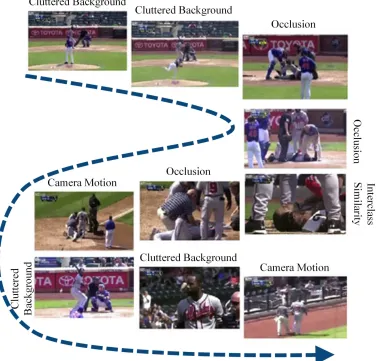
pro-cessing and computer vision scientists. Figure 1.3.1 depicts the frame sequences from a
complex video to justify the challenges in the video analysis and action recognition
do-main. In this section, we present several research challenges in the field of video action
recognition.
Occlusion. The general action recognition algorithms assume to clearly see the
per-formed action in video streams. In the real-world scenario, we always encounter extreme
cases where people are occluded while performing an action. The occlusions can be
hap-pened by the objects or people which are located in the field of view of the camera. Since
some of the body parts are not visible during occlusions, analyzing and recognizing an
action is very challenging in extreme cases. Figure 1.3.1 depicts some moments with
oc-clusions from a given video.
Volumetric analysis of actions via local features aims to address this challenge by
analy-sis entire spatiotemporal volumes of a given video. In this case, local features are extracted
when they are not occluded and this is considered as enough informative data for action
recognition. The local appearance and motion features can categorize actions via
analy-sis of tiny patches. Additionally, the local representations aim to deal with illumination,
pointing out that selection of the informative local features and patches is an open problem
in the computer vision domain.
Viewpoint Variations. The angle of the camera to a subject directly affects the action
recognition performances. Most of the conventional visual learning frameworks assume to
see an action from a fixed viewpoint. However, in the real-world cases, the videos can be
captured using different points of views. In different positions of a camera, the posture and
form of a body are changed considerably. Consequently, the appearance and motion-based
features are changed based on a variety of body poses derived from different camera angles.
Increasing the number of training samples from different viewpoints of cameras is the
most effective solution for this challenge. Thus, the features from the same action and
different viewpoints are utilized to train a single classifier. Alternatively, we can capture
several videos from different points of views on a subject. Then, the features from a variety
of viewpoints can be synthesized to create a more robust feature vector for action
recog-nition. We can classify actions using different feature sets in two formats: first, the single
classifier can be trained using the fused feature vector inspired by concatenation of
indi-vidual features. Second, several single classifiers can be trained using indiindi-vidual feature
sets. Then the scores of single classifiers are fused to make the final decision about a given
video. Chapter 3 of this dissertation evaluates different strategies to fuse individual feature
sets and enhance the action recognition performances in constrained and unconstrained
videos.
Camera Motion. The dynamic of cameras highly affects action recognition
perfor-mances since redundant and unnecessary motion features are extracted along with the
in-formative features in unconstrained conditions. Figure 1.3.1 shows several moments with
camera motion while capturing the video. In this case, the irrelevant features are extracted
from the background and included in the feature sets of walking action. Recently, the
mo-tion boundary histograms (MBH) have been proposed by [10] to address this issue. MBH
is obtained by computing the derivatives of motion patterns and aims to use the
trajec-tories from humans and objects of interests. The MBH enhances the action recognition
performance using the motion features derived from optical flow.
from person to person, which leads to the intraclass variations. Furthermore, the speed
and strength of action performance highly affect the interclass gaps. For instance,
walk-ing action can be performed slowly or rapidly based on the age, shape, and other physical
properties of different people. Additionally, there is no guarantee that a person will
iter-ate the action at the same speed and strength every time. From the other side, any video
dataset may contain similar classes such as running, walking and jogging. The similar
activities may express identical shapes and provide comparable probabilities while
classi-fying a video based on the actions. This issue is called as interclass similarity which is a
common problem in video action recognition.
The robust video representation algorithms aim to deal with interclass similarity and
anthropometric variations. Appearance-based features such as the histogram of oriented
gradients (HOG) are the simplest means of capturing pose and shape variations. HOG
aims to represent the shape of the body performing an action. The motion-based features
such as the histogram of oriented flows (HOF) and MBH are robust to address the issue
of anthropometric variations. These local motion features neglect the pose and appearance
variations. We hypothesize that enhancing the classification module using motion features
can improve the action recognition performances by solving the interclass similarity issue
in constrained videos. Chapter 4 of this dissertation thoroughly describes the novel hybrid
classification module to address the issue of interclass similarity.
Cluttered Background. The dynamic or cluttered background provides ambiguous
information in the feature sets from a given video. Motion-based features are highly
af-fected by a dynamic background since irrelevant data is attached to the informative motion
features of a video. To address this issue, most of the algorithms assume to see a static
background or handle background segmentation from the videos prior to employing the
action recognition platforms. The advanced local feature extraction methods, such as
im-proved dense trajectories, are less affected by cluttered backgrounds. The HOF and MBH
local features in the volumetric analysis of a video are robust with noises, camera motion,
and dynamic backgrounds. Chapter 5 of this dissertation provides a method to extract the
most informative features of a video and addresses the issue of dynamic backgrounds in
Real-World Unconstrained Conditions.In real-world scenarios, the dynamic camera
and background may be involved in unconstrained videos. These problems can be solved by
enhancing the local features and video representation methodologies. The bigger problems
come up when a video consists of several human actions. Most of the common action
recognition algorithms assume to see a sole action in a short shot video stream. Thus, the
extracted video features contain information about that single action. However, in case
of having several actions, the video features will contain information from several actions
since the conventional algorithms analyse the entire video for feature extraction. In order
to address this issue, a powerful video action clustering must be applied to temporally
segment a given video into several actions. Next, the action recognition frameworks can
be applied to individual temporal segments for analyzing of individual actions. Chapter 6
of this dissertation proposes multi-layer video clustering approaches for constrained and
unconstrained video analysis. Furthermore, the Chapter 6 detects the key action among
multiple clusters and recognizes the action of the key cluster using a double label learning
framework.
1.4
Objective and Contributions
The major objective of this Ph.D. dissertation is to improve the performance of video
ac-tion recogniac-tion by proposing a number of enhancements to the bag of visual world model
(BoVW). The enhancements are performed by introducing a video clustering approach
be-fore extraction of features in the BoVW model. The video clustering approach is capable of
segmenting a given video into plausible actions without having any prior knowledge about
the number of clusters. Additionally, the proposed hybrid classifier and hierarchical feature
representation approaches along with the improved rank pooling method aim to boost the
simple and complex action recognition in constrained and unconstrained benchmark video
datasets. This section enlists the major contributions of this dissertation as follows:
1) As an initial step, we have studied and tried the cooperative learning methods to
enhance the action recognition algorithms by combining the appearance and
of different features can enhance the action recognition performances in benchmark
datasets. However, the early fusion of features generates the huge vectors which
make the classification task very challenging and time-consuming. To address this
issue, we have trained single classifiers using individual features and combined the
scores of classifiers for making the final decision about a given video. This
strat-egy could enhance the action recognition performances compare to the early fusion
method.
2) As the second contribution, we propose a hybrid classifier (HC) to confidently
dis-criminate the similar actions such as walking, running, and jogging. It is worth
point-ing out that similar classes provide analogous probabilities in the action classification
step. The proposed HC is capable to check the validity of produced probabilities
be-fore making the final decision about a given sample. Furthermore, we analyse the
effect of motion saliency map and proposed hybrid classifier on simple and complex
action recognition performance in benchmark datasets.
3) As the third contribution, we propose the hierarchical pooled-feature representation
(PFR) methodology to leverage the motion and appearance-based information from
a given video. The PFR is derived from the proposed double phase encoding (DPE)
framework which represents the individual temporal blocks of a given video in two
phases. The low-level information is obtained by representing the individual blocks
at the first phase of DPE. At the second phase of DPE, The higher-level information
is achieved by synthesizing the represented features of the first phase. The PFR has
been experimented on six benchmark datasets and obtained reliable results compare
to the state-of-the-art methods.
4) The representation of individual blocks of DPE framework is performed by the
pro-posed improved rank pooling (IRP) strategy. The IRP enhances the regular rank
pooling method by removing the similar frames of a given video. The cleaned set of
features aims to generate reliable rank-pooled vectors to represent individual
tempo-ral blocks in the DPE framework. Additionally, the double thresholding scheme has
5) The conventional action recognition algorithms have been developed and tested on
pre-segmented video datasets which contain a sole action in few seconds. However,
the videos contain long and complicated temporal contents in real-world scenarios.
We hypothesize that clustering a captured video into plausible actions is a crucial
pre-processing step to action recognition task in real-world applications such as video
surveillance and video retrieval. As the fourth contribution, we propose the two video
action clustering approaches for constrained and unconstrained videos. The proposed
clustering approaches aim to segment a given video into plausible actions without
having any prior knowledge about the number of clusters in a given video. The
introduced video clustering approaches obtained comparable results in benchmark
datasets.
6) As the last contribution, we propose the key action perception (KAP) framework to
analyse the temporal clusters of a video. The KAP aims to detect and recognize the
key action among multiple clusters in a video stream. Based on different applications,
we may not be able to recognize all the actions of individual clusters due to lack of
video samples in training phase. The KAP includes two classifiers to address this
issue: the first classifier detects the key and noise temporal clusters in a video and
the second classifier recognizes the action of the key clusters. We have manually
labeled the key and noise clusters of Hollywood2 and URADL datasets to train the
first KAP classifier. We utilize the labels of the key clusters to train the second KAP
classifier. The KAP approach obtained competitive performance with the
state-of-the-art techniques in benchmark datasets.
1.5
Organization of Thesis
The rest of the dissertation is structured as follows: Chapter 2 consists of an extensive
liter-ature review of video analysis algorithms including feliter-ature extraction and encoding,
clas-sification, and time-series video clustering approaches. The ensemble learning to leverage
different video descriptors for action recognition is discussed in Chapter 3. The effect of
in Chapter 4. Chapter 5 proposes the hierarchical feature representation along with the
im-proved rank pooling methodology. Finally, the key action perception methodology along
with the video action clustering approaches are introduced in Chapter 6 followed by
Related Work and Datasets
2.1
Overview
Human actions and activities contain the simple movements of human body which are
called gestures. For instance, playing violin contains a mix of different simple movements
in hands. Variety of researchers define the term of an action based on their own intuitions.
We follow the proposed terminology in [11] to describe a human action. As mentioned in
[11], ”action is the most elementary human-surrounding interaction with a meaning”. The
category of each individual action is obtained by analysis of the interaction between the
human and its surroundings.
The real-world videos include long and complex temporal contents with various editing
artifacts, variable length, and different camera motion conditions [9]. Variety of recent
methodologies pay attention to simple and complex human activity recognition for video
analysis approaches [12, 13, 14, 15, 16, 17, 18]. Complex actions are composed of a
sequence of simple actions, such as long jump, vault, and discus throw [19]. The same
class of an action contains significant intra-class appearance and motion variations due to
the complicated temporal structure, cluttered backgrounds, viewpoint changes and motion
speed variations [19]. Consequently, the representation and classification of simple and
complex human actions are still considered as challenging problems in constrained and
unconstrained videos. During the past three decades, action recognition researchers first
focused on simple actions in constrained conditions, but more attention is now paid to
complex actions in realistic videos [19].
Activity recognition is considered as a multi-class classification problem where each
of two major steps: first, the features are selected, described, and encoded. Then, a
classifi-cation algorithm is employed to categorize actions. In such a system, an efficient feature set
is able to reduce the burden of the classification algorithm. On the other hand, a powerful
classification algorithm is able to accurately classify actions even with low discriminative
feature sets. Computer vision scientists have been working to compare a variety of visual
descriptions and representations which are well-suited for video action recognition
prob-lems. The performances of these representations are typically evaluated on benchmark
datasets [11, 20].
To justify our major contributions and bold the context of our research, this chapter
reviews and presents the existing literature on video action recognition. We separate the
existing methodologies related to the field of action recognition into four major groups.
First, we describe the holistic representations which are derived from the human body
ar-chitecture, movements and shapes as global information. Second, we review the local
rep-resentations inspired by edges, colors, trajectories, and interest points from video streams.
Third, we review the classification modules to categorize a given video using local or global
representations. Finally, we review the available literature to address the video action
clus-tering problems. Altogether, this chapter presents the state-of-the-art methods and describe
their advantages and limitations to recognize human activities in videos.
2.2
Holistic Representations
Holistic representations are one of the early approaches used for video action recognition.
The methodology of silhouette frames and features has been proposed by [21], and
ex-tracts the human shape mask for each individual frame. Then, the ratio of background to
foreground pixels is calculated based on the cells of the grid over silhouette. Next, the
codebook is generated using the vector quantization algorithm using the grid of the video
frames. For categorizing a given video, they utilize the Hidden Markov Models (HMM) to
figure out the best model which matches the obtained symbol sequence.
The idea of temporal templates has been proposed by [1] to extract shape masks from
Figure 2.2.1: The motion energy image and motion history image for temporal template matching [1].
achieved information using differences of frame sequences is used to generate the binary
motion-energy image (MEI) and scalar-valued motion history image (MHI) as depicted in
Figure 2.2.1. The MEI represents the existence of a motion in video frames, and MHI
presents the pixel intensities as a temporal history of the motion. Finally, the action of
a given video is recognized by temporal template matching against obtained examples of
training samples.
The extraction of three-dimensional shapes using silhouettes has been proposed by [2].
This methodology has five major steps: first, the background subtraction is performed
to calculate the silhouette information; second, the silhouettes are concatenated over ten
frames to generate a spatio-temporal shape as shown in Figure 2.2.2 (a) ; third, the action
dynamics, shape structure, and saliency of that blocks are calculated using Poisson’s
equa-tion as depicted in Figure 2.2.2; fourth, the blocks of ten frames are matched using the
sliding window approach; finally, the actions are recognized using the nearest neighbour
classifier with Euclidean distance.
It is worth pointing out that the accuracy of holistic approaches is highly dependent
on the segmentation of a video. In the real-world scenario, the segmentation task is very
difficult where videos contain long shots including dynamic backgrounds and motion of
cameras while capturing frames. From the other side, holistic algorithms are not strong to
deal with action variations. For instance, the holistic approaches definitely fail to properly
recognize actions if the videos of the same action are captured from different points of
views with occlusions. In order to address the limitations of silhouette approaches, the
advanced video action recognition frameworks have been shifted to extract local features
Figure 2.3.1: The general framework of bag of visual words model for video action recog-nition.
algorithms.
2.3
Local Representations
Local features aim to represent a given video by analysis of spatiotemporal volumes.
Anal-ysis of spatiotemporal windows helps to solve the issues of occlusions in videos due to
the following reason: local representation approaches usually analyse the entire video for
feature selection and description. Consequently, the extracted features from the normal
moments with no occlusions are enough to represent a video. Many of the successful
ac-tion recogniac-tion frameworks employ low-level features with bag of visual word (BoVW)
framework [22]. The pipeline of BoVW contains four major steps: feature detection,
fea-ture description, feafea-ture encoding, and classification as depicted in Figure 2.3.1. This
sec-tion thoroughly describes the state-of-the-art methods to enhance the individual blocks of
the BoVW framework.
2.3.1
Feature Detectors
One of the early successful local feature detectors is Harris3D [3] which is considered as
the extension of regular Harris detector [23]. The Harris3D is derived from the
signifi-cant eigenvalues of a spatiotemporal second-moment matrix at each pixel of video frames.
The local positive spatiotemporal maxima is employed to define the final corners as
inter-est points in video frames as depicted in Figure 2.3.2. Additionally, Harris3D brings the
novelty to video analysis domain by employing separate spatial and temporal scale values
Figure 2.3.2: Detection of spatio-temporal interest points from the movements of the legs while performing walking action [3].
recognition. To address this problem, the Gabor detector [24] has been proposed to obtain
denser interest points from video frames. The Gabor detector employs Gaussian kernels on
the spatial domain and Gabor filters on the temporal domain of video frames. Finally, the
interest points are identified using local maxima of the employed response functions.
The Gabor detector extracts a huge number of interest points for action recognition and
video analysis frameworks. However, many of the selected points are irrelevant to human
actions and deliver noises to the feature sets. To address this problem, the Hessian3D
de-tector [4] has been proposed to select the most reliable interest points as shown in Figure
2.3.3. The Hessian matrix is computed for each individual interest points and its
determi-nant is used for scale selection and point localization. The obtained interest points are scale
invariant and denser than points in Harris3D detector. Additionally, the Hessian3D is much
faster compared to the previous detectors due to the usage of integral video by calculating
derivatives with the box-filter algorithm.
The dense sampling strategy has been proposed by [25] to analyse the spatiotemporal
domains of a video for extracting of reliable interest points. The dense sampling detector
extracts a huge number of interest points and then selects the most reliable points for action
Figure 2.3.3: The results of Hessian3D detector with different thresholding values to extract sparse and dense sets of interest points [4].
have been performed in [25]. As described in [25], it is shown that Harris3D outperforms
other feature detectors for simple action recognition. However, dense sampling obtained
impressive results for complex action recognition. The major limitation of dense sampling
is to extract a huge number of interest points which is computationally very expensive.
Aside from that, the moving subjects are ignored and motion features are not considered in
dense sampling detector.
To address these limitations, the dense trajectories has been introduced by [5] as shown
in Figure 2.3.4. The interest points are extracted and tracked using an optical flow
al-gorithm. The tracked interest points are described by powerful descriptors such as the
histogram of oriented gradients (HOG) [26], the histogram of oriented flows (HOF) [27],
and motion boundary histograms (MBH) [10] which deliver minor spatiotemporal details
of a video. The most widely used local feature extractions are evaluated and analysed in
[28, 22]. Based on the mentioned literature, the best current frameworks for human action
recognition rely on dense trajectory features [5] that are then encoded by Fisher vector (FV)
method. The extracted interest points are supposed to be described for video action
classifi-cation. Next section presents the advanced feature descriptors for human action recognition
in videos.
2.3.2
Feature Descriptors
The appearance and motion characteristics of each detected interest point must be described
for video action recognition. One of the early descriptors has been introduced by [29] based
on the histogram of spatiotemporal gradients. They employed the higher-order derivatives
indi-Figure 2.3.4: The dense trajectory structure including HOF, HOG, and MBH feature de-scriptors [5].
vidual interest points.
The more advanced appearance and motion-based descriptors have been proposed in
[27]. These local descriptors are obtained in local cuboids followed by spatial-temporal
in-teresting points (STIP) detectors [30] or dense sampling strategies [5]. Each interest point
is divided into a spatiotemporal grid to extract the most informative data from individual
local features. The histogram of oriented gradients (HOG) has been proposed by [27] to
describe shape information and visual appearance. The histogram bins are quantized by
calculating the orientations of edges in video frames. The motion features are described by
the histogram of oriented flows (HOF) [27]. The histogram bins are quantized by
calculat-ing the optical flows over each interest point. the HOG and HOF are calculated for each
individual cell of the grid. Finally, the obtained HOG and HOF descriptors are normalized
and merged into the final descriptor. The HOF describes all the moving interest points from
video frames. Thus, it cannot address the issue of moving points which are obtained based
on moving cameras. To address this limitation, the motion boundary histogram (MBH) has
been proposed by [31].
The MBH describes a given interest point by separating the optical flow into vertical and
horizontal components as depicted in Figure 2.3.5. The histogram is quantized based on the
vertical and horizontal orientation information. In other words, the spatial derivatives are
calculated based on vertical and horizontal perspectives. Finally, the obtained histograms
are merged to generate the final MBH descriptor. Additionally, the trajectory descriptor
has been proposed to extract informative data from dense trajectories [5]. The trajectory
Figure 2.3.5: The results of the MBH descriptor for ignoring the irrelevant moving objects from cluttered background [5].
pointing out that the displacement vectors are normalized by the sum of their magnitudes
before generation of trajectory descriptors.
Each individual descriptor represents a given video from different perspectives. Thus,
the concatenation of different descriptors as early fusion aims to boost the action
recog-nition performance [31]. However, the early fusion of different descriptors provides huge
vectors for the classification stage. We hypothesize that late fusion strategies can address
this limitation since separate classifiers are trained over individual descriptors. Then, the
score level fusion of single classifiers can enhance the action recognition performance as
presented in chapter 3 of this dissertation. The video samples of a dataset are
2.3.3
Feature Encoding
Selection of appropriate encoding method is a significant step to action recognition
per-formance in the BoVW framework [22]. Advanced feature encoding methods have been
presented for action recognition, such as vector of locally aggregated descriptors (VLAD)
[32], soft-assignment [33], and Fisher encoding [34]. The effective encoding methods for
action recognition are evaluated in [22] and it is shown that Fisher encoding outperforms the
state-of-the-art strategies. As discussed in [10], the Fisher vector (FV) encoding method
is successfully adopted with improved dense trajectory features and obtained promising
results on challenging action datasets. The combination of dense trajectories and Fisher
action datasets. The approach was further modified and enhanced in [36] by employing the
stacked FVs. Moreover, Jain et al. [37] showed that the accuracy of this approach could be
improved by modeling the context of an action. We adopt FV encoding in this dissertation
due to its impressive performance in the field of video action recognition.
The adopted FV algorithm encodes the difference among video features and the
vo-cabulary by applying derivative operations on the likelihood concerning the distribution
parameters, (mean (µ), weights (̟), and covariance (σ)), of the vocabulary. The Gaus-sian Mixture Model (GMM) is adapted to shape the vocabulary parameters. The GMM,
includingK components{kς, ς = 1...K}is trained to learn the parameters over a subset of training features. However, training a huge number of video descriptors from a dataset
is computationally expensive and requires enormous amounts of memory. Thus, it is
rec-ommended to randomly select 1000 features from each video descriptor to train the GMM
vocabularies. The random selection of features should not affect the learning procedure
of GMM vocabularies. Before building vocabulary, principal component analysis (PCA)
is applied to reducing the size of the local feature dimension. PCA decorrelates features
to support the diagonal covariance assumption since the covariance matrices of the GMM
vocabulary are considered to be diagonal. The dimension of the local features is reduced to
Dusing the PCA algorithm before the creation of GMM vocabularies. Finally, the first and
second order derivatives are calculated based on the local video features and vocabularies
as follows,
¯
ukς =
1
N√̟kς
N X
i=1 γkςi(
xi−µkς σkς
) (2.3.1)
¯
vkς =
1
Np
2̟kς
N X
i=1 γkςi[(
xi −µkς σkς
)2−1] (2.3.2)
where xi ∈ ℜN×D is the set of features from a given video, N is the number of local features,Dis the dimension of features,u¯kς ∈ ℜ
D,v¯ kς ∈ ℜ
Dandγ
kςiis the weight of local
features forkthGaussian. Theγkςiis obtained by,
γkςi =
e[−12(xi−µkς) T
σ−1
kς(xi−µkς)]
K P
ς=1
e[−12(xi−µkς) Tσ−1
kς(xi−µkς)]
where the Gaussian Mixture Model (GMM) links each vector ofxi to a componentk in the mixture with a strength calculated by the posterior probability. The final Fisher vector
is obtained by concatenation of the first and second order derivatives asf¯={ukς, vkς|ς =
1...K}. In a given Gaussian component, the distribution of features inclines to small values around zero when the number of components increases [34]. In this case, the power andL2
normalization approaches aim to unsparsify the Fisher vectors [34]. As the power
normal-ization, we apply the signed squared rooting by applying the functionf( ¯f) = sgn( ¯f)
q f¯
to each dimension off¯wheresgn(.)is thesignumfunction [38]. As theL2normalization, the obtained vector is further normalized by theL2 norm [38]. The final dimension of the
Fisher vector is2DK, whereD is the dimension of the set of local features andK is the number of components in GMM training.
2.4
Higher-level Representations
In the computer vision domain, the ultimate goal of action recognition frameworks is to
provide informative higher-level and semantic video representations on top of the low-level
features. The low-level features deliver local intensity variations such as key points, edges,
and gradients from the video frames. However, the higher-level features contain more
re-alistic and structured information based on the whole shape and motion of an action.
Con-sequently, an enormous gap exists between low-level video features and high-level action
parts. This gap includes the differences between lower-level features (tiny spatiotemporal
details of the video frames) and higher-level representations (more structured information
from the whole motion in video frames). Minimizing the gap between low-level and
high-level representations aims to boost the action recognition performance in unconstrained and
constrained videos.
It should be noted that the standard FV (SFV) efficiently encodes the local features into
a high-dimensional space, and aggregates the codes into a huge encoded vector. However,
FV is incompetent to directly extract more structured data from a given video. To address
this problem, a variety of higher-level representations have been proposed for complex
methods take the advantages of discriminative spatiotemporal components while having
limited representative ability or requiring a high computational cost. Most of the current
frameworks train a classifier for each spatiotemporal segment and finally present the
out-puts of these classifiers as video representations by max-pooling. Consequently, each part
produces a single value for the final representation. This procedure limits the power of
the higher-level representations. For example, discriminative cuboids by Exemplar-SVM
and multiple instances learning frameworks which are adapted to mine discriminative
ac-tion parts are introduced in [44]. Furthermore, the clustering and ranking algorithms are
presented in [41, 40] to extract the discriminative 3D features for video representation.
The mined 3D parts are large sub-volumes and contain rich semantic information which
is related to action categories. Along the line of these ideas, Peng et al. [36] presented a multi-layer hierarchical mid-level methodology to densely encode sampled sub-volumes
via Fisher encoding. However, this method is highly expensive to implement due to the
encoding each feature sample in the first layer and to consider a massive number of
spa-tiotemporal sub-volumes in the second layer. The mid-level representation based on atoms
and phrases is proposed in [46]. Even though the [46] framework obtains promising
re-sults, it is highly expensive to implement due to the clustering stage as the first step of the
framework.
Furthermore, the deep networks demonstrate an efficient power to produce higher level
video representations [47, 12, 48, 49, 50]. Video processing with deep networks is inspired
by the success of image representation and classification using deep networks [12, 50]. It is
very expensive to train an effective deep multi-layer network for video analysis even though
the deep networks can represent videos from the low level to mid and high-level features.
Aside from that, deep features include the foreground and background information from
image sequences whereas many of the video sections are irrelevant to actions. For instance,
zooming, tilting, and rotation of a camera may transfer irrelevant features through deep
networks. Thus, the diversity and irregular distribution of features make it difficult to
employ deep networks for action recognition directly. In other words, the interest region
detection is supposed to be adopted as a preprocessing step in the deep learning approaches
We hypothesize that combining the temporal sub-volumes of low-level motion features
is capable of providing significant clues to video analysis since an elaborate video always
includes multiple finer-grained parts in the temporal domain. Chapter 5 of this
disserta-tion proposes a novel hierarchical strategy, called double phase encoding (DPE), to provide
higher-level representations from an unconstrained video. The principal motivation behind
this framework is to represent the entire video with higher level information derived from
temporal sub-volumes of low-level motion features. Unlike the standard feature encoding
where all the features of a given video are encoded in one stage, the DPE methodology
encodes a video using two hierarchical phases. At the first phase, the motion features
are extracted and then the temporal sub-volumes of low-level features are represented
in-dividually. Each represented vector presents specific information related to its temporal
sub-volume. At the second phase, a pool of the individual represented vectors (IRVs) is
generated by concatenating the IRVs from the first phase. The pool may contain redundant
features since the temporal sub-volumes are occluded in different scales. The principal
mo-tivation behind compression of encoded features is to extract the most informative data in
the second phase of DPE. The compressed pool transfers the most prominent information
for higher-level encoding at the second phase of DPE. We target to encode the compressed
pool for extraction of the video-parts vector (VPV). The VPV allows distilling the
repre-sentation and extracting new higher level information from temporal sub-volumes of local
features.
2.5
Classification Modules
Based on the nature of action recognition frameworks, we employ the supervised learning
algorithms in this dissertation. In the supervised frameworks, the training samples are
available along with their annotated labels. The learning models are trained based on the
available training samples. Then, the models are validated and tested using the rest of
data. The classification is the last stage in a general action recognition framework. Action
classification is tremendously challenging for computers due to the complexity of video
![Figure 2.2.2: (a) demonstrates the three-dimensional shapes using silhouettes [2], (b) showsthe solution to the Poisson equation on space-time shapes [2], (c) depics the local space-time saliency features [2].](https://thumb-us.123doks.com/thumbv2/123dok_us/1356950.1168522/37.612.238.412.236.500/demonstrates-dimensional-silhouettes-showsthe-solution-poisson-saliency-features.webp)
![Figure 2.3.2: Detection of spatio-temporal interest points from the movements of the legswhile performing walking action [3].](https://thumb-us.123doks.com/thumbv2/123dok_us/1356950.1168522/39.612.150.495.77.292/figure-detection-spatio-temporal-movements-legswhile-performing-walking.webp)