One to One Optimization (OTOO) Technique
used in MANET’s to Balance Trade-off
between Data Availability and Query Delay
Shruthi P
Assistant Professor, Dept. of CSE, ATME College of Engineering, Mysuru, Karnataka, India
ABSTRACT: As the importance of computers in our daily life increases it also sets new demands for connectivity. A Mobile Ad Hoc Network, also called MANET, is a collection of mobile interconnected nodes. In a MANET, the network topology can change unpredictably during data transmissions. In Mobile Ad hoc Networks (MANETs), nodes move freely and link/node failures are common, which leads to frequent network partitions. Due to this the data accessibility process in network leads to data unavailability. Normally node access data from another node, which requires query transmission process i.e. the partition of networks, will make delay in providing such requested data. The basic idea is to replicate the most frequently accessed data locally and only rely on neighbour’s memory when the communication link to them is reliable. When a network partition occurs, mobile nodes in one partition are not able to access data hosted by nodes in other partitions, and hence significantly degrade the performance of data access. To deal with this problem, data replication techniques are applied to the proposed system. Existing data replication solutions in either wired or wireless networks aim at either reducing the query delay or improving the data availability, but not both. As both metrics are important for mobile nodes, the paper proposes schemes to implement tradeoffs between data availability and query delay under different system settings and requirements. To overcome this problem some of the following techniques are implemented: The One-To-One Optimization (OTOO) scheme, the Reliable Neighbour (RN) scheme and Reliable Grouping (RG) scheme. In OTOO scheme, each node will replicate the data of the most neighbour data item. In RN scheme each node will replicate the data item of one neighbour to other. In RG scheme node will replicate the data item in large group so that each and every node can use the shared data. This paper proposes OTOO technique.
KEYWORDS: MANET; Data availability; Query delay; OTOO. I. INTRODUCTION
availability, nodes should not replicate the same data that neighbouring nodes already have. However, this solution may increase the query delay since some nodes may not be able to replicate the most frequently accessed data, and have to access it from neighbours. Although the delay of accessing the data from neighbours is shorter than that from the data owner, it is much longer than accessing it locally.
A new data replication technique to address query delay and data availability issues is proposed. As both metrics are important for mobile nodes, proposed technique balances the tradeoffs between data availability and query delay under different system settings and requirements. The OTOOschemecan achieve a balance between these two metrics and provides efficient system performance. The major advantage of OTOO is, it offers low query delay, high data availability and cooperation between the neighboring nodes.
II. RELATED WORK
[1] An Optimum Query Delay and Efficient Data Access in MANETs.
JoslinAnie Abraham, Dr. C.D. Suriyakala
Generally, network partition in Mobile Ad-hoc network causes link/node failure. Mobile Ad-hoc Networksnode shares the data through collaborative behaviour, which means that dataaccessing from one node to the other isthrough query transmission process. Partitioning of networks will make a delay for providing requested data to nodes. This may affect the network performance like data sharing. The paper highlights number of data replication techniquesthat will either improve the data availability or reduce the query delay, but not both.
[2] A Survey of Data Replication Techniques for Mobile Ad-hoc NetworkDatabases
PrasannaPadmanabhan, LeGruenwald, Anita Vallur, Mohammed Atiquzzaman
The paper identifies issues involved in MANET data replication and attempts to classify existing MANET data replication techniques based on the issues they address. The attributes of the replication techniques are also tabulated to facilitate a feature comparison of the existing MANET data replication works. Parameters and performance metrics are also presented to measure the performance of MANET replication techniques. In addition, the paper also proposes criteria for selecting appropriate data replication techniques for various application requirements.
[3] Exploring Group Mobility for Replica Data Allocation in aMobileEnvironment.
Jiun-Long Huang, Ming Syan Chen
The paper addresses the problem of replica allocation in a Mobile Ad-hoc network by exploring group mobility. Analyse the group mobility model and derive several theoretical results. In light of these results, a replica allocation scheme to improve the data accessibility is proposed. Several experiments are conducted to evaluate the performance of the proposed scheme. The experimental results show that the proposed scheme is able to not only obtain higher data accessibility but also produce lower network traffic than prior schemes.
[4] Distributed Data Replication (DDR) in MANET.
A. Akila
Data replication technique is a method which pacts with the smooth trade-off between data availability, data collision and query delay. Existing data replication techniques pact with any one of the following: reducing the query delay, improving the data accessibility and data collision. To overcome this problem, distributed data replication technique is proposed. Simulation result shows the proposed replication technique which can achieve both query delay and data accessibility with higher performance when compared to the existing technique.
[5] Data Consistency for Co-operative Caching in Mobile Environments
P. Nithiyalakshmi, V. Udhaya Kumar
III.PROPOSED ALGORITHM
The project has been implemented by dividing whole project into five modules as listed below: 1. Neighbor Node Identification and Delay Calculation
2. Server Route Identification 3. Data Served from Server
4. One To One Optimization (OTOO) 5. Data Served from Cache
Neighbour Node Identification and Delay Calculation
In this module following steps are being followed:
Broadcast the ECHO packets in the network and broadcasted time is noted. The active nodes in the network will ECHO back the packets
The acknowledged time is noted.
Delay is calculated with respect to broadcasted and acknowledged time.
Server Route Identification
In this module the shortest path to sink/server node is identified based on delay being calculated in the previous module.
Data Served from Server
In this module the server/sink node provides a download link of resources available in the server for the nodes being connected to the server and is displayed on client systems.
The One-To-One Optimization (OTOO)
The OTOO scheme works as follows:
All nodes are marked as “white” initially, which means that no one has executed the allocation process yet. These nodes broadcast their s and their access frequency for each data item.
Among the white nodes, the node which has the smallest among its neighboring white nodes starts the following process. It sends an invitation to the neighboring white node with which it has the lowest link failure probability ( ). If the neighbor only receives one such invitation, these two neighboring nodes calculate the values and each node allocates data items with the highest values until it cannot accommodate more data. Then both nodes are marked as “black” and no longer participate the replication process until the next allocation period.
Two or more nodes may start the process at the same time. As long as they do not pick the same node as the most reliable neighbor, they can allocate their replicas at the same time. Otherwise, the node picked by more than one neighbor only accepts the invitation from the node with the lowest . All other inviting nodes have to select another neighbor again.
If all neighbors of a white node are black nodes, which mean that this white node cannot find any neighbor to cooperate in the allocation process, it only allocates its own most interested data items to its memory.
Data Served from Cache
In this module the, if a request is made for a file that has already being downloaded and cached in nodes, then file will be served from cache instead of accessing from server.
IV.PSEUDO CODE
The OTOO scheme optimizes the data to be cached between the nodes. This is one of the most efficient optimization schemes for the Data Replication used in the MANET’s. The working of OTOO scheme is briefed in section III and the pseudo code for OTOO scheme is as follows:
Step 1: Initially caches are empty
Step 2: if (CooperativeNodeCache(Empty))
Else return false
Step 3: Divide data into 2 parts
Client will cache one part2 of data
Other part1 is cached to the cooperative node
Step 4:AccessTime will hold the time when file will be last accessed Step 5: AccessCount will hold the number count of file accessed
Step 6: Every time when file is accessed, the AccessTime and AccessCount will be updated Step 7: Sort the CacheLog depending on AccessTime
Step 8: If(CacheMemory> 90)
Delete the least accessed data depending on AccessCount
If many files have same AccessCount, check for the AccessTime and delete thefile which is accessed earlier The node which deletes the part of cached file will ask its cooperative node to delete the other part of the same
file. Make the remaining cache memory available for data storage.
Step 9: If(No Cooperative Node Available)
The client tries to cache the entire dataV. RESULTS
4 PC’s are connected in a network to show that proposed schemes can achieve a balance between the two metrics i.e., data availability and query delay in MANET’s and provide satisfying system performance. The snapshots of the project are as shown below with description.
Figure 1: Selection form
Figure 1 is selection form that appears when the application is executed. Here the application is executed by selecting as node form.
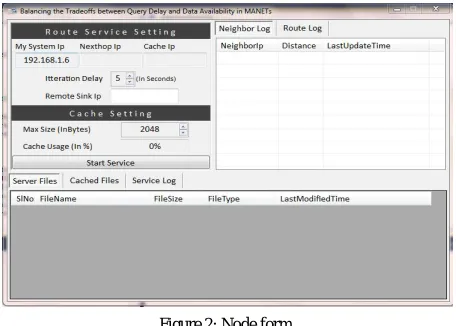
Figure 2 shows the node form that appears when node in selection form is selected.
Figure 3: selection form
Figure 3 is selection form that appears when the application is executed. Here the application is executed by selecting as sink form.
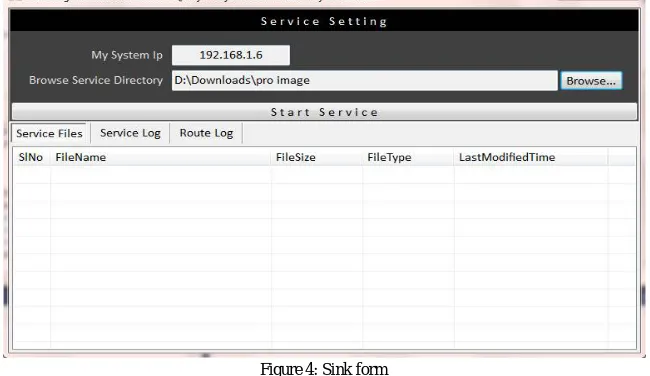
Figure 4: Sink form
Figure 4 shows the node form that appears when sink in selection form is selected.
Figure 5 shows sink form in which path has been selected from which files will be loaded
Figure 6: Sink form2
Figure 6 shows sink form with files being loaded.
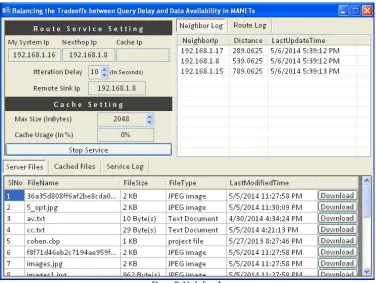
Figure 7: Node form1
Figure 8: save form
Figure 8 shows the form showing path to select in which downloaded file will be saved.
Figure 9: successful download form
Figure 9 is the form that will be shown when file is downloaded successfully.
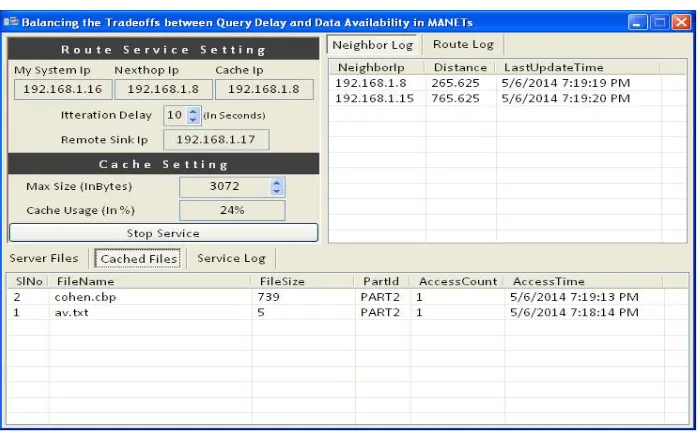
Figure 10: cache utilization form
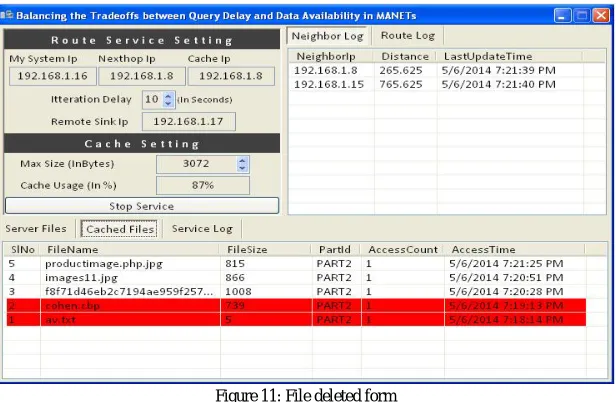
Figure 11: File deleted form
Figure 11 shows form showing files being deleted in cache when cache utilization exceeds 90%.
VI.CONCLUSION AND FUTURE WORK
In MANETs, due to link failure, network partitions are common. As a result, data saved at other nodes may not be accessible. One way to improve data availability is through data replication. A data replication scheme to improve the data availability and reduce the query delay has being implemented. The basic idea is to replicate the most frequently accessed data locally and only rely on neighbor’s memory when the communication link to them is reliable. Extensive performance evaluations demonstrate that the proposed schemes outperform the existing solutions in terms of data availability and query delay. Results also show that there is fundamental tradeoff between data availability and query delay. Higher degree of cooperation improves the data availability, but it also increases the query delay because more data need to be retrieved from neighboring nodes.
In future work can done towards improving cooperation between nodes and increasing cache size without effecting the network and also on the parameters which improve the overall system performance. Group Optimization can be used in future instead of One To One to Optimization. In Group Optimization instead of sharing data with one neighbor, sharing of data takes place with group of neighbor nodes. Hence if link failure occurs with one neighbor data will be available with other neighbors.
REFERENCES
1. Andrew Troelsen,”ASP.NET concepts”, 2nd edition, Apress, 2003.
2. Andrew S .Tanenbaum “Computer Networks “, 4th edition, Pearson Education, 2003.
3. Yang Zhang, Liangzhong Yin, Jing Zhao, Guohong Cao, "Balancing the Trade-Offs between Query Delay and Data Availability in MANETs,"IEEETransactions on Parallel and Distributed Systems, vol. 23, no. 4, pp. 643-650,April 2012.
4. “Trade-Offs between Query Delay and Data Availability in MANET’s”, International Journal of Engineering Trends and Technology (IJETT) Volume 4 Issue 5-May 2013.
5. A.Akila, “Distributed Data Replication (DDR) in MANET”,International Journal of Advanced Research in Computer Science and Software EngineeringVolume 4, Issue 2, February 2014, ISSN: 2277 128X.
6. P. Nithiyalakshmi, V. Udhaya Kumar, “Data Consistency for Cooperative Caching in Mobile Environments”, International Journal of Science and Research (IJSR), Volume 3 Issue 1, January 2014.
7. M. Siva Lakshmi, R.RajaSekhar, “ODRS: Optimal Data Replication Scheme for Time Efficiency in MANETs”,IOSR Journal of Computer Engineering (IOSRJCE) ISSN: 2278-0661 Volume 5, Issue 1 (Sep-Oct. 2012), PP 21-27.
8. PrasannaPadmanabhan, Le Grunewald , Anita Vallur, Mohammed Atiquzzaman, “A survey of data replication techniques for Mobile Ad-hoc network databases”,The VLDB Journal (2008) 17:1143–1164, DOI 10.1007/s00778-007-0055-0.
9. Jiun-Long Huang, Ming-Syan Chen, Wen-ChihPeng, “Exploring Group Mobility for Replica Data Allocation in a Mobile Environment”.
BIOGRAPHY