University of Windsor University of Windsor
Scholarship at UWindsor
Scholarship at UWindsor
Electronic Theses and Dissertations Theses, Dissertations, and Major Papers
7-17-1965
Resale price maintenance.
Resale price maintenance.
William J. Waldron
University of Windsor
Follow this and additional works at: https://scholar.uwindsor.ca/etd
Recommended Citation Recommended Citation
Waldron, William J., "Resale price maintenance." (1965). Electronic Theses and Dissertations. 6410. https://scholar.uwindsor.ca/etd/6410
This online database contains the full-text of PhD dissertations and Masters’ theses of University of Windsor students from 1954 forward. These documents are made available for personal study and research purposes only, in accordance with the Canadian Copyright Act and the Creative Commons license—CC BY-NC-ND (Attribution, Non-Commercial, No Derivative Works). Under this license, works must always be attributed to the copyright holder (original author), cannot be used for any commercial purposes, and may not be altered. Any other use would require the permission of the copyright holder. Students may inquire about withdrawing their dissertation and/or thesis from this database. For additional inquiries, please contact the repository administrator via email
INFORMATION TO USERS
This manuscript has been reproduced from the microfilm master, UMI films
the text directly from the original or copy submitted. Thus, some thesis and
dissertation copies are in typewriter face, while others may be from any type of
computer printer.
The quality of this reproduction is dependent upon the quality o f the
copy submitted. Broken or indistinct print, colored or poor quality illustrations
and photographs, print bleedthrough, substandard margins, and improper
alignment can adversely affect reproduction.
In the unlikely event that the author did not send UM! a complete manuscript
and there are missing pages, these will be noted. Also, if unauthorized
copyright material had to be removed, a note will indicate the deletion.
Oversize materials (e.g., maps, drawings, charts) are reproduced by
sectioning the original, beginning at the upper left-hand corner and continuing
from left to right in equal sections with small overlaps.
ProQuest Information and Learning
300 North Zeeb Road, Ann Arbor, Ml 48106-1346 USA 800-521-0600
RESALE PRICE HAIRTEHANCE
by
William J, Waldron B.Comm.
A Thesis
Submitted to the Department of Economics and Political Science in Partial Fulfillment of the Requirements
for the Degree of Master of Arts at the University of Windsor
Windsor, Ontario
UMI*
UMI Microform EC52591
Copyright 2007 by ProQuest Information and Learning Company. All rights reserved. This microform edition is protected against
unauthorized copying under Title 17, United States Code.
ProQuest Information and Learning Company 789 East Eisenhower Parkway
9 / 9 7
Approved :
RESALE PRICE MAINTENANCE
The ImpllcatlonB of resale price maintenance for the
public Interest continue to be Interpreted differently by
economists and businessmen. As a result of the investigation
of the HaeQuarrie Committee in 1951, resale price maintenance
was banned unconditionally in Canada in the same year but
recently a retrenchment of the position occurred with the
amending of the Combines Investigation Act in I960.
An examination of the history of the practice within
modern retailing in the United Kingdom, the United States and
Canada reveals a difference in the legal approach by the govern*
ments concerned. The more common arguments advanced in support
of resÊleoprlce maintenance fail in their objective when exam
ined in relation to the benefits accruing to the consumer.
The most prevalent aspect of these arguments, ^loss-leader"
competition, appears as an indeterminate concept because of
the inability of both economists and businessmen to arrive at
an acceptable definition. Nevertheless these sane arguments
give some Insight into the motives of retailers, wholesalers
and manufacturers for desiring the use of resale price mainten
ance. These motives evolve from the desire to either increase
or protect present profits. Retailers who support the practice
admittedly desire protection from price competition but their
reasons for entitlement to such protection fail to Indicate
any benefits for the consumer, Manufacturers claim many
damaging aspects resulting from the use of their product as a
"loss-leader”, none of which are clearly substantiated. It
appears that it is their profit margin which is damaged.
Resale price maintenance appears as detrimental to the
public interest. It creates a favourable climate for price
agreements at the various distributive levels. The consumer
is forced to pay a higher price than might otherwise have been
required if price competition were present. In addition he is
made to pay for services which he may not desire end at the
same time is denied his right to influence the distribution
system thus retarding change in the structure of distribution.
As a result inefficient uses of resources occur both in distri
bution and in manufacturing.
Combine laws designed to protect the public from mono
polistic and restrictive practices exist in the greater major
ity of the countries of the western world. Because of the
dynamic quality of modern economic development the need exists
to fre(piently reexamine the relevance of such legislation to
the rapidly changing econttnic conditions.
Resale price maintenance is one topic relating to combine
law which has received increasing attention during recent times
in both North America and Western Europe. There is no complet
ely settled position on the practice although a tendency in
one direction is spearing.
The purpose of this thesis is to evaluate the issues in
volved and to present a conclusion as to the position of the
practice.
In acknowledging my indebtedness to the members of my
thesis committee I wish particularly to thank the Chairman,
Professor W. J« Cillen for his patience and encouragement,
I am also grateful to Dr. W. G, Phillips and Dr. C, M, Birch
for their direction and timely suggestions.
To the staff of the University Library I owe a large debt
of gratitude for the cheerful way in which they filled my
every request for assistance.
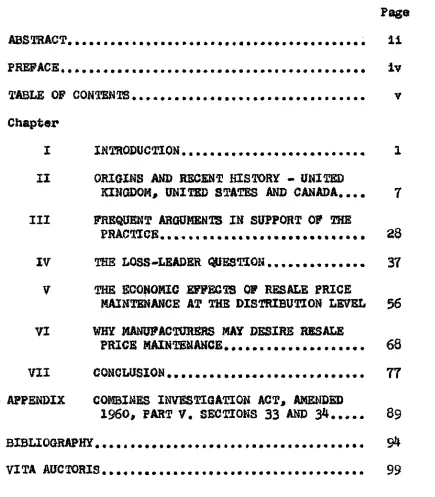
TABLE OF CONTENTS
Page
ABSTRACT... 11
P R ^ A C E ... ... iv
TABLE OP CONTENTS... v
Chapter
I INTRODUCTION... 1
II ORIGINS AND RECENT HISTORY - UNITED
KINGDOM, UNITED STATES AND CANADA..,. ^
III FREQUENT ARGUMENTS IN SUPPORT OP THE
PRACTICE. ... 28
IV THE LOSS-LEADER QUESTION... 37
V THE ECONOMIC EPPECTS OF RESALE PRICE
MAINTENANCE AT THE DISTRIBUTION LBPBL 56
VI WHY MANOFACTORERS MAY DESIRE RESALE
PRICE MAINTENANCE... 68
VII CONCLUSION... 77
APPENDIX COMBINES INVESTIGATION ACT, AMENDED
I960, PART V. SECTIONS 33 AND 3%.... 89
BIBLIOGRAPHY... 94
VITA AUCTORIS... 99
INTRODUCTION
Resale price maintenance is the term used to identify a
situation where a particular article la being resold by re
tailers, wholesalers or other distributors at either a fixed
price or at not less than a specified price.
The particular price may result from either of two
methods of agreement, horizontal or individual. Horizontal
resale price maintenance exists where rival wholesalers or
manufacturers collectively agree on the resale price. This
type of price fixing agreement is generally recognized as
being against the public interest and will not be discussed
in this paper.
Individual resale price maintenance results when an in
dividual supplier specifies a minimum or fixed price at which
a particular article is to be resold. The manufacturer may
state the price at which all wholesalers will resell his pro
duct or a wholesaler may specify the price at which retailers
will resell a certain article. In other instances an individ
ual manufacturer may specify the prices at both the wholesale
and retail level. The arguments submitted herein will apply
2
Individual resale price maintenance is associated pri
marily with branded or trade marked products, "The purpose
of branding is to emphasize a distinction between a particu
lar article or class of articles and all other articles not
marked in the same way; it becomes effective when the public
Is aware of this distinction",^ The manufacturer of a bran
ded or trade marked product is in a position to undertake
national advertising stressing real or alleged differences
between his product and other comparable products with the
objective of creating a demand for it.
Enforcement of individual resale price policies will be
determined by existing legislation, "Where the legislation
permits, suppliers may require distributors to sign contracts
agreeing to resell the product concerned at the indicated
price. In some cases mere notifiction of the resale price
may be sufficient or the signing of a contract by one dis
tributor may automatically bind all other distributors.
Under such arrangements the supplier is then in a position to
take legal action against any distributors who do not resell
at the stated price.
Where legislation does not allow the supplier recourse
to legal action the opportunity may exist to attempt
enforcement of resale price maintenance by withholding sup
plies from distributors who resell below the stated resale
price.2
With a policy of resale price maintenance the resale
price may be established as a minimum price below which the
article is not to be sold or it may be established as a fixed
price at which the article is to be sold. The result will
tend to be the same in either case. With a minimum resale
price the distributor will be inclined to sell at this price
as a result of competitive factors. The more general ten
dency appears to be to specify fixed prices.
In the examination of the practice of resale price main
tenance the various stages of economic activity which connect
the producer with the consumer become involved. Whereas tra
ditional economic theory is concerned mainly with a single
product situation involving manufacturing or agriculture.
2 "In 1926 the Owl drug chain operating on the Pacific Coast defied the established policy of E, R. Squibb & dompany by announcing that it would sell Squibb's products at cut prices. This announcement precipitated a fight in which the Squibb Company was alleged to have arranged with druggists
operating in the affected area to have them sell at cut prices, but at margins equivalent to those formerly enjoyed. This
action, coupled with Squibb's refusal to sell to the Owl chain, brought the latter to terms in early 1927". An excellent ex ample of the possible action that may be open to manufacturers. E. R. A. Seligraan and R. A, Love. Price Cutting and Price
4
retailing, on the other hand, presents a different combina
tion of factors which usually result in a multiple product
firm. In addition the merging of the various stages of the
distributive system is not generally covered in traditional
theory,
The lack of any theoretical framework which can be di
rectly applied to resale price maintenance presents two al
ternatives in the method of approach to the topic. One pos
sibility Involves the searching out of theoretical articles
which are applicable and from these attempt to establish a
model which fits resale price maintenance. The second choice
consists of a more Inductive approach in which arguments are
examined and motives questioned in an effort to determine the
economic consequences of the practice and to derive an assess
ment of its Implications for the public interest.
The latter method has been chosen along with the result
ing limitations to the scope of this discussion. As a con
sequence this thesis cannot answer all questions relating to
combines* law.
It is accepted that in general economists have a bias
right to make exceptions where the situation warrants it.3
As this is in keeping with traditional theory it Is therefore
accepted as given the principle that restrictions on competi
tion, price as well as otherstypes, are presumed against the
public interest unless proved otherwise. Consequently the
reader will undoubtedly detect a bias toward price competition
In the arguments which follow.
Resale price maintenance io said to have been in exis
tence as far back as 200 B.C. but this discussion is concerned
with its more recent history dating from the latter part of
the nineteenth century and more particularly the developments
since the end of World War II,
In Chapter II the development of the practice within the
structure of modern retailing Is examined with reference to
the United (dngdom, the United States and Canada, % e varied
reception of the practice by the governments of the three
countries la then outlined from the early twentieth century
up to the present date.
In attempting to establish the thesis that resale price
maintenance is detrimental to the public Interest it becomes
necessary to first examine the more common arguments presents*
6
in support of the practice* Chapter III is devoted to such
an examination with a rebuttal extended to each argument
considered,
In the next chapter particular attention la focused on
the "loss-leader" argument which is an inherent part of the
major arguments rendered in support of resale price mainten
ance. The attempt is made to examine and analyse all aspects
of "loss-leader" competition in arriving at a conclusion as
to the strength and validity of the argument.
Chapter V consists of an endeavour to gain an insight
into the underlying motives which may lead distributors to
support resale price maintenance followed by a discussion of
the possible economic effects that the practice may tend to
have on the distribution system of the economy.
The more recent development of strong support and in
some cases aggressive leadership originating with manufactur
ers requires a subsequent questioning of the possible motives
behind these actions and it is to this which Chapter VI Is
assigned along with the resulting economic Implications*
In conclusion the relevant points are examined in refer
ence to their effect upon the consumer and upon economic
effl<-ciency* An effort is made to summarize the specific points
which support and illustrate the detrimental nature of resale
ORIGINS AND RECENT HISTORY
UNITED KINODOM. UNITED STATES AND CANADA
The movement to foster the more widespread use of resale
price maintenance appears to have gained significant impetus
during the last two decades of the nineteenth century. The
growing price competition In many branches of retailing pro
vided the motivating force for the movement.
New types of retailing establishments were rapidly cut
ting into the trade of the small retailer. Department and
chain stores, through their trading advantage, were able to
offer the pablic numerous and significant price reductions,
an attraction to which large sections of the public responded.
The competition provided by new methods of retailing was superimposed uptm probably more leisurely ccxnpetition that existed among the typ ical small-scale retailer of an earlier period. The so-called 'legitimate* retailers (operating on a small or medium scale along traditional lines) felt the severe effects of the enhanced competition. The smaller share of the trade that remained for them had to ba transacted at lower prices and mar gins of profit*^
The branding or trade-marking of merchandise became much
more prevalent during this period contributing to the severity
of retail competition. By advertising, manufacturers of
8
branded goods gained acceptance of their products by consumers
and this preselling contributed to minimizing the need for
specialized knowledge in retail selling. With the branded or
trade marked products relatively easy to handle the large-
scale retailers could now use unskilled labour for the now
simplified function of selling. The entry of new firms into
retailing was also made easier because of the reduced requir
ement for specialised knowledge. Branding also led to compe
tition across product lines. Grocers could now sell tobacco
products or patent medicines, since no specialized knowledge
of the merchandise was necessary to sell the branded goods of
other trades. Consequently the different retail trades began
to compete with each other.
The small and medium sized retailers operating along
traditional lines of specialization were hardest hit by this,
competition and ware forced to seek out methods to improve
their competitive position. Some groups of small retailers
combined their purchases to secure the better terms which
their bulk-buying rivals enjoyed. Others joined together to
form trade organizations with one of the major objectives^
being to negotiate with manufacturers In an effort to persuade
them to adopt resale price maintenance.
Professor Yataey^ reveals that the great majority of manu
facturers In the United Klngdoc* during the last decade of the
nineteenth century were reluctant to adopt resale price main
tenance. They did not appear to believe that uniform retail
prices for a brand would be of any advantage to them. Price
maintenance, at best, was regarded as an unfortunate restric
tion sometimes necessary in order to placate influential
sections of the retail trade.
Demands for maintained prices forced a difficult decision
upon the manufacturer. Since not all retailers were in favour
of price maintenance the manufacturer was faced with an assess
ment of the relative strength of the two broad groups of sup
portera and opponents. In addition he had to judge the extent
of the damage which each group was likely to inflict upon him
if dissatisfied with his decision.
If frustrated by its introduction, the opponents of re
sale price maintenance would have a strong Incentive to In
crease the sales of substitute brands. The larger firms could
be moved to undertake production of competitive private brands
and would be able to advertise extensively. Conversely sup
porters of price maintenance could indicate their dissatisfac
tion with non-protected goods by endeavouring to substitute
10
their sales and promotion efforts and by keeping their lines
poorly displayed or hidden from view. Associations of suppor
ting retailers could sponsor the production of brands to be
distributed solely by members, The London and District Tobac
conists Association introduced a selection of its own branded
pocket tobaccos in 1892, and the Birmingham Association mar
keted Its own brands in 1895*^
The retail trade associations used various arguments in
their attempts to persuade manufacturers to adopt resale price
maintenance. They consisted of a mixture of offers of friend
ship and support at one extreme through to threats of absolute
boycott at the other. The amount of progress in overcoming
the objections of the manufacturers depended to a great ex
tent upon the strength of the retail organization. Tlie strong
est and most effective resistance came from producers of well
established brands. The strongest and moat persistent pres
sure from the retail trade originated with druggists.
The efforts to establish resale price maintenance in
modern retailing originated in the period covering the last
two decades of the nineteenth century and the first decade of
the twentieth century. The movement was a result of the efforts
of the independent small retailer to protect his profits from
the danger which aggressive firms and their successful price
policies presented. The movement originated with the retail
trade and the majority of manufacturers who adopted the prac
tice did 30 reluctantly in the beginning.
Prom this period resale price maintenance met with dif
ferent attitudes on the part of the governments in the United
Kingdom, the United States and Canada as revealed in part by
the existence of or the lack of relevant legislation.
United Kingdom
It is only during the last two decades that the United
Kingdom has enacted legislation aimed at the control of com
bines and restrictive practices. Prior to the Monopolies and
Restrictive Practices Act of 1948 the United Kingdom had con
ducted public enquiries into the problems of resale price
maintenance on several occasions,
A sub committee of the Standing-Committee on Trusts con
ducted the first enquiry in 1920. The majority of the commit
tee found that resale price maintenance generally was to the
advantage of the public, provided the maintained prices were
fair and reasonable. To ensure this overriding provision,
the committee recommended that resale price maintenance, to
gether with other forms of restrictive business practices,
should be subject to supervision by a tribunal which could
12
would be empowered to take or recommend such action as neces
sary to correct the situation.
In 1930, another public inquiry, which also covered
other restrictive business practices than resale price main
tenance, was carried out by the Committee on Restraint of
Trade, Although the committee viewed price maintenance as
not free from disadvantage to the public, it was not satisfied
that the public interest would be better served through a
change in the existing law.
The Lloyd Jacob Committee was appointed in 1947to investi
gate the practice of resale price maintenance. In its report
rendered in 1949a the committee recommended no prohibition of
individual resale price maintenance. But it also concluded
that:
It appears to us to be contrary to the public interest for a manufacturer to use his power to cut off supplies in such a way as to obstruct the
growth of particular methods of trading, to impede the distribution by another manufacturer of com petitive goods or to deprive the public of the benefits of low cost systems of distribution,^
The recommendation for not banning the practice was based
on the premise that it protected manufacturers of branded
goods from the harmful effects of so-called "loss-leader"
competition among resellers. The committee further recommended
that the appropriate Government Departments discuss with the
principal national organizations in trade and industry the .
most satisfactory means of removing the undesirable results
of individual resale price maintenance. In addition it was
recommended that collective resale price maintenance be made
Illegal.
As a result of the failure to resolve the undesirable
effects of the practice, the Government issued a White paper
in June 1951 announcing its intention of introducing legisla
tion to make individual as well as collective resale price
maintenance illegal. The legislation had not been introduced
when a new government took office in November, 1951.
In December 1952, this government asked the Monopolies
and Restrictive Practices Commission to conduct an inquiry
into certain widely prevalent restrictive practices. The
committee report was presented in 1955 and as a result the
Restrictive Trade Practices Act of 1956 was passed.
The collective enforcement of resale prices was made
Illegal but manufacturers were now able to enforce individual
resale contracts not only in the case of dealers who had signed
a contract but also in the case of a person who acquires the
goods with a notice of the resale price conditions.
Between I960 and 1964 The Monopolies Commission conclu
14
In particular Industries that the practice was against the
public interest and should be terminated.
In July of 1964, the Government passed the Resale Prices
Act making resale price maintenance illegal effective April
30J 1965. Suppliers of goods were allowed to apply for ex
emption from the statutory prohibition of resale price main
tenance from August 15, 1964 to November 15, 1964. Until a
decision is rendered by the Restrictive Trade Practices Court
the suppliers in question can continue with resale price main
tenance, Suppliers applying after November 15, 1964 will
have to await a favourable decision before commencing price
maintenance.
The Act specifies that the Court may exempt a class of
goods if it appears to the Court that in default of a system
of maintained minimum resale prices applicable to those goods
(a) the quality of the goods available for sale, or the varieties of the goods so available would be substantially reduced to the detri ment of the public as consumers or users of those goods; or
(b) the number of establishments in which the goods are sold by retail would be substan tially reduced to the detriment of the public as such consumers or users; or
(d) the goods would be sold by retail under con ditions likely to cause danger to health in consequence of their misuse by the public as such consumers or users; or
(e) any necessary services actually provided in connection with or after the sale of the goods by retail would cease to be so provided or would be substantially reduced to the detri ment of the public as such consumers or users,
and in any such case that the resulting detriment to the public
as consumers or users of the goods in question would outweigh
any detriment to them as such consumers or users (whether by
the restriction of competition or otherwise) resulting from
the maintenance of minimum resale prices in respect of the
goods.^
A substantial number of requests were submitted for ex
emption from prohibition of resale price maintenance by the
time of the deadline on November 15, 1964. More recently^
there are indications that a growing proportion of the appli
cations are being withdrawn because of competitive conditions
or lack of legal basis for the request.
6 The Resale Prices Act, 1964, Bee. 5(2) as quoted by B. S, Yatney Resale Price Maintenance and Shopper's Choice,
(London, 1964) p. 53.
16
United States
The period prior to the 1930»s was characterized by the
uncertainity of the legal position of resale price maintenance.
Under the Sherman Act of I89O, the Courts had held individual
as well as collective price maintenance enforced by agreement
or contract as illegal in interstate commerce.& But the courts
upheld the right of manufacturers to refuse to sell to dealers
who had cut prices substantially,^
Manufacturers interested in establishing resale price
control could attain it either by refusing to sell to dealers
who cut prices or by shipping goods to dealers on consignment,
retaining title until the goods were sold. The only other
alternative was direct price control through sales agencies
owned by the manufacturer,
Manufacturers found that refusal to sell enabled them to
exercise a considerable degree of control over the resale
price of their distributors (wholesalers). But in the case
of the retail trade the number of retailers made it difficult
for most manufacturers to deal directly with them.
Experience with resale price control had shown that
8 See E. R. A, Seligraan and R. A. Love, Price Cutting and Price Maintenance. (New York, 1932) p. 54 for a discussion of the Hartman and Miles cases,
identical retail prices could be secured by means of resale
price contracta. As a consequence, manufacturers of branded
merchandise and trade association leaders in the retail field
- particularly the drug trade • turned their efforts toward
securing a legalization of resale price maintenance. The
economic position of wholesalers being closely related to
the profit return of retailers, they also joined in advocating
resale price legislation.
The growth of chain and cut-rate stores offering limited
services and lower prices coupled with the depression In 1930
gave greater Impetus to the efforts of independent retailers
and wholesalers to obtain the legalizing of resale price main
tenance.
The retail and wholesale trade associations in California
were the most aggressive in their demands. As a result, in
1931 California became the first state to legalize the use of
resale price contracts in intrastate commerce. To be eligible
the commodity concerned was required to bear the trade-mark,
brand or name of the producer or owner and to be in fair and
open competition with commodities of the same general class
produced by others. The agreed upon prices were to prevail
at all times except for closing out sales, the sale of damaged
and deteriorated goods, and the sale of goods by order of a
1 8
An amendment to the California statute in 1933 added the
highly significant provision that a single agreement to fix
the resale price of a trade marked product is applicable to
all other sellers even though they do not sign a price main
tenance contract. This amendment which came to be known as
the ”non-signers* clause" made it possible for a manufacturer
to make a resale price agreement with a single wholesaler or
retailer and thereupon require all other wholesalers or re
tailers in the state to charge the same resale price for the
product. Any distributor having notice of the contractual
arrangement and not conforming to the prices became at once
subject to civil action on the charge of unfair competition.
This clause made the resale price control laws extremely ef
fective in maintaining prices within the state.
In view of this, the California statute and amendment
were rapidly adopted by a considerable number of other states
at the request of organized trade groups.
As the laws applied only to intrastate commerce price
maintenance still remained illegal in interstate commerce
under the Sherman Act,
In response to the increasing demands of state and local
trade associations. Congress in 1937 enacted the Miller-
Tydings Act, amending the Sherman Act to exempt resale price
Into states for resale where such contracts are legal. Manu
facturers were now able to enforce price maintenance contracts
both on an interstate and an Intrastate basis in those states
which had enacted legislation.
In 1951 the effectiveness of resale price contracts was
substantially restricted by the Supreme Court in the schweg-
mann Bros. vs. Calvert Distillers Corp. decision. The Court
ruled that the Miller-Tydings law does not give immunity to
non-signer arrangements. Only voluntary, signed resale price
contracts, it held, are exempted from the Sherman Act,
The Schwegtnann decision invalidated all resale price
systems in interstate commerce which were based on the use
of non-signer clauses. As a result in some areas, especially 10
New York retail price competition became very intense.
The result was a campaign by retail trade associations
to have the Federal legislation altered. In July 1952, Con
gress passed the McGuire Act which made pannissable the use
of the non-signer clause within a given state, in accordance
with the legislation of the state, by manufacturers selling
in interstate commerce.
But the rise of the large Discount houses during the
early 1950®s created new and costly problems for manufacturers
20
enforcing resale price maintenance. The Discount houses
formed their OKtn association to fight against wholesalers and
manufacturers who refused to sell to discount houses, protes
ting that such action was In restraint of trade.
The non-signer clause was ruled unconstitutional by the
Supreme Courts of thirteen "Pair Trade” states and In two
other states the Supreme Courts held the entire "Fair Trade"
act to be invalid.
The cost of policing price maintenance agreements
became heavier as violations became more frequent. Manufac
turers began to abandon their fair trade policy, particularly
in the electric appliance Industry
In September 1955* the Westlnghouse Electric Corporation,
after six years of setting fà%r trade prices on its products,
abandoned resale price maintenance. The General Electric
Company, who had signed approximately 30,000 fair trade agree
ments with retailers and had policed these agreements aggres
sively finally abandoned resale price maintenance In February
1956. The expenditure of approximately one million dollars a
year for the previous two years reveals the company's favour
able attitude toward fair trade but at the same time the
expenditure indicates how costly such a policy had become.
General Electric was followed one day later by the Sun
beam Corporation who felt they were forced to make the move
in order to keep their dealers competitive in the electrical
appliance market.
A contributing factor to General Electric's decision was
a setback received in 1957 when the courts ruled that mail
order sales from the District of Columbia, where there is no
fair trade law, to New York at prices below those fixed under
"Pair Trade" agreements in New York did not violate the Hew
York fair trade statute.
The efforts of the electrical appliance Industry to keep
resale price maintenance reveals the change in attitude of
manufacturers from the early history of the practice. Manu
facturers appear to have become more aggressive than retailers
in their efforts to retain price maintenance.
The strong growth of discount department stores coupled
with the rising inclination of aggressive retailers to violate
resale price agreements and risk or fight legal action, no
doubt contributed to the decision of manufacturers to abandon
resale price maintenance In the 1950’s. It would appear that
resale price maintenance plays an insignificant role in
2 2
Canada
Except for the last two decades there appears to be
limited reference to resale pries maintenance in Canadian
journals. This may be a result of uncertainity about the
legal position of the practice prior to 1951.
Resale price maintenance was concerned in a number of
investigations under the Combines Investigation Act, but usu
ally in conjunction with other restrictive practices.
It was the only issue in one inquiry involving the Pro
prietary Articles Trade Association, an offshoot of a druggists'
trade organization of the same name in Great Britain. In two
reports published in 1926 and 1927 the conclusion was expres
sed that the public interest was detrimentally affected. The
Proprietary Articles Trade Association was dissolved shortly
after the final report was published,
A similar conclusion was reached in four other investi
gations under the Combines Investigation Act, tobacco 1938,
dental supplies 1947* optical goods 1948, and bread in western
Canada 1948,
An indication that resale price maintenance was becoming
fairly widespread following World War II appears in the Report
of the Royal Commission on Prices rendered in 1949 which states :
Throughout our inquiry we have been impressed by the degree to which individual manufacturers fix the resale prices of their products and so narrow the area in which price competition amongst whole salers and retailers is operative. In view of the extension of this practice, we recommend that the Combines Investigation Commission give careful study to this problem with a view to devising measures to deal with It,^3
The same report reveals that Canadian consumers had be
come perturbed over the practice, Ihe Canadian Association
of Consumers and the National Council of Women presented a
joint brief to the Royal CooMis&ion on Prices expressing con
cern over the growth of resale price maintenance,
The HacQuarrle Committee was appointed in June 1950 to
study Combines Legislation, As a result of the recommendation
of the Royal Commission on Prices, resale price maintenance
was included as part of the study.
The Committee found it difficulti
to measure precisely the extent of resale price maintenance, The Committee, however, is satisfied that the practice of fixing resale prices is wide spread, that it covers whole classes of goods, and that, if not quite as comprehensive as the United Kingdom, it la yat of significant and growing pro portions,^*
In its interim report on resale price maintenance
13 Report of the Royal Commission on Prices I (Ottm*a,
1949) p. 41.
24
published In October, 1951, the Committee recommended "that
It should be made an offence for a manufacturer or other sup
plier:
1. To recommend or prescribe minimum resale prices for his products:
2, TO refuse to sell, to withdraw a franchise or to take any, other form of action as a means of enforcing minimum resale prices.15
As a result Canada became the first country to ban resale
price maintenance unconditionally when legislation was enacted
in December 1951. The Director of Investigation and Research
was allocated the duty of Investigating restrictive practices
forbidden by the Act. % e Restrictive Trade Practices Com
mission became responsible for examining evidence submitted
to it by the Director,
An extensive public inquiry into loss-leader selling and
the effects of abolishing resale price maintenance resulted
in two reports^^ published in 1954 and 1955 In which it was
concluded that no new legislation was warranted for suppression
or control of loss-leader selling.
Section 34 of the Combines Investigation Act which deals
15 Resale Price Maintenance. An Interim Report, p, 21,
16 (a) Loss-Leader Selling. Material Collected by the Director of Investigation and Research, Restrictive Trade Practices Conmiisslon, Ottawa, 1954,
with resale price maintenance was amended in I960, Under the
amendment a manufacturer can now refuse to sell to anyone who
is using his product as a loss-leader, that is, not for the
purpose of making a profit but for advertising or attracting
customers to his store in the hope of selling them other art
icles. The manufacturer may also refuse to sell to anyone
engaged in misleading advertising of his product or anyone
falling to provide a level of servicing that purchasers might
reasonably expect.
On examination this amendment might lead manufacturers
to attempt to enforce some type of minirapn price based on the
interpretation of the word profit,
Recent Developments in European Legislation^^
Since the action of Canada to ban resale price mainten
ance, the governments of several European countries have taken
measures to abolish or limit the use of resale price mainten
ance.
In 1953 Sweden enacted legislation making resale price
maintenance subject to criminal p.'enalties where permission is
17 See Report Concerning the Piatrlbutlon and Sale of Electric Appliances, Electric Shavers and Accessory Products,
(sunbeam Corporation (Canada) Limited) Ottawa, 1962,
26
not granted by the Freedom of Commerce Board, In spite of
wide legislative grounds for granting permission only three
exemptions were granted between 1953 and 1962 and only recently
one of these was withdrawn.
France adopted a similar attitude toward resale price
maintenance in the same year. Prohibition of the practice
Is the rule and exemptions are the exception and are "very
rarely granted".
Denmark enacted legislation in 1955 which included a
general prohibition of resale price maintenance unless special
permission is granted by the cartel authority. Between 1955
and 1963 exemptions were granted to ten products.
Ireland has indicated a growing disapproval of the prac
tice, Although no legislation has been enacted to prohibit
resale price maintenance generally* six rulings were made pro
hibiting the practice in various trades between 1955 and 1962,
Germany joined the increasing list of countries legislat
ing against resale price maintenance in 1957. The approach
adopted has been more lenient than other countries with exemp
tions being rather numerous.
Norway by way of Royal Decree also became a member of the
group of countries prohibiting resale price maintenance in
1957. Exceptions are allowed but have seldom been granted.
only throe exemptions resulting between 1957 and 1961.
The increase in legislation directed at abolishing or
limiting the practice of resale price maintenance appears to
Indicate an increasing doubt of the validity of arguments
favouring acceptance of resale price maintenance. The next
chapter Is devoted to a consideration of the arguments more
CHAPTER III
FREQUENT ARGUMENTS IN SUPPORT OF THE PRACTICE
In examining the most prevalent arguments in support:of
resale price maintenance the following point should be kept in
mind;
When discussing the motives which induce dis tributors and manufacturers to support resale price maintenance, one has to take into consideration a source of error that àâ always present in cases where human interest are involved; the parties con cerned tend to omit or under-emphasiae the more selfish motives behind their actions and to make much of their concern for the public welfare. To obtain a true picture of the situation, it is, therefore, necessary to make a critical appraisal of the motives publicly stated and also to consider whether there may not be other motives as well.l
A frequent argument in favour of resale price maintenance
contends that it helps to keep the small independent retailer
in business, thus ensuring an adequate number of outlets and
preventing concentration of economic power, Ohls result would
be achieved because resale price maintenance requires all dis
tributors to sell at a uniform price providing an adequate
margin of profit for all.
Without resale price maintenance large department and
chain stores operating at a lower unit cost are in a position
to charge a lower price than the small retailer. % e large
29
retailers are also in a favourable position to use the
"loss-leader" device in order to attract oiore business and gradually
eliminate the small retailers. In addition the large stores
have contï*oî over their private brands and without resale price
maintenance price cutting would occur only on products also
handled by dealers whose volume of trade is already too small
to enable them to carry their own brands* As a result of
these advantages the larger outlets would Increase their share
of the market forcing the small retailer out of business*
The first presumption in the argument is that all small
retailers should be protected from the price competition of
large retailers, particularly the department and chain stores,
or the small retailer will disappear,
There Is no doubt that without the protection of resale
price maintenance the chances of survival of the inefficient
and marginal operators among the small retailers are greatly
reduced,
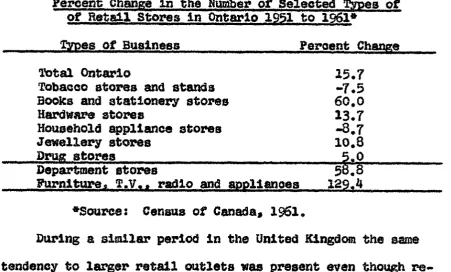
Data in Table 1 indicate: a tendency to larger retail
outlets but at the same time would appear to suggest that the
small retailer has continued to survive despite the banning of
30 Table 1
gercent; Change In the Number of Selected Types of of Retail Stores In Ontario 1951 to 1961*
Total Ontario 15.7
Tobacco stores and stands -7.5 Books and stationery stores 60.0
Hardware stores 13.7
Household appliance stores -8.7
Jewellery stores 10.8
Drug stores - ÿ.o
Department stores 58.6
Furniture. T.V.. radio and apollanoes
*Source: Census of Canada, 1961.
During a similar period in the United Kingdcmi the same
tendency to larger retail outlets was present even though re
sale price maintenance was in effect. During this period
from 1950 to 1961 the number of small retailers declined by
6,000 indicating that resale price maintenance does not nec
essarily protect the Inefficient small retailer.
In Canada the greatest price conq>etition in some instances
has come not from the large department stores and chains but
from the growing independent retailer who only a few years
previous was a small retailer himself «3 effect has been
changes in retailing methods with resulting benefits for
2 See "RFM - The Castle %mble@". Economist (March 13* 1965) pp. 1157-58.
consumers.
The second portion of the same argument assumes that the
concentration of economic power in the retail field is neces
sarily against the interests of the consumer.
Resale price maintenance has tended to appear in indus
tries in which there are relatively few well established manu
facturers with systems of national distribution. The situa
tion approaches that outlined by J. K. Galbraith^ in which a
market has been pre-empted by a few large sellers, entry of
new firms has become difficult and existing firms have accep
ted a convention against price coi^etition. Strong sellers,
the manufacturers, in control of prices are opposed by weak
buyers.
"In the typical m o d e m market of few sellers the active
restraint is provided not by cong>etitors but from the other
side of the market by strong buyers".5 The development of
economic power by retailers will serve the interest of the
consumer as the large retailers use their bargaining power to
exert pressure on the margins of manufacturers. "Retailers
are required by their situation to develop countervailing
power on the consumer's behalf.
4 John Kenneth Galbraith, American Capitalism. (Boston, 1956) p. 113.
32 Without resale price maintenance, price competition
among distributors and the resulting reduction of gross profit
margins will tend to give rise to increasing demands from all
distributors that manufacturers reduce their prices to them.
As price competition is likely to favour the larger and more
active retailers, their bargaining strength as opposed to the
manufacturer Is increased making the possibility of obtaining
a price concession from manufacturers more likely.
Two frequent arguments that are closely related are that
resale price maintenance (l) prevents vertical integration
and (2) protects the specialized retailer. By accomplishing
the protection of the specialized retailer the reason for the
need of vertical integration is also eliminated. The conaaon
basis for both arguments is the need for specialized selling
and aftersale service for so-called technical goods - electric
appliances, radios, television.
The argument states th&t without resale price maintenance
competition will drive prices to such a level that retailers
will not want to handle the product or will not provide the
aftersale service; which is required. Consequently manufactur
ers may decide to establish their own retail outlets to ensure
proper aftersale service.
The protection of the specialized dealer is considered
field of technical goods. The consumer will receive no bargain
if he should purchase an electrical appliance at a low price
if it falls and he finds it impossible to obtain parts or
service.
Canadian experience has disproved these arguments.^ In
the electrical ^pliance industry Inppartlcular, servicing
requirements have been much less than indicated. S«ae retail
ers have hired special service con^anles to carry out their
servicing. In some of the larger centres manufacturers have
established their own service centres. Pre selling by manu
facturers and greater conswner knowledge have greatly decreased
the need for specialized knowledge in selling.
Supporters have also argued that resale price maintenance
prevents the use of monopoly power at the retail level and the
resulting excessive prices. The basis of the reasoning is
that without resale price maintenance prices of an individual
manufacturer's product would vary in different localities
dependent upon whether there was more than one dealer in its
products. In small localities served by only one dealer,
prices would tend to increase out of line with large
coomani-ties where there are a number of dealers.
According to this argument* competitive conditions are
7 See Report on an Inquiry into Loss-Leader Selling.
34 too readily assumed throughout the retail field. Each retail
er has a certain amount of Influence over a section of his
clientele even if faced with a large number of competitors.
This monopolistic aspect increases as the number of
ccHnpeti-tors decreases. One seller in a «nail community may have con
siderable monopoly power. With resale price maintenance how
ever, monopoly power does not present any threat since main
tained prices are maxieaun as well as minimum.8
This argianent overlooks one of the main characteristics
of retailing, the ease of entry. If a retailer is the only
dealer in a community and charges excessive prices, the
incentive exists to set up a competitive outlet, undersell ttie
existing retailer and still obtain an adequate profit. In
addition, the location of the eomnunity in relation to sur
rounding communities will be a limiting factorw Excessive
prices may drive patronage to a neighboring eonmiunlty.
Another argument in the same vein is that resale price
maintenance results in a more stable price structure and pre
vents excessive prices in both directions. The emphasis is
on the retarding effect on the upward pressure of prices. In
times of scarcity resale price maintenance is argued to pre
vent the charging of excessive prices with the resulting
exorbitant profits.
Prices under a resale price system will be slower to move
up or down for two reasons. First, the structure of the sys
tem Itself will require infrequent changes. Frequent changes
could result in loss of dealer and consumer confidence and
would also make It difficult to coordinate advertising policies
Secondly, manufacturers margins are likely to be more than
adequate and consequently less sensitive to coat increases.
In times of scarcity It is doubtful if the manufacturer
will be able to maintain the price if pressure is strong. The
retailer has other alternatives to increasing prices openly to
obtain an increased return from the product. Under the coun
ter transactions are difficult to detect and would require a
great deal of policing on the part of the manufacturer.
This argument also assumes that price stability is desir
able. Flexible prices are necessary to adjust to changing
conditions of supply and demand. In times of shortage of
supply price adjustment is the natural means of determining
who will receive the available supply unless government inter
vention is warranted. Conversely when demand is low price
cuts are desired in an effort to stimulate demand and maintain
production and employment.
The most frequent argument advanced by the manufacturer
36 the use of his product as a "loss-leader". Such use is
alleged to damage the manufacturer's interests in several ways,
It results in the loss of public confidence in the product.
Because of the unprofitable price it may influence retailers
to push substitute goods on which they can make an adequate
profit, The "loss-leader" practice may lead to the loss of
retail outlets to the manufacturer as retailers find it is
not profitable to handle his product and discontinue stocking
it.
The "loss-leader" is the most controversial aspect of the
arguments concerning retail price maintenance. It is related
to practically every argument submitted by retailer» whole
saler and manufacturer who support resale price maintenance.
Consequently it has been given separate attention in the next
CHAPTER
Vr
THE LOSS-LEADER QUESTION
After first outlinig the main arguments advanced to sup
port the need of resale price maintenance to prevent
"loss-leaders" this chapter will discuss the Interpretation and def
inition of the concept of a "loss-leader". This will be fol
lowed by a rebuttal to the arguments and a summary of attempts
or recommendations short of resale price maintenance which
have been made with the view of controlling loss-leaders.
"Loss-leaders" it is maintained are products which are
sold at a loss with the purpose of drawing customers to the
retail outlet who will not only buy the loss-leader but also
other articles carrying normal or high profits. The objective
is to obtain profits from the sale of other conanodities to new
customers which will more than offset the loss resulting from
the leader.
In some instances it has been said that this practice is
actually unfair to the customer. The reasoning is that the
prices of other goods must necessarily be higher than in other
retail outlets in order to cover the loss of the leader.
It is further argued that unless their resale prices are
maintained established brands in general demand will always be
used as loss-leaders by some retailers. Resulting price
38 competition will force down the prices of the brand concerned
throughout the market area to the same low level. Ultimately
retail margins will be reduced to the point where dealers will
no longer be interested in selling these brands. Manufacturers'
sales will suffer both from the loss of retail outlets and the
loss of customer confidence and goodwill, With all retailers
prices at the sane low level, those retailers who made the
original price cut will have no further competitive advantage
and will turn to new brands as loss-leaders.
Consequently there is a continual tendency to disturb the
market of well-known brands. The manufacturers of these brands
require resale price maintenance to protect their interests,
îhe market fluctuations resulting from the use of branded pro
ducts as loss-leaders will make steady production and sale of
the goods impossible. In order to maximize economies in the
production of branded goods resale price maintenance is neces
sary and therefore in the interest of consumers.
Ihe basis of the loss-leader reasoning is open to criti
cism from two points of view. First, the very concept of a
loss-leader has never attained an acceptable exact definition.
Second, the required assumptions for price competition to re
sult in the reasoned disruption of turnover and production are
very precise with the consequence they are rarely found in
The Canadian Restrictive Trade Practices Commission in
its inquiry into loss-leader selling found:
that a major difficulty in approaching the examina tion of practices alleged to Involve loss-leader selling, is to obtain a clear description of the f o m s of selling which would unmistakably constitute such a practice, and not merely active price con-petition. Indeed a satisfactory definition is so elusive that a number of those appearing before the Commission stated that they did not know how loss-leader selling should be defined, or that there was no point in trying to define it, or that it cannot be defined.!
% e term "loss-leader" suggests the distinctive feature
of an item sold at a price involving a financial loss. The
problem arises in selecting a yardstick to separate loss-leader
competition from ordinary price competition, that is to deter
mine when prices involve a loss and when they do not.
In their inquiry the Restrictive Trade Practices Commis
sion found that definitions submitted fell roughly into two
categories "depending on whether the emphasis in the definition
was in terms of the purpose of the price cut or whether it was
in terms of the extent of the price cut"
In the definition of loss-leader selling which gave empha
sis to the extent of the price cut, the price below which it
was argued an article could not be sold without being considered
1 Report on An Inquiry into Loss-Leader Selling. Restric tive Trade Practices Commission. (Ottawa, 1955) p. 7.
40 a loss-leader, ranged through the entire scope from the manu
facturer's suggested retail price to the lower of invoice or
replacement cost.
As a result it becomes difficult to determine just what
is really meant by "loss-leader" cc^etition. The objective
of all forms of competition Is to obtain new customers, or
keep old ones, with the view of raising or stabilising sales
and increasing net profits.
According to economic theory, a specific price results
in a loss to a retailer if be would be better off by not sell
ing the product at all than by doing so at the price consid
ered, Using this analysis a loss is suffered only if the pur
pose of the loss-leader is not realized, That purpose is to
Increase the total net profit of the retailer, the loss of
the leader being more than offset by the profit on the increa
sed turnover of other goods. Because of the close connection
which sometimes exists between the sale of various merchandise
in a store the purpose may be accomplished in spite of the
fact that the leader is sold below its invoice cost to the
retailer.
By the same reasoning it is apparent that retailers who
use loss-leaders will not necessarily charge higher prices
for other goods than their con^etitors.^ It is possible with
their prices of other goods equal to or lower than their com
petitor's prices that the net profit on the increased sale of
those goods may exceed the loss on the leader. It is Impor
tant to note in this respect that the operating costs of a
retail outlet in the very short run may be considered in the
most part fixed or overhead costs. Consequently the increase
in costs resulting fran a larger turnover will not greatly exi-i
ceed the invoice price of the additional goods sold.
It is apparent that the usual criterion of economic theory
to distinguish profitable from unprofitable pricing would not
be applicable in separating loss-leader competition from ordi
nary price coR^etition. Using principles of economic theory,
loss-leader competition would include only those cases where
the Objective of using loss-leaders was not achieved, the pro
fit on the increased turnover of other goods failed to cover
the loss on the leader. Such z*esults being viewed as tactical
errors resulting in iquick correction it cannot be against such
incidents that the major claim to protection from loss-leader
competition is raised.
Another definition frequently encountered is that
loss-leader competition exists when the prices of loss-leaders in iso
lation do not cover the cost Involved in selling those leaders^
42 difficulty arises in deteiwlnlng the selling costs invol
ved^ as overhead costs are ocmmon to all goods sold. The
distribution of overhead costs over the various articles of
merchandise has no generally approved application. Goods sold
in the same store contribute in an unecpial degree to the cov
ering of these costs. Therefore It would not be feasible to
argue that loss-leader competition exists where goods do not
contribute proportionally to the covering of overhead costs.
This suggests that in deciding which costs are involved
in selling the leader we should disregard overhead costs. As
practically all operating costs in the very short run are
overhead costs^ this definition then implies in practice that
goods are only loss-leaders when they are sold below their
purchase price. But this would require further qualification
so as not to include perishable items sold below cost to limit
loss, sales in trades with seasonal pricing where it is con
sidered legitimate practice to sell goods out-of-season at
strongly reduced prices; sales of bankrupt firms and clearance
sales of old stocks.
A further definition would identify loss-leaders as art
icles sold with a smaller margin than other merchandise belon
ging to the same general category in the same store.^ But a g # n
a problem arises in arriving at a standard. Some goods are
of a distinctive nature allowing no comparison. Even where
there is a basis for comparison, brands with a slower rate of
turnover would carry higher margins than quicker-moving brands,
if competition were totally free and were unaffected by restric
tive influences or practices.
This definition is too inclusive, as it is not concerned
with the absolute level of margins, but only with the relative
level. As a result loss-leader competition would be identified
as )all cases where a brand is sold at a lesser margin than
other brands of the same type of goods, whether a loss is
suffered or a profit is gained.
Professor B, S. Yamey defines a "loss-leader" as "a
’leader* Item which is re-sold below its trade price to the
shopkeeper"
It would appear that the definiticm of a "loss-leader"
in order to be consistent with the literal term would include
goods sold for a purpose other than contributing, in isolation,
directly to the gross profit of the retailer. This would
Include all goods sold at or below invoice price to the re
tailer. Merchandise sold at invoice cost certainly will not
contribute directly to the gross profit of the retailer and in