DEPARTMENT OF INFORMATION ENGINEERING AND COMPUTER SCIENCE ICT International Doctoral School
Design and Evolution of
Sociotechnical Systems
A Requirements Engineering Perspective
Fatma Başak Aydemir
Advisor
Prof. Paolo Giorgini
Università degli Studi di Trento
Co-Advisor
Prof. John Mylopoulos
Università degli Studi di Trento
Acknowledgments
Firstly, I would like to express my sincere gratitude to my advisors Prof. Paolo Giorgini and Prof. John Mylopoulos for the continuous support of my Ph.D study and related research, for their patience, motivation, immense knowledge and wisdom. Their guidance helped me in all the time of research and writing of this thesis.
Besides my advisors, I would like to thank the rest of my thesis committee: Prof. Giacomo Cabri, Prof. Roberto Sebastiani, Prof. Munindar Singh, and Dr. Anna Perini, for their insightful comments and the lively discussion during my defense. I would like to thank Prof. Munindar Singh also for giving me the opportunity to visit his team and the access to the research facilities at North Carolina State University. The discussions I had with him and his team broaden my horizons and helped me with my research.
I am grateful for collaborating with inspirational researchers during my Ph.D. studies. Dr. Tong Li, Dr. Fenglin Li, and Dr. Amit Chopra were great collaborators with their ideas and hard work. Dr. Fabiano Dalpiaz supported me in doing research, as well as in the writing process with his hands-on approach. Dr. Jennifer Horkoff has been a role model and inspired me with her attention to details, willingness to take initiative, and strong research ethics.
I also thank my friends from the Multiagent Systems Laboratory at the Boğaziçi University. Dr. Özgür Kafalı and Dr. Akın Günay encouraged me throughout my Ph.D studies and contributed to the final version of my thesis with their comments. I’m grateful for Prof. Pınar Yolum for helping me having my first steps into research during my masters studies and providing support during my Ph.D.
I received great emotional support from friends. Fellow Ph.D students in the Software Engineering and Formal Methods froup empathized with me in good and hard times. Dr. Ramona Marfievici shared her wisdom on life and secrets about Trentino with me. We experienced the importance of stamina together. I also cannot thank enough to Dr. Begüm Demir who took care of me and became my family in Trento.
Abstract
Sociotechnical systems are systems of systems where social, technical, and organiza-tional systems interact with each other to satisfy their requirements. The interplay of social and technical systems blurs the borders in between them, and the constant change within and outside the sociotechncial systems create difficulties to manage the overall evo-lution. This thesis explores the methods to model, analyse, and evolve the requirements of sociotechnical systems. We propose a systematic design process and a formal language to aid social systems refine their requirements into not other requirements but also so-cial interactions to generate system as well as interaction specifications. Although such specifications are useful to generate interaction protocols among systems, they haven’t been investigated in detail by the requirements engineering community. We then explore the design space created during the design process with artificial intelligence planing to discover sequence of actions to satisfy requirements with minimal cost.
We adopt an iterative approach for handling requirements evolution and focus on the problem of selecting the optimal set of requirements for the next release. We capture syn-ergies among requirements in goal-oriented requirements models and transform the next release problem into a multi-objective satisfiability modulo theories/optimization modulo theories problem and solve it using an external reasoner. We apply a similar approach for risk analysis using goal models. We model goals, risks, and treatments in three layers and solve multi-objective risk analysis problem with SMT/OMT reasoning. We evaluate our proposal with self-evaluation studies, a case study and scalability experiments and report results. The novelty of these two approaches is the combination of satisfiability analysis with multi-objective optimization for goal models.
Contents
1 Introduction 1
1.1 Sociotechnical Systems . . . 1
1.2 Design and Evolution of Sociotechnical Systems . . . 2
1.3 Challenges . . . 3
1.4 Research Roadmap . . . 5
1.4.1 Research Questions . . . 5
1.4.2 Evaluation Activities . . . 7
1.5 Overview and Contributions . . . 9
1.5.1 Designing Sociotechnical Systems with Protos . . . 9
1.5.2 Exploring Sociotechnical System Designs . . . 9
1.5.3 Evolution of Requirements . . . 10
1.5.4 Risk Analysis . . . 11
1.6 Publications . . . 11
1.7 Organization of the Thesis . . . 12
2 Related Work 15 2.1 Goal–Oriented Requirements Engineering . . . 16
2.1.1 Goal Modeling . . . 16
2.1.2 Analyzing Goal Models . . . 18
2.2 Modeling Social Interactions . . . 19
2.3 Evolution . . . 22
2.3.1 Software Evolution . . . 22
2.3.2 Requirements Evolution . . . 23
2.3.3 The Next Release Problem . . . 24
2.4 Risk Assessment . . . 26
2.4.1 Risk Analysis . . . 26
2.4.2 Goal–Oriented Risk Analysis Approaches . . . 26
3 Protos: A Methodology for Designing Sociotechnical Systems 29 3.1 Research Baseline . . . 31
3.1.1 Classical Formulation of the Requirements Problem . . . 31
3.1.2 Commitment Models . . . 32
3.2.2 Modularity of the Design Space . . . 35
3.3 Social Refinement . . . 36
3.3.1 Model Elements . . . 36
3.3.2 Design Configurations . . . 37
3.3.3 Design Process . . . 38
3.3.4 Social Refinement Types . . . 40
3.3.5 Logic of Design Elements . . . 42
3.3.6 Example of Design Paths . . . 42
3.3.7 Soundness . . . 43
3.4 Evaluation . . . 44
3.5 Chapter Summary . . . 45
4 Exploring Sociotechnical System Design Space 49 4.1 DEST: A Modeling Language for Designing Sociotechnical Systems . . . . 49
4.1.1 Requirements . . . 50
4.1.2 Actors . . . 51
4.1.3 Commitments . . . 53
4.2 Designing a Sociotechnical System . . . 53
4.3 Implementation . . . 57
4.4 Evaluation . . . 59
4.5 Chapter Summary . . . 61
5 The Next Release Problem 63 5.1 Research Baseline . . . 64
5.2 The Next Release Problem . . . 65
5.3 Encoding NRP to SMT . . . 70
5.4 Reasoning . . . 72
5.5 Evaluation . . . 74
5.5.1 Next Release Tool . . . 74
5.5.2 Scalability Experiments . . . 75
5.6 Chapter Summary . . . 79
6 Risk Analysis in Sociotechnical Systems 81 6.1 Risk Modeling . . . 82
6.2 Evaluation of the Visual Notation . . . 84
6.3 Risk Analysis . . . 86
6.4 Chapter Summary . . . 92
7 Discussion, Conclusions, and Future Work 93 7.1 Fulfillment of Success Criteria . . . 93
7.2 Conclusions . . . 94
List of Tables
1.1 Research questions and success criteria . . . 6 1.2 Satisfaction of Succes Criteria via Evaluation Activities . . . 8 3.1 Insurance illustration refinement . . . 39 3.2 The underlying logic is propositional logic augmented with the following
axioms pertaining to the symbols introduced in Protos. . . 43 3.3 A portion of the design process during the modeling session on the London
Ambulance System . . . 46 4.1 List of PDDL Predicates and Fluents . . . 58 5.1 Inter-Dependencies between requirements for the next release identified by
List of Figures
3.1 The overall design space for sociotechnical systems . . . 33
3.2 Paths through the design space. . . 42
4.1 Meta-model of the DEST modeling language . . . 50
4.2 DEST model of the travel reimbursement sociotechnical system . . . 52
4.3 A partial design plan for the model described in Figure 4.2 . . . 56
4.4 PDDL action for an actor satisfying the goal of which it is capable . . . 59
4.5 The results of the scalability experiments w.r.t model size . . . 62
5.1 A simple goal model . . . 64
5.2 Metamodel for the NRP . . . 66
5.3 An example model . . . 67
5.4 Process diagram for solving the NRP . . . 69
5.5 Sample models demonstrating precedence relation . . . 71
5.6 A screenshot from Next Release Tool . . . 75
5.7 Component Diagram of Next Release Tool . . . 76
5.8 Scalability wrt problem size . . . 77
5.9 Scalability wrt problem size . . . 78
5.10 Scalability wrt problem size . . . 78
5.11 Scalability wrt alternatives . . . 79
6.1 Meta–model for risk modeling in goal models . . . 82
6.2 Illustrative example: Loan Origination Process (LOP) . . . 83
6.3 Legend for the visual notation . . . 86
Chapter 1
Introduction
1.1
Sociotechnical Systems
Traditional institutions such as government bodies, health-care systems, universities, and many others have been increasingly relying on technical systems to generate and consume information, to communicate with others, and run tasks that are too dangerous, difficult, or repetitive for humans. The rise of certain technologies enable contemporary institu-tions, such as massive open online courses and open source software communities, where the technical infrastructures are indispensable parts of the organization. Hardware and software systems have been integral components of institutions big and small to operate and reach their goals.
Eric Trist, Ken Bamford, and Fred Emery coined the term sociotechnical systems (STSs) to describe English coal mines, referring to the interrelatedness of human, tech-nical, and organizational aspects [1], [2]. There are several examples of sociotechnical systems in our daily lives, some of which are mentioned above. A smart city is a sociotech-nical system, where citizens, province, and law-enforcement officers are few of human and organizational systems, and traffic sensors, garbage collection machines, and lighting in-frastructures are examples of technical systems. Similarly, an e-commerce website is another example of sociotehnical systems where the management, employers, purchasing department and customers are social systems that are supported by the technical systems such as the web site, mobile app, source management software and so on.
suggesting that organizations as a whole can be part of sociotechnical system. This is an application of the principle of excluded reductionism from general systems theory.
There are three ways of achieving goals of sociotechnical systems in terms of organiza-tional relations: hierarchy, heterarchy, and responsible autonomy. Military and religious organizations exemplify strict hierarchy. In heterarchical sociotechnical systems control shifts around systems based on their capabilities (personality, skills, experience). Con-sortia established for European projects operate heterachically, where different partners lead the work packages that match to their qualifications and expertise the best. Finally, in case of responsible autonomy the systems have autonomy to decide what to do, but are accountable for the outcome of their decision. Research groups (generally) have re-sponsible autonomy; they can decide on the venues to present their works, candidates to hire, proposals to write and so on. In general, the combination of these three aproaches in various degrees are applied to sociotechnical systems [5].
In a sociotechnical system actions may be executed by technical (hardware or software) or social (humans or organizations) systems, hence the principle of equi-functionality applies. Due to technological advances especially in the artificial intelligence area, the border between social and technical systems become blurry. Technical systems do not take final decisions or set global or local goals as of now, but they highly support social systems for these actions. Technical systems are capable of executing human actions, in some cases performing even better than humans.
In summary, sociotechnical systems are systems-of-systems composed of both social and technical systems. Internal systems as well as the global sociotechnical systems are goal oriented, and capable of taking actions to reach their goals. There is a hierarchical structure that is formed by the ways inner systems collaborate with each other. Yet the social systems still set goals and make final decisions and technical systems are assigned to tasks that are repetitive, dangerous, or difficult for humans.
1.2
Design and Evolution of Sociotechnical Systems
Sociotechnical systems are composed of heterogeneous systems, which might be software or hardware systems, human systems, organizations, and combinations of these. As we discuss above, these systems interact with each other in various ways to achieve the local and global goals. Thus, one of the identifiers of a system is its interactions with others. A system may participate in multiple sociotechnical systems through the interactions it forms. For example, a company interacts with other companies, its customers, and government bodies to conduct business. It may operate in different countries, hence participate in different sociotechnical systems.
1.3. CHALLENGES
facilitated interactions is distributed computing. Distributed computing removed physical barriers for social systems to engage in with each other [8]. Service–oriented computing [9], grid computing [10], application programming interfaces (APIs) [11], among many others, exemplify distributed computing, enabling multiple social and technical systems to use the same software products, form interactions in various forms: sharing their resources, trading goods, and building collaborations.
When a technical system is designed, the requirements of individual systems are con-sidered, but the interactions among the systems are often not taken into account, which results in undesired outcomes. A great example is the ‘Flash Crash’, where the Dow Jones Industrial Average dropped by over 600 points that resulted in a total loss of $800bn in market value on May 6, 2010 [12]. Although the market recovered within minutes, the ‘Flash Crash’ got a lot of attention from multiple disciplines from policy making to infor-mation systems engineering. The incident was caused by a single large block of sale by a fund management company, leading to a sudden drop and rise in the market. In this case, all technical systems worked as specified, however a legitimate exchange between a social system and the other caused tremondous negative side–effects for the overall sociotechnical system.
Designing social interactions has received attention from the areas of requirements en-gineering and agent–oriented software enen-gineering. One of the most prominent framework isi* [13], which is a goal–oriented requirements modeling framework and is the research baseline for this thesis. i* describes an organizations as a set of actors that interact with each other through dependencies to satisfy their goals. The interaction may be in the form of achieving a goal, executing a task, or providing a resource for another actor. The dependencies ini* do not capture the two way interactions between actors, they represent on which way an actor relies on the other. Also,i* framework does not have a modeling process defined to build the social models. In this thesis, we propose a goal–oriented modeling language that captures two-way interaction among systems and a requirements refinement process to build social models.
1.3
Challenges
Designing sociotechnical systems is still an open challenge due to several reasons. i. The focus of each system might be different, it is likely that their local goals are diverse, ii.
they may even be conflicting with local goals of other systems. iii. Due to heterogeneity of sociotechnical systems, participating systems have different technical backgrounds, dif-ferent capabilities, and use difdif-ferent jargon to express their goals. Interaction is one of the core elements for satisfying local and global goals. We identify the challenge of designing a sociotechncial systems as follows:
resolve their conflicts, guide systems through the design activity, let systems specify their local goals, and create a common understanding of the state of the design. Sociotechnical systems are situated in dynamic environments. Environmental changes may force altering strategies for achieving goals, or even reconsideration of global and local goals. Change in sociotechnical system goals implies evolution of sociotechnical system. Apart from the environmental causes, internal factors may also force evolution. For example, an internal social system may change its local goals, a software product that is part of a technical system may have a new release. If not handled properly, sociotechnical system evolution may cause misalignment among systems, causing failures. In order to prevent such cases, evolution should be controlled by carefully selecting its direction among many possibilities. It is important to consider the objectives of the sociotechnical system, and how well each direction of evolution maximizes (resp. minimizes) these objectives. Challenges related to sociotechnical system evolution are as follows:
C2 capturing existing and new goals, and synergies that will result from applying changes. There are synergistic relationships between goals apart from the traditional relation-ships, such as decomposition, make, help, hurt, and break. Synwrgystic relationships are active when both goals are satisfied, and they have impact on criteria other than the satisfaction of the goal, such as a reduction on cost, or increased utility. These synergies should be identified, and captured within goal models.
C3 finding optimal solutions for the next iteration of evolution. Optimization in goal models has not been explored in detail, yet for the controlled evolution of require-ments, optimization analysis is significant for the selection of requirements for the next iteration. Fo example, maximizing the utility while minimizing the cost could be an objective for a sociotechnical system design.
Studies show that risks are highly underestimated in IT projects [14]. Identifying incidental and intentional risks early in the design process is necessary to minimize loss, and propose treatments when possible. The complex structure of sociotechnical systems leads to more complicated relations among the requirements of the systems. For example, one system’s requirements may create risks for others, but may help mitigating the impact of other risks. It is difficult for decision-makers to reason on these complex relations and discover the optimal solutions with respect to multiple criteria such as cost, gain, or risk aversion.
C4 capturing the synergies among goals in terms of risk and mitigation. We need methods capture risk likelihoods and impacts on requirements models, as well as mitigations. Satisfaction of a requirement may create a risk for the satisfaction of another requ-irement, or may help to mitigate the impact of a risk.
1.4. RESEARCH ROADMAP
the early stages. Many strategies might be followed for this task, such as minimizing cost, minimizing risk, an maximizing the mitigation impact. We need methods to assess and mitigate risk in requirements models.
1.4
Research Roadmap
Design and evolution of sociotechnical systems is a broad area that includes many chal-lenges with respect to social and technical aspects. Section 1.2 discusses specific chalchal-lenges that we are interested in within the scope of this thesis. Social interactions should be con-sidered during the design process, as they are the key of satisfying sociotechnical goals. Systems should be part of the design process both to express their goals and to build the interactions needed to achieve those goals.
The evolution of sociotechnical systems should be controlled in order to prevent mis-alignment within sociotechnical systems, or worse, the collapse as a result. The ‘eco-nomics’ of evolution should be considered, the optimal solution that maximizes (resp. minimizes) the objectives of the sociotechnical system should be found. Risk analyses should be incorporated to these processes from early stages for improved risk manage-ment.
We tackle these challenges form a requirements engineering perspective. Our aim is to stand on the shoulder of giants of goal–oriented requirements engineering, revising and extending existing approaches for improving approaches for design and evolution of sociotechnical systems.
1.4.1
Research Questions
Our research objective is tosupport design and evolution of sociotechnical systems from the requirements engineering perspective by providing languages, processes, reasoning mecha-nisms, and tools. The overall objective of the thesis will be achieved by answering the following research questions.
RQ1 What is an effective process for designing, analysing requirements, and generating specifications for sociotechnical systems?
RQ2 How to analyze requirements models in order to select optimal plans for sociotech-nical systems?
RQ3 How to manage the incremental evolution of requirements of sociotechnical systems? RQ4 What is an effective method for risk analysis for sociotechnical systems?
Table 1.1: Research questions and success criteria RQ Success Criteria
RQ1 SC1 Have a systematic approach that is
SC1.1 able to conduct modeling requirements and interactions,
SC1.2 applicable to different domains,
SC1.3 equipped with a formal semantics.
RQ2 SC2 Have a systematic approach that is
SC2.1 able to capture requirements and interactions,
SC2.2 able to automatically create plans to execute at run-time.
RQ3 SC3 Have a systematic approach that is
SC3.1 able to capture requirements and synergies for next iteration,
SC3.2 able to support automated analysis for finding optimal solutions.
SC3.3 able to provide solutions in acceptable time.
RQ4 SC4 Have a systematic approach that is
SC4.1 able to capture risk and synergies in requirements models,
SC4.2 able to support automated analysis for finding optimal solutions.
In order to address RQ1, ‘What is an effective process for modeling requirements and interactions of sociotechnical systems?’ we need a systematic approach that supports modeling activities to specify a sociotechnical system.
SC1.1 Conduct modeling requirements and interactions in few steps. There should be a systematic modeling process that supports designing sociotechnical systems starting from requirements of participating systems, and builds a specification by refining the initial requirements, forming interactions among systems, and creating new systems when necessary. The process should respect the characteristics of sociotechnical systems such as heterogeneity, autonomy of individual systems, and open systems principle.
SC1.2 Applicability to different domains. The process should be domain-independent, that is, it can be used to specify different sociotechnical systems from different domains.
SC1.3 Formal semantics. The design produced as the product of the process should not only capture and convey the specification of a sociotechnical system, but also allow formal reasoning to answer questions, such as ‘Is the design complete?’, ‘Are there any requirements that are not accounted for by a system?’. Having a formal semantics enables us to reason on the models.
1.4. RESEARCH ROADMAP
SC2.1 Capture requirements and interactions. The modeling framework should capture requirements and interactions within sociotechnical system and visualize them. Vi-sual models better conveys actors, their requirements, their interactions, and a s a result a better overview of the sociotechnical system that is modeled.
SC2.2 Automatically create plans as a solution to the design problem.A plan, which is a list of executable actions, should be generated based on the requirements and interaction models. The plan should respect the commitments specified at design-time and satisfy the requirements of the systems.
We ask RQ3 ‘How to manage the iterative evolution of sociotechnical systems?’ to make progress towards challenges C2 and C3 discussed in Section 1.2. We need a sys-tematic approach that supports controlled, iterative evolution. Success criteria for RQ3 are:
SC3.1 Capture requirements and synergies for next iteration. We provide a conceptual model to capture requirements, both implemented and under consideration for the next iteration, and the synergies rise from including certain requirements together. SC3.2 Support automated analysis for finding optimal solutions. It is not trivial for re-quirements analyst to find a solution thati. satisfies requirements andii. optimizes the objectives stated for the model. Automated analysis supports the analyst to make a decision for the next iteration of evolution.
SC3.3 Provide solutions in acceptable time. The analysis should scale well with respect to different model sizes, number of alternative solutions available in the model, and the degree of connectivity of model elements.
RQ4‘What is an effective method for risk analysis for sociotechnical systems’ addresses C4 explained in Section 1.2. We need a systematic approach that can be integrated into early phases of requirements modeling and analysis. Success criteria for RQ4 are:
SC4.1 Capture risk and synergies in requirements models. We provide a conceptual model to capture requirements, risks, treatments, and the synergies between these model elements.
SC4.2 Support automated analysis for finding optimal solutions. It is not trivial for re-quirements analyst to find a solution thati. satisfies requirements andii. optimizes the objectives stated for the model. Our approach supports several risk management strategies, finding optimal solutions for different objective functions.
1.4.2
Evaluation Activities
Section 1.4.1. The categories of evaluation activities that are carried out to evaluate one or more components are listed below.
E1 Self– evaluation study via scenarios. For this activity we apply the design process, the language, and other artifacts to a scenario. The scenario can be derived from interviews with stakeholders (domain experts, end– users, and others), examination of a domain, or documents describing a domain. Scenarios from previous research work can be used. The aim of this activity is to demonstrate the applicability of the proposal in the given domain and scenario.
E2 Self– evaluation study of the visual notation. The visual of the elements of the artifacts are analyzed according to visual design principles, mainly for the principles stated for modeling languages by Moody [15], [16]. The results discuss the cognitive and visual loads of models, and effectiveness of the visual notation.
E3 Case study. We interact with the intended user groups, provide them with a scenario. End users build models following the design process and using the language and tools developed by us. We then collect feedback from users via interviews, questionnaires, and discussions and report them.
E4 Formal semantics. We propose formal frameworks in order to provide unambiguous description mechanisms, verify and analyze models.
E5 Scalability study. This activity evaluates the scalability of the proposed analysis with respect to increasing model size, the degree of connectivity of model elements, and the number of solutions available in the model.
Table 1.2: Satisfaction of Succes Criteria via Evaluation Activities
Design Operationalization Evolution Risk Analysis
SC1.1 SC1.2 SC1.3 SC2.1 SC2.2 SC3.1 SC3.2 SC3.3 SC4.1 SC4.2
E1S.E. Scenario X X X X
E2S.E. Visual X X
E3Case Study X
E4Formal Semantics X X X X
E5Scalability X
1.5. OVERVIEW AND CONTRIBUTIONS
1.5
Overview and Contributions
1.5.1
Designing Sociotechnical Systems with Protos
RQ1, ‘What is an effective process for modeling requirements and interactions of sociotech-nical systems?’ Protos is a requirements engineering approach that gives prominence to the interactions of systems and specifies a sociotechnical system in terms of the social in-teractions of systems. Protos addresses challenges with respect to design of sociotechnical systems stated in Section 1.2. The contributions of Protos beyond the state of the art are the following:
Requirements problem for sociotechnical systems. Zave and Jackson [17] characterize the requirements problem in terms of a set of domain assumptions, machine specification, and a set of stakeholder requirements. The problem is to come up with a specification that satisfies the requirements given the domain assumptions. Such characterization ignores the role of social systems towards a solution for the requirements problem, therefore insufficient to capture the requirements problem for sociotechnical systems.
We propose a new formulation of the requirements problem for sociotechnical systems. Instead of relying on a single machine specification, our formulation relies on a system specification and an interaction specification, that is, a protocol, for the satisfaction of requirements under domain assumptions. A system might be a social or a technical system, which does not have to reveal all of its local goals, such as the goals related to other sociotechnical systems than the one being specified.
Modeling Language. We provide a modeling language to capture the requirements and interactions. We separate systems parts of a sociotechnical system (teams) from the systems participating at the design process (stakeholders). Social commitments [18] capture interactions. We define refinement relations for each type of construct that maps one construct to another, which is assumed to be more concrete andrefined.
Design Process. Protos defines a set of formal rules to be applied by stakeholders during design. Each rule aims at moving the design to a state that is more elaborated, better defined, and more refined. Applications of these rules to the initial set of constructs creates thedesign space of the sociotechnical system, with alternativedesign paths.
Evaluation. We have self–evaluated the design process and language using a car in-surance scenario [19]. We have also conducted a case study with PhD students to further evaluate the effectiveness of the approach using London Ambulance Scenario [20].
1.5.2
Exploring Sociotechnical System Designs
Formal semantics. We formalize the notion of a sociotechnical system configuration and design plan, and shows how these concepts are useful for describing how to design an STS from scratch. A plan is a sequence of actions that leads to the establishment of a network of interactions among the subsystems of the STS that fulfills their requirements. We describe the planning of finding a plan as an AI (artificial intelligence) automated planning problem, and encode it in PDDL (planning domain definition language) [21].
Evaluation. For the evaluation of our approach, we have built a travel reimbursement scenario by interviewing administrative personnel, project investigators, students, and professors at the University of Trento. We have used this scenario to self-evaluate the modeling language. We have also evaluated the visual notation.
1.5.3
Evolution of Requirements
RQ3 ‘How to manage the iterative evolution of sociotechnical systems?’ We support controlled evolution of sociotechnical systems in order to prevent misalignment among systems. Our starting point is software evolution, which is handled in iterations, in forms of ‘updates’, ‘versions’, ‘releases’, and so on. The problem of selecting the optimal set of requirements to be included in the next release of a software product is stated as the next release problem, first as a single objective optimization problem by Bagnall et al. [22], and later as a multiobjective optimization problem by Zhang et al. [23]. These approaches follow search–based software engineering and apply genetic search algorithms to disocver optimal solutions. We propose a more expressive modeling approach to capture the hieararchy among requirements as well as several interpedendencies between them.
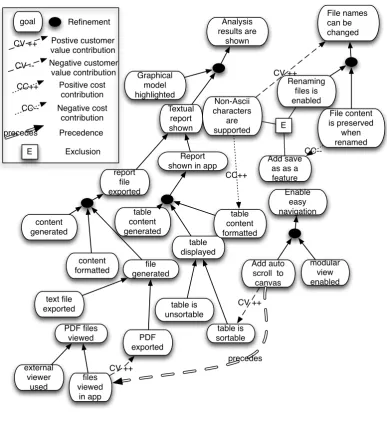
Modeling Language. We provide a goal–oriented requirements modeling language to capture requirements in consideration for the next release as well as the requirements that have been implemented. We also represent ‘synergies’ arising from having certain requirements together in a solution. One example of such a synergy is one requirement increasing the customer value of another, such as implementing a graphical user interface to increase the value of a functionality. Our meta-model also enables representing ex-clusions, and temporal constraints. Requirements may have associated reward and cost values, and synergies have intensities to determine optimal solutions during analysis.
Formal Semantics. We transform goal oriented requirement models into Satisfiability modulo theories (SMT) / optimization modulo theories (OMT) clauses. It is possible to specify lexicographic order of objectives, linear multi–objective functions, or a combina-tion of both.
Next Release Tool. Next Release tool is a standalone Eclipse RCP application. It has a graphical modeling editor to help users to build syntactically correct models. It also checks the well-formedness of the models. It automatically converts next release models into SMT/OMT formulas, and runs external OMT solver OptimathSAT [24] to obtain the optimal solution that satisfies the mandatory requirements respecting constraints in the model. The tool highlights the solution in the model and produce textual reports.
1.6. PUBLICATIONS
different scalability experiments to evaluate the scalability of our approach with respect to model size, model connectivity, and number of alternative solutions.
1.5.4
Risk Analysis
RQ4 ‘What is an effective method for risk analysis for sociotechnical systems’ We extend the three layered-approach of Asnar et al. [25] with relations to capture synergies in the models. Asset layer includes the initial requirements, which are threatened by the risks represented in the event layer. In order to mitigate these risks, treatments are considered in the treatment layer. As for the synergies, risks may increase the likelihood or the severity of impact other risks. Similarly, treatments reduce the likelihood, or the severity of impact.
Formal Semantics. We map requirement–risk models in Satisfiability modulo theories (SMT) / optimization modulo theories (OMT) clauses. We rely on OptiMAthSAT [24] as SMT/OMT solver.
Risk Management Strategies. We implement several optimization schemes that serve for different risk management strategies from risk aversion to cost aware and to more opportunistic strategies. For each strategy we identify the combination of the OMT optimization scheme and demonstrate how different strategies can be combined together.
Evaluation. We use the Loan Origination Process (LOP) scenario presented in [25] to self–evaluate the modeling language. We also provide an analysis of the visual notation.
1.6
Publications
We list the published work related to this thesis here. International Conferences
1. Amit Chopra, Fabiano Dalpiaz, Fatma Başak Aydemir, Paolo Giorgini, John My-lopoulos, and Munindar Singh (2014), Protos: Foundations for Engineering Inno-vative Sociotechnical Systems, In Proceedings of the 22nd IEEE International Re-quirements Engineering Conference, pages 53–62.
2. Fatma Başak Aydemir, Fabiano Dalpiaz, Paolo Giorgini, and John Mylopoulos (2014), Exploring Alternative Designs for Sociotechnical Systems, In Proceedings of the 8th IEEE International Conference on Research Challenges in Information Sciences, pages 1–12.
4. Fatma Başak Aydemir, Paolo Giorgini, and John Mylopoulos (2016), Risk Analysis with Goal Models, In Proceedings of the IEEE 10th International Conference on Research Challenges in Information Sciences, (to appear).
International Workshop and Demos
1. Fatma Başak Aydemir, Paolo Girogini, and John Mylopoulos (2014), Designing Sociotechnical Systems with Protos, In Proceedings of the 7th i* Workshop.
2. Fatma Başak Aydemir, Dagmawi Neway Mekuria, Paolo Girogini, and John My-lopoulos (2015), Next Release Tool, 34th International Conference on Conceptual Modeling, [online], http://er2015.dsv.su.se/files/2014/07/demo-3.pdf Under preparation
International Conferences
1. Fatma Başak Aydemir, Dagmawi Neway Mekuria, Paolo Giorgini, and John My-lopoulos, Scalable Solutions to the Next Release Problem: A Goal-Oriented Perspec-tive, Submitted to 24th IEEE International Requirements Engineering Conference. 2. Jennifer Horkoff, Fatma Başak Aydemir, Evellin Cardoso, Tong Li, Alejandro Mate
Morga, Elda Paja, Mattia Salnitri, John Mylopoulos, and Paolo Giorgini, Goal-Oriented Requirements Engineering: A Systematic Literature Map, Submitted to 24th IEEE International Requirements Engineering Conference.
1.7
Organization of the Thesis
The rest of the thesis is organized as follows.
• Chapter 2 presents the related work for this thesis. We review goal-oriented require-ments engineering languages and methodologies in Section 2.1. We investigate the state of the art for modeling social interactions in Section 2.2. Section 2.3 presents research for software evolution and risk analysis techniques and risk modeling lan-guages are examined in Section 2.4.
• Chapter 3 presents Protos approach for designing sociotechnical systems.
• Chapter 4 includes our work on sociotechnical system design. The meta–model is presented in Section 4.1. Section 4.2 lists the actions that are part of execution plan. PDDL mapping is described in Section 4.3. Section 4.4 reports on the results of the evaluation of the virtual notation.
1.7. ORGANIZATION OF THE THESIS
• Chapter 6 proposes a goal-oriented risk analysis framework that includes inter-dependencies among treatments and risks in terms of likelihood and generate optimal solutions with respect to multiple objectives such as goal rewards, treatment costs, or risk factor. Section 6.1 presents our meta–model for requirement–risk models. Section 6.3 lists different types of analyses supported by our approach.
Chapter 2
Related Work
Ross and Schoman state that requirements analysis must state why a system is needed,
what system features satisfy this need, andhow the system is to be constructed [26]. Zave defines requirements engineering as the branch of software engineering that deals with the real-world goals for, functions of and constraints on software systems in [27]. More re-cently Nuseibeh and Easterbrook describe requirements engineering as the process of the process of discovering the purpose of software systems by identifying stakeholders and their needs and by documenting these in a form that is amenable to analysis, communi-cation, and subsequent implementation [28]. van Lamsweerde lists the activities withing requirements engineering as domain analysis, elicitation, negotiation and agreement, spec-ification, specification analysis, documentation, and evolution [29].
Goal–Oriented Requirements Engineering (GORE) is a requirements engineering ap-proach where goals are used to used to conduct the activities stated by van Lamsweerde [30]. Goals have been used in artificial intelligence before their adoption by requirements engineering. There are several definitions of a goal in the requirements engineering lit-erature. van Lamsweerde defines a goal as an objective that the system should achieve through cooperation cooperation of agents in the software-to-be and in the environment [30]. Anton describes goals as high-level objectives of the of the business, organization or system that aid decision making at various levels within an enterprise [31]. The common perspective is that goals represent objectives, desired states of affairs.
2.1
Goal–Oriented Requirements Engineering
2.1.1
Goal Modeling
NFR framework [33], [34] captures and reasons on non-functional requirements (NFRs), global requirements such as maintainability, reliability, performance and so on. This work highlights the importance of non-functional requirements and use them to justify decisions during software development process. The authors state that a qualitative or quantitative approach can be adopted, yet obtaining quantitative measurements are too hard, so they present a qualitative treatment of NFRs. There are five major components of the NFR Framework. i. a set of goals that represent NFRs, design decisions, and arguments in support or against other goals, ii. a set of link types that relate goals to other goals, iii.
a set of methods to refine goals into other goals, iv. a set of rules to infer interaction among goals, and v. a labeling procedure to decide the level of satisfaction of an NFR. Actually, instead of satisfied or achieved, the framework uses the term satisficed, a term coined by Simon in [35], for there is no clear cut criterion for full satisfaction of an NFR. During the design process goals are refined into other goals using the refinement rules, as a result Soft-goal Interdependency Graph (SIG) is built. The requirement analyst can select between alternative results by applying label propagation algorithms to verify how well each alternative satisfice the high-level NFRs.
Jureta et al. propose Techne [36] modeling language. In Techne requirement state-ments are labeled, therefore categorized into five categories: goals, quality constraints, softgoals, tasks, and domain assumptions. In Techne quantitative treatment for soft-goals are adopted. Softsoft-goals are approximated into quality constraints in the models, and preference relations are used to represent preferred approximation by the requirements analyst. Our evaluation of Techne [37] shows that this concept is difficult to realize during early requirements engineering stage.
Li et al. [38] treat NFRs asqualities over requirements. Qualities are captured as map-pings, and have a domain and codomains in requirements models. The authors provide a set of refinement operators in [39] to incrementally refine informal, vague, ambiguous requirements into a formal, practically satisfiable and measurable specification.
2.1. GOAL–ORIENTED REQUIREMENTS ENGINEERING
KAOS methodology later extended to handle obstacles [41], and to build anti-models, models that capture intentions of an attacker [42], and to focus on security requirements [43], and so on.
GBRAM (Goal–Based Requirements Analysis Method) [44] is a method to identify, analyze, elaborate, and specify requirements. GBRAM starts by exploring available infor-mation related to requirements (policies, interviews, transcripts, and so on). Next, goals and the responsible agents are identified, and the goals are classified and dependency rela-tions are built. ‘Refine’ activity refers to pruning of the goal set. Then, the prune goal set is elaborated by analyzing obstacles and constructing scenarios to uncover hidden goals. Finally the goals are operationalized, they are transformed into operational requirements for the final requirements specification.
Rolland et al. [45] use goals to discover scenarios, and scenarios to discover goals. They call a goal and a scenario pair arequirement chunk (RC). Requirement chunk models capture RCs, where high-level, fuzzy RCS are refined into concrete RCs. The authors make a distinction of refinement and AND/OR decomposition. The conceptual meta-model is supplemented with a set of guidelines to help discovery of goals and scenarios.
i* [13], [46] is an agent–oriented goal modeling framework for business process re-engineering, organizational modeling, and requirements engineering. In other approaches such as KAOS and GBBRAM, goals exist regardless of agents, and agents are assigned goals towards the final steps of the requirements process. On the other hand, goals existed only if an associaoted agent exists in i* models, so agents have goals, and they depend on each other to satisfy them. i* has a broad view of agents, that are actors. Agents are concrete actors with certain capabilities. Roles can also be actors, they are abstract actors with responsibilities and expectations captured as goals, or positions which are socially recognized roles. Actors have intentional, they have their goals. There are two types of goals, hard and softgoals, the difference is that softgoals do not have a clear cut criteria for achievement as opposed to hardgoals. Hardgoals, softgoals, resources, and task may contribute positively or negatively to other intentional elements. Strategic Dependency (SD) graphs capture dependencies among actors. Strategic Rationale (SR) models capture the rationale of every actor in terms of hardgoals, softgoals, resources, tasks, dependencies and relations between these. i* framework has been very influential in the goal-oriented requirements engineering and has been extended in multiple ways: SI/*/ [47], to better capture security and trust requirements, URN as a combination of GRL and use case maps [48], and Tropos [49] to name the few.
2.1.2
Analyzing Goal Models
Goal models are used to capture and communicate requirements, yet their structure natu-rally allows reasoning on the achievement of goals as well as some domain properties such as security and trust. There are number of analysis methods proposed in the literature of goal–oriented requirements engineering.
Satisfaction analysis concerns whether goals in the model are achieved or denied. The procedure is to assign a set of initial values to the model and propagate these values either forward or backward direction of the links present in the model.
Amyot et al. [50] propose a quantitative reasoning technique that is based on forward propagation of labels for URN, which combines GRL and use case maps. The labels are determined by a predefined set of rules that combines evidence from contribution links, which can be make, help, some positive, unknown, negative, break, and hurt. There are seven satisfaction levels (labels), which are denied, weakly denied, weakly satisfied, satisfied, conflict, unknown, and none.
Chung et al. [34] propose a forward reasoning technique to reason on NFRs, similar to the technique presented in [50] there are several labels to represent the degree of satisfaction. Instead of relying of predefined set of rules to combine the evidence from contribution links, this method relies on human interference.
Giorgini et al. devise forward propagation qualitative and quantitative reasoning tech-niques techtech-niques [51]. Conflicting contributions are combined according to a set of rules. The results are presented as achieved/denied for the qualitative analysis or in terms of numeric values for the quantitative analysis.
Sebastiani et al. [52] encode the satisfaction analysis as a satisfiability problem and allows user to define additional constraints on the models. If the problem is satisfiable the solver returns an assignment for the model. There might be multiple assignments, in order to distinguish between these weights are assigned to goals, and minimum weight assignment is returned by the solver. Asnar et al. [53] apply this technique [52] to reason on risk in goal models and to find minimum cost solutions, where cost values are assigned to task as their weights. Wang et al. [54] adapt the same technique to diagnose run-time failures using goal models.
Giorgini et al. present forward and backward reasoning applied in Tropos in [55]. The techniques presented in [55] is a combination of those presented in [51] and [52] applied to Tropos models, so contribution links are automatically combined. For satisfaction and denial, partial (P) and fully (F) labels are used.
Horkoff and Yu [56] transform goal models in conjunctive normal form (CNF) and iteratively apply SAT solver and human intervention. Human judgment is used to decide for the combination of the conflicting contribution links. The approach is applied to i*
models that are formalized by the authors.
2.2. MODELING SOCIAL INTERACTIONS
between alternatives in terms of quality values.
Some methods apply maps the design problem into AI planning problem to determine the sequence of actions to satisfy goals. Bryl et al. [58] create social interaction networks within goal models by finding plans in terms of cost. The authors later extend this approach and apply it to i* and Tropos models [59] as a requirements analysis method. The authors define planning actions and encode the models in PDDL. The encoding of the actions (domain file) and the encoding of the modeling domain (the problem file) is given as input to an external planner and if there is a sequence of actions that satisfy the top level goals, the planner returns a plan. The author later defines metrics to evaluate the plans in [60]. Three metrics defined arei. the length of the proposed plan, ii. overall plan cost, iii. degree of satisfaction of NFRs. Asnar et al. [61] combine the planning-based approach presented in [58] and goal-based risk analysis technique presented in [53].
Liaskos et al. [62] distinguish between mandatory goals and preferences (nice-to-have goals). Preferences are goals of stakeholders whose satisfaction is desired yet their denial does not invalidate a solution. The authors use priorities to set a level of importance on preferences. The authors also introduce temporal preferences, temporal constraints over the sequences of goals of the mandatory decompositions. Goal models are formalized into hierarchical task network (HTN) and PDDL, and an external planner HTNPlan-P [63]. The preference score of a plan is the sum of prioritization (weights) of preferences satisfied by a plan. The plan with the highest preference score is returned by the planner.
Nguyen et al. [64] encode goal models in satisfiability modulo theories/optimization modulo theories and can perform not only satisfaction analysis but also multi-objective optimization analysis. It is possible to set global constraints, such as setting a budget limit for solutions, on the models as well as local constraints on goals, such as specifying a budget limit for the solution of a single goal. The framework allows prioritization of goals and is able to capture and reason on conflict relations. Goals can be mandatory and optional goals are supported. The framework is fully formalized and has tool support which is proved to be scalable. The tool automatically converts constrained goal models into SMT/OMT formulas and feeds these as in put to external solver OptiMathSat [24]. The optimal solution retrieved from the solution is highlighted on the graphical goal model. Although there have been attempts for single objective optimization analysis [25], [52] these approaches are not as expressive as constrained goal models in terms of expressing multiple global and local constraints, multiple objectives and objective schema (lexicographic and linear objective functions).
2.2
Modeling Social Interactions
systems. Social interactions are studied in different areas, our focus is on agents and multiagents systems, conceptual modeling, software and service engineering.
AUML (Agent Unified Modeling Language) [65] The first layer represents the overall protocol, using packages and templates. The second level includes interactions among agents. Sequence diagrams are directly borrowed from existing UML specification. Col-laboration diagrams are diagrams similar to sequence diagrams. In sequence diagrams an ordered sequence of interactions can be followed from top to bottom, in collaboration diagrams the number of the interaction is labeled on the links between agents, which can be placed anywhere. Activity diagrams consist of pool of agents, and activities in these pools showing how they trigger other operations and events. Statecharts capture valid states, where agent interactions are labeled on the edges between states. Finally the third level concerns the internal processing of agents. In this layer, activity diagrams and statechart diagrams are used to depict internal processing of agents.
KQML (Knowledge Query and Manipulation Language) is an agent communication language (ACL), independent of content syntax and applicable ontology. There are three components of a KQML message: content, communication, and message. The content is the actual content of the message, and can be in any language. The communication part includes meta information such as the identity of the sender of the identifier of the message. The message part identifies the interaction protocol and supplies a speech act. A speech act is an utterance that has performative function [66]. The syntax of KQML includes balanced parentheses lists.
FIPA Agent Communication Language [67] is another speech act-based agent commu-nication language. Similar to KQML, the conent of FIPA ACL can be in any language. Sender, receiver, and reply-to fields are used to represents the agents included in the communication. Communicative act is the performative of the message. The content field is the content of the message. The receiver interprets the content together with the communicative act.
Singh [68] points that these languages do not solve the interoperability problem among heterogeneous agents. The author argues that the communicative acts are not clear since they are based on interpretation of the receiver or the sender agent. The languages do not cover all of the most common communicative acts, which are assertives, directives, com-missives, percom-missives, prohibitives, declaratives, and expressives, focusing on assertives and declaratives only. Moreover, the languages rely on agents’ internal state rather than providing means for communication independent of the internal beliefs, goals, desires, and intentions of agents. The author states that existing ACLs design autonomy (minimizing requirements on agent builders) and execution autonomy (agent’s freedom of choosing its own actions), and communication is inherently public and depends on the social context of agents.
2.2. MODELING SOCIAL INTERACTIONS
agents, and it is not designed for open systems.
Cheong and Winikoff [70] propose a goal–oriented approach to agent interaction. Her-mes approach has three parts: a methodology for for designing goal-based interactions, failure handling mechanisms, and a process for mapping design artefacts to an executable implementation. The authors argue that message–based protocols restrict autonomy of agents, and limit the flexibility (shortcuts) and robustness of agent interaction. Goal– oriented interaction is described in terms of interaction goals, available actions, and con-straints. Message sequences among agents are not predefined, but they emerge during interaction. The methodology is consisted of six steps: role and goal identification, inter-action goal hierarchy, inter-action identification, inter-action sequences, message identification, and message definitions. Action failures can be recovered by re-performing an action. If an interaction goal fails due to an action failure, the interaction can be terminated or agents may request a rollback to the previous interaction goal. This approach may fit for the greenfield design of a multiagent system, but it does not consider an open system where new agents with different interaction goals can enter to the multiagent system.
Singh proposes social commitments in [18] to overcome challenges stated above regard-ing agent communication. The framework is called spheres of commitments and relies on eight assumptions set by the author: agents can be recursively composed of heterogeneous individuals or groups of agents, agents are autonomous but constrained by commitments, social commitments cannot be reduced into internal commitments, commitments are in general revocable, commitments exist and can be manipulated all in social context, com-mitments rely on the social structure of the multiagent system in which they exist, but they also help creating the social structure, the semantics of commitments must be dis-tinguished from their pragmatics, and finally commitments are evaluated in the world not in the minds of agents. A commitment c is a four place relation c=C(x, y, G, p) where
x is the debtor agent, which is committed, y is the creditor agent, which receives the commitment, G is the context and y is the discharge condition. So c=C(x, y, G, p) is a commitment fromx toy in the context ofG and for the propositionp. Commitments can be created, discharged (satisfied), canceled, released (eliminated), delegated, or assigned. Yolum and Singh [71], [72] build flexible communication protocol using commitments. In their formal framework a base level commitmentC(x,y,p) refers to a commitment from debtorx to creditory for the conditionp. A conditional commitmentCC(x,y,p,q)denotes that if the condition p is brought out, x will be committed to y for q. The framework is formalized in event calculus [73]. A protocol specification is a set of initiates and termi-nates clauses, and the protocol execution is a set of happens clauses. The interaction is meaningful, meanings of the actions are captured via commitments, verifiable via commit-ments, and declarative. Later Desai et al. [74] specify interaction protocols for business processes using commitments, their framework is formalized in theπ-calculus [75]. Telang
[49] extended with commitments. Chopra et al. reason on service–oriented architectures [79] and on protocols [80] using agents and commitments, their frameworks are formalized in Datalog [81].
2.3
Evolution
2.3.1
Software Evolution
Software evolution is a term in use since 1960s [82]. Later Lehman and his colleagues state overall eight laws on software evolution. The first three laws are presented in [83], which are i. a software product either undergoes continual change or become less and less useful, ii. as software evolves, its complexity increases unless some work done to main or reduce it, iii. software growth inevitably slows as it grows older. Two more laws, iv. the average rate of change in an evolving software system tends to stay constant (invariant) over the life time of a system, and v. the average incremental growth remains invariant or declines as systems evolve, are introduced in [84]. The sixth law, ‘functional content of a software must be continually increased to maintain user satisfaction over its lifetime’ is included in [85], Final two laws, vii. software will be perceived as of declining quality unless rigorously maintained and adapted to a changing operational environment,
viii. software development processes constitute multi-loop, multi-level feedback systems and must be treated as such to be successfully modified or improved are presented in [86]. These laws are effective on what Lehman et al. call type E systems, that are, software systems that deal with, or solve problems in real world. There is supporting and contradicting of these laws [87], yet our point is that software evolution is a valid concern for over 40 years.
2.3. EVOLUTION
2.3.2
Requirements Evolution
Zowghi et al. [89], [90] specifically focus on the evolution of requirements. They propose a framework formalized in Telos [91]. Requirements are kept in a belief base, and the framework manages changes in requirements models (beliefs), checking also consistency and completeness. The approach has explained using a toy example and intended for systems monolithic software systems, making the assumption that the requirements should be complete and consistent. Such assumptions are not realistic for modern software, or sociotechnical systems.
Barber et al. [92] propose applying system engineering process activities (SEPA) for managing the evolution of requirements. The authors identify necessary steps to practice ‘good’ software engineering and manage evolving requirements as mapping new requirements into old ones, creating traceability links from the existing implementation to new requirements, implementing components for new requirements that are not covered by the old implementation, and integrating the old and the new implementation. A funnel metaphor is used to describe SEPA activities, where there is continual gathering of knowledge (requirements and domain knowledge) which are refined into component-based system design specification. The objective is to create a single technical system, the methodology does not handle relations among requirements, or requirements from multiple stakeholders. The infrastructure reference architecture classes diagram presented in the paper, people are clearly separated from technology. So the approach is not suitable for handling requirement for sociotechnical systems.
Anderson and Fellici [93] present an empirical investigation of controlled evolution of requirements. The study is conducted for the requirements of a technical system, a safety-critical avionics system. Two significant results for our research work are i. the number of requirements increases over software releases, ii. the evolution tends to show some dependencies between requirements. So requirements evolution is a valid challenge that should be attended over the course of software life cycle, and dependencies between requirements have a significant role during evolution. The authors define metrics for monitoring evolution of requirements in [94].
Zowghi and Gervasi [95], [96] propose a formal foundation to ensure consistency, com-pleteness, and correctness of requirements. They present the requirements problem in terms of evolving requirements and domain assumptions. For sociotechnical system de-sign where multiple systems are involved, conflict and inconsistency in requirements are inevitable. Rigid systems that do not allow modeling inconsistency and conflicts are not suitable to model and analyze requirements in sociotechnical systems.
is anticipated, and it is part of the evolution of the requirements. The authors state a requirements problem for evolving requirements, and four different alternatives for valid solutions: the standard solution that ignores the implemented requirements and treat the problem as a greenfield design problem, the minimal change effort solution that selects the new requirement set based on its distance from the previous set, the maximal famil-iarity solution that selects the solution with the maximal reuse, and solutions that re-use past solutions. The proposed framework uses knowledge base [99] to store information ac-quired during requirements acquisition and domain modeling and query this information to discover and compare alternative solutions. The paper reports the results of scalability experiments.
Ali et al. [100] propose a goal–oriented requirements engineering approach to handle requirements evolution. The authors define requirements evolution in a broad way, for example, they classify switching to an alternative solution due to a failure caused by a change in the context. An ‘autonomic’ evolution is to automatically select a variant based on historical success/failure data, such a case is classified as adaptation by others, such as [98]. Designer supported evolution occurs when the requirements analyst modifies the goal model.
Ghaisas and Ajmeri [101] develop a knowledge–assisted ontology–based method to deal with requirements evolution. The authors advocate for knowledge re-use for 50% of requirements knowledge for similar system can be re-used completely or with minimal modification [102]. K-RE tool developed by the authors enable knowledge sharing between stakeholders using environmental context ontology, problem domain ontology, generic requirements ontology, and RE process ontology. The tool also helps analyst handling change requests, listing related requirements for a specific request.
2.3.3
The Next Release Problem
Bagnall et al. [22] define and solve the next release problem where each customer has their set of requirements, and a weight representing the customer’s importance to the company. All possible software enhancements are represented in a directed, acyclic graph, where edges denote requirements dependencies. Each requirement has an associated cost. The problem is to find a set customers, whose requirements to be satisfied in the next release of the software, such that the sum of customer weights in the selected set is maximized subject to the sum of cost of requirements to be satisfied. This problem statement has attract attention and many solutions have been proposed. The authors apply three different methods: i. knapsack formulation, ii. greedy algorithms, and iii.
local search algorithms.
2.3. EVOLUTION
effort and risk estimation as well as a resource constraint. Requirement dependencies are shown as a partial order. They propose an iterative approach that applies a genetic algorithm to determine L best solutions that respect constraints (temporal constraints and requirements dependencies). Saliu and Ruhe [105] apply analytic hierarchy process (AHP) [106] to determine the weights used for objectives. Ngo-The and Ruhe [107] integrate a multi-criteria decision aid method (ELECTRE IS) for deciding the final solution. Du and Ruhe [108] apply rough set analysis (RSA) [109] and dependency network analysis (DNA) [110] techniques to the framework.
Baker et al. [111] report on the performance of the search–based approaches for the next release problem. They compare simulated annealing and greedy algorithms and human judgment. Both search-based methods outperform expert judgment. Simulated annealing algorithm also performs better than greedy algorithm.
Zhang et al. [23] define the multi-objective next release problem, adding ‘value’ ob-jective to ‘cost’ obob-jective. In this formulation of the next release problem, requirements dependencies are ignored. The authors solve the problem in four different ways: i. non-dominated sorting generic algorithm-II (NSGA-II) [112], ii. Pareto GA algorithm, iii.
single–objective GA, iv. random search. NSGA-II algorithm performs the best in a scal-ability experiment where the highest number of requirements and customers are 140 and 100, respectively.
Durillo et al. [113], [114] solve the multi-objective next release problem with three different algorithms: i. NSGA-II,ii. multi-objective cellular genetic algorithm [115], and
iii. random search. In the scalability experiment number of requirements vary between 40 and 200 whereas the number of customers vary between 15 to 100. NSGA-II algorithm outperforms the others.
Jiang et al. [116], [117] use approximate backbone–based multilevel algorithm to solve the next release problem. Their approach reduce large problem instances into smaller ones. The experiment results show that such divide and conquer approach canperformance than direct solving approaches.
Sagrado et al. [118] compares genetic algorithms, simulated annealing, and ant colony optimization techniques for the solution of the next release problem. Ant colony opti-mization techniques demonstrate better performance than the other algorithms.
Veerapen et al. [119] apply integer linear programming techniques to single and bi-objective next release problem. They report that exact solutions for large single bi-objective and small bi-objective problems can be found in reasonable time using linear programming techniqes thanks to advancements in solvers. On large bi-objective instances, execution times can still be significant. The Integer Linear Programming-based approximate algo-rithm outperforms the NSGA-II genetic approach on large bi-objective instances.
2.4
Risk Assessment
2.4.1
Risk Analysis
Uncertain events are defined over their likelihood to happen and severity. probabilistic risk analysis (PRA) is used for quantitative analysis [121]. Quantitative approaches such as FMECA (Failure Mode, Effects, and Critical Analysis) [122] use qualitative values. For example frequent, reasonably probable, occasional remote, and extremely likely is used for distinguishing frequencies for likelihood. Expectancy loss or risk factor, which is the product of the likelihood of an event and the severity, is used to determine the criticality of a risk.
CORAS [123] is a risk analysis framework that models, analyzes, and treats risks. In CORAS, each risk is analyzed independent of system or malicious actor objectives. Each risk has a single impact and likelihood, so the effect of the same event on multiple objectives are considered as separate risks.
Feather [124] proposes Defect Detection and Prevention (DDP) as a three layered (ob-jectives, risks, and mitigation) approach. Each risk has a likelihood as the probability of occurrence, and the severity of a risk is represented by an impact relationship between the risk and an objective. Mitigation and risks have affect relations. There are no depen-dencies captured within objectives, risks, or mitigations. The author later models risks as fault trees, providing a more structured representation. ‘What if’ question is investigated by turning mitigations on and off.
2.4.2
Goal–Oriented Risk Analysis Approaches
KAOS [40] is extended with the concepts of obstacle [41] and anti-goals [42]. Obstacles are situation that lead to goal failure, they create unintended risks for a system. On the other hand anti-goals are malicious intentions of a malicious actor, such as an attackers threatening a system. Van Lamsweerde et al. provide a systematic approach to derive and resolve obstacles in [41] and building anti-models to capture intentions of attackers and mitigate threats in [42].
Asnar et al. [25], [53] propose Goal–Risk (GR) Framework for modeling and reasoning about risk during requirements engineering process. Goal–Risk models have three layers. The asset layer includes requirements represented as goals. Goal can be AND/OR de-composed and contribute to each other as in i* and Tropos. The event layer is consisted of events, each event has an associated likelihood to happen and and impact on some of the goals captured in the asset layer. The severity of the impact denotes how the event affect the satisfaction of a goal. Tasks presented in the treatment layer mitigate risks. Forward and backward label propagation algorithms are used in combination to decide satisfaction and denial of goals, multiple evidence is combined according to predefined rules. The framework discovers optimal results with respect to a single object, total cost of tasks and goals. Risk assessment process proposed by the framework has three steps:
2.4. RISK ASSESSMENT
iii. assessing the countermeasures to mitigate risks. The framework is equipped with two tools, GR-Tool and SI* Tool.
Mayer et al. [125] et al. extend i* with concepts related to security risks. The approach first identifies business assets in the models and then set security goals on these assets. ‘Controls’ are modeled to ensure the satisfaction of the security goals. Controls have an associated cost so the authors use cost-benefit analysis together with satisfaction analysis.
Matulevicius et al. [126] focus on handling security related risks in information sys-tems. The framework extends Secure Tropos framework [127], an extension of Tropos framework focusing on modeling and analyzing security. Similar to [25], constructs in the language are categorized into three categories. Asset related constructs are actors, hardgoals, softgoals, resources, plans, and secure goals. Risk related constructs are the same but malicious versions of the original, shown using a different syntax in models. Impact relation is defined to represent the effect of the risk related constructs on asset related constructs. Treatment related constructs are the same as asset related concepts, with the addition of mitigates relation. Risk assessment process with asset identification, continues with risk analysis and then treatment identification. The framework provides satisfaction analysis only.
Chapter 3
Protos: A Methodology for Designing
Sociotechnical Systems
We define a SocioTechnical System as one involving interactions between humans and organizations (principals) facilitated bytechnical artifacts, including software. STSs under this definition include two or more autonomous parties, who ordinarily act and interact in ways that promote their respective agendas. Thus the participants may act in ways that are unexpected by others.
We further restrict our attention to STSs whose rules of encounter are formally repre-sented, whether created via explicit engineering or otherwise. The benefit of an “institu-tionalized” STS is that its explicit rules of encounter facilitate reasoning by (prospective) participants about whether and how to participate in the STS. Examples of such STSs can be found in many domain