A Business Process Analysis of Islamic Microfinance: Value Maximization and Social
Capital Development in Pakistan
Author’s Details:
Shahbaz Tariq-
MS management science, Federal Urdu University of Art Science and Technology, Islamabad, Pakistan
Zeeshan Ur Rahman Awan-
Visiting Faculty Member Alhamd Islamic University, Islamabad, Pakistan
Abstract
This paper explains the analysis of the business process of a successful and second largest in term of geographical coverage Islamic Microfinance program in Pakistan. The program is scientifically designed to facilitate the poor’s through monetary benefits and social capital development. Monetary benefits include financial support and social capital development by sensitizing or mobilize the community to undertake their developmental activities by themselves. The paper focuses on the practices, approaches, mechanism, model, strategies, mode of financing, geographic coverage, and targeted segments of the program. To determine the financing mechanism, processes and data flow author visited the main office and branch offices. In developing countries, for Islamic microfinance organization, a social capital development unique feature of Esaar Microfinance and limited resources for operational self-sufficiency could be informative. However, this program has unique characteristics, so there is a need for global expansion to prepare students for assignment in developing countries is one of the major goals of this study
Keywords: Geographical Coverage, Islamic Microfinance, Scientifically, Monetary, Social Capital Development.
Introduction
Overwhelming support had been received from SBP, NGOs, development agencies and the government, to accelerate the microfinance services. Yet in spite of the popularity from senior stakeholders, the outreach has generally been very low, meeting only 5% of the potential microfinance demand (Pakistan Country Profile. n.d:1), Grameen Bank and contrary to the financial lending standpoint that claim large outreach can only be achieved through fully self-sufficient MFP (Robinson, 2001:23). There are two major contending schools of thought in microfinance especially in terms of achieving outreach, the Welfarist perspective (poverty lending approach) and the Institutionalist standpoint (financial lending or profitability approach) (Robinson, 2001:2; Fisher, 2002:19; Woller et al., 1999:30).
Non Profit Organizations (NPOs), Non Government Organizations (NGOs) and many Rural Support Programs (RSPs) have been important players in the Islamic microfinance sector in Pakistan, State Bank of Pakistan (SBP) still take it a new idea as compared to the other developing countries that NPOs, NGOs and RSPs in Islamic Microfinance have been involved in poverty alleviation across the country. Islamabad-based Helping Hand for Relief and Development (Brotherhood & Scarify) is second largest NGO in the Islamic Microfinance sector according to the geographical coverage that has been providing interest-free loans to the poor and poorest of the poor in 27 cities across Punjab and Sindh, AJ &K, Khyber Pakhtunkhwa and Baluchistan.
Inspired by Islamic values and teachings; Helping Hand for Relief and Development (HHRD) built up its Islamic microfinance program in 2010 based on Shariah principles. HHRD’s Esaar Microfinance Program was started at large scale with the objective to contribute to increasing economic opportunities in the underprivileged areas of Pakistan. Following an integrated approach, the program is providing opportunities to increase the income of beneficiaries to earn a livelihood for their families by undertaking productive income-generating activities. The Islamic approach emphasizes microenterprise development through financial and non-financial assistance adhering to principles of transparency, brotherhood, and cooperation. Its mission statement follows: “To facilitate and support livelihood opportunities and microenterprise development for poverty alleviation through the provision of Islamic Microfinance as a Flagship Program of HHRD.”
Since it was founded in 2010, HHRD’s Esaar Microfinance Program primary objective has been to enable economic wellbeing and resilience for individuals with low income, especially suffering the disaster through interest free microfinance, to provide social assistance, capacity building opportunities and integrated development ingredients to support the poor break the poverty cycle by creating the spirit of brotherhood and community development and to institutionalize the Esaar Microfinance Program regarding sustainable, growth-oriented and replicable one.This program is based on brotherhood, mutual help, and principles of Islam. Interest is strictly prohibited in Islam. Quran says “O you who believe! De-vour (eat), not usury (interest), doubled and multiplied, but fear Allah that you may prosper” Similarly prohibition of interest is also found in Sunnah of Prophet PBUH. Prophet PBUH has ordered to stay away from seven deadly things, and Interest is one of them.
An Overview of Program Approaches and Practices
Implementation Strategy
Areas are selected that are affected by some natural disaster & calamity or which are socially and economically deprived. Urban or semi-urban areas are generally avoided.
HR Selection & Facilitation
Young people having good educational skills and socializing and mobilizing capabilities are recruited. The staff and the office are well equipped with all the necessary requirements.
Baseline Survey
A survey is conducted for a comprehensive picture of its demographic details, economic activities, health facilities and educational opportunities.
Target Group Identification
Individuals are addressed who are socially and economically weak and have capabilities to grow but require capital or financing.
Community Mobilization & Organization
The local community is mobilized and organized so that they can realize their own needs and available resources. Together they are social collateral and guarantee of each other for Esaar Microfinance.
Disbursement
After making a community organization, social and technical appraisals of CO members are done which include social & economic details and the demanded item of an individual. After necessary processing, the individuals are given the required items.
Recovery & Follow up
Recoveries are made both on a monthly basis and also lump sum amount on the harvesting of crops.
Figure 1. Implementation Strategy of Esaar Microfinance (Annual report for 2016)
Characteristics of Esaar Microfinance
Esaar Microfinance model has unique characteristics which distinguish it from other models and organizations.
Cluster Base Approach
Esaar Microfinance adopts a Union Council (Comprised of 10-12 villages) and mobilizes different communities within that Union Council.
At every step of Esaar Microfinance program implementation, the local community is given participation, whether it is social mobilization, community meetings or disbursement. The community is given the most important place in this program.
Interest Free: Islamic Modes of Financing
The program is operating through a variety of Islamic Financial Products which are based on Islamic Shariah. Esaar Microfinance is a pioneer program which has adopted not only trade based mode of Islamic finance but also a partnership based mode which is nearest to the spirit of Islamic financial principles.
Sustainable: Operational Self Sufficiency
Esaar Microfinance is meeting 80 percent of its operational cost with its own sources, making it a reliable and long lasting program for uplifting the economic lives of masses.
Universally Replicable
Due to the uniqueness and simplicity of this program, it can be applied in any part and environment of the world.
Branchless Network with Online System
Unlike formal financial institutions Esaar Microfinance doesn’t have branch offices, rather it provides services at the doorstep and sends the applications directly to Head office through an online Management Information System (MIS).
Shariah Certified
All the modes of financing and documentation are backed by Shariah certification. The operations are examined by Shariah experts through annual Shariah Audit.
Enhancement of Income Generating Activities
The aim of Esaar Microfinance is to make its beneficiaries financially independent. For this Objective, financing is made for such activities which generate a permanent source of Income for the individuals.
Social Capital Design of Esaar Microfinance
Social mobilization is the crux of a social sector. It is processed through which Social mobilizers sensitize or mobilize the community to undertake their developmental activities by themselves. Social organizer identifies social capital, motivates community, explores common interests and pursues the mobilization of their social & economic assets. Esaar Microfinance after mobilizing and organizing the community, finance them against this social collateral. This social bonding and community approach morally compels an individual to repay the financed amount.
Esaar Microfinance also has a community-based approach which is spread across Pakistan. Esaar Microfinance has divided its Social Mobilization into three levels.
1. Community Organization (CO): A Community Organization (CO) is the smallest group unit of Esaar Microfinance’s social networking. The program forms CO of a group of Individuals living in a village.
2. Village Council (VC): In a large village which has a different settlement, there must be more than one CO. Different COs of a village form a Village Council (VC). This VC consists of members nominated by CO.
3. Community Humanitarian Forum (CHF): To enhance the capacity of the community members for the development of their area there is the Community Humanitarian Forum (CHF) which comprises all the organizations of a village. The members of CHF are the representatives of VCs.
Islamic Financial Products of Esaar Microfinance
Esaar Microfinance is operating through Shariah based modes of financing which means that these modes are according to the true spirit of Islamic business principles. With these modes deserves are provided Income Generating Activities. Through which they obtain a permanent source of income which helps them to get out of the poverty cycle. Currently, Esaar Microfinance is operating through three modes of financing.
Murabaha: Murabaha is a trade based mode of financing which Esaar Microfinance uses for providing seeds and fertilizers to farmers, trade material to businessmen and also other material for income generating activities.
Qard-e-Hasan: This Interest-free loan is given for the rehabilitation of widows and physically disabled persons. Through this, they can fulfill their personal and social needs.
Mode of Financing Objectives Amount limit
(PKR) Duration of Loan
Qard-e-Hasan For rehabilitation of widows and
physically disabled 20,000 to 30,000 10 monthly installments
Murabaha For purchasing fertilizers, seeds,
merchandise, machinery, etc. 30,000 to 40,000
10 monthly installments or to the time of harvesting crop
Mudarbaha For enhancing livestock business 30,000 to 40,000 At selling the animal or maximum 12 months
Table 1. Islamic Financial Products of Esaar Microfinance (Annual report for 2016)
Outreach of Esaar Microfinance
Esaar Microfinance is operational in 27 districts five provinces of Pakistan. Name of districts as under:-
Kashmir & Hazara:- HattianBala-Lamnian, Poonch-Hurnamera, Kotli-Tarala, Mansehra-Kaghan, Mansehra-Shinkiari, Gilgit-Jaglot.
Punjab:- Mianwali-DherUmaid Ali Shah, Muzaffargarh-Kot Addu UC 1, Rajanpur-Basti Rindan, Bahawalpur-Goth Mehrab, Bahawalpur-Tiba Badar Sher.
Head Office:- Islamabad
Baluchistan:- Jaffarabad-Dirgi, Ziarat
Khyber Pakhtunkhwa:- Charsadda-Agra, Lower Dir-Talash, Swat-Madyan, Swat-Kalam, Malakand-Thana, Nowshehra-Choki Town, Chitral-UC 1.
Sindh:- Jacobabad-Thul, Kashmor-Ghouspur, Mirpurkhas-DaulatPur, Tando Allah Yar -UC 3, S. Benazir Abad – Bandhi, Matiari – Zerpir.
Staffing
Figure 2. Organogram of Esaar Microfinance (Annual report for 2016)
Financing Mechanism
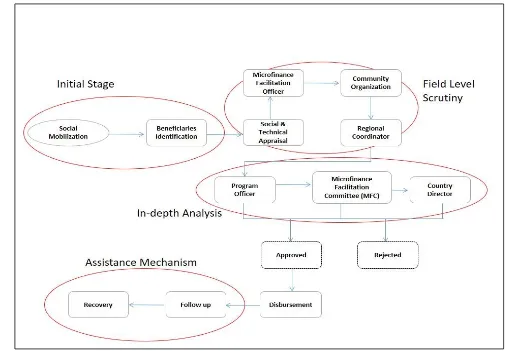
At initial stage credit officers starts mobilization to create awareness about Islamic microfinance after that people those agree to get loan is identified than their social and technical appraisal will be filled by the loan officer with the social collateral of community organization after completion of request application reach to the regional coordinator where regional coordinator verify it at field level and send to the head office. Request application reaches head office where in depth analysis done by the program officer, microfinance facilitation committee, and country director who can approve or reject the application. With the approved application official also determines how much amount should be approved. Approval of amount depends upon the credit history of the beneficiary and also its poverty score. The process starts with the application to recovery save in the online management system (MIS) also known as Esaar online database. The system also has the capability to send data from one branch to another directly through e-mail. Each month, every branch sends portfolio and accountancy updates to the headquarters. Each beneficiary information and other financial data are saved and secured at the head office in Islamabad and available to management at any time. The online MIS can provide a hundred types of the report to management through its unique filters options.
Figure 3. Flowchart for the Lending Methodology and Selection Criteria
Esaar Microfinance Working Model
Step 1: Donations are generated by Muslim families living in the USA and Canada.
Step 2: Whatever donation is generated it is distributed among the most deserving segment of the society through different models of income generations.
Step 4: The recovered amount is put back in the donation pool and is once again distributed among deserves.
Figure 4. Working Model of Esaar Microfinance (Annual report for 2016)
Targeted Income Generating Activities
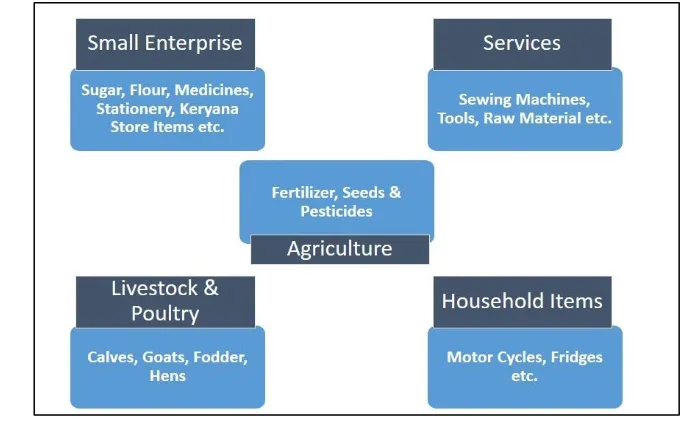
Esaar Microfinance is providing loan facilities to the targeted segment of societies for poverty alleviation which includes Small and medium enterprise, services sector, Agriculture Sector, Asset base (household items) and livestock & Poultry.
Figure 5. Targeted Income Generating Activities of Esaar Microfinance (Annual report for 2016)
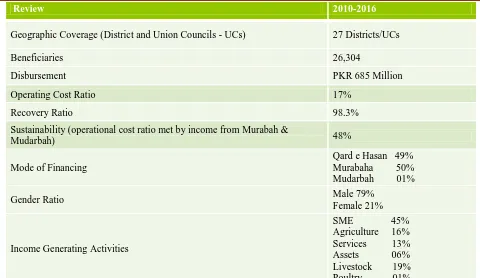
Summary Review of Esaar Microfinance
Review 2010-2016
Geographic Coverage (District and Union Councils - UCs) 27 Districts/UCs
Beneficiaries 26,304
Disbursement PKR 685 Million
Operating Cost Ratio 17%
Recovery Ratio 98.3%
Sustainability (operational cost ratio met by income from Murabah &
Mudarbah) 48%
Mode of Financing
Qard e Hasan 49% Murabaha 50% Mudarbah 01%
Gender Ratio Male 79%
Female 21%
Income Generating Activities
SME 45% Agriculture 16% Services 13% Assets 06% Livestock 19% Poultry 01% Table 2. Summary of Esaar Microfinance
CONCLUSIONS
The purpose of this study was to analyze the business process of a successful and second largest in term of geographical coverage Islamic Microfinance program in Pakistan. For this purpose scientifically designed business process of Islamic Microfinance program of Helping Hand for Relief and Development was reviewed. On the basis of examination, it is documented that Islamic Microfinance program is facilitating poor’s not only with monetary benefits it is also developing the social capital. After the review of practices, approaches, financing mechanism, model, strategies and geographic coverage it is concluded that this program is helping poor by fulfilling the socio-economic needs through financial support and social capital development by sensitizing or mobilize the community to undertake their developmental activities by themselves. Further, it can be concluded that in developing countries for Islamic microfinance organization resources constraints for operational self-sufficiency and social capital development could be informative. However, this program has unique characteristics, so there is a need on global expansion to prepare students for assignment in developing countries is one of the major goals of this study.
References
i. Esaar Microfinance Annual report for 2016. HHRD’s publication. ii. Esaar Microfinance Annual report for 2014. HHRD’s publication. iii. Esaar Microfinance Annual report for 2012. HHRD’s publication. iv. Esaar Microfinance Annual report for 2011. HHRD’s publication.
v. Fisher, Thomas, and Sriram, M.S. (2002). “Introduction,” in Thomas Fisher and M.S Sriram (Ed/s), Beyond micro-credit; putting development back into micro-finance (pp. 19-32). Oxford: Oxfam Publishing.
vi. HHRD Website, http://www.hhrd.org/hhrd_ifmf vii. Personal Interviews on site
viii.Pakistan Country Profile. (n.d.). Available at: <URL:
http://www.bwtp.org/arcm/pakistan/I_Country_Profile/Pakistan_mf_country_profile.htm>
ix. Robinson, Marguerite S. (2001). The Microfinance Revolution; Sustainable finance for the poor. Washington: The World Bank
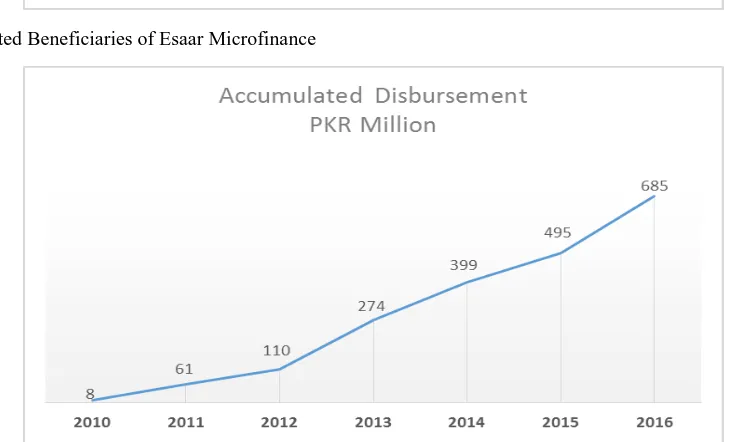
Figure 6. Accumulated Beneficiaries of Esaar Microfinance