ISSN 0015–5659 www.fm.viamedica.pl
Address for correspondence: S.M. Zaki, MD, Anatomy Department, Faculty of Medicine, Cairo University, El-Kasr Al Aini Street, Cairo, Egypt,
Thyroid hormone dysfunctions affect
the structure of rat thoracic aorta:
a histological and morphometric study
S.M. Zaki
1, M.F. Youssef
21Anatomy Department, Faculty of Medicine, Cairo University, Cairo, Egypt 2Histology Department, Faculty of Medicine, Cairo University, Cairo, Egypt
[Received 12 May 2013; Accepted 2 July 2013]
Background: There are limited data about the influence of hypothyroidism and hyperthyroidism on the connective tissue component and smooth muscle cells of the thoracic aorta. The aim was to study the histological changes of the wall of the thoracic aorta in the hypothyroid and hyperthyroid rats. Morphometric measurements were also done.
Materials and methods: Thirty adult rats were used. They were divided into control, hyperthyroid, and hypothyroid groups. Each group consisted of 10 rats. The animals were sacrificed at the end of 8 weeks and the descending aorta was excised. Sections were stained with haematoxylin and eosin, orcein and Masson’s trichrome stains. The morphometric measurement included: number of smooth muscle cell nuclei, number of the elastic lamellae, thickness of the tunica media, elastic fibre optic density, and relative collagen area.
Results: Atheromatous plagues had been observed in the hyperthyroid group. Thinning and rupture of the elastic lamellae had been observed in the hypothyroid group; these were accompanied with intimal ulceration and aortic dissection. The average number of smooth muscle cell nuclei in the hyperthyroid group had do-ubled and tripled compared to their fellows in the control and hypothyroid groups, respectively. The thickness of the tunica media increased in the hyperthyroid and hypothyroid groups by 75% and 35%. In addition, the relative collagen area incre-ased in the previously mentioned groups by 142% and 120%, respectively. On the other hand, the mean elastic fibre optic density decreased in both groups by 30%. Conclusions: Structure wall affections of the intima and media of the descending aorta were associated with the thyroid hormone dysfunctions. These changes were more severe in the hypothyroid group. (Folia Morphol 2013; 72, 4: 333–339)
Key words: hyperthyroidism, hypothyroidism, descending aorta
INTRODUCTION
Thyroid disease affects nearly 10% of the popula- tion [4]. Alterations in thyroid hormone levels have a profound impact on the cardiovascular system [13]. Cardiovascular dysfunction has been associated with both hyperthyroidism and hypothyroidism [13, 20]. In
of increased cardiac muscle contractility, heart rate, cardiac output, red cell number, blood volume, and decreased total peripheral resistance [22]. Aortic dis-section, aortic aneurysm and atherosclerosis had been reported with hypothyroidism [9, 18].
Up to our knowledge, there are limited data about
the influence of hypothyroidism and hyperthyroidism
on the connective tissue component and smooth muscle cells of the thoracic aorta, as most of the literatures are concentrating their works on the me-chanical affection of aorta in thyroid gland diseases, using the noninvasive techniques. In addition, the data on the histological composition in human aortas of hypothyroid patients are scarce [20].
We hypothesised that thyroid hormone dysfunctions have structural effects on the thoracic aorta. Therefore, we aimed in this work to study the histological changes of the wall of the thoracic aorta in the hypothyroid and hyperthyroid albino rats. Morphometric measurements were also done using the image analyser.
MATERIALS AND METHODS
Thirty adult male Sprague Dawley rats weighing 200–250 g were used. The animals were acclimatised to standard laboratory conditions (12:12-h light-dark cycle, temperature 20°C, relative humidity 55%, and central ventilation). They were fed ad libitum and allowed free water supply. The animals were raised in the animal house of the Faculty of Medicine, Cairo University, which follows its guideline, and also according to the guideline of the National Institute of Health Guide.
The animals were divided into 3 groups: control group, hyperthyroid group and hypothyroid group. Each group consisted of 10 rats.
Hyperthyroidism was induced by the administra-tion of L-thyroxine (L-thyroxine sodium salt pentahy-drate, Sigma Chemicals, St. Louis, Missouri). L-thyro-xine (1 mg/100 mL) was added to the drinking water daily for 8 weeks [16]. The oral treatment induced hyperthyroidism without causing the stress provoked by the daily injections [16]. This method was proved to be effective in induction of hyperthyroidism [25]. Hypothyroidism was induced by the administra-tion of propylthiouracil (PTU, Sigma Chemicals, St. Louis, Missouri). Propylthiouracil (0.04 g/100 mL) was added to the drinking water daily for 8 weeks [17]. Such concentration used resulted in a moderate hypothyroidism [23].
Both hypothyroidism and hyperthyroidism were
confirmed by determining serum concentration of
total T3 and total T4. This was accomplished in the laboratory by use of radioimmunoassay kits [8].
The animals were sacrificed after 8 weeks of
agents’ administration by a high dose of ether. The thoracic cavity was opened through a median sterno-tomy. The descending aorta was excised with extreme care to avoid damage to the aortic wall.
Light microscopic study
Parts of the descending aorta were fixed in phosphate --buffered formaldehyde solution and routinely processed
for paraffin sections. At least 4–8 sections were prepared
from each specimen. The sections were separated by a given distance 20 µm to obtain roughly random choice of sections for morphometric measurements. The sections were stained with haematoxylin and eosin (H&E), orcein
stain for elastic fibers detection, and Masson’s trichrome
for collagen staining. The prepared sections were exa-mined and photographed using a Canon digital camera (Canon, Japan) attached to IBM computer system.
Morphometric study
The sections were examined using Leica Qwin 500 image analysis software on IBM operated computer system (Leica Microsystems, Wetzlar, Germany). Thirty preparations in each group were subjective to the quantitative studies:
1. Number of smooth muscle cell nuclei/field; 2. Number of the elastic lamellae/field;
3. Thickness of the tunica media: this measurement includes both the thickness of the intima and
me-dia, as it is difficult to draw a clear border between
intima and media in an elastic type artery;
4. Elastic fibre optic density: this was done by trans -forming the image into grey image and then ma-sking the positive areas by blue binary colour. The parameters chosen were the number of pixels, the sum of grey and mean grey areas. The optical density was expressed in the form of mean grey area that was obtained by the following equation:
5. The relative collagen area was measured inside a standard measuring frame of a known area. The
collagen fibres were selected and masked by blue
binary colour. Then the area of the blue binary colour was measured and expressed as an area per cent in relation to the area of the standard measuring frame of a known section area.
Number of pixels Mean grey area =
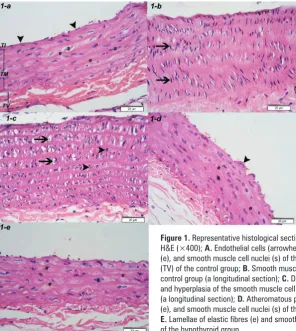
In addition, atheromatous plaques were observed in some animals (Fig. 1D). In the hypothyroid group, the histological structure of aorta was similar to that of the control group (Fig. 1E).
Histological structure of rat descending aorta in control and experimental groups, as revealed by orcein and Masson’s trichrome staining
The orcein stained sections showed the arran-gement of the elastic lamellae of different studied groups, with relatively wide gaps between the elastic lamellae in the hypothyroid group (Figs. 2A–C).
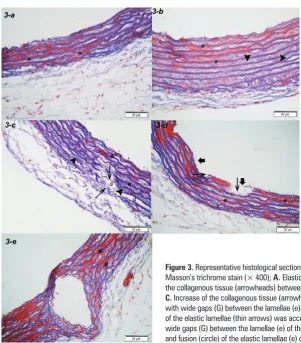
As compared with the control group (Fig. 3A), an
increase of the volume of collagen fibres between
the elastic lamellae in aorta’s wall was observed in both the hyperthyroid (Fig. 3B) and hypothyro-id (Fig. 3C) groups, using the Masson’s trichrome staining. Intimal ulceration had been observed in the hypothyroid group (Fig. 3D). In addition, thinning and ruptures of the elastic lamellae were observed in some rats of this group; this was accompanied by the presence of wide gaps between the elastic lamellae (Fig. 3C). Finally, severe structural changes The data were collected and studied using analysis
of variance (one way ANOVA), followed by post hoc Bonferroni test to compare between the studied groups using SPSS v. 20 statistical program. The quantitative data were examined by Kolmogrov Smirnov test for normality.
Level of significance was considered at p-value < 0.05.
RESULTS
General microscopic structure of rat descending aorta in control and experimental groups
The H&E-stained sections of the control group showed typical 3 tunicae of the thoracic aorta: the tunica intima with the endothelial cells lining the tunica media with the normal arrangement of elastic lamellae and the horizontally oriented spindle-shaped
nuclei of the smooth muscle cells, and finally the
tunica adventitia (Figs. 1A, B).
All the rats of the hyperthyroid group presen-ted with morphological alterations of the smooth muscle cell nuclei of the tunica media. The tunica media showed degeneration, round-shape and hy-perplasia of the smooth muscle cell nuclei (Fig. 1C).
Morphometric evaluation of the aorta structure Structural alterations of thoracic aorta structure were observed in both hyperthyroid and hypothyroid groups in comparison to the control group. The mean were observed in 2 rats of the hypothyroid group
in the form of abnormal arrangement and fusion of the elastic lamellae (Fig. 3E).
Total levels of T3 and T4 in different groups had been recorded in Table 1.
Figure 3. Representative histological sections of the wall of the thoracic aorta stained with Masson’s trichrome stain (× 400); A. Elastic lamellae (e) of the control group; B. Increase of the collagenous tissue (arrowheads) between the elastic lamellae (e) of the hyperthyroid group; C. Increase of the collagenous tissue (arrowheads), thinning of the elastic lamellae (arrows) with wide gaps (G) between the lamellae (e) of the hypothyroid group; D. Thinning and ruptures of the elastic lamellae (thin arrows) was accompanied by intimal ulceration (thick arrows) and wide gaps (G) between the lamellae (e) of the hypothyroid group; E. Abnormal arrangement and fusion (circle) of the elastic lamellae (e) of the hypothyroid group.
Table 1. Data for total levels of T3 and T4 in different groups
Control group Hypothyroid group Hyperthyroid group
Total T3 levels [ng/mL] 0.3 ± 0.01 0.04 ± 0.01 3.4 ± 0.5
Total T4 levels [ng/mL] 35.9 ± 6.1 19.9 ± 1.5 300 ± 20.6
Table 2. Measurements of the aortic media components in different groups
Control group Hypothyroid group Hyperthyroid group
Number of smooth muscle cell nuclei/field 91.5 ± 2.6 67.6 ± 3.7 213 ± 4.2
Number of elastic lamellae/field 6.9 ± 0.3 5.4 ± 0.5 7.5 ±0.5
Media thickness [µm] 61.6 ± 3.4 82.9 ± 3.1 107.7 ± 5.8
Elastic fibre optic density 0.3 ± 0.04 0.2 ± 0.01 0.2 ± 0.01
Relative collagen area 19.4 ± 3.7 42.7 ± 5 47.1 ± 7.2
roid group was nearly doubled and tripled compared to the control and hypothyroid groups, respectively (Tables 2, 3). However, the number of myocytes’ nuclei in the aorta’s wall of hypothyroid rats was decreased by 25% as compared to the control group (p = 0.0001). The average number of elastic lamellae in the hyperthyroid group was not different compared to that of the control group, and was 38% more than
that of the hypothyroid group (p < 0.05); moreover,
their mean number had been decreased by 21% in the hypothyroid group compared to that of the control group (p = 0.000) (Tables 2, 3).
The thickness of the tunica media of both hypert-hyroid and hypothypert-hyroid groups increased by 75% and 35%, respectively, when they were compared with their similarities in the control group; however, the thickness in the hyperthyroid group was nearly more than that of the hypothyroid group by 30% (p = 0.000).
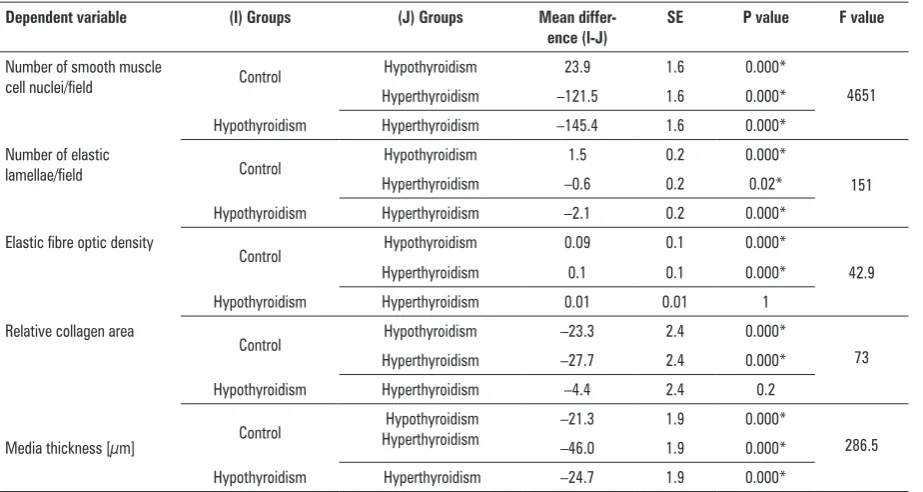
Table 3. Comparison between the aortic media components in different groups
Dependent variable (I) Groups (J) Groups Mean
differ-ence (I-J) SE P value F value Number of smooth muscle
cell nuclei/field Control HyperthyroidismHypothyroidism –121.523.9 1.61.6 0.000*0.000* 4651
Hypothyroidism Hyperthyroidism –145.4 1.6 0.000* Number of elastic
lamellae/field Control HyperthyroidismHypothyroidism –0.61.5 0.20.2 0.000*0.02* 151
Hypothyroidism Hyperthyroidism –2.1 0.2 0.000* Elastic fibre optic density
Control Hypothyroidism 0.09 0.1 0.000*
42.9
Hyperthyroidism 0.1 0.1 0.000*
Hypothyroidism Hyperthyroidism 0.01 0.01 1
Relative collagen area
Control Hypothyroidism –23.3 2.4 0.000*
73 Hyperthyroidism –27.7 2.4 0.000*
Hypothyroidism Hyperthyroidism –4.4 2.4 0.2
Control HypothyroidismHyperthyroidism –21.3 1.9 0.000*
286.5
Media thickness [µm] –46.0 1.9 0.000*
Hypothyroidism Hyperthyroidism –24.7 1.9 0.000*
The mean elastic fibre optic density had been
decreased in both hyperthyroid and hypothyroid groups by nearly 30% compared to their fellows in the control group (p = 0.000); however, no difference had been observed between the hyperthyroid and hypothyroid groups (p = 1).
The relative collagen area had been increased in the hyperthyroid group by 142% when compared to that of the control group, and it also had been increased in the hypothyroid group by 120% when compared to that of the control group. Nearly no dif-ference had been observed between the hyperthyroid and the hypothyroid groups.
DISCUSSION
The aortic wall is composed of elastin, collagen, and smooth muscle. The viscoelastic properties of the arterial wall depend on a passive component due to elastic and collagenous connective tissue and on an active component due to smooth muscle activity [2]. The aorta is from the elastic type arteries with
a higher proportion of elastic fibres and only a small
quantity of smooth muscle cells [2].
In the current study, degeneration with change shape of the smooth muscle cell nuclei had been observed in the hyperthyroid group. These nucle-ar changes seemed to be models on which aortic dissection may occur [12]. In addition, the mean number of the smooth muscle cell nuclei had been doubled in the hyperthyroid group compared to the control group. This increase seemed to be related to the strong mitogenic effect of T3 and its capability of cell proliferation in rats [29]. Wang and Sun [29] added, that T3 induced the rat aorta smooth muscle proliferation by up-regulating a gene called NOX1. The smooth muscle cells of the aorta are responsible for the production of extracellular matrix [19]. They make substantial contributions to the elastic lamellar archi-tecture through their production of elastin, collagen, and other matrix proteins [24]. They also participate in matrix remodelling through localised expression of various proteinases and their inhibitors [3].
The decrease in the elastic fibre optic density and the increase of the area % of collagen fibres had
been observed in both hyperthyroid and hypothyroid groups. These structural changes affect the mecha-nical characteristics of the aorta. Sokolis el al. [27] reported that at low pressures, passive stiffness of the aorta is determined by the elastin content, and at high pressures, the stiffness is determined by the collagen
content. The previous authors added that at physio-logic pressure, the stiffness is determined by both elastin and collagen content [27]. The impairment of the elastic properties of the aorta and the marked increase in its collagen content are associated mostly with increased stiffness of the aorta and decrease of its distensibility [20, 30]. The impairment of aortic elastic properties in hyperthyroidism may be due to the direct effect of the thyroid hormones on the aorta and due to the modulate effects of thyroid hormones on the vascular renin–angiotensin system [1].
One important finding in the current study was the
presence of atheromatous plagues in the aortic wall of the hyperthyroid group. It was reported that the increased stiffness of the aorta was associated with the development of cardiovascular disease [28]. The change of the aortic stiffness contributed indirectly to the deve-lopment of atherosclerosis, through the effects of cyclic stress on arterial wall histological alterations [14, 15].
Another important finding in the hypothyroid
group was the presence of aortic dissection. Intimal wall tear had been observed in this group. This tear
allowed the shear forces of blood flow to dissect the
intima from the media and to penetrate the diseased media with resultant rupture of aortic lamellae. Beside the ruptured aortic lamellae, wide gaps between the elastic lamellae had been observed in the previously mentioned group. Many investigators contributed the association between hypothyroidism and aortic pathologies, such as aortic dissection, to the effect of hypothyroidism on the mechanical performance of the aorta, the disturbance of the mechanical pro-perties of the aorta, and to the altered mucopolysac-charide turnover leading to weakening of the aortic wall [5, 26]. The occurrence of aortic dissection in
cases of hypothyroidism is a very important finding,
as the mortality rate associated with thoracic aortic dissection is high [10], leading to a 68% mortality within 48 hours [7].
CONCLUSIONS
We concluded that structure wall affections of the intima and media of the thoracic aorta were associa-ted with thyroid hormone dysfunctions in the albino rats. These changes were more severe and profound in the hypothyroid group.
We recommend the routine follow-up of the tho-racic aorta in patients with thyroid hormone dys-function — especially the hypothyroid one — with noninvasive maneuver like Doppler for early detection of the medial wall aortic affection, so that severe pathological complications can be avoided.
REfERENCES
1. Akcay M, Akcay E, Yeter E, Durmaz T, Keles T, Bayram NA, Yuksel I, Yuksel Kalkan G, Ayhan H, Simavli H, Simsek S, Bozkurt E (2011) Aortic elastic properties are impaired in patients with Graves’ ophtalmopathy. Vasa, 40: 41–48.
2. Barenbrock M, Spieker C, Witta J, Evers S, Hoeks AP, Rahn KH, Zidek W (1996) Reduced distensibility of the common carotid artery in patients treated with ergotamine. Hypertension, 28: 115–119.
3. Bendeck MP, Zempo N, Clowes AW, Galardy RE, Reidy MA (1994) Smooth muscle cell migration and matrix metallo-proteinase expression after arterial injury in the rat. Circ Res, 75: 539–545.
4. Canaris GJ, Manowitz NR, Mayor G, Ridgway EC (2000) The Colorado thyroid disease prevalence study. Arch Intern Med, 160: 526–534.
5. Cigarroa JE, Isselbacher EM, DeSanctis RW, Eagle KA (1993). Diagnostic imaging in the evaluation of suspected aortic dissection. Old standards and new directions. N Engl J Med, 328: 35–43.
6. Danzi S, Klein I (2004) Thyroid hormone and the cardiovascular system, Minerva Endocrinol, 29: 139–150.
7. Erbel R, Alfonso F, Boileau C, Dirsch O, Eber B, Haverich A, Rakowski H, Struyven J, Radegran K, Sechtem U, Taylor J, Zollikofer Ch (2001) Diagnosis and management of aortic dissection. Eur Heart J, 22: 1642–1681.
8. Gilbert ME. Impact of low-level thyroid hormone disruption induced by propylthiouracil on brain development and fun-ction (2011) Toxicol Sci, 124: 432–445.
9. Gutierrez PS, Pereira MA, Oliveira RC, Stolf NA, Higuchi M (2004) Thyroid hormone levels in patients with aortic dis-section: comparison with controls and correlation with the percentage of the aortic media composed of myxoid deposits. Arq Bras Cardiol, 82: 134–8, 29–33.
10. Hagan PG, Nienaber CA, Isselbacher EM, Bruckman D, Karavite DJ, Russman PL, Evangelista A, Fattori R, Suzuki T, Oh JK, Moore AG, Malouf JF, Pape LA, Gaca C, Sechtem U, Lenferink S, Deutsch HJ, Diedrichs H, Marcos y Robles J, Llovet A, Gilon D, Das SK, Armstrong WF, Deeb GM, Eagle KA (2000) The International Registry of Acute Aortic Dissection (IRAD): new insights into an old disease. JAMA, 283: 897–903. 11. Harrington J, Peña AS, Gent R, Hirte C, Couper J (2010)
Aortic intima media thickness is an early marker of atherosclerosis in children with type 1 diabetes mellitus. J Pediatr, 156: 237–241.
12. Hartman JD, Eftychiadis AS (1990) Medial smooth-muscle cell lesions and dissection of the aorta and muscular arteries. Arch Pathol Lab Med, 114: 50–61.
13. Klein I, Ojamaa K (2001) Thyroid hormone and the cardiova-scular system, N Engl J Med, 344: 501–509.
14. Laurent S, Boutouyrie P, Asmar R, Gautier I, Laloux B, Guize L, Ducimetiere P, Benetos A (2001) Aortic stiffness is an inde-pendent predictor of all-cause and cardiovascular mortality in hypertensive patients. Hypertension, 37: 1236–1241. 15. Malayeri AA, Natori S, Bahrami H, Bertoni AG, Kronmal R,
Lima JA, Bluemke DA (2008) Relation of aortic wall thickness and distensibility to cardiovascular risk factors (from the Multi-Ethnic Study of Atherosclerosis [MESA]). Am J Cardiol, 102: 491–496.
16. Martí-Carbonell MA, Garau A, Sala-Roca J, Balada F (2012) Effects of adult dysthyroidism on the morphology of hippo-campal granular cells in rats. Acta Neurobiol Exp, 72: 230–239. 17. McAllister RM, Luther KL, Pfeifer PC (2000) Thyroid status
and response to endothelin-1 in rat arterial vessels. Am J Physiol Endocrinol Metab, 279: E252–E258.
18. Mitu F, Cojocaru E, Tamba B, Leon MM (2012) [Prevalence of cardiovascular diseases to the patients with hypothyroidism]. Rev Med Chir Soc Med Nat Iasi, 116: 413–418.
19. Moulakakis KG, Poulakou MV, Paraskevas KI, Dontas I, Vlachos IS, Sokolis DP, Dosios T, Karayannacos PE, Perrea D (2007) Hyperthyroidism is associated with increased aortic oxidative DNA damage in a rat model. In Vivo, 21: 1021–1026. 20. Moulakakis KG, Sokolis DP, Perrea DN, Dontas I, Dosios T,
Poulakou MV, Mylonas SN, Dimitriou CA, Karayannacos PE (2010) The effects of hypothyroidism on the mechanical properties and histomorphological structure of the thoracic aorta. Angiology, 61: 259–268.
21. Obuobie K, Smith J, Evans LM, John R, Davies JS, Lazarus JH (2002) Increased central arterial stiffness in hypothyroidism. J Clin Endocrinol Metab, 87: 4662–4666.
22. Obuobie K, Smith J, John R, Davies JS, Lazarus JH (2002) The effects of thyrotoxicosis and its treatment on central arterial stiffness. Eur J Endocrinol, 147: 35–40.
23. Pantos C, Malliopoulou V, Mourouzis I, Sfakianoudis K, Tzeis S, Doumba P, Xinaris C, Cokkinos AD, Carageorgiou H, Varonos DD, Cokkinos DV (2003) Propylthiouracil-induced hypothyroidism is associated with increased tolerance of the isolated rat heart to ischaemia-reperfusion. J Endocrinol, 178: 427–435. 24. Rasmussen LM, Wolf YG, Ruoslahti E (1995) Vascular smooth
muscle cells from injured rat aortas display elevated matrix production associated with transforming growth factor-beta activity. Am J Pathol, 147: 1041–1048.
25. Sala-Roca J, Estebanez-Perpina E, Balada F, Garau A, Martí-Carbo-nell MA (2008) Effects of adult dysthyroidism on the morphology of hippocampal neurons. Behav Brain Res, 188: 348–354. 26. Shigeta O, Makuuchi H, Kaneko Y, Takuma S, Konishi T, Omura M
(1994) [A case of acute aortic dissection associated with myxedema]. Nihon Kyobu Geka Gakkai Zasshi, 42: 1096–1100. 27. Sokolis DP, Kefaloyannis EM, Kouloukoussa M, Marinos E,
Boudoulas H, Karayannacos PE (2006) A structural basis for the aortic stress-strain relation in uniaxial tension. J Biomech, 39: 1651–1662.
28. Van Bortel LM, Struijker-Boudier HA, Safar ME (2001) Pulse pressure, arterial stiffness, and drug treatment of hyperten-sion. Hypertension, 38: 914–921.
29. Wang X, Sun Z (2010) Thyroid hormone induces artery smooth muscle cell proliferation: discovery of a new TRalpha1-Nox1 pathway. J Cell Mol Med, 14: 368–380.
30. Yurtdaş M, Gen R, Ozcan T, Aydın MK (2013) Assessment of