A comparative study of using internet to enhance
learning in developed and developing nations
Sapan Kumar Gupta1
Juneesh K. Kuriachan2
1. (Amity University, Noida, U.P., India),[email protected], 9313604325
2. Assistant Professor,Amity University
SHIV SHAKTI
International Journal in Multidisciplinary and Academic Research (SSIJMAR)
Vol. 2, No. 3, May-June (ISSN 2278 – 5973)
Abstract
The rapid and increasing use of the internet, particularly for training and education with information technology can be seen quite easily. Investigation is required to identify and analyze the internet with the training needed improvements for the students. To provide the better use of the internet and to improve student learning, it is necessary to investigate, with the developed countries and developing countries in terms of comparison. In my study it was found by checking with the students in the developed countries and developing countries to identify the shortfall and to analyze the relationship between the internet use and training. I collected data from the questionnaires, quantitative research, and analyzed the relationship with the correlation analysis. It is reported that internet use in a positive impact on student learning context increases the quality. However, with the technology of the time and training students in the developed world are absolutely higher than the developed aided countries. Thus I ensure that the use of the Internet is a positive relationship with the students training.
1 Introduction
Increasing use of the internet reflects the new information technologies that the whole world is experiencing. Communication network technologies may be used to improve learning process. Internet is also very important to the people whose lives nowadays. Globalization opportunities and challenges focus for students in higher education on information and communication technologies (ICT) is used as the Internet (Nyakwende Macharia, 2011). The Internet is useful. You can find information easily and helps students with their homework. A little research on one search engine can lead them to the answer they want to know. It also helps each other, exchange ideas, interact and share knowledge in a different place at the same time. The interaction between
the students have to get different perspectives on the problem under discussion sharing training activities with other students in the problem-solving strategies (Salomon
And Perkins, 1998; Fischer and Mandl Troendle, 2003). Thus, the growth of internet-based learning satisfaction of students such as learning. An important role as a mediator (Liao and Hsieh, 2011). The Internet is also useful community resources to provide new opportunities for schools and Web technologies (Crook, 1999). The students were actively involved in the communication and content Creation of internet / web technologies (Hill et al, 2004;. Menchaca and Bekele, 2008). Study on the relationship between Internet use and training is useful for improving education and should be directed to use the Internet and motivate students. Internet use in the classroom, According to Sylvia (2000), helps to use the internet in education. It can be
with individual training and education, such as fast delivery, development
Communication skills and written communication skills and increase their motivation for learning and autonomy. The Internet is also necessary to use specialized information systems, and A universal system of international studies. In fact, the World Wide Web (WWW) for education and research is necessary for students improve learning. The use of information and communication technologies (ICT) is important for developing countries to develop their teaching current and future plans, such as education for students in information processing with new information and communication technologies, the development of high-speed research networks communication, expansion of the existing national network of educational institutions (Sylvia, 2000). So is the study of the Internet to improve learning comparison between the developed and the developing countries in the implementation of use of the Internet in education. This can help us to improve the distinctiveness of identifying learning between developed and developing countries. Relationship between Internet use and training suggest ways to improve the learning environment and technology to solve problems in the economy, society and politics. Sylvia stated (2000) that the developed countries stress use of the internet for education, as they develop comprehensive programs on the internet integration in education. Internet usage is also very important for the development of countries that are in the global educational community.
Statement of the problem
Improving the transfer of information and communication technologies (ICT), to be effective for the study improvement, as the internet basic training necessary to strengthen the participants training on the path of development. The use of the Internet to improve the studies is very high in developed countries, while in developing countries is the lack of motivation and internet use focused on training. I was looking for this study to examine and identify the internet as it can improve student learning, to ensure that the use of the Internet has a connection with training environment. The study shows the behavior of the student / circumstances on the internet use, it is useful to improve communication and information technologies (ICT)
.
Purpose of the study
Use of the Internet in education is not fully implemented in most developing countries, Specifically for high school students. Thus, the main objective of my research is to compare the use of the internet for learning in the school between the developed and developing countries for their development in the effectiveness of teaching. And i also try to find a link between the use of the Internet and education improvement of a group of students in secondary schools. We address research, identification and analysis of the Internet, to improve student learning. Thus, it may open a new learning environment.
Research Questions
To study the problems and achieve it is important is to keep a researcher research questions in his / her head. On the basis of the task for the internet based training, I have listed the following questions and sub-questions:
The most important question:
How students' learning over the Internet can be gain momentum in the developing countries in contrast to developed countries?
Sub-topics:
- What is the relationship between the use of the internet and student learning? - Is the use of internet can improve student learning?
- What are the differences in the use of the internet for learning between developed and developing countries?
- What are the key principles of design can be used to create a more effective system for Internet-Based Learning?
So it is important for the development of interactive human-computer interaction (HCI) for e-learning
Target Groups
This report is devoted to young students in order to improve the Internet in their training, cycle of secondary education in both developed and developing countries. These groups can be useful in the implementation of the internet for learning. Overcome their learning problem with the use of the Internet can be a solution to improve the efficiency and Information technologies can help them in their future education.
Expected Results
The advantage of using the Internet is to improve the learning environment. The study tries to find a positive relationship between the use of the internet and education. Developed countries can improve the tendency of online learning over developing countries to study. The result should judge, to improve the information and technology solutions for learning. E-learning motivates students to use the internet, especially for young students concentrate in high school on the use of the internet in the learning process. It will also be useful for schools to motivate students to use the Internet for learning improvements.
Structure of the work
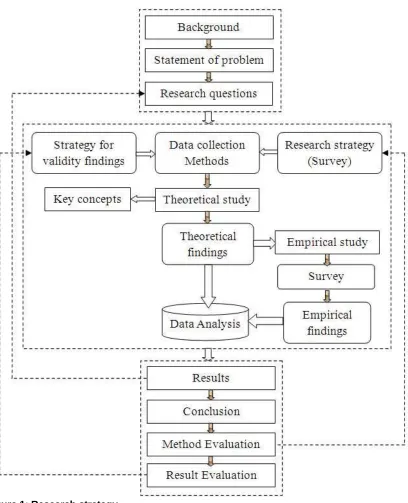
Figure 1 shows an overview of the research design. Let's start with the first part to begin at the bottom of the search based on, the previous search. This study refers to the
computer science and problem issues. The following section describes the research strategy, data collection methods and strategies. Data collection methods will provide orientation studies that interact with the key concept of the theoretical conclusion. Empirical studies are monitor to get the result, completed as empirical results with theoretical analysis. The result of the analysis is the correct answer to the questions in the discussion Conclusion is to support the results of the evaluation.
Data collection methods
In my research I have collected a quantitative study and data from questionnaires. Theoretical and empirical research is connected for collection and analysis.
.
Key Concepts
This section provides a brief description of the main concepts of documentary sources which relate to the use of the Internet for learning to improve.
Internet
The Internet is an electronic system of interconnected computer networks, wide area networks system for the exchange and publication of information, resources and large, on-line World Wide Web (WWW) and the infrastructure to support electronic mail.
Information Technology (IT)
The information technology (IT) with the computer system, which save you allow transfer affected process and current information. The main purpose is to benefit people and society.
Improving learning
E-learning
Interactions between people and the development of network technology effective communication. Problems of studying online database interaction between people and the Internet service providers online education that is relevant in HCI perspective. Now, the Internet is a great center of learning to share information and communication technologies in education, such as e-learning and distance learning.
Developed and developing countries
Developing countries, the country has a low per capita income, people have a lower life expectancy standard, low human resource development and low economic growth. While developed country is a country with a high per capita income, and most people high quality of life, economic growth and increased development of human resources.
Use of ICT in developing countries
Most developing countries use different types of information disclosure (ICTs), such as fixed and mobile telephony services and low-bandwidth access to broadband Internet. and accelerate applications development of the country in the course of time.
Distance Learning
Distance learning has traditionally been used to provide educational opportunities for Group of students for training is generally not suitable. For example People work on different, learning at home, in remote areas or those with physical illness (Watabe, Hamalainen and Whinston, 1995). Distance learning is a process of distance education, where teachers and students come together. Students can learn even without physically on in the classroom, they should not go to school or universities. According to the theory of Moore (1973), the success of education can even place if the teacher and the student are physically separated in the process of learning from each other. Distance learning programs and courses, mainly offers web-based, joined public universities (Consortium, 2006). Distance education began in the 21 century and everything in this system of education peace anywhere the ability to learn independently. By Passerini and Granger (2000), the use of the Internet expands, the new generation distance education (fourth generation) are complex instruments that deliver standards. With serious consequences for the development of online courses
Effective Use of IT in Education
• It is very important that the use of IT in education, management and leadership, the government should also provide direction and organization of promotional activities and resources. It contributes to the culture necessary to use computers.
• The success of their application in the formation depends on the success in IT
Education is a multi-level school administration, teachers and support the school relevant pedagogy as a practitioner.
• Success in school depends on computing and IT as a flexible plan for students and teachers.
IT strategy on the teaching and learning of
• Infrastructure: The focus is to make progress in the field of computer networks Plant and equipment for schools
• Professional development professional: training is required for teachers to improve computer skills.
• Resources for Education: Adapting applications and education resources to support learning and teaching
• Teaching methods: it is necessary to train to teach skills.
• Use computer science students in order to motivate and encourage students to use it in their habits and frequencies so that it levels basic computer knowledge and skills at all learning steps.
Improve learning
In terms of improving the quality of education we focus on the behavior of the students at the center of their ability and training. The development of learning and goal-directed behavior, depending on the degree of perceptive analysis of the specific skills and knowledge measured potential, identification and normalization relations, physiological effects of treatment learning disabilities (Mangina, 1993). In education, children try to solve more problems than adults, as a strategy, as the children practice with such problems in the course of time. Thus, the education of children and in particular, development of changes in the learning process (Kuhn, 2006) learning by doing is the approach
Limits of the use of internet for learning in developed countries and
developing countries
All developed countries using new technologies to help educational institutions development of e-learning and technology. In particular, the focus is on e-learning that can be incorporated online effective teaching and learning (Coldwell,
Goold and Craig, 2011). While most developing countries using electronic technologies have not deeply rooted in schools much higher (SIFE Lwoga, and Sanga
2007). In this section, we talked about limiting the use of the Internet for learning improvement in developing countries compared to developed countries in terms of Internet course design based on a technological limitation, computer literacy and culture.
Human Computer Interaction (HCI)
with efficient communication between humans and machines through various human-like sensors and motors, and structures that reflect human conceptualizations. "Martin, et al. (1997) states that" Human Computer Interaction (HCI) as knowledge of the capabilities and limitations of human operator is used for system design, software, tasks, tools, environments, and organizations in order to improve productivity while providing a safe, comfortable and satisfying experience for the operator. "According to Harper, Rodden, Rogers & Sellen (2008), "Human Computer Interaction (HCI) refers to the understanding and design of different relationships between people and computers that the main concern of HCI 'Usability' in late 1970 and then, HCI has established an impressive record for development and application of all types of design and evaluation methods to ensure that technologies are easy to learn and easy to use. "HCI was adopted in mid-1980, as a means to describe this new field. This term recognizes that the focus was broader
only the design of the interface and handles all aspects relating to the interaction between users and computers (Preece, et al., 1994). "HCI is a discipline that related to the design, evaluation and implementation of interactive computing systems
to users and to the study of major phenomena surrounding them "(Hewett et al., 1992). Preece, et al. (1994) stated that "Human-Computer Interaction design is computer
systems that support people so they can carry out their activities productively and safely. So the goal of the Human-Computer Interaction is to make the system safe and usable by understanding of the factors of how people use the technology, tools and techniques to make the effective, efficient and safe interaction
Conclusions
The use of information and communication technology (ICT) is central to the new social students to improve the idea, ability, skill and experience in the field of online learning, information science and computer science. The Internet allows students to practice their knowledge effective learning. Developed countries are reluctant to use technology and information system such as the Internet, the emphasis on educational institutions to be stronger in teaching and learning. Students in developed countries are familiar with using the Internet to improve their study. Whereas students in developing countries are weak interaction with information communication and technology (ICT) for their low education in the use of Internet. Developing countries are poor bandwidth broadband system and the poor conditions of fixed the Internet to communicate with each other. Internet use increases communication and interaction activities to improve student learning easily and efficiently. But students developed and developing countries believe that the Internet is useful for learning to let grow more attention by using anyway.
Using the Internet to help students in developed and developing countries to find huge information more effectively to improve and update their learning ability. The Internet can improve student learning on their skills, abilities and skills and self-
learning because it gives them the opportunity to interact with each other easily, efficiently and efficiently. Internet-based learning offers students share their experiences and know each other, work together on projects, develop working groups
We also found that the Internet contributes to student learning in developed and developing such as they prefer to search the internet to accomplish their tasks. And helps students communicate with each other online network to discuss and share ideas easily. The students generally always find the information they want, and also learn something new from the Internet. We examined students who have experience with the use of the Internet as developed and developing countries, the results showed that students had a lot of class Vgs those who are reluctant to use the Internet. Today mobile phones are very popular for the interactions of students in developed countries and developing countries such as learning through the Internet, because it is easy, convenient and accessible
for them anytime and anywhere. In our study showed that the use of the Internet is essential for student learning in their everyday lives. It can improve their experience, skills, competencies, Messages easily and playful interaction. Thus, the development and developing countries are strongly insists on the use of information technology
education, because it has a positive impact on student learning. Internet improves teaching and learning to increase student satisfaction and performance expectations. Students in developed and developing countries are reluctant to use the Internet than those better learning. Therefore, we argue that the use of the Internet is very important for students developed countries and developing countries, because the Internet improves their skills, ideas, skills, perceptions and communication to enhance their learning and be better, stronger.
References
Ahmed, H., Daim, T., & Basoglu, N. (2007). Information technology diffusion in higher education. Technology in Society, 29(4), 469-482.
Akber, S. U. (2005). ”eLearning in Developing Countries: Challenges and Opportunities Bangladesh Perspective”. Proceedings of the Second International Conference on
eLearning for Knowledge-Based Society, Bangkok, Thailand.
Amsel, A. (1989). Behaviorism, Neobehaviorism, and Cognitivism in Learning Theory, in: Historical and Contemporary Perspectives ( John M Maceachran Memorial Lecture Series).
ANDO, R., Takahira, M., & Sakamoto, A. (2004). Effects of the Internet use on elementary
school students f attitude toward learning, World Conference on Educational Multimedia, Hypermedia and Telecommunications (EDMEDIA).
http://editlib.org/noaccess/12594 (Access 2012).
Anonymous. (2000). Pilot program uses laptops and Internet to improve student learning. T.H.E. Journal, 27(8), 16.
Antona, M., & Savidis, A. (2006). Design for all: Computer-assisted design of user interface
adaptation. Foundation for Research and Technology–Hellas (FORTH) Heraklion, Crete, Greece.
Awodele, O., Kuyoro, S. O., Adejumobi, A. K., Awe, O., & Makanju, O. (2011). Citadel ELearning:
Balbo, S., Bentley, T., & Collings, P. (2007). Human-Computer Interaction in Information
Systems. Australasian Journal of Information Systems, 13(2).
Bandura, A. (1977). Social Learning Theory. Englewood Cliffs, NJ: Prentice Hall. Retrieved
from http://www.infed.org/biblio/b-learn.htm, and http://www.learningtheories. com/social-learning-theory-bandura.html (Access 2012-04-16)
Battersby, S. L. (2009). Nonverbal Communication: Increasing Awareness in the General Music Classroom. General Music Today, 22(3), 14-18.
Bekele, T. A., & Menchaca, M. P. (2008). Research on Internet-Supported Learning: A Review. Quarterly Review of Distance Education, 9(4), 373-405.
Blair-Early, A., & Zender, M. (2008). User Interface Design Principles for Interaction Design.
Design Issues, 24(3), 85-107.
Boghossian, P. (2006). Behaviorism, Constructivism, and Socratic Pedagogy. Educational
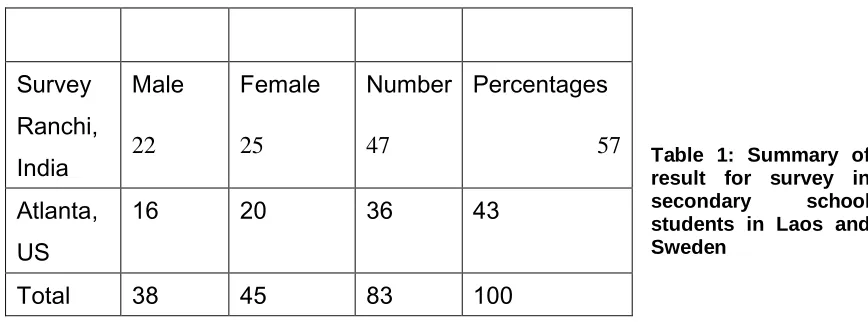
Table 1: Summary of result for survey in secondary school students in Laos and Sweden
Survey Ranchi, India
Male
22
Female
25
Number
47
Percentages
57
Atlanta, US
16 20 36 43