88
COMPARATIVES STUDY ON THE EFFECT OF WET AND DRY SUBSTRATES
ON BIOGAS YIELD
O. A. Aworanti
1O. O. Ogunleye
1and S. E. Agarry
1*
1Department of Chemical Engineering, Biochemical Engineering and Biotechnology
Laboratory, Ladoke Akintola University of Technology, Ogbomoso, Nigeria.
*
Corresponding author: Email: [email protected];Abstract
The objective of this study is to compare the use ofwetanddry wastes as substrates for anaerobic digestion and its effect on biogas yield.Different quantities of substrates and co-substrates (wet and dried) were weighed and mixed vigorously with corresponding quantity of distilled water to form the fermentation slurry in the digesters; the digesters were operated at 45°C in batch anaerobic digesters for 25 days. The results showed that the average volume of biogas obtained from the dried animal wastes co-digested with dried fruit wastes and wet animal wastes co-digested with wet fruit wastes was found to be 0.2928 kg and 0.0972 kg per day respectively. When the fermentation process was performed with dried animal wastes only and wet animal wastes only the value of the average volume of biogas obtained were calculated to be 0.1508 and 0.0892 kg per day respectively. Thus biogas yield using dried substrates comparatively gave a better biogas yield than wet substrates. In conclusion, the use of dried wastes for biogas production suggests superior energy recovery, saving resources and engineering investment as compared to the use of wet wastes as substrates.
Keywords:
Biogas Yield
,
Wet Substrates, Dried Substrates, Animal wastes, Fruit wastes
Introduction
Biogas is a non polluting and clear combustible gas consisting mainly methane that can be produced through fermentation of organic material such as agricultural wastes (animal and fruits), biomass wastes, green wastes, municipal waste and energy crops under anaerobic condition (usmanet al., 2012).Generations of animal and fruit wastes are increasing due to the rate of industrialization, population growth and community development and these wastes constitute environmental nuisance. Utilization of these wastes for biogas production will address the major environmental pollution posed by these wastes. The composition of manure and fruit wastes from different animals and fruit wastes varies over the world. The animal and fruit wastes contain lignin, hemicelluloses carbon, and crudefiberand protein. The cattle manure has higher carbon content if it is in solid form (Budiyano et al., 2010) while in liquid form it contains more nitrogen (moller et al., 2004). The chicken and pig manure contain more protein than cattle manure (Litorell and Persson, 2007). Fermentation of biodegradable materials provides solution to global concerns such as renewable energy production, how to manage human, animal, agricultural municipal and industrial waste, controlling environmental pollution and recycling of nutrients back to soil(Marchaim, 2002, Prakash, 2011). The amount of calorific value of biogas depends on the percentage of methane in the biogas(Raja and Lee 2012; Ziana and Rajesh,2015).The raw materials or organic materials used for biogas production maybe in wet or dried
89
of the reactor was increased twice in the wet fermentation process (7.68% TS) of cow dung compared to the dry fermentation (15.18% TS) at the same loading rate. It was also suggested that dry methane fermentation process was superior in energy recovery, saving resources and engineering investment compared with wet fermentation process. Therefore, pretreatment (dried or wet) of wastes is a very important parameter to be considered in the design for biogas production. Nevertheless, cost-effective and environmentally friendly methods of enhancing biogas yield still need to be further investigated. However, to the best of the authors’ knowledge there is little or no information on comparing biogas yield from using dry substrates and wet substrates. Therefore, the objective of this study is to compare the quantity of biogas produced from non pretreatment wastes (wet animal wastes co-digested with wet fruit wastes)and pretreatment wastes (dry animal wastes co-digested with dry fruit wastes).Materials and Methods
Sample Collection and Feedstock Preparation
The Animal wastes (cattle dung, pig dung and poultry droppings) were collected from LAUTECH farm, Ogbomoso, Oyo State, Nigeria.
The rotten fruits (mango, orange and pineapple wastes) were collected from Bodija market, while the inoculum (chicken rumen) was collected from Mokola market, both in Ibadan, Oyo State, Nigeria. The animal wastes served as the substrates while the rotten fruits excluding their seeds served as the substrates. The substrates (animal wastes) and co-substrates (fruit wastes) were prepared according to the method described by Iyagbaet al. (2009). The substrates and co-substrates were washed, sun dried for twenty days, oven dried at 100 ºC for 24 h in order to reduces the volumetric load in the digester and alsocreate total surface area for the organism to penetrate so that degradation will be easy, thereafter crushed mechanically using a mortar and pestle to ensure homogeneity. Cow dung, pig dung, and poultry droppings (mixed together) were used as main substrates while mango,orange, and pineapple fruit wastes mixed together were used as co-substrates. The wastes used under non pretreatment were not dried. Different quantities of substrates and co-substrates (wet and dried) were weighed and mixed vigorously with corresponding quantity of distilled water to form the fermentation slurry in the digesters which are shown in Table 1
Table 1: Composition of Materials in Each Digester at Different Total Solid Content
Substrate (kg) Sample Digester Cattle
dung Pig dung Poultry droppings Orange waste Mango waste Pineapple waste Water
T1 D1 1.3 1.3 1.3 1.3 1.3 1.3 4
T2 D2 1.3 1.3 1.3 1.3 1.3 1.3 4
T3 D3 2.6 2.6 2.6 N/A N/A N/A 4
T4 D4 2.6 2.6 2.6 N/A N/A N/A 4
T1 = mixture of dried animal waste, all the three dried fruits waste, and water (W T2 = mixture of wet animal waste, all the three wet fruits waste, and water (W) T3 = mixture of dried animal waste only
T4 = mixture of wet animal waste onlyNA = not applicable
Biomethane Experimental Procedure and Set-Up.
The experimental rig used for this study was set up according to the method of Umar et al. (2013).The set-up is shown in plate 1. The digesters were set up for this research work to handle the combination of the feed substrate. The digesters had inlet and outlet valves on the lid with two rubber hoses connected to them; one for injection of feed substrates and the other connected to the improvised gas bag for the collection of the biogas produced. The hose for feeding and collecting sludge samples was clamped with a clamp in order to keep air out and air in while the other hose that was connected to the improvised gas bag was made airtight and has a three-way valve that can be opened to collect gas
90
measured by means of weighing scale according to the method of Umar et al. (2013).Results and discussion
Comparisons of Daily Biogas Yield from Dried Animals Waste Co-digested with Dried Fruit Wastes and Wet Animals Waste Co-digested with Wet Fruit Wastes
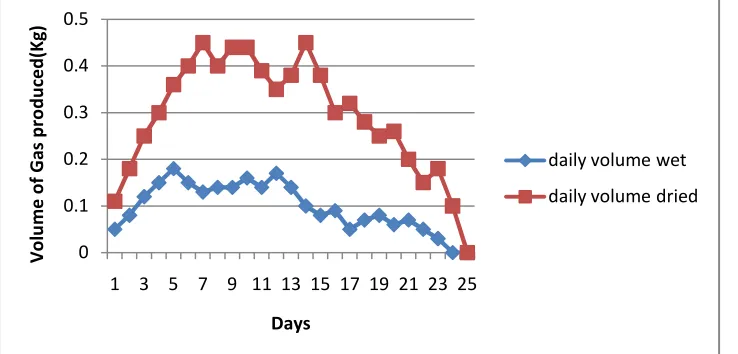
Figure 1 shows the volume of biogas produced from dried animal wastes (cow dung, pig dung and poultry droppings) co-digested with dried fruit wastes (pineapple, mango and orange wastes) and wet animal wastes (cow dung, pig dung and poultry droppings) co-digested with wet fruit wastes. The digester with dried animal wastes (cow dung, pig dung and poultry droppings) co-digested with dried
fruit wastes (pineapple, mango and orange wastes) produced biogas whose volume increases from 0.11 and has maximum production on the 7th day and again a peak performance on the14th day there is a fluctuation in the production between the 14th and 23th day after which it declined while the digester with wet animal wastes (cow dung, pig dung and poultry droppings) co-digested with wet fruit wastes (pineapple, mango and orange wastes) produced biogas whose volume increases from 0.05 and has maximum production on the 5th day and again a peak performance on the12th day there is a fluctuation in the production between the 13th and 21st day after which it declined.
Figure 1: Comparisons of Daily Biogas Yield from wet and dried animals waste co-digested with fruit wastes.
The values of the average volume of biogas obtained from the dried animal wastes co-digested with dried fruit wastes and wet animal wastes co-digested with wet fruit wastes are calculated to be 0.2928 and 0.0972 kg per day respectively. It was observed that there was an increased in the rate of digestion of dried animal wastes co-digested with dried fruit wastes than wet animal wastes co-digested with wet fruit wastes. It was suggested that drying the wastes for biogas production will create total surface area for the micro organism to penetrate so that degradation will be easy and also it reduces the volumetric load in the digester. Also drying of the wastes kills the pathogenic micro-organism. A similar observation has been reported by Ajay et al., 2013 also reportedthat dry methane fermentation process was superior in energy recovery, saving resources and
engineering investment compared with wet fermentation process.
Comparisons of Daily Biogas Yield from Dried Animals Waste Only and Wet Animals Waste Only
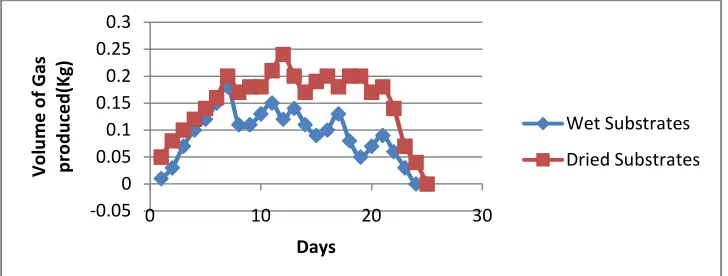
Figure 2shows the volume of biogas produced from dried animal wastes (cow dung, pig dung and poultry droppings) and wet animal wastes (cow dung, pig dung and poultry droppings) only. The digester with dried animal wastes (cow dung, pig dung and poultry droppings) only produced biogas whose volume increases from 0.05 and has maximum production on the 7th day and again a peak performance on the12th day there is a fluctuation in the production between the 12th and 21th day after which it declined.
0 0.1 0.2 0.3 0.4 0.5
1 3 5 7 9 11 13 15 17 19 21 23 25
Vo
lu
m
e
of
G
as
p
ro
du
ce
d(
Kg
)
Days
91
Figure 2: Comparisons of Daily Biogas Yield from wet and dried animals waste only
While the digester with wet animal wastes (cow dung, pig dung and poultry droppings) only produced biogas whose volume increases from 0.01 and has maximum production on the 7th day and again a peak performance on the11th day there is a fluctuation in the production between the 12th and 21st day after which it declined.The values of the average volume of biogas obtained from the dried animal wastes only and wet animal wastes only are calculated to be 0.1508 and 0.0892 kg per day respectively. It was observed that there was an increased in the rate of digestion of dried animal wastes than wet animal wastes only. Pavan et al. (2000) has reported that the use of dry waste for fermentation process offers great advantages like utilization of wastes in its produced form, no requirement of liquid source, high organic loading rate, smaller digester, no liquid effluent, no
requirement of purification of effluent and the likes Moreover, the use of dry wastes for methane fermentation process eliminates need for additional liquid and is considered as capable of producing higher methane production per m3 volume of the bioreactor. The dry methane fermentation process stabilizes the organic solid wastes without dilution or using limited amount of water.
Cumulative Biogas Yield
Figure 3, shows the comparison of cumulative biogas yield from dried animal wastes (cow dung, pig dung and poultry droppings) co-digested with dried fruit wastes (pineapple, mango and orange wastes) and wet animal wastes (cow dung, pig dung and poultry droppings) co-digested with wet fruit wastes.
Figure 3: Accumulated Biogas production from animals waste co-digested with fruit wastes
It is seen that the digester with dried animal wastes (cow dung, pig dung and poultry droppings) co-digested with dried fruit wastes (pineapple, mango and orange wastes) has the highest yield with values of 7.32 kg/day while wet animal wastes (cow dung, pig dung and poultry droppings) co-digested with wet fruit wastes has 2.43 kg /day. This shows that pretreatment of wastes before the production will result into more gas production.Figure 4 also shows
increase, however, dried animal wastes (cow dung, pig dung and poultry droppings) only has the highest cumulative biogas yield, with value of 3.77 kg/day. This results as a consequence of the non introduction of fruit wastes whose action led to less gas production. Thus wet animal wastes (cow dung, pig dung and poultry droppings) only has least value of 2.23 kg/day, This results as a consequence of the non -0.050
0.050.1 0.150.2 0.250.3
0 10 20 30
Vo
lu
m
e
of
G
as
pr
od
uc
ed
(K
g)
Days
Wet Substrates Dried Substrates
0 2 4 6 8
1 3 5 7 9 11 13 15 17 19 21 23 25
Vo
lu
m
e o
f G
as
pr
od
uc
ed
(K
g)
Days
92
introduction of fruit wastes and non pretreatment of waste whose action led to less gas production.
Figure 4: Accumulated Biogas production from dried and wet animals waste only
Conclusion
Pre-treatment (drying) is one of the physical factors used to improve the anaerobic degradation of agricultural materials. The study reveals that anaerobic digestion can occur using the wastes in both dried and wet forms. Anaerobic digestion rate is fast when using dried wastes as substrates. The presence of fruit wastes caused the production of the biogas to be higher. The addition of fruit wastes increased the amount of yield of biogas. Wet fermentation process required larger reactor volume and higher energy to maintain the temperature of the reactor for the same loading rate.
References
Ajay Kumar Jha, Jianzheng Li, Liguo Zhang, Qiaoying Ban and Yu Jin (2013). Comparison between Wet and Dry anaerobic digestions of cow dung under mesophilic and thermophilic conditions. Advances in Water Resource and Protection 1( 2): 28-38. Alvarez, R. and Lidén, G. (2008) Semi-continous co-digestion of solid slaughterhouse waste, manure, and fruit and vegetable waste. Renewable Energy, 33: 726-734.
Budiyono, I N., Widiasa, S. J, and Sunarso,O (2010) The kinetic of biogas production rate from cattle manure in batch mode. International Journal of Chemical and Biological Engineering, 10(1): 68-75.
Iyagba, E. T.,Ibifuro A.M.,and Yahaya S.M.( 2009) The study of cow dung as co-substrate with rice husk in biogas production. Scientific
Research Essay Academic Journal, 4(9): 861-866.
Jha AK, Li J, He J, Chang S (2010) Optimization of dry anaerobic fermentation of solid organic wastes. Advance Material Resource. 113-114: 740-743.
Litorell, O. and Persson, L.A. (2007).Influence of inoculums on performance of anaerobic reactors for treating municipal solid waste. Bioresource Technology Journal, 94(3):261-266 .
Mallick, J., Narayana, K. L., Khuntia, S., Singh, D. and Barik. R. (2000) Biogas generation from leafy biomass and vegetable wastes by application of ultrasound. Institute of Minerals & Materials Journal, 35(8): 2003- 2009.
Marchaim, U (2002) Biogas processes for sustainable development MIGAL Galilee Technological Centre Kairyat shmona, Israel, Available online: www.fao.org
Möller, H.B., Sommer, S.G. and Ahring, B.K. (2004) Methane productivity of manure, straw and solid fraction of manure. Biomass and Bioenergy. 26: 485-495
Pavan P, Battistoni P, Mata-Alvarez J, Cecchi F (2000). Performance of thermophilic semi-dry anaerobic digestion process changing the feed biodegradability. Water Science Technology. 41(3): 75-81.
Prakash,P. (2011) Biogas measurement techniques and the associated errors. Department of biological and environmental science. 0
1 2 3 4 5 6 7
1 3 5 7 9 11 13 15 17 19 21 23 25
Vo
lu
m
e
of
G
as
pr
od
uc
ed
(K
g)
Days
93
Renewable energy programme. University of Jyvaskyla.1-38.Raja, A.S and Lee, R.L.C (2012) Biomethanation of water hyacinth using additives under forced mixing in a bioreactor. International Journal Chemical Resources, 2(4):15-24
Umar, H. S, Firdausi, B. R, Sharifah, R. W. A, and Fadimtu M (2013) Biogas production through co-digestion of palm oil mill effluent with cow manure. Nigerian Journal of Basic and Applied Science, 21(1): 79-84. Usman, M.A., Olanipekun, O.O., Ogunbanwo, O.A.
(2012) Effect of temperature on Biogas
production from lignocellulosic substrate. International Journal of Research in Chemistry and Environment, (2): 68-71. Yadvika, S., Sreekrishnan, T.R, Sangeeta, K., Vineet,
R. (2004) Enhancement of biogas production from solid substrates using different techniques– Bioresource Technology, (95): 1-10.