ASSESSMENT OF UNIVERSITY- INDUSTRY COLLABORATION
AND TECHNOLOGY TRANSFER IN SCHOOLS OF
ENGINEERING AND SCIENCES IN NIGERIA
1A. I. Obanor, 2C. C. Kwasi-Effah
1,2DEPARTMENT OF MECHANICAL ENGINEERING,UNIVERSITY OF BENIN,P.M.B1154,BENIN CITY,NIGERIA
2Corresponding author [email protected], [email protected]
Abstract
Despite the cultural differences between university and industry, the mutual benefits from collaboration between university and industry have long been recognized in the advanced countries. Recently, the issue of technology transfer and collaboration between universities and industries has been receiving attention in the developing countries. A survey was recently conducted in order to determine the issue of technology transfer between schools of engineering and sciences in universities and industries within the north central, south south and western region of Nigeria. The survey was conducted by asking appropriate persons to respond to a set of questions and having interviews with them. The survey revealed that there is a very low level of technology transfer and collaboration between most industries and universities in this region. The reasons for this state of affairs are highlighted and suggestions are made to effectively increase the level of technology transfer and collaboration in Nigeria.
Keywords: collaboration, technology transfer, university, development, engineering, sciences, industry.
1. Introduction
Knowledge is a key driver of growth and development in a country .Countries with higher skilled levels are better equipped to face new challenges and master technological discoveries [1]. Highly technologically developed countries in the world invest so much in technological innovation through partnership of industry with academia [2]. The
network systems and communications
industry drew from academic research fundamental innovations, as well as using universities as test beds for new networking
concepts that have provided the
underpinnings of the internet world wide web and ecommerce [3]. Technology transfer between industry and university come in
different ways such as direct hires of students,
graduates, temporary exchanges of
researchers, university/faculty consultancies, joint research involving industry and academic scientists and engineers, industry-sponsored research, contracts and grants, a variety of institutional mechanisms at universities (e.g., research centers, consortia, and industrial liaison programs), publications, conferences, and short courses [4]. It is important to note that, a country can only be highly technically developed and innovative through effective technology transfer between its local university and small and medium scale enterprises (SMEs) [3].
Nigeria industries may be said to constitute a major source of internal brain drain by
Vol. 32. No. 2. July 2013, pp. 286 – 293 Copyright© Faculty of Engineering, University of Nigeria, Nsukka, ISSN 1115-8443
NIGERIAN JOURNAL OF TECHNOLOGY VOL.32NO.2,JULY 2013
287
demanding so little of their scientists, engineers and technologists; reason being that, technology is only transferred from developed countries and not necessarily from our local universities [5]. For instance, most engineers employed in Nigerian industries are involved in the assembly of machine systems, operations, maintenance and adoption of imported technology. Consequently the creative technical skills of local engineers and scientists are underutilized. Research works done by either postgraduate or undergraduate engineering and science students have produced artifacts or machines which require further developments to commercialize them but this has not happened because of lapses in technology transfer between the industry and university [3]. Besides the government failure to keep pace with the enormous goal of Nigeria universities in terms of technology transfer, the reason behind this low level of technology transfer may be modeled towards the organization and individual characteristic behavior of the university and industry.
The student’s industrial work experience scheme (SIWES) was established by industrial training fund (ITF) in 1973 to solve the problem of lack of adequate practical skills preparatory for employment in industries by Nigerian graduates of tertiary institutions. The Scheme exposes students to industry based skills necessary for a smooth transition from the classroom to the world of work. It affords students of tertiary institutions the opportunity of being familiarized and exposed to the needed experience in handling machinery and equipment which are usually not available in the educational institutions [6]. Over the years, ITF has been able to perfect the training services in different aspects of the economy, thus giving students in the nation’s universities and polytechnics who are studying courses that are in the sciences, engineering and technology the opportunity to be part of an actual work situation outside the classroom. But recently, the scheme has been facing various challenges and setbacks due to lack of funds, which may send it into extinction [3].The Director-General of the scheme, Professor Longmas Wapmuk, speaking with
journalists recently, disclosed that funds were not forthcoming, due to the numerous programmes the government had to attend to [7]. No doubt, the SIWES programme has failed; especially for the purpose it was established. Most students leave school in search of companies to undergo the industrial training program. Some get lucky and get a suitable place of their choice, while others are being frustrated to stay at home during this period, due to rejection by numerous companies applied as a consequence of funding or population limit in the specific industry. Some will say we are in a world where ‘connection’ is needed to secure a suitable working place. It’s quite obvious that ITF, in recent times, has not been discharging its specific responsibilities and this has not helped participating students who sought for placement on their own [8]. Also, some students acquire an industrial training placement that is not related to their course of study, maybe they got frustrated of searching for a relevant placement or because of the enormous stipend they would receive. In this scenario, the essence of SIWES is lost. Furthermore, after the service period (National Youth Service Corps) some youths get lucky and are employed in the organization where they served. This may be assed as a result of collaboration network. However, the university-industry collaboration needs to be strengthened such that a curriculum or technological research is favorable so as to meet up with the growing demand of technology advancement in the country and the world at large.
This paper discusses the issue of collaboration and technology transfer between universities and industries within the north central, south south and western region of Nigeria with a view to enhancing technology development and innovation in the country.
1.1 Effect size
NIGERIAN JOURNAL OF TECHNOLOGY VOL.32NO.2,JULY 2013
288
methods used to estimate the effect size of a phenomenon are d-values of Cohen, Pearson correlation, chi-squared test, Phi coefficient e.t.c [10]. However, d-value of Cohen is used in this context.
Cohen's d is defined as the difference between two means divided by a standard deviation for the data
d= –
(1)
Cohen’s d-value is frequently used
in estimating sample sizes. Where, X 1 and X 2 are the mean values of two different samples and S is the standard deviation. A lower Cohen's d-value indicates that the sample size is large, and vice versa. Fields using effect sizes apply words such as "small", "medium" and "large" to the size of the effect. Whether an effect size should be interpreted small, medium, or large depends on its substantial context and its operational definition. Cohen's conventional criteria small, medium, or big are near ubiquitous across many fields.
For d-values of Cohen, an effect size of 0 to 0.1 is considered insignificant,0.2 to 0.4 is a "small" effect, around 0.5 to 0.7 a "medium" effect and 0.8 to infinity, a "large" effect. (But note that the d might be larger than one).The terms 'small,' 'medium,' and 'large' are relative, not only to each other, but to the area
of behavioral science or even more
particularly to the specific content and research method being employed in any given investigation. Thus, this scientific method (d-values of Cohen) is used to investigate the current status of collaboration between the university and the industry and reasons behind this low collaboration.
2.0 Measurements
Questionnaires were developed in other to collect a common and categorical view concerning University-Industry collaboration.
The questions on questionnaire were
technically grouped into basic sections, each having varying constructs. This grouping was done in other to correlate results of respondents and ease of interpretation. The questionnaires were distributed to and collected from respondents, mostly by hand.
Respondents were asked to reflect their views on a 4-point Likert scale in the range of, 1: strongly agree; 2: agree; 3: disagree; and 4: strongly disagree.
The questionnaire was distributed to 44 industrialists (Personnel managers) from 26 companies and a total of 74 academics from 5 universities within the north central, south south and western regions of Nigeria.
Descriptive analytical statistics and comparative analytical approach using d-values of Cohen were used in order to examine the arguments or difference in opinion between the academic and industrialist with regards to their responses (see Appendix A and B for questionnaire). The significant difference between the following groups were determined with the aid of equation 1.Where X1 = Mean value of industry response, X2 = Mean value of university response and S = Maximum standard deviation.
Considering question 12 (see Appendix A) as regards the industrialist and academic behavioral attitude on “mind set”, having computed the mean values and standard deviation, d-value of Cohen is;
=..
. = 0 (insignificant) (2)
Equation 2 shows that they both agree on the stated reason behind the university-industry
communication gap asked in the
questionnaire. Table 1 shows a summary of constructs linked to each questions based on behavioral attitude which influences the communication gap.
Also, considering Question 1 (see Appendix B) as regards the industrialist and academic behavioral attitude on “Personnel”, having computed the mean values and standard deviation, d-value of Cohen is;
d = ..
. = 0.4 (Small effect)
NIGERIAN JOURNAL OF TECHNOLOGY VOL.32NO.2,JULY 2013
289
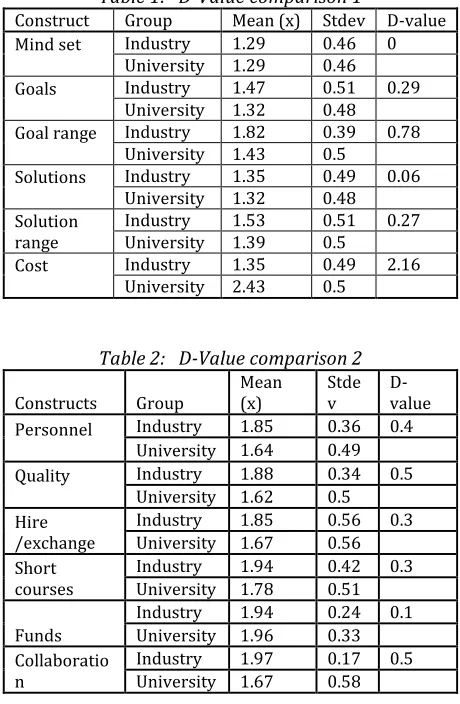
Table 1: D-Value comparison 1
Construct Group Mean (x) Stdev D-value Mind set
Industry 1.29 0.46 0 University 1.29 0.46 Goals
Industry 1.47 0.51 0.29 University 1.32 0.48 Goal range
Industry 1.82 0.39 0.78 University 1.43 0.5 Solutions
Industry 1.35 0.49 0.06 University 1.32 0.48 Solution
range
Industry 1.53 0.51 0.27 University 1.39 0.5 Cost
Industry 1.35 0.49 2.16 University 2.43 0.5
Table 2: D-Value comparison 2
Constructs Group
Mean (x)
Stde v
D-value Personnel
Industry 1.85 0.36 0.4 University 1.64 0.49 Quality
Industry 1.88 0.34 0.5 University 1.62 0.5 Hire
/exchange
Industry 1.85 0.56 0.3 University 1.67 0.56 Short
courses
Industry 1.94 0.42 0.3 University 1.78 0.51
Funds
Industry 1.94 0.24 0.1 University 1.96 0.33 Collaboratio
n
Industry 1.97 0.17 0.5 University 1.67 0.58
3. Results and discussions
With reference to the questionnaire and data obtained, findings are grouped in the following sections.
3.1 Current Status of Cooperation between Academia and Industry
3.1.1: As seen from the side of the university It was found that, collaboration between university and Industry is mostly by individual effort. However, some academics work hard towards bridging this gap. This has resulted in weak collaboration since this act is informal.
Most Academics are driven by their
conferences, technical journals and their need to publish and less driven by how technology can be effectively transferred through effective collaboration. In the aspect of industrial conference attendance which is a means of technology transfer, it was found out that academics seldom attend as they feel it is
below their standard. However, Academics also claim that they are not well informed about any scheduled conferences if at all there is any. This has also contributed to the unawareness of the academics about problems faced in the industry, hence slowing the rate of technological innovations. It was also found that academics distrust industrial managers, whom they believe want to exploit them to achieve their business goals.
3.1.2: As seen from the side of the industry
From the industrial point of view,
collaboration is mainly by individual effort. This is synonymous to the university’s experiences. Industrialists are driven by their vendors and the IT media (newspapers and magazines) and less concerned about the incubating technology in the academia. Their participation in academic conferences has not been encouraging. This has contributed to the lack of awareness concerning the mutual benefit of collaboration. The industry feels that there is little it can learn from the academia especially in the field of maintenance and reengineering. Industrial personnel do not often access academic journals also, some industrialist are not concerned about what academics have to offer. Industrial managers distrust academics, they believe they only want to experiment at their expense. These are the current states that co-exist in both sectors. Thus we may affirm that the individual attitude has a great role to play in bridging the gap.
From Table 1;
• With the effect size d=0, this means that both industrialist and academics strongly agree on the fact that they are living in different world. •With regard to the construct on ‘goals’, a small effect size d=0.29 was obtained. This means that the academics and industrialist agree with the stated fact regarding their goals with reference to the questionnaire i.e most academics is striving for recognition from his peers, while the industrialist is striving for survival.
NIGERIAN JOURNAL OF TECHNOLOGY VOL.32NO.2,JULY 2013
290
regarding their goal range. Industry thinks in terms of short range goals, the university has a long range perspective.
•For the construct on ‘solution’, a small effect size d=0.06 is recorded. This implies that there is no significant difference in responses between the industry and university on the concept of proven solutions with low risk as in the case of Industry and creating new solutions with a high innovative rate as per academics. The degree of distrust between the academic and industrialist has influenced negatively the rate of innovative solutions in Nigeria. Managers seldom give research grants to academics due to distrust involved and subjecting local research grants as maximum risk, due to the absence of enabling environment in Nigeria universities.
•With regard to the construct on ‘solution range’, d=0.27 which is a small effect size. This means that universities and industries have no difference in opinion regarding their solution range i.e the academic is striving for maximum solution to maximize their recognition while the industrialist seeks for minimum solution to minimize their risk.
•In terms of cost, there is substantial difference in response between academics and industrialists. Here, d=2.16 .The industry has a lower mean value which implies that they agree more strongly than the academics in the opinion raised in the questionnaire i.e , academics could care less about costs of research grant, they are mainly interested in the benefits and Industrialists care more about cost. Most SME’s (small and medium enterprises) are not buoyant enough to fund research projects.
From Table 2;
With the effect size d=0.4, this logically means that most industrialists are mainly concerned with finding personnel to maintain their product quality and with migrating it to different platforms. They are less concerned about improving their product quality. With regard to the construct on ‘quality’, a medium effect size (d=0.5) was obtained. This means that the academics and industrialists have small arguments concerning their quality improvement i.e the academics are concerned
with improving the quality of products by reengineering or advancement in design, unlike the industrialist who believes in migration of product. For the construct on ‘Hire / Exchange’, a small effect size (d=0.3) was gotten. It implies that the university and industry agree on the fact that industry rejects the idea of direct hires of students/graduates and temporary exchange of researchers as they feel this will be a financial burden to the company. Thus, no argument exists between the industry and academia about this stated fact. With regard to the construct on ‘short courses’, d=0.3 which is a small effect size. This means that industrial managers prefers ‘on the job training’ for their staffs, rather than short term courses in universities. In terms of funds, d=0.1. This implies that there is no significant difference in argument between the industrialist and academic on the fact that some industrialist refuse sponsorship or grants proposed by the academics as the industrialist feel it’s a waste of finance and will just add a little to their credit. Furthermore, the industry is not ready to fully fund any research projects (with an estimated cost of five million naira and above) concerning their products and not necessarily paying attention to the mutual benefit involved. They prefer spending lesser amount. For the construct on
collaboration d=0.5 (medium effect),
arguments. This means that there is a significant difference in opinion between the industrialist and academic. The mean value is 1.97 which implies that they are not well informed about the benefit of collaboration. However it is the duty of the academics to educate them on this.
Some other findings with respect to replies during interviews and observations are summarized as follows:
▪It was discovered that there are no research teams working as a body in various engineering and science departments.
NIGERIAN JOURNAL OF TECHNOLOGY VOL.32NO.2,JULY 2013
291
functioning) hence, get discouraged in collaborating with SME’s formally.
▪Some SME’s are not aware of the mutual benefit they can derive in innovative research between the university and their firms.
▪ Local Industries face challenges of unsolved problems and have become stagnated due to lack of funds and productivity.
▪The industrialist sees himself as an expert in his field and is not interested in attending academic conference.
▪Most of the multinational companies get their technology from their source country and not really concerned about developing our own local technology. However, SME’s are the country’s prospect for basic technological implementation.
▪The industrial managers of multinational companies distrust academics whom they believe only want to experiment at their expense. They claim that the Nigerian universities do not have the required facilities. ▪Lack of utilization of local raw materials and inappropriate government policies have resulted in making Nigerian industries to be import dependent.
▪Academics claim that there are inadequate facilities, and where they exist such facilities are obsolete and inefficient to conduct or correlate research / curricula to suit the industrial needs of the country.
It is evident to say that, most academics and industrialists are not dedicated to technology transfer or linkages. On the contrary, the driving force for academics is towards publishing basic research findings in journals which is necessary for their academic career. This characteristic behavior seems to be recycled year after year. The current state of technology transfer is basically a result of informal collaboration between individual lecturers or groups of lecturers and industry. According to [11], communication can easily be enhanced via Internet to perform research at the national and international levels rather than remain in isolation. This may however save time and energy during the course of a project. Collaboration definitely yields positive results and best approach in selecting strategies for problem solving [12].
4. Conclusion and recommendations
Translating new technology into benefits for the University, Industry and the economy is dependent on addressing the gaps between sectors and creating the right policy environment in which innovation can flourish. In this paper, the reasons behind the poor state of collaboration and local technological advancement in Nigeria have been established. The following are recommendations towards effective technology transfer and innovation. ▪Since Small and Medium Enterprises (SME’s) are the country’s prospect for basic
technological implementation and
advancement, government should encourage them by giving funds to any intelligent research project and lay down policies to eliminate any form of misconduct.
▪Multinational companies should be
encouraged to establish research and development facilities locally and source for local raw materials for their production processes.
▪The University should encourage the formation of research teams to foster regeneration acts whereby, industry and academia collaborate in order to solve problems faced in industry hence creating mutual benefits. Also, this could possibly create an avenue for spin-offs (Venture Startup) for product commercialization via the university.
▪Universities should offer continual short courses programs relevant to the industry. Also, industrial personnel should attend courses in the universities to refresh their knowledge.
▪There need to be a common language, i.e. the language used by academics should be understood by managers in the industry. ▪Technology transfer should be taught as a compulsory course in science and engineering faculties.
▪The University must sustain a highly skilled workforce with the full range of skills needed to advance understanding and develop new technologies.
NIGERIAN JOURNAL OF TECHNOLOGY VOL.32NO.2,JULY 2013
292
reward should be given to the lecturers and their students for excellent performance.
References
[1]Harry, M. and Sneed, A.T. “Bridging the gap between academia and industry”, Stevens award lecture, 2009, Kaiserslautern, Germany.
[2]Bramwell, A. and Wolfe, D.A. “Universities and regional economic development”, the entrepreneurial University of Waterloo, 2008
Research Policy, Florida, pp. 1175–1187.
[3] Obanor, A.I and Kwasi-Effah, C.C. “Technology transfer, intellectual property and university-industry collaboration”, Technical report,
Department of Mechanical Engineering, University of Benin, 2012.
[4]Murray, F and O'Mahony S. “Exploring the foundations of cumulative innovation”,
Implications for Organization Science, Vol.1, 2007, pp. 47-81.
[5] Onwuka E.N. “Reshaping engineering education curriculum to accommodate the current needs of Nigeria”, Educational research and review
Vol. 4 (7), 2009 pp. 334-339.
[6] www.ysu.edu.ng/centres-units/siwes-unit, Accessed on March 27, 2013.
[7] www.tribune.com.ng. Accessed on March 27, 2013.
[8] www.campusdelight.org . Accessed on March 27, 2013.
[9] Kelley K and Kristopher J. “Effect size sampling”,Psychological Methods, Vol. 17 (2), 2012, p137-152.
[10] www.wikipedia.org/cohen . Accessed July, 2011.
[11]Nathan David. “Campus wide network for university of Nigeria, Nsukka campus”,
Nigerian Journal of Technology, 2010, Vol 29 (1), pp. 52-60.
[12] Tanko, J.A, Musa S.N and Ahiarammunnah P.L . “Medium scale projects selection using multi-objective decision matrix in north eastern Nigeria”, Nigerian Journal of Technology, 2010, Vol. 29 (1), pp.129-134.
Appendix A :
SECTION 1 [For Industry Only] CURRENT STATUS OF COOPERATION
1. Industrial users are driven by their vendors and the IT media (newspapers and magazines)
[1] [2] [3] [4]
2. Industrial participation in academic conferences has not been encouraging for years
[1] [2] [3] [4]
3. Industry feels that there is little it can learn from academia especially in the fields of maintenance and reengineering.
[1] [2] [3] [4]
4. Most Industrial personnel do not access academic journals.
[1] [2] [3] [4]
5. The Industry is not aware of what academics have to offer
[1] [2] [3] [4]
6. Industrial managers distrust academicians, they believe they only want to experiment at their expense.
[1] [2] [3] [4]
SECTION 1.2 (For Academics Only) CURRENT STATUS OF COOPERATION.
7. Academics are driven by their conferences and technical Journals and their need to publish. [1] [2] [3] [4]
8. Academics seldom attend industrial conferences as they feel this is below their standard.
[1] [2] [3] [4]
9. Academics look down upon industrial newspapers and magazines.
[1] [2] [3] [4]
10. Academics are not aware of the problems and constraints of industry.
[1] [2] [3] [4]
11. Academics distrust industrial managers, whom they believe only want to exploit them to achieve their business goals
NIGERIAN JOURNAL OF TECHNOLOGY VOL.32NO.2,JULY 2013
293
SECTION 2
REASONS BEHIND THE GAP (For both Academics and Industry)
12. Academics and Industrialists have a different mindset; they are living in different worlds.
[1] [2] [3] [4]
13. Academics and Industrialists are pursuing different goals. The Academic is striving for recognition from his peers. The Industrialist is striving to survive.
[1] [2] [3] [4]
14. Industry thinks in terms of short range goals, Academia has a long range perspective.
[1] [2] [3] [4]
15. Industry prefers proven solutions with a low risk, Academia is interested In creating new solutions with a high innovation rate.
[1] [2] [3] [4]
16. Industry seeks for a minimum solution to minimize their risk whereas Academia strives for a maximum solution to maximize their recognition. [1] [2] [3] [4]
17. Industry is mainly concerned with costs. Academia could care less about costs; it is mainly interested in the benefits.
[1] [2] [3] [4]
Appendix B
1. Industrialists are mainly concerned with finding personnel to maintain their product quality and with migrating it to different platforms. But not improving on the standard.
[1] [2] [3] [4]
2. Academics are concerned with improving the quality of products i.e. in reengineering rather than migration.
[1] [2] [3] [4]
3. Industry rejects the idea of direct hires of students/graduates and temporary exchange of researchers as they feel this will be a financial burden to the company.
[1] [2] [3] [4]
4. Most industrial managers refuse the sponsorship of research contracts and grants proposed by the academics as they feel is a waste of finance and will just add little to their credit.
[1] [2] [3] [4]
5. Industrial managers don’t buy the idea of their staffs taking short courses in universities as they feel ” on the job training” is most significant towards achieving their goals.