Vol.7 (2017) No. 1
ISSN: 2088-5334
A Swarm Optimization Based Power Aware Clustering Strategy
for WSNs
Harendra S. Jangwan
#1, Ashish Negi
#2 #Department of Computer Science & Application, G. B. Pant Engineering College, Ghurdauri, Pauri, 246194, India E-mail: [email protected], [email protected]
Abstract— The technique of division of a wireless sensor network (WSN) into clusters has proved to most suitable for the reliable data communication inside the network. This approach also improves the throughput of the system along with other attributes such as rate of delivering data packet to the base station (BS) and overall energy dissipation of the sensor nodes in the network. This in turn results in the increased network lifetime. As the sensor nodes are operated by battery or some other source, this introduces a constraint in energy resource. Therefore, there is a strong need to develop a novel approach to overcome this constraint, since this phenomenon leads to the degradation of the network. The swarm intelligence approach is able to cope with all such pitfalls of WSNs. In this paper, we have presented a cluster-head (CH) selection technique which is based on swarm optimization with the main aim to increase the overall network lifetime. The proposed approach gives higher effects with regards to power utilization of nodes, data packets received at BS and stability period, and for this reason serves to be a higher performer as compared to Stable Election Protocol (SEP) and Enhance Threshold Sensitive Stable Election Protocol (ETSSEP). MATLAB simulation outcomes exhibit that the proposed clustering strategy outperforms the SEP and ETSSEP with regards to the above noted attributes.
Keywords— swarm optimization; power aware; wireless sensor network; clustering strategy
I. INTRODUCTION
A WSN is a network of numerous interconnected sensors geared up with constrained battery power. The sensor nodes are deployed in a region under study to monitor various ongoing activities occurring inside the region. These can be the physical phenomenon or natural conditions including temperature, pressure, wind, pollution, motion, vibration etc. The regions wherein the sensor network is set up are a few territories that are not effortlessly reachable. The major assignments that can be achieved by using the sensors: information sensing and information transmitting. The sensing unit of node sense information from its encompassing surroundings and after that it is forwarded to a control point referred as the sink/base station [1], [2], [3]. The BS can be located inside as well as outside the sensor network. In a WSN, the sensor nodes may be fixed to a particular location throughout the working of the functioning of the whole network mobile i.e. can change their locations at different times remaining inside the region based on the requirements. Also, the deployment can be random or it can be done in a particular fashion. The pattern for the deployment depends on certain key factors such as: energy utilization, size, operating lifetime, power level etc. WSNs have numerous applications in the areas viz. surveillance,
operation and sends it to the BS directly as shown in Fig. 1, or through a multi-hop transmission as shown in Fig. 2.
Fig. 1 Cluster Based WSN
We can classify a clustered WSN again as homogeneous and heterogeneous WSNs on the basis of nodes energy level at initial stage. Homogeneous WSNs consist of similar type of nodes with regards to energy and computational capabilities while heterogeneous WSNs consist of different types of nodes with regards to energy and computational capabilities.
Fig. 2 Multi-hop Communication in WSN
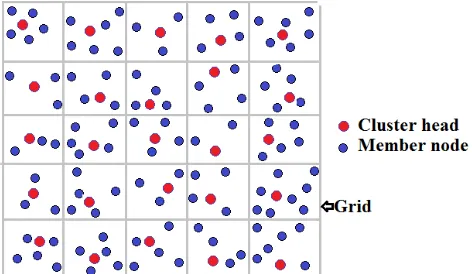
In Grid-cluster based routing protocols, the network is divided into horizontal and virtual grids. Each grid is considered to be a cluster and a cluster head selection is done by the member nodes themselves. The role of cluster head is rotated among each member node of the cluster according to some criteria. All the grids are equal sized but all the clusters are not, as the nodes are randomly deployed within the region as shown in Fig. 3.
Fig. 3 Grid Clustering in WSN
In chain based clustering, a chain of sensor nodes is formed in which each node communicates only with its close neighbours as shown in Fig. 4. The nodes in each chain transmit their data to their CH in the first stage. In the second stage, CHs of chains form a cluster themselves and their new CH is formed to which the fused data is transferred.
Fig. 4 Chain Cluster in WSN
After applying the technique of clustering, a huge reduction can be gained in the power dissipation during the network operation that causes a significant expansion in the lifetime of the entire network. Further, clustering provides a good scalability as the deployed sensor nodes may be thousands or millions in number in a region of interest. In both of these protocols, the nodes and CHs are responsible for sensing data and forwarding it to sink respectively. The major difference between these two protocols is the operating nature of CHs. In reactive protocols, the CHs only forward data statistics to sink when a drastic change occurs in sensed data, whereas, in proactive protocols, the CHs constantly forward its data to the sink.
Another most important concern in WSNs is a balanced distribution of nodes inside a region of interest. In some of the prevailing techniques, the nodes distribution is not uniform. That ends up with a quick drain of battery mounted on a few sensor nodes. This in turn may lead to a problem of good coverage. As an instance, every node forwards its data directly to the sink in direct transmission. Therefore, the nodes far away from BS will require extra power to transmit their information and as a result, they die out speedy in comparison to the nodes which might be nearer to the sink. Whereas, in minimum energy transmission (MTE) [12] data is routed via a path connecting the nodes and BS and at which the transmission power is minimum. So, in this approach the nodes near the BS die out faster than the ones farther from BS.
II. MATERIAL AND METHOD
A. Related Work
rotated at each epoch of round. Some other protocols are also developed for heterogeneous type of WSNs. LEACH-VF (LEACH with Virtual Force), proposed by Awad et al. [13] in 2012, uses the principles of virtual field force to locate the sensor nodes in each cluster. The approach is based on two key issues: sensing coverage and data transmission energy. Clustering is done similar to the LEACH protocol. In addition to this, every node messages its current location to its CH. In the next phase, the nodes move to their new locations determined by their CHs. Both attractive and repulsive forces are used to move the nodes within the cluster. The attractive forces are used to move nodes towards respective cluster heads so that the energy consumed for transmitting the data is reduced. Repulsive force is used to move the nodes covering the same area, apart from each other in order to cover the maximum area for data sensing. The data transmission phase is also same as in LEACH. Simulation results show that performance of LEACH-VF as compared to LEACH is better in terms of both area coverage and increasing network lifetime. The only drawback that appears is that the cost of mobility of sensor nodes is not considered. The basic assumption in HEED (Hybrid Energy-Efficient Distributed clustering) is that each sensor node is capable of controlling its transmission power level but they are location unaware. Proposed by Younis & Fahmy [14] in 2004, this technique was developed as a distributed and energy efficient cluster formation. HEED employs a combination of two different parameters for CH selection i.e. residual energy of each node and node degree. A node can be selected as a CH depending on its residual energy together with some probability. The cluster formation occurs when the other nodes in the network choose their respective CHs maintaining minimum cost of communication. The main objective of HEED is to prolong network lifetime as well as supporting scalable data aggregation. Initially the proposed algorithms were able to build only two-level hierarchy. As a modification of HEED, the DWEHC (Distributed Weight-based Energy-efficient Hierarchal Clustering scheme) for wireless sensor networks was proposed by Ding et.al. [15] in 2005. The objective of this technique was to balance the cluster size and have minimum energy topology within the cluster. As an approach of being energy efficient protocol, this technique also focused on enhancing the lifetime as well as scalability of the WSN. In order to achieve this goal, clustering is done based on some neighborhood and weight of each node. Each node calculates its weight depending on its residual energy and its distance from the neighboring nodes. Maximum weight node becomes the CH. Clusters are formed depending on minimum energy path to the CH. The data is transmitted to the neighboring parent node until it reaches the respective CH. Simulation results demonstrate that in DWEHC, the clusters are well balanced and energy consumption was far much lower than previously existing energy efficient protocols such as HEED. UCS (Unequal Clustering Size) emerged as the first clustering protocol which employed unequal sized cluster formation. In this approach, all clusters do not contain the same number of nodes. The algorithm was proposed by Soro & Heinzelman [16] in 2005 with the aim of prolonging lifetime of WSNs. The main idea behind unequal sized clustering is to balance
the energy load among the clusters. The network is divided into heterogeneous clusters and the energy dissipation of each CH is uniform. More unbalanced energy consumption by member nodes among the clusters results in more balanced energy consumption among the CHs. This approach was especially beneficial when the networks collecting large amount of data are considered and can also be applied to prolong the lifetime of both homogeneous and heterogeneous networks. The residual energy of the CH decides the number of member nodes within its cluster.
EECS (Energy-Efficient Clustering Scheme) was proposed by Ye et.al. [17] in 2005 for WSNs applying periodical data gathering. It is a single-hop routing protocol with a different approach for cluster head selection and cluster formation. This scheme also focuses on balancing energy load and prolonging network lifetime. CHs are selected through comparisons of residual energy of a sensor node with the neighboring ones. CHs are distributed uniformly across the network. Cluster formation is based on minimum energy consumption by the member within the cluster using distance metric as well as CH communication with the BS.
The hierarchal protocol TEEN (Threshold-sensitive Energy Efficient sensor Network protocol) was proposed by Manjeshwar et al. [18] for reactive networks. Reactive networks are those in which the sensor nodes adapt themselves according to the changes in the environment. This protocol tries to reduce the number of transmissions in order to increase energy efficiency of the network. Data is transmitted only when the sensed data value falls into a specific range of interest. In each cluster, the CH sets two two attributes: Hard and soft threshold for its member nodes. Data is transmitted only when it is greater than the hard threshold value and the difference between the old value and new value is greater than the soft threshold value. In this way some transmissions are eliminated which saves energy of sensor nodes within the network.
done in parallel but alternatively. Finally, the head node has all data and it destroys the tokens. In cluster routing, after all the head nodes are ready with their collected data, all other sensor nodes go to sleep mode. Now, these head nodes form a cluster with a CH. The CH is chosen based of the residual energy of these nodes. Comparison between the nodes is done and the node with higher residual energy advertises for itself. In case of conflict, the node which advertised first is selected. Afterwards, CH assigns TDMA slots to other nodes for data transmission. The CH collects all the data and sends it directly to the BS.
Proposed by Azizi et al. [20] in the year 2012, HCTE (Hierarchical Clustering based routing algorithm with applying the Two cluster heads in each cluster for Energy balancing in WSN) is a multi-hop cluster based routing protocol in which each cluster contains two CHs for energy load balancing. The CHs are named as initial and second cluster heads. Both of these CHs have different tasks to perform. This technique has five phases: initial CH announcement, cluster formation, second CH announcement, schedule creation and data transmission. The initial CHs have high residual energy and its neighbouring nodes are also more in number. Tasks performed by initial CHs are cluster formation, data gathering form other sensor nodes within the cluster and sending those data to the second CH. The clusters are formed when each sensor node calculates the confidence value of initial CHs using its transmission range. In this manner a node chooses its CH which is high in residual energy as well as close to it. If any node fails to do so, then it chooses the nearest initial CH as its CH. Again, within each cluster, the node with highest confidence value is chosen as second CH. That is its distance with the BS is least and its residual energy is high. The tasks performed by the second CH is gathering the data from respective initial CH or second CHs of other clusters, sending the data to other second CHs or to the BS(since this is a multi-hop routing). Again using multi-hop routing for data transmission, data is routed to the second CH which has lowest cost. The cost function is calculated on the basis of some parameters such as residual energy and distance to the BS. One of the most extensively used protocols is the Stable Election Protocol (SEP) [21]. The CHs are decided on the basis of some probability. It considers that the proper utilization of energy affects the overall network performance.
The protocol ETSSEP [23] was developed based on TSEP [22]. In ETSSEP, the sensor nodes can be divided into three categories as: advance, intermediate and normal nodes consistent with their power levels. Advance and normal nodes contains high and low power respectively. The sensor nodes containing less power than advance node and more power than normal nodes are known as intermediate nodes. The advance nodes consist of α power level and intermediate nodes contain β time’s higher power in comparison to normal nodes. Also, β=α/2 is also considered. In ETSSEP, the total energy distributed is calculated after the energy distributed for normal, advance and in nodes is calculated separately.
At round r, the mean energy of the network is calculated as:
(1)
Here, N refers to the total number of nodes and R represents the entire range of rounds of the network computed as the ratio of total energy distributed and energy of each round. After that the total energy dissipation in current round is computed. In the next step, the probabilities of advance and intermediate nodes to become CHs are calculated. The threshold value and residual energy of nodes is also calculated.
B. Proposed Algorithm
In order to increase network performance in terms of throughput, stability period, energy utilization of the network, we introduce a modified firefly algorithm for wireless sensor. The behaviour of fireflies is describes by Xing-She Yang [24] as:
• Every firefly can be attracted to any other firefly,
• Attractiveness is directionally proportional to their brightness,
• For any two fireflies, a less bright one moves to brighter one,
• Brightness is increased as the distance between them is decreased,
• Brightness of fireflies is calculated by an objective function.
The proposed algorithm is presented in the following subsection.
Algorithm
1. Begin
2. Initially, generate the number of fireflies (Xi)
where i = 1, 2, 3...n.
3. Initialize the number of iterations. 4. Generate the initial locations of fireflies. 5. Intensities (Ii) at (Xi) is determined by the
objective function f(Xi).
6. Define light absorption coefficient . 7. While t < MaxIterations
For i = 1: Number of fireflies For j = 1: i
If EC < ME
RE = TE - EC
Evaluate distance having maximum Ii using
Cartesian distance formula
8. Calculate attractiveness using equation β = β0 exp(-γ rij)
9. Determine the best possible solution. 10. Update the intensities based on the attractiveness.
11. End for j. 12. End for i. 13. End Loop.
where is the location of firefly, I Є [1, n], is the iteration variable,
Ii is the light intensity of ith firefly that depends on the
objective function f(x),
EC, ME, TE represents the energy consumption, mean
energy and total energy respectively.
The attractiveness or intensity of flash light of a firefly increases as the distance between fireflies decreases. Therefore, attractiveness is inversely proportional to the distance (r) between fireflies. In this approach, we replace the light intensity with the distance of cluster head and the other nodes of a cluster. If the node intensity is high it means
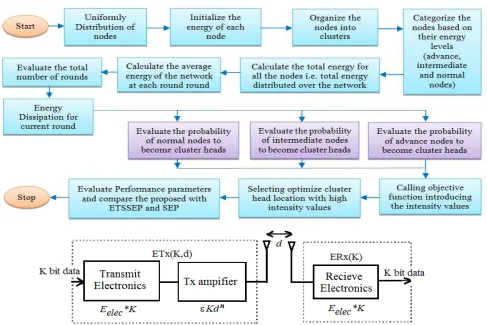
the distance between the nodes is less and vice-versa. For a particular round, extra power is dissipated by a node to communicate with the respective cluster head as the distance between them increases. If the ordinary node is not having that much of energy to broadcast or transmit the data then there will be huge chance of node to drop the packets. This entire working of the proposed approach as a flow diagram is depicted in the following flowchart:
Fig. 5 Radio Energy Dissipation Model
C. Radio Model and Simulation Environment
As per the first order radio model [25] appeared in Fig. 5, the energy/power needed to transmit K-bits at a distance d is given as:
= (2) The energy required for receiving K-bit message is
given as:
(3) where d refers the distance between member node and cluster head or between cluster head and sink and d0 is
threshold distance, Eelec is the transmitter/receiver electronics
energy expense and Efs , Eamp are transmitter-amplifier
energy-expenses by a node when d < d0 and d ≥ d0
respectively.
(4)
The performance of the proposed algorithm is examined using MATLAB 7.1 as a simulation tool. We assume that the sensor nodes are deployed on random basis across a plain area. Each node has been distributed initially equal amount of energy. Table I shows the parameters and their values used in simulation.
TABLE I
PARAMETERS USED FOR SIMULATION
S.No. Parameter Parameter’s Value
1 Network field 100, 100
2 Number of nodes 25 – 400 3 Initial energy for nodes 0.5 J
4 Message size 4000 bits
5 Eelec 50 nj/bit
6 Efs 10 nj/bit/m2
7 Eamp 0.0013 pj/bit/signal
8 EDA 5 nj/bit/signal
9 Popt 0.1
10 A 2
III.RESULTS AND DISCUSSION
Based on the above parameters, a set of experiments is conducted to test the performance of our proposed algorithm with SEP and ETSSEP. In our simulation, we have considered the dimension of whole network area as 100m * 100m and the numbers of nodes placed in this network area are considered to be 400 as shown in Fig. 6. The initial energy of each node is assumed as 0.5 J. The BS is situated in the middle of sensing area. All the sensor nodes are aware about their location and follow a single hop process for communication from member node to cluster head and from cluster head to the sink.
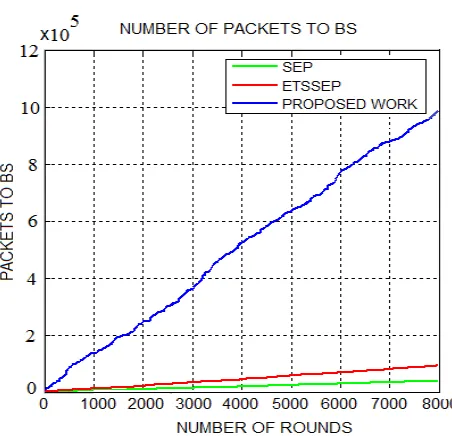
Fig. 7 indicates that the number of data packets received at BS in proposed approach is much higher than SEP and ETSSEP, which clearly indicates the increased throughput in proposed approach with respect to SEP and ETSSEP.
Fig. 6 Nodes Deployed in Network Field
Fig. 7 Number of Data Packets Received at BS
Fig. 8 shows the comparison of number of dead nodes over the number of rounds in SEP, ETSSEP and proposed approach. It indicates that in SEP, ETSSEP and proposed
approach, the last node dies around 9193, 10,000 and 10,400 rounds respectively. Hence, from the analysis of our results, we can conclude that the proposed approach prolongs the overall network lifetime as compared to SEP and ETSSEP.
Fig. 8 Number of Dead Nodes
Fig. 9 indicates the number of alive nodes per round, which clearly indicates that the node death rate in our proposed approach is much lesser in comparison to SEP and ETSSEP. In SEP, ETSSEP and proposed approach, the first node dies at round 1003, 2005, 2405 respectively. Therefore, we can conclude that the proposed approach prolongs the stability period as compared to SEP and ETSSEP.
Fig. 9 Number of Alive Nodes
IV.CONCLUSIONS
sensor nodes distribution with clustering can be most suitable to real application as far as the sensor deployment is concerned. On the basis of simulation results noted above, we are able to reason that the proposed data routing strategy beats over SEP and ETSSEP as far as the lifetime of network system, stability period and throughput are concerned.
REFERENCES
[1] Thang Vu Chien, Hung Nguyen Chan and Thanh Nguyen Huu, “A Comparative Study On Hardware Plateforms for Wireless Sensor Networks,” International Journal on Advance Science Engineering Information Technology, vol. 2, 2012.
[2] D. Singh and B K Pattanayak, “Analytical Study of an Improved Cluster based Routing Protocol in Wireless Sensor Network,” Indian Journal of Science and Technology, vol. 9, 2016.
[3] G Acampora , D.J. Cook ,P Rashidi and A.V. Vasilakos , “A survey on ambient intelligence in healthcare,” in Proc. of the IEEE, 2013, pp. 2470–2494.
[4] Y Zeng , K. Xiang., D. Li and A. V. Vasilakos , “Directional routing and cheduling for green vehicular delay tolerant networks,” Wireless Networks, vol. 19, pp. 161–173, 2013.
[5] C Jothikumar and R Venkataraman, “A Review of Hierarchical Routing Protocol for Wireless Sensor Network,” Indian Journal of Science and Technology, vol. 9, Aug. 2016.
[6] A Rajeswari and P T Kalaivaani, “A Bi-directional Energy Splitable Model for Energy Optimization in Wireless Sensor Networks,” in proc. of the International Conference on Advance Science, Engineering and Information Technology, 2011, pp. 347-350. [7] H. J. A Nasir, K. Ruhana and K. Mahamud, “Wireless Sensor
Network: A Bibliographical Survey,” Indian Journal of Science and Technology, vol. 9, 2016.
[8] Shepard and T. J., “A channel access scheme for large dense packet radio networks,” In Proceedings of ACM SIGCOMM, pp. 219–230, 1996.
[9] D. Kumar, T. C. Aseri and R. B. Patel, “EEHC: Energy efficient heterogeneous clustered scheme for wireless sensor networks,” Computer Communications, vol. 32, pp. 662–667, 2009.
[10] K. Vijyan and Arun Raaza, “A Novel Cluster Arrangement Energy Efficient Routing Protocol for Wireless Sensor Networks,” Indian Journal of Science and Technology, vol. 9, 2016.
[11] G. V. Thiriveni and M. Ramakrishnan, “Distributed Clustering based Energy Efficient Routing Algorithm for Heterogeneous Wireless Sensor Networks,” Indian Journal of Science and Technology, vol. 9, 2016.
[12] W. B. Heinzelman, A. Chandrakasan and H. Balakrishnan, “An Application Specific Protocol Architecture for Wireless Sensor
Networks,” IEEE Transactions on Wireless Communications, vol. 1, October 2002,
[13] F. Awad, “Energy-Efficient and Coverage-Aware Clustering in Wireless Sensor Networks,” Wireless Engineering and Technology, vol. 03, pp. 142–151, 2012.
[14] O. Younis and S. Fahmy, “HEED: A Hybrid , Energy-Efficient, Distributed Clustering Approach for Ad-hoc Sensor Networks,” IEEE Transactions on Mobile Computing, vol. 3, pp. 366–379, 2004. [15] P. Ding, J. Holliday and A. Celik, “Distributed Energy-Efficient
Hierarchical Clustering for Wireless Sensor Networks,” in Proc. of the First IEEE international conference on Distributed Computing in Sensor Systems, pp. 322–339, 2005.
[16] S. Soro and W. B. Heinzelman, “Prolonging the Lifetime of Wireless Sensor Networks via Unequal Clustering,” in Proc.19th IEEE International Parallel and Distributed Processing Symposium, 2005.
[17] M. Ye, C. Li, G. Chen, and J. Wu, “EECS: an energy efficient clustering scheme in wireless sensor networks,” in Proc. of 24th IEEE International Performance, Computing ,and Communications Conference, pp. 535–540, 2005.
[18] A. Manjeshwar and D. P. Agrawal, “TEEN: A Routing Protocol for Enhanced Efficiency in Wireless Sensor Networks,” in Proc. of 15th International Parallel and Distributed Processing Symposium, pp. 2009–2015, 2005.
[19] F. Tang, I. You, S. Guo, M. Guo, and Y. Ma, “A chain-cluster based routing algorithm for wireless sensor networks,” Journal of Intelligent Manufacturing, vol. 23, pp. 1305–1313, 2010.
[20] N. Azizi, J. Karimpour, and F. Seifi, “HCTE: Hierarchical Clustering based routing algorithm with applying the Two cluster heads in each cluster for Energy balancing in WSN,” IJCSI International Journal of Computer Science, vol. 9, pp. 57–61, 2012.
[21] G. Smaragdakis, I. Matta and A. Bestavros, “SEP: A stable election protocol for clustered heterogeneous wireless sensor networks,” In Second international workshop on sensor and actor network protocols and applications (SANPA ), Boston. 2004.
[22] A. Kashaf, N. Javaid, Z. A. Khan and I. A. Khan, “TSEP: Threshold-sensitive stable election protocol for WSNs,” in 10th international conference on frontiers of information technology (FIT), vol. 164, pp. 17–19, 2012.
[23] S. Kumar, S. K. Verma and A. Kumar, “Enhanced Threshold Sensitive Election Protocol for Heterogeneous Wireless Sensor Network,” Wireless Pers Commun, pp. 2643-2656, July 2015. [24] M Chen, S. Gonzalez , A. Vasilakos, H. Cao and V. C. Leung ,
“Body area networks: A survey,” Mobile Networks and Applications, vol. 16, pp. 171–193, 2011.