Vol.6 (2016) No. 6
ISSN: 2088-5334
Children’s Interaction Ability Towards Multi-Touch Gestures
Nor Hidayah Hussain
#1, Tengku Siti Meriam Tengku Wook
#2, Siti Fadzilah Mat Noor
#3,
Hazura Mohamed
#4#Research Center for Software Technology and Management, Faculty of Information Science and Technology, Universiti Kebangsaan Malaysia, 43600, Bangi, Selangor, Malaysia.
E-mail: [email protected], [email protected], [email protected], [email protected]
Abstract— The modern, powerful and multi-touch technology has gained attention among younger users. The devices are not only
limited to entertainment purposes but are also increasingly introduced for learning purposes at kindergartens and preschool. However, the number of studies that address the interaction of multi-touch gestures among kindergarten children are still limited. In fact, such interactions foster great learning potential in developmental skills for children. This paper specifically focuses on the priority of children’s interaction abilities towards multi-touch gestures such as rotation, zoom-in, and zoom-out. This study had involved ten kindergarten children in a kindergarten located in Kajang, Selangor between ages of four to six years old. A direct observation technique was used in this study. The findings show three items from the aspects of motor and cognitive skills (such as touch input unable to reach screen sensitivity, unintentional touches, and fingers touching the object inaccurately) are the interaction ability that should be prioritized. Thus, this study suggests that the development of an adaptive multi-touch gestures application should be adapted into to children’s motor and cognitive skills, besides the other aspects.
Keywords— interaction ability; multi-touch gestures; kindergarten children
I. INTRODUCTION
Nowadays, tremendous development has enabled multi-touch technologies to receive widespread attention not only from the industry sector but also in academics, especially early childhood education. Multi-touch gesture interaction promotes an interesting learning platform for students. Through this new interaction, the user can perform flexible gestures using their fingers directly to the screen, without uses of conventional input devices like the mouse and keyboard [1], [2]. Additionally, most touch screen mobile devices such as tablets and smartphones have interfaces that allow multi-touch interaction. This absolutely attracts children's interests especially ones that love to explore the use of new technology. Besides, such interaction that combines real and virtual learning experiences [3] seeks to offer an intuitive and natural learning environment to users [4]-[6]. The multi-touch interaction may improve the motor and cognitive developmental skills that coordinate finger movements and thinking skills [7].
Meanwhile, the use of touch screen devices as a learning tool at a kindergarten level recently is the appropriate time to be implemented since children at this age mostly already have the basics on the background of technology knowledge. They learn to interact with touch screens without guidance from adults. There are two kindergartens in Malaysia such as
Genius Aulad and Jabatan Kemajuan Masyarakat (KEMAS) kindergarten that have interactive whiteboards in their classrooms. However, kindergarten children are not exposed and provided with the new multi-touch interaction. Such supplied devices are only used for watching videos, reading story materials and playing songs. In addition, aspects of touch gestures in their software devices are totally different and not fully the touch screen devices’ aspect. This is a lacking to the children’s developmental skills, which is known as Net generation. In fact, they learn to interact with touch screen mobile devices even before they can speak [8]. Previous studies have shown that young users are able to perform basic gestures such as tap, drag and press successfully [8], [9]. Such gestures are the basic core that only uses one finger to interact on the screen, which is known as single touch gestures.
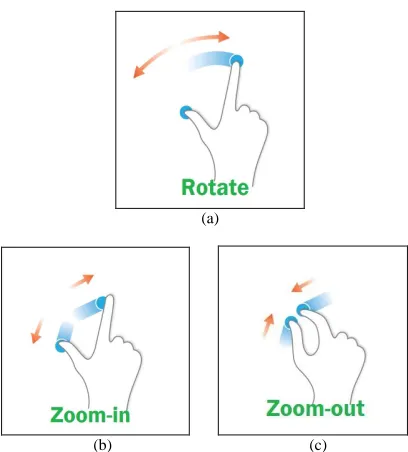
Even though children are able to perform single gestures correctly, that alone does not necessarily mean that they can perform multi-touch gestures very well. The way to perform multi-touch gestures such as rotation, zoom-in and zoom-out are quite different since these gestures involve more than one finger (see Fig. 1). In fact, such interactions need development of physical, motor and cognitive skills that are still developing at this age. Additionally, multi-touch gestures involve finger movement on a same target area that may cause the finger occlusion if they do not give attention [4].
(a)
(b) (c)
Fig. 1 Multi-touch gestures rotation, zoom-in, and zoom-out
Furthermore, the latest study by [10] identified that there are three main aspects that determine a child’s ability in interaction towards multi-touch gestures: (a) difficulty factor; (b) practical guidance; and (c) motor and cognitive skills.
Regarding the difficulty factor, past studies showed that children face problems to perform multi-touch gestures successfully [4], [11]. They are often confused and do not understand the ergonomics of multi-touch gestures [6]. They also used the wrong finger which causes system failure in recognizing their interaction used [9]. Besides, guidance has also become the main issue faced by children when performing multi-touch. They need step by step teaching and practical guidance about how to perform multi-touch in a proper way. Findings from [12] identified that children like to use their own finger without following instructions from the teacher. This is actually due to the fact they had misunderstood the instructions given by teacher since they have less mental acuity and are not matured yet. Meanwhile, children could not perform zoom-in and zoom-out gestures because of low motor and visual coordination [4]. Children have relatively small fingers, weaker arms and limited motor control to perform multi-touch gestures, besides having limited concentration skills. This is because children in the preoperational stage can only keep track of one thing at a time.
But the question is, how far can the three aspects of interaction ability influence children and which aspect is most dominant to them? We still do not know the answer since there is no study that examine children's interaction abilities towards multi-touch gestures. Existing studies on touch interaction involved kindergarten children limited to only single touch gestures such as tap, press and drag [4], [11], [13], comparison of ability between children and adults [14]-[16] and performance between pen and finger gestures [16]-[18]. The requirement to explore kindergarten children’s interaction ability in detail is important because it is to find out how they interact with multi-touch devices.
Thus, this paper explores the priority of children’s interaction ability to perform multi-touch gestures in touch
screen mobile devices via direct observation in a kindergarten. Related works from previous studies show that touch-screen interactive technology has become more and more popular, piquing everyone’s interests. The development of such technology evolved rapidly in markets that have made it available everywhere with relevant and affordable prices. The uses of touch screen mobile devices became popular culture and slowly changing the lifestyle of our society. Because of that, children who are born and raised in this environment are known as the Net generation. They are modern babies and toddlers that have gradually developed the skill to use touch screen devices ever since they were infants. So, it is not weird when touch screen devices become their daily toys since it is part of their life. Children love to explore new technology and they will master how to interact with gestures in touch screen indirectly [19]. Additionally, touch interaction that detects the presence of only one finger on the screen made their adaption towards this technology easier. Such new interaction does not need maximum effort because it is easy to perform and has similarities with the interaction in real situations [20].
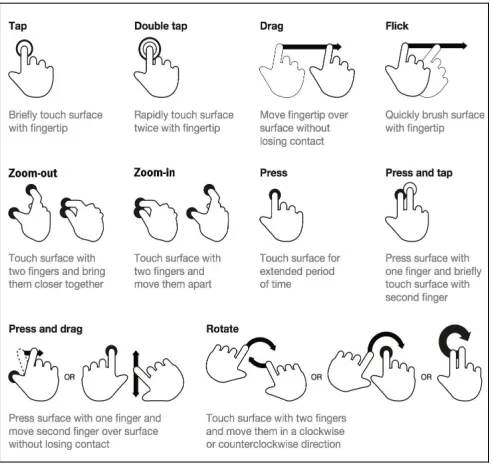
User interaction towards touch screen mobile devices involves several basic gestures. The gestures are tap, double tap, drag, flick, zoom-in, zoom-out, press, press and tap, press and drag and rotate [21] (see Fig. 2). There are two types of touch gestures, which are single touch and multi-touch. Single touch gestures only require one finger to interact on screens which are tap, double tap, drag, flick, press, press and tap, press and drag. While multi-touch gestures involve more than one finger such as rotate, zoom-in and zoom-out. Multi-touch offers more powerful functionalities rather than single gestures. Through these gestures, users are allowed to perform various flexible gestures using their fingers on the screen.
This study only focuses on multi-touch gestures. Basically, children can perform most of single touch gestures correctly. Previous studies have shown that children can perform single gestures such as tap, drag, flick, and press successfully [8], [9]. This is because interaction for such gestures is simple and easy, resembling real-world interaction [20]. However, it differs with other types of gestures. Children find it difficult and because they are unable to perform multi-touch gestures correctly [4], [11]. This is regarded to the children that have limited knowledge and experiences towards technology, besides development of motor and cognitive skills that are still developing.
Analysis from several studies discussed the children’s interaction ability towards multi-touch gestures such as rotate, zoom-in and zoom-out [4], [6], [9], [12], [22], [23]. A study by [9] has found that children always use their fingers inconsistently when performing multi-touch gestures. The reason why is that they get quite confused and unable to comprehend the right way to perform multi-touch [6]. They also do not follow the instructions given when they shift their fingers following their own comfort. At last, it affects the finger movement rendering it incorrect. Next, gestures performed by children especially zoom-in and zoom-out are unable to reach the target boundary [6]. Consequently, their interaction will not be recognized by the system. This is because of the interaction of both zoom gestures considering
several aspects like finger use, diameter between fingers, entry point, and target boundary.
Fig. 2 Basic core gestures for touch screen
A study by [24] with children ages two to four years old identified that visual instructions provided to them were unable to help them perform gestures successfully. The children in his study could not perform the gestures as shown in visual instructions. This is because the content developed in the visual instructions was not age-appropriate to those children. Providing visual instructions actually help engage the user with the gestures to be performed, simultaneously helping them to achieve the skills required.
Moreover, providing feedback in an application helps to inform users that their task is finished successfully. The feedback should be given immediately to users especially when the user in question is children [23]. Delayed feedback in an application will cause children to be impatient in waiting. They will then try to do same interaction repeatedly to get immediate feedback. Children do not like to wait and are always hoping that the application system will give them an immediate response. Sometimes gestures performed by children such as rotation could not be recognized by the system as a proper gesture. It may be because of the children’s physical such as small fingers, weaker arms and limited motor control which all contribute to the fact that their touch input was unable to reach screen sensitivity [9]. Additionally, they tend to put their hand on the screen in the wrong way.
There were several studies that highlight unintentional touches among children [4], [6], [22]. This interaction happens when other parts of their hand touch the screen without realizing it. Children are found to be more likely to accidentally touch than adults, especially smaller targets. Next, finger touches by children always stray far away from the target object. This is because they have less experience estimating how much pressure should be given to the screen, thus affecting their gestures that could not be recognized by the system.
Moreover, zoom-in and zoom-out gestures performed by children are not successful due to low motor and visual skill coordination [4]. The combination of such skills is related to their limited cognitive ability and concentration. Meanwhile, regarding the rotate gestures, children in preoperational stage are only able to perform the gestures in a clockwise direction [6], [25]. Children are often confused to relate between finger movements and rotate edges when several edges are involved. Besides, children are unable to perform rotate gestures in an anti-clockwise direction since it requires maximum effort that is not quite balanced with their limited motor skills.
One important part that should be discussed is children's cognitive development. This study involved kindergarten children ages four to six, meaning it will focus on the preoperational stage. Children in this stage have limitations in motor and cognitive developmental skills. The way they think or see something is central to single things at a time [4], [26]. This is known as egocentric thinking. They also cannot think logically and rationally. Moreover, children learn to develop their motor skills during this period. As they grow up, their body evolves into stronger fingers and arms which help them achieve a fine level of motor skills.
From the review that had been done, children faced problems to perform multi-touch gestures compared to single touches. It showed existing applications developed for children do not benefit nor even helped them to perform multi-touch correctly. Hence, this study is conducted to explore the priority of interaction ability needed by children to perform multi-touch gestures. The study goal is to gain knowledge about useful ways to perform multi-touch. Thus, it may help in the development of multi-touch applications that can be adapted to children's limited motor and cognitive skills.
II. MATERIALS AND METHODS
Fig. 3 presents the technique used to identify the children’s interaction ability with multi-touch gestures based on an analysis of the interaction ability as derived from the literature review. The activities involved are:
• Analysis of children’s ability to list three main aspects of ability for multi-touch as described in Related Works.
• Direct observation of children in kindergarten.
Fig. 3 Technique to identify children's ability
Analysis on children’s interaction ability
Observation in experiment
The priority of interaction ability
A. Observation
This study uses an observation in an experimental technique with ten participants from Emaan Kindy Hillpark kindergarten at Kajang, Selangor. The children were aged four years (3 children), five years (4 children) and six years (3 children). The genders of the children were five boys and five girls. All the participants had prior experience using at least smartphones or tablets according to the selection by their class teacher. The kindergarten’s consent was obtained before conducting the study.
This study uses a checklist form as an instrument for data collection. The form was divided into two parts. Part A contains seven items, which are general participant background (two items) and participant background using touch screen applications (five items). Part B consists of nine items based on three interaction abilities which are three aspects. These aspects are difficulty factor, practical guidance and cognitive and motor [6], [10], [18], [27]. There are two items in difficulty factor, two items in practical guidance and five items in cognitive and motor aspect (as shown in Table 1).
The device used for this experiment was a Samsung Galaxy S2 9.7 tablet with Android 5.0.2 equipped with a capacitive multi-touch screen. A prototype application of preschool touch gestures was developed for this study (Fig. 4 and 5). The purpose of such prototype was to examine children’s interaction ability. The participants sat on a chair in front of a table in face-to-face situations with the researcher. The experiment session will be conducted by the researcher herself who also acts as a facilitator with the participants. All activities were recorded based on the checklist form and additional notes were taken during the experiment.
Fig. 4 Home page
Fig. 5 Main menu
B. Procedure
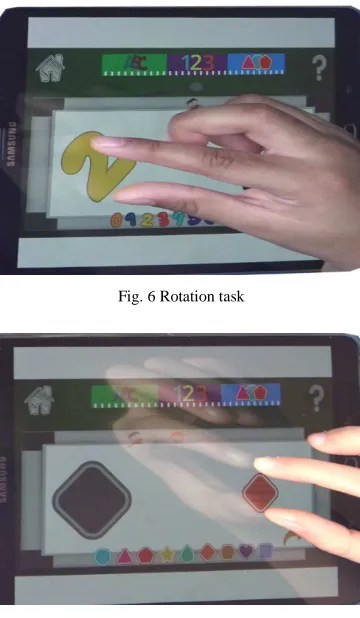
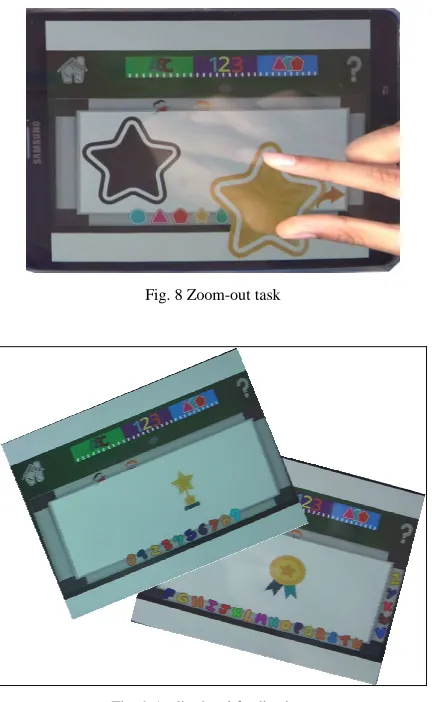
The researcher asked the participants basic questions on touch screen usage at home. Next, the participants started the tasks of performing rotation, zoom-in and zoom-out (Fig. 6, 7 and 8) with the introduction of interactive visual for each task. The overall time provided was 10 minutes. The prototype gave positive audiovisual feedback whenever a gesture was completely successful (Fig. 9). Two sets of video recordings were taken during the experiment that was aided by the other facilitators. The purpose was to not only record finger interaction on screen but also vocal behaviour, facial expressions and their gestures which are all useful for data analysis.
1) Rotation: There are two number images on screen: a
colour image (left screen) and a target image in black (right). The participants are required to rotate the image to the degree that appears on the screen. The successful gestures will be determined when the colour image disappears and is in the target image.
2) Zoom-In: There are two images on screen: a colour
image and a target image in grey. Participants need to scale up the colour image until the image has an equal size with the target image. Successful gestures are determined when the target image changes from grey to black.
3) Zoom-Out: There are two images on screen: a colour
image and a target image in grey. Participants need to scale down the colour image until the image has an equal size with the target image. The successful gestures are determined when the target image changes from grey to black colour.
Fig. 6 Rotation task
Fig. 7 Zoom-in task
Fig. 8 Zoom-out task
Fig. 9 Audiovisual feedback
Data collected in this study is related to the frequency of children's interaction ability towards multi-touch gestures. Items of the interaction ability were identified via observation by the researcher during the experiment. There are nine items in children's interaction ability where each item has a different way to determine the frequency value. For example, the availability of item A1 (inconsistent finger use) (refer Table 1) was determined when participants shift their fingers or any left and right hand during the interaction. A study by [12] mentioned that children failed to perform multi-touch successfully because they do not follow the interactive visual instructions. They would much rather shift their fingers on their own. Thus, to make sure whether there was a finger shift during the interaction, the researcher will review the video recordings. Data collection from this observation will be analysed in the next section.
III.RESULTS AND DISCUSSION
The results of children’s interaction ability towards multi-touch gestures gained from the observation were recorded in Table 1 and Fig. 10.
TABLE I
FREQUENCY OF INTERACTION ABILITY OF MULTI-TOUCH GESTURES
Aspects of Interactio
n Ability
Interaction Ability Item R Zin Zout
Difficulty factor
A1 Inconsistent finger use 5 5 6
A2 High recognition of
target boundary 9 9 9
Practical guidance
A3 Inappropriate visual
instructions 9 5 8
A4 Delayed feedback 8 5 6
Cognitive and motor
A5 Touch input unable to
reach screen sensitivity 8 7 9
A6 Unintentional touches 5 8 9
A7 Fingers touch the
object inaccurately 8 7 9
A8 Low coordination of
motor and visual skills 8 8 8
A9 Rotation in clockwise
only 6 - -
Description: A - Ability R – Rotation Zin – Zoom-in Zout –Zoom-out
Based on Table 1, the frequencies of each item that is equal to or exceed five represent the children who are unable to perform rotation, zoom-in, and zoom-out successfully. Next, Fig. 10 illustrates the percentage of each item (from all aspects) for each multi-touch gestures. The percentage of 50% is selected as a minimum item for children’s interaction ability while the item with 90% shows the highest priority of children's interaction ability towards multi-touch. From the graph, all multi-touch gestures that reached 50% or above, meant that overall, the items coincided with the interaction ability of children faced with performing multi-touch.
An aspect of difficulty factor, especially the high recognition of target boundary, recorded the highest percentage (90%) among all tasks, as shown in the graph.
The children need practical guidance from adults since the visual instructions provided are inappropriate and often confusing (90%). The same percentage (80%) could be seen as other aspects of motor and cognitive skills, especially the system not recording touch input registration, fingers touch the object inaccurately and high coordination of motor and visual skills. Furthermore, children are only able to perform a rotation in a clockwise direction which recorded 60% compared with counter clockwise.
The same percentage (80%) was recorded for zoom-in tasks, which refer to the children's interaction in unintentional touches and coordination between the motor and visual aspects. Overall, the ability aspect for this task is lower compared to the task for rotation and zoom-out.
Meanwhile, the highest percentages for ability aspect for zoom-out tasks are in high recognition of target boundary, system not recorded touch input registration, unintentional touches, and fingers touch the object inaccurately, recorded at 90%.
Fig. 10 Percentage of ability aspects for rotation, zoom-in, and zoom-out
Based on the percentages of interaction ability for overall tasks in Fig. 10, it may be said that gestures performed by the children did not achieve the target because of the high recognition target boundary of the system. A study by [8] stated that children ages 4 and above could perform multi-touch gestures to rotate, zoom-in, and zoom-out, but these gestures fail to be recognized by the system as they did not reach a specific target boundary.
Next, children need specific and clear visual instructions for rotation gestures in terms of practical guidance they got from the adults [27]. With smaller and weaker fingers, their interaction often strays away from the object. In addition, the rotation gestures require both motor and visual coordination.
Furthermore, children’s ability to perform zoom-out is influenced by three main ability items of motor and cognitive skills aspect. This is because they have less experience at estimating how much pressure that should be imparted to the screen, thus making the gestures performed go unrecognized by the system.
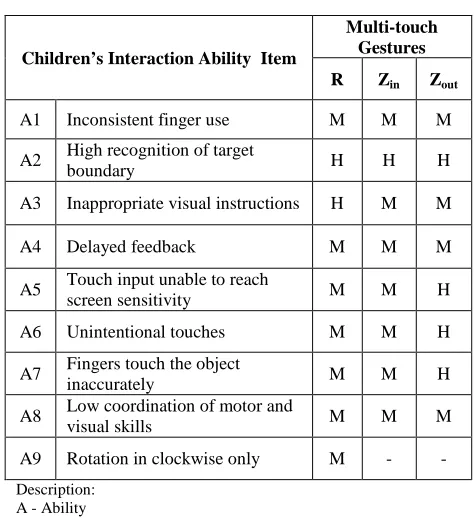
As a whole, findings (see Table 2) indicate that the highest priority of children’s interaction ability is most influenced by the item of high recognition of target boundary for all multi-touch gestures. Moreover, three from five items (touch input unable to reach screen sensitivity, unintentional touches and fingers touch the object inaccurately) in motor and cognitive skills aspect became the most priority ability for zoom-out interactions, followed by the item of inappropriate visual instructions rotate gestures. However, other items from the aspect of difficulty and practical guidance have affected the successfulness of multi-touch gestures performed by kindergarten children. Hence, all nine items are included in the children’s interaction ability that should be highlighted in the development of the interfaces for multi-touch gestures.
The findings obtained from this study have strengthened the aspect of difficulties, practical guidance, and limited motor and cognitive skills faced by children during interaction with rotation, zoom-in, and zoom-out. Although these results are consistent with other researcher’s findings, the development of an adaptive interface design that can be adapt into children's motor and cognitive skills [25], [28] should be addressed in the future. This is because children of different ages have different levels of skill and abilities that are still developing.
TABLE II
THE PRIORITY OF CHILDREN’S INTERACTION ABILITY TOWARDS MULTI-TOUCH GESTURES
Children’s Interaction Ability Item
Multi-touch Gestures
R Zin Zout
A1 Inconsistent finger use M M M
A2 High recognition of target
boundary H H H
A3 Inappropriate visual instructions H M M
A4 Delayed feedback M M M
A5 Touch input unable to reach
screen sensitivity M M H
A6 Unintentional touches M M H
A7 Fingers touch the object
inaccurately M M H
A8 Low coordination of motor and
visual skills M M M
A9 Rotation in clockwise only M - -
Description: A - Ability R – Rotation Zin – Zoom-in Zout –Zoom-out
H –achieve Highest priority M- fulfil Minimum requirement
IV. CONCLUSIONS
This paper specifically discusses the priority of children’s interaction ability in performing multi-touch gestures. There are two activities used in this study, which are analyses of children’s interaction ability and observation. This study is limited to kindergarten children ages four to six years old and focuses on multi-touch rotation, zoom-in, and zoom-out gestures.
The contribution of this study is knowledge on the priority of children's interaction ability that will assist designers and developers who are developing multi-touch gestures applications suitable for kindergarten children. This study also aims to help children to perform multi-touch gestures in a proper way and at the same time may improve their motor, cognitive and visual skills. Moreover, future attempts should be taken by researchers to provide benefits in kindergarten education in accordance with the Malaysia Education Blueprint 2013-2025 the seventh shift to transform the system, maximizing ICT use in the learning process.
ACKNOWLEDGMENT
We would like to thank Universiti Kebangsaan Malaysia and the Emaan Kindy Hillpark kindergarten for their collaboration in this study. This study has been sponsored by
Fundamental Research Grant Scheme
(FRGS/2/2014/ICT05/UKM/02/2) and DPP-2015-022 research grant.
REFERENCES
[1] S. Ahsanullah, Sulaiman, A. K. Mahmood, and M. Khan, "Investigation of fingertip contact area and shape for precise target selection on multi-touch screen," in Imcom’15, 2015, p. 31. [2] A. Baccaglini-Frank and M. Maracci, “Multi-touch technology and
preschoolers’ development of number-sense,” Digit. Exp. Math. Educ., vol. 1, no. 1, pp. 7–27, 2015.
[3] X. Yu, Y. Xue, M. Zhang, and Z. Zhu, “An exploration of developing multi-touch virtual learning tools for young,” in 2nd Int. Conf. Educ. Technol. Comput. ICETC, 2010, vol. 3, pp. 0–3. [4] R. Vatavu, G. Cramariuc, and D. M. Schipor, “Touch interaction for
children aged 3 to 6 years: Experimental findings and relationship to motor skills,” Int. J. Hum. Comput. Stud., vol. 74, pp. 54–76, 2015. [5] J. Lai and D. Zhang, “Extended Thumb: a target acquisition approach
for one-handed interaction with touch-screen,” IEEE Transactions on Human-Machine Systems, vol. 45, no. 3, pp. 362–370, 2015. [6] V. Nacher, J. Jaen, E. Navarro, A. Catala, and P. González,
“Multi-touch gestures for pre-kindergarten children,” Int. J. Hum. Comput. Stud., vol. 73, pp. 37–51, 2015.
[7] D. Kammer, R. Dang, J. Steinhauf, and R. Groh, “Investigating interaction with tabletops in kindergarten environments,” in Proc. 2014 Conf. Interact. Des. Child. – IDC, 2014, pp. 57–66.
[8] N. A. A. Aziz, F. Batmaz, R. Stone, and P. W. H. Chung, “Selection of touch gestures for children’s applications,” in Sci. Inf. Conf. (SAI), 2013, pp. 721–726.
[9] L. F. M. Ibharim, N. Borhan, and M. H. M. Yatim, “A field study of understanding child’s knowledge, skills and interaction towards capacitive touch technology (iPad),” in 8th Int. Conf. Inf. Technol. Asia - Smart Devices Trend Technol. Futur. Lifestyle, Proc. CITA, 2013, pp. 6–10.
[10] N. H. Hussain, T. S. M. T. Wook, S. F. M. Noor, and H. Mohamed, “Theoretical framework of multi-touch gestures in multimodal systems interaction for children”, in International Conference on Applied Computing, Mathematical Sciences and Engineering (ACME), 2016.
[11] M. Spindler and M. Schuessler, “Pinch-drag-flick vs. spatial input: rethinking zoom & pan on mobile displays,” in Proc. of the 32nd annual ACM conference on Human factors in computing systems, 2014, vol. v, pp. 1113–1122.
[12] L. F. M. Ibrahim, N. A. A. Zaki, and M. H. M. Yatim, “Touch gesture interaction of preschool children towards games application using touch screen gadjet,” Asia-Pacific Journal of Information Technology and Multimedia, vol. 4, no. 1, pp. 47–58, 2015. [13] R. Tahir, and F. Arif, “A measurement model based on usability
metrics for mobile learning user interface for children,” International Journal of E-learning and Educational Technologies in Digital media (IJEETDM), vol. 1, no. 1, pp. 16–31, 2014.
[14] E. Campisi, and A. Ozyurek, “Iconicity as a communicative strategy: Recipient design in multimodal demonstrations for adults and children,” J. Pragmat., vol. 47, no. 1, pp. 14–27, 2013.
[15] L. Anthony, Q. Brown, J. Nias, B. Tate, and S. Mohan, “Interaction and recognition challenges in interpreting children’s touch and gesture input on mobile devices,” in Proc. 2012 ACM Int. Conf. Interact. tabletops surfaces - ITS ’12, 2012, p. 225.
[16] A. S. Arif, and C. Sylla, “A comparative evaluation of touch and pen gestures for adult and child users,” in Proc. 12th Int. Conf. Interact. Des. Child., 2013, pp. 392–395.
[17] H. Tu, X. Ren, and S. Zhai, “A comparative evaluation of finger and pen stroke gestures,” in Proc. 2012 ACM Annu. Conf. Hum. Factors Comput. Syst. - CHI ’12, 2012, p. 1287.
[18] L. McKnight and B. Cassidy, “Children’s interaction with mobile touch-screen devices,” Int. J. Mob. Hum. Comput. Interact., vol. 2, no. 2, pp. 1–18, 2010.
[19] N. A. A. Aziz, “Children’s interaction with tablet applications: gestures and interface design,” Int. J. Comput. Inf. Technol., vol. 02, no. 03, pp. 447–450, 2013.
[20] L. McKnight, and D. Fitton, “Touch-screen technology for children: giving the right instructions and getting the right responses,” in Proc. 9th Int. Conf. Interact. Des. Child., 2010, pp. 238–241.
[21] C. Villamor, D. Willis, and L. Wroblewski. (2010) Touch gesture
reference guide. [Online]. Available:
http://www.lukew.com/ff/entry.asp?1071
[22] L. Anthony, Q. Brown, B. Tate, J. Nias, R. Brewer, and G. Irwin, “Designing smarter touch-based interfaces for educational contexts,” Pers. Ubiquitous Comput., vol. 18, pp. 1471–1483, 2014.
[23] C. Stößel, and L. Blessing, “Tap, swipe & pinch: designing suitable multi-touch gestures for older users,” in Proc. Des. 2010, 11th Int. Des. Conf., 2010, pp. 463–472.
[24] A. Hiniker, K. Sobel, S. R. Hong, H. Suh, D. Kim, and J. A. Kientz, “Touch screen prompts for preschoolers: designing developmentally appropriate techniques for teaching young children to perform gestures,” in Proceedings of the 14th International Conference on Interaction Design and Children, 2015, pp. 109-118.
[25] V. Nacher, and J. Jaen, Evaluating the Accuracy of Pre-kindergarten Children Multi-touch Interaction, Lecture Notes in Human-Computer Interaction, Springer International Publishing, 2015, pp. 549-556. [26] J. Piaget, Piaget’s Theory, P. Mussen ed., Handbook of Child
Psychology. Wiley & Sons, New York, NY, USA, 1983.
[27] Sesame Street. (2012) Best practices: designing touch tablet experiences for preschoolers. [Online]. Available:
http://www.sesameworkshop.org/wp_install/wp-content/uploads/2013/04/Best-Practices-Document-11-26-12.pdf [28] T. S. M. T. Wook, N. H. Hussain and J. Jumahad, “Preliminary study
of an adaptive multimodal interface design for student’s digital library,” in International Conference on Computational Science and Technology (ICCST), 2014, pp. 1-5.