Two algorithms for the reorganisation
of the problem list by organ system
Daniel B Hier ,1 Joshua Pearson2
To cite: Hier DB, Pearson J. Two algorithms for the reorganisation of the problem list by organ system. BMJ Health Care Inform 2019;26:e100024. doi:10.1136/ bmjhci-2019-100024
Received 02 April 2019 Revised 13 November 2019 Accepted 03 December 2019
1Neurology and Rehabilitation,
University of Illinois at Chicago, Chicago, Illinois, USA 2Quality and Risk Management,
Your Community Health Center, Rolla, Missouri, USA
Correspondence to Dr Daniel B Hier; dbhier@ dbhier. com © Author(s) (or their employer(s)) 2019. Re- use permitted under CC BY- NC. No commercial re- use. See rights and permissions. Published by BMJ.
AbstrACt
Objective Long problem lists can be challenging to use. Reorganisation of the problem list by organ system is a strategy for making long problem lists more manageable.
Methods In a small- town primary care setting, we examined 4950 unique problem lists over 5 years (24 033 total problems and 2170 unique problems) from our electronic health record. All problems were mapped to the International Classification of Diseases, 10th Revision, Clinical Modification (ICD-10- CM) and SNOMED CT codes. We developed two different algorithms for reorganising the problem list by organ system based on either the ICD-10- CM or the SNOMED CT code.
results The mean problem list length was 4.9±4.6 problems. The two reorganisation algorithms allocated problems to one of 15 different categories (12 aligning with organ systems). 26.2% of problems were assigned to a more general category of ‘signs and symptoms’ that did not correspond to a single organ system. The two algorithms were concordant in allocation by organ system for 90% of the unique problems. Since ICD-10- CM is a monohierarchic classification system, problems coded by ICD-10- CM were assigned to a single category. Since SNOMED CT is a polyhierarchical ontology, 19.4% of problems coded by SNOMED CT were assigned to multiple categories.
Conclusion Reorganisation of the problem list by organ system is feasible using algorithms based on either ICD-10- CM or SNOMED CT codes, and the two algorithms are highly concordant.
IntrOduCtIOn And sIgnIfICAnCe
The problem list is one of the four critical elements of the problem- oriented medical record, as described by Dr Lawrence Weed in 1968.1 Weed2 wrote that ‘the first page of the patient record should consist of a numbered problem list. It is a ‘table of contents’ and ‘index’ combined, and the care with which it is constructed determines the quality of the whole record’. The electronic problem list is now a standard component of all electronic health records (EHRs). A turning point in the adoption of the electronic problem list occurred in the USA in 2014 when the Mean-ingful Use programme required providers to maintain an electronic problem list. The Meaningful Use programme defined the problem list as ‘A list of current and active diagnoses as well as past diagnoses relevant to
the current care of the patient’.3 The wide-spread use of the electronic problem list has raised the issue of responsibility for ensuring that the problem list is complete and accu-rate.4 5 A problem list that is incomplete or that is cluttered with numerous inactive problems may lack utility. Several studies have noted that problem lists are often incomplete.6 7 On the other hand, as Holmes8 commented, for some unhealthy patients, the problem list can ‘…grow to 30 or more lines of text, making a clear and quick understanding of the patient’s health nearly impossible’. Reconciliation of long problem lists (making sure the problem list is complete and identifying inactive prob-lems) is challenging and time- consuming. One strategy for dealing with long problem lists is to reorganise them by organ system. The reorganisation of problems by organ system could make long problem lists more manageable by facilitating the recognition of redundant problems, problems subsumed by other problems, missing problems and inac-tive problems.
On most problem lists, problems are not captured as free text, but rather as struc-tured data coded as either the International Classification of Diseases (ICD) codes or SNOMED CT codes. Both International Clas-sification of Diseases, 10th Revision, Clinical Modification (ICD-10- CM) and SNOMED CT have an inherent structure that could allow the problem list to be reorganised by organ system. We have tested the hypothesis that the problem list can be reorganised algorith-mically by using the inherent structure in ICD-10- CM and SNOMED CT.
MethOds setting
Your Community Health Center is a federally qualified health centre in rural Missouri with four primary care providers (one physician and three advanced practice nurses). During the study period, providers used eClinical-Works V.10e (Westborough, Massachusetts) as their electronic medical record.
copyright.
on September 12, 2020 by guest. Protected by
Table 1 Reorganising algorithms for problems by organ systems
Organ system Acronym ICD-10- CM*(range) SNOMED CT†(subsumption)
Cardiovascular CV I00–I52
I70–I99 O10–O16
|49601007|Cardiovascular disorder (disorder)
Endocrine and metabolic END E00–E89 |75934005| Metabolic disease (disorder) |70241007| Nutritional deficiency (disorder)
|362969004| Disorder of endocrine system (disorder)
Ear, nose, throat ENT H60–H95
K00–K14 J00–J06 J30–J39
|232208008| Ear nose and throat disorder (disorder)
Eye EYE H00–H59 |128127008|Disorder of visual system (disorder)
Gastrointestinal GI K20–K95 |53619000|Disorder of digestive system (disorder) Genito- urinary- breast GUB N00–N99
O91–O92 |42030000|Disorder of the genitourinary system (disorder)|79604008| Disorder of breast (disorder) |129103003| Endometriosis (disorder)
Haematological HEM D50–D78 |414022008|Blood disease (disorder)
|362970003|Disorder of haemostatic system (disorder) |414027002|Disorder of haematopoietic structure (disorder) Inflammatory or infectious INF A00–B99
O85–O87 D80–D89
|40733004| Infectious disease (disorder) |128139000| Inflammatory disorder (disorder)
Integumentary INT L00–L99 |128598002|Disorder of integument (disorder) Musculoskeletal and injury MS M00–M99
S00–T88 |928000| Musculoskeletal disorder (disorder)|417163006| Traumatic and/or non- traumatic injury (disorder) Neoplasms NEO C00–D49 |399981008|Neoplasm and/or hamartoma (disorder)
Neurological NEU G00–G99
F51 I60–I69
|118940003| Neurological disorder (disorder) |230461009| Headache disorder (disorder) |39898005| Sleep disorder (disorder)
Psychiatric PSY F20–F49
F60–F99 |74732009|Mental illness (disorder)
Respiratory RSP J09–J18
J20–J22 J40–J99
|50043002|Respiratory disease (disorder)
Signs and symptoms SIGNS R00–R99
F10–F19 F50–F59
|250171008| Clinical history and observation finding (finding) |441742003|Evaluation finding (finding)
*All ICD-10- CM codes that were within the listed ranges were included.
†All SNOMED CT codes that were subsumed by the listed SNOMED CT codes were included. See SNOMED CT documentation for the operational definition of subsumption.12
ICD-10- CM, International Classification of Diseases, 10th Revision, Clinical Modification.
ehr functionality
eClinicalWorks V.10e allows providers to add new prob-lems, mark inactive problems as resolved or move inac-tive problems to medical history. Resolved problems are filtered out of the active problem list but can be retrieved by adjusting the filter settings. By organisational policy, providers are required to maintain a valid problem list on every patient to comply with the Meaningful Use of EHR programme.3 A quality management report moni-tors compliance with this policy monthly. By organisa-tional policy, problems must be entered as structured data (ICD-10- CM codes), and free- text problems are not
permitted. eClinicalWorks V.10e can map ICD-10- CM codes to a supplementary problem list of SNOMED CT codes. However, since no one- to- one map from ICD-10- CM to SNOMED CT codes exists, the use of the SNOMED CT problem list requires some manual mapping of terms from ICD-10- CM to SNOMED CT. As a result, our providers use the problem list based on ICD-10- CM codes exclusively.
Problems
This study was based on 41 749 patient encounters between 22 April 2014 and 15 February 2019. Using the
copyright.
on September 12, 2020 by guest. Protected by
Table 2 Top 20 problems
ICD-10- CM code Description Count Proportion of total (%)
I10 Essential hypertension 1417 5.9
F17.200 Nicotine dependence 1221 5.1
F41.9 Anxiety disorder 992 4.1
F32.9 Major depressive disorder 865 3.6
E66.9 Obesity 831 3.5
K21.9 Gastro- oesophageal reflux disease 484 2.0
E11.9 Type 2 diabetes mellitus without complications 452 1.9
E03.9 Hypothyroidism 327 1.4
G89.29 Other chronic pain 322 1.3
J30.2 Seasonal allergic rhinitis 321 1.3
E66.01 Morbid obesity 311 1.3
G47.00 Insomnia 278 1.2
J30.9 Chronic allergic rhinitis 277 1.2
F43.10 Post- traumatic stress disorder 257 1.1
F33.1 Major depressive disorder 235 1.0
J44.9 Chronic obstructive pulmonary disease 229 1.0
G62.9 Polyneuropathy 211 0.9
F31.9 Bipolar disorder 199 0.8
E78.5 Hyperlipidaemia 194 0.8
F41.1 Generalised anxiety disorder 189 0.8
R03.0 Elevated blood pressure reading 186 0.8
Total 9798 40.8
ICD-10- CM, International Classification of Diseases, 10th Revision, Clinical Modification.
eClinicalWorks eBO database tool, we took a snapshot of all problem lists in our EHR as of 15 February 2019. Data extracted included provider name, date problem was added, problem name, patient record number and ICD code. We reduced our initial data set of 34 757 prob-lems by excluding probprob-lems coded as ICD-9- CM or with ICD-10- CM codes beginning with letters ‘U’ or ‘Z’. This yielded a final data set of 24 033 problems, 4950 unique problem lists and 2170 unique problems (mean problem list length of 4.9±4.6 problems). Since no one- to- one map between ICD-10- CM and SNOMED CT exists, each of the 2170 ICD-10- CM codes was manually mapped to a corre-sponding SNOMED CT code.9
Algorithms for reorganising the problem list by organ system
Organ systems for the reorganising algorithms were selected to mirror the organisation of ICD-10- CM chap-ters10 (see table 1). We developed two algorithms for reorganising the problem list by organ system. The first algorithm was based on parsing the ICD-10- CM codes according to the chapter organisation of ICD-10- CM (eg, codes beginning with ‘G’ are neurological, codes beginning with ‘I’ are cardiovascular; see also table 1). A second algorithm for reorganising the problem list by organ system was based on using subsumption within the hierarchy of SNOMED CT codes.11 For example, most
cardiovascular disorders are subsumed by the SNOMED CT concept |105969002| Cardiovascular disorder (disorder) (see table 1). Both algorithms were imple-mented in Python V.3.7 ( www. anaconda. com). For the SNOMED reorganising algorithm, we used a transitive closure table (encompassing all subsumption relations) provided by SNOMED International.12
results
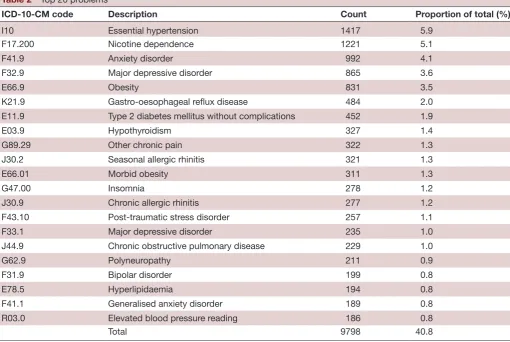
During the 5- year study period, providers used 2170 unique ICD-10- CM codes to add 24 033 problems. The top 20 problems accounted for more than 40% of all problems added (table 2). The top 5 problems by count were essential hypertension, nicotine dependence, anxiety disorder, major depression and obesity, similar in frequency to other studies of the problem list.13
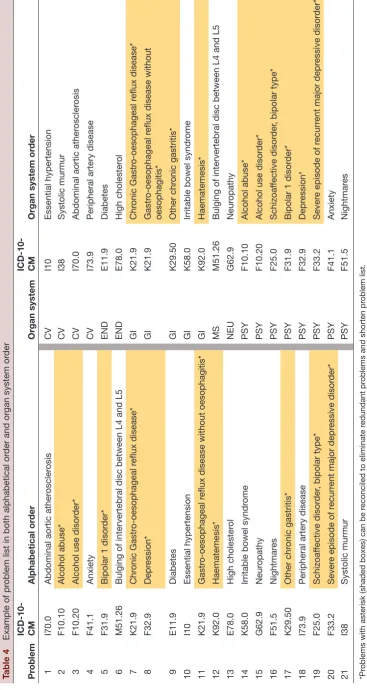
Problems were reorganised into one of 15 different organ systems according to either the ICD-10- CM or SNOMED CT code algorithm (table 3). Table 4 demon-strates how a typical long problem list of 21 problems can be reorganised by organ system. Note that reconciliation of the problem list could eliminate at least five redundant problems from the problem list.
copyright.
on September 12, 2020 by guest. Protected by
Table 3 Concordance between ICD-10- CM and SNOMED CT reorganising algorithms
Organ system*
Assignment by ICD-10- CM algorithm (count)
Assignment by SNOMED algorithm (count)
Concordant assignments (count)
Concordant assignments as proportion of ICD-10- CM codes† (%)
Proportion of the total problems (%) (n=24 034)
CV 148 186 148 100 8.5
END 125 147 122 98 8.8
ENT 108 107 97 90 6.8
EYE 50 63 50 100 0.4
GI 144 159 138 96 4.6
GUB 153 168 144 94 3.8
HEM 35 50 34 97 0.7
INF 103 303 92 89 2.5
INT 96 128 90 94 2.0
MS 590 469 469 79 9.8
NEO 54 60 52 96 0.4
NEU 145 258 141 97 5.0
PSY 129 131 114 88 16.5
RSP 70 107 60 85 4.0
SIGNS 220 305 207 91 26.2
Total 2170 2641 1958 90 100.0
*For acronyms, see table 1.
†Column 4 counts divided by column 2 counts.
ICD-10- CM, International Classification of Diseases, 10th Revision, Clinical Modification.
Both algorithms were able to reorganise problems into one of the 15 categories (table 3). As a proportion of the total problems, the largest categories were signs and symptoms (26.2%), psychiatric (16.5%), musculoskeletal and injuries (9.8%), endocrine (8.8%), and cardiovas-cular (8.5%), reflecting the high prevalence of hyperten-sion, diabetes, hypothyroidism, depression and anxiety (table 2). The two reorganising algorithms were concor-dant (defined as both algorithms assigning the problem to the same organ system) for 1958 of the unique prob-lems (90%). The ICD-10- CM reorganisation algorithm returned one category for each problem, reflecting its structure as a monohierarchic classification system. The SNOMED CT reorganisation algorithm returned more than one category for 19.4% of the problems (table 4), reflecting its organisation as a polyhierarchical ontology. We considered the two algorithms concordant if at least one of the categories returned by the SNOMED CT algo-rithm matched the ICD-10- CM algoalgo-rithm category.
dIsCussIOn
The goal of the electronic problem list is to be accurate, complete and usable. Complete means that all actively managed problems are on the problem list. Accurate means that inactive or resolved problems have either been moved to medical history or filtered out of the active problem list. Usable means that the problem list is not so excessively long that the user finds it cumbersome to grasp
and reconcile. Several studies have found that the elec-tronic problem list is often incomplete.6 7 Some studies have explored making the problem list more complete by using natural language processing,14 importing claims data,15 or implementing rules based on structured data or decision support tools.16 17
It is our opinion that long problem lists are an emerging challenge for healthcare providers. Problem list reconciliation (identifying missing problems and filtering out resolved problems) is time- consuming and cognitively demanding. At our institution, an analysis of 4951 problem lists showed that 10% have 10 or more problems, 4% have 15 or more problems, and 2% have 20 or more problems. The reasons for long problem lists are varied. At each patient encounter, EHRs facilitate the easy transfer of diagnoses from the progress note to the problem list. At subsequent visits, redundant problems (eg, overweight and obesity) may be inadvertently added to the problem list. As some problems become inactive, providers may fail to mark these problems as resolved. Signs or symptoms that have been transformed into ongoing problems (eg, shortness of breath becomes asthma) may remain on the problem list.18 Importantly, providers may lack the time to reconcile these long lists. As Krauss et al19 commented, ‘even with a unified problem list policy in place, there is little incentive in many documentation workflows to curate problem lists’.
copyright.
on September 12, 2020 by guest. Protected by
Table 4
Example of pr
oblem list in both alphabetical or
der and or
gan system or
der Pr oblem ICD-10- CM Alphabetical or der Organ system ICD-10- CM
Organ system or
der
1
I70.0
Abdominal aortic ather
oscler osis CV I10 Essential hypertension 2 F10.10 Alcohol abuse* CV I38 Systolic murmur 3 F10.20
Alcohol use disor
der*
CV
I70.0
Abdominal aortic ather
oscler osis 4 F41.1 Anxiety CV I73.9
Peripheral artery disease
5
F31.9
Bipolar 1 disor
der* END E11.9 Diabetes 6 M51.26
Bulging of intervertebral disc between L4 and L5
END E78.0 High cholester ol 7 K21.9 Chr onic Gastr oesophageal r eflux disease* GI K21.9 Chr onic Gastr oesophageal r eflux disease* 8 F32.9 Depr ession* GI K21.9 Gastr oesophageal r
eflux disease without
oesophagitis* 9 E11.9 Diabetes GI K29.50 Other chr onic gastritis* 10 I10 Essential hypertension GI K58.0
Irritable bowel syndr
ome 11 K21.9 Gastr oesophageal r
eflux disease without oesophagitis*
GI K92.0 Haematemesis* 12 K92.0 Haematemesis* MS M51.26
Bulging of intervertebral disc between L4 and L5
13 E78.0 High cholester ol NEU G62.9 Neur opathy 14 K58.0
Irritable bowel syndr
ome PSY F10.10 Alcohol abuse* 15 G62.9 Neur opathy PSY F10.20
Alcohol use disor
der* 16 F51.5 Nightmar es PSY F25.0 Schizoaf fective disor der
, bipolar type*
17 K29.50 Other chr onic gastritis* PSY F31.9
Bipolar 1 disor
der*
18
I73.9
Peripheral artery disease
PSY F32.9 Depr ession* 19 F25.0 Schizoaf fective disor der
, bipolar type*
PSY
F33.2
Sever
e episode of r
ecurr
ent major depr
essive disor
der*
20
F33.2
Sever
e episode of r
ecurr
ent major depr
essive disor der* PSY F41.1 Anxiety 21 I38 Systolic murmur PSY F51.5 Nightmar es *Pr
oblems with asterisk (shaded boxes) can be r
econciled to eliminate r
edundant pr
oblems and shorten pr
oblem list.
END, endocrine and metabolic; GI, gastr
ointestinal;
CM, Inter
national Classification of Diseases, 10th Revision, Clinical Modification; MS, musculoskeletal and injury; NEU,
neur
ological; PSY
, psychiatric.
copyright.
on September 12, 2020 by guest. Protected by
Table 5 Problems assigned to one or more organ systems by SNOMED CT algorithm
Number of organ
systems Frequency (count) Proportion (%)
1 1793 81.6
2 320 15.7
3 43 2.0
4 10 0.4
5 4 0.2
Total 2170 100
Others have introduced the idea of reorganising the problem list by organ system to improve usability.20 21 At least one terminology vendor has introduced software that will allow the reorganising of the problem list by organ system within some EHRs.22 Our study demonstrates the feasibility of reorganising the problem list by organ system. We have shown that when problems are mapped to either ICD-10- CM codes or SNOMED CT codes, approx-imately 75% of the problems on typical problem lists can be categorised by organ system (table 3). When we exam-ined 2170 unique problems in use at our health centre, the ICD-10- CM grouping algorithm assigned all but 295 ICD-10- CM codes to an organ system, and the SNOMED CT grouping algorithm assigned all but 305 SNOMED CT codes to an organ system (tables 1 and 3). Of the 2170 unique problems examined, the algorithms were concordant for 1958 of the problems (90%). Reasons for lack of concordance between the two reorganising algorithms are twofold. First, ICD-10- CM is a monohier-archy, whereas SNOMED CT is a polyhierarchy. Diseases and disorders are assigned to only one organ system in ICD-10- CM, whereas they may be assigned to one, two or more organ systems in SNOMED CT (see table 5). For example, diabetic neuropathy (E13.42) in ICD-10- CM is assigned to endocrine disorders, whereas SNOMED CT (SCT 230572002) assigns diabetic neuropathy to both neurological disorder and endocrine disorder. Second, SNOMED CT and ICD-10- CM handle signs and symptoms somewhat differently. ICD-10- CM defines ‘R’ codes as ‘less well- defined conditions and symptoms that, without the necessary study of the case to establish a final diagnosis, point perhaps equally to two or more diseases or two or more systems…’.10 SNOMED CT distinguishes between clinical findings and disorders. SNOMED CT defines clin-ical findings as ‘normal/abnormal observations, judg-ments, or assessments of patients’ and disorders as ‘always and necessarily an abnormal clinical state’.23 In general, SNOMED CT is more conservative and will not assign a sign or symptom to an organ system if it is compatible with more than one organ system.
study limitations
We did not do any human factor studies to determine whether reorganising the problem list by organ system will facilitate problem list use or reconciliation. Further
studies will be needed to address these issues. Another study limitation was the small number of providers studied. Other studies have shown significant interprovider differ-ences in their approach to maintaining the problem list.19 Furthermore, in a primary care setting such as ours, the primary care provider has sole ownership of the problem list and carries full responsibility for reconciliation of the problem list. The situation is more complicated in a multi-specialty practice setting where a variety of providers are adding to the problem list and ownership of the problem list is shared. Nonetheless, we are of the opinion that reorganisation of the problem list by organ system will be even more valuable in a multispecialty setting by allowing each specialist to view easily those problems addressed by that specialty. Another study limitation is that we did not investigate other reorganisation algorithms, such as the ordering of problems by chronicity or acuity or the nesting of problems by subsumption. Finally, use of the SNOMED CT reorganisation algorithm assigns problems to multiple categories approximately 19% of the time. Users of the SNOMED CT algorithm are faced to choose between allowing a problem to appear in multiple catego-ries or assigning that problem to a single category.
generalisability of findings and implications for ehr design
Nearly all hospital and physician practices now use commercially available EHRs. Implementation of problem list reorganisation by organ system will require support from EHR vendors. We have demonstrated that easy- to- implement algorithms based on either SNOMED CT or ICD-10- CM codes can be used to reorganise the problem list by organ system. Although we have not yet performed usability studies, we believe that reorganisa-tion of the problem list by organ system will make these problem lists easier to reconcile. These algorithms could be implemented in any EHR system that uses SNOMED CT or ICD-10- CM to encode the problem list. Physician burn- out related to use of the EHR is a growing problem.24 We believe that the EHR should and will evolve so that more of the time- consuming work of maintaining accu-rate problem lists can be done algorithmically to conserve clinician time and effort.
COnClusIOns
With the increasing adoption of the problem list as a key element of the EHR, long problem lists are inevitable, especially in complex medical patients. One strategy for making long problem lists more usable is to reorganise these lists by organ system. We have demonstrated the feasibility of two algorithms to reorganise the problem list by organ system based on either ICD-10- CM codes or SNOMED CT codes. We found high levels of concor-dance between the two categorisation algorithms.
Acknowledgements We thank Your Community Health Center, Rolla, Missouri for supporting this research.
Contributors DBH developed the study concept. DBH and JP performed the data collection and analysis. DBH performed the algorithm coding. DBH wrote the manuscript with assistance from JP.
copyright.
on September 12, 2020 by guest. Protected by
funding The authors have not declared a specific grant for this research from any funding agency in the public, commercial or not- for- profit sectors.
Competing interests None declared. Patient consent for publication Not required.
ethics approval This study was reviewed and approved by the Institutional Review Board of the University of Illinois at Chicago.
Provenance and peer review Not commissioned; externally peer reviewed. data availability statement Data are available upon reasonable request. Open access This is an open access article distributed in accordance with the Creative Commons Attribution Non Commercial (CC BY- NC 4.0) license, which permits others to distribute, remix, adapt, build upon this work non- commercially, and license their derivative works on different terms, provided the original work is properly cited, appropriate credit is given, any changes made indicated, and the use is non- commercial. See: http:// creativecommons. org/ licenses/ by- nc/ 4. 0/.
OrCId id
Daniel B Hier http:// orcid. org/ 0000- 0002- 6179- 0793
referenCes
1 Weed LL. Medical records that guide and teach. N Engl J Med Overseas Ed 1968;278:652–7.
2 Weed LL. Medical records, medical education, and patient care. Press of Case Western University Press, Cleveland OH, 1969. 3 Maintain Problem List. Eligible professional meaningful use core
measures measure 3 of 13. Available: https://www. cms. gov/ regulations- and- guidance/ legislation/ ehrincentiveprograms/ downloads/ 3_ maintain_ problem_ listep. pdf
4 Simons SMJ, Cillessen FHJM, Hazelzet JA. Determinants of a successful problem list to support the implementation of the problem- oriented medical record according to recent literature. BMC Med Inform Decis Mak 2016;16:102.
5 Hodge CM, Narus SP. Electronic problem Lists: a thematic analysis of a systematic literature review to identify aspects critical to success. J American Medical Informatics Assoc 2018;25:603–13. 6 Wright A, McCoy AB, Hickman T- TT, et al. Problem list completeness
in electronic health records: a multi- site study and assessment of success factors. Int J Med Inform 2015;84:784–90.
7 Szeto HC, Coleman RK, Gholami P, et al. Accuracy of computerized outpatient diagnoses in a Veterans Affairs general medicine clinic.
Am J Manag Care 2002;8:37–43.
8 Holmes C. The problem list beyond meaningful use. Part I. The problems with problem Lists. Journal AHIMA 2011;82:30–3. 9 Cartagena FP, Schaeffer M, Rifai D, et al. Leveraging the NLM map
from SNOMED CT to ICD-10- CM to facilitate adoption of ICD-10- CM. J Am Med Inform Assoc 2015;22:659–70.
10 CDC. International classification of diseases, tenth revision, clinical modification (ICD-10- CM). Available: https://www. cdc. gov/ nchs/ icd/ icd10cm. htm
11 SNOMED International. Data analytics with SNOMED CT. Available: https:// confluence. ihtsdotools. org/ display/ DOCANLYT/ Data+ Analytics+ with+ SNOMED+ CT
12 SNOMED International. Transitive closure files. Available: https:// confluence. ihtsdotools. org/ display/ DOCRELFMT/ 4. 2. 5+ Transitive+ Closure+ Files
13 Wright A, Bates DW. Distribution of problems, medications and lab results in electronic health records: the Pareto principle at work. Appl Clin Inform 2010;1:32–7.
14 Devarakonda MV, Mehta N, Tsou C- H, et al. Automated problem list generation and physicians perspective from a pilot study. Int J Med Inform 2017;105:121–9.
15 Poissant L, Taylor L, Huang A, et al. Assessing the accuracy of an Inter- Institutional automated patient- specific health problem list.
BMC Med Inform Decis Mak 2010;10:10.
16 Wright A, Pang J, Feblowitz JC, et al. A method and knowledge base for automated inference of patient problems from structured data in an electronic medical record. J Am Med Inform Assoc
2011;18:859–67.
17 Galanter WL, Hier DB, Jao C, et al. Computerized physician order entry of medications and clinical decision support can improve problem list documentation compliance. Int J Med Inform
2010;79:332–8.
18 Joseph C. Ehr Explainer: decoding the problem list. Available: https:// youtu. be/ 6Pp8lqrAXOg
19 Krauss JC, Boonstra PS, Vantsevich AV, et al. Is the problem list in the eye of the beholder? An exploration of consistency across physicians. J Am Med Inform Assoc 2016;23:859–65.
20 Buchanan J. Accelerating the benefits of the problem oriented medical record. Appl Clin Inform 2017;26:180–90.
21 Hodge CM, Kuttler KG, Bowes WA III, et al. Problem management module: an innovative system to improve problem list workflow. AMIA annual symposium proceedings, 2014: 661–70.
22 Problem it plus. Available: https:// youtu. be/ graLPSyPH
23 Clinical finding/Disorder. Available: https:// confluence. ihtsdotools. org/ pages/ viewpage. action? pageId= 71172245
24 Downing NL, Bates DW, Longhurst CA. Physician burnout in the electronic health record era: are we ignoring the real cause? Ann Intern Med 2018;169:50–1.
copyright.
on September 12, 2020 by guest. Protected by