______________________________________________
COMMUNICATING AGRICULTURAL INFORMATION FOR DEVELOPMENT: A GHANAIAN CASE
Benjamin K Addom
I
nformation and communication technologies (ICT) aregetting increasing attention in discussions about agricultural development. For example, the World Bank produced two reports in 2011 and 2012 highlighting the potential of ICTs in connecting farmers with important persons and agencies in the agricultural sector. In 2011 it was ICT in Agriculture, Connecting Smallholders to Knowledge, Networks and institutions. In 2012, the Bank and infoDev published Maximizing Mobile which explored the applications of mobile phone technology to a variety of sectors including agriculture. In this paper, we report on research in Ghana that looked at how key parts of the agricultural community communicate with each other in an emerging ICT environment.
With the current emphasis being shifted from agricultural ‘production’ to ‘productivity’, it is important to go beyond knowledge generation to explore factors that influence or impact the use of agricultural k n o w l e d g e o r i n f o r m a t i o n . D e v e l o p m e n t c o m m u n i c a t i o n , w h i c h i n t e g r a t e s s t r a t e g i c communication in development projects to increase the chances of success of development projects (World Bank, 2004), is a key to productivity.
As a result of poor and outdated communication channels among key stakeholders in Ghana‟s agricultural sector, the flow of information, knowledge and innovations have been impeded. While agricultural knowledge generation from two main sources – scientific research and local experience – have been fairly consistent over the years, the use of knowledge products by the end users has been on the decline. In order to understand how
„
among local farmers and agricultural researchers, in 2009 we studied three administrative districts of southern Ghana. We gathered data from local farmers, agricultural researchers, agricultural extension agents and other intermediary organisations through interviews and focus group discussions within the three districts. The results reveal some of the challenges with most national agricultural extension systems and advisory services across Africa, which are the main communication channels for the agricultural sector. The study recommends the coordination of functions among intermediaries through the new ICTs for effective and efficient knowledge management within the sector.
The central importance of agricultural growth in reducing rural poverty in agricultural-based economies has been well established (World Development Report, 2008). But the most important issue remains as to how best to create the necessary conditions for the growth of the agricultural sector. With the current emphasis being shifted from agricultural „production‟ to „productivity‟, it is important to go beyond knowledge generation to explore factors that influence or impact the use of agricultural knowledge or information. Development communication, which integrates strategic communication in development projects to increase the chances of success of development projects (World Bank, 2004), is a key to productivity. Communicating agricultural information, knowledge or innovation for development has two important dimensions – the message or content, and the channel or media through which it is transmitted. While the paper looks more into the channels or media for transmitting agricultural knowledge, it is important to link these channels to the content and its generation.
The Traditional Media
that a great deal of information and knowledge which is favourable for bringing about change in agricultural practices must be introduced in rural areas through the mass media. The new media, however, have the capability to add to the existing traditional communication technologies and for development of a “mix” of traditional and/or appropriate media (Richardson, 1996; CODESRIA/IDRC, 2003).
The Newer Information and Communication Technologies (ICTs)
The advent of the newer ICTs coupled with the on -going phenomenon of globalisation has led to more efficient means of communication among several actors. According to Stiglitz (1999), the Internet and globalisation have brought prospects of integration into the world economy, the transformative power of knowledge in development, and knowledge access closer to the ideal of a global public good by enhancing the ability of developing and transitional countries to tap into the global pool of (codified) knowledge. According to the United Nations Economic Commission for Africa (1999), ICTs cover Internet service provision, telecommunications equipment and services, information technology equipment and services, media and broadcasting, libraries and documentation centers, commercial information providers, network-based information services, and other related information and communication activities. Hamelink (1997) pointed out that ICTs encompass all those technologies that “enable” the handling of information and “facilitate” different forms of communication among human actors, between human beings and electronic systems, and among electronic systems.
successful social processes are essential for supporting technology-enabled group processes (Orlikowski and Baroudi, 1991; Orlikowski et al., 1995). Hence, identifying the development objectives of a given social approach, identifying the new information requirements needed to meet those objectives, and then identifying the role that ICTs could play in meeting those information requirements (Heeks, 2002), will help to ensure a functioning socio-technical system. This type of approach to the use of ICTs recognises technologies as enablers of social process such as systemic resource management.
The Research Problem
Knowledge management within the agricultural sector unlike other sectors is complex considering the nature of knowledge generation. Within the agricultural sector, two key sources of knowledge generation are recognised. While the dominant mode has been through scientific research (Andersen, 2007), there is also a huge body of literature on the value of farmers‟ local knowledge and innovations in agriculture (Critchley and Mutunga, 2002; Chinkhuntha, 2004). This unique approach to agricultural knowledge generation brings along the challenge for effective and efficient approach to two-way communication of the knowledge products across the users. National Agricultural Extension Service (NAES) in most developing countries has been the main channel for the flow of resources among local communities, research institutes and other national and international institutions. With its challenges, several approaches to agricultural extension service delivery have emerged over the years (Rogers, 1962; Feder, Willett, and Zijp, 2001). However, the emphasis of all these approaches has been on the flow of global and scientific knowledge generated both externally by international research institutes and internally by local institutions to local farmers to the detriment of reverse flow of local knowledge into research.
the flow of knowledge resources across the stakeholder groups. The resultant situation where the NAES is weak in communicating content couple with outdated media is the creation of knowledge barrier between knowledge generation and knowledge use.
According to a UNESCO document “Towards Knowledge
Societies” the underlying causes of knowledge divides in the contemporary knowledge economy are the disparities in stakeholder capacity to access knowledge assets, both public and private, as well as differences in capacity to participate in learning and innovation processes (UNESCO, 2005).
Aim, Objectives and Research Questions
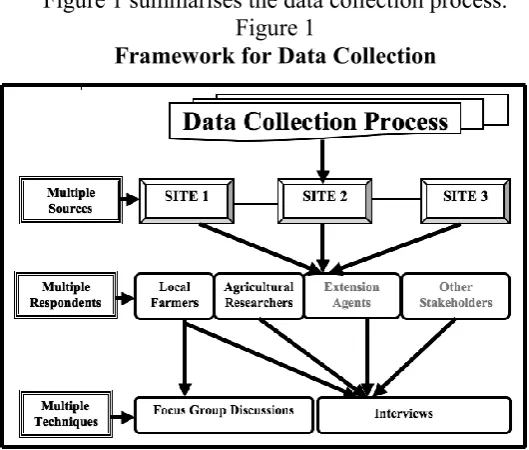
Figure 1 summarises the data collection process. Figure 1
Framework for Data Collection
The overall data collection process took one year - between January 2009 and December 2009. The main data collection process began with the local farmers. The agricultural extension agents, researchers and other intermediary organisations were included as and when they were available. The data collection from the first site continued until saturation was reached and informational redundancy was observed. The procedure was repeated at sites two and three. A second trip to all the three sites was undertaken to obtain clarification and confirmation of some of the data gathered.
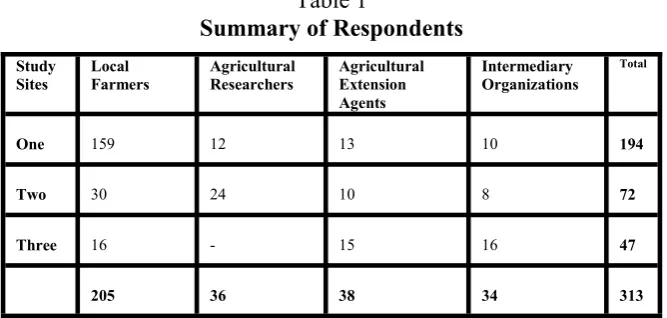
Table 1
Summary of Respondents
Data Analysis - Code Development and Coding
Interviews and focus group discussions were digitally recorded and transcribed by trained research assistants who are natives of the respective regions. Transcripts in the local languages – Fante, Twi and Ga – were also translated into English. The data were content analysed using QDA Miner, a social science software application optimised for textual data analysis. Separate coding schemes were developed for i) the transcript for the local farmers; ii) the transcript for agricultural researchers; and iii) the transcript for agricultural extension agents and other stakeholders. Inductive approach was used through iteratively reading and coding to identify categories, patterns, and themes in knowledge generation. The majority of the final codes were therefore manifest codes – visible content of the transcript (Krippendorf, 2004).
Results and Discussion
I: Identifying the existing channels of communication : local farmers
Study
Sites Local Farmers Agricultural Researchers Agricultural Extension Agents
Intermediary Organizations
Total
One 159 12 13 10 194
Two 30 24 10 8 72
Three 16 - 15 16 47
Figure 2
Summary of Local Farmers’ Demography
While the youngest farmer respondent was 20 years old, the oldest was not certain of his age but stated he was over 80 years. The farmers are generally of age with about 45 percent of the local farmers reported age between 41 and 60 years and about 25 percent of them are over 60 years old. The data also revealed the low
literacy level of Ghanaian farmers - about 40 percent of them have no formal education at all (see Figure 2 above). The general gender
i) Intra-communication
The results show that there is a very strong informal communication network among the local farmers (horizontal network) relative to their communication with other stakeholders (vertical network) at the study sites. These farmers have, therefore, for a very long time depended on the knowledge and experiences of their colleagues. They seek for external assistance only when they are unable to address the issue among themselves. However, issues relating to resources or input acquisitions do go directly to the extension service providers. When asked „whom they communicate with when faced with problems during the farm work‟, farmers responded:
We receive the majority of supports among ourselves as farmers (colleagues). I, for instance, always ask my colleague farmers for information when necessary in order to decide on what to do (Local Farmer).
There are also cliques within the communities such as vegetable farmers as against other farmers. Local farmers also share information that they learn from the agricultural extension agents with their colleague farmers providing farmer-to-farmer extension.
Before we call for assistance from the agricultural officer, we first discuss it with our colleagues and if it does not work out, it gets to the agricultural officer (Local Farmer).
The network among the local farmers is also very informal. In their (farmers‟) response to the question „whether they have any forum that they meet and discuss their farming issues,‟ the consensus from most of the focus group discussions has been that there is nothing like an organised forum by and for them.
The results also show that these farming communities have no sophisticated means of communicating their thoughts, ideas and practices with their colleagues. These ideas flow through informal personal and social networks. But these interactions have little effect on how they collaborate in knowledge generation. Innovative activities among the farmers are reported individually instead of communal or shared.
ii) Inter-communication with other stakeholders
Local farmers‟ communication with other stakeholders basically dwelt on information about inputs for production and avenues for marketing their products. These they are able to achieve through interaction with the agricultural extension agents, input dealers (private sector), market women/men, and other non-governmental organisations working for community development.
As I said earlier, we strongly need technical advice from the officers who must visit us regularly though we tend to ask our colleague farmers. This will enable us apply the right chemical/ fertilizer (Local Farmer).
The above quotes from the local farmers are very telling with respect to their relationships with the agricultural extension agents. The general view across all the three study sites is that there is a high demand for agricultural information due to communication problems from extension. The communities most affected are the ones that are remote from the cities or the district capitals since the officers always give transportation excuses.
Figure 3
Summary of the Demography of Agricultural Researchers
The 36 researchers who participated in the study came from fields such as entomology, agricultural economics, agricultural ex-tension, pathology, and agronomy, among others. As shown in Fig-ure 3 above, about 416 percent of the researchers reported ages of 51 years and above with some of them on contract after their retirement. The study shows that the researchers are well educated with about 58 percent of them holding doctorates in their respective fields of study. Also most of them either had one or two of their degrees within Ghana (55%). Unfortunately, agricultural research in the study sites is gender biased with 89 percent being male and only 11 percent female.
i) Intra-communication
In general, the results show that a weak institutionalised communication network exists among the agricultural researchers from the six research institutes and universities located within three study sites. The results revealed that intra communication among the researchers is dominated by non-institutionalised patterns of communication.
is what I have, can we brainstorm? We are now trying to institute some kind of seminar, weekly seminar where we could meet
with colleagues to brainstorm or to listen…So mostly we knock at the door or you meet, email or …but when it comes to a funded project or where it's actually interdisciplinary then you may organise here and there (Researcher).
The data also revealed that the frequency of communication increased among the members of research teams in which there are graduate students.
Internally, almost every day because two of my team members are graduate students, so they will come and find out what we will do and then we also meet and go to field to do assessment (Researcher).
A senior researcher who lamented on the poor communication links among researchers and research institutes across the country cites a classic example as below:
Is a big problem, is a big, big problem, even in the university. Repetition! I am just going to go to a conference in Bangkok and I found that a Ghanaian is also going for that conference. Apparently he did his masters here and the topic that he worked on is something that I have had two graduate students to work on for their masters‟ degree. ….this country that we have very limited resources, we cannot afford to continue repeating things simply because we don't do our homework very well.
their work. The results show that half of the respondents rated themselves between 0 and 2 („never‟, „rarely‟, and „sometimes‟) while the other half also indicated between 3 and 4 („often‟ and „all the time‟) on giving advice to their colleagues. On seeking advice, the frequency dropped with about 58 percent of the respondents either „rarely‟ or „sometimes‟ sought advice from their colleagues. Below are some of the comments from the respondents after making their choices:
ii) Inter-communication with other stakeholders
The data showed a mix of responses from the researchers when asked about their official/formal relationship with the staff of the Department of Agricultural Extension of the Ministry of Food and Agriculture. In general, researchers strongly acknowledged that there is a break in the link between their work and extension services.
No I mean forget it because, most of the interaction I have with the extension people, the NGOs is ad hoc. The relationships are not formalized. I have explored that issue, and it is not the best. For instance we don't have any formal linkage with MOFA extensions (Researcher).
Most of the researchers have also reported working directly wi t h t he farm ers t hrough fi el d ex perim ent ati ons and demonstrations organised through contact farmers who are usually selected based on certain criteria that may not even favour most hard working farmers.
Yes as for the farmers you know the population is very high and that is where the extension wing is very important because we the researchers may not necessarily get in contact one-on-one with the farmers but like I was saying we have this cocoa farmer‟s newspaper (Researcher).
innovation into the research institutes for utilisation by the researchers is non-institutionalised. All the stakeholders interviewed have acknowledged the value and importance of this knowledge domain but little has been done to tap into it. When asked whether there is any national or institutional policy that mandates them to officially identify and document farmers‟ local knowledge and innovations for use, this is what the researchers had to say:
There is no policy like that but you do it yourself because you also gain knowledge from the farmer so is to your own benefits. But there is no policy of that nature whereby you go to seek that knowledge from the farmer for use (Researcher).
III: Identifying the existing channels of communication: extension agents
Figure 4
Summary of Demography for the Extension Agents
i) Intra-communication
The Extension Agents were asked a series of questions to understand their communication pattern. Their answers revealed a range of communication patterns between them and their offices such as monthly or bi-monthly meetings in their district offices for updates:
We have monthly meetings, beside that all of us are linked by mobile phones - we are eleven in this district and we have the numbers of our colleagues (AEA).
ii) Inter-communication with other stakeholders
The national agricultural extension service is officially mandated to ensure the flow of scientific research outputs from the country‟s research institutes to the local farming communities with constant feedback to the researchers and policy makers on the performance of the system. Below are some of the quotes from the officers in response to question that asked them to name some of their collaborators and explain their roles in the extension delivery.
Actually, this one I will say negative - there is no linkage, no strong linkage between AEAs and the researchers. But at times, when after researching into certain crops then they will pass through the Ministry and then bring it down to the field as demonstration but for we the AEAs having a direct link with the researchers, there is nothing like that (AEA).
But at the same time, some of the agents have acknowledged the support of the research institutes in resourcing them to reach the farmers. The relationship, however, seems to be unofficial, even though it is supposed to be an institutionalized process. In other words, as a result of having a personal relationship with a specific researcher, an agricultural extension officer may approach him or her for a solution to farmers‟ problem.
So we bring problems and discuss at the regional level and if is not solved, then we get into Crop Research Institute (CRI). In this case for instance if I know a researcher over there, then is like on friendly basis - most of the time not official.
IV: Identifying the media for communication: local farmers
to share agricultural information among themselves.
It is by face-to-face with my colleagues. Face-to-face helps a lot because the person will have enough time to educate you on the things that help. It is simple to communicate with one another because we are very close (Local Farmer).
2) Mobile phones (one-to-one information sharing): The use of mobile phones is also penetrating deep into the rural communities. Local farmers have reported using their mobile phones in a number of situations to facilitate their farm work.
I called an experienced colleague farmer on phone when I had a problem with pest spoiling my garden eggs and he advised me on phone which chemical to use when it did not work I called him again (Local Farmer).
3) Gong-gong beating (one-to-many information sharing): Local farmers also need to have access to information outside the direct interaction with colleagues. Gong-gong beating is one of the traditional Ghanaian means of getting information to community members or informing the community about issues or making announcements, gathering people for communal labor, community gathering, etc. It is very effective and has its roots in the traditional authority system. The gong-gong beater is someone appointed by the traditional ruler to perform that role. When asked how they normally get access to information as a community, the general response is:
The gong-gong is used mostly (Local Farmer).
And both agricultural extension agents and the researchers have reported using this medium sometimes in getting information to local communities.
for you to get access to the farmers (Agricultural Researcher).
4) Another innovative technology being used to get information out to members of their communities is the use of public address systems. This is done by placing megaphones on erected bamboos located at vantage points in the community. This is a new medium being used. They are private initiatives and fees are charged for the use of this facility. The current use of megaphones goes beyond religious and political boundaries. They are being used to disseminate various types of information including agricultural information. Agricultural extension agents from two of the study sites confirmed this as a place that they do go to deliver information to farmers. Some even refer to it as “local FM station.” This is because some of these centers do secondary broadcasting - by connecting to live FM stations and playing the music or programmes to the community so that even those who don't have radio can also benefit.
Yes, apart from even beating the gong-gong they have some new technology…that's FM stations - their local FM stations. So when we want to meet them, we go and they have everything, the microphones, etc. At first when I have information for the farmers, I will see them and they will beat the gong-gong but now they don't beat the gong-gong again (Agricultural Extension Agent).
V: Identifying the media for communication: researchers
Researchers were also asked about their tools of communication.
First of all they provided us with Internet access so I have a university base Internet access paid for by the university, the computer and everything loaded, the actual mast that allows me to have my internet flowing so that's a good condition (Researcher).
While there is an exception in one of the research institutes that has a local internal communication (intercom) facility, face-to-face communication still dominates. Those who collaborate with other researchers from different research institutes, however, use email and mobile phones for information sharing. Further probes revealed that even though the researchers have personal emails, most of them are not aware of email listservs and other Web 2.0 applications that can facilitate knowledge or information sharing among them.
The researchers were asked to rate their frequency of use of some communication tools classified into basic, intermediate and advanced levels. Basic tools such as books and face-to-face communication are used regularly while libraries are used occasionally. Computers and flash drives (intermediate tools) are regularly used for their work – 83 percent and 79 percent respectively. For the advanced tools, the researchers use emails and websites regularly for their work, but about 64 percent never used digital forums, 89 percent never used blogs, and 86 percent never used web-conferencing. Wikis are however used occasionally for their work.
These blogs and what not, I don't even know what it is. I see them sometime you open an email and is like people giving their opin-ions/comments and what not. I don't need them, some are useful, and probably I have to start exploring (Researcher).
VI: Identifying the media for communication: Agricultural Extension Agents (AEAs)
stakeholders. Being the main conduit for sharing knowledge, information, and technologies within the agricultural sector, the agricultural extension service should have been well-equipped to communicate with outside stakeholders.
Conclusion and Recommendations
In conclusion, the results show how the stakeholders communicate among themselves and between them and other stakeholders, and some of the dominant tools being used. While the agricultural researchers mostly communicate among themselves through institutionalised processes, agricultural extension agents have a mixture of institutionalised and non-institutionalised processes of communication among them and between them and the other stakeholders. The local farmers, on the other hand, have mostly non-institutionalised patterns of communication among them and between them and the other stakeholders. All the stakeholders still use the basic and traditional information communication tools such as face-to-face, radio, phone, papers, etc. to share information. While the researchers reported having good knowledge of, and access to the new information and communication technologies in their research institutes, the agricultural extension agents reported very poor knowledge of the tools and basically no access to these tools in their respective offices.
The resultant effect is the knowledge gap among the stakeholders in the wake of abundance of content. We recommend the concept of „knowledge brokering role‟ among the stakeholders and the exploration of the new ICTs to communicate timely and appropriate agricultural information to and from the local communities. The concept of knowledge brokering role involves:
to capture data for analysis. Also other digital technologies for gathering and managing primary data, cleaning, archiving, and digital mapping are good examples of information communication tools for supporting demand articulation function.
2) Net work Form at i on funct i ons r equi re i nform at i on communication tools to facilitate relationship building, and social network development. Some of the tools may include subscriptions, feeds, and syndications such as RSS, XML, bookmarks, and tagging, Adobe connect, Skype, MS Net meeting, email listservs, and other social media tools.
3) Process Management functions require processing and system management tools to ensure sustaining of the relationships built through network formation. Knowledge management systems such as e-learning tools, digital repositories, and software for scheduling events, collaboration tools such as electronic data collection software, software for data analysis and reporting, content management systems, and wikis for storage and retrieval could be very useful in data management.
4) Supply Activation functions require communication and display media for awareness creation and training of users. Intermediaries performing this function could use one-on-one or the media to create awareness of new knowledge products, newspapers, radio, television, text/SMS, digital broadcasting, blogs, websites, digital video lectures, content on DVDs/CDs at telecenters, e-learning tools and other social media tools.
Endnotes
1. The data for this paper is part of a larger study carried out by the authors for the Food and Agriculture Organization of the United Nations to understand and explore the role of ICTs in pollination and biodiversity conservation.
2. This follow-up trip was originally designed as multi-stakeholder forums at the three study sites to share the preliminary results with all the stakeholders on a single platform for their feedback. However, the necessary logistics for the organisation of these forums could not be secured.
3. Due to a number of issues (respondents not willing to disclose some information, others leaving during the discussion process, and others were interviewed for some specific infor-mation) during the interviews and the focus group discussions, there were a number missing demographic data. This is reflected in the sum of the percentages for each of these variables.
References
Andersen, P. (2007). Agricultural Technology Dissemination Structures and Farmers' Knowledge Seeking Strategies. The Annual Conference of the Norwegian Association for Development Research (NFU), CMI, Bergen, November 5 - 7. Chinkhuntha, G. (2004). How to Support Innovation and Entrepreneurship in African Farmers. http://www.ifpri.org/2020aficaconference.
CODESRIA/IDRC. (2003). Information and Communication Technologies for Development in Africa: Volume 1, Opportunities and Challenges for Community Development.
Colle, R. and Roman, R. (2003). ICT4D: A Frontier for Higher Education in Developing Nations. African and Asian Studies, 2 (4), Koninklijke Brill NV, Leiden.
Critchley, W., and Mutunga, K. (2002). The Promises and Perils of ‘Farmer Innovation.’
SciDev.net, August.
Dewarl, A. A. K. (1999). Mass Media and the Growth of Agriculture with Reference to Principal crops in Bangladesh. Unpublished Ph.D. Thesis, Institute of Bangladesh Studies, Rajshahi University, Bangladesh.
Feder, G., Willett, A. and Zijp, W. (2001). Agricultural Extension: Generic Challenges and the Ingredient for Solutions. Working paper 2129, World Bank, Washington, D.C.
Hamelink, C. J. (1997). New Information and Communication Technologies, Social Development and Cultural Change. The United Nations Research Institute for Social Development (UNRISD) Discussion Paper No. 86.
Heeks, R. (2002). i-Development not e-development. Journal of International
Development, 14(1), 1 - 11.
Kippendorff, K. (2004). Content Analysis: An Introduction to its Methodology (2nd ed.). Thousand Oaks, CA: Sage.
Orlikowski, W. J. and Baroudi, J. J. (1991). Studying Information Technology in Organizations: Research Approaches and Assumptions. Information Systems
Research, 2 (1), 1 - 28.
Orlikowski, W. J., Yates, J., Okamura, K., and Fujimoto, M. (1995). Shaping Electronic Communication: The Metastructuring of Technology in the Context of Use. OrganizationScience, 6 (4), 423 - 444.
Strategy and Activity. FAO, Rome.
Rogers, E. M. (1962). Diffusion of Innovations (1st ed.). New York: Free Press.
Stiglitz, J. (1999). Scan Globally, Reinvent Locally: Knowledge Infrastructure and the Localization of Knowledge. A Keynote Address given at the first Global Development Network Conference, Germany.
United Nations Economic Commission for Africa. (1999). An Overview of ICT Trends and Policy in Africa. May.
UNESCO. (2005). Towards Knowledge Societies. Paris: United Nations Educational, Scientific and Cultural Organization (UNESCO).
World Development Report. (2008). Agriculture for Development. The International Bank for Reconstruction and Development / the World Bank.
World Bank. (2004). http://go.worldbank.org/5CHGCEWM70, accessed December 2011.
World Bank. (2011). Connecting Smallholder to Knowledge, Networks and Institutions,
Report 64605. World Bank, Washington, DC.
World Bank. (2012). Information and Communication for Development 2012, Maximizing
Mobile. World Bank, Washington, DC.