
Method devolpment and validation of desloratadine in bulk and its tablet dosage forms
6
0
0
Full text
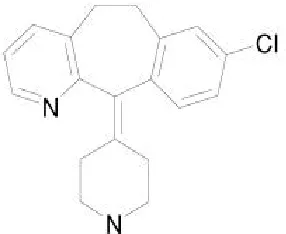
(2) 246. Desloratadine5 is a second generation tri cyclic anti histaminic drug which has a selective and peripheral H 1 antagonist action. It is active form of prodrug Loratadine. It is chemically 8-chloro-6, 11- di hydro11(4-piperdinylidene)-5H (5,6 cycloheptyal(1,2-b) pyridine. Molecular weight is 310.84 gm/mol and white to off white powder. It is mainly used in the treatment of allergic disorder and in common cold. Sedation and dryness of mouth are common adverse drug reaction. B.M. Mahbubul Alam Razib et.al.,6 has studied the validation and application of a modified RP-HPLC method for quantification of Desloratadine in pharmaceutical dosage form. The purpose of study was to develop simple sensitive and rapid RP-HPLC method for determination of Desloratadine in market products Meiling qi et.al7., has studied the determination of Desloratadine in drug substance and pharmaceutical preparations by liquid chromatography. The simple and selective LC method is described for the determination of Desloratadine in drug substances and pharmaceutical preparations Dantu durgarao et.al8., has studied a validated stable indicating gradient reverse phase ultra performance liquid chromatography method was developed for determination of purity of Desloratadine in presence of its impurities and forced degradation products. HPLC Method for Determination of Desloratadine 1. Instrumentation: Quantitative HPLC was performed on an isocratic LC – 10AT VP SHIMADZU High- Pressure Liquid Chromatographic instrument for the analysis. The instrument is provided with solvent delivery module with UV-visible detector SHIMADZU SPD-10A, ODS Reverse phase column (250 X 4.6mm). An auto injector and window based class vp software was used for its semi automatic operation, recording and analysis. A sartorious electronic balance was used for weighing the materials.. 2. Mobile Phase: A number of trials were made to find out the ideal solvent system (mobile phase) for eluting the drug. The mobile phase containing Buffer: Acetonitrile: methanol in different ratios (60: 30:10, 50:40:10) was tried. Better peak resolution with less tailing was obtained with the ratio of Buffer: Acetonitrile (HPLC grade): methanol (HPLC grade) (50:40:10). 3. Wavelength: The sensitivity of the HPLC Method depends upon the proper selection of the detection wavelength. An ideal wavelength is one that’s give good response to be detected. The maximum peak area with Desloratadine solution (0.1mg/ml) was observed at 247nm with the Buffer: Acetonitrile: Methanol (50:40:10). 4. Flow Rate: The mobile phase was run at different flow rates 0.8ml/min, 1.0ml/min, and 1.2 ml/min and observed with all these flow rates separation was good. The time of analysis was less at 0.8ml/min, but base-to-base peak was not observed. The time of analysis is more at 1.2ml/min flow rate time and also base-to-base peak was not observed. Hence for present study a flow rate of 0.8ml/min was selected because time of analysis is less and base-to-base peak area observed. 5. Diluents:. Diluent 1: HPLC grade of methanol is used as first diluents for the preparation of standard stock solution. Diluent 2: Prepared a mixture of buffer: Acetonitrile: Methanol in the ratio of 50: 40:10 which was used as second diluent for further dilution of standard stock solution. 6. Chromatographic conditions: Instrument : Shimadzu pump LC - 10AT VP Detector : SPD-10AT VP U.V – visible detector. Reagents required: Milli-Q-water Int. J. Pharm & Ind. Res. Ortho Phosphoric Acid - AR Grade Acetonitrile - HPLC Grade Methanol - HPLC Grade Potassium Dihydrogen Phosphate - AR Grade. Vol - 01. Issue - 03. Jul - Sep 2011.
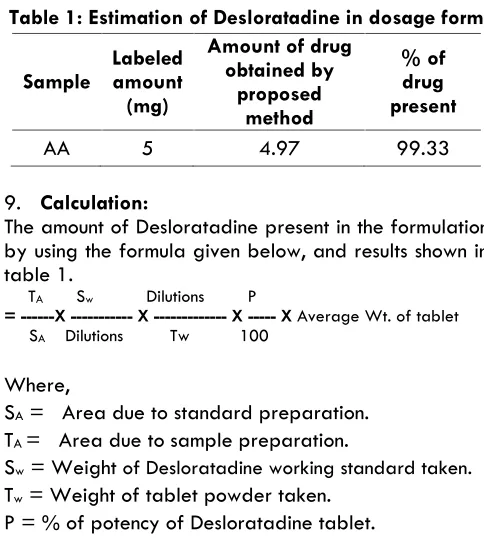
(3) 247. Column : Phenomix stainless steel Column (250 X 4.6 mm) packed with ODS chemically bounded porous silica particles. Temperature : 25±2oC Flow rate : 0.8ml/min Wave length : 247nm Runtime : 7 min Sample size : 20l Diluents : Buffer: Acetonitrile: Methanol (50:40:10) Sample retention time: 3.587 ± 0.06 min Asymmetry factor: 1.17 7. Preparation of mobile phase, standard and sample solutions of Desloratadine a. Mobile phase: A mixture of 50 volume of Buffer, 40 volume of Acetonitrile (HPLC grade) and 10 volumes of Methanol as prepared. The mobile phase was sonicated for 10min to remove gases. Buffer preparation: 8g of potassium di-hydrogen was weighed and dissolved in 100ml of water and volume was made up to 1000ml with water. Adjust the pH to 3.0 0.05 using dilute Ortho phosphoric acid. The buffer was filtered through 0.45mc filters to remove all fine particles and gases. b. Standard solution of Desloratadine : 50mg of Desloratadine was dissolved into 50ml of diluent-1 (Methanol HPLC Grade) to get 1mg/ml solution; sonic ate for 5 min and mix. Pipette out 1ml of the above solution to 10ml volumetric flask and make up volume with diluent-2 (Buffer: Acetonitrile: Methanol 50:40:10) (0.1mg/ml). c. Sample solution of Desloratadine: Sample name : Deslor Strength : 5mg Make : SUN PHARMA Weigh 20 tablets and crush them to powder. Weigh accurately tablet powder equivalent to 50mg of Desloratadine and transfer in to 50ml volumetric flask, add 20ml of diluent-1, keep on rotary shaker for 30 minutes. Sonic ate for 10 minutes with occasional shaking in between. Make up the volume with diluent-1 and mix well. Centrifuge at 3000rpm for 10 minutes. Int. J. Pharm & Ind. Res. Vol - 01. Pipette 1ml of the clear solution in to 10ml volumetric flask and make up volume with diluent-2 (0.1mg/ml). 8. Validation Procedure9: Separately injected the blank, triplicate injections of standard and duplicate injections of sample preparations in to the liquid chromatogram and record the areas for major peaks. The results for sample were shown in table1. Table 1: Estimation of Desloratadine in dosage form Amount of drug Labeled % of obtained by Sample amount drug proposed (mg) present method AA 5 4.97 99.33 9. Calculation: The amount of Desloratadine present in the formulation by using the formula given below, and results shown in table 1. TA Sw Dilutions P = ------X ----------- X ------------- X ----- X Average Wt. of tablet SA Dilutions Tw 100. Where, SA = Area due to standard preparation. TA = Area due to sample preparation. Sw = Weight of Desloratadine working standard taken. Tw = Weight of tablet powder taken. P = % of potency of Desloratadine tablet. Table 2: System Precision observed areas Injection number 01 02 03 04 05 Mean %RSD. Desloratadine area 1184.202 1190.508 1178.154 1178.125 1197.347 1185.66 0.699. Acceptance criteria. The %RSD of peak areas of Desloratadine should not be more than 2.0. Table 3: System Suitability parameters System suitability parameter. Observed value. Asymmetry factor. 1.17. Acceptance criteria In between 0.5 to 2.0. Results and Discussion The proposed analytical method is simple, reliable, rapid, sensitive, reproducible and accurate for the Issue - 03. Jul - Sep 2011.
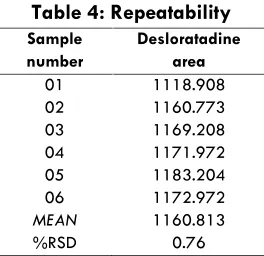
(4) 248. estimation of Desloratadine. A newer RP-HPLC method was developed for both bulk drug and formulation. This proposed method given reliably assay results with short analysis time (<5.0 min) using the mobile phase of pH3 phosphate buffer: Acetonitrile: Methanol in the ratio of 50:40:10.. Table 7: Standard Concentration to peak response for Desloratadine Concentration 20 40 60 80 100 Correlation coefficient(r) Slope (m) Intercept (b). Table 4: Repeatability Sample number 01 02 03 04 05 06 MEAN %RSD. Desloratadine area 1118.908 1160.773 1169.208 1171.972 1183.204 1172.972 1160.813 0.76. Relative standard deviation. Percentage Recovery. Standard deviation. Concentration. Mean percentage recovery. Sample ID. Acceptance criteria: The %RSD of %drug recovery of Desloratadine from five injections should be not more than 2.0. Table 6: Accuracy. 100.26 100.04 99.68 100.49 99.01 100.48 99.96 99.89 100.13. 99.91. 1.90. 0.204. 99.99. 6.61. 0.601. 99.993. 4.788. 0.377. Acceptance criteria: The mean % recovery of the Desloratadine at each level should be not less than 97.0% and not more than 103.0%. Int. J. Pharm & Ind. Res. Asymmetry factor of Desloratadine peak in standard. 1.14. 1.17. 0.98. Acceptance criteria. In between 0.5 to 2.0. Table 9: Effect of Variation in flow rate. Time intervals Area 00 1184.202 02 1190.508 04 1178.154 06 1178.125 08 1197.347 1185.66 0.72. 80% 80% 80% 100% 100% 100% 120% 120% 120%. 14438 0.0. Observed value 90% 100% 110% organic organic organic phase phase phase. System suitability parameter. Table 5: intraday precision. 1 2 3 4 5 6 7 8 9. 0.998. Table 8: Effect of variation in organic phase. Acceptance criteria: The %RSD of %drug recovery of Desloratadine from five injections should be not more than 2.0.. Sample number 01 02 03 04 05 Mean %RSD. Area 263.569 567.758 851.758 1158.805 1458.384. Vol - 01. System suitability parameter Asymmetry factor of Desloratadine peak in standard. Observed value. 0.8/min flow rate. 1.0ml/min flow rate. 1.2ml/min flow rate. 1.13. 1.17. 1.15. Acceptance criteria. In between 0.5 to 2.0. Table 10: Effect of Variation in buffer pH System suitability parameter Asymmetry factor of Desloratadine peak in standard. Observed value Buffer Buffer Buffer pH 2.8 pH3.0 pH3.2. Acceptance criteria. 0.97. In between 0.5 to 2.0. 1.17. 1.09. Acceptance criteria: The % RSD and asymmetry factor of Desloratadine standard should be in between 0.5 to2.0 for both variation of organic phase, flow rate and buffer pH. So the proposed method is robust for small variations in the test method. The content of drug present in the formulation was found to be 4.91 mg (99.33%). All the above method doesn’t suffer from any interference due to common Issue - 03. Jul - Sep 2011.
(5) 249. excipients. Therefore it was shown that the proposed method could be successfully applied to estimate commercial Pharmaceutical products containing Desloratadine. Thus the above studies and findings will enable the quantification of the drug for future. investigation in the field of analytical chemistry. Among the established analytical method, this RP-HPLC method was found to be more precise and accurate. Hence RPHPLC method can be applied for regular analysis of Desloratadine from bulk drug and its dosage forms.. Fig 2: Linearity graph of Desloratadine. Area Retention Time Asymmetry. 0.4. Area Retention Time Asymmetry. 0.3. 0.3. 0.2. 0.2. 2920061 2.883 0.00. Volts. 0.4. Pump pressure deslora 60 deslora60dat-Rep3. 0.1. 0.0. 0.0. 0.5. 1.0. 1.5. 2.0. 2.5. Volts. Detector A (247nm) deslora 60 deslora60dat-Rep3. 0.1. 0.0. 3.0. 3.5. 4.0. 4.5. 5.0. Minutes. Fig 3: Chromatogram of Desloratadine. Area Retention Time Asymmetry. Pump pressure deslora 60 deslora60dat-Rep2. 0.4. Area Retention Time Asymmetry. 0.3. 0.3. 0.2. 0.2. 3057973 2.883 1.60. 0.1. 0.0. 0.0. 0.5. 1.0. 1.5. 2.0. 2.5. Volts. Detector A (247nm) deslora 60 deslora60dat-Rep2. 47574 1.625 0.00. Volts. 0.4. 0.1. 0.0. 3.0. 3.5. 4.0. 4.5. 5.0. Minutes. Fig 4: Chromatogram of sample Desloratadine Int. J. Pharm & Ind. Res. Vol - 01. Issue - 03. Jul - Sep 2011.
(6) 250. Acknowledgements The authors are grateful to the Management of school of pharmaceutical sciences, VELS University, Chennai, for their continuous support and encouragement and for providing the necessary facilities.. References 1. Beckett, A.H. and Stenlake, J.B, Practical Pharmaceutical Chemistry, part B. 4th edn., CBS publishers and Distributors, New Delhi, 2002, 272-280. 2. Chatwal, R. Gurdeep and Sham, K. Anand. Instrumental Methods of Chemical Analysis. 5 th Revised edn Himalaya publishing House, Mumbai, 2000, 2, 160. 3. Indian Pharmacopeia, Indian pharmacopeia commission office, Delhi, 1996, Volume-II, appendix A, 158. 4. British Pharmacopoeia, British Pharmacopoeia commission office, London, 2003, Volume-II, 1225. 5. http://en.wikipedia.org/wiki/Desloratadine,june2 0,2010.. Int. J. Pharm & Ind. Res. Vol - 01. 6. B.M. Mahbubul Alam Razib, has studied the validation and application of a modified RP-HPLC method for quantification of Desloratadine in pharmaceutical dosage form. 2006, 113-115. 7. Meiling qi, has studied the determination of Desloratadine in drug substance and pharmaceutical preparations by liquid chromatography. Journal of pharmaceutical and biomedical analysis, 2009, 355-359. 8. Dantu durgarao, has studied a validated stable indicating gradient reverse phase ultra performance liquid chromatography method was developed for determination of purity of Desloratadine. Journal of pharmaceutical and biomedical analysis, 2010, 51, 736-742. 9. Code-Q2A, Text on validation on Analytical method ICH harmonized tricartite guidelines. 1997.. Issue - 03. Jul - Sep 2011.
(7)
Figure

Related documents
Walachowski S, Dorenlor V, Lefevre J, Lunazzi A, Eono F, Merbah T, Eveno E, Pavio N, Rose N (2014) Risk factors associated with the presence of hepatitis E virus in livers
This study aimed to develop and pilot test an educa- tional video containing information regarding the in- formed consent process for trauma patients undergoing surgery, develop
The purpose of this study is to characterize the very eld- erly population, who received emergency general surgery, and examine their surgical outcomes including identifica- tion
The current endeavors for the sustainable development of metal free processes employing visible light has evoked considerable interest in organic synthesis [9-12],
suis cells were detected on PAECs incubated with the negative control preparation (Figure 5d).. To assess whether the presence
We used a thematic analysis [50] to summarize respondents ’ major thoughts and concerns about post-mortem needle biop- sies, including acceptable motivations for conducting
In this paper we describe how a participatory, multi- method, continuous informed consent process developed by researchers, study participants and community stake- holders during
Aldous EW, Mynn JK, Banks J, Alexander DJ: A molecular epidemiological study of avian paramyxovirus type 1 (Newcastle disease virus) isolates by phylogenetic analysis of a
