INTRODUCTION
Many physical problems in science and engineering when formulated mathematically gives rise to Partial Differential Equations (PDE's). The study of PDE's is fundamental area of Mathematics which links important strands of pure Mathematics to applied and Computational Mathematics. PDE's form the governing equations that the field variable must satisfy for equilibrium and compatibility conditions of solid or str uctural system. Unfortunately, closed analytical solutions can be found only in very special circumstances, and these are mostly of limited theoretical and practical interest. Thus, scientists and mathematicians have naturally been led to seek techniques for the approximation of solutions. Indeed, the advent of digital computers has stimulated the incarnation of Computational Mathematics, much of which is concerned with the construction and mathematical analysis of numerical algorithms for the approximate solution of PDE's. The most powerful and generally applicable algorithms for the approximate solution of partial differential equations rely on the concept of discr imination, whereby the PDE under
A Neuro-finite Element Analysis of
Partial Differential Equations of Solid Mechanics
SANGEETA YADAV¹, K.K. PATHAK² and RAJESH SHRIVASTAVA³
¹Barkatullah University, Bhopal - 462 003 (India).
²Advanced Material and Processes Reasearch Institue (CSIR) Bhopal - 462 026 (India). ³Government Science and Arts College, Benazir, Bhopal - 462 003 (India).
(Received: March 05, 2009; Accepted: May 14, 2009)
ABSTRACT
Numerical analysis of Partial Differential Equations (PDE's) of the solid mechanics using Finite Element Method (FEM) is very popular. One issue which is haunting the finite element solution is the computer time. Finite Element Analysis (FEA) using fine mesh and large number of nodes consumes lot of solution time. To overcome this difficulty, a hybrid Neuro-FEM is proposed. FEM solutions considering coarse mesh is used for training neural networks which is further employed for finer predictions. The proposed methodology is successfully employed on a cantilever beam problem.
Key words: Stress, Displacement, finite element, neuro-finite element.
consideration is replaced by a finite-dimensional problem. The transition from the partial differential equation to the discrete model is a non-trivial mathematical problem, and the selection of an appropriate finite-dimensional representation is rarely a matter of arbitrar y choice: physical properties behind the mathematical model (such as energy and mass conservation, positivity, total-variation-boundedness, dispersion and dissipation) have to be borne in mind, as well as issues of resolution of relevant scales, complete and guaranteed control of the discrimination error, in addition to concerns about the efficiency and reliability of the resulting algorithm. The study of these mathematical questions represents the focus of the field of Numerical Analyses of Par tial Differential Equations.
pre-specified size map using advancing - front combined method for defining the field points and connected using optimization technique. Leonid V.Tasap et al., (2002) proposed a new general framework for application of Nonlinear FEM to non rigid motion analysis. Patra et al., (2003) proposed adaptive finite element methods in which both grid size 'h' and local polynomial 'p' are dynamically altered, are very effective discretization schemes for the numerical solution of a large class of partial differential equations. Phillip Frauenfelder, Christoph Schwab and Radu Alexander Todor (2004) described a deterministic finite element (FE) solution algorithm for a stochastic elliptic boundary value problems whose coefficients are assumed to be random fields with finite second moments and known piece wise smooth two point spatial correlation coefficient. J.J. del Coz Diaz (2006) determined the distribution of strains and stresses throughout a sheet cover known as "umbrella" due to the dead and alive loads taking into account large displacements by FEM. Irfan Anjum et al. (2006) carried out Numerical Analysis of heat transfer by convection, conduction and radiation in a saturated porous medium enclosed in a square cavity using a thermal non-equilibrium model. The governing Partial Differential Equation were non-dimensionalised and solved numerically using FEM. Ladislav Musil (2006) dealt with numerical simulation of the dynamic phenomena in an electromagnetic feeder of molten zinc. The mathematical model consists of one Partial Differential Equation (PDE) describing distribution of magnetic fields for various levels of zinc and a system of nonlinear ordinary differential equation.
Computations are carried out by FEM. Gudur and Dixit (2006) used neural networks for predicting the velocity field and location of neural point. The procedure provides highly accurate solution with reduced computational time and is suitable for online control or optimization. Choubey et al., (2006) analysed the effect of cracks on natural frequencies in two vessel structures with the help of FEM. Natural frequencies and mode shapes were analysed using Artificial Neural Network (ANN) and it was found that the reduction in natural frequencies depends upon mode shapes of structures. Rougui et al., (2007) proposed an esy method for determining the shell non-linear mode shapes with their corresponding amplitude dependent non-linear frequencies by minimisation of the energy functional with respect to basic function contr ibution coefficients which in turn leads to simple non-linear multi modal equation.
Although huge amount of literature are available on finite element applications, the major problem which haunts is the computational time. Computer time goes up vigorously with mesh refinement and it will eventually need more primary and secondary memories. To address this issue of finite element computations, a neuro FEM is proposed in this study. Results of the finite element computations considering coarse mesh is used for training the neural networks. Successfully trained networks are further used for computation of field variables at interior locations. The proposed neuro-FEM methodology is successfully verified for displacement computations in a cantilever beam.
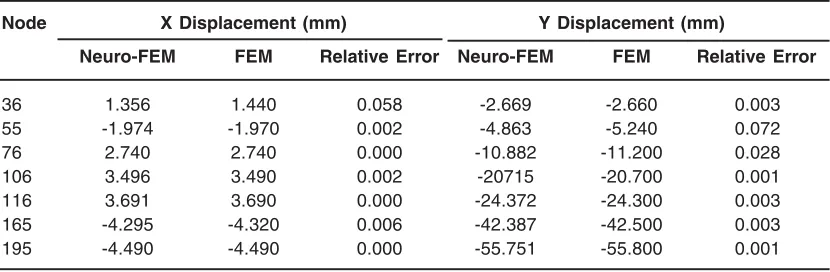
Table 1: Computational Results
Node X Displacement (mm) Y Displacement (mm)
Neuro-FEM FEM Relative Error Neuro-FEM FEM Relative Error
36 1.356 1.440 0.058 -2.669 -2.660 0.003
55 -1.974 -1.970 0.002 -4.863 -5.240 0.072
76 2.740 2.740 0.000 -10.882 -11.200 0.028
106 3.496 3.490 0.002 -20715 -20.700 0.001
116 3.691 3.690 0.000 -24.372 -24.300 0.003
165 -4.295 -4.320 0.006 -42.387 -42.500 0.003
Finite Element Method
Finite element analysis is a fairly recent technique of numerical computations of PDEs. The method has wide application and enjoys extensive utilization in the structural, thermal and fluid analysis areas. The finite element method is comprised of three major phases: (1) pre-processing, in which the analyst develops a finite element mesh to divide the subject geometr y into sub-domains for mathematical analysis, and applies material properties and boundary conditions, (2) solution, during which the program derives the governing matrix equations from the model and solves for the primary quantities, and (3) post-processing, in which the analyst checks the validity of the solution, examines the values of field quantities such as displacements and derives and examines additional quantities such as stresses. The governing equation of solid mechanics are:
along with the boundary conditions:
where T is the traction and l, m and n are the direction cosines.
In order to solve above equations using FEM, given domain is first descretized into element which are connected at nodes (Zienkiewicz and Taylor, 1991). Considering the virtual principal and applying variational principle, the problem is reduced to following to following algebraic
equations-[K] {∆} = {F}
where K is global stiffness matrix, F and ∆ are the
force and displacement vectors. In order to obtain the nodal displacement stiffness matrix need to be inverted as follows:
{∆} = [K]-1 {F}
The major computational steps of FEM are shown in Fig. 1 (a). The matrix inversion consumes most of the time of the finite element analysis. If N is the number of nodes then, for two dimensional analysis, the size of K will be (2N X 2N). It is apparent that there will be considerable increase in the computational effort as the FE model becomes finer.
Fig. 1: Flow diagrams (a) FEM (b) Neuro FEM
Artificial Neural Network
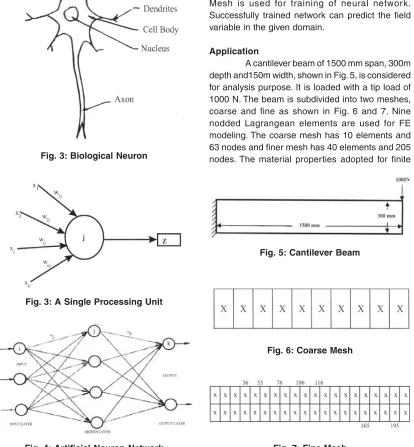
Artificial neural network attempts to imitate the learning activities of the brain. The human brain is composed of approximately 10" neurons (nerve cells) of different types. In a typical neuron, we can find the nucleus, where the connections with other neurons are made through a network of fibers called dendrites. Extending out from the nucleus is the axon, which transmits, by means of a complex chemical process, electric potentials to the neurons with which the axon is connected to (Fig. 2). When the signals received by the neuron equal or surpass their threshold, it "triggers", sending the axon an electric signal of constant level and duration. In this way the message from one neuron to the other neuron is transmitted.
several input paths corresponding to the dendrites. The units combine usually, by a simple summation, the weighted values of these paths (Fig. 2). The weighted value is passed to the neuron, where it is modified by threshold function. The modified value is directly presented to the next neuron. In Fig. 4 a 3-4-2 feed forward back propagation artificial neural network is shown. The connections between various neurons are strengthened or weakened according to the experiences obtained during training.
Neuro-finite Element Method
In order to enhance the computational efficiency of FEM, artificial neural network are employed in this study. ANN can help in predicting displacement of finer mesh from coarse mesh which thereby overcomes the major difficulties of FEM like memory requirements and computational time. Since computation time is directly related to mesh size, the proposed approach is bound to reduce the computational time. In Fig. 1 (b) major computational steps of the proposed Neuro-FEM are shown. The results of coarse Finite Element Mesh is used for training of neural network. Successfully trained network can predict the field variable in the given domain.
Application
A cantilever beam of 1500 mm span, 300m depth and150m width, shown in Fig. 5, is considered for analysis purpose. It is loaded with a tip load of 1000 N. The beam is subdivided into two meshes, coarse and fine as shown in Fig. 6 and 7. Nine nodded Lagrangean elements are used for FE modeling. The coarse mesh has 10 elements and 63 nodes and finer mesh has 40 elements and 205 nodes. The material properties adopted for finite
Fig. 3: A Single Processing Unit
Fig. 4: Artificial Neuron Network
Fig. 5: Cantilever Beam
analyses are: Young's Modulus as 2x10⁵ MPa and
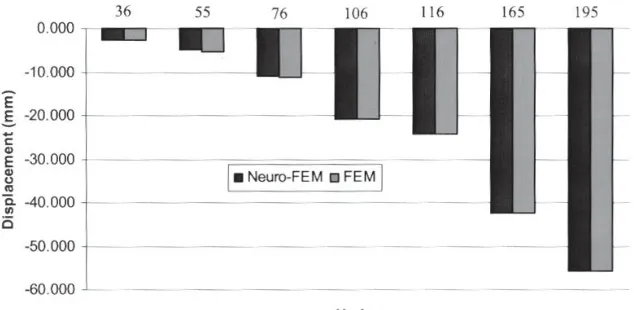
Poisson's ratio as 0.3. The X and Y displacements obtained from finite element analysis using the coarse mesh are used for training the neural network. For this a back propagation neural network of size 2-4-2 is used. Further, finite element analysis is carried out considering fine mesh. The displacement results are verified at some of the randomly selected nodes of the fine mesh and compared with the neural network predictions at same points. These results are tabulated in Table 1 and graphically shown in Fig. 8 and 9. It can be obser ved that both are in good match. The
maximum relative error in X and Y displacements are 0.58 mm and 0.028 mm.
CONCLUSION
In this study, a Neuro-FEM is proposed for numer ical solution of par tial differential equations. It overcomes some of the drawbacks of FEM like high computational time and large memory requirement. The method is shown to be working efficiently for displacement predictions in a cantilever beam. Even old computers with low memories can be used effectively using proposed approach. Fig. 8: Displacement Comparison (uy)
1. Choubey A, Sehgal D.K. and Tondon N., Finite element analysis of vessels to study changes in natural frequencies due to cracks, International Journal of Pressure Vessels and Piping, 83(3): 181-187 (2006).
2. Del Coz Diaz J.J.; Non linear analysis of a reinforced concrete sheet cover (umbrella) of 40m diameter by the FEM, Applied Mathematical Modeling, 33(1): 34-53 (2009). 3. Gudur P. and Dixit U.S., A neural network assisted finite element analysis of cold flat rolling, Engineering Applications of Artificial Intelligence, 21(1): 43-52 (2008).
4. Houman Borouchaki and Paul Louis George, Quality Mesh Generation, Computes Rendus Del'Academie des Sciences - Series IIB-Mechanics, 328(6): 505-518 (2000). 5. Irfan Anjum Badruddin, Zainal Z.A., Aswatha
P.A. Narayana and Seetharamu K.N., Numerical Analysis of convection, conduction and radiation using a non-equilibrium in a square porous cavity, International Journal of Thermal Science, 46(1): 20-29 (2000). 6. Ladislav Musil, Dynamic parameters of
electromagnetic feeder of molten metal, Journal of Materials Processing Technology,
REFERENCES
181(1-3): 291-295 (2007).
7. Patra A.K., Laszloffy A., Long J., Data structures and local balancing for parallel adaptive hp finite-element methods, Computers and Mathematics with Applications, 46(1): 105-123 (2003). 8. Phillip Frauenfelder, Christoph Schwab and
Radu Alexander Todor; Finite elements for elliptic problems with stochastic coefficients, Computer Methods in Applied Mechanics and Engineering, 194(2-5): 205-228 (2005). 9. Rougui M., Moussaoui F., Benamar R.,; Geometrically non-linear vibrations of simply supported circular cylindrical shells: A semi analytical approach, International Journal of Non-Linear Mechanics, 42(9): 1102-1115, (2007).
10. Zohar Yosibash, Numerical methods for extracting edge stress intensity functions in anisotropic three-dimensional domains, Computer Methods in Applied Mechanics and Engineering, 196(37-40): 3624-3649, (2007).