Kernel Methods for Relation Extraction
Dmitry Zelenko DMITRY [email protected]
Chinatsu Aone CHINATSU [email protected]
Anthony Richardella [email protected]
SRA International 4300 Fair Lakes Ct. Fairfax VA 22033 USA
Editors: Jaz Kandola, Thomas Hofmann, Tomaso Poggio and John Shawe-Taylor
Abstract
We present an application of kernel methods to extracting relations from unstructured natural language sources. We introduce kernels defined over shallow parse representations of text, and design efficient algorithms for computing the kernels. We use the devised kernels in conjunction with Support Vector Machine and Voted Perceptron learning algorithms for the task of extract-ingperson-affiliationandorganization-locationrelations from text. We experimentally evaluate the proposed methods and compare them with feature-based learning algorithms, with promising results.
Keywords: Kernel Methods, Natural Language Processing, Information Extraction
1. Introduction
Information extraction is an important unsolved problem of natural language processing (NLP). It is the problem of extracting entities and relations among them from text documents. Examples of enti-ties arepeople,organizations, andlocations. Examples of relations areperson-affiliation andorganization-location. Theperson-affiliationrelation means that a particularperson is affiliated with a certainorganization. For instance, the sentence “John Smith is the chief scien-tist of the Hardcom Corporation” contains theperson-affiliationrelation between theperson “John Smith” and theorganization “Hardcom Corporation”. In this paper, we address the prob-lem of extracting such relations from natural language text.
We propose a machine learning approach to relation extraction. The patterns for identifying relations are learned from a set of already extracted relations rather than written manually. We also present a novel methodology for adaptive information extraction based on kernel methods (Vapnik, 1998, Cristianini and Shawe-Taylor, 2000). Kernel methods have enjoyed successful applications for other related problems such as text categorization (Joachims, 2002) and bioinformatics (Furey et al., 2000). Recently, kernel methods exhibited excellent performance for natural language parsing (Collins and Duffy, 2001).
We believe that shallow parsing (Abney, 1990) is an important prerequisite for information extraction. Shallow parsing provides a fairly robust mechanism for producing text representation that can be effectively used for entity and relation extraction.
system comprises a sequence of cascading finite state machines that identify names, noun phrases, and a restricted set of parts of speech in text. The system also classifies noun phrases and names as to whether they refer to people, organizations and locations, thereby producing entities. Thus, the input to the relation extraction system is a shallow parse, with noun phrases and names marked with relevant entity types.
We formalize a relation extraction problem as a shallow parse classification problem in Sec-tion 4. A shallow parse is turned into an example whose label reflects whether a relaSec-tion of interest is expressed by the shallow parse. The learning system uses the labeled examples to output a model that is applied to shallow parses to obtain labels, and thus extract relations.
We note that our learning methodology differs from the prevalent approach to information ex-traction, viz., probabilistic modeling (Bikel et al., 1999, Miller et al., 1998). In contrast to prob-abilistic modeling, our approach is inherently discriminative. That is, we do not seek to explain the underlying text probabilistically. Instead, we learn a model whose sole purpose is to separate instances of a particular relation from non-instances thereof.
The approach is most similar to that of linear methods (Roth and Yih, 2001) that produce linear models for extracting fields from seminar announcements. In contrast to (Roth and Yih, 2001), whose models are feature-based, our models are expressed in terms of kernels. In Section 6, we present an experimental comparison of feature-based and kernel-based learning methods for relation extraction.
A unique property of the kernel methods is that we do not explicitly generate features. More precisely, an example is no longer a feature vector as it is common in machine learning algorithms. Instead, examples retain their original representations (of shallow parses) and are used within learn-ing algorithms only via computlearn-ing a similarity (or kernel) function between them. Such a use of examples allows our learning system to implicitly explore a much larger feature space than one computationally feasible for processing with feature-based learning algorithms.
Application of kernel methods to NLP has been pioneered by Collins and Duffy (2001), who defined kernels on parses and proposed to improve parsing via a ranking procedure. The re-ranking procedure is based on the Voted Perceptron learning algorithm, which has been shown to have a kernel formulation Freund and Schapire (1999). Collins (2002) extended the approach to part of speech tagging and entity extraction problems. We conduct an experimental evaluation of our approach in Section 6. We compare our approach with the feature-based linear methods (Roth, 1999), with promising results.
The rest of the paper is structured as follows. In Section 2, we survey the previous work on relation extraction, with emphasis on learning-based methods. In Section 3, we introduce the kernel-based machine learning algorithms and delineate a number of kernels relevant for natural language. In Section 4, we formalize the relation extraction problem as a learning problem. In Section 5 we design novel kernels defined in terms of shallow parses. In Section 6, we conduct a performance evaluation of the proposed approach on a number of relation extraction tasks. Finally, Section 8 contains conclusions and comments on the future work.
2. Related Work on Relation Extraction
were developed for identifying relations of interest (see Aone et al., 1998), only a single learning-based approach (Miller et al., 1998) was proposed.
Miller et al. (1998) considered the problem of relation extraction in the context of natural lan-guage parsing and augmented syntactic parses with semantic relation-specific attributes. At the training stage, a lexicalized probabilistic context free grammar was estimated that incorporated the semantic attributes. At the evaluation stage, the decoding process yielded a relation-specific inter-pretation of text, in addition to a syntactic parse.
Our approach to relation extraction differs from that of Miller et al. (1998) in several important aspects. First, we remove parsing as a necessary prerequisite for relation extraction, and replace it with shallow parsing. Second, in contrast the generative approach which attempts to learn a single global model of text, we seek to learn a set local relation-specific models in a discriminative fashion. Third, we use kernel methods that allow us to eschew computational constraints in exploiting long-range dependencies that are inherent to generative models.
We briefly survey a number of approaches currently used for such natural language tasks as part of speech tagging and entity extraction. Hidden Markov Models (HMM) (Rabiner, 1990) have been perhaps the most popular approach for adaptive information extraction. HMMs exhibited excellent performance for name extraction (Bikel et al., 1999). Recently, HMM (with various extensions) have been applied to extraction of slots (“speaker”, “time”, etc.) in seminar announcements (Freitag and McCallum, 2000). HMMs are mostly appropriate for modeling local and flat problems. Rela-tion extracRela-tion often involves modeling long range dependencies, for which HMM methodology is not directly applicable.
Several probabilistic frameworks for modeling sequential data have recently been introduced to alleviate for HMM restrictions. We note Maximum Entropy Markov Models (MEMM) (McCallum et al., 2000) and Conditional Random Fields (CRF) (Lafferty et al., 2001). MEMMs are able to model more complex transition and emission probability distributions and take into account various text features. CRFs are an example of exponential models (Berger et al., 1996); as such, they enjoy a number of attractive properties (e.g., global likelihood maximum) and are better suited for modeling sequential data, as contrasted with other conditional models (Lafferty et al., 2001). They are yet to be experimentally validated for information extraction problems.
Online learning algorithms for learning linear models (e.g., Perceptron, Winnow) are becoming increasingly popular for NLP problems (Roth, 1999). The algorithms exhibit a number of attractive features such as incremental learning and scalability to a very large number of examples. Their recent applications to shallow parsing (Munoz et al., 1999) and information extraction (Roth and Yih, 2001) exhibit state-of-the-art performance. The linear models are, however, feature-based which imposes constraints on their exploiting long-range dependencies in text. In Section 6, we compare the methods with our approach for the relation extraction problem.
We next introduce a class of kernel machine learning methods and apply them to relation ex-traction.
3. Kernel-based Machine Learning
In many cases, data cannot be easily expressed via features. For example, in most NLP prob-lems, feature based representations produce inherently local representations of objects, for it is computationally infeasible to generate features involving long-range dependencies.
Kernel methods (Vapnik, 1998, Cristianini and Shawe-Taylor, 2000) are an attractive alternative to feature-based methods. Kernel methods retain the original representation of objects and use the object in algorithms only via computing a kernel function between a pair of objects. A kernel function is a similarity function satisfying certain properties. More precisely, a kernel function
K over the object space X is binary function K : X×X →[0,∞]mapping a pair of objects x,y∈ X to their similarity score K(x,y). A kernel function is required to be symmetric1 and
positive-semidefinite.2
In can be shown that any kernel function implicitly calculates the dot-product of feature vectors of objects in high-dimensional feature spaces. That is, there exist features f(·) = (f1(·),f2(·),...),
fi: X →R, so that K(x,y) =hf(x),f(y)i.3
Conversely, given features f(·) = (f1(·),f2(·),...), a function defined as a dot product of the corresponding feature vectors is necessarily a kernel function.4
In many cases, it may be possible to compute the dot product of certain features without enu-merating all the features. An excellent example is that of subsequence kernels (Lodhi et al., 2002). In this case, the objects are strings of characters, and the kernel function computes the number of common subsequences of characters in two strings, where each subsequence match is additionally decreased by the factor reflecting how spread out the matched subsequence in the original sequences (Lodhi et al., 2002). Despite the exponential number of features (subsequences), it is possible to compute the subsequence kernel in polytime. We therefore are able to take advantage of long-range features in strings without enumerating the features explicitly. In Section 5.2, we will extend the subsequence kernel to operate on shallow parses for relation extraction.
Another pertinent example is that of parse tree kernels(Collins and Duffy, 2001), where objects represent trees and the kernel function computes the number of common subtrees in two trees. The tree kernel used within the Voted Perceptron learning algorithm (Freund and Schapire, 1999) was shown to deliver excellent performance in Penn Treebank parsing.
We also note that both subsequence and subtree kernels belong to a class of convolution kernels (Haussler, 1999). Convolution kernels allow to compute the similarity between two objects based on the similarities of objects’ parts. Although the kernels that we introduce are not convolution kernels per se, they are closely related thereto.
There are a number of learning algorithms that can operate only using the dot product of ex-amples. The models produced by the learning algorithms are also expressed using only examples’ dot products. Substituting a particular kernel functions in place of the dot product defines a specific instantiation of such learning algorithms. The algorithms that process examples only via computing their dot products are sometimes called dual learning algorithms.
The Support Vector Machine (SVM) (Cortes and Vapnik, 1995) is a learning algorithm that not only allows for a dual formulation, but also provides a rigorous rationale for resisting overfitting (Vapnik, 1998). Indeed, for the kernel-based algorithms working in extremely rich (though implicit)
1. A binary function K(·,·)is symmetric (over X ), if∀x,y∈X,K(x,y) =K(y,x).
2. A binary function K(·,·)is positive-semidefinite, if∀x1,x2,...,xn∈X the n×n matrix (K(xi,xj))i j is
positive-semidefinite.
3.ha,bidenotes the dot product of vectors a and b.
feature spaces, it is crucial to deal with the problem of overtraining. Both theoretical and experi-mental results indicate that SVM is able generalize very well and avoid overfitting in high (and even infinite) dimensional features spaces. In Section 6 we experimentally evaluate the Support Vector Machine for relation extraction.
After discovery of the kernel methods, several existing learning algorithms were shown to have dual analogues. For instance, the Perceptron learning algorithm (Rosenblatt, 1962) can be easily represented in the dual form (Cristianini and Shawe-Taylor, 2000). A variance-reducing improve-ment of Perceptron, Voted Perceptron (Freund and Schapire, 1999), is a robust and efficient learning algorithm that is very easy to implement. It has been shown to exhibit performance comparable to that of SVM. We employ the algorithm for relation extraction in Section 6.
We note that, from the learning system design perspective, the kernel methods shift the focus from the problem of feature selection to the problem of kernel construction. Since kernel is the only domain specific component of a kernel learning system, it is critical to design a kernel that ade-quately encapsulates information necessary for prediction. On the other hand, we hypothesize that use of long range dependencies in kernel computation will allow the algorithm implicitly explorer a much larger space than that available to feature-based algorithms. We next show how to formalize relation extraction as a learning problem.
4. Problem Formalization
Let us consider the sentence, “John Smith is the chief scientist of the Hardcom Corporation”. The shallow parsing system produces the representation of the sentence shown in Figure 1. The sentence is represented a shallow parse tree. In contrast to common parse trees, the type of a parent node does not determine the structure of its children nodes. Instead of providing the full interpretation of the sentence, shallow parsing only identifies its key elements. Therefore, shallow parsing is fairly robust, and is able to generate structured representations even for ungrammatical sentences.
We next convert the shallow parse tree into examples for the person-affiliation relation. This type of relation holds between a person and an organization. There are three nodes in the shallow parse tree in Figure 1 referring to people, namely, the “John Smith” node with the type “Person”, and the “PNP” nodes.5 There is one “Organization” node in the tree that refers to an organization. We create an example for theperson-affiliationrelation by taking apersonnode and anorganizationnode in the shallow parse tree and assigning attributes to the nodes specifying the role that a node plays in theperson-affiliationrelation. The person and organization under consideration will receive the member and affiliation roles, respectively. The rest of the nodes will receive none roles reflecting that they do not participate in the relation. We then attach a label to the example by asking the question whether the node with the role of member and the node with the role of affiliation are indeed (semantically) affiliated, according to the sentence. For the above sentence, we will then generate three positive examples, shown in Figure 2.
Note that in generating the examples between the “PNP” and the “Organization” we eliminated the nodes that did not belong to the least common subtree of “Organization” and “PNP”, thereby removing irrelevant subtrees. To summarize, a relation example is shallow parse, in which nodes are augmented with the role attribute, and each node of the shallow parse belongs to the least common subtree comprising the relation entities under consideration. We now formalize the notion of relation example. We first define the notion of the example node.
Figure 1: The shallow parse representation of the the sentence “John Smith is the chief scientist of the Hardcom Corporation”.The types “PNP”, “Det”, “Adj”, and “Prep” denote “Personal Noun Phrase”, “Determiner”, “Adjective”, and “Preposition”, respectively.
Figure 2: The twoperson-affiliation examples generated from the shallow parse in Figure 1. The “Label=+1” means that the examples do express the relation.
Definition 1 A node p is a set of attributes{a1,a2,...}. Each node may have a different number of
attributes. The attributes are named, and each node necessarily has attributes with names “Type” and “Role”.
We use p.a to denote the value of attribute with the name a in the node p, e.g., p.Type=Person
and p.Role=member.
• Let p be a node, then the pair P= (p,[]) is a relation example, where by [] we denote an empty sequence.
• Let p be a node, and[P1,P2,...,Pl]be a sequence of relation examples. Then, the pair P=
(p,[P1,P2,...,Pl])is a relation example.
We say that p is the parent of P1,P2,...,Pl, and Pi’s are the children of p. We denote by P.p
the first element of the example pair, by P.c the second element of the example pair, and use the
shorthand P.a to refer to P.p.a, and P[i]to denote Pi. If unambiguous, we also use P.ai to denote
the child Piof P such that Pi.Type=ai. A labeled relation example is unlabeled relation example
augmented with a label l∈ {−1,+1}. An example is positive, if l= +1, and negative, otherwise. We now define kernels on relation examples that represent similarity of two shallow parse trees.
5. Kernels for Relation Extraction
Kernels on parse trees were previously defined by Collins and Duffy (2001). The kernels enumer-ated (implicitly) all subtrees of two parse trees, and used the number of common subtrees, weighted appropriately, as the measure of similarity between two parse trees. Since we are operating with shallow parse trees, and the focus of our problem is relation extraction rather than parsing, we use a different definition of kernels.
The nodes of the shallow parse trees have attributes, and we need to use the attributes in the kernel definition. We define a primitive kernel function on the nodes in terms of nodes’ attributes, and then extend it on relation examples.
We first define a matching function t(·,·)∈ {0,1}and a similarity function k(·,·)on nodes. The matching function defined on nodes determines whether the nodes are matchable or not. In the case of relation extraction, the nodes are matchable only if their types and roles match. Thus, if two nodes have different roles, and non-compatible types,6then their node matching function is equal to zero; otherwise, it is equal to 1. The similarity function on nodes is computed in terms of the nodes’ attributes.
For example,
t(P1.p,P2.p) =
1, if P1.Type=P2.Type and P1.Role=P2.Role 0, otherwise
and
k(P1.p,P2.p) =
1, if P1.text=P2.Text 0, otherwise
Then, for two relation examples P1,P2, we define the similarity function K(P1,P2)in terms of similarity function of the parent nodes and the similarity function Kc of the children. Formally,
K(P1,P2) =
0,if t(P1.p,P2,p) =0
k(P1.p,P2.p) +Kc(P1.c,P2.c), otherwise
(1)
Different definitions of the similarity function Kcon children give rise to different K’s. We now
give a general definition of Kcin terms of similarities of children subsequences. We first introduce
some helpful notation (similar to Lodhi et al. (2002)).
We denote by i a sequence i1≤i2≤...≤inof indices, and we say that i∈i, if i is one of the
sequence indices. We also use d(i)for in−i1+1, and l(i)for length of the sequence i. For a relation example P, we denote by P[i]the sequence of children[P[i1],...,P[in]].
For a similarity function K, we use K(P1[i],P2[j])to denote ∑s=1,...,l(i)K(P1[is],P2[js]). Then,
we define the similarity function Kcas follows
Kc(P1.c,P2.c) =
∑
i,j,l(i)=l(j)
λd(i)λd(j)K(P
1[i],P2[j])
∏
s=1,...,l(i)
t(P1[is].p,P2[js].p) (2)
The formula (2) enumerates all subsequences of relation example children with matching par-ents, accumulates the similarity for each subsequence by adding the corresponding child examples’ similarities, and decreases the similarity by the factor ofλd(i)λd(i), 0<λ<1, reflecting how spread out the subsequences within children sequences. Finally, the similarity of two children sequences is the sum all matching subsequences similarities.
The following theorem states that the formulas (1) and (2) define a kernel, under mild assump-tions.
Theorem 3 Let k(·,·)and t(·,·)be kernels over nodes. Then, K as defined by (1) and (2) is a kernel over relation examples.
The proof of Theorem 3 is in Appendix A.
We first consider a special case of Kc, where the subsequences i and j are assumed to be con-tiguous and give a very efficient algorithm for computing Kc. In Section 5.2, we address a more
general case, when the subsequences are allowed to be sparse (non-contiguous).
5.1 Contiguous Subtree Kernels
For contiguous subtree kernels, the similarity function Kc enumerates only children contiguous
subsequences, that is, for a subsequence i in (2), is+1=is+1 and d(i) =l(i). Since then d(i) =d(j)
as well, we slightly abuse notation in this section by makingλstand forλ2in formula (2). Hence, (2) becomes
Kc(P1.c,P2.c) =
∑
i,j,l(i)=l(j)
λl(i)K(P
1[i],P2[j])
∏
s=1,...,l(i)
t(P1[is].p,P2[js].p) (3)
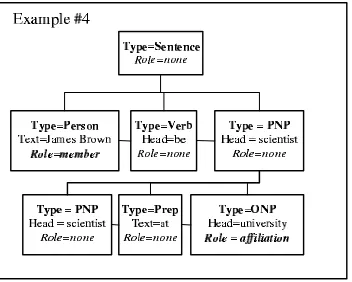
Let us consider a relation example corresponding to the sentence “James Brown was a scientist at the University of Illinois”. The example is shown in Figure 3. We compare the example with the relation example #1 in Figure 2.
According to the definitions (1) and (3), for the examples P1(relation example #1) and P2 (rela-tion example #4), the kernel func(rela-tion is computed as follows (Assume that for all matching nodes, the similarity is 1 if their text(head) attributes match and 0, otherwise. Also assume thatλ=0.5).
K(P1,P2) = k(P1.Sentence.p,P2.Sentence.p)
+Kc([P1.Person,P1.Verb,P1.PNP],[P2.Person,P2.Verb,P2.PNP]) = 0.5(k(P1.Person,P2.Person)+k(P1.Verb,P2.Verb)+K(P1.PNP,P2.PNP))
+0.52(k(P
1.Person,P2.Person)+2k(P1.Verb,P2.Verb)+K(P1.PNP,P2.PNP)) +0.53(k(P
Figure 3: A relation example for the sentence “James Brown was a scientist at the University of Illinois”. The type “ONP” denotes “ Organization Noun Phrase”.
= 1.125+0.875K(P1.PNP,P2.PNP)
= 1.125+0.875(k(P1.PNP.p,P2.PNP.p)+0.5(k(P1.PNP.PNP,P2.PNP.PNP) +k(P1.PNP.Prep,P2.PNP.Prep)+k(P1.PNP.Organization,P2.PNP.ONP))
0.52(k(P
1.PNP.PNP,P2.PNP.PNP)+2k(P1.PNP.Prep,P2.PNP.Prep) +k(P1.PNP.Organization,P2.PNP.ONP))
+0.53(k(P
1.PNP.PNP,P2.PNP.PNP)+k(P1.PNP.Prep,P2.PNP.Prep) +k(P1.PNP.Organization,P2.PNP.ONP))
= 1.125+0.875(1+0.5+0.25+0.125)
= 1.125+0.875·1.875
= 2.765625
The core of the kernel computation resides in the formula (3). The formula enumerates all contiguous subsequences of two children sequences. We now give a fast algorithm for computing
Kcbetween P1and P2, which, given kernel values for children, runs in time O(mn), where m and n is the number of children of P1and P2, respectively.
Let C(i,j) be the Kc computed for suffixes of children sequences of P1 and P2, where every
subsequence starts with indices i and j, respectively. That is,
C(i,j) =
∑
i,j,i1=i,j1=j,l(i)=l(j)
λl(i)K(P
1[i],P2[j])
∏
s=1,...,l(i)
t(P1[is].p,P2[js].p)
Let L(i,j)be the length of the longest sequence matching states in the children of P1and P2starting with indices i and j, respectively. Formally,
L(i,j) =max{l :
∏
s=0,...,lt(P1[i+s].p,P2[j+s].p) =1}
Then, the following recurrences hold:
L(i,j) =
0, if t(P1[i].p,P2[j],p) =0
C(i,j) = (
0,if t(P1[i].p,P2[j],p) =0
λ(1−λL(i,j))
1−λ K(P1[i],P2[j]) +λC(i+1,j+1),otherwise
(5)
The boundary conditions are:
L(m+1,n+1) =0
C(m+1,n+1) =0
The recurrence (5) follows from the observation that, if P1[i]and P2[j]match, then every match-ing pair(c1,c2)of sequences that participated in computation of C(i+1,j+1)will be extended to the matching pair([P1[i],c1],[P2[j],c2]), and
C(i,j) = λK(P1[i],P2[j]) +
∑
(c1,c2)
λl(c1)+1(K(P
1[i],P2[j]) +K(c1,c2))
=
∑
s=1,...,L(i,j)
λsK(P
1[i],P2[j]) +λ
∑
(c1,c2)
λl(c1)K(c
1,c2))
= λ(1−λL(i,j))
1−λ K(P1[i],P2[j]) +λC(i+1,j+1) Now we can easily compute Kc(P1.c,P2.c)from C(i,j).
Kc(P1.c,P2.c) =
∑
i,j
C(i,j) (6)
The time and space complexity of Kc computation is O(mn), given kernel values for children.
Hence, for two relation examples the complexity of computing K(P1,P2)is the sum of computing
Kcfor the matching internal nodes (assuming that complexity of t(·,·)and k(·,·)is constant).
5.2 Sparse Subtree Kernels
For sparse subtree kernels, we use the general definition of similarity between children sequences as expressed by (2).
Let us consider a example corresponding to the sentence “John White, a well-known scientist at the University of Illinois, led the discussion.” The example is shown in Figure 4. We compare the example with the relation example #1 in Figure 2.
According to the definitions (1) and (3), for the examples P1(relation example #1) and P2 (rela-tion example #5), the kernel func(rela-tion is computed as follows (Assume that for all matching nodes, the similarity is 1 if their text(head) attributes match and 0, otherwise. Also assume thatλ=0.5).
K(P1,P2) = k(P1.Sentence.p,P2.Sentence.p)+
+Kc([P1.Person,P1.Verb,P1.PNP],[P2.Person,P2.Punc,P2.PNP,P2.Verb,P2.BNP]) = 0.52(k(P1.Person,P2.Person)+k(P1.Verb,P2.Verb)+K(P1.PNP,P2.PNP))
+0.520.54k([P1.Person,P1.Verb],[P2.Person,P2.Verb])+ +0.530.53([P
1.Person,P1.PNP],[P2.Person,P2.PNP])+ +(0.52+0.56)K(P
Figure 4: A relation example for the sentence “James Brown, a well-known scientist at the Univer-sity of Illinois, led the discussion.” The types “Punc” and “BNP” denote “Punctuation” and “Base Noun Phrase”, respectively.
= 0.265625(k(P1.PNP.p,P2.PNP.p)+0.52(k(P1.PNP.PNP,P2.PNP.PNP) +k(P1.PNP.Prep,P2.PNP.Prep)+k(P1.PNP.ONP,P2.PNP.ONP))
0.54(k(P
1.PNP.PNP,P2.PNP.PNP)+2k(P1.PNP.Prep,P2.PNP.Prep) +k(P1.PNP.ONP,P2.PNP.ONP))+0.56(k(P1.PNP.PNP,P2.PNP.PNP)+ +k(P1.PNP.ONP,P2.PNP.ONP))+
+0.56(k(P
1.PNP.PNP,P2.PNP.PNP)+k(P1.PNP.Prep,P2.PNP.Prep) +k(P1.PNP.ONP,P2.PNP.ONP))
= 0.265625(1+0.52·3+0.54·4+0.56·(2+3)) = 0.265625·2.078125
= 0.552
As in the previous section, we give an efficient algorithm for computing Kcbetween P1and P2. The algorithm runs in time O(mn3), given kernel values for children, where m and n (m≥n) is the number of children of P1and P2, respectively. We will use a construction of Lodhi et al. (2002) in the algorithm design.
Derivation of an efficient programming algorithm for sparse subtree computation is somewhat involved and presented in Appendix B. Below we list the recurrences for computing Kc.
Kc =
∑
q=1,...,min(m,n)
Kc,q(m,n)
Kc,q(i,j) = λKc,q(i,j−1) +
∑
s=1,...,it(P1[s].p,P2[j].p)λ2Cq−1(s−1,j−1,K(P1[s],P2[j]))
Cq(i,j,a) = aCq(i,j) +
∑
r=1,...,qCq,r(i,j)
Cq(i,j) = λCq(i,j−1) +Cq0(i,j)
Cq,r(i,j) = λCq,r(i,j−1) +C0q,r(i,j)
Cq0,r(i,j) =
t(P1[i],P2[j])λ2Cq−1,r(i−1,j−1) +λCq0,r(i,j−1), if q6=r t(P1[i],P2[j])λ2K(P1[i],P2[j])Cq−1(i−1,j−1) +λCq0,r(i,j−1), if q=r
The boundary conditions are
Kc,q(i,j) = 0,if q>min(i,j) Cq(i,j) = 0,if q>min(i,j) C0(i,j) = 1,
Cq0(i,j) = 0,if q>min(i,j)
Cq,r(i,j) = 0,if q>min(i,j)or q<r Cq0,r(i,j) = 0,if q>min(i,j)or q<r
As can be seen from the recurrences, the time complexity of the algorithm is O(mn3)(assuming
m≥n). The space complexity is O(mn2).
6. Experiments
In this section, we apply kernel methods to extracting two types of relations from text:
person-affiliationandorganization-location.
Apersonand anorganizationare part of theperson-affiliationrelation, if thepersonis a member of or employed byorganization. A company founder, for example, is defined not to be affiliated with the company (unless, it is stated that (s)he also happens to be a company employee).
Aorganization and a location are components of the organization-location relation, if theorganization’s headquarters is at thelocation. Hence, if a single division of a company is located in a particular city, the company is not necessarily located in the city.
The nuances in the above relation definitions make the extraction problem more difficult, but they also allow to make fine-grained distinctions between relationships that connect entities in text.
6.1 Experimental Methodology
The (text) corpus for our experiments comprises 200 news articles from different news agencies and publications (Associated Press, Wall Street Journal, Washington Post, Los Angeles Times, Philadel-phia Inquirer).
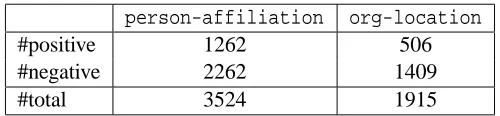
We used the existing shallow parsing system to generate the shallow parses for the news articles. We generated relation examples from the shallow parses for both relations, as described in Section 4. We retained only the examples, for which the shallow parsing system did not make major mistakes (90% of the generated examples). We then labeled the retained examples whether they expressed the relation of interest. The resulting examples’ statistics are shown in Table 6.1.
person-affiliation org-location
#positive 1262 506
#negative 2262 1409
#total 3524 1915
Table 1: Number of examples for relations.
the learning curves by gradually increasing the number of examples in the training set and observ-ing performance change on the test set. The learnobserv-ing curves were also averaged over 10 random train/test splits.
For extraction problems, the system performance is usually reflected using the performance measures of information retrieval: precision, recall, and F-measure (van Rijsbergen, 1979). Pre-cision is the ratio of the number of correctly predicted positive examples to the number predicted positive examples. Recall is the ratio of the number of correctly predicted positive examples to the number of true positive examples. F-measure (Fm) combines precision and recall as follows:
Fm=2∗precision∗recall (precision+recall)
We report precision, recall, and F-measure for each experiment. We also present F-measure learning curves for each learning curve experiment.
In the experiments below, we present the performance of kernel-based algorithms for relation extraction in conjunction with that of feature-based algorithms. Note that the set of features used by the feature-based learning algorithms (presented in Appendix C) is not the same as the set of implicit features employed by kernel-based learning algorithms. The features used correspond to small subtrees of the shallow parse representations of relation examples, while the kernel formulation can take advantage of subtrees of any size. Therefore, in comparing the performance of kernel-based and feature-based methods, we seek to evaluate how much advantage a kernel formulation can give us with respect to a comparable yet less expressive feature formulation.
We now describe the experimental setup of the algorithms used in evaluation.
6.2 Kernel Methods Configuration
We evaluated two kernel learning algorithms: Support Vector Machine (SVM) (Cortes and Vap-nik, 1995) and Voted Perceptron (Freund and Schapire, 1999). For SVM, we used the SV MLight (Joachims, 1998) implementation of the algorithm, with custom kernels incorporated therein. We implemented the Voted Perceptron algorithm as described in (Freund and Schapire, 1999).
We implemented both contiguous and sparse subtree kernels and incorporated them in the kernel learning algorithms. For both kernels,λwas set to 0.5. The only domain specific information in the two kernels was encapsulated by the matching t(·,·)and similarity k(·,·)functions on nodes. Both functions are extremely simple, their definitions are shown below.
t(P1.p,P2.p) =
where the function Class combines some types into a single equivalence class: Class(PNP)=Person, Class(ONP)=Organization, Class(LNP)=Location, and Class(Type)=Type for other types.
k(P1.p,P2.p) =
1, if P1.text=P2.Text 0, otherwise
We should emphasize that the above definitions of t and k are the only domain-specific information that the kernel methods use. Certainly, the kernel design is somewhat influenced by the problem of relation extraction, but the kernels can be used for other (not necessarily text-related) problems as well, if the functions t and k are defined differently.
We also normalized the computed kernels before their use within the algorithms. The nor-malization corresponds to the standard unit norm nornor-malization of examples in the feature space corresponding to the kernel space (Cristianini and Shawe-Taylor, 2000):
K(P1,P2) =
K(P1,P2)
p
K(P1,P1)K(P2,P2)
For both SV MLight and Voted Perceptron, we used their standard configurations (e.g., we did not optimize the value of C that interpolates the training error and regularization cost for SVM, via cross-validation). For Voted Perceptron, we performed two passes over the training set.
6.3 Linear Methods Configuration
We evaluated three feature-based algorithms for learning linear discriminant functions: Naive-Bayes (Duda and Hart, 1973), Winnow (Littlestone, 1987), and SVM. We designed features for the rela-tion extracrela-tion problem. The features are conjuncrela-tions of condirela-tions defined over relarela-tion example nodes. The features are listed in appendix C. Again, we use the standard configuration for both al-gorithms: for Naive Bayes we employed add-one smoothing (Jelinek, 1997); for Winnow, learning rate (promotion parameter) was set to 1.1 and the number of training set passes to 2. For SVM, we used the linear kernel and set the regularization parameter (C) to 1.
6.4 Experimental Results
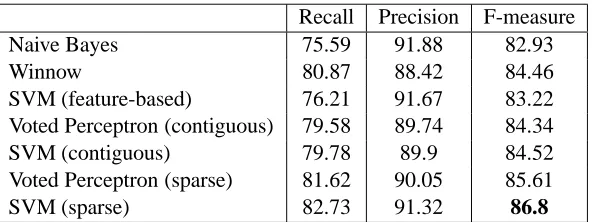
The performance results for person-affiliation and organization-location are shown in Table 2 and Table 3, respectively. The results indicate that kernel methods do exhibit good per-formance and, in most cases, fare better than feature-based algorithms in relation extraction. The results also highlights importance of kernels: algorithms with the sparse subtree kernels are always significantly better than their contiguous counterparts. The SVM results also pinpoint that kernels and not regularization are crucial for performance improvement.
6.4.1 FEATURE-BASED VS. KERNEL-BASED: LEARNING CURVES
The Figure 5 depicts F-measure learning curves for for feature-based and kernel-based algorithms with the sparse subtree kernel.
Recall Precision F-measure
Naive Bayes 75.59 91.88 82.93
Winnow 80.87 88.42 84.46
SVM (feature-based) 76.21 91.67 83.22 Voted Perceptron (contiguous) 79.58 89.74 84.34 SVM (contiguous) 79.78 89.9 84.52 Voted Perceptron (sparse) 81.62 90.05 85.61
SVM (sparse) 82.73 91.32 86.8
Table 2:Person-affiliationperformance (in percentage points)
Recall Precision F-measure
Naive Bayes 71.94 90.40 80.04
Winnow 75.14 85.02 79.71
SVM (feature-based) 70.32 88.18 78.17 Voted Perceptron (contiguous) 64.43 92.85 76.02 SVM (contiguous) 71.43 92.03 80.39 Voted Perceptron (sparse) 71 91.9 80.05
SVM (sparse) 76.33 91.78 83.3
Table 3:Organization-locationperformance (in percentage points)
kernel, is just comparable to that of feature-based algorithms. SVM, with the sparse subtree kernel, performs far better than any of the competitors for theorganization-locationrelation.
6.4.2 SPARSE VS. CONTIGUOUS: LEARNINGCURVES
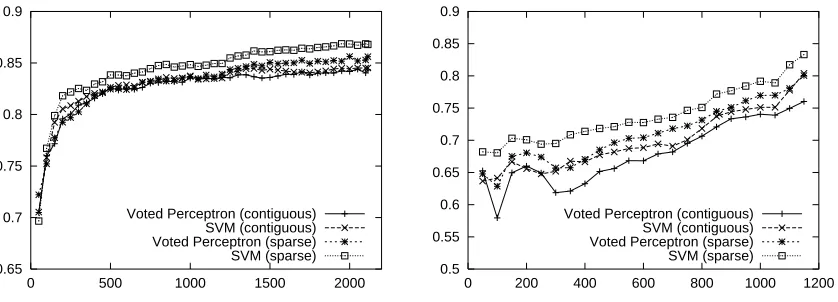
The Figure 6 depicts F-measure learning curves for for kernel-based algorithms algorithms with different kernels.
The learning curves indicate that the sparse subtree kernel is far superior to the contiguous sub-tree kernel. From the enumeration standpoint, the subsub-tree kernels implicitly enumerate the
expo-nential number of children subsequences of a given parent, while the contiguous kernels essentially
operate with n-grams, whose number is just quadratic in a children sequence length. This exponen-tial gap between the sparse and contiguous kernels leads to a significant performance improvement. The result is extremely promising, for it showcases that it is possible to (implicitly) consider an exponential number of features while paying just a low polynomial price, with a significant perfor-mance boost.
7. Discussion
0.65 0.7 0.75 0.8 0.85 0.9
0 500 1000 1500 2000 Naive Bayes
Winnow Voted Perceptron (sparse) SVM (sparse) 0.6 0.65 0.7 0.75 0.8 0.85 0.9
0 200 400 600 800 1000 1200 Naive Bayes
Winnow Voted Perceptron (sparse) SVM (sparse)
Figure 5: Learning curves (of F-measure) for theperson-affiliation relation (on the left) and org-locationrelation (on the right), comparing feature-based learning algorithms with kernel-based learning algorithms.
0.65 0.7 0.75 0.8 0.85 0.9
0 500 1000 1500 2000 Voted Perceptron (contiguous)
SVM (contiguous) Voted Perceptron (sparse) SVM (sparse) 0.5 0.55 0.6 0.65 0.7 0.75 0.8 0.85 0.9
0 200 400 600 800 1000 1200 Voted Perceptron (contiguous)
SVM (contiguous) Voted Perceptron (sparse) SVM (sparse)
Figure 6: Learning curve (of F-measure) for the person-affiliation relation (on the left) and org-locationrelation (on the right), comparing kernel-based learning algorithms with different kernels.
Our work follows recent applications of kernel methods to natural language parsing (Collins and Duffy, 2001) and text categorization (Lodhi et al., 2002). The common theme in all the papers is that objects’ structure need not be sacrificed for simpler explicit feature-based representation. Indeed, the structure can be leveraged in a computationally efficient and statistically sound way.
convergence than such attribute-efficient7 algorithms as Winnow. We hypothesize that the methods will require much fewer examples in achieving the state of the art performance for a range of NLP problems than approaches based on probabilistic modeling.
One practical problem in applying kernel methods to NLP is their speed. Kernel classifiers are relatively slow compared to feature classifiers. Indeed, an application of a kernel classifier requires evaluation of numerous kernels whose computational complexity may be too high for practical purposes. Many low level problems in natural language processing involve very large corpora with tens and hundreds of thousands of examples. Even if kernel classifiers only depend on a small subset of the examples (for instance, support vectors of SVM), the need to evaluate thousands of complex kernels during the classifier application may render kernel methods inappropriate for various practical settings. Therefore, there is a pressing need to develop algorithms that combine the advantages of kernel methods with practical constraints that require efficient application of the classifiers learned.
Design of kernels for structural domains is a very rich research area. An interesting direction to pursue would be to use extensive work on distances defined on structural objects (Sankoff and Kruskal, 1999) in kernel design. The distance-based methods have already found widespread ap-plication in bioinformatics (Durbin et al., 1998), and can be fruitfully extended to work in the NLP domain as well. Watkins (1999) presents sufficient conditions for a Pair Hidden Markov Model (which is a probabilistic version of edit distance) to constitute a kernel. More generally, the work of Goldfarb (1985) makes it possible to use any distance measure to embed objects (and define a dot product) in a pseudo-euclidean space. Incidentally, SVM can be adapted for the pseudo-euclidean representations (Graepel et al., 1999, Pekalska et al., 2001), hence, lending the power of regulariza-tion to learning in structural domains, where natural distance funcregulariza-tions exist.
8. Conclusions and Further Work
We presented an approach for using kernel-based machine learning methods for extracting relations from natural language sources. We defined kernels over shallow parse representations of text and designed efficient dynamic programming algorithms for computing the kernels. We applied SVM and Voted Perceptron learning algorithms with the kernels incorporated therein to the tasks of rela-tion extracrela-tion. We also compared performance of the kernel-based methods with that of the feature methods, and concluded that kernels lead to superior performance.
Aside from a number of interesting research directions mentioned in Section 7, we intend to apply the kernel methodology to other sub-problems of information extraction. For example, the shallow parsing and entity extraction mechanism may also be learned, and, perhaps, combined in a seamless fashion with the relation extraction formalism presented herein. Furthermore, the real-world use of extraction results requires discourse resolution that collapses entities, noun phrases, and pronouns into a set of equivalence classes. We plan to apply kernel methods for discourse processing as well.
9. Acknowledgments
This work was supported through the DARPA Evidence Extraction and Link Discovery program under the contract 2001-H697000-000.
Appendix A. Proof of Theorem 3
To prove the theorem, we need the following lemmas.
Lemma 4 (Haussler (1999)) Let K be a kernel on a set U×U and for all finite non-empty A,B⊆ U define ¯K(A,B) =∑x∈A,y∈BK(x,y). Then ¯K is the kernel on the product of the set of all finite, nonempty subsets of U with itself.
Lemma 5 (Cristianini and Shawe-Taylor (2000)) If K1is a kernel over a set X , and K2is a kernel
over a set Y , then K1LK2((x,x0),(y,y0)) =K(x,x0)+K(y,y0)is a kernel over a set X×Y . The kernel
K1
L
K2is called the direct sum of kernels K1and K2.
Corollary 6 If K1,...,Kn are kernels over the corresponding sets X1,...,Xn, and then the direct sum K1L···LKn((x1,x01),...,(xn,xn0)) =∑i=1,...,nK(xi,x0i)is a kernel over the set Xi× ···×Xn. Lemma 7 (Cristianini and Shawe-Taylor (2000)) If K1is a kernel over a set X , and K2is a kernel
over a set Y , then K1
N
K2((x,x0),(y,y0)) =K(x,x0)K(y,y0)is a kernel over a set X×Y . The kernel
K1
N
K2is called the tensor product of kernels K1and K2.
Corollary 8 If K1,...,Kn are kernels over the corresponding sets X1,...,Xn, and then the tensor product K1
N
···NKn((x1,x10),...,(xn,x0n)) =∏i=1,...,nK(xi,x0i)is a kernel over the set Xi×···×Xn. Proof [Proof of Theorem 3] For two relation examples P1 and P2, of which at least one has no children, K(P1,P2) =k(P1.p,P2.p)t(P1.p,P2.p). Therefore, K is a kernel as a product of two ker-nels(Cristianini and Shawe-Taylor, 2000).
For two relation examples P1and P2with non-empty children lists, we first extend each children subsequence to be of length M=max(l(P1.c),l(P2.c))by appending to it a sequence of “empty” children, thereby embedding the space of all subsequences in the space of subsequences of length
M. We also extend the t(·,·) and k(·,·) to empty nodes by making empty nodes match only with empty nodes, and putting k(x,y) =0, if x or y is empty. We also let d(i)denote in−i1+1, where in
is the last “non-empty” index of the sequence i.
We then observe that Kc(P1.c,P2.c)can be written as
Kc(P1.c,P2.c) =
∑
i,j
λd(i)λd(j)K(P
1[i],P2[j])
∏
s=1,...,M
t(P1[is].p,P2[js].p)
K(P1[i],P2[j])is a direct sum of kernels defined over individual children, hence, it is a kernel over subsequences children by Corollary 6. Similarly,∏s=1,...,l(i)t(P1[is].p,P2[js].p) is a tensor product
of kernels, hence, it is a kernel over subsequences of children by Corollary 8. Since the set of ker-nels is closed with respect to product and scalar multiplication,
λd(i)λd(j)K(P
1[i],P2[j])∏s=1,...,Mt(P1[is].p,P2[js].p)is a kernel over subsequences of children.
Ap-plication of Lemma 4 to this kernel, where U is the set of subsequences of children entails that Kc
Finally, since a sum and a product of kernels is also a kernel,
K(P1,P2) =t(P1.p,P2.p)k(P1.p,P2.p) +t(P1.p,P2.p)Kc(P1.c,P2.c) is a kernel over relation examples.
Appendix B. Sparse Subtree Kernel Computation
Let Kc,q(i,j) be Kc computed using subsequences of length q in prefixes of children sequences of P1and P2ending with indices i and j.
Kc,q(i,j) =
∑
i⊆{1,...,i} j⊆{
∑
1,...,j} l(i)=l(j)=qλd(i)λd(j)K(P
1[i],P2[j])T(i,j)
where
T(i,j) =
∏
s=1,...,l(i)t(P1[is].p,P2[js].p)
Let Cq(i,j,a) be the Kc computed using subsequences of length q in prefixes of children
se-quences of P1 and P2 ending with indices i and j, respectively, with a number a∈R added to each result of kernel children computation, and setting a damping factor for a sequence i(j) to be λi−i1+1(λi−i1+1). Formally,
Cq(i,j,a) =
∑
i⊆{1,...,i} j⊆{
∑
1,...,j} l(i)=l(j)=q[λi−i1+j−j1+2(K(P
1[i],P2[j]) +a)T(i,j)]
Then the following recurrences hold:
C0(i,j,a) = a
Cq(i,j,a) = λCq(i,j−1,a) +
∑
s=1,...,i
[t(P1[s].p,P2[j].p)λi−s+2·Cq−1(s−1,j−1,a+K(P1[s],P2[j]))]
Kc,q(i,j) = λKc,q(i,j−1) +
∑
s=1,...,i
[t(P1[s].p,P2[j].p)λ2·Cq−1(s−1,j−1,K(P1[s],P2[j]))]
Kc =
∑
q=1,...,min(m,n)
Kc,q(m,n)
The above recurrences do not allow, however, for an efficient algorithm in computing Kcdue to
presence of real-valued parameter a.
In order to obtain an efficient dynamic programming algorithm, we rewrite Cq(i,j,a)as follows:
Cq(i,j,a) =aCq(i,j) +
∑
r=1,...,qCq,r(i,j)
where
Cq(i,j) =
∑
i⊆{1,...,i} j⊆{
∑
1,...,j} l(i)=l(j)=qand
Cq,r(i,j) =
∑
i1=1,...,i j1=1,...,j
[t(P1[i1].p,P2[j1].p)λi−i1+j−j1+2Cq−1,r(i1−1,j1−1)],if q6=r
∑
i1=1,...,i j1=1,...,j
[t(P1[i1].p,P2[j1].p)λi−i1+j−j1+2K(P1[i1],P2[j1])Cq−1(i1−1,j1−1)],if q=r
Observe that Cq(i,j) computes the subsequence kernel of Lodhi et al. (2002) (with matching
nodes) for prefixes of P1and P2. Hence, we can use the result of Lodhi et al. (2002) to give O(qi j) for Cq(i,j)computation. Denote
Cq0(i,j) =
∑
s=1,...,it(P1[s].p,P2[j].p)λi−s+2Cq−1(s−1,j−1)
Then
Cq(i,j) =λCq(i,j−1) +Cq0(i,j)
and
Cq0(i,j) =t(P1[i],P2[j])λ2Cq−1(i−1,j−1) +λCq0(i,j−1)
Using the same trick for Cq,r(i,j), we get
Cq,r(i,j) =λCq,r(i,j−1) +Cq0,r(i,j)
where
C0q,r(i,j) =
λCq0,r(i,j−1) +t(P1[i],P2[j])λ2Cq−1,r(i−1,j−1),if q6=r
λCq0,r(i,j−1) +t(P1[i],P2[j])λ2K(P1[i],P2[j])Cq−1(i−1,j−1),o.w. That completes our list of recurrences of computing Kq(i,j,a). The boundary conditions are
Kc,q(i,j) = 0,if q>min(i,j) Cq(i,j) = 0,if q>min(i,j) C0(i,j) = 1,
Cq0(i,j) = 0,if q>min(i,j)
Cq,r(i,j) = 0,if q>min(i,j)or q<r Cq0,r(i,j) = 0,if q>min(i,j)or q<r
Appendix C. Features for Relation Extraction
In the process of feature engineering, we found the concept of node depth (in a relation example) to be very useful. The depth of a node P1.p (denoted depth(P1.p)) within a relation example P is the depth of P1in the tree of P. The features are itemized below (the lowercase variables text, type,
role, and depth are instantiated with specific values for the corresponding attributes).
• For every node P1.p in a relation example, add the following features:
– depth(P1.p) =depth∧Class(P1.Type) =type∧P1.Role=role
• For every pair of nodes P1.p, P2.p in a relation example, such that P1is the parent of P2, add the following features:
– depth(P1.p) =depth∧Class(P1.Type) =type∧P1.Role=role∧depth(P2.p) =depth∧
Class(P2.Type) =type∧P2.Role=role∧parent
– depth(P1.p) =depth∧Class(P1.Type) =type∧P1.Role=role∧depth(P2.p) =depth∧
P2.Text=text∧P2.Role=role∧parent
– depth(P1.p) =depth∧P1.Text=text∧P1.Role=role∧depth(P2.p) =depth∧Class(P2.Type) =
type∧P2.Role=role∧parent
– depth(P1.p) =depth∧Class(P1.Type) =text∧P1.Role=role∧depth(P2.p) =depth∧
P2.Text=text∧P2.Role=role∧parent
• For every pair of nodes P1.p, P2.p in a relation example, with the same parent P, such that P2 follows P1in the P’s children list, add the following features:
– depth(P1.p) =depth∧Class(P1.Type) =type∧P1.Role=role∧depth(P2.p) =depth∧
Class(P2.Type) =type∧P2.Role=role∧sibling
– depth(P1.p) =depth∧Class(P1.Type) =type∧P1.Role=role∧depth(P2.p) =depth∧
P2.Text=text∧P2.Role=role∧sibling
– depth(P1.p) =depth∧P1.Text=text∧P1.Role=role∧depth(P2.p) =depth∧Class(P2.Type) =
type∧P2.Role=role∧sibling
– depth(P1.p) =depth∧Class(P1.Type) =text∧P1.Role=role∧depth(P2.p) =depth∧
P2.Text=text∧P2.Role=role∧sibling
• For every triple of nodes P1.p, P2.p, P3.p in a relation example, with the same parent P, such that P2follows P1, and P3follows P2in the P’s children list, add the following features:
– depth(P1.p) =depth∧Class(P1.Type) =type∧P1.Role=role∧depth(P2.p) =depth∧
Class(P2.Type) =type∧P2.Role=role∧depth(P3.p) =depth∧P3.Text=text∧P3.Role=
role∧siblings
– depth(P1.p) =depth∧Class(P1.Type) =type∧P1.Role=role∧depth(P2.p) =depth∧
P2.Text=text∧P2.Role=role∧depth(P3.p) =depth∧Class(P3.Type) =Type∧P3.Role=
role∧siblings
– depth(P1.p) =depth∧P1.Text=text∧P1.Role=role∧depth(P2.p) =depth∧Class(P2.Type) =
type∧P2.Role=role∧depth(P3.p) =depth∧Class(P3.Type) =type∧P3.Role=role∧
siblings
References
S. Abney. Parsing by chunks. In Robert Berwick, Steven Abney, and Carol Tenny, editors,
Principle-based parsing. Kluwer Academic Publishers, 1990.
C. Aone and M. Ramos-Santacruz. REES: A large-scale relation and event extraction system. In
Proceedings of the 6th Applied Natural Language Processing Conference, 2000.
A. L. Berger, S. A. Della Pietra, and V. J. Della Pietra. A maximum entropy approach to natural language processing. Computational Linguistics, 22(1):39–71, 1996.
D. M. Bikel, R. Schwartz, and R. M. Weischedel. An algorithm that learns what’s in a name.
Machine Learning, 34(1-3):211–231, 1999.
M. Collins. New ranking algorithms for parsing and tagging: Kernels over discrete structures, and the voted perceptron. In Proceedings of 40th Conference of the Association for Computational
Linguistics, 2002.
M. Collins and N. Duffy. Convolution kernels for natural language. In Proceedings of NIPS-2001, 2001.
C. Cortes and V. Vapnik. Support-vector networks. Machine Learning, 20(3):273–297, 1995.
N. Cristianini and J. Shawe-Taylor. An Introduction to Support Vector Machines (and Other
Kernel-Based Learning Methods). Cambridge University Press, 2000.
R. O. Duda and P. E. Hart. Pattern Classification and Scene Analysis. John Wiley, New York, 1973.
R. Durbin, S. Eddy, A. Krogh, and G. Mitchison. Biological Seqience Analysis. Cambridge Univer-sity Press, 1998.
D. Freitag and A. McCallum. Information extraction with HMM structures learned by stochastic optimization. In Proceedings of the 7th Conference on Artificial Intelligence (AAAI-00) and of the
12th Conference on Innovative Applications of Artificial Intelligence (IAAI-00), pages 584–589,
Menlo Park, CA, July 30– 3 2000. AAAI Press.
Y. Freund and R. E. Schapire. Large margin classification using the perceptron algorithm. Machine
Learning, 37(3):277–296, 1999.
T. Furey, N. Cristianini, N. Duffy, D. Bednarski, M. Schummer, and D. Haussler. Support vec-tor machine classification and validation of cancer tissue samples using microarray expression.
Bioinformatics, 16, 2000.
L. Goldfarb. A new approach to pattern recognition. In Progress in pattern recognition 2. North-Holland, 1985.
T. Graepel, R. Herbrich, and K. Obermayer. Classification on pairwise proximity data. In Advances
in Neural Information Processing Systems 11, 1999.
D. Haussler. Convolution kernels on discrete structures, 1999. Technical Report UCS-CRL-99-10, 1999.
R. A. Horn and C. A. Johnson. Matrix Analysis. Cambridge University press, Cambridge, 1985.
T. Joachims. Text categorization with support vector machines: learning with many relevant fea-tures. European Conf. Mach. Learning, ECML98, April 1998.
T. Joachims. Learning Text Classifiers with Support Vector Machines. Kluwer Academic Publishers, Dordrecht, NL, 2002.
J. Lafferty, A. McCallum, and F. Pereira. Conditional random fields: Probabilistic models for segmenting and labeling sequence data. In Proc. 18th International Conf. on Machine Learning, pages 282–289. Morgan Kaufmann, San Francisco, CA, 2001.
N. Littlestone. Learning quickly when irrelevant attributes abound: A new linear-threshold algo-rithm. Machine Learning, 2:285, 1987.
H. Lodhi, C. Saunders, J. Shawe-Taylor, N. Cristianini, and Chris Watkins. Text classification using string kernels. Journal of Machine Learning Research, 2002.
A. McCallum, D. Freitag, and F. Pereira. Maximum entropy Markov models for information extrac-tion and segmentaextrac-tion. In Proc. 17th Internaextrac-tional Conf. on Machine Learning, pages 591–598. Morgan Kaufmann, San Francisco, CA, 2000.
S. Miller, M. Crystal, H. Fox, L. Ramshaw, R. Schwartz, R. Stone, and R. Weischedel. Algorithms that learn to extract information - BBN: Description of the SIFT system as used for MUC-7. In
Proceedings of MUC-7, 1998.
M. Munoz, V. Punyakanok, D. Roth, and D. Zimak. A learning approach to shallow parsing. Tech-nical Report 2087, University of Illinois at Urbana-Champaign, Urbana, Illinois, 1999.
National Institute of Standars and Technology. Proceedings of the 6th Message Undertanding
Con-ference (MUC-7), 1998.
E. Pekalska, P. Paclik, and R. Duin. A generalized kernel approach to dissimilarity-based classifi-cation. Journal of Machine Learning Research, 2, 2001.
L. R. Rabiner. A tutorial on hidden Markov models and selected applications in speech recognition.
Proceedings of the IEEE, 1990.
F. Rosenblatt. Principles of Neurodynamics: Perceptrons and the theory of brain mechanisms. Spartan Books, Washington D.C., 1962.
D. Roth. Learning in natural language. In Dean Thomas, editor, Proceedings of the 16th
Inter-national Joint Conference on Artificial Intelligence (IJCAI-99-Vol2), pages 898–904, S.F., July
31–August 6 1999. Morgan Kaufmann Publishers.
D. Roth and W. Yih. Relational learning via propositional algorithms: An information extraction case study. In Bernhard Nebel, editor, Proceedings of the seventeenth International Conference
on Artificial Intelligence (IJCAI-01), pages 1257–1263, San Francisco, CA, August 4–10 2001.
Morgan Kaufmann Publishers, Inc.
C. J. van Rijsbergen. Information Retrieval. Butterworths, 1979.
V. Vapnik. Statistical Learning Theory. John Wiley, 1998.