_____________________________________________________________________________________________________
*Corresponding author: E-mail: [email protected];
3(1): 1-12, 2019; Article no.APRJ.51588
ISSN: 2581-9992
Effect of Vermicompost and Earthing Up on the
Growth and Yield of Onion
Shirajum Monira
1, Tahmina Mostarin
1, Khaleda Khatun
1, Md. Ehsanul Haq
2*,
Ismita Akter Soniya
1, Sanjida Akhter
1, Iffat Sharmin
1and Avijit Ghosh
31
Department of Horticulture, Sher-e-Bangla Agricultural University, Dhaka, Bangladesh.
2Plant Breeding Division, Bangladesh Rice Research Institute, Gazipur, Bangladesh. 3Institute of Seed Technology, Sher-e-Bangla Agricultural University, Dhaka, Bangladesh.
Authors’ contributions
This work was carried out in collaboration among all authors. Authors TM and KK planned the experiment and lead the research. Authors TM, KK and SM designed and carried out the research. Author MEH performed the statistical analysis. Authors SM and IAS carried out the research on the field. Authors SA, IS and AG collected the data. Authors SM and MEH wrote the manuscript. Authors IAS, SA, IS and AG managed the literature searches. All authors provided critical feedback and helped shape the research, analysis and manuscript. All authors read and approved the final manuscript.
Article Information
DOI: 10.9734/APRJ/2019/v3i130059 Editor(s): (1) Dr. Langa Tembo, Lecturer, Department of Agriculture Production, Makerere University, Kampala, Uganda and
Department of Plant Science, University of Zambia, Lusaka, Zambia. Reviewers: (1) Paul Benyamin Timotiwu, University of Lampung, Indonesia. (2)Dale Loussaert, Iowa State University, USA. (3)N. Karmegam, Government Arts College, India. Complete Peer review History:https://sdiarticle4.com/review-history/51588
Received 11 July 2019 Accepted 23 September 2019
Published 01 October 2019
ABSTRACT
A field research was conducted at the Horticultural Farm of Sher-e-Bangla Agricultural University, Dhaka-1207 during the period from October 2017 to March 2018 to study the effect of vermicompost and earthing upon growth and yield of onion. The experiment consists of two
factors. Factor-A Vermicompost V0 (control), V1 (6 t ha-1 vermicompost), V2 (10 t ha-1
vermicompost) and V3 (14 t ha-1 vermicompost) and Factor-B Earthing up E0 (control), E1 (Two
times earthing up) and E2 (Three times earthing up). The experiment was laid out in RCBD
Monira et al.; APRJ, 3(1): 1-12, 2019; Article no.APRJ.51588
analyzed. Results revealed that in terms of vermicompost application The highest fresh weight
bulb-1 (40.07 g), yield plot-1 (527.89 g) and yield ha-1 (5.39 t) were found from the treatment V3
compared to V0 (control) treatment. Again, in terms of different earthing up treatments, the highest
fresh weight bulb-1 (32.48 g), yield plot-1 (431.67 g) and yield ha-1 (4.41 t) were found from the
treatment E2 (Three times earthing up) compared to E0 (control) treatment. Both vermicompost
and earthing up and their combination showed a considerable variation on different growth and
yield parameters of onion. The highest fresh weight bulb-1 (42.73 g), yield plot-1 (567.33 g) and
yield ha-1 (5.79 t) were found from the treatment combination of V3E2 compared to control V0E0
(control) treatment combination. And it may be summarized that 14 t/ha vermicompost with three times earthing up performed the maximum yield compared to other treatments.
Keywords: Earthing up; onion; vermicompost and yield.
1. INTRODUCTION
Onion (Allium cepa L.) is an important
herbaceous bulb and spice crop in the world which belongs to the family Alliaceae. It is also considered as the most important vegetable crops commercially grown in the world. It probably originated from Central Asia between Turkmenistan and Afghanistan where some of its relatives still grow in the wild. Onion is mainly used as spices but it is also used as condiments for flavoring food and also as delicious vegetables and salad crop. Onion is popularly referred as “Queen of Kitchen.” Onion is liked for its flavour and pungency which is due to the presence of a volatile oil ‘allyl propyl disulphide’- organic compound rich in sulphur. It is being used in several ways as fresh, frozen, dehydrated bulbs and green bunching types [1]. Onion has got good medicinal value. Recently onion is being used by processing industry to greater extent for preparing dehydrated forms
like powder and flakes. Onion contains
carbohydrates (11.0 g), proteins (1.2 g), fiber (0.6 g), moisture (86.8 g) and several vitamin like vitamin A (0.012 mg), vitamin C (11 mg), thiamin (0.08 mg), riboflavin (0.01 mg) and niacin (0.2 mg) and also some minerals like phosphorus (39 mg), calcium (27 mg), sodium (1.0 mg), iron (0.7 mg) and potassium (157 mg) per 100 g [2]. In Bangladesh it is commercially cultivated in the
greater districts of Dhaka, Mymensingh,
Rajshahi, Rangpur, Rajbari, Khustia, Khulna, Barisal and Pabna [3]. Among the spice crops grown in Bangladesh, onion ranks top in respect of production and second in respect of area [4]. Onion is generally grown in Rabi season in Bangladesh. Growth and yield of this crop is remarkably influenced by different nutrients management. There are two types of fertilizer one is Organic and another is Inorganic. Chemical fertilizers generate several deleterious effects on the environment and human health.
The synthetic fertilizers are rapidly lost by
leaching in drainage water; this causes
dangerous environmental pollution [5]. It is an established fact that use of inorganic fertilizer for the crops is not so good for health because of residual effect but in the case of organic fertilizer such problem does not arise and on the other hand it increase the productivity of soil as well as crop quality and yield [6]. However, overall, excessive amounts of inorganic fertilizers are applied to onion in order to achieve a higher bulb yield [7]. Organic manure contains nutrient elements that can support crop production and enhance chemical and physical properties of soil. Application of organic fertilizers to the soils promoted nutrients availability, plant uptake, increased crop yield and quality [7,8]. Organic manure is a two way practice of saving the environment by transforming waste materials into a valuable resource that can be used to supplement soil nutrients [9]. Organic manure also helps to conservation of soil moisture. Available soil moisture also helps taking other nutrients for the plants. In this way organic manure helps up taking of different plant nutrients and to increase fertility and productivity of soil [10]. Manure like cowdung, poultry manure, mustard oil cake, vermicompost is becoming popular and they are also available locally. Vermicompost is organic manure which is important as a product of interactions between earthworm and microorganisms by degradation of organic waste [11]. Vermicompost is very important to increase Onion quality and yield.
Several researchers have reported that
vermicompost contains substaces which helps in building soil structure, stimulation of plant growth, particularly that of roots, drilling mud and emulsiliers. Vermicompost stimulates to influence the microbial activity of soil, increases the availability of oxygen, maintains normal soil
temperature, increases soil porosity and
Monira et al.; APRJ, 3(1): 1-12, 2019; Article no.APRJ.51588
increases growth, yield and quality of the plant
[12].It is documented that vermicompost is a rich
source of vital macronutrients (N, P, K, Ca and Mg) and micronutrients (Fe, Mo, Zn, and Cu). The chemical analysis of vermicompost reveals that N, P, K content was 0.8, 1.1 and 0.5 percent respectively. It is scientifically proving as ‘miracle growth promoter and also plants protector’ from pests and diseases. Vermicompost retains nutrients for a long time and while the conventional compost fails to deliver the required amount of macro and micronutrients including the vital NKP to plants in a shorter time, the vermicompost does [11]. There are different types of intercultural operation have been observed on onion cultivation such as irrigation, weeding, thining, mulching, earthing up and so on. In which earthing up play vital role in growth and yield of onion. Earthing up is the technique in agriculture and horticulture of piling soil up around the base of a plant. Earthing up provided maximum number of tuber with large size [13].
Mukherjee et al. [14] reported that earthing up is
an economically viable weed control practice. The well known benefits that earthing up provides are regulating soil moisture and
temperature, improving germination and
emergence etc. high yield and quality, prolonged growing season higher nutritive value of the produce, improved storability etc. are also well described advantages of earthing up, therefore, aids in reducing cost involved in crop production with irrigation. The present study was aimed to determine the effects of vermicompost and earthing up on the growth and yield of onion from Bangladesh.
2. MATERIALS AND METHODS
2.1 Experimental Site
The experiment was carried out at Sher-e-Bangla
Agricultural University Farm, Dhaka-1207,
Bangladesh. It is located at 90o22′ E longitude
and 23°4l′ N latitude at an altitude of 8.6 meters above the sea level. The land belongs to Agro-ecological zone of Modhupur Tract, AEZ-28. Soil
was having the texture of sandy loam with pH 5.6.
2.2 Treatments of the Experiment
The experiment consists of two factors which are given below:
Factor A: Vermicompost – 4 levels
1) V0 = Control
2) V1 = 6 t ha
-1
vermicompost
3) V2 = 10 t ha-1 vermicompost
4) V3 = 14 t ha-1 vermicompost
Factor B: Earthing up – 3 levels
1) E0 = Control
2) E1 = Two times earthing up (25 & 50
DAT)
3) E2 = Three times earthing up (25,50 & 75
DAT)
Therefore the treatment combinations were given below: V0E0, V0E1, V0E2, V1E0, V1E1, V1E2, V2E0,
V2E1, V2E2, V3E0, V3E1, V3E2.
2.3 Manures and Fertilizers
BARI recommendation doses of Urea, Triple Super Phosphate (TSP) and Muriate of Potash
(MP) are 200 Kg ha-1, 125 Kg ha-1, and MP-180
Kg ha-1 respectively. But in the present study, no
chemical fertilizer was used. Only vermicompost were applied in experiment field according to the treatment assigned under the present study. vermicompost with available amount of nutrient:
N (1.5-2%), P2O5 (0.5-1.5%), K2O (0.5-1%).
Analyzed by soil science laboratory of Sher-e-Bangla Agricultural University.
2.4 Statistical Analysis
The collected data on various parameters under study were statistically analyzed using MSTAT-C computer package programme. The means for all the treatments were calculated and analysis of variance for all the characters was performed by the F- variance test Gomez and Gomez [15]. Significance of difference between means was evaluated by Least Significance Difference (LSD) and the probability level 5% and 1% for the interpretation of results.
3. RESULTS AND DISCUSSION
3.1 Plant Height (Cm)
There was a significant variation was found on plant height of onion influenced by different levels of vermicompost application at different growth stages (Fig. 1). Results revealed that the highest plant height (53.80 cm) at 60 DAT was
found from the V3 (14 t ha
-1
vermicompost) treatment which was significantly different from
all other treatments followed by V2 (10 t ha-1
vermicompost) treatment. The lowest plant height (43.60 cm) at 60 DAT was found from the
treatment V0 (control). Similar result was also
found that the plant height increased significantly with increasing levels of vermicompost
30 t ha-1.
Plant height at different growth stages was significantly influenced by earthing up of onion (Fig. 2). At 60 DAT the highest plant height
Table 1. Concentration of nitrogen, phosphorus and potassium in sample soil
Soil analysis interpretation Optimum
Medium Low Very low
Source: Fertilizer recommendation guide 2012 (BARI) [1
Fig. 1. Effect of vermicompost on
Here, V0 = Control, V1 = 6 t ha-1 vermicompost, V
Fig. 2. Combined effect of earthing up on plant height at different
Here, E0 = Control, E 0
10 20 30 40 50 60
30days
P
la
n
t
h
e
ig
h
t
(c
m
)
0 10 20 30 40 50 60
30days
P
la
n
t
h
ei
g
h
t
(c
m
)
Monira et al.; APRJ, 3(1): 1-12, 2019; Article no.
found that the plant height increased significantly with increasing levels of vermicompost from 10 to
Plant height at different growth stages was significantly influenced by earthing up of onion (Fig. 2). At 60 DAT the highest plant height
(50.52 cm) at was found from the E
times earthing up) treatment which was
statistically identical with E1 (Two times earthing
up) treatment at 60 DAT where the lowest plant height (47.00 cm) was found from the E
treatment. Similar result was also observed by et al. [18] which supported the present study.
Concentration of nitrogen, phosphorus and potassium in sample soil
N P K Cow dung (t/ha)
0-30 0-15 0-40
31-60 16-30 20-Nov
61-90 31-45 21-30 5
91-120 46-60 31-40
Fertilizer recommendation guide 2012 (BARI) [19]
Fig. 1. Effect of vermicompost on plant height at different days after transplanting
vermicompost, V2 = 10 t ha-1 vermicompost, V3 = 14 t ha-1, vermicompost
Fig. 2. Combined effect of earthing up on plant height at different days after transplanting onion
= Control, E1 = Two times earthing up, E2 = Three times earthing up
45days 60days
Days after transplanting
V0 V1 V2 V3
45days 60days
Days after transplanting
E0 E1 E2
; Article no.APRJ.51588
(50.52 cm) at was found from the E2 (Three
times earthing up) treatment which was (Two times earthing up) treatment at 60 DAT where the lowest plant height (47.00 cm) was found from the E0 (control) treatment. Similar result was also observed by Ali
] which supported the present study.
Concentration of nitrogen, phosphorus and potassium in sample soil
Cow dung (t/ha)
days after transplanting of onion
, vermicompost
Monira et al.; APRJ, 3(1): 1-12, 2019; Article no.APRJ.51588
Significant variation was observed on plant height at different growth stages influenced by combined effect of vermicompost and earthing up of onion (Table 2). At the 60 DAT highest
plant height (55.33 cm) was found from the V3E2
(treatment combination) which was statistically
similar to V2E2, V3E0 and V3E1 treatment
combination and the lowest plant height (39.00
cm) was found from the V0E0 (control) treatment
combination.
3.2 Number of Leaves Plant-1
Number of leaves plant-1 at different growth
stages was significantly varied due to different levels of vermicompost application (Fig. 3). At the
60 DAT highest number of leaves plant-1 (7.09)
was found from the treatment V3 (14 t ha
-1 vermicompost) and the lowest number of leaves
plant-1 (5.56) and at 60 DAT was found from the
V0 (control) treatment. Similar result was also
observed by Mukherjee et al. [14] and Gomez and Gomez [15]. They found that number of leaves per plant increased significantly with increasing levels of vermicompost from 10 to 30 t
ha-1.
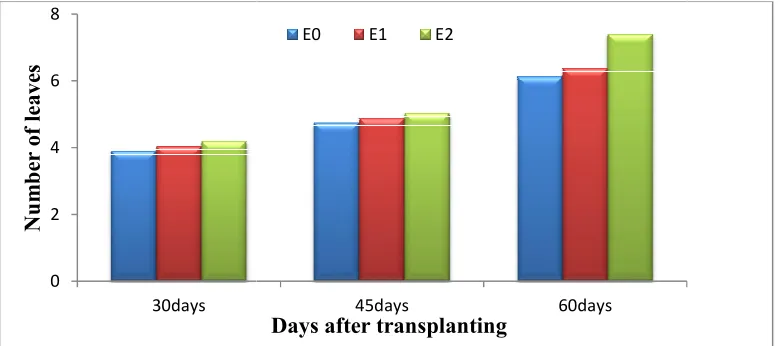
Remarkable variation was observed on number
of leaves plant-1 at different growth stages
influenced by earthing up of onion (Fig. 4). At the
60 DAT highest number of leaves plant-1 (7.40)
was found from the treatment E2 (Three times
earthing up) treatment and the lowest number of
leaves plant-1 (6.13) at 60 DAT was found from
the E0 (control) treatment which was statistically
identical with E1 (Two times earthing up)
treatment at all growth stages. The result obtained from the present study was similar with the findings of Ali [16].
Significant influence was noted on number of
leaves plant-1 affected by combined effect of
vermicompost and earthing up of onion (Table 3).
At the 60 DAT highest number of leaves plant-1
(7.27) was found from the V3E2 (treatment
combination) which was statistically identical to V3E1 and statistically similar with V3E0 and V2E1 (Treatment combination).The lowest number of
leaves plant-1 (5.27) at 60 DAT was found from
the V0E0 (treatment combination) which was
statistically similar with the treatment
combination of V0E1 at 60 DAT.
3.3 Root Length (cm)
Root length of onion varied significantly due to different levels of vermicompost application
(Table 4). It was found that the highest root
length (7.59 cm) was found from the V3 (14 t ha-1
vermicompost) treatment and the lowest root
length (5.04 cm) was found from the treatment V0
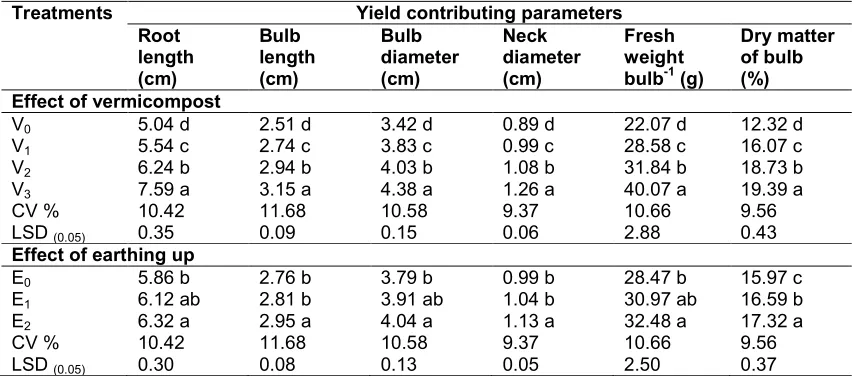
(control) treatment. Significant variation was remarked as influenced by earthing up of onion (Table 4). Results indicated that the highest root
length (6.32 cm) was found from the E2 (Three
times earthing up) treatment, which was
statistically similar with E1 (Two times earthing
up) treatment where the lowest root length (5.86
cm) was found from the E0 (control) treatment,
which was statistically similar to E1 treatment.
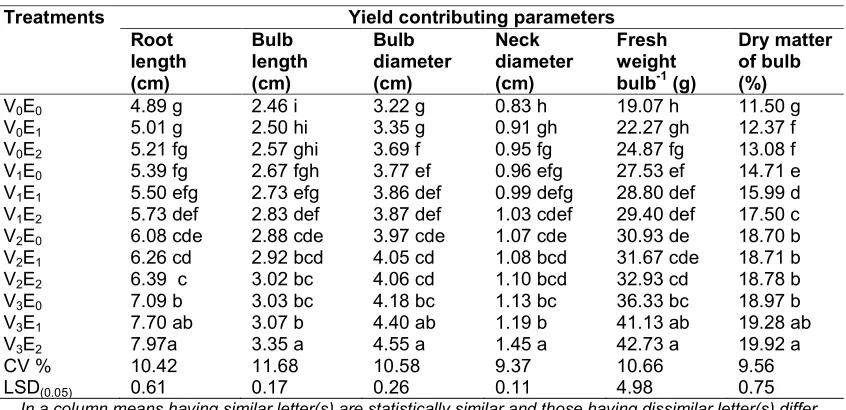
Root length was significantly influenced by combined effect of vermicompost and earthing up of onion (Table 5). The highest root length
(7.97 cm) was found from the V3E2 (treatment
combination) which was statistically similar with
the V3E1 (treatment combination). The lowest
root length (4.89 cm) was found from the V0E0
(control) treatment combination, which was
statistically identical with the treatment
combination of V0E1 and statistically similar with
V0E2, V1E0 and V1E1.
3.4 Bulb Length (cm)
Variation on bulb length was significantly influenced by different levels of vermicompost application (Table 4). The highest bulb length
(3.15 cm) was found from the V3 (14 t ha-1
vermicompost) treatment which was significantly
different from all other treatments followed by V2
(10 t ha-1 vermicompost). The lowest bulb length
(2.51 cm) was found from the treatment V0
(control; 0 t ha-1 vermicompost) which was also
significantly different from all other treatments
followed by V1 (4 t ha-1 vermicompost). The result
obtained from the present study was similar with the findings of [20,21]. Bulb length was significantly affected by earthing up of onion (Table 4). The highest bulb length (2.95 cm) was
found from the E2 (Three times earthing up)
treatment which was significantly different from all other treatments and the lowest bulb length (2.76 cm) was found from the E0 (control)
treatment which was statistically identical with E1
(Two times earthing up) treatment. The recorded data on bulb length was significantly influenced by combined effect of vermicompost and earthing up of onion (Table 5). The highest bulb length
(3.35 cm) was found from the V3E2 (treatment
combination), which was significantly different from all other treatment combinations followed by V3E1. The lowest bulb length (2.46 cm) was
found from the V0E0 (control) treatment
combination, which was statistically similar with
Table 2. Combined effect of vermicompost and earthing up on
Treatments
30 DAT
V0E0 24.20 j
V0E1 25.67 i
V0E2 26.67 hi
V1E0 27.40 gh
V1E1 27.73 gh
V1E2 28.13 fg
V2E0 28.93 ef
V2E1 29.67 de
V2E2 30.27 cd
V3E0 31.27 bc
V3E1 32.33 b
V3E2 33.80 a
CV % 8.62
LSD(0.05) 1.08
In a column means having similar letter(s) are statistically similar and those having dissimilar letter(s) differ significantly at 0.05 level of probability
Fig. 3. Effect of vermicompost on number of leaves plant
Here, V0 = Control, V1 = 6 t ha-1 vermicompost, V
3.5 Bulb Diameter (cm)
Considerable influenced was observed on bulb diameter persuaded by different levels of vermicompost application (Table 4). The highest bulb diameter (4.38 cm) was found from the
treatment V3 (8 t ha-1 vermicompost) which was
significantly different from all other treatments
followed by V2 (6 t ha
-1
vermicompost). The lowest bulb diameter (3.42 cm) was found from
the treatment V0 (control; 0 t ha-1 vermicompost)
followed by V1 (4 t ha
-1
vermicompost). Similar result was also observed by Kaswan
Remarkable variation was identified on bulb 0 1 2 3 4 5 6 7 8 30days
N
u
m
b
er
o
f
le
a
v
es
Monira et al.; APRJ, 3(1): 1-12, 2019; Article no.
Combined effect of vermicompost and earthing up on plant height at different after transplanting of onion
Plant height (cm) 45 DAT 32.33 i 34.73 h
26.67 hi 35.33 h
27.40 gh 36.07 gh
27.73 gh 37.33 fg
28.13 fg 38.20 ef
28.93 ef 39.33 de
29.67 de 41.20 cd
30.27 cd 42.07 bc
31.27 bc 42.40 bc
43.87 b 45.87 a 7.54 1.00
In a column means having similar letter(s) are statistically similar and those having dissimilar letter(s) differ significantly at 0.05 level of probability
Fig. 3. Effect of vermicompost on number of leaves plant-1 at different days after transplanting of onion
vermicompost, V2 = 10 t ha-1 vermicompost, V3 = 14 t ha-1 vermicompost
Considerable influenced was observed on bulb diameter persuaded by different levels of vermicompost application (Table 4). The highest bulb diameter (4.38 cm) was found from the vermicompost) which was ly different from all other treatments vermicompost). The lowest bulb diameter (3.42 cm) was found from vermicompost) vermicompost). Similar Kaswan et al. [17]. Remarkable variation was identified on bulb
diameter due to the effect of earthing up of onion (Table 4). The highest bulb diameter (4.04 cm) was found from the E2 (Three times earthing up) treatment, which was statistically similar wit (Two times earthing up) treatmen. The lowest bulb diameter (3.79 cm) was found from the E
(control) treatment. Bulb diameter was
significantly influenced by combined effect of vermicompost and earthing up of onion (Table 5). The highest bulb diameter (4.55 cm) was found
from the V3E2 (treatment combination) which was
statistically similar with the V3
combination). The lowest bulb diameter (3.22
cm) was found from the V0E0 (control) treatment
45days 60days
Days after transplanting
V0 V1 V2 V3
; Article no.APRJ.51588
height at different days
60 DAT 39.00 g 45.60 f 46.20 ef 47.27 d-f 48.67 c-f 49.00 c-f 49.73 c-e 50.27 b-d 51.53 a-c 52.00 a-c 54.07 ab 55.33 a 5.67 3.96
In a column means having similar letter(s) are statistically similar and those having dissimilar letter(s) differ
days after transplanting
vermicompost
diameter due to the effect of earthing up of onion (Table 4). The highest bulb diameter (4.04 cm) (Three times earthing up) treatment, which was statistically similar with E1 (Two times earthing up) treatmen. The lowest
bulb diameter (3.79 cm) was found from the E0
(control) treatment. Bulb diameter was
significantly influenced by combined effect of vermicompost and earthing up of onion (Table 5). (4.55 cm) was found (treatment combination) which was
3E1 (treatment
combination, which was statistically identical
the treatment combination of V0E1.
3.6 Neck Diameter (cm)
Neck diameter was varied significantly due to different levels of vermicompost application (Table 4). The highest neck diameter (1.26 cm)
was found from the V3 (14 t ha-1 vermicompost)
treatment which was significantly different from all other treatments followed by V
vermicompost). The lowest neck diameter (0.89
cm) was found from the V0 (control) treatment
which was also significantly different from all other treatments followed by V
vermicompost). The result obtained from the present study was similar with the findings of Mandal et al. [22]. Significant variation was remarked on neck diameter as influenced by earthing up of onion (Table 4). The highest neck diameter (1.13 cm) was found from the E
times earthing up) treatment which was significantly different from all other treatments where the lowest neck diameter (0.99 cm) was
found from the E0 (control) treatment which was
statistically identical with E1 (Two times earthing up) treatment. Neck diameter of onion was significantly influenced by combined effect of vermicompost and earthing up (Table 5). The highest neck diameter (1.45 cm) was found from the V3E2 (treatment combination), which was significantly different from all other treatment
combinations followed by V3E1. The lowest neck
diameter (0.83 cm) was found from the V (control) treatment combination, which was
Fig. 4. Effect of earthing up on number of leaves plant
Here, E0 = Control, E 0 2 4 6 8 30days
N
u
m
b
er
o
f
le
a
v
es
Monira et al.; APRJ, 3(1): 1-12, 2019; Article no.
combination, which was statistically identical with
Neck diameter was varied significantly due to different levels of vermicompost application (Table 4). The highest neck diameter (1.26 cm) vermicompost) treatment which was significantly different from
all other treatments followed by V2 (10 t ha-1
vermicompost). The lowest neck diameter (0.89 (control) treatment which was also significantly different from all
lowed by V1 (6 t ha
-1 vermicompost). The result obtained from the present study was similar with the findings of ]. Significant variation was remarked on neck diameter as influenced by earthing up of onion (Table 4). The highest neck
ter (1.13 cm) was found from the E2 (Three
times earthing up) treatment which was significantly different from all other treatments where the lowest neck diameter (0.99 cm) was (control) treatment which was (Two times earthing Neck diameter of onion was significantly influenced by combined effect of vermicompost and earthing up (Table 5). The highest neck diameter (1.45 cm) was found from (treatment combination), which was significantly different from all other treatment . The lowest neck diameter (0.83 cm) was found from the V0E0 (control) treatment combination, which was
statistically similar to V0E
combination.
3.7 Fresh Weight Bulb-1 (g)
Variation on fresh weight bulb-1 was significant
influenced by different levels of vermicompost application (Table 4). The highest fresh weight
bulb-1 (40.07 g) was found from the V
vermicompost) treatment where the lowest fresh
weight bulb-1 (22.07 g) was found from the V
(control) treatment which was significantly different from all other treatments. Similar result was also observed by Dhaker et al.
supported the present study. Fresh
was affected significantly by earthing up of onion (Table 4). The highest fresh weight bulb
g) was found from the E2 (Three times earthing
up) treatment, which was statistically similar with
E1 (Two times earthing up) treatment where
lowest fresh weight bulb-1 (28.47 g) was found
from the E0 (control) treatment which was
statistically similar to E1 (Two times earthing up)
treatment. Similar result was also observed by et al. [18] which supported the present study. The recorded data on neck diameter was significantly influenced by combined effect of vermicompost and earthing up of onion (Table 5).
The highest fresh weight bulb-1 (42.73 g) was
found from the V3E2 (treatment combination),
which was statistically similar with V
the lowest fresh weight bulb-1 (19.07 g) was
found from the treatment combination of V (control) which was statistically similar to V treatment combination.
4. Effect of earthing up on number of leaves plant-1 at different days after transplanting onion
= Control, E1 = Two times earthing up, E2 = Three times earthing up
45days 60days
Days after transplanting
E0 E1 E2
; Article no.APRJ.51588
E1 treatment
was significant influenced by different levels of vermicompost application (Table 4). The highest fresh weight
(40.07 g) was found from the V3 (14 t ha-1
treatment where the lowest fresh
(22.07 g) was found from the V0
(control) treatment which was significantly different from all other treatments. Similar result Dhaker et al. [23] which
supported the present study. Fresh weight bulb-1
was affected significantly by earthing up of onion
(Table 4). The highest fresh weight bulb-1 (32.48
(Three times earthing up) treatment, which was statistically similar with (Two times earthing up) treatment where the (28.47 g) was found (control) treatment which was (Two times earthing up) treatment. Similar result was also observed by Ali ] which supported the present study. data on neck diameter was significantly influenced by combined effect of vermicompost and earthing up of onion (Table 5). (42.73 g) was (treatment combination),
which was statistically similar with V3E1 where
(19.07 g) was
found from the treatment combination of V0E0
(control) which was statistically similar to V0E1
Monira et al.; APRJ, 3(1): 1-12, 2019; Article no.APRJ.51588
Table 3. Combined effect of vermicompost and earthing up on number of leaves plant-1 at different days after transplanting of onion
Treatments Number of leaves plant-1
30 DAT 45 DAT 60 DAT
V0E0 3.33 e 4.13 h 5.27 f
V0E1 3.67 de 4.40 g 5.60 ef
V0E2 3.73 c-e 4.53 fg 5.80 d-f
V1E0 3.80 b-e 4.67 ef 5.93 de
V1E1 3.93 b-e 4.80 de 6.20 c-e
V1E2 4.07 b-d 4.87 de 6.27 cd
V2E0 4.13 b-d 4.93 d 6.40 b-d
V2E1 4.13 b-d 5.00 cd 6.67 a-c
V2E2 4.20 a-d 5.20 bc 6.27 cd
V3E0 4.33 a-c 5.27 b 6.93 ab
V3E1 4.40 ab 5.33 ab 7.07 a
V3E2 4.80 a 5.53 a 7.27 a
CV % 7.45 8.62 9.97
LSD(0.05) 0.61 0.22 0.63
In a column means having similar letter(s) are statistically similar and those having dissimilar letter(s) differ significantly at 0.05 level of probability
Table 4. Effect of vermicompost and earthing up on yield contributing parameters of onion
Treatments Yield contributing parameters Root
length (cm)
Bulb length (cm)
Bulb diameter (cm)
Neck diameter (cm)
Fresh weight bulb-1 (g)
Dry matter of bulb (%) Effect of vermicompost
V0 5.04 d 2.51 d 3.42 d 0.89 d 22.07 d 12.32 d
V1 5.54 c 2.74 c 3.83 c 0.99 c 28.58 c 16.07 c
V2 6.24 b 2.94 b 4.03 b 1.08 b 31.84 b 18.73 b
V3 7.59 a 3.15 a 4.38 a 1.26 a 40.07 a 19.39 a
CV % 10.42 11.68 10.58 9.37 10.66 9.56
LSD (0.05) 0.35 0.09 0.15 0.06 2.88 0.43 Effect of earthing up
E0 5.86 b 2.76 b 3.79 b 0.99 b 28.47 b 15.97 c
E1 6.12 ab 2.81 b 3.91 ab 1.04 b 30.97 ab 16.59 b
E2 6.32 a 2.95 a 4.04 a 1.13 a 32.48 a 17.32 a
CV % 10.42 11.68 10.58 9.37 10.66 9.56
LSD (0.05) 0.30 0.08 0.13 0.05 2.50 0.37
In a column means having similar letter(s) are statistically similar and those having dissimilar letter(s) differ significantly at 0.05 level of probability
3.8 Dry Matter of Bulb (%)
Considerable influenced was observed on dry matter (%) of bulb persuaded by different levels of vermicompost application (Table 4). The highest dry matter (%) of bulb (19.39%) was
found from the V3 (14 t ha-1 vermicompost)
treatment, which was significantly different from
all other treatments followed by V2 (10 t ha-1
vermicompost). The lowest dry matter (%) of bulb
(12.32%) was found from the V0 (control)
treatment. Similar result was also found by Degwale [24] which supported the present study.
Remarkable variation was identified on dry matter (%) of bulb due to the effect of earthing up of onion (Table 4). The highest dry matter (%) of
bulb (17.32%) was found from the E2 (Three
times earthing up) treatment, which was significantly different from all other treatments where the lowest dry matter (%) of bulb (15.97
%) was found from the E0 (control) treatment.
Variation on dry matter (%) of bulb was significantly influenced by combined effect of vermicompost and earthing up (Table 5). The highest dry matter (%) of bulb (19.92%) was
Monira et al.; APRJ, 3(1): 1-12, 2019; Article no.APRJ.51588
which was statistically similar to V3E1. The lowest
dry matter (%) of bulb (11.50%) was found from
the V0E0 (control) treatment combination,
which was significantly different from all other
treatment combinations followed by V0E1 by and
V0E2.
3.9 Yield Plot-1 (g)
Yield plot-1 varied significantly due to different
levels of vermicompost application. The highest
yield plot-1 (527.89 g) was found from the V3 (14 t
ha-1 vermicompost) treatment, which was
significantly different from all other treatments V2
(10 t ha-1 vermicompost). The lowest yield plot-1
(324.11 g) was found from the V0 (control)
treatment which was also significantly different from all other treatments. Significant variation
was remarked on yield plot-1 as influenced by
earthing up of onion. The highest yield plot-1
(431.67 g) was found from the E2 (Three times
earthing up) treatment which was significantly
different from all other treatments followed by E1
(Two times earthing up) where the lowest yield
plot-1 (388.00 g) was found from the E0 (control)
treatment. Combined effect of vermicompost and earthing up of onion was significantly influenced
by yield plot-1 (Table 5).
Table 5. Combined effect of vermicompost and earthing up on yield contributing parameters of onion
Treatments Yield contributing parameters Root
length (cm)
Bulb length (cm)
Bulb diameter (cm)
Neck diameter (cm)
Fresh weight bulb-1 (g)
Dry matter of bulb (%)
V0E0 4.89 g 2.46 i 3.22 g 0.83 h 19.07 h 11.50 g
V0E1 5.01 g 2.50 hi 3.35 g 0.91 gh 22.27 gh 12.37 f
V0E2 5.21 fg 2.57 ghi 3.69 f 0.95 fg 24.87 fg 13.08 f
V1E0 5.39 fg 2.67 fgh 3.77 ef 0.96 efg 27.53 ef 14.71 e
V1E1 5.50 efg 2.73 efg 3.86 def 0.99 defg 28.80 def 15.99 d
V1E2 5.73 def 2.83 def 3.87 def 1.03 cdef 29.40 def 17.50 c
V2E0 6.08 cde 2.88 cde 3.97 cde 1.07 cde 30.93 de 18.70 b
V2E1 6.26 cd 2.92 bcd 4.05 cd 1.08 bcd 31.67 cde 18.71 b
V2E2 6.39 c 3.02 bc 4.06 cd 1.10 bcd 32.93 cd 18.78 b
V3E0 7.09 b 3.03 bc 4.18 bc 1.13 bc 36.33 bc 18.97 b
V3E1 7.70 ab 3.07 b 4.40 ab 1.19 b 41.13 ab 19.28 ab
V3E2 7.97a 3.35 a 4.55 a 1.45 a 42.73 a 19.92 a
CV % 10.42 11.68 10.58 9.37 10.66 9.56
LSD(0.05) 0.61 0.17 0.26 0.11 4.98 0.75
In a column means having similar letter(s) are statistically similar and those having dissimilar letter(s) differ significantly at 0.05 level of probability
Table 6. Effect of vermicompost and earthing up on yield parameters of onion
Treatments Yield parameters
Yield plot-1 (g) Yield ha-1 (t) Effect of vermicompost
V0 324.11 d 3.31 d
V1 363.67 c 3.71 c
V2 424.33 b 4.33 b
V3 527.89 a 5.39 a
CV % 12.87 11.43
LSD (0.05) 21.92 0.22
Effect of earthing up
E0 388.00 c 3.96 c
E1 410.33 b 4.19 b
E2 431.67 a 4.41 a
CV % 12.87 11.43
LSD (0.05) 18.98 0.19
Monira et al.; APRJ, 3(1): 1-12, 2019; Article no.APRJ.51588
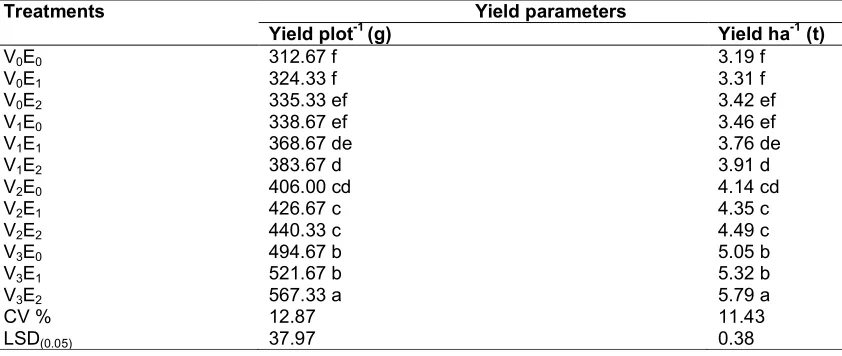
Table 7. Combined effect of vermicompost and earthing up on yield parameters of onion
Treatments Yield parameters
Yield plot-1 (g) Yield ha-1 (t)
V0E0 312.67 f 3.19 f
V0E1 324.33 f 3.31 f
V0E2 335.33 ef 3.42 ef
V1E0 338.67 ef 3.46 ef
V1E1 368.67 de 3.76 de
V1E2 383.67 d 3.91 d
V2E0 406.00 cd 4.14 cd
V2E1 426.67 c 4.35 c
V2E2 440.33 c 4.49 c
V3E0 494.67 b 5.05 b
V3E1 521.67 b 5.32 b
V3E2 567.33 a 5.79 a
CV % 12.87 11.43
LSD(0.05) 37.97 0.38
The result obtained from the present study was similar with the findings of Dhaker et al. [23]. The
highest yield plot-1 (567.33 g) was found from the
V3E2 (treatment combination), which was
significantly different from all other treatment
combinations followed by V3E1 and V3E0. The
lowest yield plot-1 (312.67 g) was found from the
V0E0 (control) treatment combination which was
statistically identical to V0E1 and statistically
similar to V0E2 and V1E0 treatment combination.
3.10 Yield Ha-1 (t)
Variation on yield ha-1 was noted significant
influenced by different levels of vermicompost application (Table 6). Results showed that the
highest yield ha-1 (5.39 t) was found from the V3
(14 t ha-1 vermicompost) treatment which was
significantly different from all other treatments
followed by V2 (10 t ha
-1
vermicompost). The
lowest yield ha-1 (3.31 t) was found from the V0
(control) treatment which was also significantly different from all other treatments followed by V1
(6 t ha-1 vermicompost). The result obtained from
the present study was similar with the findings of
[14,25]. Yield ha-1 was affected significantly
influenced by earthing up of onion (Table 6). The
highest yield ha-1 (4.41 t) was found from the E2
(Three times earthing up) treatment which was significantly different from all other treatments
where the lowest yield ha-1 (3.96 t) was found
from the E0 (control) treatment. The result
obtained from the present study was similar with the findings of Ali et al. (2007).
The recorded data on yield ha-1 was significantly
affected by combined effect of vermicompost and
earthing up (Table 7). The highest yield ha-1
(5.39 t) was found from the V3E2 (treatment
combination), which was significantly different from all other treatment combinations followed by
V3E0 and V3E1. The lowest yield ha-1 (3.31) was
found from the V0E0 (control) treatment
combination which was statistically identical to
V0E1 and statistically similar to V0E2 and V1E0
treatment combination.
4. CONCLUSION
Considering the above result of this experiment it can be said that vermicompost (14t ha-1) was superior to the others. It may be concluded that the efficient production of onion is increased by the application of vermicompost and earthing up. Thus the combination effect of vermicompost &
earthing up (V3E2) is more suitable for onion
production.
COMPETING INTERESTS
Authors have declared that no competing interests exist.
REFERENCES
1. Hernandez AH, Castillo D, Ojeda A, Arras
J, Lopez, Sanchez E. Effect of
vermicompost and compost on lettuce production. Chilean J. Agric. Res. 2010;70 (4):583-589.
2. Rahman MA, Mahmud JA, Islam MM.
Influence of mulching on the growth and yield of onion. Technical Journal of Engineering and Applied Sciences. 2013;3 (24):3497-3501.
3. BBS. Statistical year book of Bangladesh.
Monira et al.; APRJ, 3(1): 1-12, 2019; Article no.APRJ.51588
division, ministry of planning, government of the people’s republic of Bangladesh. 2015;137-138.
4. BBS. Statistical year book of bangladesh.
23th editions. Statistics and informatics
division, ministry of planning, Government of the People’s Republic of Bangladesh. 2012;107.
5. Aisha AH, Rizk FA, Shaheen AM,
Abdel-Mouty MM. Onion plant growth, bulbs yield and its physical and chemical properties as affected by organic and natural fertilization. Res. J. Agric. and Biol. Sci. 2007;3(5): 380-388.
6. Tindall M. Mineral and organic fertilizing in
cabbage. Residual effect for commercial
cultivation on yield and quality
performance with organic farming. Hort. Bras. 2000;6(1):15-20.
7. Shedeed SI, EL-Sayed, SAA, Abo Bash
DM. Effectiveness of bio-fertilizers with organic matter on the growth, yield and
nutrient content of Onion (Allium cepa L.)
plants. European Int. J. Sci. Tech. 2014;3 (9):115-122.
8. Shaheen AM, Rizk FA, Singer SM.
Growing onion plants without chemical fertilization. Res. J. Agric. Biol. Sci. 2007;3 (2):95-104.
9. Anonymous. Earthworm vermicompost: A
powerful crop nutrient over the
conventional compost & protective soil
conditioner against the destructive
chemical fertilizers for food safety
and security. Journal of Agriculture
and Environmental Science. 2009;5:
01-55.
10. Anonymous. Chinese cabbage or pet-sai
in: Vegetable production in the sub-tropics
and tropics. Overseas Technical
Cooperation Agency, Japan, Text Book. 1992;25:146 - 157.
11. Arancon NQ, Edwards CA, Bierman P,
Metzger JD, Lucht C. Effects of
vermicomposts produced from cattle
manure, food waste and paper
waste on the growth and yield of peppers in the field. Pedobiologia. 2005;49:297-306.
12. Arora VK, Singh CB, Sidhu AS, Thind SS.
Irrigation, tillage and mulching effects on soybean yield and water productivity in relation to soil texture. Agric Water Manag. 2011;98(4):563–568.
13. Tesfaye G, Derbew B, Solomon T.
Combined effect of plant spacing and time of earthingup on tuber quality parameters
of potato (Solanum tuberosum L.) at
Degem district, North Showa Zone of
Oromia regional state. Asian J. Crop Sci.
2013;5(1):24-32.
14. Mukherjee PK, Rahaman S, Maity SK,
Sinha B. Weed management practices in
potato. Solanum tuberosum L. Japanese
Crop Weed. 2012;8(1):178-180.
15. Gomez KA, Gomez AA. Statistical
procedure for agricultural research (2nd
edn.). Int. Rice Res. Inst. A Willey Int. Sci. Pub. 1984;28-192.
16. Reddy KC, Reddy KM. Differential levels
of vermicompost and nitrogen on growth
and yield in onion (Allium cepa L.) and
radish (Raphanus sativus L.) cropping
system. Journal of Research Angra U. 2005;33(1):11-17.
17. Kaswan PK, Yadav PK, Sharma BD.
Response of onion (Allium cepa L.)
varieties to FYM in arid region of Western Rajasthan. Annals of Horticulture. 2013;6 (1):30-34.
18. Ali MK, Alam MN, Barkotulla MAB,
Khandaker SMAT, Simon PW. Effect of earthing up and level of irrigation on yield and quality seed production of
onion. Progress. Agric. 2007;18(2):
81-91.
19. BARI. Krishi projukti hatboi, bangladesh
agricultural research institute. Joydevpur, Gazipur. 2012;1701:304.
20. Gopakkali P, Sharanappa. Effect of
organic farming practices on growth, yield,
quality and economics of onion (Allium
cepa L.) in dry zone of Karnataka. Indian
Journal of Agronomy. 2014;59(2):336- 340.
21. Zedan GJ. Effect of organic manure and
harvest date on growth and yield of onion
(Allium cepa L.). Journal of Tikrit University for Agricultural Sciences. 2011;11(1):263-275.
22. Mandal J, Ghosh C, Chattopadhyay GN.
Proportional substitution of chemical fertilizers with vermicompost on growth
and production potential of onion (Allium
cepa L.). International Journal of Bio-resource and Stress Management. 2013; 4(2):356-357.
23. Dhaker B, Sharma RK, Chhipa BG,
Rathore RS. Effect of different organic
manures on yield and quality of
onion (Allium cepa L.). Int. J. Curr.
Microbiol. App. Sci. 2017;6(11):
Monira et al.; APRJ, 3(1): 1-12, 2019; Article no.APRJ.51588
24. Degwale A. Effect of vermicompost on
growth, yield and quality of garlic (Allium
sativum l.) in enebse sar midir district,
northwestern ethiopia. Journal of
Natural Sciences Research. 2016;6(3):51-63.
25. Ansari AA. Effect of vermicompost and
vermiwash on the productivity of spinach
(Spinacia oleracea), onion (Allium cepa L.)
and potato (Solanum tuberosum). World
Journal of Agricultural Sciences. 2008;4(5): 554-557.
_________________________________________________________________________________ © 2019 Monira et al.; This is an Open Access article distributed under the terms of the Creative Commons Attribution License (http://creativecommons.org/licenses/by/4.0), which permits unrestricted use, distribution, and reproduction in any medium, provided the original work is properly cited.
Peer-review history: