S28 Journal of Neurosciences in Rural Practice | 2014 | Vol 5 | Supplement 1 Journal of Neurosciences in Rural Practice | 2014 | Vol 5 | Supplement 1 S29
S28 Journal of Neurosciences in Rural Practice | 2014 | Vol 5 | Supplement 1 Journal of Neurosciences in Rural Practice | 2014 | Vol 5 | Supplement 1 S29
Nidhi Yadav, Sumit Kar, Bhushan Madke, Digambar Dashatwar, Neha Singh, Kameshwar Prasad, Vikash Kesari1 Departments of Dermatology, Venereology, Leprosy and 1Community Medicine, Mahatma Gandhi Institute of Medical Sciences, Wardha, Maharashtra, India
Leprosy elimination: A myth busted
Introduction
Leprosy has afflicted humanity since time immemorial. It has left behind a terrifying image in history and human memory-of mutilation, rejection and exclusion from society. Leprosy has struck fear into human beings for thousands of years, and was well recognized in the oldest civilizations of China, Egypt and India.
Leprosy is mainly a chronic infectious disease caused by Mycobacterium leprae. The disease mainly affects the skin, the peripheral nerves, mucosa of the upper respiratory tract and eyes.
There are many countries in Asia, Africa and Latin America with a significant number of leprosy cases. It is estimated that there are between one and two million people visibly and irreversibly disabled due to past and present leprosy who require to be cared for by the community in which they live.
Leprosy still remains an important cause of disability even after adopting the resolution by World Health Assembly in 1991 to “eliminate leprosy as a public health problem by year 2000.”[1] It was the availability of effective multidrug treatment that led to the thought of leprosy elimination despite little understanding of its epidemiology.[2,3] The combination of biological and epidemiological evidence suggests that the leprosy cannot be eliminated by multidrug therapy alone as the microbiology of leprosy is still not fully elucidated. Leprosy should be grouped under the chronic stable diseases that are being successfully controlled.[4] Though the target of leprosy elimination was achieved at national level in 2006 even then a large proportion of leprosy
Address for correspondence:
Prof. Sumit Kar, Department of Dermatology, Venereology, Leprosy, Mahatma Gandhi Institute of Medical Sciences, Sewagram ‑ 442 102, Maharashtra, India. E‑mail: [email protected]
ABSTRACT
Background: Leprosy is mainly a chronic infectious disease caused by Mycobacterium leprae. The disease mainly affects the skin, the peripheral nerves, mucosa of the upper respiratory tract and eyes. Though the target of leprosy elimination was achieved at national level in 2006 even then a large proportion of leprosy cases reported globally still constitute from India. Aim and Objective: To study the clinico‑epidemiological profile of new cases of leprosy in a rural tertiary hospital. Materials and Methods: Thirty‑five newly diagnosed cases of leprosy presented in out‑patient/admitted in the department of Dermatology, Venereology and Leprosy (between September 2012 and August 2013) were included in the study. Detailed history regarding leprosy, deformity, sensory loss, skin smear for AFB and histopathological examination were done in every patient. Results: The incidence was more in age group of 20 to 39 years (48.57%) and 40 to 59 years (37.14%). 68.57% were males. 48.57% cases were found to have facial deformity and ear lobe thickening was found to be pre‑dominant form of facial deformity. Ulnar (88.87%) and common peroneal nerve (34.28%) were the most commonly involved nerves. The split skin smear examination was found to be positive in 27 out of 35 cases. On histopathological examination 10 patients (28.57%) were of lepromatous pole (LL), 4 (11.43%) were of indeterminate, 6 (17.14%) were of tuberculoid type (TT), 4 BT (11.4%) and 1 BL type (2.8%).
Conclusions: This study helps in concluding that leprosy is still not eliminated. Active surveillance is still needed to detect the sub‑clinical cases and undiagnosed cases.
Key words: Deformity, elimination, subclinical cases
Original Article
Access this article online Quick Response Code:
Website:
www.ruralneuropractice.com
DOI:
S28 Journal of Neurosciences in Rural Practice | 2014 | Vol 5 | Supplement 1 Journal of Neurosciences in Rural Practice | 2014 | Vol 5 | Supplement 1 S29
S28 Journal of Neurosciences in Rural Practice | 2014 | Vol 5 | Supplement 1 Journal of Neurosciences in Rural Practice | 2014 | Vol 5 | Supplement 1 S29
cases reported globally still constitute from India. In many countries the proportion of MB Leprosy cases among new cases remains still high like, for example, in Democratic Republic of Congo (72%), Indonesia (81%), Cuba (83%) and Kenya (99%).[5] Not only the indicator of active transmission, that is, proportion of children among new cases remains high (>20%) in countries like Liberia, Dominican Republic, Indonesia but also the trend shows increases in Nepal and Sudan up to 5% in the past few years and continues to remain high in India.[5,6] The indicator of late detection, that is, the proportion of new cases with grade-2 disabilities has also shown at higher levels in Madagascar, Sudan, and China. Out of the 17 countries, in 9 countries including India the trend is rising (from 2.2% in 2006 to 3.1% in 2010).[5] In 2011, of the total 219,075 new leprosy cases reported globally, 58.1% were detected only in India.[7] According to WHO Weekly Epidemiological Record 2013 the South-east Asian region accounts for 71% of new cases detected worldwide. Out of global total 232,857, new patients 134,752 have been detected in India in 2012 according to WER 2013.[8]
According to WHO Weekly Epidemiological Record 2013 the number of cases of leprosy (rate per 100 000 population) with grade-2 disabilities among new cases reported is 0.43. In 2009, of the 244,796 new cases reported globally, 133,717 were detected in India. Among them more than 10% were children which strongly indicate that active transmission is occurring.[9]
Objectives
To study the clinico-epidemiological profile of new cases of leprosy in a rural tertiary hospital.
Materials and Methods
The present study was conducted in the department of dermatology in a rural medical college in central India. The study was done from September 2012 to August 2013. Diagnosed leprosy patients either coming to out-patient department (OPD) or in-patient department (IPD) were included in the study. Thirty-five newly diagnosed cases of leprosy were detected during this period. Informed consent was taken from all the patients and only those patients providing consent were included in the study.
A structured pre-designed, pre-tested questionnaire was used to collect data related to socio-demographic profile and to record the findings or clinical examination and laboratory investigations.
After obtaining informed consent, brief history regarding the onset of symptoms and previous treatment taken, if any were obtained followed by thorough clinical examination of all the cases. After a thorough cutaneous and neural assessment, routine hematological investigations such as complete blood counts, blood sugar, and erythrocyte sedimentation rate were done followed by skin slit smear for acid-fast bacilli and histopathology.
All patients were diagnosed in the same way: first they were checked for the presence of skin and/or nerve lesions consistent with leprosy. Then slit skin smear examination was performed to demonstrate the presence of acid-fast bacilli. Subsequently patients were further classified into multi-bacillary (MB) or pauci bacillary (PB) patients, using the WHO classification based on number of lesion and skin smear positivity for AFB.[10] MB was defined as smear positive (with any number of lesions) or smear negative with more than five lesions, while the PB classification was assigned to smear-negative patients that had a maximum of five lesions. Biopsy was also done for histopathological examination. Patients are also examined for deformity and graded according to WHO classification of deformities of hand and foot.[11]
WHO Grading of hands and feet deformity
Grade 0: No anesthesia/no visibledeformity
Grade 1: Anesthesia present but no visible deformity Grade 2: Visible deformity/damage.
The collected data were encoded and entered electronically in computer using Epi info version 3.5.4 (CDC, Atlanta) and statistical analysis was also performed using the same software.
Results
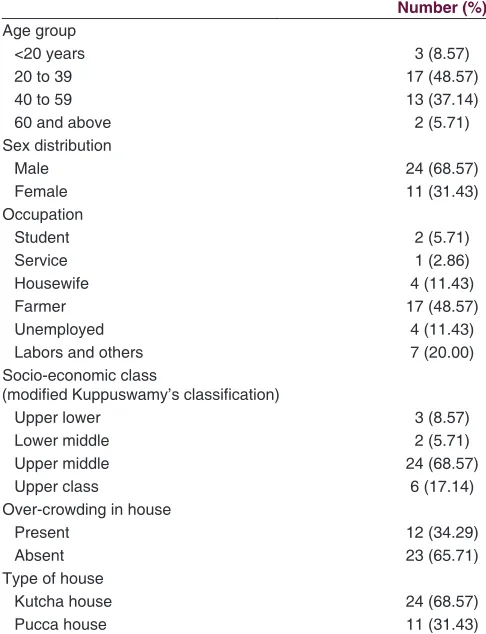
The basic socio-demographic profile of the patients is depicted in Table 1 which shows that out of 35 patients, 68.57% were males and 31.43% were females. 48.57% patients were from the age group of 20-39 years and 48.57% patients were farmers. 68.57% belong to upper middle class according to Kuppu-Swami’s classification.[12] In 34.29% of patients history of overcrowding was present.
S30 Journal of Neurosciences in Rural Practice | 2014 | Vol 5 | Supplement 1 Journal of Neurosciences in Rural Practice | 2014 | Vol 5 | Supplement 1 S31
Histogram in Figure 1 shows that eight patients were found to be negative for split skin AFB while the remaining patients were positive for SSS (Slit Skin Smear) for AFB. The value for SSS for AFB was between 5.1 and 6 for four patients which indicates a very high bacillary load.
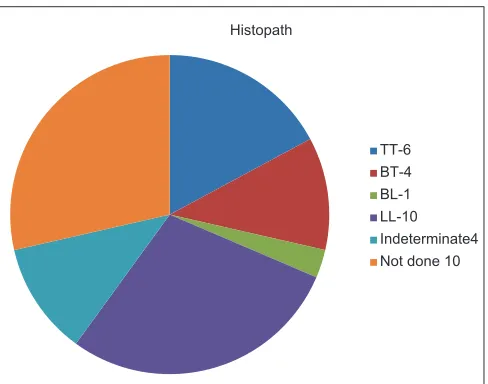
The pie chart in Figure 2 shows the histopathological classification of leprosy. Ten patients (28.57%) were of lepromatous pole (LL-lepromatous leprosy), 4 (11.43%) were of indeterminate, 6 (17.14%) were of tuberculoid type (TT), 4 BT (borderline tuberculoid) (11.4%) and 1 BL (borderline lepromatous) type (2.8).
Discussion
The goal of WHO for the elimination of leprosy has given a boost in this direction but has it been achieved? Global alliance has played a crucial role by publishing its evaluation report and recommended that the World Health Assembly should pass a clear cut resolution
Table 1: The basic socio‑demographic profile of
patients (n=35)
Number (%) Age group
<20 years 3 (8.57)
20 to 39 17 (48.57)
40 to 59 13 (37.14)
60 and above 2 (5.71)
Sex distribution
Male 24 (68.57)
Female 11 (31.43)
Occupation
Student 2 (5.71)
Service 1 (2.86)
Housewife 4 (11.43)
Farmer 17 (48.57)
Unemployed 4 (11.43)
Labors and others 7 (20.00)
Socio‑economic class
(modified Kuppuswamy’s classification)
Upper lower 3 (8.57)
Lower middle 2 (5.71)
Upper middle 24 (68.57)
Upper class 6 (17.14)
Over‑crowding in house
Present 12 (34.29)
Absent 23 (65.71)
Type of house
Kutcha house 24 (68.57)
Pucca house 11 (31.43)
Table 2: Associated medical history of the patients
Number (%)
History of any systemic disease 3 (8.57)
History of tuberculosis 0
History of diabetes mellitus 2 (5.71)
History of HIV 1 (2.86)
Family history of Hansen’s disease 1 (2.86)
HIV: Human immunodefeciency virus infection
45.7% patients had Grade 1 deformity and 2.9% had grade 2 deformity [Table 3]. Table 4 shows the facial deformities prevalence which were present in the form of depressed nasal bridge (8.6%), ciliary madarosis (2.9%) and ear lobe thickening (37.1%) [Table 4 ]. Table 5 shows that the deformities are mostly present in the age group of 20-39.
Table 6 is showing the relation of nerve involvement in leprosy. In 31 (bilateral ulnar nerve in 74.3% and unilateral in 14.3%) patients ulnar nerve was found to be thickened followed by common peroneal nerve which was thickened in 12 patients (34.28%). Median nerve was involved in 2.9%. In 20% patients of the patients posterior tibial nerve was thickened.
Table 5: Deformities in leprosy with age group
Age group 0‑Grade 0 1‑Grade 1 2‑Grade 2
<20 years 1 2 0
20 to 39 years 10 7 0
40 to 59 years 6 7 0
60 years and above 1 0 1
Table 6: Pattern of nerve involvement in leprosy
Nerve Number (%)
Common peroneal nerve 12 (34.28)
Median nerve 1 (2.9)
Posterior tibial nerve 7 (20)
Radial nerve 4 (11.42)
Ulnar nerve 31 (88.57)
Total number and percentage is more than 100 due to multiple nerve involvement in same patients
Table 3: Hand and foot deformities in leprosy according to WHO classification
Deformity Frequency Percentage
Grade 0 18 51.4
Grade 1 16 45.7
Grade 2 1 2.9
Total 35 00
Table 4: Facial deformities in leprosy
Number (%)
Depressed nasal bridge 3 (8.6)
Ciliary madarosis 1 (2.9)
S30 Journal of Neurosciences in Rural Practice | 2014 | Vol 5 | Supplement 1 Journal of Neurosciences in Rural Practice | 2014 | Vol 5 | Supplement 1 S31
to the world community that still the mankind could not be get rid of from the clutches of leprosy as it is not eliminated.[13-16] There may be a political agenda, aspiration of the people but the medical and scientific disciplines have not acquired enough base and ground to eradicate this disease.[17]
The present study also indicated high load of undiagnosed cases in the community. Leprosy seems to be affecting people across all age group although the incidence was more in the age group of 20 to 39 years (48.57%) and 40 to 59 years (37.14%). Leprosy is known to have male preponderance; in our study too the majority of the cases were of males (68.57%). Contrary to prior evidences, in our study the maximum number (68.57%) of leprosy cases were reported from upper middle socio-economic group. Presence of over-crowding in the house was not found be important contributor in incidence of leprosy in our study. Associated medical history or family history of Hansen’s disease was not associated with higher incidence of leprosy according to the present study [Table 2].
In the present study, 48.57% cases were found to have facial deformity and ear lobe thickening was found to be pre-dominant form of facial deformity [Table 4]. Majority of the cases presented with grade 0 deformity [Table 5]. The present study also strengthens the evidence that the ulnar (88.87%) and common peroneal nerves (34.28%) involvement is most common in leprosy cases [Table 6]. One important finding in this study is that majority of the patients are MB type and on histological examination the most common pattern was found to be lepromatous pattern. While in other studies BT was found to be the most prevalent type of leprosy in India.[18] The split skin smear examination was found to be positive in 27 out of 35 cases, that is, 77.1% [Figure 1].
The delivery of better health care system and management of better quality leprosy services can shoulder to a great
extent while good referral system can bring a revolutionary faith in the minds of the masses. We can achieve a major breakthrough results by reducing the deformity through early detection, self care, physiotherapy and reconstructive surgery and developing sound surveillance systems.
The political will power and vision and mission of the government can prove to be a guiding star and as well as devising strategies for eradication, elimination and prevention of this disease by the scientific and techno managerial professional community should go hand in hand in perfect harmony with the government.
Conclusion
The clinical, bacteriological, and histopathological characteristics of newly detected cases evidently indicate the grave nature of the problem. This study helps in concluding that leprosy is still not eliminated. Lepromatous type was found to be the most common pattern. Active surveillance is still needed to detect the sub clinical cases and undiagnosed cases.
References
1. World Health Assembly. Elimination of Leprosy: Resolution of the 44th World Health Assembly. Geneva: World Health Organization, 1991.
2. World Health Organziation Expert Committee on Leprosy. Seventh Report. World Health Organ Tech Rep Ser 1998;874:20.
3. Noorden SK. Epidemiology and control of leprosy: A review of progress over the last 30 years. Trans R Soc Trop Med Hyg 1993;87:515‑7.
4. Molyneux DH. “Neglected” diseases but unrecognized successes‑challenges and opportunities for infectious disease control. Lancet 2004;364:380‑3.
5. Leprosy update, 2011. Wkly Epidemiol Rec 2011;86:389‑99.
6. Singal A, Sonthalia S, Pandhi D. Childhood leprosy in a tertiary‑care
3RVLWLYH 1HJDWLYH
1XPEHURISDWLHQWV
Figure 1: Results of split skin smear (SSS) for acid fast bacilli in leprosy
77 %7 %/ // ,QGHWHUPLQDWH 1RWGRQH +LVWRSDWK
S32 Journal of Neurosciences in Rural Practice | 2014 | Vol 5 | Supplement 1 Journal of Neurosciences in Rural Practice | 2014 | Vol 5 | Supplement 1 SPB
hospital in Delhi, India: A reappraisal in the post‑elimination era. Lepr Rev 2011;82:259‑69.
7. Singal A, Sonthalia S. Leprosy in post‑elimination era in India: Difficult journey ahead. Indian J Dermatol 2013;58:443‑6.
8. Global leprosy: Update on the 2012 situation. Wkly Epidemiol Rec 2013;88:365‑79.
9. Global leprosy situation, 2010. Wkly Epidemiol Rec 2010;85:337‑48. 10. Duthie MS, Balagon MF, Maghanoy A, Orcullo FM, Cang M, Dias RF,
et al. Rapid quantitative serological test for detection of infection with Mycobacterium leprae, the causative agent of leprosy. J Clin Microbiol 2014;52:613‑9.
11. Brandsma JW, Van Brakel WH. WHO disability grading: Operational definitions. Lepr Rev 2003;74:366‑73.
12. Mishra D, Singh HP. Kuppuswamy’s socioeconomic status scale‑a revision. Indian J Pediatr 2003;70:273‑4.
13. Lockwood DN, Suneetha S. Leprosy: Too complex a disease for a simple elimination paradigm. Bull World Health Organ 2005;83:230‑5.
14. Braber KL. An evaluation of GAEL, the Global Alliance for the
Elimination of Leprosy. Lepr Rev 2004;75:208‑13.
15. Durston T. What lessons can we learn from the evaluation of GAEL? Lepr Rev 2004;75:214‑6.
16. Ji B. Comments on the report entitled ‘Independent evaluation of the Global Alliance for the Elimination of Leprosy’. Lepr Rev 2004;75:217‑20. 17. Smith C, Richardus JH. Leprosy strategy is about control, not eradication.
Lancet 2008;371:969‑70.
18. Shetty VP, Ghate SD, Wakade AV, Thakar UH, Thakur DV, D’souza E. Clinical, bacteriological, and histopathological characteristics of newly detected children with leprosy: A population based study in a defined rural and urban area of Maharashtra, Western India. Indian J Dermatol Venereol Leprol 2013;79:512‑7.
How to cite this article: Yadav N, Kar S, Madke B, Dashatwar D, Singh N, Prasad K, et al. Leprosy elimination: A myth busted. J Neurosci Rural Pract 2014;5:28‑32.
Source of Support: Nil. Conflict of Interest: None declared.
Author Help: Reference checking facility
The manuscript system (www.journalonweb.com) allows the authors to check and verify the accuracy and style of references. The tool checks the references with PubMed as per a predefined style. Authors are encouraged to use this facility, before submitting articles to the journal.
• The style as well as bibliographic elements should be 100% accurate, to help get the references verified from the system. Even a single spelling error or addition of issue number/month of publication will lead to an error when verifying the reference.
• Example of a correct style
Sheahan P, O’leary G, Lee G, Fitzgibbon J. Cystic cervical metastases: Incidence and diagnosis using fine needle aspiration biopsy. Otolaryngol Head Neck Surg 2002;127:294-8.
• Only the references from journals indexed in PubMed will be checked.
• Enter each reference in new line, without a serial number.
• Add up to a maximum of 15 references at a time.
• If the reference is correct for its bibliographic elements and punctuations, it will be shown as CORRECT and a link to the correct article in PubMed will be given.