COMPUTER SCIENCE & TECHNOLOGY
www.computerscijournal.org
December 2013, Vol. 6, No. (4): Pgs. 401-412 An International Open Free Access, Peer Reviewed Research Journal
Published By: Oriental Scientific Publishing Co., India.
INTROdUCTION
Blood loaded with oxygen comes into the hands through the arteries, and then again towards the heart through the veins. The oxygen depleted blood is not the same as the absorption filter arterial it absorbs light at wavelengths near infrared (about 760 microns).
When the hand is illuminated with infrared light, the vein appears black. It is recorded as an “identity card” in a database and can then be used for comparison during authentication.
There are two types of “photography”. Method “reflective” is more reliable than the
Biometric Technology Based on Hand Vein
SARAH BENzIANE and ABdELkAdER BENYETTOU
University of Oran Es Senia, Abdelkader Benyettou, University of Science and Technology of Oran, Algeria
(Received: November 03, 2013; Accepted: November 09, 2013)
ABSTRACT
After fingerprints or iris digital, biometric identification of an individual can now be done through the veins of the hand. This technique uses a “palm vein scanner”: it is an optical sensor capable of “photographing” the palm vein using the “near infrared rays.” This technique uses a “palm vein scanner”.Biometric authenticationbyrecognition offinger veinorpalmis especially developed by Hitachi and Fujitsuin Japansince 2005. Compared to thetechnologyusingfingerprint recognition, it offers the advantage of beingsafer andit does not involveany physical contactwith the sensor.Vein recognitionis performed byremote effectoptically. This paper presents a survey of the biometric systems technology based hand vein.We first review the component modules including the algorithms they employ. Finally, a summary of the accuracy results reported in the literature is also provided.
key words: Hand vein, palm, dorsal, finger, and biometric system.
transmission method (capture of light that passes through the hand). Indeed, when it is cold, the veins contract and the contrast is not quite visible transmission. For cons, the reflected light is not changed, and can use the same method reflective cold weather. On the other hand, the two parts of the device are in the same location, since the light is returned.
contactduring authenticationaswith fingerprints, so no hygiene problem. However, the method is stilltoo recent to beproperly assessed.Thescanneris relatively bulkycompared tofingerprint sensors.
As often noted in the literature, hand shape biometrics is attractive due to the following reasons:
1 We do not need to record photography:
respect for privacy,called “traceless" 1-2.
2 Readersof biometricsvenous systemeven
work withstained hands3.
3 High level ofsecurity,to date nomeansto
defraud4-5.
4 FAR - False Acceptance Rate (people
authenticated as someone else) is less than
0.001%6-7.
5 Durable: Do not change in time, unlike the
way or face or iris.
Operation of a hand veins-based biometric system
The biometric system has two purposes: authentication and identification.
Authentication or verification
It is better known amongst 1.1 8, because
it allows to certify (ensure) a claimed identity of the
user9.
Identification
It is better known one amongst N8, since it
allows users to determine which best fits the person to recognize. It adds the ability to check whether the user actually belongs to the database.
Based on the comparison result, the claimed identity is accepted or denied. The identification system includes the following modules: the sensor module, the feature extraction module, the matching module, the decision-making module and an optional template adaptation module.
The sensor module
In visible light, the veins are not apparent. Indeed, a multitude of other factors, including the surface characteristics such as moles, warts, scars,
pigmentation and hair can also hide the image9.
Fortunately, the use of the infrared light eliminates most unwanted surface features.
Required parameters to obtain good
quality data are listed below10-9.
1. The light affects the quality of the image
obtained with the exception of no IR filter.
2. The temperature of the ambient environment
must be neither too hot nor too cold, around the human body temperature.
3. The distance between the sensor and
the object should be sufficient for a good acquisition.
Starting with Jackson W. Wegelinpatent11,
ncludes a dispenser controller coupled to a memory unit, which includes a database of previously-stored vein patterns. A vein-pattern sensor maintained by the dispenser images the unique vein pattern of a user’s hand without contact. A recent study proposed using a three dimensional biometric
scanner1 for the capillary mapping of the palm of the
hand2 incorporates two image sensors5,6 configured
for obtaining a stereoscopic image of a vascular map and where for each image corresponding to each wave length, the depth of each point on the plane
is known12.Some multimodal biometric systems
captureplamprint/ finger vein15, hand geometry/
vein16. Other systems capture the palmar veins13-14.
Based on On registering finger vein information, a hand photography camera 106 photographs an image in a state where a finger is set to a finger vein reader 102, and it is discriminated of which finger the finger vein information is to be registered, on the basis of the photographed image. There is too
central combining several modalities as17 which
comprise a central command station (9) in signal communications (24a, 24b, 24c) with a series of blasting machines (16a, 16b, 16c). Command
station9 has a biometric analyser unit10 and a
authorizing means11. The blasting apparatuses
have enhanced security features by including
biometric analysis of specific biological features13
of an authorized blast operator to generate a known biometric signature. The biometric signature can be derived from a fingerprint scan; a recognition scan of a hand, a foot, an iris or a retina; a skin spectroscopy analysis; a finger vein pattern analysis; a voice recognition analysis; or a DNA fingerprint analysis.
The feature extraction module
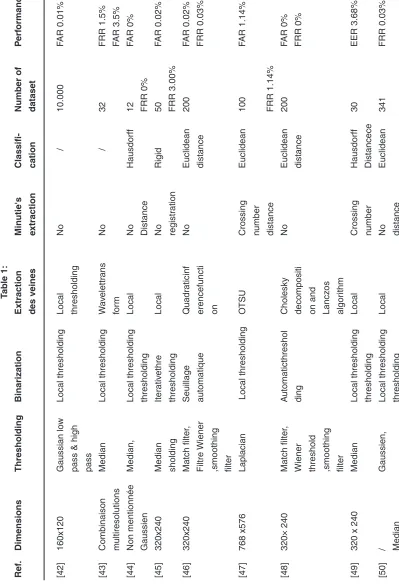
Tab le 1: Ref . d imensions Thresholding Binarization Extraction Min utie's Classifi-Number of P erf ormance des veines extraction cation dataset [42] 160x120 Gaussian lo w Local thresholding Local No / 10.000 FAR 0.01%
pass & high
thresholding pass [43] Combinaison Median Local thresholding W av elettr ans No / 32 FRR 1.5% m ultiresolutions for m FAR 3.5% [44] Non mentionnée Median, Local thresholding Local No Hausdorff 12 FAR 0% Gaussien thresholding Distance FRR 0% [45] 320x240 Median Iter ativ ethre Local No Rigid 50 FAR 0.02% sholding thresholding registr ation FRR 3.00% [46] 320x240 Match filter , Seuillage Quadr aticinf No Euclidean 200 FAR 0.02% Filtre Wiener automatique erencefuncti distance FRR 0.03% ,smoothing on filter [47] 768 x576 Laplacian Local thresholding O TSU Crossing Euclidean 100 FAR 1.14% number distance FRR 1.14% [48] 320× 240 Match filter , A utomaticthreshol Cholesky No Euclidean 200 FAR 0% Wiener ding decompositi distance FRR 0% threshold on and ,smoothing Lancz os filter algor ithm [49]
320 x 240
[51]
/
Median
O
TSU
Histog
rameq
Crossing
Tr
iangulation des
/
/
ualization&
number
min
uties
Local thresholding
[52]
640x480
/
Local thresholding
Local
/
/
thresholding
[53]
/
/
/
Histog
ram
Crossing
Housdroff
/
/
equalization
number
Distance
[54]
Wiener ,
Local thresholding
Local
HOUGH
K
20
/
Median&mor
ph
thresholding
Tr
ansf
or
mation
Nearest
ological
Neighbor
oper
ations
[55]
300×240
/
K-means
with k=2
ICA Method
No
Cosinesi
40
FRR 20%
milar
ity
measure
FAR 0%
[56]
Median,
Local thresholding
Local
No
Hausdorff
/
/
Gaussien high
thresholding
Distance
pass
, lo
the image, extract veins from hand, we need some techniques:
Format conversion JPEG BMP
The conversation JPEG BMP is required. Indeed, the main advantage of BMP image quality is provided as BMP format is not compressed and therefore no loss of quality. Against by the JPEG
format is compressed and therefore quality lost18.
Enhancement
The resulting image may not contain noise as tasks, blobs, dust ... ect. Different filters can be applied to eliminate the noise and enhance the image, but if the pictures have a good quality, this
step is not required19. In20, the clearness of the vein
pattern in the extracted ROI varies from image to image; they uses a 5x5 Median Filter to remove the speckling noise in the images and a 2-D Wiener filter to the ROI image to suppress the effect of
high frequency noise21. Uses a various contrast
enhancement techniques in order to compare which gives the best results, the study is very interest.
Converting the color image into a gray level Converting a color image into a grayscale means that the image size will be reduced from 24 bits per pixel (color image) to 8 bits per pixel
(grayscale image) 22-23. Instead of having three
matrices that represent the level of colors (red, green, blue) for each pixel, we have just a single matrix that represents the gray level for each pixel,
which reduces the processing time24-25.
Binarization
Binarization is the segmenting the image into two levels; object (hand region) and background; most of the time the object segment which is the region of interest (ROI) in white and
the background segment in black26-28.
Feature extraction
After the binarization, there is the most difficult step which is the feature extraction. Some
researchers add a step in this module29-32. Some
works uses the minutiae features extracted from the vein patterns for recognition, which include bifurcation points, ending points and the position
and orientation of minutiae points33,35,36,37. Uses it
with the vein finger, when [34] uses it with the dorsal
hand vein. In38 the feature extraction was based on
the geometry veins.
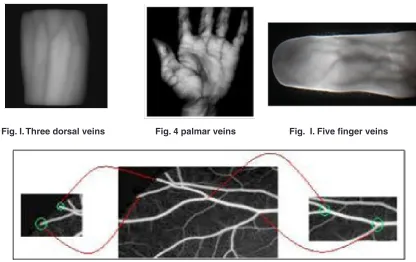
The figure below shows these minutiae (playback direction: from left to right).
We can call it too Identification/Authetication phase or then Verification. The image of the veins that was extracted in the previous phase allow us to create a database of prototypes with (s) models that are in the base (template) byAuthenticating the identity of an undividual, will either accept the person, or reject it. Instead of the identification, the system will identify the right person. In order to
evaluate theirsystem testing performance39, uses
a dataset of 500 persons of different ages above 16 and of different gender, each has 10 images per person was acquired at different intervals, 5 images for left hand and 5 images for right hand. [40] used correlation and template matching as
a recognition algorithm whether41 used Using
Principle Component Analysis (PCA).
Survey : biometrics dorsal veins
This last year’s many works has been made on the dorsal veins, the table below give the several techniques that has been used for each biometric step.
Thresholding (removing noise)
In [42], they used the low pass Gaussian filter (3 * 3) and high pass (11 * 11) to obtain a good image vein patterns. Others have preferred to use
the Median filter (5 * 5) instead of Gaussian43,45,49
in the case of 45 the Gaussian filter remove some
needed edges, as an alternative the Median filter
that conserves the edges49.
On the other hand, 44,42,57 used the two
filters: low pass Gaussian components to reduce the image having a high frequency (dark pixels) and Median (5 * 5) to remove speckles (the small jobs that appear in the image texture ). Another
technique has been adapted in58; the ridgelet
transform in order to eliminate noise and highlight the veins.
Tab
le 2:
Sur
ve
y:
the palm vein biometrics
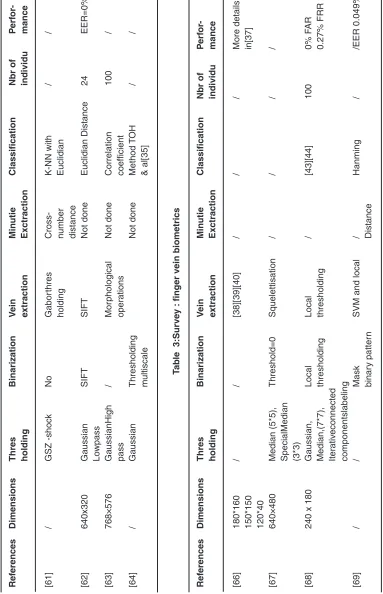
Ref erences d imensions Thres Binarization V ein Min utie Classification Nbr of P erf or -holding extraction Exctraction individu mance [61] / GS z -shoc k No Gabor thres Cross-K-NN with / / holding number Euclidian distance [62] 640x320 Gaussian SIFT SIFT Not done Euclidian Distance 24 EER=0% Lo wpass [63] 768×576 GaussianHigh / Mor phological Not done Correlation 100 / pass oper ations coefficient [64] / Gaussian Thresholding Not done Method TOH / / m ultiscale & al[35] Tab
le 3:Sur
ve
y :
fing
er vein biometrics
Ref erences d imensions Thres Binarization V ein Min utie Classification Nbr of P erf or -holding extraction Exctraction individu mance [66] 180*160 / / [38][39][40] / / / More details 150*150 in[37] 120*40 [67] 640×480 Median (5*5), Threshold=0 Squelettisation / / / /
SpecialMedian (3*3)
[68]
240 x 180
Gaussian, Local Local / [43][44] 100 0% F AR Median,(7*7), thresholding thresholding 0.27% FRR Iter ativ econnected componentslabeling [69] / / Mask
SVM and local
Binarization
Several techniques exist for the binarization.
Indeed42-45,47,48,56,used a local thresholding based on
the neighboring pixels, as it gives better results
compared to theglobal threshold8,11 have used
another type of automatic thresholding is OTSU, for
it requires shortprocessing time59.One more method
of binarization, is the K-means which was applied
with k = 2 (the bottom and hand)55.
Feature extraction
Some researchers divide this module in two steps extraction veins then extracting minutiae; sometimes we can found onlyfeature vein’s extraction.
Extraction veins
The local thresholdinggives good results;
for that it is very used in particular in30,42,44,45,50,5
1,52,53,56,43. Applied the wavelet transformation to
locate veins. Others used a quadratic function46,
for the reason that it has as main advantage reducing the size of the matrix; which has a direct
impact on the processing time classification46-47.
Used OTSU method which has been widely used for the document’s binarization; it often gives
the best results and the fast20. UsedCholesky
decomposition and Lanczos algorithm to reduce
the processing time. When,53 based on anhistogram
equalization;this makes dark pixels appear darker and bright pixels appear brighter. To get the right threshold from the histogram.
·
Extraction of minutiae
Crossing number used to extract more
properties on the veins29,30,60,28. used Hough
transform to isolate the end points that will be used
afterwards for classification54.
Classification
To compare the shape of the extracted
veins (s) size (s) of reference44,56,31,30 used the
Hausdorff distance, the test results showed that all the vein pattern images in the database have
been correctly recognized44,46,47,50. Used Euclidean
distance, the error rate of FAR and FRR was still reduced.
Others51 have used the method of minutiae
triangulation, which can form triangles from
minutiae (bifurcation points and end points). Then a score is generated by computing the number of triplets bifurcation and end points of the input image, and compared with the number of the triplets and end points that are stored in the database. Another
technique was used, the rigid registration51, which
showed that the right hand and the left hand of the same person are not identical. 4.3.1. Survey : palm vein biometrics
In the followed table, we quote some works that have been studiedaround the palm veins. The boxes marked with / want to say that the technique was not mentioned in references
In61, the filter-GSz shock was used to
eliminate noise and improve contours62-63. Used the
Gaussian filter to correct the contrast of the image63
used the Gaussian filter for high pass intensity improvement.
In61, they based on the Gabor filter to
extract the characteristics of the hand in the form of texture. Others have preferred to use a local
thresholding”SIFT”. In62 extract the hand and palm
vein doing like65, and showed the effectiveness of
this method for binarization. Another technique, which is the multi-level thresholding was applied
in64.
In61, they used the Gabor filter to extract
the veins, then they made a skeletonization to better visualize the veins.
In61, they used K-NN to classify individuals
where63 used another technique which is the
correlation coefficient; it is widely used in image
processing. By cons64 adopted the method of TOH
et al in66.
Enhancement
Used a filter oriented to improve the
image46. In67, the median filter (5 * 5) was used to
improve the image quality. Median filter and another Special (3 * 3) was applied after the detection of finger vein to eliminate all single points (unwanted
noise in the background) from the image67. In68, they
Fig. 1: Processing steps in an identity verification system using hand vein
Fig. I. Three dorsal veins Fig. 4 palmar veins Fig. I. Five finger veins
Fig. I. 6: End Points, veins branching points33
iterative labeling connected components because the picture still contains points not belonging to the finger vein.
Binarization
In67, a threshold (= 0) was set to extract to
the bottom. In68, they preferred to use an automatic
thresholding, which gives good results, based on
the pixel neighbors (more details are in67). Applied
a mask in order to detect the edges of the finger, and they reduced the size of the image taking area
of the finger69.
VeinExtraction
To extract finger vein, three algorithms
goal is to apply the methods used in fingerprint to
extract finger vein66 and see what happens. So, by
combining several resolutions, the algorithm used
in38 gave stable results for the FAR and FRR. In41,
they made the veins in the form of a skeleton using a fairly simple and effective.
Found that the finger veins are not always clear, so the solution is to use the local binary pattern, because it is a very robust method. Then
they45 classified the code that has been obtained
by this method into three categories: LA (Large amount), MA (Medieum amount) and SA (Small amount) using SVM.La figure below shows it. Also,
in45 they deduced that the minutiae extraction step is
not necessary, it takes a lot more time in treatment. So they have to add this step.
Classification
In67 used the methods found in43-44. By
cons69 used the Hamming distance based on the
LBP code has been extracted in the extraction phase characteristics are.
CONCLUSION
In a biometric system, two important criteria to consider: the accuracy of results and processing time. It is for this reason that this chapter has presented a state of the art biometrics veins of the hand, to discover different algorithms and study them in detail in the chapters that come after, starting from the second step is preprocessing to the classification, which aims to identify people by the dorsal veins of the hand.
Indeed, the most important operation in the preprocessing module is the binarization. Several techniques existbinarization, but to choose a single technique that meets these two criteria, a state of the art must be done in order to know the complexity of each algorithm and the quality of the results provided.
REFERENCES
1. Hisham Al-Assam, Sabah Jassim, Security
evaluation of biometric keys, Computers &
Security, 31(2): 151-163 (2012), ISSN 0167-4048, 10.1016/j.cose.2012.01.002.
2. Lakhdar.LIMAM,Lamine. HANINI, «Mise au
point d’un système d’acquisition biométrique : SAB-11 Veines de la main,» PFE pour l’obtention du diplôme d’ingenieur en instrumentation,Institut de maintenance et sécur ité industr ielle, Université d’Oran,Algérie, 2011.
3. Nicolás Antequera Diaz & José Sanchez Del
Rio Saez, 3d biometric scanner, EP 2413263 A1, 2012
4. Takahiro Aoki, Mitsuaki Fukuda & Soichi
Hama, Biometric authentication device and biometric authentication method, EP 2371283 A1, 2011
5. Ltd. IPO Tatsuyuki Hitachi Nakazawa, Ltd.
IPO Kazuyuki Hitachi yazumi, Biometric information registration apparatus, EP 1744264 A2, 2007
6. Eiji Makimoto, yasuo Mizuno,Kunihiro
Nomura, Hisao Ogata & Noboru Takamura,
Biometric Authentication Apparatus and Biometric Authentication Method, EP 2312495 A2, 2011
7. Blayn W Beenau, David S Bonalle, Seth W
Fields, William J Gray, Carl Larkin, Joshua L Montgomery, Peter D Saunders, Hand geometry biometrics on a payment device, US 8289136 B2, 2012
8. Ronald Stewart, Security enhanced blasting
apparatus with biometric analyzer and method of blasting, EP 2357442 A2, 2011
9. Pal, M. M., & Jasutkar, R. W. (2012,
May). Implementation of Hand Vein Structure Authentication Based System. In Communication Systems and Network Technologies (CSNT), 2012 International Conference on (pp. 114-118). IEEE.
10. Wang, L., & Leedham, G. (2006, November).
Near-and far-infrared imaging for vein pattern biometrics. In Video and Signal Based Surveillance, 2006. AVSS’06. IEEE International Conference on (pp. 52-52). IEEE.
of next generation: An overview. Second Generation Biometrics, 2010
12. Wang, L., Leedham, G., & Siu-yeung Cho,
D. (2008). Minutiae feature analysis for infrared hand vein pattern biometrics. Pattern Recognition, 41(3), 920-929.
13. ] Prasanna, R. D., Neelamegam, P., Sriram,
S., & Raju, N. (2012). Enhancement of Vein Patterns in Hand Image for Biometric and Biomedical Application using Various Image Enhancement Techniques. Procedia Engineering, 38, 1174-1185.
14. R.KAVITHA & al, « Localization of palm
dorsal vein pattern using image processing for automated intra venous drug needle inser tion,» Inter national Jour nal of Engineering Science and Technology, vol. 3, n° %16, pp. 4833-4838, June 2011
15. Loh yee.KOON , «Implementation of hand
vein biometricauthentification on FPGA-BASED embedded systèm,» thesis to obtain the degree of Bachelor of Engineering (Microelectronics), Faculty of Electrical Engineering, Universiti Teknologi Malaysia,… 2010.
16. Wang, J. G., yau, W. y., Suwandy, A., &
Sung, E. (2008). Person recognition by fusing palmprint and palm vein images based on “Laplacianpalm” representation. Pattern Recognition, 41(5), 1514-1527.
17. Wang, M. H., & Chung, y. K. (2012).
Applications of thermal image and extension theory to biometric personal recognition. Expert Systems with Applications.
18. Badawi, A. M. (2006, June). Hand vein
biometric verification prototype: A testing performance and patterns similarity. In Proceedings of the 2006 International Conference on Image Processing, Computer Vision, and Pattern Recognition, Las Vegas USA.
18. Wang, K., zhang, y., yuan, z., & zhuang, D.
(2006, June). Hand vein recognition based on multi supplemental features of multi-classifier fusion decision. In Mechatronics and Automation, Proceedings of the 2006 IEEE International Conference on (pp. 1790-1795). IEEE.
19. Kumar, A., & Prathyusha, K. V. (2009).
Personal authentication using hand vein
triangulation and knuckle shape. Image Processing, IEEE Transactions on, 18(9), 2127-2136.
20. Ajay KUMAR and K. Venkata PRATHyUSHA,
«Personal Authentication using Hand Vein Triangulation and Knuckle Shape,» IEEE Transactions on Image Processing, September, vol. 18, pp. 2127-2136 , 2009.
21. Peter Gregory, C. I. S. A., SIMON, Michael A.,
et al. Biometrics for dummies. For Dummies, 2008.
22. Loh yee.KOON , «Implementation of hand
vein biometricauthentification on FPGA-BASED embedded systèm,» thesis to obtain the degree of Bachelor of Engineering (Microelectronics), Faculty of Electrical Engineering, Universiti Teknologi Malaysia,, 2010.
23. M.M.Pal and W. R.Jasutkar, «Implementation
of hand vein structure authentification based system,» BIOINFO Computer Engineering, vol. 2, n° %11, pp. 19-21, 2012.
24. M.Rajalakshmii and R.Rengaraj, «Bimetric
authentification using near infrared images of palms dorsal vein patterns,» International Journal of Advanced Engineering Technology , vol. 2, n° %14, pp. 384-389, October-December, 2011
25. Malki, S., & Spaanenburg, L. (2007, May).
Hand veins feature extraction using DT-CNNS. In Microtechnologies for the New Millennium (pp. 65900N-65900N). International Society for Optics and Photonics.
26. Wang, L., Leedham, G., & Siu-yeung Cho,
D. (2008). Minutiae feature analysis for infrared hand vein pattern biometrics. Pattern Recognition, 41(3), 920-929.
27. Miura, N., Nagasaka, A., & Miyatake, T.
(2004). Feature extraction of finger-vein patterns based on repeated line tracking and its application to personal identification. Machine Vision and Applications, 15(4), 194-203.
28. Jain, A., Ross, A., & Prabhakar, S. (2001).
Fingerprint matching using minutiae and texture features. In Image Processing, 2001. Proceedings. 2001 International Conference on (Vol. 3, pp. 282-285). IEEE.
29. Jain, A. K., Hong, L., Pankanti, S., & Bolle,
using fingerprints. Proceedings of the IEEE, 85(9), 1365-1388.
30. Wang, K., zhang, y., yuan, z., & zhuang, D.
(2006, June). Hand vein recognition based on multi supplemental features of multi-classifier fusion decision. In Mechatronics and Automation, Proceedings of the 2006 IEEE International Conference on (pp. 1790-1795). IEEE.
31. Badawi, A. M. (2006, June). Hand vein
biometric verification prototype: A testing performance and patterns similarity. In Proceedings of the 2006 International Conference on Image Processing, Computer Vision, and Pattern Recognition, Las Vegas USA.
32. Tanaka, T., & Kubo, N. (2004, August).
Biometric authentication by hand vein patterns. In SICE 2004 Annual Conference (Vol. 1, pp. 249-253). IEEE.
33. Khan, M. H. M., Subramanian, R. K., & Khan,
N. M. (2009). Low dimensional representation of dorsal hand vein features using principle component analysis (PCA). World Academy of Science, Engineering and Technology, 49, 1001-1007.
34. Sang-Kyun.IM, Hyung-Man.PARK,
young-Wooang.KIM, S-Chan.HAN, Soo-Won. KIM,Chul-Hee.KANG,Chang-Kyung. CHUNG, «An biometric identication system by extracting hand vein patterns,» Journal of the Korean Physical Society, vol. 38, n° %13, pp. 268-272, March 2001.
35. Biometric verification using thermal images
of palm-dorsa vein-patterns
36. Lingyu WANG, Graham LEEDHAM, «A
thermal hand vein pattern verification system,» In Proceedings of ICAPR (2), pp. 58-69, 2005.
37. Mohamed SHAHIN, Ahmed BADAWI, and
Mohamed KAMEL, «Biometric Authentication Using Fast Correlation of Near Infrared Hand Vein Patterns,» International Journal of Biological and Medical Sciences 2:3, pp. 141-147, 2007.
38. Maleika Heenaye- Mamode KHAN and
Naushad Ali Mamode KHAN, «A new method to extract dorsal hand vein pattern,» International Journal of Computer Science and Information Security, vol. 6, n° %13, pp.
26-30, 2009.
39. Ajay KUMAR and K. Venkata PRATHyUSHA,
«Personal Authentication using Hand Vein Triangulation and Knuckle Shape,» IEEE Transactions on Image Processing, September, vol. 18, pp. 2127-2136 , 2009.
40. Maleika Heenaye- Mamode KHAN , Naushad
Mamode KHAN and Raja K.SUBRAMANIAN, «Feature Extraction of Dorsal Hand Vein Pattern using a fast modified PCA algorithm based on Cholesky decomposition and Lanczos technique,» International Journal of Mathematical and Computer Sciences, pp. 230-233, 2009.
41. Loh yee.KOON , «Implementation of hand
vein biometricauthentification on FPGA-BASED embedded systèm,» thesis to obtain the degree of Bachelor of Engineering (Microelectronics), Faculty of Electrical Engineering, Universiti Teknologi Malaysia,, 2010.
42. Mohit Sony ,SSandesh Gupta,M.S.Rao and
Phalguni GUPTA, «A new vein pattern-based
verification system,» International Journal of
Computer Science and Information Security,
vol. 8, n° %11, pp. 58-63, 2010.
43. M.RAJALAKSHMIi and R.RENGARAJ,
«Bimetric authentification using near infrared images of palms dorsal vein patterns,» International Journal of Advanced Engineering Technology , vol. 2, n° %14, pp. 384-389, October-December, 2011.
44. R.KAVITHA and Little FLOWER, «Localization
of palm dorsal vein pattern using image processing for automated intra venous drug needle insertion’’, International Journal of Engineering Science and Technology,» International Journal of Engineering Science and Technology, vol. 3, n° %16, pp. 4833-4838, June 2011.
45. M . M . PA L a n d W. R . J A S U T K A R ,
«Implementation of hand vein structure authentification based system,» BIOINFO Computer Engineering, vol. 2, n° %11, pp. 19-21, 2012.
46. C. NANDINIi,C.ASHWINI, Medha APARNA,
2, n° %15, pp. 837-840, 2012.
47. V. a. S.O.RAJANKAR, «Dorsal Hand Vein
Biometry by Independent Component Analysis,» International Journal on Computer Science and Engineering, vol. 4, n° %17, pp. 1338-1344, July 2012
48. G.SATHISH, S.V. SARAVANAN, S.
NARMADHA and S. Uma MAHESWARI, «Personal Authentication System using Hand Vein Biometric,» Int.J.Computer Technology & Applications, vol. 3, n° %11, pp. 383-391, JAN-FEB 2012.
49. C. NANDINIi,C.ASHWINI, Medha APARNA,
Nivedita RAMANI, Pragnya KINI and K.ShEEBA , «Biometric authentication by dorsal hand vein pattern,» International Journal of Engineering and Technology, vol. 2, n° %15, pp. 837-840, 2012.
50. X. H. a. S.-l. M. yu zHANG, «Feature
Extraction of Hand-Vein Patterns Based on Ridgelet Transform and Local Interconnection Structure Neural Network,» Intelligent Computing in Signal Processing and Pattern Recognition, pp. 870-875, 2006.
51. Olivier MOFFETTE, «Extraction des
informations nutritionnelles d’une étiquette alimentaire par vision artificielle,» Mémoire de maîtrise électronique, École de technologie supérieure,MONTRÉAL., 2011
52. WATANABE, Masaki, ENDOH, Toshio,
SHIOHARA, Morito, et al. Palm vein authentication technology and its applications. In : Proc. Biometric Consortium Conference, Arlington VA, USA. 2005.
53. M . M . PA L a n d W. R . J A S U T K A R ,
«Implementation of hand vein structure authentification based system,» BIOINFO Computer Engineering, vol. 2, n° %11, pp. 19-21, 2012.
54. M.Madheswaran, M.Deepamalar and, «An
improved multimodal palm vein recognition,» International Journal of Computer Theory and Engineering, vol. 2, n° %13, pp. 1793-8201, June, 2010.
55. Kar-Ann TOH, How-Lung ENG, yuen-Siong
CHOO,yoon-Leon CHA, Wei-yun yAU, and Kay-Soon LOW, «Identity verification through palm vein and crease texture,» chez
Advances in Biometrics, Springer-Verlag, Berlin, Heidelberg, zhang , D. and A.K. Jain , 2005, p. 546–553.
56. yi-Bo zHANG, Qin LI, Jane yOU, and
Prabir BHATTACHARyA, «Palm vein extraction and matching for personal authentication,» VISUAL’07 Proceedings of the 9th international conference on Advances in visual information systems, p. 154–164, 2007.
57. K . M I L KO L A J C z K , C. S C H M I D, « A
performance evaluation of local descriptors,» IEEE Transactions on Pattern Analysis and Machine Intelligence, vol. 27, n° %110, p. 1615–1630, 2005.
58. A.VENCKAUSKAS,N.MORKEVICIUS
and . Kulikauskas, «Stydy of finger vein authentification algorithms for physical access control,» Electronics and Electrical Engineering. – Kaunas: Technologija, vol. 121, n° %15, pp. 101-104, 2012.
59. Dana LORDROVA, Radim DVORAK,
Martin DRAHANSKy, and Filip ORSAG, «A new approach for veins detection,» chez Proceedings of Internation Conference BSBT 2009, Berlin, DE, 2009, pp. 76-80.
60. David MULyONO, Horng Shi JINN, «A
study of finger Vein biometric for personal identification,» Comput. Sci. & Inf. Eng, November 5, 2008.
61. Hyeon Chang LEE, Byung Jun KANG, Eui
Chul LEE, Kang Ryoung PARK, «Finger vein recognition using weighted local binary pattern,» Journal of zhejiang University-SCIENCE C (Computers & Electronics), pp. 514-524, 2010.
62. WANG, yunxin, WANG, Dayong, LIU,
Tiegen, et al. Local SIFT analysis for hand vein pattern verification. In : International Conference on Optical Instrumentation and Technology. International Society for Optics and Photonics, 2009. p. 751204-751204-8.
63. Benziane, Sarâh et Benyettou, Abdelkader.
State of Art: Hand Biometric. International Journal, 1963, vol. 2.
64. Debyo.Saptono, «Conception d’un outil de