http://ijessr.com Page 63 IMPROVING STUDENTS' DEMOCRATIC ATTITUDES THROUGH GROUP
INVESTIGATION LEARNING MODELS IN HISTORICAL LEARNING IN KRADENAN HIGH SCHOOL, INDONESIA.
Adi Setiawan, Sariyatun and Deni Tri Ardiyanto SebelasMaret University, History Education Department, Ir. Sutami Road No. 36A, Surakarta, Central Java, Indonesia.
ABSTRACT
This study aims to improve the democratic attitude of class XI students high school in Kradenan District through the application group investigation learning models in historical learning. This study aims to improve the democratic attitude of class XI students high school in Kradenan District through the application group investigation learning models in historical learning. Data is obtained through observation, interviews, and documentation during the research process. Data analysis using data triangulation, member check, and cross check. To determine the level of democratic attitudes of students, used democratic attitude questionnaire students using a Likert scale. The results obtained findings, (1) the use of historical learning teaching materials is still monotonous, (2) the models and methods used are still conventional, (3) the democratic attitude of students from the t hree classes wich use for sample in the research obtained percent value of 72% and 73%. From these findings it is important to use teaching materials and learning models that are creative and unconventional, as a stimulus in learning history to improve students' democratic attitudes.
KEYWORDS:History Education, Demokratis Attitude, Group Investigation
1. INTRODUCTION
Historical subjects in Indonesia today have become compulsory subjects at every level of education. However, in history learning there is one problem that still exists today in Indonesia, which is a subject that is less attractive to students. One of the things that causes this problem is the learning model used by history teachers is less creative and monotonous. As stated by Schunk (2008), tha t history subjects are less attractive to students. This is because the teacher does not appreciate and develops his insights in creating creative and interesting learning in the classroom.
http://ijessr.com Page 64 rights violations, egalitarian values that have not been socialized, truths played back, and a judicial mafia (Kusrahmadi, 2007).
Historical learning importantly role in improving students' democratic attitudes. In improving students' democratic attitudes through historical learning, a creative, not monotonous, and not needed conventional model of learning . Investigation group learning model can to an alternative in helping teachers to improve students' democratic attitudes through historical learning. Harahap (2017) Nuzullah (2016) has proven through his research on character education and citizenship education that using Group Investigation learning models can improve students' democratic attitudes. However, their research only focused on character education and civic education only. Without looking at historical learning, it is so important to improve students' democratic attitudes.
Historical learning can bring students to become democratic and critical citizens, uphold independence, values of tolerance, have local wisdom, have a high social spirit, and high social intelligence, through learning about historical events and other knowledge in it (Sardiman AM, 2004). Therefore, to realize it all requires interesting, ideal, and historical learning creative metode and not monotonous. This study aims to (1) Know the instructional materials used in the history of high school learning in Kradenan Subdistrict, (2) Know the historical learning model used by high schools in Kradenan District, (3) Know the democratic level of high school students in the District Kradenan.
2. METHODOLOGY
This type of research is qualitative descriptive research. Data obtained from the results of observations, interviews, and documentation obtained during the research process in the field. This research was held out in the Kradenan high school in Central Java province. The study in the course of from January 14, 2019 to February 26, 2019. Subjects in this study were history teachers of class XI MIPA and students of class XI MIPA of Kradenan high school.
Data collection techniques use through data reduction, data presentation, and conclusion drawing. Testing validity of the data using data triangulation, member checks, and cross checks(Sugiyono, 2013). To find the level of democratic attitudes of students, a democratic attitude questionnaire was used by students using the Likert scale (Likert, 1932). Questionnaires of students' democratic attitudes are developed from several indicators, namely, prioritizing common interests, tolerating or about other people's opinions, being critical of information or views, intelligent and considerate in making decisions, behaving discipline and obeying established regulations, upholding human values and dignity. This study focuses on the process of learning history and democratic attitudes of students in Kradenan high school, especially class XI MIPA.
http://ijessr.com Page 65 Learning history in Kradenan high school is still running conventionally, historical teaching materials used still refer to the government-provided textbooks and student enrichment books whose material is not quite different. So far there has been no further development of historical teaching materials used, both in class X, XI, and class XII.
Historical learning methods used are still conventional. The method used is more dominantly relying on the one-way lecture method, so students lack stimulus to be critical in expressing opinions. The position of the teacher in learning is still the subject of learning. Teaching materials and methods that are used fully have not followed the provisions in the 2013 curriculum that are used and established in education in Indonesia.
As a subject that has a goal to improve the democratic attitude of students, history subjects in secondary schools and the chancellor have not yet fully achieved this goal. The democratic attitude of high school students is still relatively low. The low democratic attitude of students can be seen from the results of questionnaires that have been given to students to find out the first level of democratic attitudes of students. Student democratic attitude questionnaire was conducted in class XI MIPA 4, XI MIPA 5, AND XI MIPA 3. The results of the student's democratic attitude questionnaire were 73% for MIPA 4 class and MIPA 5 class, and 72% for MIPA 6 class. The results showed importance of strengthening democratic attitude by way of historical learning.
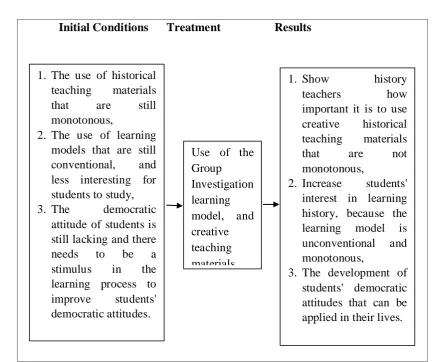
http://ijessr.com Page 66 Initial Conditions Treatment Results
Figure 1: Problem Solving Framework
4. DISCUSSION
Historical education is actually not only about historical events, but events that also occur in other fields of science. Therefore, historical education is called social science. Carole L. Hahn (2017) states “Social Studies educators have long asserted that studying and discussing issues is important to democracy”. Historical education is education that deepens the meaning and values of an event that has occurred so that wisdom can be taken. If historical learning is social studies, then the values of past historical events that become the background of this diverse nation can be lived out and manifested in life to establish a tolerant and democratic society. The importance of historical learning goals in shaping students to become good and democratic citizens must be supported by adequate and creative learning tools, especially the use of teaching materials and learning models that are not monotonous.
The curriculum used in the current education sector in Indonesia is the 2013 curriculum (K13). Therefore the process of learning history must also follow the rules of learning contained in K13. The learning process in the 2013 curriculum, must use fariative methods, teaching materials that are
Use of the Group Investigation learning model, and creative teaching materials
1. Show history
teachers how
important it is to use creative historical teaching materials
that are not
monotonous,
2. Increase students' interest in learning history, because the learning model is unconventional and monotonous,
3. The development of students' democratic attitudes that can be applied in their lives. 1. The use of historical
teaching materials that are still monotonous,
2. The use of learning models that are still conventional, and less interesting for students to study, 3. The democratic
http://ijessr.com Page 67 not monotonous, the learning process is centered on students and uses a scientific approach (Permendikbud, 2013). Smaldino (2012) states, the media and materials used by teachers in learning will affect the way students learn. Bahan ajar dapatdikatakan ideal jikamerupakankombinasidariberbagaikategoripengajaran, jenismateriterintegrasidanotentik. That is, the teaching material is really real, real, as it is in life (Ismawati, 2012).
The Group Investigation learning model will help teachers improve students' democratic attitudes, through historical learning. Joyce and Will (Huhtala and Coughlin, 1991) suggest that the Group Investigation Model is “To combine in one teaching strategy the form and dynamic of the democratic process and the process of academic inquiry“. Thus the Group Investigation model is devoted to creating a democratic learning atmosphere where each group member contributes his thoughts. In addition, in the process students are taught to respect and respect the opinions of their group mates. The Group Investigation learning model is a cooperative learning model that emphasizes the activity of students in inquiry learning. According to Sudjana (Anita et al., 2013) the Group Investigation learning model emphasizes the development of problem solving with a democratic atmosphere because all group members are involved in learning.
The use of the Group Investigation learning model in learning must be in accordance with the learning process in K13, which is to use the scientific approach with the following steps,
Steps of the Group Investigation
Learning Model with a Scientific Approach
Phase 1: Identifying Topics and dividing students into groups
The teacher as a motivator and facilitator provides an overview to students about the topic of learning:
• Observe (mengamati)
The teacher displays photos, or videos about the topic to be studied
• Ask (menanya)
1. Students analyze the topic of learning and ask the teacher to get a deep understanding of the topics to be discussed.
2. The teacher forms students into groups based on heterogeneity.
Phase 2 : Planning assigments • Associate (mengasosiasikan)
1. The teacher divides the sub topics into each group. 2. Each group is asked to understand and analyze the sub
topics that have been obtained by each group. Phase 3 : Make an inquiry
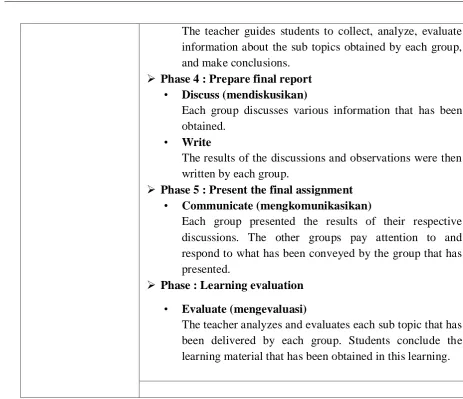
http://ijessr.com Page 68 The teacher guides students to collect, analyze, evaluate information about the sub topics obtained by each group, and make conclusions.
Phase 4 : Prepare final report • Discuss (mendiskusikan)
Each group discusses various information that has been obtained.
• Write
The results of the discussions and observations were then written by each group.
Phase 5 : Present the final assignment • Communicate (mengkomunikasikan)
Each group presented the results of their respective discussions. The other groups pay attention to and respond to what has been conveyed by the group that has presented.
Phase : Learning evaluation
• Evaluate (mengevaluasi)
The teacher analyzes and evaluates each sub topic that has been delivered by each group. Students conclude the learning material that has been obtained in this learning.
Table 2: Steps for Group Investigation with a scientific approach.
The importance of democratic attitudes in students is perceived at this time, not only needed in daily life, but also in the learning process. The democratic attitude of students in history learning is needed to foster mutual respect among others, especially wiser in interpreting every historical event in the history of learning that is much with interpretation. Quality of education develops through a continuous learning process as well as the democratic attitude of students. Students have the right to get teaching from teachers who are creative, innovative and fun. Students also have the right to get stimulus in developing their democratic attitudes through the learning process in schools, especially learning history.
5. CONCLUSION
http://ijessr.com Page 69 historical learning, and be able to improve students' democratic attitudes. The use of creative and unconventional learning models. The Group Investigation learning model is an alternative learning model that can be used by history teachers to improve students' democratic attitudes. Supporting factors in improving the democratic attitude of students through the investigation group learning model in history learning to include, the attachment of students in solving historical topics to continue to work together with each other, it takes cohesiveness between students in investigating topic solving, and complementing students in discussing to produce perfect group assignment.
REFERENCES
Anita, N. M. Y.Karyasa, I. W., &Tika, I. N. (2013). Pengaruh Model PembelajaranKooperatifTipe Group Investigation (GI) Terhadap Self-Efficacy Siswa. Jurnal Pendidikan danPembelajaran IPA Indonesia, 3(1).
Collingwood, R.C. (2001). The Principles Of History. New York: Oxford University Press.
Hahn, C. L. (2017). Social studies scholarship past, present, and future. The WileyHandbook ofSocial Studies Research, Hoboken, NJ: John Wiley & Sons, 569-95.
Harahap, Siti Syahraini. (2017). Pendidikan Karakter Dalam Menumbuhkan Sikap Demokratis Melalui Penerapan Model Pembelajaran Kooperatif Tipe Group Investigation. Prosiding Seminar Nasional Tahunan Fakultas Ilmu Sosial Universitas Negeri Medan, 1(1), 268- 272.
Huhtala, J., & Coughlin, E. B. (1991). Group investigation, democracy, and the middle east. English Journal, 80(5), 47.
Ismawati, Esti. 2012.TelaahKurikulumdanPengembanganBahan Ajar. Yogyakarta. PenerbitOmbak. Kusrahmadi, Sigit Dwi. (2007). Pentingnya Pendidikan Demokrasi Dalam Mewujudkan Masyarakat Sipil (Civil Society). Universitas Negeri Yogyakarta; 1-9. http://Staffnew.ibu.ac.id.
Likert, Rensis (1932), A Technique for the Measurement of Attitude. Archives of Psychology. 140: 1-55. https://psycnet.apa.org.
Nuzullah, Firdaus. (2016). Penerapan Model Pembelajaran Investigasi Kelompok (Group Investigation) Dalam Mata Pelajaran PKN Untuk Meningkatkan Sikap Demokratis Siswa (Penelitian Tindakan Kelas Pada Siswa Kelas XI B SMP N 12 Bandung). Skripsi Fakultas Pendidikan Ilmu Pengetahuan Sosial Universitas Pendidikan Indonesia.
Permendikbud. (2013). Peraturan Menteri Pendidikan dan Kebudayaan Republik Indonesia Nomor 65 Tahun 2013 Tentang Standar Proses Pendidikan Dasar dan Menengah.
Sardiman AM. (2004). Kebijakan dan Strategi Pendidikan Sejarah Di Era Reformasi. Makalah Diskusi Sejarah di Era Pembangunan. Kementerian Kebudayaan dan Pariwisata bekerja sama dengan Balai Kajian Sejarah dan Nilai-Nilai Tradisional Yogyakarta.
Schunk, D.H. (2008). Learning Theoris: An Educational Perspective. New Jersey: Pearson Merrill Prentice Hall.
Smaldino, E. Sharon, dkk. 2012. Intructional Technologi and Media For Learning. Jakarta. KencanaPrenada Media Group.
http://ijessr.com Page 70 Suyahmo, & Muh. Aris M. (2017). Solusi Permasalahan Proses Demokrasi Di Indonesia Modern
Melalui Peningkatan Kemampuan Musyawarah Sejak Dini. Journal