A NEW PROCEDURE FOR ELECTROLESSTIN
PLATING OF COPPER
ALI AkbAR MOTTAhEDI
Iranian Research Organization for Science and Technology (IROST) Arak Centre, Ghoddoosi Bolvard, Arak P. O. Box :35135, Arak (Iran)
(Received, April 25, 2004) AbSTRACT
An aqueous salt composition bath and methods for immersion plating gave increased deposition rates and thicker coatings of better adhesion. It was accomplished by incorporating into immersion plating tin bath of SnCI2, 2H20 in the amount of 23 g per litre and cyanide ion complexing agent for the copper, such as NaCN in the amount of 19.6 g per litre. The bath solution contains NaHC03 as an agent for adjusting the pH in the resulting bath in the amount of 10 g per litre.
keywords : Aqueous salt composition bath, Immersion plating, Cyanide ion complexing agent.
INTRODUCTION
There are three methods for plating of metal onto a substrate. These methods are (1) Electroless plating (2) Immersion plating and (3) Electroplating. The choice of method to employ for a given plating step often controlled by the choice of substrate or disadvantages of the respective methods1-6. Although both methods (1) and (2) may be broadly characterized an electroless plating, this later term used herein after well be restricted to its narrower definitation7-9. Some of the electroplating disadvantages are: a conductive path is required for the desired circuit pattern; due to uneven current densities, the “throwing power” of electrolytic baths can never reach the desired uniformity of deposit, e.g. with irregularity substrate6,9,10. Tin is electrolytically deposited in thickness typically from 0.2 to 2.0 ì when used in a printed and other circuity to provide a solderable finish, a contact material, or a corrosion resist. Tin can readily be deposited from acid solutions at room temperature10-13. Where a lower melting point material is required, electroless plating involves the use of plating bath without the imposition of any electric current, where the substrate is plated by
reduction of the plating metal from a solution of a plating metal. The plating solution contains controlled reducing agents, which are generally either catalyzed by the surface of the substrate or by some catalytic metal implaced onto the surface of the substrate or by some catalytic metal implaced onto the surface both to initiate the reduction and to give good adherence. Since the plated on surface is autocatalytic, an electroless process can be used to build up good thickness1,9,14,15. Furthermore, since an electroless procedure is not dependent upon current densities, the resulting coating is of excellent uniformity. However, reducing agents in electroless baths must be controlled in order to avoid spontaneous reduction of the metal in the bath, e.g. to a fine powder. The reduction is not localized at the surface of the substrate hence considerable losses may occur16-18. Moreover, with copper based substrates in baths are affected adversely, by contaminants such as cyanides, lead, zinc and manganese and cadmium. Immersion plating, like electroless plating, does not employ an electric current.
rection which depends on the position that the substrate metal occupies in the electromotive series with respect to the metal to be deposited from the solution4,7,19. From the foregoing it can be appreciated that due to various disadvantages inherent in electroplating and immersion plating, electroless coating would for a great many applications be a more desirable method if a greater plating rate could be achieved and if a thicker final^ plating coating were possible all with reduced whisker growth20. Therefore, objects of the present work include methods and baths for electroless plating which overcome or minimize by a great order of magnitude each of these aforementioned limitations more specially, an object of the present work in a noval method giving a faster rate of
electroless plating so as to be more competitive with the other types of the plating methods.
EXPERIMENTAL
MATERIAlS ANd REAGENTS
All chemicals were of analytical reagent grade and purchased from Merck Chemical Company and used without further purification. Experiment 1
A 9 gr. portion of SnCI2, 2H20 plus 7 gr. of NaOH and 0.7 gr. of NaCN were dissolved in 330 ml of distilled water. The solution was magnetically stirred for five minutes. At this point, the suspension solution became clear and the pH was 10 at 73 degree F. By immersion of copper plate into the solution and waiting for five minutes, the surface of the copper was covered by tin with snowy colour and very weak adhesion.
Experiment 2
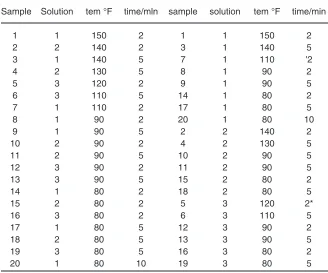
A bath composition according to the experiment 1 where in the amount of NaCN was raised to 1.2 gr. The white color suspension became Table 1 : data of experiments 8 to 16
Sample Sol tem time/ sample sol tem° ution °F mln ution
1 1 150 2 1 1 150
2
* = hour 2 140 2 3 1 140
Table 2 : data of experiments 17
Sample Solution tem °F time/mln sample solution tem °F time/min
1 1 150 2 1 1 150 2
2 2 140 2 3 1 140 5
3 1 140 5 7 1 110 '2
4 2 130 5 8 1 90 2
5 3 120 2 9 1 90 5
6 3 110 5 14 1 80 2
7 1 110 2 17 1 80 5
8 1 90 2 20 1 80 10
9 1 90 5 2 2 140 2
10 2 90 2 4 2 130 5
11 2 90 5 10 2 90 5
12 3 90 2 11 2 90 5
13 3 90 5 15 2 80 2
14 1 80 2 18 2 80 5
15 2 80 2 5 3 120 2*
16 3 80 2 6 3 110 5
17 1 80 5 12 3 90 2
18 2 80 5 13 3 90 5
19 3 80 5 16 3 80 2
precipitated, the pH jumped up and the plating was changed to dark colour with better adhesion effect. Experiment 3
A bath solution according to the experiment 1 wherein the amount of NaCN was increased to 1.7 gr. In this case, the thickness of the plating became higher and solution was turned to white color. Experiment 4
The solution of experiment 3 was heated to 120 degree F, the thickness of the plating was increased and its color became dark.
Experiment 5
A 9 gr. portion of SnCI2, 2H20 plus 7 gr. of NaOH and 4.3 gr. of NaCN were dissolved in 330 ml of distilled water. By increasing the temperature to 150 degree F, a black powder started precipitating and the quality of plating became so bad and it was removed by washing.
Experiment 6
A bath composition according to the experiment 5 was prepared and the temperature was adjusted to 120 degree F. the plating became more shinning with lower thickness.
Table 4 :The solutions of experiments 19 to 25 Sample Vol.of sol. NaCN gr/lit Sn+2 gr/lit NaHCO, gr/lit
1 50 19.6 24
2 50 19.6 24
3 50 19.6 24 20
4 200 19.6 22.5
---5 200 19.6 22.5
---6 200 19.6 22.5 20
7 500 19.6 23 10
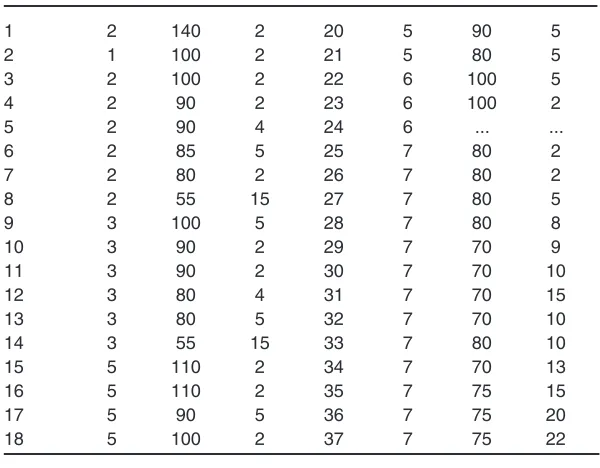
Table 3 : data of experiment
Sample Solution tem °F tlme/mln sample solution tem °F time/mln
1 2 140 2 20 5 90 5
2 1 100 2 21 5 80 5
3 2 100 2 22 6 100 5
4 2 90 2 23 6 100 2
5 2 90 4 24 6 ... ...
6 2 85 5 25 7 80 2
7 2 80 2 26 7 80 2
8 2 55 15 27 7 80 5
9 3 100 5 28 7 80 8
10 3 90 2 29 7 70 9
11 3 90 2 30 7 70 10
12 3 80 4 31 7 70 15
13 3 80 5 32 7 70 10
14 3 55 15 33 7 80 10
15 5 110 2 34 7 70 13
16 5 110 2 35 7 75 15
17 5 90 5 36 7 75 20
Experiment 7
A 1 gr. portion of NaCN was dissolved in 50 ml of distilled water. The temperature of the solution was raised to 160 degree of F and 1 gr. SnCI2, 2H20 was added to the solution. At this point the color of the solution became pink. The plating process was done at 140 degree F and the quality of coating was not good.
Experiment 8
A bath solution with 1 gr. of Na2C03 plus 0.9 gr. NaCN and 1 gr. of SnCI2, 2H20 in 50 ml of distilled water was made. The plating was done at 140 degree F in 2 miutes. The adhesion and thickness were acceptable, but the color was muddy.
Experiment 9
We run the experiment 8 at 120 degree F for 5 minutes. The results did not change.
Experiment 10
A bath solution according to the experiment 8 was prepared. The temperature was kept at 100 degree F and the coating time was 5 minutes. The result was so good, but the color of coating was not bright.
Experiment 11
The same solution as experiment 8 at 80 degree F for 5 minutes gave good adhesion, lower thickness and better shinning.
Experiment 12
The same solution as experiment 8 at 70 degree F and 5 minutes showed low thickness, good
adhesion and better shinning. Experiment 13
A bath solution according to the experiment 8 at 60 degree for 5 minutes was run. The thickness of the plating and adhesion were almost good, but the color was muddy.
Experiment 14
A mixture of 2.0 gr, NaCN, 4 gr. SnCI2,2H20, were dissolved in 200 ml of distilled water. The temperature was raised to 140 degree F and the plating was done in 7 minutes. The thickness of the coating, adhesion and the shinning were almost acceptable.
[Cu(CN)2¯ ]2 [Sn+2][CN¯ ]4
...(2) b). a bath according to part (a) was made without NaHC03. The results are indicated in the Table 2. It is clear that, by increasing the denominator of the expression (2), we increase the. In the denominator, the concentration of CN has power four. So, in practice, we see a change in the
Experiment-18
The solutions of the experiment 19 concentration of CN” has more effects than other to 25 were made according to the Table 3. The chemicals.
results are shown in the Table 4. The life time of the reaction depends to the E. By reaching E to zero, the reaction will stop. According to the equation(1), it is possible to find:
RESULTS AND DISCUSSION
The mechanism of the galvanic or immersion coating for this reaction is known as:
[Cu(CN)2¯ ]2 [Sn+2][CN¯ ]4 < 6 x 10⁹ 2 Cu + 4CN → 2 Cu(CN2)Sn+2 + 2e
→ SnE” = +0.430 ev. E° = -0.136 ev.
So, the stability constant of the reaciton is high and the reaction will go as long as the reactants exist451421*4.
is:
2 Cu + Sn+2 + 4CN- → Sn + 2 Cu(CN)2-Fig. 1:Thickness of plating versus time
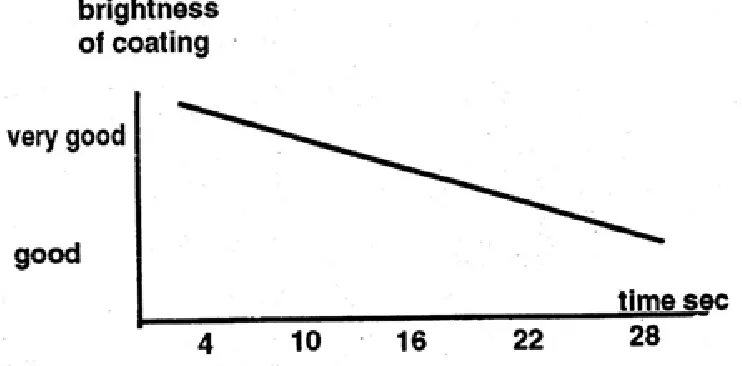
Fig. 2: Shinning of coating versus time of plating
E° = -0.294 ev.
The electromotive force for this reaction [Cu(CN) ]2
Shinning is one of the most important factor of this kind of plating. Sodium carbonate, sodium hydrogen carbonate or sodium hydroxide gives the required pH for the reaction. They also have bad effect on the shinning of the coating20. Plating in the presence of sodium carbonate will
result in unbright coating. Impurity of chemicals E = E0 -(0.0591/2)log
[Sn+2 ]4
(d will also give muddy plating2 28. The best result by this kind of method is to do
plating twice29"31. Figure 1 and Figure 2 show the relation between thickness and shinning of coating versus time of plating respectively. As we can
see in Figure 1, the best plating time at 70-80°F is 15 seconds. According to Figure 2, we have acceptable shinning at this time of coating. By giving more time to the reaction, we get more thickness, but we lose the brightness of the plating. At this condition, the adhesion of the coating and soldering were very good.
CONCLUSION
A 19.6 gr. portion of NaCN was dissolved in 1 litre of distilled water. After that, 23 gr. of SnCl2 2H2 O was added slowly to this solution. By dissolving this compound, the temperature was plating was done for five minutes. Under this raised to 160 degree F and then 10 gr. of NaHC03 condition, the coating became more bright than was added to the mixture. The solution was stirred for 5 minutes and the temperature was lowered to 70 degree F. At this point, the others which are commercially available. The cost of plating by this method is almost 10% of the price which we can get in the market.
REFERENCES 1. “Symposium on Electroless Plating” Am Soc
Test Mater Spec Tech Publ, 265, (1959) 2. J Macdermott, Plating of Plastics with metals,
Chemical Technology Review No. 27, Noyes data Corp, Park Ridge N. J. (1974)
3. Pearlstein F and Bellis H E, Electroless
Plating of Metals, American Electroplaters Society, Winter Park, Fla, (1972)
4. Mindt W, J Electrochem Soc, 117, 615 (1970)
6. Castello F A, U S Pat, No. 4061802, dec 6 (1977)
7. Saubestre E B, Plating, 59, 563 (1972) 8. Kazmachei B Y, Chem Abstr, 68, 89414n
(1968)
9. Cavallotti P and Salvago G, Electrochim Metal, 3, 23, 239 (1968)
10. Gutzeit G and Krieg A, U S Pat, No 2999770, Sept 12 (1961)
11. dockus K, U S Pat, No. 4028200, June 7 (1977)
12. Feldstein N, Plating, 61, 146 (1974) 13. Wedel R G, Int Metal Rev, 217, 97 (1977) 14. Krulik J A, J Chem Ed, 35, 361, (1978) 15. Krulik J A, Jameson M N, Fr Pat, No 2310158,
May 5 (1976)
16. Shipley C R, U S Pat, No 3011920, dec 5(1961)
18. Zeblisky R J, U S Pat, No 368671, Aug 8 (1972)
19. diBari G A, Plating, 60, 1252 (1973) 20. Mallory G l, Plating, 61, 1005 (1974)
21. davis T F, U S Pat, No 4093466, June 6 (1978)
22. Mulla M, U S Pat, No. 3764352, Oct 9 (1973)
23. Grunwald J J, Rhodenizer H and Slominski l, Plating, 57, 1004 (1970)
24. Pearlstein F and Weightman R F, PJating,61, 154 (1974)
25. Sard R, Okimaka Y and Rushton J R, Plating, 58, 893 (1971)
26. Mallory GO, t / S Pat, No. 4019910, Apr 26 (1977)
27. Parker K, U S Pat, No. 3723078, Mar 27 (1973)
28. Schmeckenbecker A F, J Electrochem Soc, 113, 778 (1966)
29. Mayer A and Catlett d S, Plating, 65, 42 (1978)
30. Metals Handbook, 8 Ed, Vol. 2., 443-445 (Heat Treating, Cleaning and Finishing) 31. Report of Mottahedi from the Training of