_____________________________________________________________________________________________________
*Corresponding author: E-mail: [email protected], [email protected];
31(6): 1-11, 2019; Article no.JPRI.52913
ISSN: 2456-9119
(Past name: British Journal of Pharmaceutical Research, PastISSN: 2231-2919, NLM ID: 101631759)
Study of the Role of New Technologies in
Pharmaceutical Industry
Zaffar Ahmed Shaikh
1*, Anwar Ali Sathio
1, Asif Ali Laghari
2,
Mashooq Ahmed Memon
1and Ibrar Hussain Mirani
1 1Benazir Bhutto Shaheed University, Lyari, Karachi, Sindh, Pakistan.2Sindh Madressatul Islam University, Karachi, Sindh, Pakistan.
Authors’ contributions
This work was carried out in collaboration among all authors. Author ZAS designed the study, performed the statistical analysis, wrote the protocol and wrote the first draft of the manuscript. Authors AAS, AAL and MAM managed the analyses of the study. Author IHM managed the literature searches. All authors read and approved the final manuscript.
Article Information
DOI: 10.9734/JPRI/2019/v31i630313
Editor(s):
(1) Dr. Syed A. A. Rizvi, Department of Pharmaceutical Sciences, Nova Southeastern University, USA.
Reviewers:
(1) Abraham K. Kisang, Kenya. (2)Manickam Tamilselivi, India. Complete Peer review History:https://sdiarticle4.com/review-history/52913
Received 03 September 2019 Accepted 17 November 2019 Published 18 November 2019
ABSTRACT
The objective of this study was to assess the importance and impact of new technologies in the pharmaceutical industry. The study also explores strategic visions for the development of technical requirements, the recognition of IT inventions that support patient care services and the assessment of pharmacists’ willingness to adopt inventions. The assumptions were therefore to assess the impact, positive or negative, of the use of new technologies on the pharmaceutical industry. Two kinds of respondents took part in collecting primary and secondary datasets. Thus, 100 participants were selected for questionnaire and 15 for interview-based data input. Pharmacy students, teachers/researchers, and employees of the pharmaceutical companies were included. The study concludes that new technologies have had a positive effect on the growth of the pharmaceutical industry. About the future, it is concluded that new technologies will give the pharmaceutical industry more advantages in expanding their businesses in their chosen fields. On the other hand, it is also concluded that some of the respondents are not satisfied with some technologies used. The study recommends that pharmacists organize training courses to educate
employees on new technologies. It also suggests that Artificial Intelligence should be implemented in the pharmaceutical sector, which may not reduce the employment of individuals because this will lead to a considerable loss of Artificial Intelligence errors.
Keywords: Artificial intelligence; barcode medicine identification; internet; electronic medical record; mobile technology; Telecare technology; electronic prescription and discharge system; pharmaceutical industry; new technologies; pharmacists; technology.
1. INTRODUCTION
In recent decades, technology has transformed the way of life as it has influenced every sector of human life, from communication, transport, manufacturing, business to medical and pharmaceutical companies [1,2]. Subsequently, it can be seen that pharmacists are using the IT systems in the modern age to build and formulate their daily work more efficiently and effectively [3,4]. The technological system provides ease of operation and enables more work to be managed in a shorter time and has a low level of complexity and error in the working process [5]. In addition, the IT requirements for up-and-coming operating practices are considered to be key aspects of the pharmaceutical business, i.e. research and development and production are largely dependent on the technology-based system [6,7,8]. The emergence of new technology takes into account the fact that day-to-day life is made more efficient, monotonous and repetitive by means of reliable and steady accuracy; consistency and unfailing use of terms and taxonomy; and mass customization, which is the capability of Information Technology (IT) to make its services available to a vast community worldwide, thus far, in a manner that can be personalized to the entity [9,10,11].
New Technologies (such as Artificial Intelligence, Barcode Medicine Identification, Internet, Electronic Medical Record, Mobile Technology, Telecare Technology, Electronic Prescription, and Discharge System, etc.) can assist clinicians and pharmacists, in such a way by enabling the storage space of patient planned proceedings and records, also smooth the progress of the electronic statute of limitations, administration and management of medicines, mechanize the conduct and treatment of medicines in the value chain and endow with the apparatus in a way to monitor the worth and protection of medicines in application at present time [12,13]. Consequently, IT can progress the protection and safety of the patient, facilitate the experts and specialists in the pharmaceutical industry to
present high-class and good care and assist the patients to be aware of the most part of their medicines [14,15,16].
During the last few years, IT has gained the most important and significant impact on lives all around the world [17,18]. A lot of production companies have clinch over computer technology for the reason for the numerous advantages of mechanized IT [19,13]. People had faced severe challenges at the global level because of shifting disease eugenics, increasing population burden and limitation in healthcare stipulation. In previous times, pharmacists had also faced numerous confronts regarding their field [20,21]. These numerous confronts, associated overcome by means of growing the role and involvement of new technologies that the worldwide drive to attain common health treatment. There is a great need to understand the importance of technology to overcome these challenges [22,23].
1.1 Problem Statement
Pharmacists are facing many challenges in terms of patient care and safety. Yet, there is a constant and successful use of new technologies that have been used in the pharmaceutical industry overtime to solve these challenges. Nevertheless, the importance of the new technologies in the pharmaceutical industry and their recognition need to be recognized. As a result, the current study attempts to understand the current and potential need for new technologies.
1.2 Research Objectives
The aims of the current study which were posed as research questions to the participants were:
To evaluate the impact of new technologies on the pharmaceutical industry,
To examine strategic visions over the development of technological
Shaikh et al.; JPRI, 31(6): 1-11, 2019; Article no.JPRI.52913
To recognize IT inventions that assist patient care services,
To evaluate pharmacists’ willingness in adopting new inventions.
1.3 Significance
The current study will have positive implications for students and researchers. It will limelight the importance of new technologies in the pharmaceutical industry for boosting performances and patient care services. Future researchers can get help from this study to understand the significance of new technologies.
1.4 Hypothesis
The hypotheses of the present study are as follows:
The use of new technologies has a positive effect on the pharmaceutical industry.
The use of new technologies in the pharmaceutical industry negatively affects the target field.
2. LITERATURE REVIEW
During the last years, pharmacists have paid their attention additionally to develop and on the creation of medicines [24,25]. However, in the 21st century, the focal point of the pharmacists is more towards the enhancement and improvement of health care services than to spend most of their time on the development and on the creation of medicines. Moreover, pharmacists were less aware of the use of technology in the field [26].
Meier et al. [27] in their study encourage pharmacy schools to arrange a curriculum that has capability with the altering position and functions of the pharmacists and to make the possible use of new technologies so that at the initial stage they can fully understand the importance of new technologies as well as how to utilize the possible inventions to improve patient care services. They additional propose that the students of pharmacy must be grant with necessary skills to shape the technology-driven latest position of pharmacists of the 21st Century.
David and Bruno [28] in their research have examined pharmacists’ involvement and recovered knowledge regarding the use of new technologies which include the participation of pharmacists in emergency sessions in a hospital.
Moreover, in their study, they had focused on the possible outlay evasion linked with the involvement of new technologies and the utilizing process made by the pharmacists. The research has established that the pharmacists had gained and portray the supporting position of professionals of health care by providing drug knowledge, amount of medicine to eat and the regulation recommendations and many more.
Jaiswal et al. [29] in their study, state the importance of new technologies in the pharmaceutical industry to improve the progress in the field. As the acquirer of new technologies can possibly assist the clinicians and pharmacists to enable and make the possible the storage space of patient records, as well as smooth the progress of the electronic decree of limitations, management and usage of medicines, automate the conduct and treatment of medicines in the value chain and provide with the apparatus to monitor the value and safety of medicines in application.
Jacobs, Caballero, Parmar, and Kane [30] in their study has examined the electronic convey of instruction from doctors and staff straightforwardly to the pharmacists and among pharmacy staff. Moreover, they recognized the role of new technologies as they assist in receiving and keeping the records and data of the patients in such a way to provide the essential and accurate consultant services to patients. They explored the use of new technologies to order the medicines by the supervision of the technological inventions competently and so far.
3. METHODOLOGY
For every research, methodology holds great importance as the researcher describes the methods that she/he has used to conduct his research. Research methodology works as a justifying tool that enables the readers to understand whether the sources of information used by the research are collected from reliable sources or not. Subsequently, in this research, the research methodology is used to provide information to the readers about the methods that are used to conduct this research work. This part of the research has discussed the research design and the methods of collecting data as well as the process of sampling.
Qualitative and quantitative methods are kinds of research methods. Another research method is a mixed method of research that is the combination of both research methods [31,32,33]. In this study, the mix method research methodology is used to evaluate results effectively.
3.1 Data Collection
In this study, two kinds of participants, survey and interview, are used in collecting primary and secondary data [34,35,36]. To conduct this study, both research methods are used to gather more data that results in greater outcomes. The educational platform of the Faculty of Pharmacy, Benazir Bhutto Shaheed University, Lyari, Karachi was used as a launchpad to offer the invitation to prospective participants as a primary data collection. As a result, 100 undergraduate Pharm-D students who were enrolled in different programs and subjects during spring semester 2019 were selected. The survey participants were briefed about the objectives of the study and were guided through the survey filling procedure. For secondary data set, the pharmacy professionals involved both at the teaching/research and practicing/ development levels in the field of pharmacy and pharmaceuticals were asked to supply their input. Together with e-mail invites, Facebook & WhatApp messages welcomed a total of 110 well-known university teachers and inter-nationally renowned professionals whose prestige was derived either from their publications or their professional achievements. In response to our invitations, a total of 15 experts pledged to take part, 4 university teachers and 16 employees of the pharmaceutical companies.
4. RESULTS AND DISCUSSION
The results hold immense importance as they have been generated through the primary research method in which a questionnaire was filled by 100 respondents who helped to generate valuable data about the discussed topic. Moreover, a total of 15 interviews were also conducted from the employees of the pharmaceutical companies and teachers /researchers as secondary data with an aim to collect added information. This section first
presents the survey results obtained through the questionnaire instrument and then puts the interview results and discusses its
findings.
4.1 Analysis of Survey Questionnaire
Survey Questionnaire Part I
The first question was on gender. The respondents from both genders took part (male 57 and female 43). All the 100 respondents were between the age of 18 and 25 years. As far as the qualification of the respondents is concerned, all respondents of the survey were undergraduate Pharm-D students.
Survey Questionnaire Part II
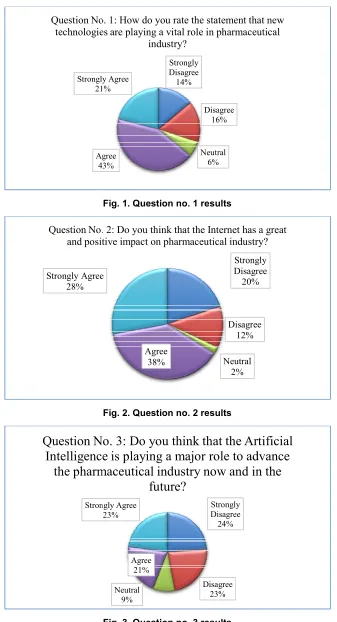
Question No. 1
How do you rate the statement that new technologies are playing a vital role in the pharmaceutical industry?
The question was asked about the role of new technologies in the pharmaceutical industry. A huge number of respondents were agreed that new technologies are playing a vital and positive role while only 16 respondents disagree on it. Furthermore, 21 and 14 strongly agree and strongly disagree (Fig. 1).
Question No. 2
Do you think that the Internet has a great and positive impact on the pharmaceutical industry?
As shown in Fig. 2, 38 of the respondents were agreed that the power of the Internet has a great and positive impact on the pharmaceutical industry and only 12 respondents disagree. 28 strongly agree and 20 strongly disagree.
Question No. 3
Do you think that Artificial Intelligence is playing a major role to advance the pharmaceutical industry now and in the future?
The figure below sheds light that many respondents were strongly-disagree that were 24 and 23 were disagree while 23 strongly agreed and 21 agreed that Artificial Intelligence is playing a major role in advancing the pharmaceutical industry. 9 of the respondents didn’t give any answer.
Agree 43% Strongly Agree
21%
Question No. 1: How do you rate the statement that new technologies are playing a vital role in pharmaceutical
Strongly Agree 28%
Question No. 2: Do you think that the Internet has a great and positive impact on pharmaceutical industry?
Strongly Agree
Question No. 3: Do you think that the Artificial
Intelligence is playing a major role to advance
the pharmaceutical industry
Shaikh et al.; JPRI, 31(6): 1-11, 2019; Article no.
Fig. 1. Question no. 1 results
Fig. 2. Question no. 2 results
Fig. 3. Question no. 3 results
Strongly Disagree
14%
Disagree 16%
Neutral 6% Agree
43% Strongly Agree
21%
Question No. 1: How do you rate the statement that new technologies are playing a vital role in pharmaceutical
industry?
Strongly Disagree
20%
Disagree 12%
Neutral 2% Agree
38% Strongly Agree
Question No. 2: Do you think that the Internet has a great and positive impact on pharmaceutical industry?
Strongly Disagree
24%
Disagree 23% Neutral
9% Agree
21% Strongly Agree
23%
Question No. 3: Do you think that the Artificial
Intelligence is playing a major role to advance
pharmaceutical industry now and in the
future?
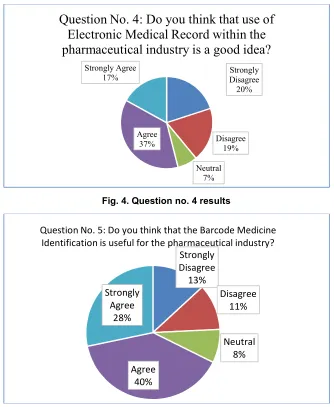
As shown in Fig. 4, 37 out of 100 respondents agreed that the use of Electronic
Medical Record in the pharmaceutical industry
is a good idea while only 19 disagreed, 17 strongly agreed and 20 strongly disagreed. The rest 7 respondents were neutral.
Question No. 5
Do you think that Barcode Medicine Identification is useful for the pharmaceutical industry?
The question relates to the use of Barcode Medicine Identification, which is agreed by the large number of respondents (68), whereas only eleven disagree. Moreover, 13 strongly
disagreed and 28 of 100 respondents were strongly agreed (Fig. 5).
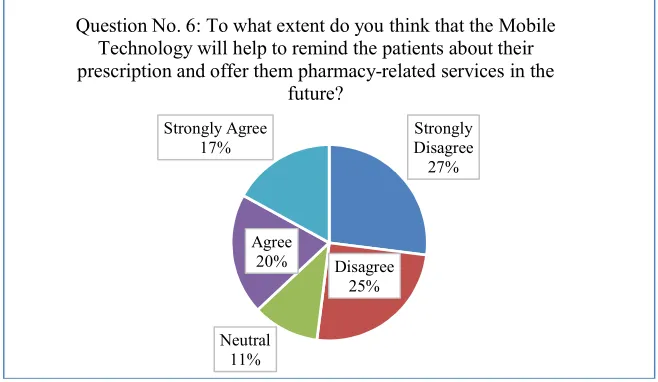
Question No. 6
To what extent do you think that Mobile Technology will help to remind the patients about their prescription and offer them pharmacy-related services in the future?
One question was asked about Mobile Technology at which a huge number of respondents were strongly-disagree that it will help to remind them about the prescription and offer the services. Those respondents were 27 in number. 17 strongly agreed on it. As shown in Fig. 6, 25 disagreed and 20 agreed with the statement (Fig. 6).
Fig. 4. Question no. 4 results
Fig. 5. Question no. 5 results
Strongly Disagree
20%
Disagree 19%
Neutral 7% Agree
37% Strongly Agree
17%
Question No. 4: Do you think that use of
Electronic Medical Record within the
pharmaceutical industry is a good idea?
Strongly Disagree
13%
Disagree 11%
Neutral 8% Agree
40% Strongly
Agree 28%
Shaikh et al.; JPRI, 31(6): 1-11, 2019; Article no.JPRI.52913
Fig. 6. Question no. 6 results
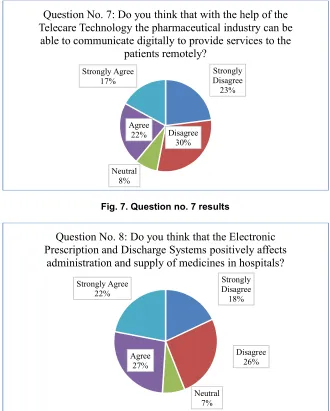
Question No. 7
Do you think that with the help of the Telecare Technology the pharmaceutical industry can be able to communicate digitally to provide services to the patients remotely?
Fig. 7 shows that 23 of the respondents were strongly-disagree with Telecare Technology while 17 strongly agreed. Adding more, 8 respondents were neutral. Subsequently, 30 disagreed and 22 agreed on it.
Question No. 8
Do you think that the Electronic Prescription and Discharge Systems positively affect administration and supply of medicines in hospitals?
The last question was on the positive impact of the Electronic Prescription and Discharge System. 27 respondents were agreeing and 26 disagreed. 7 of the totals did not give any answer. Moreover, 22 strongly agreed and 18 strongly disagreed.
4.2 Reliability Scale Test (Cronbach Alpha)
The reliability test is used to check the reliability of the collected data through the value of Cronbach Alpha. According to the test, the values below 0.7 shows that the research data collection process is questionable and not acceptable whereas above 0.70 is considered as acceptable values which shows that the research
is rightly conducted. The research reliability result is shown in the abovementioned table. With the help of this table, it is concluded that the test data of 12 questions were found as 0.745 that concludes that the test is reliable with the value of Cronbach Alpha.
Table 1. Reliability scale test results
Reliability statistics
Cronbach Alpha Number of Items
0.745 12
4.3 Analysis of Interview Questions
Question No. 1
The first question was asked about the impact of new technologies on the pharmaceutical industry. To answer this question, the experts replied that new technologies are impacting positively on the pharmaceutical industry. With the help of new technologies, the work can be done more effectively in less time. They said that new technologies give birth to speed, efficiency, and accuracy.
Question No. 2
The experts replied to the second question by saying that the pharmaceutical industry can be improved by implementing new technologies such as Artificial Intelligence, Mobile Technology to communicate remotely with the consumers with the help of digitalization. Furthermore, they said the pharmaceutical industry can be improved by training the staff about the new technologies.
Strongly Disagree
27%
Disagree 25%
Neutral 11%
Agree 20% Strongly Agree
17%
Question No. 6: To what extent do you think that the Mobile Technology will help to remind the patients about their prescription and offer them pharmacy-related services in the
Fig. 7. Question no. 7 results
Fig. 8. Question no. 8 results
5. CONCLUSION AND RECOMMENDA-TION
This study concludes that new technologies play a significant role in the pharmaceutical industry. Technologies are giving positive impacts on the growth of diverse pharmacies. Adding more, it is also concluded that new technologies are boosting the speed of doing work accurately. Regarding the future, it is concluded that new technologies will give more and more advantages to the pharmaceutical industry to expand their businesses in their selected areas. On the other hand, it is also concluded that some of the respondents were not satisfied with some of the implemented technologies. Thus, it is our
belief that the position of New Technologies, which is focused on the input of pharmaceutical students and teachers and the pharmaceutical industry employees, is a significant contribution to the literary field.
Based on our findings, we recommend pharmacists and the people in the pharmacy field to develop training sessions to educate students and employees towards the new technologies as some of the and students and employees were not much satisfied with new technologies. This may be because of the lack of attention towards new technologies. It is also recommended to the pharmaceutical industry owners to implement Artificial Intelligence that does not decrease the
Strongly Disagree
23%
Disagree 30%
Neutral 8%
Agree 22% Strongly Agree
17%
Question No. 7: Do you think that with the help of the
Telecare Technology the pharmaceutical industry can be
able to communicate digitally to provide services to the
patients remotely?
Strongly Disagree
18%
Disagree 26%
Neutral 7% Agree
27% Strongly Agree
22%
Question No. 8: Do you think that the Electronic
Prescription and Discharge Systems positively affects
Shaikh et al.; JPRI, 31(6): 1-11, 2019; Article no.JPRI.52913
employment of the individuals as this will tend towards a great loss on the errors made by Artificial Intelligence.
CONSENT
As per international standard, respondents’ written consent has been collected and preserved by the author(s).
ETHICAL APPROVAL
It is not applicable.
COMPETING INTERESTS
Authors have declared that no competing interests exist.
REFERENCES
1. Huang HM, Liaw SS, Lai CM. Exploring learner acceptance of the use of virtual reality in medical education: a case study of desktop and projection-based display systems. Interactive Learning Environments. 2016;24(1):3-19.
2. Shaikh ZA, Khoja SA. Higher education in Pakistan: An ICT integration viewpoint. International Journal of Computer Theory and Engineering. 2013;5(3):410.
3. Alhamoudi A, Alnattah A. Pharmacy education in Saudi Arabia: The past, the present and the future. Currents in Pharmacy Teaching and Learning. 2018;10(1):54-60.
4. Shaikh ZA, Khoja SA. Role of ICT in shaping the future of Pakistani higher education system. Turkish Online Journal of Educational Technology-TOJET. 2011a;10(1):149-161.
5. Al-Hariri MT, Al-Hattami AA. Impact of students' use of technology on their learning achievements in physiology courses at the University of Dammam. Journal of Taibah University Medical Sciences. 2017;12(1):82-85.
6. Koehler T, Brown A. Documenting the evolution of the relationship between the pharmacy support workforce and pharmacists to support patient care. Research in Social and Administrative Pharmacy. 2017;13(2):280-285.
7. Bach AT, Goad JA. The role of community pharmacy-based vaccination in the USA: Current practice and future directions.
Integrated Pharmacy Research & Practice. 2015;4:67.
8. Shaikh ZA, Khoja SA. Teachers’ skills set for personal learning environments. In Proceedings of the 10th European Conference on e-Learning. 2011b;1:762-769.
9. Clauson KA, Aungst TD, Simard R, Fox BI, Breeden EA. Lessons learned and looking forward with pharmacy education: Informatics and digital health. In Health Professionals' Education in the Age of Clinical Information Systems, Mobile Computing and Social Networks. Academic Press. 2017;181-199.
10. Crommelin DJ, Sindelar RD, Meibohm B. (Eds.). Pharmaceutical biotechnology: Fundamentals and applications. Springer Science & Business Media; 2013.
11. Shaikh ZA, Khoja SA. Personal learning environments and university teacher roles explored using Delphi. Australasian Journal of Educational Technology. 2014a;30(2).
12. Baertschi SW, Alsante KM, Reed RA. (Eds.). Pharmaceutical stress testing: Predicting drug degradation. CRC Press; 2016.
13. Crommelin DJ, Bouwman-Boer Y. Pharmacy preparations: Back in the limelight? Pharmacists make up your mind! International Journal of Pharmaceutics. 2016;514(1):11-14.
14. Mukattash TL, Jarab AS, Abu-Farha RK, Nusair MB. A qualitative assessment of the pediatric content in pharmacy curricula adopted by pharmacy schools in Jordan. Pharmacy Practice. 2019;17(1).
15. Parikh DM. (Ed.). Handbook of pharmaceutical granulation technology. CRC Press; 2016.
16. Shaikh ZA, Khoja SA. Towards guided personal learning environments: Concept, theory and practice. In 2014 IEEE 14th International Conference on Advanced Learning Technologies. IEEE. 2014b;782-784.
17. Murphy JE, Liles AM, Bingham AL, Chamberlin KW, Dang DK, Hill LG, Rogers E. Inter professional education: Principles and application. An update from the American College of Clinical Pharmacy. Journal of the American College of Clinical Pharmacy. 2018;1(1):e17-e28.
teaching scenarios: A Delphi study. In Proceedings of the 13th annual conference on Information technology education. ACM. 2012;127-132.
19. Baines D, Gahir IK, Hussain A, Khan AJ, Schneider P, Hasan SS, Babar ZUD. A scoping review of the quality and the design of evaluations of mobile health, telehealth, smart pump and monitoring technologies performed in a pharmacy-related setting. Frontiers in Pharmacology. 2018;9:678.
20. Doucette WR, McDonough RP, Herald F, Goedken A, Funk J, Deninger MJ. Pharmacy performance while providing continuous medication monitoring. Journal of the American Pharmacists Association. 2017;57(6):692-697.
21. Ackerknecht EH, Haushofer L. A short history of medicine. JHU Press; 2016. 22. English D, Ankem K, English K.
Acceptance of clinical decision support surveillance technology in the clinical pharmacy. Informatics for Health and Social Care. 2017;42(2):135-152.
23. Müllertz A, Perrie Y, Rades T. (Eds.). Analytical techniques in the pharmaceutical sciences. Springer; 2016. 24. Englund C, Olofsson AD, Price L.
Teaching with technology in higher education: Understanding conceptual change and development in practice. Higher Education Research & Development. 2017;36(1):73-87.
25. Frost TP, Adams AJ. Tech-check-tech in community pharmacy practice settings. Journal of Pharmacy Technology. 2017;33(2):47-52.
26. Goldin C, Katz LF. A most egalitarian
profession: Pharmacy and the evolution of a family-friendly occupation. Journal of Labor Economics. 2016;34(3):705-
746.
27. Meier K, Astier A, Bosnak AS, Gonec R. The future of oncology pharmacy: European Conference of Oncology Pharmacy 2018. European Journal of Oncology Pharmacy. 2019;2(3):e20.
28. David B, Wolfender JL., Dias DA. The pharmaceutical industry and natural products: Historical status and new trends. Phytochemistry Reviews. 2015;14(2):299-315.
29. Jaiswal PK, Kesharwani S, Kesharwani R, Patel DK. Ethosome: A new technology used as topical & transdermal delivery system. Journal of Drug Delivery and Therapeutics. 2016;6(3):7-17.
30. Jacobs RJ, Caballero J, Parmar J, Kane MN. The role of self-efficacy, flexibility and gender in pharmacy students' health information technology readiness. Currents in Pharmacy Teaching and Learning; 2019.
31. Peppas NA. (Ed.). Hydrogels in medicine and pharmacy: Fundamentals. CRC Press. 2019;1.
32. Nabelsi V, Gagnon S. Information technology strategy for a patient-oriented, lean and agile integration of hospital pharmacy and medical equipment supply chains. International Journal of Production Research. 2017;55(14):3929-3945. 33. Bazeley P. Adoption of mixed methods
approaches to research by management researchers. In Proceedings of the 14th European Conference on Research Methodology in Business and Management Studies. 2015;34-40. 34. Wheeler JS, Gray JA, Gentry CK, Farr GE.
Advancing pharmacy technician training and practice models in the United States: Historical perspectives, workforce development needs, and future opportunities. Research in Social and Administrative Pharmacy; 2019.
35. Sree PD, Kumar AM, Shanmugasundaram P. Accessibility of computer and knowledge among pharmacy students at a Private University of Tamilnadu. Research Journal of Pharmacy and Technology. 2017;10(1):188.
Shaikh et al.; JPRI, 31(6): 1-11, 2019; Article no.JPRI.52913
APPENDIX
Interviews Questions
How new technologies are affecting the pharmaceutical industry?
How the pharmaceutical industry can be improved by using new technologies now and in the future?
Questionnaire
Questionnaire Strongly
agree
Agree Neutral Disagree Strongly disagree
5 4 3 2 1
Q1 Do you think that new technologies are playing a vital role in the pharmaceutical industry?
Q2 Do you think that the Internet has a great and positive impact on the pharmaceutical industry?
Q3 Do you think that the Artificial Intelligence is playing a major role to advance the
pharmaceutical industry now and in the future?
Q4 Do you think that the use of Electronic Medical Record within the pharmaceutical industry is a good idea?
Q5 Do you think that the Barcode Medicine Identification is useful for the
pharmaceutical industry?
Q6 To what extent do you think that the Mobile Technology will help to remind the patients about their prescription and offer them pharmacy-related services in the future? Q7 Do you think that with the help of the
Telecare Technology the pharmaceutical industry can be able to communicate digitally to provide services to the patients remotely?
Q8 Do you think that the Electronic Prescription and Discharge Systems positively affect administration and supply of medicines in hospitals?
© 2019 Shaikh et al.; This is an Open Access article distributed under the terms of the Creative Commons Attribution License (http://creativecommons.org/licenses/by/4.0), which permits unrestricted use, distribution, and reproduction in any medium, provided the original work is properly cited.
Peer-review history: