A Comparative Analysis of classificaton methods
for diagnosis of Lower Back Pain
MittAL BhAtt*
1, VishAL DAhiyA
2and ArVinD K. singh
31MCA Department, at ITM Universe, Affiliated to Gujarat Technological University, Vadodara, India. 2MCA and M.Sc.(IT), at Indus University, Ahmedabad, India.
3Space Application Centre, ISRO, Ahmedabad, India.
Abstract
In this paper different classification methods are compared using base and meta(Combination of Multiple Classifier for training) level classifiers, for the fruitful diagnosis of Lower Back Pain. The Lower Back Pain becomes chronic with age, so needs to be correctly diagnose with symptoms in the early age. Five independent classifiers were implemented at base level and meta level. At meta level, five combinations of different classifiers were implemented, using voting technique. According to the scores, the overall classification using Naïve Bayes and Multilayer Perceptron got the maximum efficiency 83.87%. The purpose of this paper is to diagnose healthy individuals efficiently. To carry out study the Lower Back Pain Symptoms Dataset is used from very famous platform for predictive modeling, Kaggle. The experiments were carried out in WEKA (Waikato Environment for Knowledge Analysis), suite of machine learning software1.
Oriental Journal of Computer science and technology
Journal Website: www.computerscijournal.org
Article history
Received: 22 May 2018 Accepted:04 June 2018
Keywords
Classification Methods, Lower Back Pain, NaiveBayes, Multilayer Perceptron, Base level,
Meta level.
COntACt Mittal Bhatt [email protected] CA Department, at ITM Universe, Affiliated to Gujarat Technological University, Vadodara, India.
© 2018 The Author(s). Published by Techno Research Publishers
This is an Open Access article licensed under a Creative Commons Attribution-NonCommercial-ShareAlike 4.0 International License (https://creativecommons.org/licenses/by-nc-sa/4.0/ ), which permits unrestricted NonCommercial use, distribution, and reproduction in any medium, provided the original work is properly cited.
To link to this article: http://dx.doi.org/10.13005/ojcst11.02.09
introduction
Classification has wide range of applications like credit approval, customer group identification as well as medical diagnosis2.Lower Back Pain could be the pain due to so many causes. The causes include of wrong posture, weight lifting, stressful working environment, trauma, or even it includes some physiological disorders and even some abdominal problems like kidney stone.It mainly starts in the older age. But it becomes chronic when degeneration
happens in spine disk. It creates frustration and stress as it affects person’s mobility.
backward on the below vertebrae), Lumbar spinal Stenosis(spinal canal space get’s reduced). So it is very important that these all diseases must be classified in their beginning stage.
In this paper lower back pain dataset is first classified using base level classifiers Naïve Bayes, Bayes Net, Multilayer Perceptron, Random Forest, and Decision Table. Thereafter combinations of theses base level classifiers were implemented using meta level in WEKA. The choice of algorithm is made on the basis of the size of dataset used, and also in the context of machine learning classification algorithms, comparative study needs to be carried out.
The accuracy is best achieved using meta level combination of Naïve Bayes and Multilayer Perceptron.
Methods Classification
It is an important technique fall under the category of supervised learning in which conclusion is drawn from observed training data. Eighty five percent of chronic lower back pain disorders have no known diagnosis leading to a classification3.So classification algorithms analyzed at base and meta level on lower back pain dataset. Supervised learning algorithms can be categorized into two families: traditional learning algorithms and ensemble learning algorithms4.
Base Level Classifier Analysis
It is the technique in which single classification algorithms is implemented on dataset. here the
results generated from the implementation of Naïve Bayes, Bayes Net, Multilayer Perceptron, Random Forest and Decision Table. Out of which Naïve Bayes classifier fall under the probabilistic classifier category and Multilayer perceptron is classifier based on feed forward artificial neural network, While Random forest classifier is used to choose random subset of attributes from dataset. Decision table classifier is like Neural Net mainly used for prediction.
Meta Level Classifier Analysis
Using this technique integration of multiple classifiers is possible. As it is observed that meta level classification algorithms give better efficiency5, in this research work five combinations were implemented in WEKA. There are two approaches used to implement meta level classification, first vote and second non-vote. In voting technique each classifier count is used to classify new testing sample and in non-voting technique instead of single class decision class probabilities of all classifiers are integrated under some rule. There are many more methods under these approach, one of the best extended is multi-response model trees learn at meta level6.
results and Discussion
results
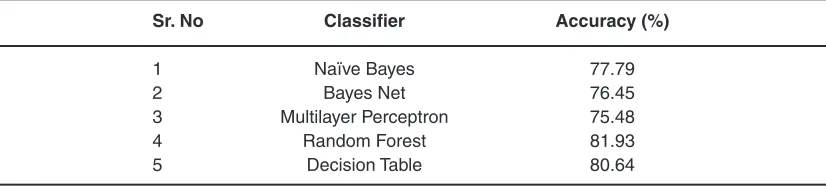
Table 1 contains the experimental results of implementation of base level classifier.
table 1: Accuracy of Base Level Classifiers
sr. no Classifier Accuracy (%)
1 Naïve Bayes 77.79
2 Bayes Net 76.45
3 Multilayer Perceptron 75.48
4 Random Forest 81.93
Table – 2 contains the weighted average accuracy comparison if bases level classification algorithms
and Figure – 1 shows the visual representation of it.
table 2: Weighted average accuracy comparison in detail of Base level classification algorithms
sr. Classifier tP FP Precision recall F-measure no
1 Naïve Bayes 0.777 0.179 0.818 0.777 0.784
2 Bayes Net 0.765 0.196 0.805 0.765 0.772
3 Multilayer Perceptron 0.755 0.316 0.755 0.755 0.755
4 Random Forest 0.819 0.233 0.819 0.819 0.819
5 Decision Table 0.806 0.244 0.808 0.806 0.807
Fig. 1: Visual representation of weighted average accuracy of base level algorithms
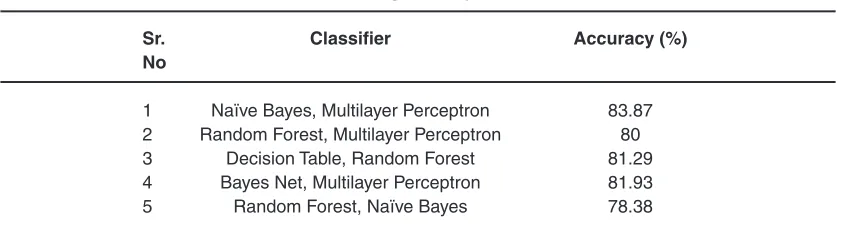
Table – 3 contains the experimental results of implementation of meta level classifier using voting technique.
table 3: Accuracy of Meta Level Classifiers using voting technique
sr. Classifier Accuracy (%) no
1 Naïve Bayes, Multilayer Perceptron 83.87
2 Random Forest, Multilayer Perceptron 80
3 Decision Table, Random Forest 81.29
4 Bayes Net, Multilayer Perceptron 81.93
5 Random Forest, Naïve Bayes 78.38
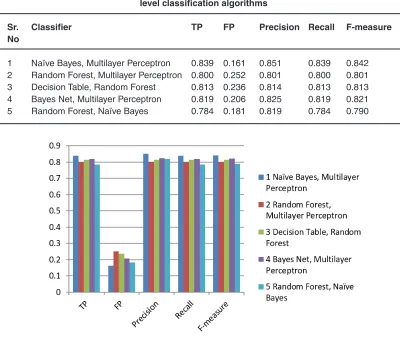
Table 4 contains weighted average accuracy comparison in detail of meta level classification
table 4: Weighted average accuracy comparison in detail of Meta level classification algorithms
sr. Classifier tP FP Precision recall F-measure no
1 Naïve Bayes, Multilayer Perceptron 0.839 0.161 0.851 0.839 0.842 2 Random Forest, Multilayer Perceptron 0.800 0.252 0.801 0.800 0.801 3 Decision Table, Random Forest 0.813 0.236 0.814 0.813 0.813 4 Bayes Net, Multilayer Perceptron 0.819 0.206 0.825 0.819 0.821 5 Random Forest, Naïve Bayes 0.784 0.181 0.819 0.784 0.790
Fig. 2: Visual representation of weighted average accuracy of meta level algorithms
Discussion
Machine learning is an area of Artificial Intelligence, in which systems automatically learn and improve from feedback, and classification is an important labeling technique. Both are widely used in the field of intelligent systems and mainly used in medical field. Machine learning algorithms can be used to develop tools for physicians that can be used as an effective approach for early detection and diagnosis7. Implementing various classification methods at base and meta level, these research work shows the comparative analysis of efficiency of classification algorithms. Under the meta level the comparative study shows that the integration using voting technique increases the efficiency of training dataset.
Conclusion
In this research, the comparative study shows that as we start implementing combinations of classification algorithms using voting technique the strength of classification represents in terms of percentage accuracy is differing shown in table 1 and table 3. As it is shown in the result that Naïve Bayes and Multiplayer Perceptron gives lower accuracy at base level and that accuracy is increased far better when they are implemented at meta level in combination.
Acknowledgement
references
1. Weka, Machine Learning Group at University of Wekato, http://www.cs.waikato.ac.nz. 2. hongjun Lu, hongyan Liu, Decision Tables:
Scalable classification exploring RDBMS capabilities, 2000; pp 373-384
3. Peter O. Sullivan, Diagnosis and classification of chronic lower back pain disorders: Maladaptive movements and motor control impairments as underlying mechanism, Manual Therapy, Elsevier. 2005; 242-255. 4. Xin Xia, Dalid Lo, Xinyuwang, Xiaohu
Yang, shanping Li, A Comparative study of supervised learning algorithms for re-opened bug prediction, IEEE. 2013; pp 331-334. 5. T. Sathya Devi, Dr. K. MeenakshiSundaram,
A comparative analysis of meta and tree classification algorithms using WEKA,
International Research Journal of Engineering and Technology (IRJET). 2016; volume 3, issue 11.
6. SasoDzeroski, Bernard Zenko, Is Combining
classifier with stacking is better than selecting best one?, Springer Machine Learning. 2004; volume 54, issue 3, pp 255-273.
7. Dana Bazazeh, RaedShubair, comparative study of machine learning algorithms for breast cancer detection and diagnosis, IEEE Explore. Jan 2017; 2159-2055.
8. Osisanvo F.Y., Akinsola J.E.T., Awodele O., hinmiKaiye J. O., Olakanmi O., Akinjobi J., Supervised machine learning algorithms: classification and coparison, IJCTT June 2017; Volume 48 Number 3.
9. Abdullah h. Wahbeh, Quasem A. Al-Radaideh, Mohammad N. Kabi, and Emad M. Al-Shawakfa, A Comparison Study between Data Mining Tools over some Classification Methods, IJCSA.