A Comparative Study of a Few Tests for Isomorphism in Planetary
Gear Trains
Rajasri Reddy
1,*, AVSSKS Gupta
2, YVD Daseswara Rao
31Vice Principal, Pathfinder Engineering College, India
2Associate Professor, JNTUH, Hyderabad
3
Pofessor, BITS Pilani, Hyderabad Campus
Received 11 January 2013; received in revised form 30 January 2013; accepted 25 February 2013
Abstract
Graph theory and Matrix methods are widely used by various kinematicians for synthesis and analysis of PGTs.
Characteristic polynomial coefficients are used to detect isomorphism in Planetary Gear Trains (PGT). With the
Eigen values and Eigen vectors method multiple matrix calculations are required. In case of Hamming number
method a single Hamming matrix is enough to detect isomorphism in two PGTs and also determine structural aspects
like symmetry easily [1]. Further using the Hamming matrix for a PGT, the number of possible combinations of levels
that can be assigned to a given PGT [2] is identified. A review and comparison of Characteristic polynomial, Eigen
vectors and Eigen value and Hamming number methods is presented.
Keywords: characteristic polynomial, Eigen values, hamming number, row transformation matrix
1.
Introduction
Graph theory has been widely used for synthesis and analysis of the Planetary Gear Trains (PGTs). For analysis and
synthesis of PGTs, many approaches were introduced by various kinematicians. Identifying the isomorphism for a given
number of PGTs generated is the one of the challenging problem in structural synthesis to avoid the duplicate graphs. Different
kinematicians [1-24] used adjacency [3], distance [4], flow [5], joint-joint [6] matrices etc to represent graphs of PGTs for
analysis and synthesis. Characteristic polynomial [4], random number technique [7], Max code [8], Min code [9], Identification
code [10], link path code [11], Eigen values and Eigen vectors [12-14], genetic algorithm [15], fuzzy logic [16], Hamming
Number Technique [17] and loop based hamming [18] etc are the methods used to detect the isomorphism in kinematic chains
and PGTs. Each and every method has its own merits and demerits. Most of the above methods are based on adjacency matrix
of a PGT. Techniques for identifying the kinematic structure of the PGTs are given by two main criteria’s namely graphical
method and Numerical method. Graphical methods are based on visual inspection of schematic diagrams of a PGT and many of
the numerical methods are based on theory of graphs.
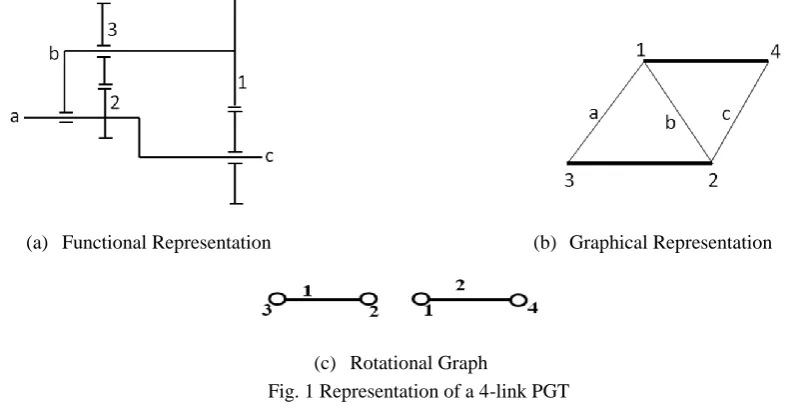
A simple PGT with two gear pairs can be represented in many ways as shown in Fig. 1. Functional or schematic
representation of a four link PGT with single Degree Of Freedom (DOF) is shown in Fig. 1(a), graph representation [1] of PGT
is shown in Fig. 1(b) and fig. 1(c) describes the rotational graph [1] of the same PGT.
(a) Functional Representation (b) Graphical Representation
(c) Rotational Graph
Fig. 1 Representation of a 4-link PGT
1.1. Adjacency matrix
Adjacency matrix is an n-link square and symmetric matrix, based on the connectivity or meshing of gears in a PGT.
Adjacency matrix is written using the following rules,
(1)
A link cannot be connected to itself so aii=0. The adjacency matrix of the PGT shown in fig-(1) using equation (1) is given
as,
(2)
2.
Procedure to Test Few Methods
Methods like Characteristic polynomial, Eigen values & Eigen vectors and Hamming Number Technique are used to
determine the isomorphism in PGTs comparison between the methods is also done.
2.1. Characteristic Polynomial Method
J. J. Uicker and A. Raicu [4] introduced this method later L.W.Tsai [7] adopted the same for PGTs. Authors considered
distance matrix which similar to adjacency matrix to determine the connectivity between the links. The characteristic
polynomial coefficient is determined using matrix algebra. Two PGTs which are isomorphic to each other which have identical
characteristic polynomials for their associated distance matrices. The characteristic polynomial coefficient for the PGT shown
in Fig 1 is given in Eq. 3,
[1.0000 0 -11.0000 -8.0000 9.0000]
2.2. Eigen values and Eigen vectors [12-14]
For a given PGT, adjacency matrix is identified then Eigen values (µ) shown in equation (4) and Eigen vectors (V) given
in Eq. 5 are computed using MAT lab. These are the Eigen vectors and Eigen values of a PGT shown in Fig. 1. If Eigen values
of two PGTs are not identical then the PGTs are non isomorphic.
(4)
(5)
2.3. Hamming Number Technique
A.C. Rao introduced the concept of hamming distances from information and communication theory. Hamming matrix is
given by following rules in Eq. 6,
(6)
hii =0. Using Eq. 6 one can able to find the hamming values of a PGT shown in Fig. 1 is given below
,
(7)
3.
Methodology
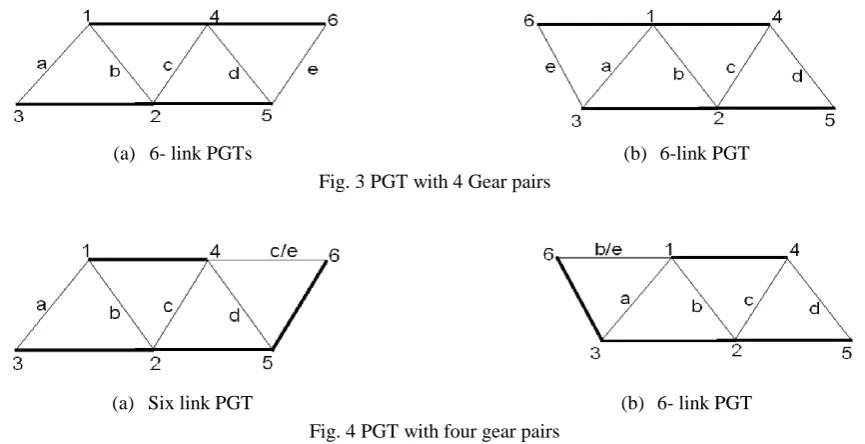
Four PGTs with four gear pairs and single DOF shown in Fig. 3 and Fig. 4 are considered to compare the above three
methods to identify isomorphism.
(a) 6- link PGTs (b) 6-link PGT
Fig. 3 PGT with 4 Gear pairs
(a) Six link PGT (b) 6- link PGT
Adjacency matrices of the PGTs shown in Fig. 3 (A1 and A2) and Fig. 4 (A3 and A4) are given in Eq. 8 respectively,
(8)
3.1. Characteristic Polynomial
, if this condition satisfied then both the PGTs are in isomorphic otherwise non-isomorphic. Mat lab
is used to find the characteristic coefficient of a PGT with n-links and F DOF. The characteristic polynomial coefficient of PGT
is shown in Fig. 3(a) is given as,
CP1= [1.0000 -0.0000 -21.0000 -16.0000 70.0000 24.0000 -33.0000]
Similarly the characteristic polynomial coefficient of a PGT shown in Fig. 3(b) is
CP2= [1.0000 0.0000 -21.0000 -16.0000 70.0000 24.0000 -33.0000]
The characteristic values of both the PGTs are identical so the given two PGTs shown in Fig. 3 are isomorphic to each
other. From the identical values of characteristic coefficients one can say the two PGTs are isomorphic otherwise
non-isomorphic.
Example: Another example shown in fig-4 is considered to explain the characteristic coefficient and isomorphism
between the two PGTs. The characteristic coefficient of PGTs shown in fig-4 is given by
CP3=CP4= [1.0000 -0.0000 -21.0000 -16.0000 73.0000 36.0000 -48.0000]. Identical characteristic polynomial
says that the two PGTs are isomorphic. The PGTs shown in Fig. 3 and Fig. 4 are non-isomorphic. In the characteristic
polynomial coefficient, the leading edge coefficient is always unity, the second coefficient must be zero and third coefficient is
always negative and fourth coefficient is twice the number of three pair loops within the sub chain and it is zero for mechanisms.
The characteristic polynomial is a sufficient test to find the isomorphism and the characteristic coefficients are unique for a
given topology.
3.2. Eigen values and Eigen vectors
The adjacency matrices of the two PGTs should be computed first. Eigen values and Eigen vectors of the two PGTs are
determined. Eigen value string is formed for the two PGTs. If string of Eigen values is not same then the PGTs are non
isomorphic. Otherwise the PGTs are isomorphic. If it is isomorphic then interchange the rows of one of the adjacency matrix
according to the single Eigen value by comparing the Eigen vectors, i.e. identifying the identical row of Eigen vectors. After
of PGT in to another PGT.R is multiplied with adjacency matrix and transpose of R. If the product is equal to another PGT
adjacency matrix then both the PGTs are said to be isomorphic. The methodology of this method is clearly understood with the
following examples,
Example 1: The Eigen values and Eigen vectors of the PGTs shown in fig-3(a) are given as
(9)
(10)
The Eigen values and Eigen vectors of the PGTs shown in Fig. 3(b) are given as
(11)
(12)
For the above two PGTs the Eigen value string is identical, then Eigen vectors of both the PGTs are compared for
identical Eigen vectors. Interchange the rows of an identity matrix by considering the identical Eigen strings between the Eigen
vectors. For the adjacency matrix A1, row transformation is done to make single Eigen value. In Eigen vector matrix the first
row is similar to the fourth row of second PGT. The third row is identical with the fifth row of Eigen vector values of second
PGT. These two rows can be interchanged. Similar check is done for the other rows also. In the above case 1 4, 2 2, 3 5,
4 1, 5 3, 6 6 are identical. After interchanging the rows the row transformation matrix is formed. The necessary condition
for isomorphism is A2=R*A1*transpose(R).
(13)
The condition for isomorphism is satisfied. Thus, the above two PGTs are isomorphic.
Example 2: Consider two four-gear pair single DOF PGT shown in Fig. 4. The Eigen values of both the PGTs are given
below, i.e for Fig. 4(a) and Fig. 4(b)
(15)
(16)
The identical rows to be interchanged are 1 4, 2 2, 3 5, 4 1, 5 3, 6 6. The Eigen vectors of an adjacent matrix of
a PGT can be transformed to that of another adjacency matrix of PGT by row transformations. Rij is the row transformation
matrix which interchanges the links ith, jth row of A3 when it is multiplied by A3.
(17)
With the above two examples one can conclude that if Eigen values of any two PGTs are identical, the PGTs are
isomorphic.
3.3. Hamming Number Technique
In this method the adjacency matrix and the hamming matrix of two PGTs can be computed first. Hamming strings and
hamming values of each PGT is calculated. Hamming strings of each row is compared with the other rows to identify symmetry
within the PGT. If the hamming strings are identical then the two PGTs are said to be isomorphic.
Example 1: Consider two 6-link PGTs with single DOF shown in Fig. 3.Hamming Matrix for Fig. 3(a) and Fig. 3(b) is
given below
0 10 7 8 8 3 36
10 0 7 12 8 9 46
7 7 0 9 3 6 32
8 12 9 0 10 7 46
8 8 3 10 0 7 36
3 9 6 7 7 0 32
Hamming string = 228 [ 46 46 36 36 32 32]
0 12 10 8 9 7 46
12 0 8 10 7 9 46
10 8 0 8 3 7 36
8 10 8 0 7 3 36
9 7 3 7 0 6 32
7 9 7 3 6 0 32
Hamming strings of both the PGTs are same which indicates the isomorphism in the PGTs. Another advantage with this
method is symmetry of a PGT is determined. Identical location of identical members with reference to another member gives
symmetry about that member. Symmetry gives better balancing; PGTs with symmetry generate more possible higher level
graphs than PGTs with no symmetry [1]. By knowing the symmetry in a graph the number of isomorphic structures enumerated
is reduced to a larger extent. Symmetry in GKCs simplifies the enumeration process and automation can be achieved using
digital computers [19]. Higher the symmetry less in the number of non isomorphic graphs generated. However, the number of
levels for a given graph of a PGT increases with symmetry in the graph [2]. Hamming matrix of PGT shown in Fig. 3 (a) and
fig-3(b) has three pairs of identical hamming values and identical hamming strings. There is no symmetry in links. The two
PGTs are isomorphic but not symmetric.
Example 2: consider two PGTS with 4 gear pairs and single DOF shown in Fig. 4, the corresponding hamming matrices
are given below, Both the PGTs have identical hamming values and hamming strings so the two PGTs are isomorphic. In H3
matrix links 1 and 2 have identical hamming value but not a identical hamming string. Links-1&2 are symmetric with respect to
links 3 and 5. Symmetry exists in this PGT. Similarly in H4 matrix links-2&4 are symmetric with respect to links 3 and 5. Thus
the PGT contributes one pair of symmetry. The above two PGTs are isomorphic as well as symmetric. For further generation
process one can select a PGT with higher symmetry among the isomorphic PGTs.
0 10 7 7 9 7 40
10 0 7 11 9 3 40
7 7 0 8 4 6 32
7 11 8 0 10 8 44
9 9 4 10 0 6 38
7 3 6 8 6 0 30
Hamming string = 224 [44 40 40 38 32 30]
0 11 10 7 8 8 44
11 0 9 10 7 3 40
10 9 0 9 4 6 38
7 10 9 0 7 7 40
8 7 4 7 0 6 32
8 3 6 7 6 0 30
Hamming string = 224 [44 40 40 38 32 30]
4.
Overview
In case of some PGTs the Eigen values are identical for both the PGTs; however, Eigen vectors are not truly same in the
sense the corresponding row in one Eigen vector should be multiplied with minus one (-1) to get the corresponding Eigen vector
for second. But when the row transformation matrix [R] is formed and they are identical. This test further strengthens the
condition that equality of Eigen values is a sufficient condition for testing isomorphism in PGTs. There is no necessity to find
the Eigen vectors and forming the row transformation matrix and unnecessary multiplications to find the isomorphism which is
tested for all the PGTs of one DOF with up to four gear pairs. In characteristic polynomial method the coefficients are computed
and if the coefficients are identical then the two PGTs are isomorphic. Hence, there is no necessity for further investigation
using random numbers. Using Eigen value - Eigen vector method and characteristic polynomial method it can’t be decided
which graph out of the isomorphic graphs of given number of links, should be selected for the further generation. From a 4-link
PGT generated five link graphs are 72 in number. Out of these graphs seven graphs are discarded due to fundamental rule -9 [7].
From the remaining 65 PGTs only six PGTs are non-isomorphic. While selecting finally any six from the total of 65 PGTs, the
PGTs with higher symmetry can be selected. This aspect of symmetry in PGTs can be established easily by using hamming
5.
Conclusions
Graph theory is widely used by different researchers for synthesis and analysis of PGTs. For topological synthesis of
PGTs adjacency matrix is used as a tool. From the adjacency matrix Eigen values and Eigen vectors are determined for PGTs of
given number of links and DOF. Isomorphism is determined comparing the Eigen values of PGTs. Characteristic Polynomials
are also used to identify isomorphism in PGTs by comparing the coefficients of the polynomial for various PGTs generated.
Hamming Number Method in addition to identify isomorphism in PGTs, gives as a by-products, the symmetry in PGTs and
identifies graphs of PGTs with possible more number of structural arrangements.
References
[1] I. Rajasri, YVD Rao and AVSSKS. Gupta, “Structural Aspects of Symmetry and Its Effects on Generation of Planetary Gear Trains,” 2011 International Conference on Mechanical and Aerospace Engineering, March 2011, pp. 530-533. [2] I. Rajasri, Dr. AVSSKS Gupta, Dr.YVD Rao “Influence of structural aspects on the generation process in planetary gear
trains,” International Journal Of Scientific Research, vol. 3, pp. 1018-1021, October 2011. [3] Z. Levai, “Structure and Analysis of planetary gear trains,” J. Mech., vol. 3, pp. 131-148, 1968.
[4] Uicker and A.Raicu, “A method for the identification and recognition of equivalence of kinematic chains,” Mach. Theory, vol. 10, pp. 375-383, 1975.
[5] Ashok Dargar., Ali Hasan., R.A.Khan., “Mobility analysis of kinematic chains,” Kathmandu university journal of science, vol. 6, pp. 25-32, March 2010.
[6] Ali Hasan, Khan. R. A., Aas Mohd, “A new method to detect isomorphism in kinematic chains,” Kathmandu university journal of science, vol. 1, pp. 1-11, January 2007.
[7] L.W.Tsai, “An Application of the Linkage Characteristic Polynomial to the Topological Synthesis of Epicyclic Gear Trains,” ASME Journal of Mechanisms, Transactions and Automation in Design, vol. 199, pp. 329-336, 1987. [8] A.G.Ambekar and V.P.Agrawal, “On canonical numbering of kinematic chains and isomorphism problem: Max code,”
ASME paper.
[9] J.N.Yadav, C.R.Pratap and V.P.Agrawal, “Detection of isomorphism among kinematic chains using the distance concept,” J. Mech. Design, ASME Trans, vol.117, pp. 607-611, 1995.
[10] H.S.Yan and W.M.Hwang, “Linkage path code,” Mech. Mach. Theory, vol.19, pp. 425-429, 1984.
[11] J. P. Cubillo and Jinbao Wan. “Comments on mechanism kinematics chain isomorphism identification using adjacent matrices,” Mech and Mach Theory, vol.40, pp. 131-139, 2004.
[12] R. P Sunkari and L.C. Schmidt. “Reliability and efficiency of the existing spectral methods for isomorphism detection,” J.
Mech. Design, ASME Trans, vol. 128, pp. 1246-1252, November 2006.
[13] Zongyu Chang, Ce Zhang, Yuhu Yang, Yuxin Wang, “A new method to mechanism kinematic chain isomorphism identification,” Mech and Mach Theory, vol. 37, pp. 411-417, 2000.
[14] Rao. A. C., 2000, “A Genetic Algorithm for epicyclic Gear Trains,” Mech. Mach. Theory, vol. 38, pp, 135-147, 2000.
[15] Rao. A. C., 2000, “Application of Fuzzy Logic for the study of Isomorphism, Inversions, symmetry, parallelism and mobility in kinematic chains,” Mech. Mach. Theory, vol. 35, pp, 1103-1116, 2000.
[16] A.C.Rao, “Hamming number technique I: Further applications,” Mech. Mach. Theory, vol. 32, pp. 477-488, 1997. [17] A.C.Rao and D.Varada Raju, “Application of the Hamming number technique to detect isomorphism among kinematic
chains and inversions,” Mech. Mach. Theory, vol. 26, pp. 55-75, 1991.
[18] A.C.Rao, “Comparison of plane and spatial kinematic chains for structural error performance using pseudo-Hamming distances,” Indian J.Tech, vol.26, pp.155-160, 1988.
[19] A C Rao & Y V D Rao. “Symmetry in planetary gear trains,” Indian Journal of Engineering & Material Sciences, vol.9, pp.
311-314, October 2002.
[20] T. S. Mruthyunjaya, and M. R. Raghavan, “Structural analysis of kinematic chains and mechanisms based on matrix representation,” ASME, J. Mech. Design, vol. 101, pp. 488-494, 1979.
[21] J.K.Shin and S.Krishnamurty, “On identification and canonical numbering of pin jointed kinematic chains,” J.Mech.
[22] H.S.Yan and A.S.Hall, “Linkage characteristic polynomials: definition, coefficients by inspection,” J. Mech. Design, vol.
103, pp. 578-584, 1981.