
P R O T O C O L
Open Access
Immigrant women
’
s experiences of maternity-care
services in Canada: a protocol for systematic
review using a narrative synthesis
Gina M A Higginbottom
1*, Myfanwy Morgan
2, Jayantha Dassanayake
3, Helgi Eyford
4, Mirande Alexandre
5,
Yvonne Chiu
6, Joan Forgeron
4and Deb Kocay
7Abstract
Background:Canada’s diverse society and statutory commitment to multiculturalism means that the synthesis of knowledge related to the health care experiences of immigrants is essential to realize the health potential for future Canadians. Although concerns about the maternity experiences of immigrants in Canada are relatively new, recent national guidelines explicitly call for tailoring of services to user needs. We are therefore assessing the experiences of immigrant women in Canada accessing maternity-care services. We are focusing on: 1) accessibility and acceptability (as an important dimension of access) to maternity-care services as perceived and experienced by immigrant women, and 2) the birth and postnatal outcomes of these women.
Methods:The aim of this study is to use a narrative synthesis, incorporating both a systematic review using narrative synthesis of reports of empirical research (qualitative, quantitative, and mixed-method designs), and a literature review of non-empirically based reports, both of which include‘grey’literature. The study aims to provide stakeholders with perspectives on maternity-care services as experienced by immigrant women. To achieve this, we are using integrated knowledge translation, partnering with key stakeholders to ensure topic relevancy and to tailor recommendations for effective translation into future policy and practice/programming. Two search phases and a three-stage selection process are being conducted (database search retrieved 1487 hits excluding duplicates) to provide evidence to contribute jointly to both the narrative synthesis and the non-empirical literature review. The narrative synthesis will be informed by the previous framework published in 2006 by Popayet al., using identified tools for each of its four elements. The non-empirical literature review will build upon the narrative-synthesis findings and/or identify omissions or gaps in the empirical research literature. The integrated knowledge translation plan will ensure that key messages are delivered in an audience-specific manner to optimize their effect on policy and practice change throughout the health service, and the public health, immigration and community sectors.
Discussion:Narrative-synthesis methods of systematic review facilitate understanding and acknowledgement of the broader influences of theoretical and contextual variables, such as race, gender, socioeconomic status, and geographical location. They also enable understanding of the shaping of differences between reported outcomes and study designs related to childbearing populations, and the development and implementation of maternity services and health interventions across diverse settings.
PROSPERO registration:Number 2185.
Keywords:Narrative synthesis, Immigrant women, Maternity-care experiences, Canada, Study protocol, Mixed research design review
* Correspondence:[email protected] 1
Faculty of Nursing, Edmonton Clinic Health Academy, University of Alberta, Edmonton, AB T6G 1C9, Canada
Full list of author information is available at the end of the article
Background
Priority of health equity for multicultural Canada
In common with most western democracies, Canada is currently experiencing large-scale immigration and in-creasing ethnocultural diversity [1]. In fact, population growth over the past 100 years has largely resulted from immigration. Successive governments have pursued pol-icies intended to actively encourage immigration and naturalization, thereby attempting to influence strategic demographic, economic, social, humanitarian, and secur-ity goals. Members of visible minorsecur-ity groups are expected to comprise between 29 % and 32 % of Canada’s population by 2031 [2].
The multicultural nature of Canadian society priori-tizes the country’s commitment to equity in healthcare access and health outcomes. As in many other immi-grant-receiving nations, the immigrants who enter Canada are relatively healthy, yet within 10 years of their arrival there is a convergence in terms of health status towards the Canadian average. A number of explana-tions have been suggested for this‘healthy immigrant ef-fect’ [3,4], including health selection [3]; acculturation; the stress of relocation, which may erode any health ad-vantage [4]; and distrust of western medicine, with a pre-ference for seeking out traditional healthcare providers. Furthermore, the needs and rights of immigrant women are often marginalized within families, communities, and legislation. Socioeconomic marginalization and the sub-sequent vulnerability of immigrant women can be fur-ther exacerbated by pregnancy and childbirth, making maternity an important focus of attention for those con-cerned with enhancing immigrant health.
Perinatal health disadvantage for immigrants
Some studies (largely epidemiological), from Canada and elsewhere, report equal or more favorable birth out-comes for migrants [5-8] thus supporting an ‘ epidemio-logical paradox’ associated with the concept of the ‘healthy immigrant effect’. These results imply that (se-lective) immigration from non-industrialized countries is associated with protective individual characteristics. Conversely, numerous reports highlight serious pro-blems of equity in birth outcomes [9-11], particularly for refugees [12] and other immigrants after increased lengths of stay [13,14].
Our preliminary review established that one systematic review of immigrant-receiving countries in Europe found substantial disadvantages for immigrant as compared to natively born women in all of their outcomes: overall risks that were 43 % higher for low birth weight, 24 % higher for pre-term delivery, 50 % higher for perinatal mortality, and 61 % higher for congenital malformations [9]. A recent Canadian study found higher rates of low birth weight and full-term low birth weight (that is,
small for gestational age (SGA)) for infants born to re-cent immigrant women [10]. The hospital costs for pre-term and SGA newborns are nine and two times higher, respectively, than those for their normal-growth coun-terparts [15]. Although these considerations are import-ant, calculating birth outcomes (largely birth weight and infant mortality) is not an adequate or all-encompassing measure for evaluating maternal and infant health and well-being over their lifetimes.
Negative maternal characteristics and birth outcomes of immigrants include significantly higher rates of gesta-tional diabetes (predisposing the mothers to pre-eclamp-sia and type 2 diabetes, and their offspring to obesity and type 2 diabetes) [16,17]; food proscriptions, resulting in low maternal weight gain (compromising both new-born and maternal health) [13]; genetic anomalies such as neural-tube defects due to lack of folic-acid intake [18]; and maternal anemia (increasing the risk of pre-term delivery) [19]. Successfully providing appropriate maternity care requires the legitimization and incorpor-ation of the pervasive traditional beliefs and practices of immigrant women, which they often adhere to despite their new environment [20,21].
Utilization of and access to health care by immigrant women
Conflicting evidence exists regarding underutilization/ overutilization of health services by immigrant communi-ties [22]. Some studies have reported that women may have more frequent contact with health services compared with men, because of their maternity needs [5]. Alterna-tively, migrant women have been reported to underutilize formal health care and other community services, largely because of language barriers, difficulties in understanding healthcare information, experiences of discrimination, and challenges in navigating the Canadian healthcare system [23,24]. Other explanations focus on socioeconomic pos-ition, including material disadvantage, geography, racial harassment, and exclusion [25-27].
influence immigrant women’s perceptions of maternal care in ways that may not be congruent with their frames of reference. The international literature arising from Europe [31-33], Australia [34-36], and the US [37,38] demonstrates similar challenges for newcomer women.
Knowledge gap regarding the maternity-care experiences of immigrants
Although a large-scale quantitative project, the Mater-nity Experiences Survey [28], was conducted in 2006 in Canada, the findings related to immigrant (and more so to refugee) women may be limited to some extent be-cause of the survey being conducted only in English and French (the availability of a glossary of terms in various languages may or may not have proved useful), and over the telephone. Moreover, the cross-cultural validity of the survey was not evaluated [39]. Likewise, although an international research collaboration formed by Gagnon (McGill University) and Small (LaTrobe University, Australia), termed Reproductive Outcomes and Migra-tion (ROAM) [40], has provided crucial insight into re-productive health (focusing on perinatal health) of migrants, the majority of its work was epidemiologically based without the specific focus on experiences of mi-grant women. Our knowledge synthesis will compliment this emerging body of research.
Performing a funded policy analysis and international comparison of maternity care for migrants in the UK, Canada and Germany, Salway et al. discovered that al-though there are contrasting policy and practice con-texts, there are similar challenges in delivery of maternity care services in these countries, with under-lying barriers and supports to good health outcomes for migrants [41]. Subsequently, Higginbottom et al. are currently using an interdisciplinary perspective to ex-plore the maternity experiences of immigrant women in Alberta [42]. Additionally, during our preliminary data-base search and review of the Canadian empirical litera-ture (as used to justify this systematic review) the evidence base strongly suggested that similar challenges exist for immigrant women in new host communities. Moreover, the Canadian evidence on this topic seems to arise from smaller scale, regional and provincial studies and we could not find any evidence of a published knowledge synthesis arising from the Canadian context.
Methods and design
Study aim and objectives
The aim of this study is to provide stakeholders with perspectives on maternity care services as experienced by immigrant women. This knowledge synthesis will use a systematic review with narrative synthesis of reports of empirical research and a literature review of
non-empirically based reports, both incorporating ‘grey literature’. In this study, we assess the acceptability of relevant processes at the individual, community, and organizational levels, as these factors are recognized to be important determinants of effectiveness of services and patient/client outcomes. We identify specific crucial points in care delivery, providing tailored solutions for policy and practice changes. For the study, we use an ap-proach known as ‘integrated knowledge translation’ (IKT) described as “KT (knowledge translation) woven into the research process”(Canadian Institutes of Health Research [43]), by partnering with key stakeholders (integrated knowledge users; IKUs) to ensure topic rele-vancy and to tailor our messages and recommendations to facilitate effective end-of-study KT (the exchange, synthesis and ethically-sound application of knowledge) for promoting translation into future policy and practice or programming. Partnerships with IKUs were started during the establishment of the research questions, will be fostered throughout the project, and have enabled early planning for dissemination. Using this IKT frame-work, this project will enable us to: 1) identify, appraise, and synthesize reports on empirical research using quali-tative, quantiquali-tative, and mixed-method designs; 2) iden-tify, appraise and synthesize reports and publications that do not have an empirical basis, and; 3) share our findings through strategic end-of-study KT to generate and disseminate important recommendations for future policy and practice/programming.
Research question
The research question to be addressed is: what are the experiences of immigrant women in Canada accessing maternity-care services? Focus will be placed on: 1) ac-cessibility and acceptability as an important dimension of access to maternity-care services, as perceived and experienced by immigrant women; and 2) birth and postnatal outcomes.
Population of interest
This study will review literature and other documents that report on immigrants in Canada; we define an‘ im-migrant’as‘a person who has settled permanently in an-other country (Canada)’ [44], but we also include economic migrants and skilled workers, temporary for-eign workers, documented and undocumented residents, refugee claimants, refugees, asylum seekers, and stu-dents [45].
Study design
designs; 2) a non-empirical literature review to identify, appraise and synthesize reports and publications without empirical basis, and; 3) IKT, for which we partner with stakeholders throughout the study and during end-of-study KT, to ensure topic relevancy, and to generate and disseminate important recommendations for future policy and practice/programming.
Search strategies and selection of studies
The search and selection strategies draw upon estab-lished systematic review methods as outlined by the Centre for Reviews and Dissemination [46], and also in-corporate recent guidelines for the selection, appraisal, and review of grey literature [47,48]. Grey literature is a field in library and information science that deals with the production, distribution, and access to multiple document types produced at all levels of government, academia, business, and organization, which are deliv-ered in electronic and print formats not controlled by commercial publishing, and thus publishing is not the primary activity of the producing body [49]. Grey litera-ture is not published commercially or indexed by major databases, although it can influence research, teaching, and learning [50]. Producers of grey literature report that policy-makers are their primary targeted audience, and three of the most important topic areas are access to health care, maternal and child health, and minority health [48].
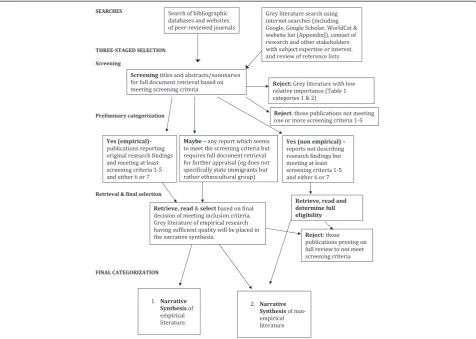
Two search phases are being conducted (with screen-ing nearly complete) to provide evidence to contribute jointly to both the narrative synthesis (empirical evi-dence) and literature review (non-empirical publications in a variety of formats) (Figure 1). The search of elec-tronic databases and websites of relevant journals largely retrieves empirical and non-empirical papers published in peer-reviewed journals. The search for grey literature is including select database searches (ProQuest Disserta-tions and Theses, Google, and Google Scholar), internet-based searches (see dditional file 1), review of reference lists, and email or phone contact with research and other stakeholders who have subject expertise or interest.
An information scientist (health research librarian) designed the database search strategies, which were reviewed by the entire research team, including IKUs, before implementation. The following databases have been searched: Ovid MEDLINE in-process and other non-indexed citations, Ovid MEDLINE daily, Ovid MEDLINE 1950 to present, Ovid PsycINFO 1987 to present, Ovid EMBASE 1980-present, EbscoHOST CINAHL 1937 to present, ISI Web of Knowledge Social Sciences Citation Index 1898 to present, ISI Web of Knowledge Sciences Citation Index 1899 to present, Scopus 1960 to present, and CSA Sociological Abstracts
1952 to present. The search strategy for Ovid MEDLINE (see Additional file 2) was reviewed and revised to use subject headings that are appropriate for the other data-bases. The results (1897 hits with 410 duplicates) from the implemented searches have been stored in RefWorks and have been screened and retrieved for selection (underway). There will also be hand searches within websites of relevant journals (such as J Immigr Minor Health, JOGNN, J Health Serv Res Policy, Can J Public Health, and Culture, Health and Sexuality) using key phrases and authors.
grey-Figure 1Search and selection process.Two search phases will provide evidence to contribute jointly to both the narrative synthesis and literature review. The screening stage of selection (nearly complete) applies a checklist (Figure 2); the first five items and one of the last two items must be met to include the literature, which will be classified later as being empirical or non-empirical. Ambiguous items will be read in full and discussed by two or possibly three reviewers. Further selection or rejection will be completed after reading full reports and categorizing them as contributing to the narrative synthesis or literature review. Grey literature is being rejected at the screening stage if it is not considered to be of sufficient relative importance (Table 1, categories 1, 2 & 3) as determined by AcademyHealth [48]. Grey-literature reports describing empirical research will be placed in the narrative synthesis if deemed to have sufficient quality (category A, in accordance with McGrathet al.[47].
literature search will be placed in the narrative synthesis if deemed to have sufficient quality (category A, in ac-cordance with McGrath et al. [47]). Any grey literature deemed to have insufficient quality or empirical basis will be placed into the non-empirical literature review, because these publications will provide more for back-ground or contextual information (category B, in accord-ance with McGrath et al. [47]). Grey literature passing the preliminary quality assessment will present a clear research question(s), state key findings, and provide suf-ficient details on the population(s) studied, interven-tions, study design, method of analysis, and evaluation outcomes [47]. Further quality appraisal will be con-ducted within the narrative-synthesis process. For the screening stage, one reviewer has screened all retrieved citations from the database searches, with those deemed questionable for selection (the‘maybe’folder) brought to one of the team leads (GH or MM) for a final decision. Concurrently, the entire team is engaging in a search of grey literature following an allocation of websites as decided collaboratively during a team meeting. Members have undergone adequate training by the information scientist on searching strategies for grey literature. In the final selection and categorization stages, there will be two investigators working independently, with any disagreement being resolved by one of the study leads (GH or MM). Inter-rater reliability of the grey literature quality assessments will be appraised, as will be the qual-ity appraisal within the narrative synthesis (refer to element 4 of the narrative synthesis).
Data extraction
For the narrative synthesis, a summary of each study reviewed will be tabulated using ATLAS.ti data analysis software (ATLAS.ti Scientific Software Development GmbH, Berlin, Germany), in which the lead author has training and consults as a trainer through an affiliation
with the North American ATLAS.ti Training Center. Publications will be uploaded as primary documents (in portable document (PDF) format; Adobe Systems Inc., San Jose, CA, USA) and coded in accordance with the summary data requirements (considered as variables which can be imported from an Excel spreadsheet; Microsoft Corp., Redmond, WA, USA), and later with respect to thematic analysis. The review team will col-lectively decide on data variables (for example study de-sign, sample population), bearing in mind those categories suggested as informative for textual descrip-tions within the narrative synthesis (Table 2; also refer to element 2 described in the section headed ‘Narrative Synthesis’). One reviewer will extract the data, and one or more team members will review for accuracy and completeness. The publications reviewed for the non-empirical literature review will generally be those other than research studies, hence narrative descriptions of the key messages of those publications will be constructed.
Narrative synthesis
Our synthesis will use the approach to narrative synthe-sis described by Popay et al. (page 5, [52]), which is defined as ‘an approach to the systematic review and synthesis of findings from multiple studies that relies primarily on the use of words and text to summarise and explain the findings of the synthesis’. This approach is equally suitable for both quantitative and qualitative studies, as the emphasis is on an interpretive synthesis of the narrative findings of research rather than on per-forming a meta-analysis of the data. It will allow us to encompass the cross disciplinary and methodologically pluralistic natures of research in this topic area of experiences and outcomes of immigrant women in maternity.
The general framework for a narrative synthesis com-prises four main elements: 1) development of a theory of Table 1 Relative importance of grey literature as used by AcademyHealth in their Grey Literature Project [48]
5 4 3 2 1
Working papers Data evaluations Speeches Newsletters Pamphlets
Committee reports Foundation reports Annual reports Biographies Protocols
Testimony Government reports Presentations Bulletins Guidelines
Conference proceedings
Grantee publications Grantee reports Slide
presentations
Poster sessions
Non-commercially published conference papers
Reports Webcasts Foundation financial
statements
Meeting agendas
Special reports Theses Translations
Technical specifications and standards
how the intervention works, why, and for whom; 2) de-velopment of a preliminary synthesis of the findings of the included studies, 3) exploration of the relationships in the data; and 4) assessment of the robustness of the synthesis. Although represented linearly, the processes are not necessarily independent of each other, and the synthesis often takes an iterative approach. Within each element, there is a variety of tools and techniques that may be used, depending on the nature of the research evidence. Additionally, additional tools and techniques may be used where appropriate [46]. For instance, because this synthesis will very likely not synthesize intervention studies exclusively, a framework of mater-nity-care experiences including accessibility and out-comes will be created, rather than a theory of these, as suggested for element 1. Table 2 lists the tools that the team envisions using for this synthesis and below is a brief description of each element.
Element 1: developing a theory
A theory will not play a large role in this synthesis which aims to largely explore experiences of immigrant women
rather than implement any intervention with measurable endpoints and outcome measures. As stated above, after reading the studies we will develop a preliminary frame-work of the maternity-care experiences and outcomes of immigrant women, which we will use to interpret and understand our synthesis. This will probably be an itera-tive process with multiple revisions as we work through Elements 2–4.
Element 2: developing a preliminary synthesis
The preliminary synthesis will provide an initial descrip-tion and mapping of the results of all included research studies. The synthesis will be further evaluated by the entire team to identify contextual and methodological factors that may have influenced the published results. Interrogation of the preliminary synthesis will facilitate construction of explanations as to how and why mater-nity services may have been implemented or may have affected immigrant women of childbearing age in a par-ticular manner. Through careful organization of results, cross literature comparisons are facilitated, allowing pat-terns to emerge regarding both the women’s experiences Table 2 Tools of possible value for elements 2 to 4 of the narrative synthesis [46,52]
Tasks Explanation
Element 2: preliminary synthesis of findings
Textual description of the studies
A descriptive paragraph with headings of‘Setting’,‘Participants’,‘Aim’,
Sampling and recruitment’,‘Method’,‘Analysis’,‘Results’, and‘thick’or‘thin’study. This may be represented in tabular format
Grouping and clustering of studies
The data extracted for the textual description will allow papers to be grouped and thus enable patterns between and within studies to be identified. This will be informed by the research questions. Data may be grouped by a particular feature (for example, location, method, ethnic groups, form of analysis, or main findings)
Translating data: thematic analysis
To identify main or recurrent themes in findings
Element 3: exploring relationships within and between studies
Moderator variables and subgroup analysis
Identifying study characteristics that vary between studies, or sample (subgroup) characteristics that might help explain differences in findings
Ideas webbing and concept mapping
‘Ideas webbing’conceptualizes and explores connections between the findings reported in the review studies and often takes the form of a spider diagram.‘Concept mapping’links multiple pieces of information from individual studies, using diagrams and flow charts to construct a model with relevant key themes
Qualitative case descriptions
Descriptions of outliers or exemplars of why particular results were found in the outcome studies
Element 4: assessing the robustness of the synthesis
Weight of evidence or validity assessment
To enable scoring of studies, quality checklists (to be determined still) will be used, and weighted scores will be applied after agreement of all researchers
Critical reflection Summary discussion, covering: 1) the synthesis methodology (focusing on the limitations and their possible effect on the results); 2) evidence used (quality, reliability, validity, and generalizability); 3) assumptions made; 4) discrepancies and uncertainties identified, and how discrepancies were dealt with; 5) areas where the evidence is weak or nonexistent; 6) possible areas for future research; and 7) discussion of the evidence, considering the‘thick’and‘thin’ evidence and commenting upon similarities and/or differences between the various sources of evidence
of maternity services, and the development and imple-mentation of health services and health care interven-tions. For the textual descriptions of the studies, we have adapted the assessment of “thick”or“thin” papers using Roen et al.’s work [53] in a systematic review of the evi-dence about the implementation of the interventions to reduce unintentional injuries among children, which it-self drew on the work of Denzin et al. [54] and may apply to both quantitative and qualitative narrative find-ings as the emphasis is on textual analysis of the narra-tive findings. This approach distinguishes between papers that offered greater explanatory insights into their outcome of interest from those that offered a lim-ited insight. Thick papers: 1) provide a clear account of the process by which their findings were produced, in-cluding the sample, its selection and size with any lim-itations or bias noted, and clear methods of analysis and adjustment for confounding in statistical studies; and 2) present a developed and plausible interpretation of the analysis based on the data presented. By contrast, thin papers: 1) lack a clear account of the process by which their findings were produced, and 2) present an under-developed and weak interpretation of the analysis based on the data presented.
Element 3: exploring relationships within and between studies
Patterns emerging from cross literature comparisons will be subjected to further rigorous evaluation to identify factors that may explain differences, including variances in women’s experiences, the effects of maternity inter-ventions, and implementation of maternity services. This evaluation will contribute to the understanding about barriers and enablers that shape maternity services for immigrant women. Evaluation will be conducted of the relationships between study characteristics and reported findings and the ways in which these relationships may correspond with key aspects reported in other literature included in the literature review. Careful attention will be paid to the heterogeneity of research methods, meth-odological approaches, and population characteristics encompassed in the literature through the application of narrative methods, which are particularly suited to syn-thesizing such findings. Key tools used here are moder-ator variables and subgroup analysis, ideas webbing and concept mapping, and qualitative case descriptions (Table 2).
Element 4: assessing the robustness of the synthesis
Key to ensuring the robustness of the synthesis is the methodological quality of key literature and the analyt-ical methods used to develop the narrative synthesis. Re-search studies will be critically appraised using the Critical Skills Appraisal Programme [55] and weighted
accordingly as defined by the study team (to be deter-mined). The team will consider the types of evidence retrieved (that is, relative contribution from qualitative and quantitative designs) to make further decision on the use of a weight-of-evidence approach, such as that described by Gough [56]. Such an approach may not al-ways be appropriate, especially in situations where insuf-ficient information about the methodological quality of studies included in the review is available [57,58]. Within our critical reflection (Table 2), qualitative papers will be assessed in accordance with the principles of confirm-ability, transferconfirm-ability, credibility, and dependability described by Lincoln and Guba [59]. There will be a clear description of the potential sources of bias within the synthesis process itself.
Non-empirical literature review
The non-empirical literature review of published litera-ture will essentially be a generic review [60] to provide additional understanding of the experiences of mater-nity-care services by immigrant women in Canada. It may build upon the findings of the narrative synthesis and/or identify omissions or gaps in the empirical re-search literature. The importance of reviewing this work partly stems from the fact that some non-empirical reports published in peer-reviewed journals, such as cor-respondence pieces, can highlight unique aspects of the topic that are not empirically studied, owing to, for in-stance, sufficient sample population (as with patient safety incidents, for example). It also relates to the fact that some audiences, such as policy-makers and founda-tions, place a high priority on grey literature to gather their information [48]. The search and selection proce-dures defined above, will be comprehensive, but no ap-praisal of quality will be undertaken because of the non-empirical basis of the publications. If suitable, the review will incorporate some conceptual or thematic analysis. Explicit statements of the limitations of using literature that may have limited validity will be discussed.
Integrated knowledge translation
Program Director) promotes multiculturalism and com-munity development by planning and organizing federal and community initiatives and programs, and by provid-ing strategic advice about program policy and delivery to senior management both regionally and nationally. The PHAC (author DK is Program Consultant) funds the Community Action Program for Children and Canada Prenatal Nutrition Program, the latter providing long-term funding to community groups to develop or en-hance programs for vulnerable pregnant women. The authors from AHS (HE and JF) represent the aspects of diversity education/strategy and nursing education of the provincial health system in one of Canada’s pro-vinces. The MCHB Co-op is a unique workers’ co-opera-tive that provides culturally respectful and responsive health education and outreach support to immigrant and refugee families in 17 immigrant and refugee com-munities. Current funded projects/programs include the Peri-Natal Outreach and Support program, the Home Visitation Program, the Multicultural Family Connec-tions Program, and IntervenConnec-tions to Support and Provide Childcare Services to Refugee and Immigrant Families. Several authors (YC, ME and HE) have substantial con-tacts within immigrant support and/or settlement agen-cies throughout Canada. In addition to using IKUs, a systematic review expert (MM) will help ensure the rigor and validity of the findings and recommendations.
Although concern with immigrant maternity experi-ences is relatively new in Canada [62] recent national guidelines from the PHAC explicitly refer to population diversity and the need to tailor services to the needs of those they serve [28]. Furthermore, although not univer-sal throughout Canada, voluntary sector immigrant agencies are active in several cities (for example the MCHB Co-op in Edmonton), supporting immigrant women in access to maternity services. A rapidly chan-ging demography and observations from maternity-care providers throughout AHS, coupled with the known health disparities that immigrant women experience, present many challenges on the trajectory of maternity-care provision whether in the community or hospital.
Partnership interactions
Interactions of the team have occurred during the prep-aration of this proposal to enable refinement of the re-search question, to optimize its relevancy for the entire team, and to identify potential strategies for dissemation. After study commencement, the entire team, in-cluding the information scientist, will meet to refine the search strategy, develop lists of websites and contacts for identifying grey literature, plan for future meetings, and identify KT opportunities. During the review, monthly scheduled meetings (and unscheduled meetings at crucial junctures) will occur, initially to reach consensus on final
inclusion of studies, and, later, to discuss results, mainly related to grouping findings, exploring relationships, and determining themes. Once preliminary findings have been synthesized, the team will discuss the nature and potential significance of the emerging synthesis, to offer interpretation of the emerging themes, and to begin to devise recommendations and messages to target specific audiences. Subsequently, a specific pre-dissemination meeting will enable review of the significance of the find-ings, the dissemination activities, and the key messages. To this meeting we will invite other key decision-makers and practitioner colleagues identified by IKUs through their extensive links. Moreover, IKUs will help to identify, plan, and present dissemination events (including com-munity-based events and conferences and symposia), and will assist with development and dissemination of other KT outputs such as the briefing paper, fact sheet, and seminars.
Dissemination of findings and recommendations
Our dissemination goals are two-fold: 1) To ensure that key messages are delivered in an audience-specific manner, aligning with the needs of IKUs, to optimize their effect on policy and practice change throughout the health service, and the public health, immigration and community sectors; and 2) to utilize widely accessible technology (webinars and possibly social networking) to ensure maximum cover-age. The specific KT strategies can be categorized by the target audience.
For mixed-audience KT, a research briefing paper for health practitioners, policy-makers and decision-makers in Canada and an accessible plain-language fact sheet will be professionally designed and produced, with wide dissemination using the activities and networks of academic team member and IKUs The fact sheets, in particular, will facilitate transfer of messages to the public and healthcare professionals, policy-makers and other knowledge users. Both will utilize the expertise of two of the IKUs (HE and ME) and will be linked with an electronic version. Contribution to academic theory and practice will occur through publication of findings in accessible international journals. The IKUs will be invited to co-author publications. A major por-tion of our efforts are also anticipated to be targeted towards PHAC and CIC to recommend revision of existing resources for women (for example, the Healthy Pregnancy Calendar and The Sensible Guide to a Healthy Pregnancy) to incorporate our findings (for example using language translation and incorpor-ation of culturally appropriate concepts).
community meetings with families, women’s groups, and workshops related to refugee/immigrant health. Likewise, additional knowledge users (multiprovincial) will be invited to attend community-based seminars/workshops. Publiciz-ing our findPubliciz-ings at multicultural and immigration/multi-cultural events will target community, provincial, and national leaders, and two of the IKUs (YC and ME) will be primary agents for these activities.
Mechanisms for diffusion and transfer of knowledge will inform policy and practice, and will include international, national, and regional networks and conferences attended by policy-makers such as the National Metropolis Confer-ence and the Qualitative Research for Policy Making Con-ference (UK); a multiprovincial electronic seminar; and a provincial email knowledge-transfer network called Col-laborative Research in Ethnicity, Social Care, and Health, which will be created and convened by the first author (GH). Presentations will be made by the IKUs when they attend conferences and advisory committee meetings with key federal and provincial policy-makers and ministers.
An electronic seminar will be developed with presen-tations by the first author (GH) and IKUs to disseminate the findings to healthcare practitioners, and additional workshops/seminars may be facilitated at national health research conferences (for example, for neonatal and ob-stetrical nursing). Two other IKUs (JF and HE) will inte-grate findings into professional practice via their clinical and diversity education capacities.
Discussion
A knowledge synthesis of maternity care among immi-grants to Canada is needed to build a coherent evidence base eliciting understanding of factors generating disparities in accessibility, acceptability, and outcomes during mater-nity care, and to improve culturally based competency of maternity care. Synthesized evidence is needed in order for knowledge users within multiple sectors to configure ma-ternity services and programs appropriately. In addition, synthesized evidence is needed for strategic enhancements to the current maternity-service provision, including pro-fessional development of health propro-fessionals to ensure provision of culturally congruent and culturally safe mater-nity care. Ultimately, enhancements to matermater-nity care for immigrant women benefit not only the female service users but also the health of future generations of Canadians.
The lack of an available synthesis of this complex issue makes our knowledge synthesis significant and important as a mechanism for drawing together mes-sages from research to guide policy and practice in meaningful ways. The heterogeneous nature of the meth-odological approaches to inquiry, being quantitative, quali-tative and mixed-method approaches, mitigates against a meta-ethnographical approach or meta-data analysis, and supports our systematic review using a narrative synthesis.
Moreover, narrative methods facilitate understanding and acknowledgement of the broader influences of theoretical and contextual variables, such as race, gender, socioeco-nomic status, and geographical location. They also enable understanding about the shaping of differences between reported outcomes and study designs in relation to child-bearing populations and the development and implemen-tation of maternity services and health interventions across diverse settings. The additional methods used to supplement and contextualize the narrative synthesis find-ings by identifying and analyzing non-empirical reports will enrich our understanding and dissemination of the findings.
Additional files
Additional file 1:List of websites generated for searching grey literature.
Additional file 2:Search strategy overview and table for MEDLINE.
Abbreviations
IKT: integrated knowledge translation; KT: knowledge translation; IKU: integrated knowledge users; PHAC: Public Health Agency of Canada; CIC: Citizenship and Immigration Canada; MCHB Co-op: Multicultural Health Brokers Co-operative; AHS: Alberta Health Services.
Competing interests
The authors declare no competing interests with this research.
Acknowledgements
We thank Thane Chambers (Research Librarian, Faculty of Nursing, University of Alberta) for her invaluable assistance with developing the search strategies for the narrative synthesis and the grey literature, and Jennifer Pillay (Research Coordinator for Dr Higginbottom, Canada Research in Ethnicity and Health, Faculty of Nursing, University of Alberta) for editing the manuscript. This study, including its support by Thane Chambers and Jennifer Pillay, is funded by a Knowledge Synthesis grant from the Canadian Institutes for Health Research (reference number 116880).
Author details
1Faculty of Nursing, Edmonton Clinic Health Academy, University of Alberta,
Edmonton, AB T6G 1C9, Canada.2King’s College London, Primary Care &
Public Health Sciences London, London, SE1 3QD, UK.3School of Rural
Health, Monash University, Bendigo, VIC, Australia.4Lois Hole Hospital,
Alberta Health Services, Edmonton, AB T5H 3V9, Canada.5Citizenship and
Immigration Canada, New Multiculturalism Grants and Contributions Program, Canada Place, Edmonton, AB T5J 4C3, Canada.6Multicultural Health
Brokers Co-operative, Edmonton, AB T5H 2M6, Canada.7Health Canada,
Public Health Agency of Canada, Calgary, AB T2G 4X3, Canada.
Authors’contributions
GH conceptualized the study and prepared the draft of the research proposal. MM provided insight to the methodological approach of the narrative synthesis and quality appraisal. MM, JD, HE, ME, DK, YC and JF contributed to the proposal development as related to research questions, aim/objectives, and dissemination activities. All authors assisted with manuscript preparation and approve of the final submission.
Received: 11 April 2012 Accepted: 31 May 2012 Published: 31 May 2012
References
2. Statistics Canada:Projections of the Diversity of the Canadian Population. Ottawa, ON: Demography Division; 2010. Author.
3. Newbold KB:Self-rated health within the Canadian immigrant population: Risk and the healthy immigrant effect.Soc Sci Med2005,
60:1359–1370.
4. Hyman I:Immigration and Health: Reviewing Evidence of the Healthy Immigrant Effect in Canada. CERIS Working Paper # 55. Toronto: Joint Centre of Excellence for Research on Immigration and Settlement; 2007. http:// ceris.metropolis.net/wp-content/uploads/pdf/research_publication/ working_papers/wp55.pdf.
5. Gagnon AJ, Zimbeck M, Zeitlin J:The ROAM Collaboration: Migration to western industrialized countries and perinatal health: a systematic review.Soc Sci Med2009,69:934–946.
6. Small R, Gagnon A, Gissler M, Zeitlin J, Bennis M, Glazier RH, Haelterman E, Martens G, McDermott S, Urquia M, Vangen S:Somali women and their pregnancy outcomes postmigration: data from six receiving countries. BJOG2008,115:1630–1640.
7. Urquia M, Frank JW, Glazier RH:From places to flows. International secondary migration and birth outcomes.Soc Sci Med2010,71:1620–1626. 8. Guendelman S, Buekens P, Blondel B, Kaminski M, Notzon FC,
Masuy-Stroobant G:Birth outcomes of immigrant women in the United States, France and Belgium.Matern Child Health J1999,3:177–187.
9. Bollini P, Pampallona S, Wanner P, Kupelnick B:Pregnancy outcome of migrant women and integration policy: a systematic review of the international literature.Soc Sci Med2009,68:452–461.
10. Urquia M, Frank JW, Glazier RH, Moineddin R:Birth outcomes by neighbourhood income and recent immigration in Toronto.Health Reports2007,18:1–10. 11. Malin M, Gissler M:Maternal care and birth outcomes among ethnic
minority women in Finland.BMC Publ Health2009,9:84.
12. Gissler M, Alexander S, MacFarlane A, Small R, Stray-Pedersen B, Zeitlin J, Zimbeck M, Gagnon A:Stillbirths and infant deaths among immigrants in industrialized countries.Acta Obstet Gynecol Scand2009,88:134–148. 13. Hyman I, Dussault G:Negative consequences of acculturation on health
behavior, social support and stress among pregnant Southeast Asian immigrant women in Montreal: an exploratory study.Can J Public Health
2000,91:357–360.
14. Uriquia ML, Frank JW, Moineddin R, Glazier RH:Immigrants’duration of residence and adverse birth outcomes: a population-based study.BJOG
2010,117:591–601.
15. Lim G, Tracey J, Boom N, Karmakar S, Wang J, Berthelot J-M, Heick C:
Hospital costs for preterm and small-for-gestational age babies in Canada.Healthc Q2009,12:20–24.
16. Renzaho A, Skouteris H, Oldroyd J:Preventing gestational diabetes mellitus among migrant women and reducing obesity and type 2 diabetes in their offspring: a call for culturally competent lifestyle interventions in pregnancy.J Am Diet Assoc2010,110:1814–1817. 17. Urquia M, Glazier RH, Berger H:Gestational diabetes among immigrant
women.Epidemiology2011,22:879–880.
18. Grewal SK, Bhagat R, Balneaves LG:Perinatal beliefs and practices of immigrant Punjabi women living in Canada.JOGNN2008,37:290–300. 19. Nybo M, Friis-Hansen L, Felding P, Milman N:Higher prevalence of anemia
among pregnant immigrant women compared to pregnant ethnic Danish women.Ann Hematol2007,86:647–651.
20. Matthey S, Panasetis P, Narnett B:Adherence to cultural practices following childbirth in migrant Chinese women and relation to postpartum mood.Health Care Women In2002,23:567–575.
21. Essen B, Johnsdotter S, Hovelius B, Gudmundsson S, Sjoberg N-O, Friedman J, Ostergren P-O:Qualitative study of pregnancy and childbirth experiences in Somalian women resident in Sweden.Brit J Obstet Gynaecol2000,107:1507–1512.
22. Wang L, Rosenburg M, Lo L:Ethnicity and utilization of family physicians: A case study of Mainland Chinese immigrants in Toronto, Canada.Soc Sci & Med2008,67:1410–1422.
23. Hyman I:Immigration and Health. Working Paper 01–05. Ottawa, ON: Health Canada; 2001.
24. Reitmanova S, Gustafson DL:“They can’t understand it”: maternity health and care needs of immigrant Muslim women in St John’s,
Newfoundland.Matern Child Health2008,12:101–111.
25. Karlsen S, Nazroo JY:Agency and structure: the impact of ethnic identity and racism on the health of ethnic minority people.Sociol Health Ill2002,
24:1–20.
26. Newbould KB:Health status and health care utilization of the foreign-born in Canada: A longitudinal analysis, 1994/95-2000/01.J Health Serv Res Po2005,10:77–84.
27. Napoles-Springer AM, Santoyo J, Houston K, Perez-Stable EJ, Stewart AL:
Patients’perceptions of cultural factors affecting the quality of their medical encounters.Heal Expect2005,8:4–17.
28. Public Health Agency of Canada:What Mothers Say: The Canadian Maternity Experiences Survey. Ottawa, ON: Maternal and Infant Health Section; 2009. Available from http://www.publichealth.gc.ca/mes.
29. Gagnon AJ, Carnevale FA, Saucier JF, Clausen C, Jeannotte J, Oxman-Martinez J:Do referrals work? Responses of childbearing newcomers to referrals for care.J Immigr Minor Health2010,12:559–568.
30. Gagnon AJ, Dougherty G, Platt RW, Wahoush O, George A, Stanger E, Oxman-Martinez J, Saucier JF, Merry L, Stewart DE:Refugee and refugee-claimant women and infants post-birth: migration histories as a predictor of Canadian health system response to needs.Can J Public Health2007,98:287–291.
31. Bharj K, Salway S:Addressing Ethnic Inequalities in Maternity Service Experiences and Outcomes: Responding to Women’s Needs and Preferences.
A Race Equality Better Health Briefing Paper No. 11. London, UK: Race Equality Foundation; 2008. Available from http://www.better-health.org.uk/ sites/default/files/briefings/downloads/health-brief11.pdf
32. Davies M, Bath PA:The maternity information concerns of Somali women in the United Kingdom.J Adv Nurs2001,36:237–245.
33. D'Souza L, Garcia J:Improving services for disadvantaged childbearing women.Child Care Hlth Dev2004,30:599–611.
34. Small R, Yelland J, Lumley J, Brown S, Liamputtong P:Immigrant women's views about care during labor and birth: an Australian study of Vietnamese, Turkish, and Filipino women.Birth2000,29:266–277. 35. Small R, Gagnon A, Gissler M, Zeitlin J, Bennis M, Glazier RH, Haelterman E,
Martens G, McDermott S, Urquia M, Vangen S:Somali women and their pregnancy outcomes postmigration: data from six receiving countries. BJOG2008,115:1630–1640.
36. Carolan M, Cassar L:Antenatal care perceptions of pregnant African women attending maternity services in Melbourne, Australia.Midwifery
2010,26:189–201.
37. Fisher JA, Bowman M, Thomas T:Issues for South Asian Indian patients surrounding sexuality, fertility, and childbirth in the US health care system.J Am Board Fam Pract2003,16:151–155.
38. Hammoud M, White CB, Fetters MD:Opening cultural doors: Providing culturally sensitive healthcare to Arab American and American Muslim patients.Am J Obstet Gynecol2005,193:1307–1311.
39. Kingston D, Heaman M, Chalmers B, Kaczorowski J, O’Brien B, Lee L, Dzakpasu S, O’Campo P:Comparison of maternity experiences of Canadian-born and recent and non-recent immigrant women: findings from the Canadain Maternity Experiences Survey.JOGC2011,33:1105–1115.
40. euroPERISTAT:Reproductive Outcomes and Migration (ROAM).: An
International Research Collaboration; http://www.europeristat.com/Network/ ROAM_Collaboration/index.shtml.
41. Salway S, Reime B, Higginbottom GMA, Bharj K, Chowbey P, Ertan K, Foster C, Friedrich J, Gerrish K, Kentenich H, Mumtaz Z, O’Brien B:Contributions and challenges of cross-national comparative research in migration, ethnicity and health: insights from a study of maternity experiences and outcomes.BMC Publ Health2011,11:514.
42. Higginbottom GMA, O’Brien B, Mumtaz Z, Yohani S, Chiu Y, Okeke-Ihejirika P, Ahmadi E, Paton P, Malhi R, Bell S:Optimizing hospital and
community-based maternity care for newcomer women in Alberta. Three paper symposium abstracts.Intern J Qualit Method2011, In press. 43. End of Grant Knowledge Translation and Integrated Knowledge Translation:
Canadian Institutes of Health Research; 2009. Available from http://www. cihr-irsc.gc.ca/e/38654.html.
44. Canadian Council of Refugees:Refugees and Immigrants.: A Glossary. 45. Uriquia M, Gagnon AJ:Glossary: migration and health.J Epidemiol
Community Health2011,65:467–472.
46. Centre for Reviews and Dissemination:Systematic Reviews: CRD’s Guidance for Undertaking Reviews in Health Care. York, UK: Centre for Reviews and Dissemination, University of York; 2009.
48. AcademyHealth:Health Services Research and Health Policy Grey Literature Project: Summary Report. National Institutes of Health: United States National Library of Medicine; 2006. Available from: http://www.nlm.nih.gov/nichsr/ greylitreport_06.html.
49. GreyNet International: http://www.greynet.org/greynethome.html. 50. UBC Library:Subject Resources for Searching for Grey Literature: http://toby.
library.ubc.ca/subjects/subjpage2.cfm?id=877.
51. Hani A:Empirical Research. Experiment Resources: 2009 [http://www. experiment-resources.com/empirical-research.html].
52. Popay J, Roberts H, Sowden A, Petticrew M, Arai L, Rodgers M, Britten N, Roen K, Duffy S:Guidance on the Conduct of Narrative Synthesis in Systematic Reviews.: A Product from the ESRC Methods Programme April 2006; 2006. Available from http://www.lancs.ac.uk/shm/research/nssr/research/ dissemination/publications/NS_Synthesis_Guidance_v1.pdf. 53. Roen K, Arai L, Roberts H, Popay J:Extending systematic reviews to
include evidence on implementation: methodological work on a review of community-based initiatives to prevent injuries.Soc Sci Med2006,
63:1069–1071.
54. Denzin N, Lincoln Y:Tuhiwai Smith L (Eds): Handbook of Critical and Indigenous Methodologies. Thousand Oaks, CA: Sage Publications; 2008. 55. Critical Appraisal Skills Programme:Critical Appraisal Skills Programme: Critical
Appraisal Skills Programme: [http://www.casp-uk.net/.]
56. Gough D:Applied and practice-based research. InWeight of evidence: a framework for the appraisal of the quality and relevance of evidence. Edited by Furlong J, Oancea A. 2007: Special edition of Research Papers in Education; 2007:213–228. 22.
57. Campbell R, Britten N, Pound P, Donovan J, Morgan M, Phil R, Pope C:
Moving Beyond Effectiveness in Evidence Synthesis: Methodological Issues in the Synthesis of Diverse Sources of Evidence. InUsing meta-ethnography to synthesise qualitative research. Edited by Pope C. London: National Institute for Health and Clinical Excellence; 2006:75–82. 58. Campbell R, Pound P, Pope C, Britten N, Pill R, Morgan M, Donovan J:
Evaluating meta-ethnography: a synthesis of qualitative research on lay experiences of diabetes and diabetes care.Soc Sci & Med2003,56:671–684. 59. Lincoln YS, Guba EG:Naturalistic Inquiry. Newbury Park, CA: Sage
Publications Inc; 1985.
60. Grant MJ, Booth A:A typology of reviews: an analysis of 14 review types and associated methodologies.Health Info Lib J2009,26:91–108. 61. Gagnon AJ, Joly MP, Bocking J:Aligning research to meet policy
objectives for migrant families: an example from Canada.Health Research Policy and Systems2009,7:15.
62. Brotto LA, Chou AY, Singh T, Woo JS:Reproductive health practices among Indian, Indo-Canadian, Canadian East Asian, and Euro-Canadian women: The role of acculturation.J Obstet Gynaecol Can2008,30:229–238.
doi:10.1186/2046-4053-1-27
Cite this article as:Higginbottomet al.:Immigrant women’s experiences of maternity-care services in Canada: a protocol for systematic review
using a narrative synthesis.Systematic Reviews20121:27.
Submit your next manuscript to BioMed Central and take full advantage of:
• Convenient online submission
• Thorough peer review
• No space constraints or color figure charges
• Immediate publication on acceptance
• Inclusion in PubMed, CAS, Scopus and Google Scholar
• Research which is freely available for redistribution
![Table 1 Relative importance of grey literature as used by AcademyHealth in their Grey Literature Project [48]](https://thumb-us.123doks.com/thumbv2/123dok_us/9527856.1935741/6.595.56.542.100.261/table-relative-importance-literature-academyhealth-grey-literature-project.webp)
![Table 2 Tools of possible value for elements 2 to 4 of the narrative synthesis [46,52]](https://thumb-us.123doks.com/thumbv2/123dok_us/9527856.1935741/7.595.55.531.98.453/table-tools-possible-value-elements-narrative-synthesis.webp)
