Iran University of Medical Sciences
____________________________________________________________________________________________________________________
1. MSc, Audiologist, Department of Audiology, School of Rehabilitation, Tehran University of Medical Sciences, Tehran, Iran, &
Rehabilita-tion Research Center (RRC), Iran University of Medical Sciences, Tehran, Iran. [email protected]
2. (Corresponding author) PhD, Associate Professor, Neuroscientist, Rehabilitation Research Center (RRC), Iran University of Medical Sci-ences, Tehran, Iran, & Department of Basic Sciences in Rehabilitation, School of Rehabilitation SciSci-ences, Iran University of Medical SciSci-ences, Tehran, Iran. [email protected]
3. PhD, Assistant Professor, Statistician, Department of Biostatistics, School of Rehabilitation, Tehran University of Medical Sciences, Tehran,
Iran. [email protected]
Static balance function in children with a history of preterm birth
Zahra Eshaghi1, Zahra Jafari*2, Shohreh Jalaie3
Received:4 July 2015 Accepted:13 October 2015 Published:27 December 2015
Abstract
Background: The incomplete maturation of brain in preterm children results in long-term neurode-velopmental impairment. This study aimed to investigate the static balance function in children with a history of preterm birth.
Methods: Participants were 31 preterm children including 21 moderately preterm (MPT), 10 very preterm (VPT), and 20 term children aged 5.5 and 6.5 years. The cervical vestibular-evoked myogen-ic potential (cVEMP) test and four statmyogen-ic balance subscales of BOT-2 were performed.
Results: The VPT children showed a significant increase in P1 and N1 wave latencies in cVEMP test compared to those in the term children (p= 0.041). Mean scores in the four static balance sub-scales of BOT-2 were significantly lower in the preterm children compared to those in the term chil-dren (p= 0.025). The P1 wave latency (p= 0.003) and mean score of standing on a balance beam with open eyes (p= 0.039) were significantly lower in the VPT children compared to those in the MPT children. A significant correlation was observed between the mean score in exercise 4 (standing on one leg on a balance beam with closed eyes) of static balance subscales of BOT-2 and P1 (r= -0.267, p= 0.036) and N1 (r= -0.304, p= 0.016) wave latencies of cVEMP.
Conclusion: The longer latency of cVEMP waves along with a poor performance of children with a history of preterm birth suggests a possible defect in central vestibular pathway.
Keywords: Preterm Birth, Static Balance, Preschool Children, Vestibular Evoked Myogenic Poten-tials.
Cite this article as:Eshaghi Z, Jafari Z, Jalaie Sh. Static balance function in children with a history of preterm birth.Med J Islam Repub Iran2015 (27 December). Vol. 29:310.
Introduction
A myriad of genetic, environmental, and social factors influence the growth and de-velopment of individuals during fetal and neonatal life (1).
In addition, the neonate initiates extra-uterine life earlier than anticipated; there-fore, experiences various kinds of physio-logical, psychophysio-logical, and environmental hazards (2).
Moreover, the disruption of developmen-tal process leads to short term, long term, and even permanent consequences. Mye-lination of nervous system in the fetus
be-gins from the caudal end of the neural tube and progresses toward the cephalic end (3). Therefore, the consequences of preterm birth are expected to be most severe in the central nervous system. Accordingly, imag-ing studies have revealed cortical and sub-cortical disorders during infancy, child-hood, and adolescence among such indi-viduals (4), which is in line with their neu-ral growth. This group has been previously shown to suffer from various disorders per-taining to neural growth and development; cognitive, motor, and linguistic as well as long-term disorders such as cerebral palsy,
learning disorder, and antisocial behavior are also prevalent among them (5,6).
In addition, premature infants are more prone to motor disorders and poor postural performance during childhood compared to their peers born at term (7,8). A meta-analysis of different aspects of motor de-velopment in preterm infants from birth until adolescence was conducted using the following three practical and valid tests: BSID-II (Bayley Scales of Infant Devel-opment version II), MABC (Movement As-sessment Battery for Children), and BOTMP (Bruininks-Oseretsky Test of Mo-tor Proficiency). Significant disorders of motor skills in very preterm infants and those with low birth weight were reported in this study. Moreover, such disorders con-tinued until their teen years. In addition, the balance skills of preterm children were found to be highly defective (9). Balance is defined as a state of action and reaction be-tween two or more parts or organs of the body. Static balance as required for normal standing is the ability to maintain the body equilibrium in some fixed posture (10).
The cervical vestibular-evoked myogenic potential (cVEMP) test is a simple, tolera-ble, and noninvasive test for assessing the vestibular function in infants and children. This test assesses the inhibitory response of the sternocleidomastoid (SCM) muscle to high-intensity sound stimuli. The cVEMP test provides worthwhile information on saccular integrity and neural pathways of sacculocollic reflex including inferior ves-tibular nerve, lateral vesves-tibular nuclei, me-dial vestibulospinal tract, and motor neu-rons of the SCM muscle. Normal cVEMP response consists of biphasic waveforms (positive and negative). These components are labeled as p1 and n1 or p13 and n23 waves. The absence of response typically results from lesions of the end organs if there is no conductive hearing loss; and pa-thologies in the central neural pathways lead to delayed reflex (11). Studies that employed cVEMP test on preterm groups suggest an increased probability of disor-ders related to sacculocollic reflex
path-way; also, a decrease in response and a significant increase in the latency of the waves were observed in the preterm groups compared to the term ones (12-15) . On the other hand, the use of behavioral tests be-sides this electrophysiological evaluation can provide further information on the probable structural defects that affect bal-ance skills.
Assessing the long-term effects of pre-term birth is of high significance. In this context, the American Psychological Asso-ciation (APA) has emphasized the need to conduct extensive studies on the conse-quences of disturbed neural and behavioral development in preterm children (16). Giv-en the important role of the vestibular sys-tem in motor development, defects in ves-tibular functions during infancy have a po-tential negative influence on other motor skills, vision growth, postural control, mo-tor coordination, and sensory integration (17). Previous studies suggest defects in the maturation of sacculocollic reflex in pre-term infants. Moreover, disorders related to motor development are observed even in adolescents with a history of preterm birth (9). Considering the importance of identify-ing the potential difficulties children might experience prior to the start of the elemen-tary school, we aimed to investigate the static balance function in preschool chil-dren with a history of preterm compared to full-term birth using behavioral and elec-trophysiological tests.
Methods
Participants
This study included 31 children with a history of preterm birth. Based on the World Health Organization (WHO) that classified preterm infants as being moder-ate or lmoder-ate (32 to ˂37 gestational weeks), very (28 to ˂32 weeks) and extremely (less than 28 weeks) preterm (18). The preterm children were divided into two groups: 1) Moderately preterm (MPT), with a mean ± SD gestational age of 34.9 ± 1.28 weeks (range 32–37 weeks) including 12 boys and 9 girls; 2) very preterm (VPT), with a mean
± SD gestational age of 30.60 ± 0.94 weeks (range 28–31 weeks) including six boys and four girls. The control group included 20 children with a history of full-term birth including 9 boys and 11 girls; all the chil-dren aged 5.5 - 6.5 years. It should be spec-ified that the incidence of very preterm birth is low, as the VPT infants constitute only 10.4% of preterm infants (18). On the other hand, although improvements in med-ical care have led to improved survival rate of VPT infants, these infants are still more prone to mortality risk (19). Therefore, ac-cessibility to this group was very difficult and the number of sample in this group was lower than that of the other groups.
Normal peripheral hearing, good general health and absence of history of ototoxic drug use, recurrent ear infection, high fe-ver, head trauma, ear or brain surgery and psychological problems were the inclusion criteria in the three groups. Preterm chil-dren were selected by reviewing medical records of children of 5.5–6.5 years of age. The age-matched control group was select-ed by reviewing the mselect-edical records of term births children with gestational age of more than 37 weeks from 5.5 to 6.5 years ago. All children were selected using sim-ple random sampling method. On the day of the evaluation, personal meetings were conducted with parents, their consent was obtained, and the case history form was completed. Children were also subjected to basic audiometry tests including immit-tance audiometry (tympanometry and acoustic reflex measurements) using GSI TympanoStar (Grason-stadler Company), GSI TympanoStar and pure tone audiome-try tests using GSI 61, a two-channel clini-cal audiometer (Grason-stadler Company). In immittance audiometry tests, normal tympanogram (type An) and the record of acoustic reflexes were considered to rule out any type of conduction disorder (20). Moreover, air and bone conduction thresh-olds from 0 to 15 dB were considered as normal peripheral sensitivity (21). This study was approved by The Ethics Commit-tee of Iran University of Medical Sciences.
Measures
cVEMP test: The cVEMP test was con-ducted using ICS Charter EP (GN Otomet-rics Company). A single-channel recording of the response was made using non-inverting, inverting and ground electrodes placed on the upper half of the SCM mus-cle, the upper edge of the sternum and forehead, respectively. The stimulus in-cluded 500-Hz tone-bursts at 95 dB nHL intensity, with rise-fall and plateau dura-tions of 2-0-2 c/s and rarefaction polarity. The stimulus was presented to each ear us-ing ER-3A insert earphones. A 10- to 1500-Hz band pass filter, 100-ms time window, and stimulation rate of 5.1/s were em-ployed; the responses were amplified 5000 times, and 150 sweeps were averaged for each test (22). To record the cVEMP, the child was seated on a chair with his/her back against a back support and the head free to move. Then, the place of the elec-trodes was cleaned with a special abrasive gel. To elicit responses, the child was asked to turn his/her head against the direction of the stimulated ear. Based on the feedback method for monitoring the SCM contrac-tion by Sphygmomanometer, the degree of head rotation was controlled by the investi-gator as the head flexed approximately 30 degrees forward and rotated approximately 30 degrees to the contralateral side of the stimulated ear. The child was made to hold the cuff, which was inflated to a standard pressure of 20 mmHg to obtain a cushion to push against between the contralateral hand and the jaw. Then the child pushed with his/her head against the hand-held cuff (by turning the head toward the cuff) to gener-ate a contraction in the SCM muscle ipsi-lateral to the stimulated ear; and the child was trained to fix it on 40 mmHg (23). The latency of the cVEMP waves was assessed as the interval of p1 and n1 apex from the baseline, and the amplitude of the waves was assessed as the voltage between two positive and negative ends of the p1–n1 complex (22). The test was conducted without the use of sedatives in subjects who remained awake. About 1–2 minutes of
laxation was offered between consecutive wave recordings. Wave reproducibility was checked by recording each wave twice.
Assessment of the Static Balance Perfor-mance
The static balance performance of chil-dren was assessed using four static balance subtest of BOT-2. Exercises 1 and 2 in-volved the child standing on the preferred leg on a straight line drawn on the ground with open and closed eyes, respectively, with both hands on the waist and the free leg bent for 10 seconds. In each exercise, if the free leg touched the ground, and formed an angle wider than 45 degrees, it was low-ered, and hooked behind the standing foot, or the standing leg was moved; and then the test had to be stopped before the 10-second duration. In this instance, the recorded time would reflect the time the child had man-aged to maintain balance. Exercises 3 and 4 involved the child standing on the preferred leg on a straight line drawn in the middle of a balance beam with open and closed eyes, respectively, with hands around his/her waist for a duration of 10 seconds. The scoring method was similar to that of the previous stages. The balance subtest of the BOT-2 test was conducted with the chil-dren wearing comfortable shoes and in a room without any distracting objects. Se-cond and third chances were provided for children who failed in the first try in any of the stages, and the best result was recorded.
Scoring was done separately for each stage (24).
Data Analysis
Kolmogorov–Smirnov test was employed to determin the normal distribution of data. The results of cVEMP test were compared between the three groups using one-way ANOVA test. The F values, p values and estimations of effect size (partial η2) of the confidence intervals (CI) are reported. The mean scores of children in the behavioral assessment of static balance were analyzed using Kruskal–Wallis test. The association between cVEMP wave latencies and the mean scores of children in the behavioral balance test was examined using Spearman correlation test. All statistical analyses were done using SPSS version18.0, with the lev-el of significance set at p < 0.05.
Results
cVEMP Test
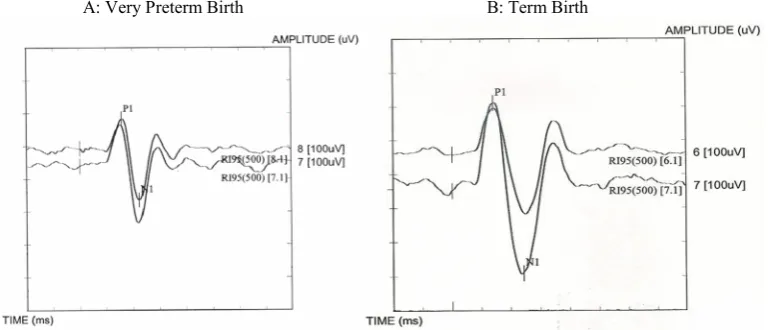
The cVEMP responses, characterized by biphasic waves, were recorded for all the study participants. A significant difference was observed between the three groups in the mean latency of P1 wave (p= 0.004). This difference results from the differences between the VPT and the control groups (p= 0.002) and also between the MPT and the VPT groups (p= 0.003). Moreover, the VPT children showed a significant increase in the N1 wave latency compared to the term children (p= 0.041). Table 1 displays
A: Very Preterm Birth B: Term Birth
Fig. 1. P1 and N1 Waves of the cVEMP test from a Very Preterm Child (A) and a Term Child (B)
the results of cVEMP comparisons between the groups. Comparison between the cVEMP responses of a VPT child and those of a term child is shown in Figure 1.
Furthermore, previous studies suggested that auditory-evoked potential wave laten-cies of the tested group, whose values devi-ated from the mean of the control group by more than two times standard deviation, could be considered as abnormal (3,25). Accordingly, the mean ± SD latency of P1 wave in the control group was 14.89±0.69 ms in the current study, and values above 16.27 ms were considered as abnormal for the preterm group. Hence, 19.04% of MPT infants and 40% of the VPT infants, four children each in both groups, showed ab-normal P1 latency.
The Static Balance Performance
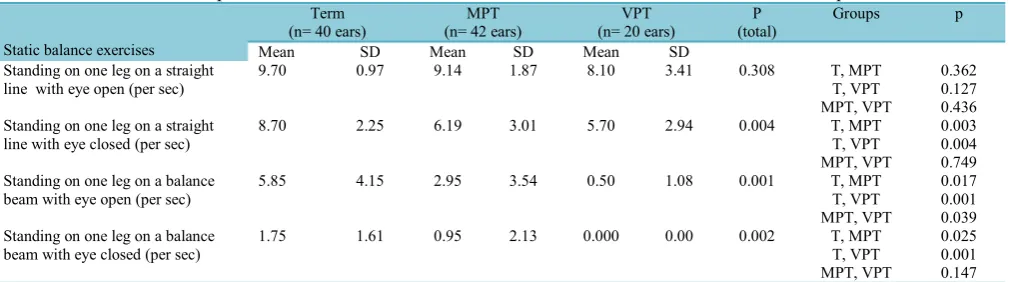
The mean scores (per sec) of children in
the three groups in each of the four static balance subtest of BOT-2 are shown in Ta-ble 2. Significant differences were observed between the three groups with respect to the mean scores in exercises 2 (standing on a straight line with closed eyes for 10 s) (p=0.004), 3 (standing on one leg on a bal-ance beam with open eyes) (p= 0.001), and 4 (standing on one leg on a balance beam with eyes closed) (p= 0.002).
Correlation between cVEMP Findings and the Static Balance Performance
In children with preterm birth history, there was a significant correlation between mean score in exercise 4 (standing on one leg on a balance beam with closed eyes) and P1 (r= -0.267, p= 0.036) and N1 (r=-0.304, p= 0.016) wave latencies of cVEMP. This correlation was not observed in the control group (r≤ 0.262, p≥ 0.1).
Table 1. Comparison of the cVEMP Results between the Three groups
VEMP
Term
(n= 40 ears) (n= 42ears)MPT (n= 20ears)VPT Statistical Results
Mean (SD) Mean (SD) Mean (SD) F P (total) Partial ƞ2 95% CI
(LB, HB) Groups p
P1 Latency (ms) 14.89
(0.69) (1.19)14.92 15.73 (1.02) 5.758 0.004 0.104 (0.012, 0.215) T, MPTT, VPT
MPT, VPT
0.906 0.002 0.003
N1 Latency (ms) 21.65 (1.22) 21.75
(1.79) 22.51 (1.41) 2.36 0.099 0.046l (0.000, 0.135) T, MPTT, VPT
MPT, VPT
0.773 0.041 0.068 P1-N1 Amplitude
(μV) (122.9)162.13 (84.46)160.00 (79.57)139.77 0.365 0.695 0.007 (0.000, 0.055 ) T, MPTT, VPT
MPT, VPT
0.924 0.627 0.681 Interaural
ampli-tude difference ratio
18.82 (9.69) 19.05
(17.24) (13.49)24.59 1.878 0.158 0.037 (0.000, 0.12) T, MPTT, VPT
MPT, VPT
0.943 0.348 0.377
Threshold 76.12 (4.99) 77.85
(7.50) 79.25 (4.94) 1.87 0.159 0.037 (0.000, 0.12) T, MPTT, VPT
MPT, VPT
0.305 0.058 0.494 CI: Confidence interval, cVEMP: Cervical vestibular evoked myogenic potentials, LB: Low bound of CI, HB: High bound of CI, ms: Millisecond, MPT:
Moderately preterm, Partial η2: Effect size estimate, SD: Standard deviation, T: term, VPT: Very preterm, μV: Micro volt
Table 2. Comparison of the Balance Subtest of BOT-2 test results between the Three Groups
Static balance exercises
Term
(n= 40 ears) (n= 42 ears)MPT (n= 20 ears)VPT (total)P Groups p
Mean SD Mean SD Mean SD
Standing on one leg on a straight
line with eye open (per sec) 9.70 0.97 9.14 1.87 8.10 3.41 0.308 T, MPTT, VPT
MPT, VPT
0.362 0.127 0.436 Standing on one leg on a straight
line with eye closed (per sec) 8.70 2.25 6.19 3.01 5.70 2.94 0.004 T, MPTT, VPT
MPT, VPT
0.003 0.004 0.749 Standing on one leg on a balance
beam with eye open (per sec) 5.85 4.15 2.95 3.54 0.50 1.08 0.001 T, MPTT, VPT
MPT, VPT
0.017 0.001 0.039 Standing on one leg on a balance
beam with eye closed (per sec) 1.75 1.61 0.95 2.13 0.000 0.00 0.002 T, MPTT, VPT
MPT, VPT
0.025 0.001 0.147 BOT-2: Bruininks-Oseretsky test-2, MPT: Moderately preterm, SD: Standard deviation, T: Term, VPT: Very preterm
No statistically significant difference was observed between the groups for body height and body weight (p≥ 0.05). Further-more, no significant correlation was ob-served between body height (r≤ 0.177, p≥ 0.05) and body weight (r≤ 0.202, p≥ 0.1) and the two tested parameters.
Discussion
Children born at a gestational age of more than 26 weeks were examined in this study. Therefore, the development of the vestibu-lar part of their inner ear could be presumed to have occurred before birth (13), which was concomitant with the cVEMP record-ings for all the term and preterm children. In the current study, the prolonged wave latencies were the noticeable results of cVEMP test. Previous studies have attribut-ed such an increase in cVEMP wave laten-cy to the impairment of the sacculocollic neural pathways (26). Research on the pre-term groups has shown that brain weight in a preterm (32 week gestation) infant is 65% of that of a term one, and the outer area of brain grooves is also limited; this underde-velopment of the brain potentially results in serious injuries (5). Imaging studies have shown that the size, volume and speed of growth of many parts of the brain including corpus callosum, ventricular system, cor-tex, gray matter and cerebellum are affect-ed by preterm birth (27). During the devel-opment of the nervous system in the fetus, myelination in the brain begins during the fifth fetal month and progresses from the caudal to the cephalic parts (3). In this re-gard, although vestibular development is soon completed in the intra-uterine stage, the central vestibular pathways continue to grow after birth, particularly in preterm in-fants (13). Accordingly, the prolonged cVEMP wave latency could be a conse-quence of the abrupt initiation of extra-uterine life and the immaturity of central pathways. The results of this study support previous studies that investigated cVEMP in preterm infants and reported a significant increase in the latency of response waves in preterm compared with normal-born infants
(12, 13, 15). Such an increase in cVEMP wave latency in children born preterm sug-gests that they show symptoms of immatu-rity in the neural pathways not only during infancy but also during preschool years; this is particularly true of VPT children, suggesting that this immaturity has not been compensated for by growth. These defects appear to have resulted from de-layed and/or defective myelination in the neural pathways of the sacculocollic reflex. However, it has to borne in mind that de-spite the statistically significant differences observed between the preterm and full-term children in the mean latency of p1 wave, as 19.04% of MPT and 40.0% of VPT chil-dren showed abnormal p1 latency, these results might be clinically less worthwhile; and therefore, more studies are needed for more reliable results.
In addition to the electrophysiological as-sessment, static balance performance was tested through behavioral exercises in this study. Four static balance subtests of BOT-2 were employed as omission or reduction of visual or somatic inputs makes balance retention more difficult, making possible the assessment of the child’s performance under more challenging situations. In exer-cises that involved standing on one leg on a straight line with closed eyes or on a bal-ance beam with open and closed eyes, the MPT as well as the VPT children showed significantly poorer performance compared with the control group; their mean scores in the exercises were significantly lower com-pared wto the term children. Although none of the participants, including term children, could complete exercise 4 (standing on a balance beam with closed eyes for 10 s), the mean scores of the preterm children were significantly lower than those of the control group. These observations revealed the overall poor performance of the chil-dren who were born preterm in four static balance subtests of BOT-2. Balance is de-pendent on receiving visual, somatic and vestibular inputs as well as their appropri-ate processing in the central nervous sys-tem; therefore, a damage and/or weakness
in one of these subsystems does not pose a significant difficulty to individuals because of adaptation and/or substitution mecha-nisms. However, the damage of two or more of these mechanisms creates a chal-lenge to balance the maintenance systems (28). Previous research has shown that a high percentage of preterm children experi-ence motor developmental disorders such as balance disorders and poor postural con-trol (7,8). The neuropathology associated with preterm birth, which has been investi-gated in a multitude of studies, includes defects in the development of central neural pathways, structural alterations in both cor-tical and subcorcor-tical structures, and low brain volume in these children (4, 6, 29, 30). Given the gestational age of the partic-ipants and the high probability of matura-tion of the peripheral parts of their vestibu-lar system, their balance performance prob-lems are possibly related to neuropatholog-ical factors, neurodevelopmental impair-ment and defects in neural transmission. Therefore, in the four static balance tests, balance disorders became evident in pre-term children when the reception of visual and somatic inputs became difficult, as a consequence of probable defects in perceiv-ing or processperceiv-ing vestibular inputs; preterm children were, therefore, significantly out-performed by the term children.
Significant differences were observed be-tween the MPT and the VPT groups in both cVEMP and behavioral static balance sub-test of BOT-2 in this study. In the cVEMP test, the latency of P1 wave was significant-ly longer in the VPT compared to that of the MPT group. Moreover, the mean score obtained in exercise 3 (standing on a bal-ance beam with open eyes) of the static balance test was significantly lower in the VPT compared to that of the MPT group. These results indicate that VPT children are more prone to the long-term consequences of preterm birth compared to the MPT chil-dren. Although VPT children are more vul-nerable to death, recent advancements in intensive care have increased the probabil-ity of their survival, leading to an increase
in the number of motor, cognitive, and sen-sory developmental disorders (5). Previous studies suggest that the risk of neurodevel-opmental diseases and defects increases concomitantly with decrease in gestational age (5,12).
There were significant correlations be-tween P1 and N1 wave latencies of cVEMP and mean scores in exercise 4 (standing on one leg on a balance beam with closed eyes) in preterm children. Such an associa-tion between electrophysiological and be-havioral results was reported in another study conducted on hearing-impaired chil-dren with profound sensorineural hearing. These children, with a mean age of 6.93 years, showed a significant correlation be-tween cVEMP response and performance in exercises 1 and 3 (31). Similar results were reported in another study (32). In gen-eral, the results of this study support the existence of probable defects in the static balance function of preterm children.
Using both electrophysiological and be-havioral tests in our study enabled us to have a better judgment of the vestibular and balance functions of preterm children in tests of static balance skills. The cVEMP results of preterm children showed a signif-icant increase in wave latencies, and these children were suspected to have impair-ment in the retrolabyrinthine pathway. This could indicate a delay and/or a defect in the myelination of the neural pathways of the vestibular system. On the other hand, sig-nificant differences were observed between preterm and full-term children with respect to their performance in behavioral static balance tests. The association of preterm birth with the neuropathology accompany-ing the delayed and/or defective maturation of the neural pathways leads to an in-creased probability of impairments in the neural pathways of the vestibular system.
In this study, the assessment of perfor-mance in the four static balance subtests of BOT-2, which were subtests of the BOT-2 balance test, was done based on subjective observations. Although this can be consid-ered a limitation of this study, observations
were made by a well-instructed practition-er. In future studies, the use of more objec-tive measurement (such as Romberg's quo-tient (RQ) of sway area and sway velocity) than subjective judgment can provide more precise information. On the other hand, dif-ficulty in perusing medical records and their occasional incomprehensiveness re-sulted in a limited access to preterm chil-dren (particularly the VPT infants), result-ing in a relatively small number of partici-pants. A larger number of participants are, therefore, recommended for future re-search. Moreover, the source of the cVEMP response is probably the saccule, which is a sensory organ that detects linear accelera-tions and deceleraaccelera-tions, and the cVEMP test assesses the response of linear balance (22). Therefore, the findings of this study are limited to the vestibular otolith organs, particularly the saccule; and hence, focus on other vestibular organs of the inner ear as well as the intervening mechanisms in the maintenance of balance is recommend-ed for future research on children with a history of preterm birth. Nevertheless, one could argue that the vestibular system plays a minor role in static balance. For example, Potter and Silverman (33) concluded that the level of vestibular response was not significantly related to static standing bal-ance; hence, findings should likely be in-terpreted with caution, and a further study using neurotologic measures (e.g., ves-tibulo-ocular reflex function and posturog-raphy) is required for the precise assess-ment of vestibular function and its contri-bution in poor performance of the children in four static balance subtests of BOT-2.
Conclusion
The results of the balance exercises sug-gest that preterm children encounter prob-lems in maintenance of static balance in challenging situations on a daily basis, which is concomitant with the observed prolonged cVEMP wave latencies. In addi-tion, the smaller gestational age has a se-vere impact on test results, as the VPT children showed more severe defects in the
current study compared to the MPT chil-dren. In general, although preterm children appear to reach the main developmental milestones, not only are their growth stages delayed, but certain long-term and perma-nent consequences are also to be expected. Given the importance of preschool years for achieving essential developmental ca-pabilities such as balance before entry into school, the existence of disorders such as uncompensated balance skills in preterm children is worrisome. The findings of this study emphasize the importance of early necessary screening programs for identify-ing at-risk children and plannidentify-ing the appro-priate therapeutic interventions to prevent the probable consequences of preterm birth. It is allowing parents to be alerted about the potential difficulties their children might experience prior to the start of elementary school.
Acknowledgments
This paper is a result of a research project approved by Rehabilitation Research Cen-ter (RRC) of Iran University of Medical Sciences, Grant Number 24122-125-03-92. The cooperation of all participants in this study is greatly appreciated. Also, the au-thor wishes to express gratitude toward the staff and directors of Shahid Akbarabadi, Mofid and Women’s Hospitals for their co-operation.
References
1. Solimani F. Developmental outcome of LBW and premature Infants. Iran J Pediatr 2007; 17.
2. Samra HA, McGrath JM, Wehbe M. An Inte-grated Review of developmental outcome and late preterm birth. JOGNN 2011; 40(4): 399–411.
3. Barkovich AJ. Magnetic resonance techniques in the assessment of myelin and myelination. J In-herit Metab Dis 2005; 28: 311–343.
4. Mento G, Bisiacchi PS. Neurocognitive de-velopment in preterm infants: Insights from differ-ent approaches. Neurosci Biobehav Rev 2012;36: 536-555.
5. Allen MC. Neurodevelopmental outcomes of preterm infants. Curr Opin Neurol 2008; 21: 123-128.
6. Woodward LJ, Moor S, Hood KM, Champion PR, Foster-cohen S, Inder TE, et al. Very preterm
children show impairments across multiple neuro-developmental domains by age 4 years. Arch Dis Child Fetal Neonatal Ed 2009; 94: 339-344.
7. Wang TN, Howe TH, Hinojosa J, Hsu Y. Pos-tural control of pre-term infants at 6 and 12 months corrected age. Early Hum Dev 2010; 86: 433–437.
8. Wocadlo C, Rieger I. Motor impairment and low achievement in very preterm children at eight years of age. Early Hum Dev 2008; 84: 769-776.
9. de Kieviet JF, Piek JP, Aarnoudse-Moens CS, Oosterlaan J. Motor development in very preterm and very low-birth-weight children from birth to adolescence: a meta-analysis. JAMA 2009; 302: 2235-2242.
10. Effgen SK. Effect of an exercise program on the static balance of deaf children. Phys Ther 1981; 61: 873-7.
11. Rosengren SM, Welgampola MS, Colebatch JG. Vestibular evoked myogenic potentials: past, present and future. Clin Neurophysiol 2010; 121: 636–651.
12. Ecevit A, Anuk-İnce D, Erbek S, Özkiraz S, Kurt A, Erbek SS, et al. Comparison of cervical vestibular evoked myogenic potentials between late preterm and term infants. Turk J Pediatr 2012; 54: 509-514.
13. Erbek S, Gokmen Z, Ozkiraz S, Erbek SS, Tarcan A, Ozluoglu, LN. Vestibular evoked myo-genic potentials in preterm infants. Audiol Neu-rotol 2009; 14: 1-6.
14. Eshaghi Z, Jafari Z, Shaibanizadeh A, Jalaie S, Ghaseminejad A. The effect of preterm birth on vestibular evoked myogenic potentials in children. Med Islam Repub Iran 2014; 28: 75.
15. Wang SJ, Chen CN, Hsieh WS, Young YH. Development of vestibular evoked myogenic po-tentials in preterm neonates. Audiol Neurotol 2008; 13: 145-152.
16. Engle WA, Tomashek KM, Wallman C, Committee on Fetus and Newborn, American Academy of Pediatrics. Late-preterm infants: a population at risk. Pediatrics 2007; 120: 1390-1401.
17. Erbek S, Erbek SS, Gokmen Z, Ozkiraz S, Tarcan A, Ozluoglu LN. Clinical application of vestibular evoked myogenic potentials in healthy newborns. Int J Pediatr Otorhinolaryngol 2007; 71: 1181-1185.
18. Blencowe H, Cousens S, Oestergaard MZ, Chou D, Moller AB, Narwal R, et al. National, re-gional, and worldwide estimates of preterm birth rates in the year 2010 with time trends since 1990 for selected countries: a systematic analysis and implications. Lancet 2012; 379: 2162-2172.
19. Behrman RE, Stith Butler A. Institute of Medicine (US) Committee on Understanding Premature Birth and Assuring Healthy Outcomes. Preterm Birth: Causes, Consequences, and Preven-tion. 2007.
20. Shanks J, Shohet J. Tympanometry in clini-cal Practice. In: Katz J, Medwetsky L, Burkard R, Hood JL (Ed) Handbook of Clinical Audiology. Lippincott Williams and Wilkins, Philadelphia. 2009, pp. 157-188.
21. Schlauch RS, Nelson P. Pure Tone Audiome-try. In: Katz J, Medwetsky L, Burkard R, Hood JL (Ed) Handbook of Clinical Audiology. Lippincott Williams and Wilkins, Philadelphia 2009, pp 30-50.
22. Hall JW III. Electrically Evoked and Myo-genic Response. In: Hall JW III (Ed) New Hand-book of Auditory evoked response. Pearson Edu-cation Inc, Boston 2007, pp 581-628.
23. Vanspauwen R, Wuyts FL, Van de Heyning PH. Improving Vestibular Evoked Myogenic Po-tential Reliability by using a Blood Pressure Manometer. Laryngoscope 2006; 116: 131–135.
24. Siegel JC, Marchatti, M, Tecklin JS. Age re-lated balance changes in hearing impaired chil-dren. Phys Ther 1991; 71: 183–189.
25. Song JH, Banai K, Russo NM, Kraus N. On the relationship between speech-and nonspeech-evoked auditory brainstem responses. Audiol Neu-rotol 2006; 11: 233–241.
26. Welgampola MS. Evoked potential testing in neuro-otology. Curr opin neurol 2008;21(1): 29-35.
27. Hart AR, Whitby EW, Griffiths PD, Smith MF. Magnetic resonance imaging and develop-mental outcome following preterm birth: review of current evidence. Dev Med Child Neurol 2008; 50: 655–663.
28. Desmond AL. Vestibular rehabilitation. In: Valente M, Hosford-Dunn H, Roeser RJ (Ed) Au-diology Treatment, 2nd edn, Thieme Medical Pub-lisher Inc, New York. 2008, pp 452-470.
29. Kesler SR, Ment LR, Vohr B, Pajot SK, Schneider KC, Katz KH, et al. Volumetric analysis of regional cerebral development in preterm chil-dren. Pediatr Neurol 2004; 31: 318-325.
30. Nosarti C, Al-Asady MH, Frangou S, Stew-art AL, Rifkin L, Murray RM. Adolescents who were born very preterm have decreased brain vol-umes. Brain 2002; 125: 1616-23.
31. Jafari Z, AsadMalayeri S. The effect of sac-cular function on static balance ability of profound hearing-impaired children. Int J Pediatr Otorhino-laryngol 2011; 75: 919-924.
32. Cushing SL, Papsin BC, Rutka JA, James AL, Gordon A. Evidence of vestibular and balance dysfunction in children with profound sensorineu-ral hearing loss using cochlear implants. Laryngo-scope 2008; 118: 1814–1823.
33. Potter CN, Silverman LN. Characteristics of vestibular function and static balance skills in deaf children. Phys Ther 1984; 64: 1071-1075.