Iran University of Medical Sciences
____________________________________________________________________________________________________________________ 1. Master Student of Audiology, Department of Audiology, School of Rehabilitation, Tehran University of Medical Sciences, Tehran, Iran. [email protected]
2.(Corresponding author) Instructor, Department of Audiology, School of Rehabilitation, Tehran University of Medical Sciences, Tehran, Iran. [email protected]
3. Associate Professor, Department of Basic Sciences in Rehabilitation, School of Rehabilitation Sciences, Rehabilitation Research Center, Iran University of Medical Sciences, Tehran, Iran. [email protected]
4. Assistant Professor, Department of Statistic, School of Rehabilitation, Tehran University of Medical Sciences, Tehran, Iran. [email protected]
5. MSc in Sport Physiology, Iran Chess Federation Member, Center of Applied Sciences of Chess Federation, Tehran, Iran. [email protected]
Auditory memory function in expert chess players
Fariba Fattahi1, Ahmad Geshani*2, Zahra Jafari3, Shohreh Jalaie4 Mona Salman Mahini5
Received:25 January 2015 Accepted:19 April 2015 Published:6 October 2015
Abstract
Background: Chess is a game that involves many aspects of high level cognition such as memory, attention, focus and problem solving. Long term practice of chess can improve cognition perfor-mances and behavioral skills. Auditory memory, as a kind of memory, can be influenced by strengthening processes following long term chess playing like other behavioral skills because of common processing pathways in the brain. The purpose of this study was to evaluate the auditory memory function of expert chess players using the Persian version of dichotic auditory-verbal memory test.
Methods: The Persian version of dichotic auditory-verbal memory test was performed for 30 expert chess players aged 20-35 years and 30 non chess players who were matched by different conditions; the participants in both groups were randomly selected. The performance of the two groups was compared by independent samples t-test using SPSS version 21.
Results: The mean score of dichotic auditory-verbal memory test between the two groups, expert chess players and non-chess players, revealed a significant difference (p≤ 0.001). The difference be-tween the ears scores for expert chess players (p= 0.023) and non-chess players (p= 0.013) was sig-nificant. Gender had no effect on the test results.
Conclusion: Auditory memory function in expert chess players was significantly better compared to non-chess players. It seems that increased auditory memory function is related to strengthening cognitive performances due to playing chess for a long time.
Keywords: Dichotic; Auditory Memory; Chess Players.
Cite this article as:Fattahi F, Geshani A, Jafari Z, Jalaie Sh, Salman Mahini M. Auditory memory function in expert chess players.Med J Islam Repub Iran2015 (6 October). Vol. 29:275.
Introduction
Chess is a complex intellectual game and is considered a hard mental activity that requires sophisticated problem solving skills. During chess playing, many kinds of cognitive processes are involved, e.g., memory, working memory, attention, visuospatial perception, motivation and de-cision making (1-3). The involved cogni-tive processes in chess playing are stimu-lated and reinforced by practicing this
game, resulting in learning-induced neuro-plasticity (4). Essentially, invisible activi-ties of the brain such as perception, memory, thinking, reasoning, learning, at-tention and logical performances are ad-dressed as cognitive performances. Cogni-tive performance is an important aspect of a person’s life (5). Memory is a part of cog-nitive performance that addresses the learn-ing endurance or its resistance in a way that is recallable after a while. This ability for
representing and retrieving information has a fundamental importance for all cognitive phenomena (6). Memory is categorized into two types of verbal and non-verbal accord-ing to the nature of the memorized material. The auditory-verbal memory is a type of memory that involves auditory reception of orally presented information, its processing, and storing and finally recalling what has been heard. This kind of memory is ex-tremely important because it plays a fun-damental role in developing language skills and the learning process in general; there-fore, the auditory-verbal memory helps us to make sense of language and without it, language will be meaningless and void of any concept. The auditory-verbal memory is one of the basic parts of working memory, and working memory is a transi-tory and temporary way of keeping infor-mation that is limited in capacity and needs to be repeated (7,8).
In the field of higher cognitive perfor-mances including memory, planning and problem solving, there are many studies and experiences in both sports and educa-tional domains which address the topic of chess (9,10). Long term gain of skills and repeating the exercise of proficiency in chess can result in considerable changes in the neural structures that are concerned with this special skill. Neuroplasticity stud-ies in the field of learning or exercising chess or other games that are similar to chess, using brain imaging techniques, have reported changes in the areas associated with a special skill as a result of intense and repeated activity of these areas (2,3,11). Duan et al. (2012), using Functional Mag-netic Resonance Imaging (FMRI), reported the influence of long term learning and practice of chess on 4 brain networks: i.e., Central Executive Network (CEN), Dorsal Attention Network (DAN), Salience Net-work (SN) and Default Mode NetNet-work (DMN), which are associated with cogni-tive behavior. CEN is critical for working memory. Also, DAN and SN are parts of these cognitive networks. Study results have shown that during the performance of
complicated cognitive tasks of chess, acti-vation typically increases in three cognitive networks, i.e., CEN, DAN, and SN, while the activation in the DMN network de-creases. Also, compared with novice play-ers (who know the rules and simple strate-gies of playing chess), Grandmas-ter/Masters (GM/Ms) have considerably better problem solving abilities. These find-ings demonstrate the effect of long-term training and experience in terms of cogni-tion on brain activity (3). Anatomical changes in the bilateral caudate nuclei have been observed in expert chess players in response to long term training in the com-plicated cognitive domain of chess. Local changes in the brain structure of chess mas-ters and expert chess players are the result of experience increment in chess playing (2). So far, many studies have analyzed the brain structure of expert and novice chess players, using brain imaging techniques. The common finding of these studies is dif-ferent activities of the brain structures be-tween novice and expert chess players (12-15). For example, Wright et al. (2013) used the event-related potential test to analyze the underlying neural events when chess players made simple judgments of a chess position. They observed that the P3 and N2 amplitudes were larger in expert chess players when compared to novice players (12).
Some studies have examined the influ-ence of neuroplasticity changes on the cog-nitive performance that could be related to chess playing using behavioral tests. Aci-ego et al. (2012) empirically studied the beneficial effects of the continued practice of chess in the improvement of cognitive and socioaffective aspects in adolescents. Using the Wechsler intelligence scale for children (WICS-R), the cognitive compe-tence variable was analyzed. The results revealed that after one year of regular chess practice, cognitive skills like attention and focus, perception organization and plan-ning, problem solving ability and also soci-oaffective development of adolescents were improved. As a result, chess is recognized
as a valuable educational tool for strength-ening cognitive skills (4).
In studies performed so far, imaging tools have been used to survey the effects of long term chess playing on brain structures. Al-so, a few studies have analyzed these ef-fects on the cognitive performance of chess players using behavioral tests. To date, no study has evaluated the cognitive perfor-mance of chess players like memory using auditory tools. The goal of this study was to use auditory tools to evaluate auditory memory in expert chess players compared to non-chess players. The auditory tool used in this study was dichotic auditory verbal memory test (DAVMT). This test was first introduced by Christianson et al. (1987) (16). To reach the aim of the study, the mean scores of expert chess players were calculated using the Persian version of DAVMT; and then the mean scores of the test in this group were compared with the mean scores of a matched group of non-chess players. Moreover, the effect of the right/left ear (right advantage) and gender on the test results was surveyed in the two groups. Because auditory memory is one of the components of cognitive performance and with regards to the influence of chess on cognition skills, it is expected that gain-ing experience in chess results in the devel-opment of other sensory cognitive skills like auditory memory. Therefore, we ex-pected to observe better results in the test used in this study in expert chess players with higher levels of experience.
Methods
The present cross- sectional study was performed on 30 expert chess players (15 males and 15 females) aged 20 to 35 years with a mean±SD age of 26.8±4.59 years, and 30 non-chess players (15 males and 15 females), without chess game experience, aged 20-35 years with a mean±SD age of 26.5±4.10 in Tehran Chess Board. The par-ticipants were selected randomly. Expert chess players were selected from those who had a rating over 2000 and were accepted in the final national tournaments of the
Ira-nian chess federation and had more than 5 years experience of participation in national and international chess tournaments. The chess rating scale is an international meas-ure of the skill of chess players that scores from 1200 to more than 2700 and is as-signed to each player of the International Chess Federation (17). The individuals in two groups were matched in terms of age and education level (Bachelor’s and Mas-ter’s degree). The inclusion criteria for par-ticipants in the two groups were based on other cognitive studies performed in con-texts similar to this study including being right handed, speaking Persian and being monolingual, having normal auditory (pure tone average better than or equal to 25dBHL) (18) and symmetric hearing in both ears (difference less than 10dB for each of frequencies 500, 1000, 2000 and 4000 hertz between two ears) (19), negative history of ear diseases, traumatic head inju-ry or accident, brain surgeinju-ry, epilepsy and any type of neurological or psychological diseases, and negative history of consump-tion of nerve or psychotropic drugs and cognitive disorders (2,3,11,12,20,21). In addition, none of the members of the two groups had musical experience, formal ed-ucation in music, or professional skills in other art or sport fields. The Research Dep-uty of Tehran University of Medical Sci-ences approved this study in terms of ethi-cal considerations.
In this study, to ensure that the auditory threshold was normal and symmetrical for the participants, pure-tone audiometry was performed in a silent environment without other competitive stimuli, using a clinical audiometer based on the ASHA 2004 standard. Then, using the Persian version of DAVMT, auditory memory was evaluated in the individuals who had the inclusion criteria. The Persian version of DAVMT was development by Aghamollaei et al. in 2011 and its results were reported in a group of normal adults. Based on the study results, the Persian version had a high level of content validity (21). This test was per-formed in the most comfortable level
(MCL) of individuals by headphones bin-aurally. The test consists of six lists, each of which containing 10 words. The charac-teristics of the words and lists used in the Persian version of the test were explained thoroughly in a paper by Aghamollaei et al. In this test, when a word presents to one ear, the reverse of the word is also present-ed simultaneously to the other ear. The par-ticipants received the following test instruc-tions before starting the test: “You will hear a real word in one ear and a nonsense word in the other ear; pay close attention to the real words coming from either the right or left ear and try to remember them. When the listening is over, say the words that you remember; the order in which you recall them is not important.” At the end of each list presentation, words were recorded in order of remembering. To increase the reli-ability of the results, the test was adminis-tered to each ear three times, and each time a different list was used. To calculate the mean score of DAVMT for each individual, the average score of three lists that was pre-sented to each ear was considered as its score, and the average score of both ears was the total score of the individual.
SPSS software version 21 was used for statistical analysis, and data were interpret-ed at a significance level of P = 0.05. The Kolmogorov–Smirnov test was used to de-termine the normal distribution of the data, and the data showed a normal distribution. Then, independent samples t-test was used to compare the scores of expert chess play-ers and non-chess playplay-ers and also to com-pare the test scores between genders. Moreover, paired sample t-test was utilized to compare the test score between the two ears of the individuals.
Results
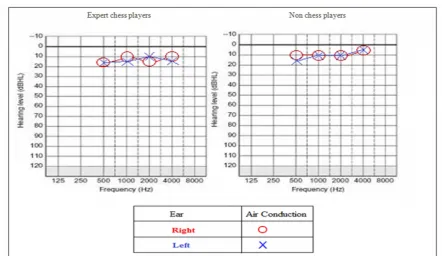
The participants’ mean±SD age was 26.8±4.59 years for expert chess players and 26.5±4.10 years for non-chess players. The educational level of the individuals ranged from a Bachelor’s degree to a Mas-ter’s degree. The mean auditory threshold of the participants in the analyzed frequen-cies is shown in Figure 1.
The mean±SD DAVMT score (number of remembered words) in expert chess players was 7.6±0.75 for the right ear and it was 7.4±0.75 for the left ear with a total score of 7.5±0.72. To compare the auditory Fig. 1. Auditory Threshold Average in Different Frequencies (horizontal axis) based on dBHL (vertical axis) in Each Group
memory of expert and non-chess players, the test results for the right and left ear and the total score of expert chess players were compared with the test results of non-chess players. The results of the comparison in each of three tests, using independent t-test, showed a significant difference between the two groups (p≤0.001). The mean and standard deviation of DAVMT score in each group and the result of the statistical analysis are demonstrated in Table 1.
To analyze the influence of the ears in each group separately, test results of the right and left ear were compared using paired t test. The results revealed that the difference between the scores of the two ears was significant in both chess players (p=0.023) and non-chess players (p=0.013). The results of the analysis of the test scores in both genders are presented in Ta-ble 2. Test results between males and fe-males in both groups were separately com-pared using independent t test, but no sig-nificant difference was observed (p>0.0.5).
Discussion
Short-term memory and working memory are cognitive performances that are influ-enced by chess. Also, auditory memory, a type of memory and a part of cognitive per-formance, is possibly influenced by the process of strengthening following steady and long-term chess playing. Therefore, analyzing auditory memory in chess
play-ers with a professional skill level who are experienced in this game compared to the auditory memory of non-chess players was the aim of this study. DAVMT is one of the dichotic auditory and behavioral tests of the central auditory processing. DAVMT, us-ing a dichotic method to present the stimuli, is a proper way to examine auditory memory. This test analyzes a special kind of memory that is called working memory and is considered a part of implicit short-term memory (8). Working memory plays an important role in facilitating the individ-ual’s performance in complex tasks and auditory-verbal memory is one of the main parts of this memory (22). Compared with other dichotic tests, the dichotic tests of au-ditory memory are associated with higher levels of cognitive performances and in-volve different structures of the brain (8).
In this study, the auditory-verbal memory function of expert chess players was exam-ined based on the test results, and the re-sults showed a significant increase in the performance of auditory-verbal memory in the expert chess players compared with non-chess players. This difference showed an increase in the auditory memory func-tion as a result of long term professional chess playing. As mentioned in the litera-ture, to date, no study has used the behav-ioral auditory test to assess memory func-tion in chess players. Studies which have used other tools to examine the influence of Table 1. DAVMT Results for Expert Chess Players and Non-Chess Players
Chess Player
Mean (2SD) (n=30) Mean (2SD) (n=30)Non Chess Player p
Right ear 7.63 (.75) 5.59 (.81) ≤0.001
Left ear 7.45 (.75) 5.31 (.60) ≤0.001
Both 7.54 (.72) 5.45 (.65) ≤0.001
SD: standard deviation
Table 2. Comparison of the Two Gender Mean Test Scores in the Experimental Groups Female
Mean (2SD) (n=15) Mean (2SD) (n=15)Male p
Chess Player Right ear 7.7 (.74) 7.6 (.78) 0.814
Left ear 7.5 (.79) 7.3 (.71) 0.471
Both 7.6 (.74) 7.5 (.72) 0.618
Non Chess
Player Right earLeft ear 5.7 (.69)5.4 (.49) 5.5 (.93)5.2 (.70) 0.3850.492
Both 5.6 (.51) 5.3 (.78) 0.394
SD: standard deviation
chess on cognition and memory scopes suggest that being skilled in chess and its long term practice can be effective in the improvement of cognitive performance and memory (4,9,10). Also, the functional inte-gration of cognitive networks in the brain that are involved during the chess game increases in expert chess players (3). The results of the present study are consistent with those of other studies reporting an im-provement in the cognitive performance due to playing chess for a long time and the results of these studies confirm the findings of the present study. Moreover, the brain structures that are involved during the chess game and common pathways with auditory memory pathways can be addressed to ex-plain the influence of chess on auditory memory. Different cortical areas are acti-vated during the chess game. Chess is a spatial-cognitive process and primarily en-gages the spatial cognition compared to logical and computational skills. During chess, the left hemisphere is more active than the right (1,20). The activities of the bilateral posterior cingulate regions, left anterior temporal cortex, left orbitofrontal cortex and right prefrontal cortex have been reported during chess playing (23,24). The observed pattern of activities in the cortex during the game is in accordance with some of the general cognitive processes that are used in the game of chess (1). Also, the ac-tivity of the dorsolateral prefrontal cortex (DLPFC) and posterior parietal cortex (PPC) increases in this game (3). With re-gards to the neural systems of auditory ver-bal memory, it should be noted that the neural systems of auditory verbal working memory include ventrolateral prefrontal cortex (VLPFC) and DLPFC, intraparietal sulcus, supramarginal gyrus and basal gan-glia, which are active in the visual verbal working memory (25). Long-term auditory verbal memory includes some different cognitive processes in the neuropsycholog-ical level (26,27). Some auditory memory pathways are active during a game of chess. Although chess is rather a visual-spatial exercise, with respect to the rule of working
memory and CEN in the combination of information and memory of different senses to understand and achieve a single notion of experienced situation, gaining experi-ence in chess is expected to result in the development of auditory memory, too. Considering the above mentioned notes and the results of this study, it can be stated that chess is likely to cause an improvement in the auditory memory of the chess players in the long term and with more studies on chess players with different levels of skills, it is possible to examine this improvement and the positive influence of neuroplasticity that occurs in the brain as a result of play-ing chess on the auditory memory.
In the present study, a significant differ-ence was observed in the DAVMT mean score between the left and right ear as the right ear score was higher in both expert chess players and non-chess players. There-fore, it was observed that the right ear ad-vantage existed in both groups. In a study by Aghamollaei et al (2010), the influence of ear on the results of the Persian version of DAVMT in young individuals was sur-veyed; the results of their study and similar studies using the same version showed the higher scores of the right ear (21,28,29). Structural differences in the right and left hemispheres are introduced as a reason for the difference in the process of verbal stim-uli in the two hemispheres. Because the left hemisphere is used for language infor-mation processing in 95% of people, oppo-sition of the right ear to this hemisphere, stronger representation of the auditory in-put of each ear in the opposite hemisphere and suppression of the auditory information in ipsilateral pathways by contralateral in-formation facilitate processing of right ear information compared with the left ear in dichotic auditory situations and result in the right ear advantage phenomenon. In dichot-ic presentation of the stimuli, the right ear scores advantage is a common result in normal right handed individuals (30). In the present study, the right ear scores ad-vantage was observed in both groups, which supports the findings of the previous
studies.
There was no significant difference in the DAVMT score between males and females in the two groups. However, with a careful consideration of the scores, it can be seen that the scores of the female participants were higher than the males’ scores in both groups. In other studies that used the Per-sian version of this test, significant differ-ences in the test results were observed be-tween genders and the results showed fe-males dominance in this test (21,28). In a study using the English version of this test, although the gender effect was not analyzed statistically, the females’ scores were better than the males’ (31). As yet, extensive re-searches have been performed on the dif-ference of the females and males’ perfor-mance, and it has been observed that there are structural and functional differences between the males and females’ brains (32,33). In addition, it is observed that males have a better performance in spatial skills while females have a better perfor-mance in performing verbal memory tests (34). In memory tests, the females’ perfor-mance was significantly different from that of males. Nevertheless, in the present study, although the females’ performance was better than the males’, this difference was not significant. The limited number of the expert chess players was introduced as a reason in this context.
One of the major limitations of this study was the difficult access to expert chess players of the country. Therefore, in this study, it was decided to recruit expert chess players with more than 5 years of experi-ence by participating in national and inter-national chess competitions. Thus, access to chess players with different levels of ex-perience in a legitimate and objective way and categorizing them into different groups can help interpret the findings of this study. Moreover, because auditory verbal memory is connected with higher levels of cognitive performance and involves different brain structures compared to other simpler tasks which are used in the dichotic test, more studies should be conducted to determine
the influence of the ear on the test results in expert chess players.
Conclusion
Based on the obtained results, the audito-ry verbal memoaudito-ry function showed a signif-icant increase in expert chess players. The increase in auditory memory function was probably influenced by long term chess playing and having professional skills in this game. According to the results, ear ad-vantage behavior was detected in expert chess players and non-chess players and although females were better than males in auditory memory function, this difference was not significant. Based on the results of the present study, chess may be considered a new method for rehabilitation of individ-uals that have problems as a result of memory impairment and learning difficul-ties and as a tool for exercising and improv-ing cognitive performance and facilitation of cognitive treatments. Therefore, this study can provide opportunities to expand research in the field of auditory cognition and methods to strengthen them.
Acknowledgements
This study was a part of a Master’s de-gree thesis in audiology that was approved and registered in Tehran University of Medical Sciences (Registration Number 93/d/360/603 on 6.28.2014). The authors wish to express their gratitude to Ms. Aghamollaei for her guidance and provid-ing the required test materials. Also, the manager and the staff of Tehran Chess Board are appreciated for their help in con-ducting this thesis.
References
1. Atherton M, Zhuang J, Bart WM, Hu X, He S. A functional MRI study of high-level cognition. I. The game of chess. Brain Res Cogn Brain Res 2003;16(1):26-31.
2. Duan X, He S, Liao W, Liang D, Qiu L, Wei L, et al. Reduced caudate volume and enhanced striatal-DMN integration in chess experts. Neu-roimage 2012;60(2):1280-6.
3. Duan X, Liao W, Liang D, Qiu L, Gao Q, Liu
C, et al. Large-scale brain networks in board game experts: insights from a domain-related task and task-free resting state. PLoS One 2012;7(3).
4. Aciego R, García L, Betancort M. The Bene-fits of Chess for the Intellectual and Social-Emotional Enrichment in Schoolchildren. Span J Psychol 2012;15(2):551-9.
5. Lezak MD, Howieson DB, Loring DW. Neu-ropsychological assessment. 4th ed. New York: Oxford University Press; 2004.
6. Elias L, Saucier D. Neuropsychology: Clinical and Experimental Foundations. 1st edition. Allyn & Bacon 2006.
7. Cusimano A. Learning disabilities: there is a cure. 1st ed. Lansdale, Pennsylvania: Achieve Pub-lications, Inc; 2002.
8. Penner IK, Schläfli K, Opwis K, Hugdahl K. The role of working memory in dichotic-listening studies of auditory laterality. J Clin Exp Neuropsy-chol 2009;31(8):959-66.
9. Charness N. Perception and memory in chess: A royal wedding. PsycCRITIQUES. 1998; 43(6):416-17.
10. Charness N, Tuffiash M, Krampe R, Reingold E, Vasyukova E. The role of deliberate practise in chess expertise. Cog Psychol 2005;19(2):151-65.
11. Lee B, Park JY, Jung WH, Kim HS, Oh JS, Choi CH, et al. White matter neuroplastic changes in long-term trained players of the game of “Baduk”1 (GO): A voxel-based diffusion-tensor imaging study. NeuroImage 2010;52(1):9-19.
12. Wright MJ, Gobet F, Chassy P, Ramchandani PN. ERP to chess stimuli reveal expert-novice dif-ferences in the amplitudes of N2 and P3 compo-nents. Psychophysiology 2013.
13. Amidzic O, Riehle HJ, Fehr T, Wienbruch C, Elbert T. Pattern of focal gamma-bursts in chess players. Nature 2001;412(6847):603.
14. Campitelli G, Gobet F, Parker A. Structure and stimulus familiarity: a study of memory in chess-players with functional magnetic resonance imaging. Span J Psychol 2005;8(2):238–45.
15. Wan X, Nakatani H, Ueno K, Asamizuya T, Cheng K, Tanaka K. The neural basis of intuitive best next-move generation in board game experts. Science 2011;331(6015):341-6.
16. Christianson SA, Nilsson LG, Silfvenius H. Initial memory deficits and subsequent recovery in two cases of head trauma. Scand J Psychol 1987;28(4):267-80.
17. Seddigh R, Shariat V, Gharraee B, Azarnik S. Evaluation of relationship between severity of de-pression and chess skill in members with interna-tional rating scale in chess Federation of Islamic Republic of Iran in 1389. Razi J Med Sci 2012; 19(100):29-36.
18. Goodman A. Reference zero level for pure tone audiometer. Am Speech Hear Assoc 1965; 7:262-263.
19. Sabini P, Sclafani AP. Efficacy of serologic
testing in asymmetrical sensorineural hearing loss.Otolaryngol Head Neck Surg 2000;122:469-76.
20. Nejati M, Nejati V. Frontal Lobe Function in Chess Players. Acta Med Iran 2012;50(5):311-4.
21. Aghamollaei M, Jafari Z, Tahaei AA, Toufan R, Keyhani MR, Rahimzade SH, et al. Dichotic Assessment of Verbal Memory Function: Devel-opment and Validation of the Persian Version of Dichotic Verbal Memory Test. J Am Acad Audiol 2011;24(8):684–8.
22. Sohani rad D, Shahbodaghi M, Bakhteiari B, Faghihzade S. Comparison of semantic and phono-logical cues in short term memory span: 18-25 years in men. Audiol 2007;16(1):53-9.
23. Krawczyk DC, Boggan AL, McClelland MM, Bartlett JC. The neural organization of perception in chess experts.Neurosci Lett 2011;499(2):64-9.
24. Nichelli P, Grafman J, Pietrini P, Alway D, Carton JC, Miletich R. Brain activity in chess play-ing. Nature 1994;369(6477):191.
25. Crottaz-Herbette S, Anagnoson RT, Menon V. Modality effects in verbal working memory: differen-tial prefrontal and parietal responses to auditory and visual stimuli. Neuroimage 2004;21(1):340-51.
26. Grasby PM, Frith CD, Friston KJ, Bench C, Frackowiak RS, Dolan RJ. Functional mapping of brain areas implicated in auditory—verbal memory function. Brain 1993 ;116(1):1-20.
27. Fletcher PC, Frith CD, Grasby PM, Shallice T, Frackowiak RS, Dolan RJ. Brain systems for encoding and retrieval of auditory—verbal memory. An in vivo study in humans. Brain 1995;118(2):401-16.
28. Yekta S, Tahaei AA, Ashayeri H, Jalaie SH. Dichotic auditory-verbal memory in adults with cerebrovascular accident. Audiol 2013;22(4):78-89.
29. Shahidipour Z, Geshani A, Jafari Z, Jalaie SH, Khosravifard E. Assessing the aging effect on auditory-verbal memory by Persian version of di-chotic auditory verbal memory test. Audiol 2013;22(4):98-107.
30. Hugdahl K, Davidson RJ. The Asymmetrical Brain. 2nded. The MIT Press 2004;441-508.
31. Hugdahl K, Asbjornsen A, Wester K. Memory Performance in Parkinson's Disease. NNBN 1993;6 (3):170-6.
32. Gur RC, Turetsky BI, Matsui M, Yan M, Bilker W, Hughett P, Gur RE. Sex Differences in Brain Gray and White Matter in Healthy Young Adults: Correlations with Cognitive Performance. J Neurosci 1999;19(10):4065-72.
33. Canli T, Desmond JE, Zhao Z, Gabrieli JD. Sex Differences in the Neural Basis of Emotional Memories. Proc Natl Acad Sci USA 2002; 99(16):10789-94.
34. Författare T. Sex differences in cognitive functions: a study of same-sex and opposite-sex twin pairs: Unevercuty of Helsinki. 2004.