[Kumar* 3(12): December, 2016] ISSN 2349-4506
Impact Factor: 2.785
G
lobal
J
ournal of
E
ngineering
S
cience and
R
esearch
M
anagement
SAFFLOWER OIL METHYL ESTER: OPTIMIZATION OF
TRANSESTERIFICATION PROCESS AND FUEL CHARACTERIZATION FOR C.I.
ENGINE PERFORMANCE
Nitin Kumar*, S. S.Ragit, S. K. Mohapatra
*
Mechanical Engineering Department, Thapar University, Patiala, India
DOI: 10.5281/zenodo.225191
KEYWORDS
:
Safflower oil (SO), Transesterification, Optimization, Safflower oil methyl ester (SOME), Fuel properties.ABSTRACT
In the present work, the production of biodiesel using safflower oil (SO) in an alkaline catalyzed transesterification reaction was investigated. The effect of different parameters including methanol to oil molar ratio (4:1, 6:1), potassium hydroxide concentration (0.5 %, 1.0%, 1.5 %) and reaction time (60 min, 75 min, 90 min) on the production of biodiesel were investigated. The result indicated that these parameters were important factor affecting the transesterification reaction. The fuel properties of biodiesel including viscosity were measured. The methyl ester production methodology is prime aspect for efficient and cost-effective production of methyl ester. The present investigation concentrated on the distinct technical aspects of methyl ester production methodology. As per consideration of maximum biodiesel yield and minimum viscosity, the optimized biodiesel yield and viscosity were evaluated as 95.22% and 5.63 centipoise respectively as per optimized process parameters. The properties of SOME were found to be close to that of diesel fuel and also they satisfied the ASTM standards.
INTRODUCTION
Due to increase in energy demand, drop in petroleum fuel reverses, growth in pollution affected by them and increasing fuel values have focused consideration on substitute or alternative sources of energy. The indiscriminate consumption of fuel also leads to energy depletion and several studies have indicated that petroleum reverses will near an end between 2050 and 2075, which has triggered many initiatives to search for alternative fuel. Biodiesel is not only to ensure energy security, but also delivers renewable, harmless, eco-friendly and cleaner energy source with properties similar to diesel [1]. As the fossil fuels are depleting day by day, there is a need to find out an alternative fuel to fulfill the energy demand of the world. Biodiesel is one of the best available sources to fulfill the energy demand of the world. The petroleum fuels play a very important role in the development of industrial growth, transportation, agricultural sector and to meet many other basic human needs. However, these fuels are limited and depleting day by day as the consumption is increasing very rapidly. Moreover, their use is alarming the environmental problems to society. Hence, the scientists are looking for alternative fuels. Biodiesel is gaining more and more importance as an attractive fuel due to the depleting nature of fossil fuel resources [2]. Biodiesel is one of these promising alternative resources for diesel engines. It is defined as the mono-alkyl esters of long chain fatty acids derived from vegetable oils or animal fats and alcohol with or without a catalyst. It is renewable, biodegradable, environmentally friendly, non-toxic, portable, readily available and eco- friendly fuel [3–6]. Biodiesel, formally known as either methyl-ester or ethyl-ester, is a natural occurring vegetable oil or animal fat which has been chemically modified to run in a diesel engine [7]. Biodiesel’s many advantages compared to petroleum diesel like its renewable nature, better emissions properties, support for domestic agriculture, compatibility with existing engines and ease of manufacture [8]. The catalyst concentration is determined by the difference in molar ratio, catalyst type and oil properties considered in the reaction process involved [10]. The reaction temperature is a vital factor impelling the yield of biodiesel and reaction rate. The transesterification is generally carried out at a temperature in the range of 25°C to 120°C, depending on the type of catalyst and oil used [1, 9-11].
[Kumar* 3(12): December, 2016] ISSN 2349-4506
Impact Factor: 2.785
G
lobal
J
ournal of
E
ngineering
S
cience and
R
esearch
M
anagement
MATERIALS AND METHODS
Materials
The safflower and kusum seed oil were collected from local dealer available in Patiala. 99.9% pure methanol and analytical grade catalyst potassium hydroxide (in pellet form) were used in biodiesel production. All reagents were available in our chemical engineering laboratory.
Apparatus
The equipment used for transesterification reaction is water bath shaker, reaction flask with digital temperature indicator for measuring reaction temperature and digital rpm meter for controlling mechanical stirring.
Experimental procedure
The transesterification reaction of safflower oil was carried out in the following steps: [12]
Firstly, the oil was heated up to 50 °C in a borosil 500 ml flask and it was kept at this constant temperature.
For obtaining homogenous mixture of reactants, a magnetic stirrer was employed.
The amount of methyl alcohol as per molar ratio was mixed with catalyst KOH and it was heated 30-40 °C
until the catalyst was completely dissolved in alcohol. Now this homogeneous mixture of alcohol-catalyst mixed with preheated safflower oil.
The mixture of oil-alcohol-catalyzer was heated at constant temperature of 55–60 °C and it was stirred
simultaneously at about constant 1000 rev/min. in the reaction cap for 2 h.
After 2 h of reaction time, the products were filled into a washing and separation funnel. The reaction products
were separated into two layers, the top one was biodiesel and the bottom one was glycerol.
The biodiesel was then washed with hot water to separate the probably remained alcohol or catalyst from
biodiesel. It was then kept for 4 h in the cap to separate the water. Finally, the biodiesel was heated above 100 °C to remove the remaining water from biodiesel fuel.
RESULTS AND DISCUSSION
Properties of safflower oil
Feed stock Safflower oil Optimized fuel properties
Density at 15 °C (kg/m3) 920.5 874.91
Kinematic viscosity at 40 °C (cSt) 30.20 5.63
Heating value (MJ/kg) 40.12 42.09
Flash point (°C) 227.9 170.50
Pour point (°C) -10 -15.33
Cloud point (°C) -2 -4
Effect of parameters on transesterification of safflower oil and kusum oil
This section presented the influence of various process parameters such as molar ratio, catalyst concentration and reaction time etc. on biodiesel production from safflower oil and kusum oil by transesterifiction process.
Effect of % catalyst concentration and reaction time on SOME formation
[Kumar* 3(12): December, 2016] ISSN 2349-4506
Impact Factor: 2.785
G
lobal
J
ournal of
E
ngineering
S
cience and
R
esearch
M
anagement
Figure 1 Variation of SOME yield with KOH concentration and reaction time at 4:1 molar ratio
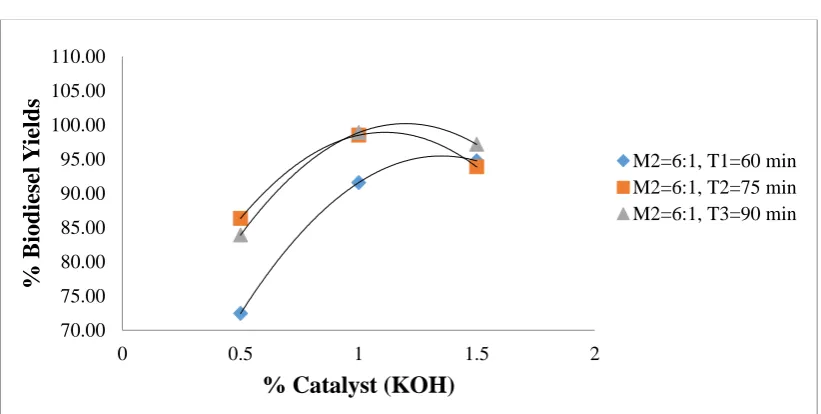
Figure 2 Variation of SOME yield with KOH concentration and reaction time at 6:1 molar ratio
The results found that catalyst concentration was a significant influencing parameter of transesterification reaction. As concentration of catalyst is raised from 0.5% to 1.5%, both Figure 1 and Figure 2 show that increasing trend of methyl ester formation at 30 minutes reaction time. Further increasing in % amount of catalyst concentrations were responsible of decreasing of methyl ester formation due to incomplete reaction because of soap formation. This is due to high FFA content present in the oil which deactivated the catalyst and present extra catalyst was responsible to form emulsion which raised the viscosity, lead to form gels and difficulty associated with glycerol separation and loss in ester yield [1].
It is also seen that reaction time is an important factor in production of biodiesel. As increasing reaction time from 60 minutes to 90 minutes, the yield grows or drops depending upon % catalyst concentration. The maximum yield is obtained 98.88% with catalyst concentration 1% at 90 minutes reaction time.
Effect of methanol/oil molar ratio and reaction time on SOME formation
After analysis of effect of catalyst concentration, it is observed that the maximum yield of biodiesel was obtained at 1.5% catalyst concentration. Figure 3 shows the influence of molar ratio and reaction time on methyl ester yield at reaction temperature 60° C with 1% catalyst concentration. It was noticed that as the methanol/oil molar ratio
70.00 75.00 80.00 85.00 90.00 95.00 100.00 105.00 110.00
0 0.5 1 1.5 2
%
B
io
d
iesel
Y
ield
s
% Catalyst (KOH)
M1=4:1, T1=60 min M1=4:1, T2=75 min M1=4:1, T3=90 min
70.00 75.00 80.00 85.00 90.00 95.00 100.00 105.00 110.00
0 0.5 1 1.5 2
%
B
iod
iese
l
Y
ield
s
% Catalyst (KOH)
[Kumar* 3(12): December, 2016] ISSN 2349-4506
Impact Factor: 2.785
G
lobal
J
ournal of
E
ngineering
S
cience and
R
esearch
M
anagement
increases from 4:1 to 6:1, the yield also increase with respect to reaction time. The cause is this, transesterification reaction is reversible in nature due to this additional methanol is needed to shift the equilibrium towards product side (higher yield of methyl ester) [13]. But generally higher molar ratio is not selected because of more consumption of energy required for recovering unreacted methanol and presence of excess methanol suspended into by product glycerin which is responsible to makes separation difficult. It is also observed that maximum methyl ester yield i.e. 98.88% was acquired with 6:1 molar ratio at 90 minutes reaction time.Figure 3 Variation of SOME yield with molar ratio and reaction time at 1% KOH concentration
Effect of methanol/oil molar ratio and reaction temperature on SOME viscosity
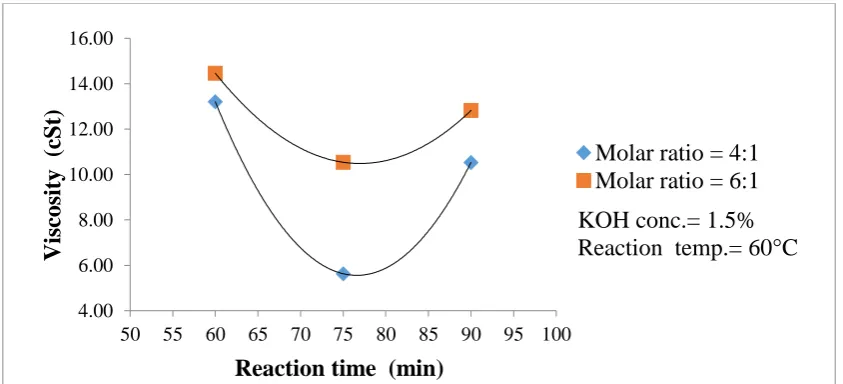
The influence of increasing molar ratio and catalyst KOH concentration was illustrated in the Figure 4. It was found that as the molar ratio increases from 4:1 to 6:1, viscosity of methyl ester increases. This is due to excess molar ratio increase the methanol solubility in glycerin which makes separation difficult and the remains glycerin in solution cause high viscosity of methyl ester. As per project requirement, the minimum viscosity has been obtained at 4:1 molar ratio and 75 minutes reaction time.
Figure 4 Variation of SOME viscosity with molar ratio and reaction time at 1.5% KOH concentration
CONCLUSION
From the detailed literature survey on safflower oil methyl ester, the following conclusion can be made:
The maximum methyl ester yield i.e. 98.88% was acquired with 6:1 molar ratio, 1% catalyst
concentration and 90minutes reaction time.
90.00
92.00
94.00
96.00
98.00
100.00
50 55 60 65 70 75 80 85 90 95 100
Molar ratio = 4:1
Molar ratio = 6:1
Reaction time (min)
%
B
iod
iese
l
Yie
ld
s
KOH conc. = 1 %
Reaction temp. = 60°C
4.00 6.00 8.00 10.00 12.00 14.00 16.00
50 55 60 65 70 75 80 85 90 95 100
Molar ratio = 4:1
Molar ratio = 6:1
Reaction time (min)
Visc
osity (
cS
t)
[Kumar* 3(12): December, 2016] ISSN 2349-4506
Impact Factor: 2.785
G
lobal
J
ournal of
E
ngineering
S
cience and
R
esearch
M
anagement
As per consideration of maximum biodiesel yield and minimum viscosity, the optimized process
parameters for safflower oil methyl ester production were 4:1 molar ratio, 1.5% KOH catalyst concentration and 75 minutes reaction time. The optimized biodiesel yield and viscosity were evaluated as 95.22% and 5.63 centipoise respectively as per optimized process parameters.
The parameters such that methanol/oil molar ratio, % catalyst concentration and reaction time were
playing the most important role in production of methyl ester.
REFERENCES
1. Ma, F., & Hanna, M. A. Biodiesel production: a review. Bioresource technology (1999);70(1):1-15.
2. A.S. Basha, K.R. Gopal, S. Jebaraj, A review on biodiesel production, combustion, emissions and
performance, Renew Sust Energ Rev (2009);13:1628–1634.
3. Agarwal AK, Rajamanoharan K. Biofuels (alcohols and biodiesel) applica- tions as fuels for internal
combustion engines. Progress in Energy and Combustion Science 2007;33(3):233–71.
4. Singh SP, Singh D. Biodiesel production through the use of different sources and characterization of oils
and their esters as the substitute of diesel: a review. Renewable and Sustainable Energy Reviews 2010;14(1):200–16.
5. Lapuerta M, Armas O, Rodrı´guez FJ. Effect of biodiesel fuels on diesel engine emissions. Progress in
Energy and Combustion Science 2008;34(2): 198–223.
6. Ahmad AL, Yasin NHM, Derek CJC, Lim JK. Microalgae as a sustainable energy source for biodiesel
production: a review. Renewable and Sustain- able Energy Reviews 2011;15(1):584–93.
7. Yadav, H.J., Rathod, P.P. Biodiesel preparation from Karanjaoil — an overview. Int. J. Adv. Eng. Res.
Stud. 2012;1:42.
8. Aransiola, E.F., Betiku, E., Ikhuomoregbe, D.I.O., Ojumu, T.V. Production of biodiesel from crude neem
oil feedstock and itsemissions from internal combustion engines. Afr. J. Biotechnol (2012); 11:6178.
9. Sumit H. Dhawane, Tarkeshwar Kumar, Gopinath Halder. Biodiesel synthesis from Hevea brasiliensis
oil employing carbon supported heterogeneous catalyst: Optimization by Taguchi method. Renewable Energy (2016); 89:506-514.
10. M. Radhakumari, Andy Ball, Suresh K Bhargava, B. Satyavathi, Optimization of Glucose formation in
Karanja Biomass Hydrolysis using Taguchi robust method. Bioresource Technology 2014;166:534-540.
11. P. L. Naik, D. C. Katpatal, Optimization of Effective Parameters of Pongamia Pinnata (Karanja)
Biodiesel Using Taguchi Method. International Journal of Engineering Research and Application (IJERA) 2013;3(4):701-706.
12. Ilkılıç C., Aydın S., Behcet R. and Aydin H. Biodiesel from safflower oil and its application in a diesel
engine. Fuel processing technology 2011;92(3):356-362.