[Esther* 4(11): November, 2017] ISSN 2349-4506
Impact Factor: 2.785
G
lobal
J
ournal of
E
ngineering
S
cience and
R
esearch
M
anagement
METHODOLGY FOR KNOWLEDGE MANAGEMENT AUDIT
Medina Nogueira, Yuly Esther*, Nogueira Rivera, Dianelys, Medina León, Alberto, Medina Nogueira, Daylin, El Assafiri Ojeda, Yusef Castillo Zúñiga, Victor Javier
*Department of Industrial Engineering, University of Matanzas, Cuba. Department of Industrial Engineering, University of Matanzas, Cuba.
Director of International Relations and Professor of the Department of Industrial Engineering, University of Matanzas, Cuba.
Chairman of the Technological Observatory Department and Professor of the Department of Industrial Engineering, University of Matanzas, Cuba.
Department of Industrial Engineering, University of Matanzas, Cuba. Professor, Uniandes University, Ecuador.
DOI: 10.5281/zenodo.1045833
KEYWORDS
:
Knowledge management, knowledge management audit, methodology for knowledgemanagement audit.
ABSTRACT
Organizations are now oriented towards intangible assets, which are difficult to manage; where one of the most important is the knowledge asset. The development of Knowledge Management with a process approach, aimed at the fulfillment of the strategic objectives of the organization is a very effective and current way of proceeding. Determining the knowledge that is lacking and capable of giving value to the processes and organization is developed through a Knowledge Management Audit and constitutes a tool for continuous improvement. Consequently, the objective of the research is: to propose a methodology to develop the Knowledge Management Audit.
INTRODUCTION
Evolving is a natural process that both people and organizations have to carry out, it is the responsibility of each party to choose where to lead this process of change. Pérez Soltero et al. (2013) argues that organizations are currently oriented towards the direction of change towards intangible assets, assets that by their nature are difficult to manage; where one of the most important is the knowledge asset. Learning is the way to organizations; and to learn, the key lies in Knowledge Management (KM). The organization that does not manage knowledge, effectively and proactively, cannot expect to be able to compete successfully (D. Medina Nogueira et al., 2013).
Therefore, the Knowledge Management Audit (KMA) is an approach for the discovery and documentation of sources and use of knowledge in organizations (García Parrondo, 2015).
On the other hand, the approach to processes is considered at present as one of the fundamental lines to follow when efficiently managing value activities in the company. The importance of management by process lies in the fact that organizations are as efficient as their processes. Most organizations that are aware of this react to the inefficiency of departmental organizations (Pérez Canto et al., 2001).
The effectiveness of any organization depends on its business processes, these have to be aligned with the strategy, mission and objectives of the institution. Hence, the process approach is today such a powerful tool for its ability to contribute in a sustained way to the results, to the satisfaction of its clients, the elevation of quality and the contribution of value (Nogueira Rivera et al., 2004; Zaratiegui, 1999). As a result, the development of Knowledge Management (KM) with a process approach aimed at fulfilling the organization's strategic objectives is a highly effective and current way of proceeding. Determining the knowledge that has and is lacking, the sources and the knowledge flows capable of giving value to the processes and the organization constitute a tool for continuous improvement.
[Esther* 4(11): November, 2017] ISSN 2349-4506
Impact Factor: 2.785
G
lobal
J
ournal of
E
ngineering
S
cience and
R
esearch
M
anagement
charge for the audit service; at least not explicitly, how the KM processes are evaluated. So the objective of the present investigation is: to propose a methodology for the development of the KMA.
MATERIALS AND METHODS
Literature review
Knowledge is information acquired by experience of a fact or situation, is associated with people, what they know and what they need to know; (D. Medina Nogueira, 2016) and, KM is the process that promotes the generation, collaboration and use of knowledge for learning and innovation, generates new value and raises the level of competitiveness, in order to achieve organizational objectives with efficiency and effectiveness, as a result of the management of intangible assets based on key factors of the KM: people, processes and technology. In the literature there are different terms to identify the processes that make up the KM. The KM processes adopted in this research are those defined by D. Medina Nogueira (2016): acquiring, organizing, disseminating, using and measuring.
Since the emergence of knowledge management approaches, it was necessary to design processes for the identification and auditing of knowledge capable of assessing existing wisdom in a deep and systematic way. The Knowledge Audit process allows "to know what is known and to know what is not known". It identifies key users, uses and attributes of knowledge assets and its analysis center is aimed at identifying what knowledge is needed, what knowledge is available and what it means, who needs it and how it is applicable (García Parrondo, 2015). Authors like Hylton (2003) and Chong et al. (2005) make distinctions between KA and KMA. These distinctions are not always considered and addressed as a single approach. Choy et al. (2004) suggest that KM is a systematic review and assessment of organizational knowledge assets and is recommended as an initial step before beginning a KM program.
From a study carried out by Y. E. Medina Nogueira (2017) which addresses the definitions given by 13 authors about KA and KMA we conclude that: KA is a tool that identifies and describes organizational knowledge, its use, gaps and duplicities within the organization. It is fundamental for the implementation and development of a KM strategy. While the KMA also includes: the KM processes; the structure and flow of knowledge (Paramasivan, 2003); the organization's strategy, leadership, cooperation, culture and teamwork; the technological infrastructure of knowledge transfer processes; and the SWOT analysis Dattero et al. (2007).
In the literature there are a large number of methodologies related to KMA. The following are 28 methodologies, two of them contextualized to the Cuban environment: Stable Rodríguez (2012) y Salas García et al. (2014). The methodologies are:
1. Debenham et al. (1994) 15. Biloslavo et al. (2007) 2. Buchanan et al. (1998) 16. Dattero et al. (2007)
3. Orna (1999) 17. Levy et al. (2009)
4. Liebowitz et al. (2000) 18. Dow et al. (2008)
5. Lauer et al. (2001) 19. Hourcade Bellocq et al. (2008) 6. (Henczel, 2000, 2001) 20. Handzic et al. (2008)
7. Reinhardt (2003) 21. Wang et al. (2009)
8. Hylton (2003) 22. Sharma et al. (2010)
9. Choy et al. (2004) 23. Arís et al. (2010)
10. Burnet et al. (2004) 24. López Nicolás et al. (2010) 11. Schwikkard et al. (2004) 25. Russ et al. (2010)
12. Iazzolino et al. (2005) 26. Stable Rodríguez (2012) 13. Cheung et al. (2007) 27. Jafari et al. (2013) 14. Pérez Soltero (2007) 28. Salas García et al. (2014)
[Esther* 4(11): November, 2017] ISSN 2349-4506
Impact Factor: 2.785
G
lobal
J
ournal of
E
ngineering
S
cience and
R
esearch
M
anagement
methodology; (V8) Focus on KM processes; (V9) Information technology; (V10) Culture; (V11) Knowledge inventory; (V12) Knowledge flow; (V13) Knowledge resources; (V14) Knowledge map; (V15) Gap analysis; (V16) Analysis of social networks; (V17) Analysis of knowledge networks; (V18) Problems and proposed solutions; (V19) Report of results of KMA; (V20) Further information on the outcome of the KMA; (V21) Present and prioritize solutions; (V22) Offer suggestions; (V23) KM strategies; (V24) Action plan to implement the KM; (V25) Continuous audit (auditing).
The information is processed using the SPSS statistical package (version 22.0). An analysis of hierarchical clusters is done, for it is necessary to verify the following elements: absence of correlation between the variables, small number of variables and homogeneous scale. As a result, as a result of the bivariate correlations between the 25 variables, two high ratios were observed for a 99% confidence level between variables 20 and 24 (with a value of 0.782) and variables 18 and 21 (with a value of 0.737). It was decided to eliminate variables 20 and 21, since they are contained in variables 19 and 18, respectively. In the remaining 23 variables all values give below 0.7 and, consequently, it is concluded that there are no significant linear correlations between the variables, so that there is no redundancy of criteria in the study.
RESULTS AND DISCUSSION
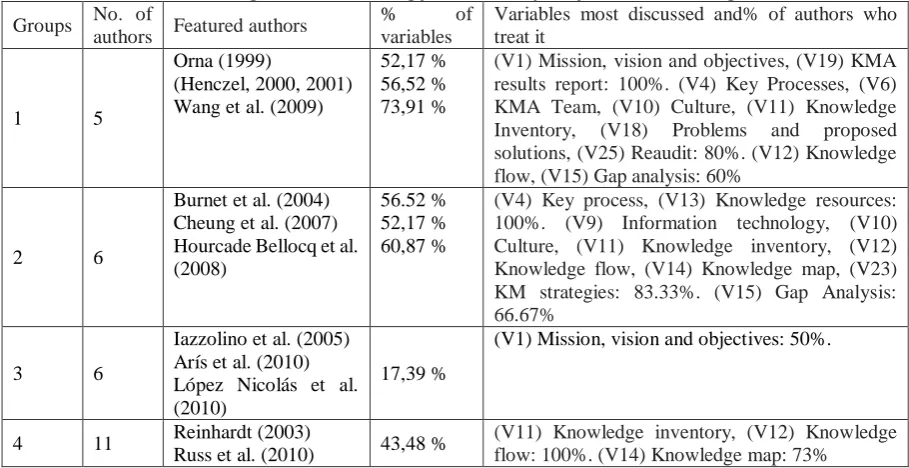
The grouping process of clusters is summarized below, both for the methodologies (according to the authors) and for the variables. The cut is made at the point of inflection: for methodologies, from twelve (12); and for the variables, from nine (9). (Table 1).
Table 1. Conglomerates resulting from the analysis of KMA methodologies.
Groups No. of
authors Featured authors
% of
variables
Variables most discussed and% of authors who treat it
1 5
Orna (1999)
(Henczel, 2000, 2001) Wang et al. (2009)
52,17 % 56,52 % 73,91 %
(V1) Mission, vision and objectives, (V19) KMA results report: 100%. (V4) Key Processes, (V6) KMA Team, (V10) Culture, (V11) Knowledge Inventory, (V18) Problems and proposed solutions, (V25) Reaudit: 80%. (V12) Knowledge flow, (V15) Gap analysis: 60%
2 6
Burnet et al. (2004) Cheung et al. (2007) Hourcade Bellocq et al. (2008)
56.52 % 52,17 % 60,87 %
(V4) Key process, (V13) Knowledge resources: 100%. (V9) Information technology, (V10) Culture, (V11) Knowledge inventory, (V12) Knowledge flow, (V14) Knowledge map, (V23) KM strategies: 83.33%. (V15) Gap Analysis: 66.67%
3 6
Iazzolino et al. (2005) Arís et al. (2010) López Nicolás et al. (2010)
17,39 %
(V1) Mission, vision and objectives: 50%.
4 11 Reinhardt (2003)
Russ et al. (2010) 43,48 %
(V11) Knowledge inventory, (V12) Knowledge flow: 100%. (V14) Knowledge map: 73%
[Esther* 4(11): November, 2017] ISSN 2349-4506
Impact Factor: 2.785
G
lobal
J
ournal of
E
ngineering
S
cience and
R
esearch
M
anagement
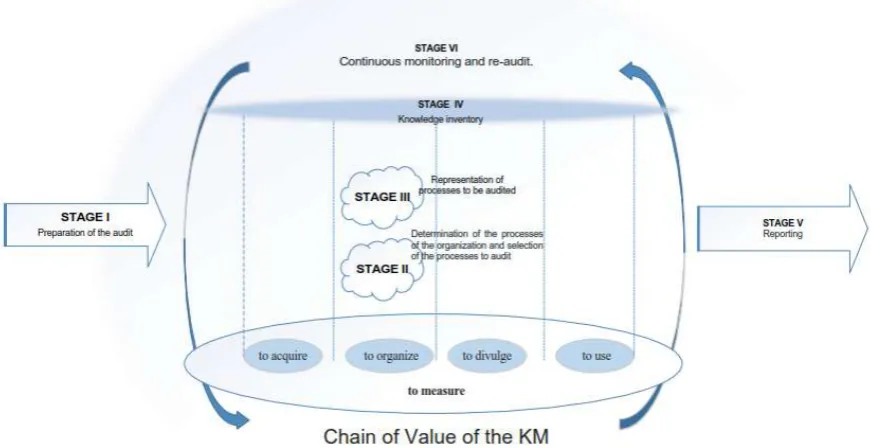
KM and on the approach of: continuous improvement, teamwork; as well as in the quest to influence the culture of the organization. The proposed methodology is shown in Figure 1.
Figure 1. Proposed methodology for developing a KMA.
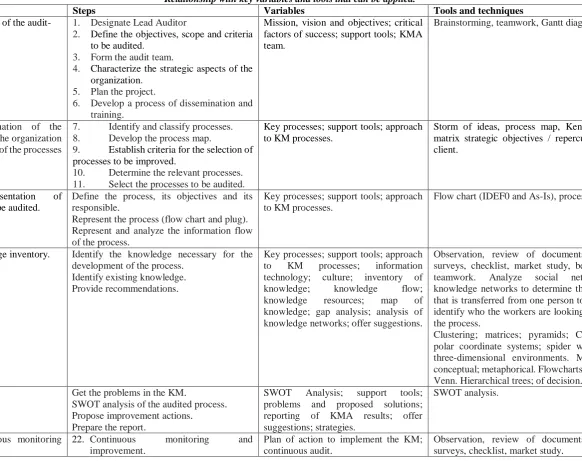
As a result, its general objective is to contribute to the efficiency and effectiveness of the organization's objectives, based on knowledge management and continuous improvement, so as to ensure the establishment of good practices, as well as the acquisition and conservation of the knowledge through the processes of the chain of value of the KM (to acquire, to organize, to divulge, to use and to measure). So the audit should respond in its stages to the following questions: How is it assessed if the necessary knowledge is acquired in the process? How is it determined if such knowledge is organized? How is it determined if knowledge is disseminated? How is it assessed if knowledge is used? How is KM measured? The specific objectives or expected results of the implementation of the proposal result in: creating processes that respond to the strategies and priorities of the company; getting members of the organization to focus on the right processes; create a culture that makes knowledge management an important part of the values and principles of all members of the organization. The following are the premises for the implementation of this procedure: the commitment of the management and its intention to incorporate it as part of the organizational culture and of the continuous improvement system; existence of strategic planning; and recognition of the need for the process approach. The steps and steps of the proposed methodology are summarized in Table 1. It also shows the relationship of the stages to the variables defined by Shahmoradi et al. (2015) and the possible tools to be applied in each case.
CONCLUSION
1. The KA is the determination of existing and missing knowledge (Choy et al., 2004); and the KMA also includes: the development of KM processes, the effectiveness of its value chain, its control and continuous improvement. A study of 28 KMA methodologies developed in the last two decades and the presence of 23 variables in them. The variables with the highest frequency of occurrence are: knowledge inventory; key processes; knowledge flow; mission, vision and objectives; map of knowledge, gap analysis; culture; and, knowledge resources.
[Esther* 4(11): November, 2017] ISSN 2349-4506
Impact Factor: 2.785
G
lobal
J
ournal of
E
ngineering
S
cience and
R
esearch
M
anagement
3. The proposed methodology for the KMA is based on KM, continuous improvement and "good practices" to ensure the conservation and acquisition of knowledge through the processes of the KM value chain and contribute to the effectiveness of the fulfillment of the objectives of the organization.
Table 2. Stages and steps of the proposed methodology. Relationship with key variables and tools that can be applied.
Stages Steps Variables Tools and techniques
I. Preparation of the audit- 1. Designate Lead Auditor
2. Define the objectives, scope and criteria to be audited.
3. Form the audit team.
4. Characterize the strategic aspects of the organization.
5. Plan the project.
6. Develop a process of dissemination and training.
Mission, vision and objectives; critical factors of success; support tools; KMA team.
Brainstorming, teamwork, Gantt diagram.
II. Determination of the processes of the organization and selection of the processes to audit
7. Identify and classify processes. 8. Develop the process map.
9. Establish criteria for the selection of processes to be improved.
10. Determine the relevant processes. 11. Select the processes to be audited.
Key processes; support tools; approach to KM processes.
Storm of ideas, process map, Kendall method, matrix strategic objectives / repercussion in the client.
III. Representation of processes to be audited.
12. Define the process, its objectives and its responsible.
13. Represent the process (flow chart and plug).
14. Represent and analyze the information flow of the process.
Key processes; support tools; approach to KM processes.
Flow chart (IDEF0 and As-Is), process tab.
IV. Knowledge inventory. 15. Identify the knowledge necessary for the development of the process.
16. Identify existing knowledge. 17. Provide recommendations.
Key processes; support tools; approach to KM processes; information technology; culture; inventory of knowledge; knowledge flow; knowledge resources; map of knowledge; gap analysis; analysis of knowledge networks; offer suggestions.
Observation, review of documents, interview, surveys, checklist, market study, benchmarking, teamwork. Analyze social networks and knowledge networks to determine the knowledge that is transferred from one person to another and identify who the workers are looking for to know the process.
Clustering; matrices; pyramids; Cartesian and polar coordinate systems; spider web graphics; three-dimensional environments. Mental maps; conceptual; metaphorical. Flowcharts; fishbone; of Venn. Hierarchical trees; of decision.
V. Reporting. 18. Get the problems in the KM.
19. SWOT analysis of the audited process. 20. Propose improvement actions.
21. Prepare the report.
SWOT Analysis; support tools; problems and proposed solutions; reporting of KMA results; offer suggestions; strategies.
SWOT analysis.
VI. Continuous monitoring and re-audit.
22. Continuous monitoring and improvement.
Plan of action to implement the KM; continuous audit.
Observation, review of documents, interview, surveys, checklist, market study.
REFERENCES
1. Arís, E., & Ayuso, B. (2010). A methodology for the auditing of technological knowledge management. In: Cruz-Cunha MM, ed. Social, Management, and Organizational Dimensions of Enterprise Information Systems. . Portugal: Business Science Reference, pp. 134-156.
[Esther* 4(11): November, 2017] ISSN 2349-4506
Impact Factor: 2.785
G
lobal
J
ournal of
E
ngineering
S
cience and
R
esearch
M
anagement
InterScience. Faculty of Management Koper, University of Primorska, Vol. 14(No. 3), pp. 1-12. doi: DOI: 10.1002/kpm.2933. Buchanan, S., & Gibb, F. (1998). The information audit: an integrated strategic approach. . Int J Inform Manage, Vol. 18(No. 1), pp. 29-47.
4. Burnet, S., Illingworth, L., & Webster, L. (2004). Knowledge Auditing and Mapping: A pragmatic Approach. Knowledge and Process Management, Vol. 11(No. 1), pp. 25-37.
5. Cheung, C., Li, M., Shek, W., Lee, W., & Tsang, T. (2007). A systematic approach for knowledge auditing: a case study in transportation sector. Journal of Knowledge Management Practice, Vol. 11(No. 4), pp. 140-158.
6. Chong, D., & Lee, W. (2005). Re-Thinking Knowledge Audit: Its values and limitations in the evaluation
of organizational and cultural asset.
http://www.emeraldinsight.com/journals.htm?articleid=1826888&show=html
7. Choy, S., Lee, W., & Cheung, C. (2004). A systematic approach for knowledge audit analysis: Integration of knowledge inventory, mapping and knowledge flow analysis. Journ Univer Comput Scien, Vol. 10(No. 6).
8. Dattero, R., Galup, S., & Quan, J. (2007). The knowledge audit: meta-matrix analysis. Knowl Manage Res Pract, Vol. 5(No. 3).
9. Debenham, J., & Clark, J. (1994). The knowledge audit. Robot Comput Integr Manuf. Vol. 11(No. 3), pp. 201-211.
10. Dow, R., Pallaschke, S., & Merri, M. (2008). Overview of the knowledge management system in ESA/ESOC. Acta Astron, Vol. 63(No. 1-4), pp. 448-457.
11. García Parrondo, M. (2015). La Auditoría del Conocimiento y su relación con la Gestión del Conocimiento. (Máster en Ciencias de la Información Tesis en opción al Grado Científico de Máster en Ciencias de la Información), Universidad de La Habana, La Habana.
12. Handzic, M., Lagumdzija, A., & Celjo, A. (2008). Auditing knowledge management practices: model and application. Knowledge Management Research & Practice, Vol. 6, pp. 90-99.
13. Henczel, S. (2000). The Information Audit As A First Step Towards Effective Knowledge Management: An Opportunity For The Special Librarian. Inspel, Vol. 34(No. 3-4).
14. Henczel, S. (2001). The information audit as a first step towards effective knowledge management. Inform Outlook, Vol. 5(No. 6), pp. 48-66.
15. Hourcade Bellocq, J., Haytayan, T., & Tuckermann, B. (2008). Developing a regional knowledge centre in HIV/ AIDS in Latin America and the Caribbean: a knowledge audit. Knowl Manage Dev J, Vol. 4(No. 1).
16. Hylton, A. (2003). A KM initiative is Unlikely to Succeed without a Knowledge Audit. Operational Research Society/Aston Business School, Birmingham, UK., pp. 10-18.
17. Iazzolino, G., & Pietrantonio, R. (2005). An Innovative Knowledge Audit Methodology: Some First Results From an Ongoing Research in Southern Italy. . Paper presented at the Proceeding of International Conference on Knowledge Management, University of New Zealand.
18. Jafari, A., & Payani, N. (2013). A systematic approach for knowledge auditing. Afr J Bus Manage. Vol. 7(No. 32), pp. 3159-3167. doi: DOI: 10.5897/AJBM11.819
19. Lauer, T., & Tanniru, M. (2001). “Knowledge Management Audit – A Methodology and Case Study”. Australian Journal of Information Systems, Vol. 41(No. 23).
20. Levy, M., Hadar, I., & Aviv, I. (2009). Enhancing knowledgeintensive business processes via knowledge management audit. Paper presented at the Paper presented at the 15th Americas Conference on Information Systems (AmCIS); August 6-9, San Francisco, California.
21. Liebowitz, J., Rubenstein-Montano, B., McCaw, D., Buchwalter, J., & Browning, C. (2000). The knowledge audit. Knowledge and Process Management, Vol. 7(No. 1), pp. 3-10.
22. López Nicolás, C., & Meroño Cerdán, L. (2010). A model for knowledge management and intellectual capital audits. In: Russ M, ed. Knowledge Management Strategies for Business Development. Hershey, PA: IGI Global. Business Science Reference, pp. 115-132.
[Esther* 4(11): November, 2017] ISSN 2349-4506
Impact Factor: 2.785
G
lobal
J
ournal of
E
ngineering
S
cience and
R
esearch
M
anagement
24. Medina Nogueira, D., Nogueira Rivera, D., & Medina León, A. (2013). Contribución al almacenamientoy distribución del conocimiento para las ciencias empresariales cubanas. Paper presented at the International Conference in Economics and Management (ICEM 2013), Universidad de La Habana. 25. Medina Nogueira, Y. E. (2017). Metodología para el desarrollo de la Auditoría de Gestión del
Conocimiento. (Tesis en opción al título de Ingeniería Industrial), Universidad de Matanzas, Matanzas, Cuba.
26. Nogueira Rivera, D., Medina León, A., & Nogueira Rivera, C. (2004). Fundamentos para el Control de la Gestión Empresarial. La Habana, Cuba: Editorial Pueblo y Educación.
27. Orna, E. (1999). Practical Information Policies. New York: Gower Publishing, Ltd.
28. Paramasivan, T. (2003). Knowledge audit. Chartered Account New Delhi, Vol. 52(No. 5), pp. 498-506. 29. Pérez Canto, S., & Ureña López, A. E. (2001). El enfoque basado en procesos. Gestión de la calidad y
reingeniería. Escuela Técnica Superior de Ingenierios Industriales. Universidad de Málaga.
30. Pérez Soltero, A. (2007). Modelo para la Auditoría del Conocimiento considerando los procesos clave de la organización y utilizando tecnologías basadas en conocimientos. (Tesis en opción al Grado Científico de Doctor en Ciencias), Universidad de Murcia, Murcia, España.
31. Pérez Soltero, A., Leal Soto, V., Barceló Valenzuela, M., & León Duarte, J. A. (2013). Un diagnóstico de la gestión del conocimiento en las pymes del sector restaurantero para identificar áreas de mejora en sus procesos productivos. Omnia Science, Vol. 1(No. 9).
32. Reinhardt, R. (2003). Theoretical Basis of a Knowledge Audit: An Integrative Measurement Approach. In Proceedings of IKnow Paper presented at the 3rd International Conference on Knowledge Management Conference, Graz - Austria.
33. Russ, M., Fineman, R., & Jones, J. (2010). KARMA: Knowledge Assessment Review andManagement Audit. In:RussM, ed. Knowledge Management Strategies for Business Development. Hershey, PA: Business Science Reference (an imprint of IGI Global), pp. 64-84.
34. Salas García, G., & Ponjuán Dante, G. (2014). Auditoría del conocimiento orientada a procesos principales en un área biomédica. Revista Cubana de Información en Ciencias de la Salud, Vol. 25(No. 3).
35. Schwikkard, D. B., & Du Toit, A. S. A. (2004). Analizing knowledge requirements: a case study. Aslib Proceedings, tomo 56(No. 2), pp. 104-111.
36. Shahmoradi, L., Ahmadi, M., Sadoughi, F., Piri, Z., & Reza Gohari, M. (2015). A Comprehensive Model for Executing Knowledge Management Audits in Organizations. A Systematic Review. The Health Care Manager, Vol. 34(No. 1). doi: DOI: 10.1097/HCM.0000000000000046
37. Sharma, R., Chia, M., Choo, V., & Samuel, E. (2010). Using a taxonomy for knowledge audits: some field experiences. J Knowl Manage Pract, Vol. 11(No. 1), pp. 1-5.
38. Stable Rodríguez, Y. (2012). Auditoría de información y conocimiento en la organización. Revista de Ingeniería Industrial, Vol. 33(No. 3).
39. Wang, J., & Xiao, J. (2009). Knowledge management audit framework and methodology based on processes. Journal of Technology Management in China, Vol. 4(No. 3), pp. 239-249.