189
Advances in Science and TechnologyResearch Journal
Volume 11, Issue 4, June 2017, pages 189–197
DOI: 10.12913/22998624/80319 Research Article
POSSIBILITIES OF MORE EFFICIENT USE OF SIMULATION TOOLS
IN ENTERPRISE LOGISTICS
Matúš Hegedüš1, Gabriel Fedorko1, Matúš Beluško1, Martina Hlatká2, Pavel Fábera3, Hana Neradilová4
1 Technical University of Košice, Letná 9, 042 00 Košice, Slovak Republic, e-mail: [email protected]; [email protected]; [email protected]
2 Institute of Technology and Business in Česke Budějovice, Okružní 517/10, 370 01 české Budějovice, Czech Republic, e-mail: [email protected];
3 GW Train Regio a.s. , U stanice 827/9, 400 03 Ústi nad Labem, Czech Republic, e-mail: [email protected]
4 College of Logistics in Přerov, Palackého 1381/25, 750 02 Přerov, Czech Republic, e-mail: hana.neradilova@ vslg.cz
ABSTRACT
Computer simulation, as a powerful scientific and engineering tool, is increasingly used to solve a wide range of issues within the enterprise logistics processes. This trend is mainly due to the fact that the computer simulation method offers a whole range of benefits for enterprise logistics e.g. saving time, space and finance. The use of computer simulation in logistics, however, still has certain limitations that handicap it and do not allow it to be more operationally exploited. The main reason is that the creation of models of different logistics processes is exacting on the skills and knowl
-edge in this area. The factors as the difficulty of creating new and modifying existing models or repeating simulation experiments complicate the more frequent application of computer simulation models in logistics. For this reason, it is necessary to look for a way to simplify and make the issue available to a larger circle of users.
Keywords: simulation, logistics, software, efficiency, modelling.
INTRODUCTION
Currently, in the context of enterprise logis -tics, computer simulation is one of the dominant tools for obtaining, evaluating a wide range of information and supporting decision-making [1]. This is mainly because its application brings enormous potential. For example, by using this method, logistics staff can analyze selected busi -ness logistics processes to the smallest detail, verify the impact of individual changes and mea -sures on a complex logistics system or its compo -nent parts [2].
The use of the computer simulation method incorporate logistics has gradually shifted from the strategic level of the enterprise to the tacti -cal and is already slowly becoming familiar at the operational level at present. It is possible to
opti-mize production plans, plan the receipt of goods in warehouses or analyze the performance of in -dividual logistics processes using this tool [3].
In the field of logistics, there are used mainly discrete simulation models in connection with computer simulation [4]. Discrete-oriented simu -lation is used primarily for planning, reviewing and monitoring individual processes [5]. The syn -chronization of individual production processes in terms of supply is another suitable area for apply -ing this method [6]. Today, the use of the com -puter logic simulation method in the field of enter -prise logistics is constantly evolving and utilizing various new trends and approaches in the field of information technologies, such as cloud [7].
As mentioned above, we can efficiently use simulation models for transport and supply lo -gistics planning across different types of techno -Received: 2017.10.10
Advances in Science and Technology Research Journal Vol. 11 (4), 2017
190
logical processes [8]. These are often transport systems which, for example, can be used for the operation of logistic trains. Dias et al. [9] describe the use of computer simulation for logistics train -ers and their operation within the Milk Run sys -tem. However, we can meet the requirement for rapid modification and variation to create simula -tion models of transport processes and other pro -cesses enterprise logistics [10, 11, 12]. However, this can mean a significant problem that is related to the development of simulation programs itself and the development of a computer simulation method.
PROBLEMS ASSOCIATED WITH
CREATING SIMULATION MODELS IN
ENTERPRISE LOGISTICS
The problem of creating simulation models and realization of simulation experiments in the area of enterprise logistics has its own specifics [13, 14]. In the beginnings of using the simulation method in logistics processes, the first problems have already begun, especially when operating simulation programs [15, 16].
The first simulation tools put into practice were based on the principle of machine program -ming. There were several drawbacks in the simu
-lation. If anyone wanted to simulate any logistical process, he had to know to control the program -ming language. There were several drawbacks in the simulation. One is the need to control the programming language to simulate any logistical process. In other words, they created a whole sim -ulation based on the information they provided, but they understood the issue of enterprise logis -tics only minimally.
However, there was another immediate dis -advantage for businesses. Because the employ -ment of programmers was inefficient in terms of the use of their work capacities. Because they worked the role by programming the simulation, their further use was needed only when creating another model.
191
Advances in Science and Technology Research Journal Vol. 11 (4), 2017
tion programs. Most companies have demand -ed universal software (which they could use in multiple directions of their business) from developers. These requirements culminated in the fact that we currently had simulation pro -grams on the market that was provided by the modular modeling system.
The new generation of simulation systems contains several types of building blocks in the form of blocks and commands from which it is possible to create the required simulation model very quickly and conveniently. Thus, simulation programs resemble a kit whose individual parts can be combined. Today, many of these simula -tion programs are also available with the op-tion of extending the system version, allowing the user to create custom modular elements. One of the results of such efforts (for example in the au
-tomotive industry) is to create a portfolio of VDA logistics libraries that are designed for use in the Tecnomatix Plant Simulation software tool.
USING VDA LI BRARIES TO SIMULATE
BUSINESS LOGISTICS PROCESSES
The concept of VDA, which originates in the German engineering industry, can be defined as a standard quality management system. In this case, these are VDA libraries that serve to simpli -fy the simulation model creation and to simpli-fy the manipulation of the model.
At present, progress in simulation model -ing is at a level that a trained person can handle manipulation with a selected simulation mod -el, but it does not apply when creating a model. Such a breakthrough was achieved due to the Fig. 2. The content of the LogStation block
Advances in Science and Technology Research Journal Vol. 11 (4), 2017
192
use of pre-defined libraries. These libraries are made up of special blocks that have multiple blocks (several hundred) integrated from the basic libraries. Therefore, we only need a small number of blocks from a pre-created library to create a more complex simulation model. The great advantage is simple manipulation and creation of simulation models. However, every
advantage has its disadvantage. The disadvan -tage is that this kind of libraries is not univer -sal and can only be used when creating models in the selected area.
The creation of VDA libraries is closely related to its use. It’s a never-ending story in which library user comments are the main in -formation for programmers. The more com -plex the process, the more it is necessary to modify the individual blocks of the library for the simple creation of the model itself.
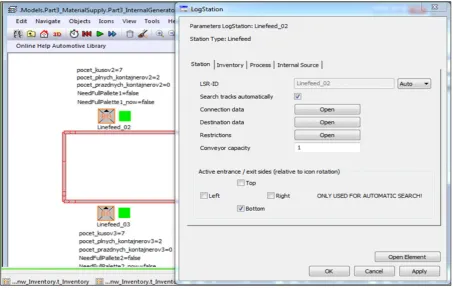
The Figure 1 shows the selected LogStation block from the VDA library used in the automo -tive industry. The advantage of this block is that we do not have to connect it to other blocks of one another. The only action (which is done for the connection) is the determination from which side the block will be automatically fed to the other blocks. There are four options to choose from: top, bottom, left, right.
Another advantage is easier manipulation with block settings than the basic block in the classic version of the simulation program. Work -Fig. 4. Demonstration of logistics train [17]
Fig. 5. The course of the proposed process of creating a simulation model
193
Advances in Science and Technology Research Journal Vol. 11 (4), 2017ing with the dialog box created by the block is easier than with the block from the base library.
A closer look at each of the predefined blocks shows that one block consists of multiple blocks of the base library. In Figure 2, there is a preview of the detailed structure and composition of the LogStation block.
The Figure 3 shows a block comparison from a VDA library and a block from a base li -brary. On the left, there is the LogStation block from the VDA library, which is made up of sev
-eral blocks from the base library and has easier control. The reason is to simplify manipulation, which means that the trained person can han -dle the logistics process. On the right, there is a Source block that belongs to the base library blocks. It can be part of a block from the VDA library, too. At first glance, there is the differ -ence and complexity of setting the block proper -ties. The basic functionality of both blocks is the same, which is to generate input requirements into the simulation model.
Fig. 7. Structure of blocks created and demonstration of the supplementary programming method
Advances in Science and Technology Research Journal Vol. 11 (4), 2017
194
DESIGN OF VARIABLE SYSTEM
MODELLING THE SUPPLY PROCESSBY
LOGISTIC TRAINS
The requirements for the rapid creation of simulation models and their operative modi -fication occur very often. However, it is very difficult to provide the desired speed of cre -ation. The necessary specialist for creating a simulation model needs a certain amount of time to study the background and to develop a simulation model. It is similar even when the need for subsequent modifications and adjust -ments simulation model.
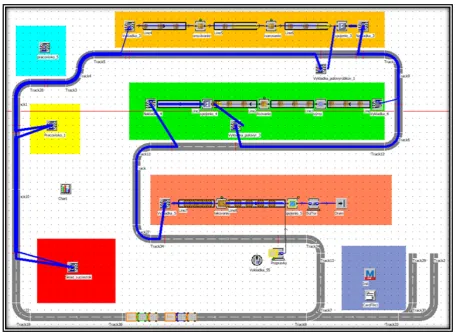
We can meet this problem, for example, the creation process simulation model of supply lo -gistics train (Figure 4), the transport routes need to be changed at irregular intervals for various reasons. When creating this model, it would be possible to use VDA libraries and Tecnomatix Plant Simulation. However, this would be a very time-consuming and financial process. Also, if its modifications and modifications are suffi -cient, e.g. allocation of individual workplaces, this would have to be done with the original creator of the simulation model in most cases, which would re-complicate and prolong the whole process.
Fig. 9. Demonstration of workload visualization
195
Advances in Science and Technology Research Journal Vol. 11 (4), 2017One of the possible solutions is shown in Figure 5. This is the process of creating a simula -tion model in which we use a suitable simula-tion program, Tecnomatox Plant Simulation and help in the initial phase of a programmer’s specialist. Custom Block Library (which will contain clearly defined inputs and outputs) will be created using it and based on the requirements.
SIMULATION MODEL OF THE SUPPLY
PROCESS BY LOGISTIC TRAINS
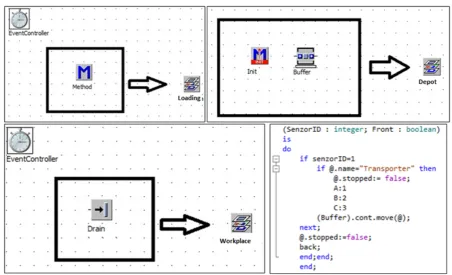
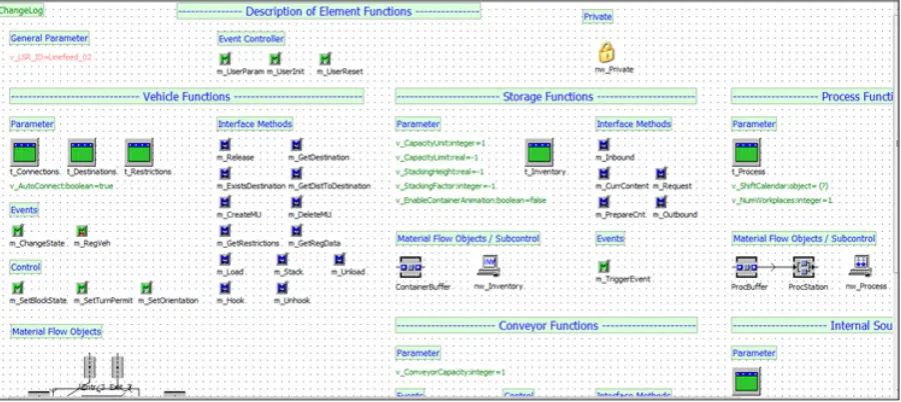
In the library, the user has created selection blocks (according to the schematic part of Fig -ure 6) that depict the store, workplace, and traffic communication. When working with this created library, we work only with the blocks it contains. A trained logistics worker can carry out the con -struction of a model structure. Model creation consists only in selecting the required blocks, ad -justing their parameters and placing them in ac -cordance with the relevant layout. The way the model is created is based on the kit principle. A logistics worker composes individual workplaces
according to the technological process and starts the simulation. The wide range of processed in -formation, between the logistics department itself and the programmer, precedes this process.
Individual blocks are created in such a way that their connection is realized automatically and each block can automatically identify its position. This important feature was created using the add-on programming method (Figure 7, Figure 8).
The principle of the supplementary program -ming method is based on the recording of com -mands that ensure the implementation of the select -ed activities by the SimTalk programming language.
USING THE SIMULATION MODEL
The concept of creating the simulation model is very effective and brings simplification of the work associated with the use of computer simula -tion. It was possible to create a highly sensitive and variable simulation model of the supply pro -cess through logistic trains by its application. The Simulation Model allows us to implement an un -limited number of predefined workstations. Such
Advances in Science and Technology Research Journal Vol. 11 (4), 2017
196
a structured simulation model no longer requires the use of specialists to carry out further modi -fications. Conversely, specialists of enterprise´s logistics can work with it after a brief training.
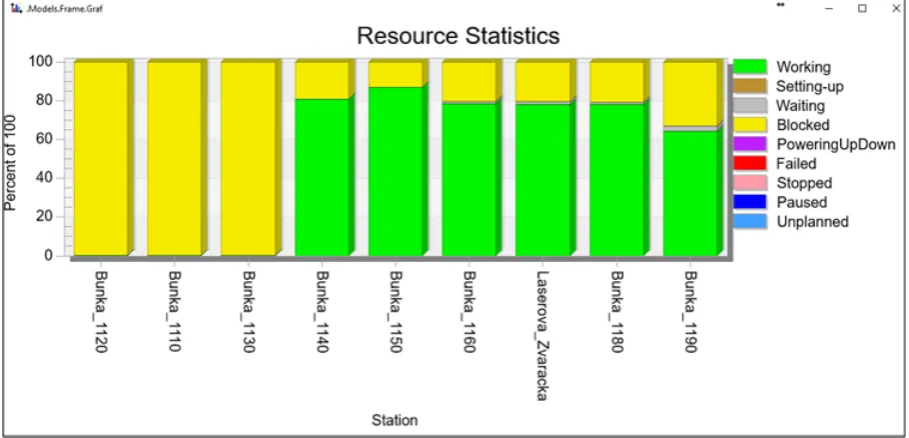
The simulation model can be used for verifica -tion of individual variants keeping traffic routes. The simulation model may be used for verifica -tion of individual variants solu-tions of transport routes. Furthermore, all selected data can be used as a support tool for decision-making and plan -ning processes (Figure 9). Realization of indi -vidual simulation experiments (specifically their preparation) takes place in the minimum possible time interfaces. There are minimized financial costs that would be much higher in the classical process due to the constant use of external simu -lation model makers.
Also, the simulation model allows us to veri -fy the material distribution plans created in indi -vidual workplaces. In case of shortcomings, we can quickly implement additional corrections and adjustments. The information provided by the system is practically unlimited (Figure 10). Their disadvantage is only that the information require -ments need to be determined in advance when designing individual modular blocks, or their in -corporation is possible in a later phase of use, but again after the intervention of a specialist.
Other important information (provided by the modified enterprise logistics model) is to high -light the material flow intensity using the Sankey Diagram (Figure 11.).
CONCLUSIONS
The problem of creating simulation models for business logistics is determined high demand -ing to master a whole range of different skills and knowledge. Their implementation is conditional on long-term practice and experience. Also, some skill in controlling the simulation program is needed. Thus, the fact so significantly impedes its further expansion and exploitation.
Today, the efforts of producers (but also of individual enterprises) are aimed at finding ways to make it more efficient and maximized. One of these options is the presently presented approach, which was used to create a simulation model of the system of supplying production using logistic trains. Its application in the initial phase requires disposal to know the necessary information and the expected results. The result is the creation of modular simulation blocks that can be used to
create a simple model of a particular enterprise logistics process and subsequently modify this model. Managing such work is possible based on short-term training from building block makers. Thus, the simulation model becomes an instru -ment for everyday logistics practice.
Acknowledgements
This contribution is the result of the proj -ects VEGA 1/0403/18, VEGA 1/0063/16, VEGA 1/0708/16, KEGA 018TUKE-4/2016.
REFERENCES
1. Strohmandl J. Use of simulation to reduction of faulty products. UPB Sci. Bull. Ser. D Mech. Eng., 76, 2014, 223–230.
2. Klozíková J. and Dočkalíková I. Decision Support in Rating of the Level of Corporate Governance Using the WINGS Method. In: 11 th European Conference on Management, Leadership and Gov
-ernance, ECMLG 2015. 569 – 579, 2015.
3. Nedeliakova E., Sekulova J., Nedeliak I. and Abramovic B. Application of raymond fisk model in researchof service quality. Komunikacie 2 (18), 2016, 11-14.
4. Fabianová J., Kačmáry P., Molnár V. and Michalik P. Using a Software Tool in Forecasting: a Case Study of Sales Forecasting Taking into Account Data Uncertainty. Open Eng., 6 (1), 2016, 270-279. 5. Bergmann S., Feldkamp N. and Strassburger S.
Journal of Simulation 11, 2017, 38–50.
6. Chankov S.M., Malloy G. and Bendul J. The In
-fluence of Manufacturing System Characteristics on the Emergence of Logistics Synchronization: A Simulation Study. In: 5th International Conference LDIC, 2016 Bremen, Germany, Springer Interna
-tional Publishing, pp. 29-40, 2016.
7. Tao F., Cheng J., Cheng Y., Gu S., Zheng T. and Yang H. Robotics and Computer-Integrated Manu
-facturing 45, 2017, 34–46.
8. B. Costa, L.S. Dias, J.A. Oliveira, and G. Pereira: In: IEMC-Europe 2008 - 2008 IEEE International Engineering Management Conference, Europe: Managing Engineering, Technology and Innova
-tion for Growth, Estori, 2008.
9. Dias L.S., Vik P., Oliveira J.A. and Pereira G. Simulation in the design of an internal logistic system-Milk run delivering with Kanban con
-trol. In: 10th International Industrial Simulation Conference 2012, ISC 2012, EUROSIS, Brno, 159–66, 2012.
10. Ficzere P., Ultmann Z. and Torok A. Time–space analysis of transport system using different map
197
Advances in Science and Technology Research Journal Vol. 11 (4), 201711. Bartošíková R., Bilíková J., Strohmandl J., Šefčík V. and Taraba P. Modelling of decision-making in crisis management. In: 24th International Business Information Management Association Conference - Crafting Global Competitive Economies: 2020 Vision Strategic Planning and Smart Implementa
-tion. 2014, 1479 -1483.
12. Molnár V. and Pačutová K. Assessing the possibili
-ties of reducing the transport company costs. In: 3rd International Conference on Traffic and Trans
-port Engineering, ICTTE 2016. 570-575, 2016. 13. Molnár V. Integrated transport system - the main
mean of transport for employees to US Steel Kosice. In: Carpathian Logistics Congress, CLC 2013. 561-566, 2013.
14. Mantič M., Kuľka J., Krajňák J., Kopas M. and Schneider M. Influence of selected digitization
methods on final accuracy of 3D model. In: Ma
-jerník, M., Daneshjo, N., and Bosák, M. (eds.) Pro
-duction Management and Engineering Sciences. pp. 475–480. CRC Press Taylor and Francis Group A Balkema Book, 2016.
15. Debski H., Koszalka G., Ferdynus M. Application of FEM in the analysis of the structure of a trailer supporting frame with variable operation param
-eters. Eksploatacja i Niezawodnosc – Maintenance and Reliability, 14, 2012, 107–113.
16. Jachowicz T., Sikora R.: Methods of forecasting of the changes of polymeric products properties. Po
-limery, 2006, 3 (51), 11-18.
17. Tow train logistics solution. Jungheinrich Official Website (http://www.jungheinrich.co.za/company/ events/ifoy-award/ifoy-award-2015/tow-train-lo
Advances in Science and Technology Research Journal Vol. 11 (4), 2017
199
Advances in Science and Technology Research Journal Vol. 11 (4), 2017
Advances in Science and Technology Research Journal Vol. 11 (4), 2017
Advances in Science and Technology Research Journal Vol. 11 (4), 2017
Advances in Science and Technology Research Journal Vol. 11 (4), 2017
Advances in Science and Technology Research Journal Vol. 11 (4), 2017
Advances in Science and Technology Research Journal Vol. 11 (4), 2017
211
Advances in Science and Technology Research Journal Vol. 11 (4), 2017
Advances in Science and Technology Research Journal Vol. 11 (4), 2017
Advances in Science and Technology Research Journal Vol. 11 (4), 2017
Advances in Science and Technology Research Journal Vol. 11 (4), 2017
219
Advances in Science and Technology Research Journal Vol. 11 (4), 2017
221
Advances in Science and Technology Research Journal Vol. 11 (4), 2017
Advances in Science and Technology Research Journal Vol. 11 (4), 2017
Advances in Science and Technology Research Journal Vol. 11 (4), 2017
Advances in Science and Technology Research Journal Vol. 11 (4), 2017
229
Advances in Science and Technology Research Journal Vol. 11 (4), 2017
Advances in Science and Technology Research Journal Vol. 11 (4), 2017
Advances in Science and Technology Research Journal Vol. 11 (4), 2017
Advances in Science and Technology Research Journal Vol. 11 (4), 2017
Advances in Science and Technology Research Journal Vol. 11 (4), 2017
Advances in Science and Technology Research Journal Vol. 11 (4), 2017
241
Advances in Science and Technology Research Journal Vol. 11 (4), 2017
Advances in Science and Technology Research Journal Vol. 11 (4), 2017
Advances in Science and Technology Research Journal Vol. 11 (4), 2017
Advances in Science and Technology Research Journal Vol. 11 (4), 2017
249
Advances in Science and Technology Research Journal Vol. 11 (4), 2017
Advances in Science and Technology Research Journal Vol. 11 (4), 2017
Advances in Science and Technology Research Journal Vol. 11 (4), 2017
Advances in Science and Technology Research Journal Vol. 11 (4), 2017
Advances in Science and Technology Research Journal Vol. 11 (4), 2017
Advances in Science and Technology Research Journal Vol. 11 (4), 2017
Advances in Science and Technology Research Journal Vol. 11 (4), 2017
Advances in Science and Technology Research Journal Vol. 11 (4), 2017
Advances in Science and Technology Research Journal Vol. 11 (4), 2017
Advances in Science and Technology Research Journal Vol. 11 (4), 2017
Advances in Science and Technology Research Journal Vol. 11 (4), 2017
Advances in Science and Technology Research Journal Vol. 11 (4), 2017
Advances in Science and Technology Research Journal Vol. 11 (4), 2017
Advances in Science and Technology Research Journal Vol. 11 (4), 2017
Advances in Science and Technology Research Journal Vol. 11 (4), 2017
Advances in Science and Technology Research Journal Vol. 11 (4), 2017
281
Advances in Science and Technology Research Journal Vol. 11 (4), 2017
Advances in Science and Technology Research Journal Vol. 11 (4), 2017
Advances in Science and Technology Research Journal Vol. 11 (4), 2017
Advances in Science and Technology Research Journal Vol. 11 (4), 2017
289
Advances in Science and Technology Research Journal Vol. 11 (4), 2017
291
Advances in Science and Technology Research Journal Vol. 11 (4), 2017
Advances in Science and Technology Research Journal Vol. 11 (4), 2017
Advances in Science and Technology Research Journal Vol. 11 (4), 2017
Advances in Science and Technology Research Journal Vol. 11 (4), 2017
299
Advances in Science and Technology Research Journal Vol. 11 (4), 2017
Advances in Science and Technology Research Journal Vol. 11 (4), 2017
Advances in Science and Technology Research Journal Vol. 11 (4), 2017
Advances in Science and Technology Research Journal Vol. 11 (4), 2017
Advances in Science and Technology Research Journal Vol. 11 (4), 2017
Advances in Science and Technology Research Journal Vol. 11 (4), 2017
Advances in Science and Technology Research Journal Vol. 11 (4), 2017
Advances in Science and Technology Research Journal Vol. 11 (4), 2017
Advances in Science and Technology Research Journal Vol. 11 (4), 2017
Advances in Science and Technology Research Journal Vol. 11 (4), 2017
Advances in Science and Technology Research Journal Vol. 11 (4), 2017
Advances in Science and Technology Research Journal Vol. 11 (4), 2017
Advances in Science and Technology Research Journal Vol. 11 (4), 2017
Advances in Science and Technology Research Journal Vol. 11 (4), 2017
Advances in Science and Technology Research Journal Vol. 11 (4), 2017
Advances in Science and Technology Research Journal Vol. 11 (4), 2017
Advances in Science and Technology Research Journal Vol. 11 (4), 2017
Advances in Science and Technology Research Journal Vol. 11 (4), 2017
Advances in Science and Technology Research Journal Vol. 11 (4), 2017
Advances in Science and Technology Research Journal Vol. 11 (4), 2017
Advances in Science and Technology Research Journal Vol. 11 (4), 2017
Advances in Science and Technology Research Journal Vol. 11 (4), 2017
Advances in Science and Technology Research Journal Vol. 11 (4), 2017
Advances in Science and Technology Research Journal Vol. 11 (4), 2017
Advances in Science and Technology Research Journal Vol. 11 (4), 2017
Advances in Science and Technology Research Journal Vol. 11 (4), 2017
Advances in Science and Technology Research Journal Vol. 11 (4), 2017
Advances in Science and Technology Research Journal Vol. 11 (4), 2017
Advances in Science and Technology Research Journal Vol. 11 (4), 2017
Advances in Science and Technology Research Journal Vol. 11 (4), 2017
Advances in Science and Technology Research Journal Vol. 11 (4), 2017
Advances in Science and Technology Research Journal Vol. 11 (4), 2017
Advances in Science and Technology Research Journal Vol. 11 (4), 2017
Advances in Science and Technology Research Journal Vol. 11 (4), 2017
Advances in Science and Technology Research Journal Vol. 11 (4), 2017
![Fig. 4. Demonstration of logistics train [17]](https://thumb-us.123doks.com/thumbv2/123dok_us/8807067.1775151/4.595.152.448.618.753/fig-demonstration-of-logistics-train.webp)