CODEN (USA): IAJPBB ISSN: 2349-7750
I
IN
ND
DO
O
A
AM
ME
ER
RI
IC
CA
AN
N
J
JO
OU
UR
RN
NA
AL
L
O
OF
F
P
P
H
H
A
A
R
R
M
M
A
A
C
C
E
E
U
U
T
T
I
I
C
C
A
A
L
L
S
S
C
C
I
I
E
E
N
N
C
C
E
E
S
S
Available online at:
http://www.iajps.com
Research Article
MICROEMULSION BASED TRANSDERMAL GELS OF
GLIMEPIRIDE TO ENHANCE BIOAVAILABILITY: IN
VITRO EVALUATION
Kalpana Madikattu
*
1,
Venkatasimhadri Naidu Kalamata
2,K.Srisailam
31
Vishnu Institute of Pharmaceutical Education and Research, Narsapur, Medak,
Telangana-502313
Email: [email protected], Ph.No:9985912188
2
Senior Manager - Formulation Development, AET Laboratories Pvt. Ltd., Medak Dist,
Hyderabad - 502 319.
Email: [email protected], Ph No: 9949417700
3
Department of Pharmacy, Satavahana University, Karimnagar-505001
Email: [email protected], Ph No: 9246894465
Abstract:
The main aim of the current research work was to formulate and evaluate the microemulsion based transdermal gel for glimepiride. Saturation solubility studies of the drug were conducted in various solvents and oils. Labrafil M 1944 CS, Tween 80 and Transcutol P were selected as oil phase, surfactant and co surfactants respectively. Surfactant to co surfactant ratio was fixed as 1:2 in all the formulations. Microemulsion prepared with oil to smix ratio of 1:9 (F9) was found to be stable with the globule size of 55.9±6.54, and has more % of drug diffusion of 86.4±1.8 % within 6h and has been selected for the preparation of microemulsion based gel using carbopol 934 as gelling agent. The prepared gel has shown 93.74±2.3% drug release in 8h which was higher than control gel.
Keywords:
Microemulsion, gel, transdermal, glimepiride, carbopol.Corresponding author:
Kalpana Madikattu
,
Vishnu Institute of Pharmaceutical Education and Research,
Narsapur, Medak, Telangana-502313
Email: [email protected],
Ph.No:9985912188
Please cite this article in press as Kalpana Madikattu et al, Microemulsion Based Transdermal Gels of
Glimepiride to Enhance Bioavailability: In Vitro Evaluation, Indo Am. J. Pharm. Sci, 2016; 3(5).
INTRODUCTION:
Transdermal drug delivery system is having several advantages such as it avoids first pass metabolism, avoids drug degradation in GIT, and thereby improves bioavailability [1]. Sustained drug delivery is also achieved by transdermal route. While selecting a suitable dosage form drug physicochemical properties like solubility, pKa and lipophilicity etc., must be taken into consideration [2-4]. Microemulsion based gels gained much popularity in the recent era, as they offers the advantages of both emulsions and gels while having good patient acceptability[5-7]. Majority of the drugs entering into market are suffering from bioavailability as they belong to low soluble, high permeable BCS class II. And the drugs having less biological half life are needed to be administered as sustained release dosage forms. Therefore, when one is concerned with topical delivery of poorly water-soluble drug, microemulsion based gels may serve as better option. Emulsified gel has proven a stable one and better vehicle for hydrophobic or poorly water-soluble drugs [8], [9].
Glimepiride, an important drug of sulfonylurea class, is currently available for treating hyperglycemia in Non-Insulin Dependent Diabetes Mellitus (NIDDM); but has been associated with severe and sometimes fatal hypoglycaemia and gastric disturbances like nausea, vomiting, heartburn, anorexia and increased appetite after oral therapy. Since the drug is usually intended to be taken for a long period, patient compliance is also very important. Glimepiride (molecular weight: 490.6 and pKa: 6.2) showed favourable partition coefficients (1.8 in octanol/pH 7.4 buffer) [10]. Hence, in the present research work an attempt was done to prepare microemulsion based gels of glimepiride for transdermal delivery [10-12].
MATERIALS AND METHODS:
Materials
Glimepiride was obtained as gift sample from Biochem pvt ltd, India. Labrafil 1944CS and Trancutol-P were received as gift samples from Gattefosse, India. Remaining all the excipients were purchased from Finar Chemicals India.
Methods
Saturation Solubility Studies:
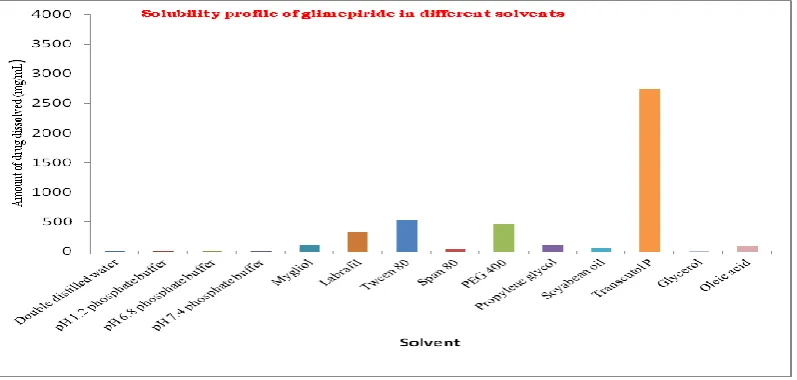
The saturation solubility studies of Glimepiride were carried out in different oils and solvents such as distilled water, myglyol, ethanol, labrafil M 1944 CS, oleic acid, transcutol P, poly ethylene glycol 400 (PEG 400), propylene glycol (PG), span 80, tween 80, soyabean oil, glycerol, pH 1.2 phosphate buffer, pH 6.8 phosphate buffer and pH 7.4 phosphate buffer. Saturated solutions of drugs were prepared by adding excess amount of drug to 2 mL of each selected vehicle and were agitated on the mechanical shaker for 48 h at 25º C. After reaching equilibrium, samples were collected and centrifuged at 10,000 rpm for 15 min. Further 100 µL of supernatant was collected and suitably diluted with methanol and amount of drug dissolved was quantified by using UV-Visible spectrophotometry [13].
Formulation Development of Glimepiride Loaded Microemulsions:
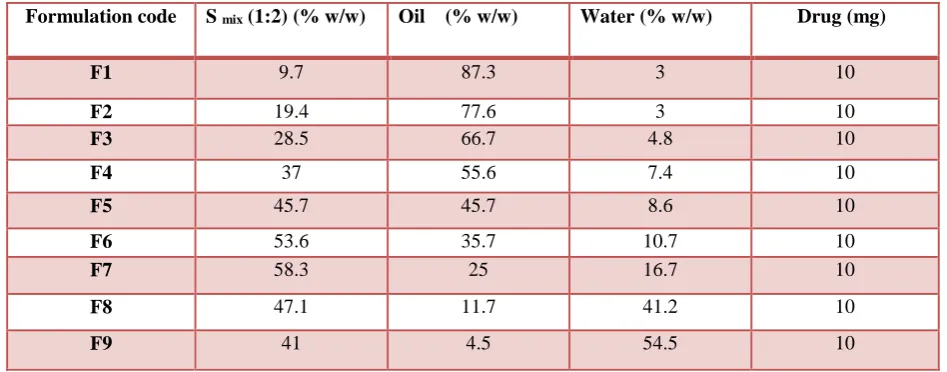
The micro emulsion formulations were prepared by using labrafil M 1944 CS as oil phase, tween 80 as surfactant and transcutol P as co- surfactant. Smix ratio was fixed as 1:2 in all the formulations. Compositions of Glimepiride loaded microemulsions are given in table no 1. Microemulsions were prepared by mixing the oil phase and water phase at constant stirring rate. The surfactant mixture and drug was added to the oil phase, followed by drop wise addition of aqueous phase to oil phase at constant stirring rate until turbidity was observed. Thus formed microemulsions were checked for physical appearance after 24h and categorized as clear/ transparent/ translucent if stable and as milky if there is precipitation [11, 12].
Table 1: Composition of Micro Emulsion Formulations
Formulation code S mix (1:2) (% w/w) Oil (% w/w) Water (% w/w) Drug (mg)
F1 9.7 87.3 3 10
F2 19.4 77.6 3 10
F3 28.5 66.7 4.8 10
F4 37 55.6 7.4 10
F5 45.7 45.7 8.6 10
F6 53.6 35.7 10.7 10
F7 58.3 25 16.7 10
F8 47.1 11.7 41.2 10
Characterization of Drug Loaded Microemulsions Measurement of Droplet Size and Zeta Potential:
The mean droplet size and zeta potential was determined by photon correlation spectroscopy using zetasizer (Malvern instruments, UK). Each sample was diluted to a suitable concentration with filtered double distilled water. Globule size analysis was performed at 25°C with an angle of detection of 90°C. Size and poly dispersity index of microemulsions were obtained directly from the instrument [7].
In vitro Drug Diffusion Studies:
In vitro drug diffusion studies were conducted for thermodynamically stable microemulsions by using franz-diffusion cells fitted with a modified dialysis membrane. Initially, the dialysis membrane was soaked in a pH 7.4 phosphate buffer solution for 12 hours at room temperature before initiation of experiment. The receptor compartment was filled with 18mL of phosphate buffer (pH 7.4) a small bar magnet was used to stir the elution medium at a speed of 600 rpm with the help of magnetic stirrer. The temperature of the elution medium was maintained and controlled at 37±1°C by a thermo static arrangement to mimic in vivo condition. An aliquot of 1 mL was withdrawn at a predetermined time interval replaced by an equal volume of elution medium to maintain sink conditions, diffusion studies were carried out for a period of 6 hours. The drug concentration in the aliquot was determined by UV-Visible spectrophotometer by using the standard curve. Amount of drug diffused at a various time intervals was calculated and plotted against time for all the developed formulations [16].
Formulation Development of Microemulsion Based Gel:
The best microemulsion was selected based on the results of in vitro characterization of microemulsions. The selected best formulation of microemulsion was incorporated into gel base and further research was done. Carbopol 934 was selected as gelling agent. About 1g of carbopol 934 was soaked in the 100 mL of distilled water overnight. The formed carbopol 934
gel base was neutralized by drop wise addition using triethanolamine (TEA) till the pH was adjusted to 6.8. To the gel base the best microemulsion formulation equivalent to 10 mg dose for glimepiride was dispersed slowly with the help of overhead stirrer [5].
Characterization of Microemulsion Based Gel: Drug Content:
For determination of drug content, about 1 g of the microemulsion based gel which was equivalent to 10 mg in case of glimepiride was weighed and dissolved in methanol and the volume was made up to 100 mL. The above solution was diluted appropriately and drug content was determined spectrophotometrically. In Vitro Drug Diffusion Study from Dialysis
Membrane:
An in vitro drug release study was performed using franz diffusion cell. The release of drug of optimal formulation was compared with the control gel. DialysisMembrane (Hi Media, molecular weight 5000 Daltons) was placed between receptor and donor compartments. Microemulsion based gel equivalent to 1g was placed in the donor compartment and the receptor compartment was filled with pH 7.4 phosphate buffer (18 mL). The diffusion cells were maintained at 37 ± 0.5° C with stirring at 600 rpm (Remi, India) throughout the experiment. At fixed time interval, 1 mL of aliquots were withdrawn for every 1, 2, 3, 4, 6, 8 hours from receiver compartment through side tube and equal aliquots were replaced. The samples were analyzed by UV- Visible spectrophotometry.
RESULTS & DISCUSSION:
Saturation Solubility Studies
From the solubility studies Labrafil M 1944 CS was selected as oil phases based on the drug solubility and natural penetrating action. Tween 80 and transcutol P were selected as surfactant and co-surfactant respectively. Tween 80 was chosen as surfactant because of its high hydrophilic nature (HLB = 15) and good emulsion forming capacity. However the drug is also having good solubility in tweeen 80 and transcutol P.
Development of Microemulsion Formulations:
Formulations were developed based on the micro emulsion zone of pseudo-ternary phase diagrams. 4.5 - 87.3 % of oil and 9.7 - 58.3 % Smix concentration was selected and formulations were developed. All the developed formulations were found to be clear/ transparent, but at higher amounts of oil (F1 & F2 which contains more than 70 % w/v of oil) precipitation was observed on overnight storage at ambient conditions.
Characterization of Microemulsion:
Measurement of droplet size and zeta potential:
The globule size plays a significant role in the micro emulsion. The size of the globules found to be in the range of 55.9±6.54 to 75.3±4.6 nm and as the concentration of surfactant mixture increased the globule size decreased. Polydispersity indicates the uniformity of droplet size within the formulation. The higher the polydispersity, the lower the uniformity of the droplet size in the formulation. The PDI was within the acceptable limits for all the microemulsion formulations. The F9 formualtion has shown the low polydisersity index (0.145±0.03), low globule size (55.9±6.54) and high zeta potential (-33±1.7) compared to other formulations.
In Vitro Drug Diffusion Studies: In vitro release studies were performed for microemulsions (F4 to F9), using dialysis method. The study was carried up to 6 hours. The results are graphically represented in figure no. 2. It can be observed that optimal formulations F9 have shown 86.4±1.8% in 6h. This indicates that the diffusion was increased by the use of surfactant
mixture at highest ratio (oil: Surfactant mixture-1:9). Hence it has selected as best formulation.
Fig 2: In vitro diffusion profiles of microemulsions
Formulation Development Microemulsion Based Gel:
The optimal microemulsion formulations F9 was incorporated into gel base by continuous stirring until a homogenous microemulsion based gel (MEBG) is formed. The pure drug solution (control) was also incorporated into gel base to form control gel for comparative analysis with the optimal formulation.
Characterization of Microemulsion Based Gel:
In Vitro Drug Diffusion Study from Dialysis
Membrane:
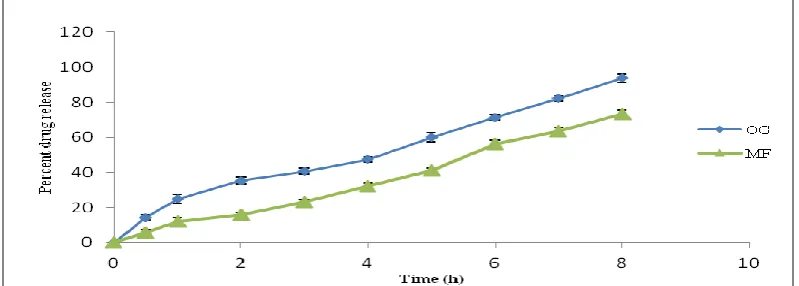
Glimepiride drug diffusion studies were carried through dialysis membrane and the cumulative amount of drug permeated was calculated. The release of drug from gel formulations has been prolonged to 8h which was 6h in case of microemulsion. This delay was due the effect of the carbopol 934 (gelling agent). The release of drug of optimal formulation was compared with the control gel. It was observed that optimal gel showed 93.74±2.3% drug release in 8h and the percent of drug release for control gel was 52.6±1.3%. Results of drug diffusion study of gels are shown in figure no.3.
CONCLUSION:
Microemulsions were prepared successfully using labrafil M 1944 CS as oil, Tween 80 as surfactant and transcutol P as co surfactant. Microemulsion-based gel was successfully prepared with Carbopol 934 (1%) as a gelling agent to impart viscosity to the preparation as well as to sustain the action of the drug by increasing residence time. The results of this study, suggests that microemulsion based transdermal gels of Glimepiride provided much better maintenance of therapeutic levels of drug in blood and for a prolonged period of time as well. The non-irritant nature of the gels also revealed the advantage of using the natural mucoadshesive polymer. Consequently this technology can be explored for other anti- diabetic molecules as well so as to achieve better control over the disease
ACKNOWLEDGEMENTS:
The authors would like to acknowledge Biochem pharmaceuticals and Gattefosse for providing gift samples and supporting in the successful completion of this study.
REFERENCES:
1.Shingade GM, Aamer Q, Sabale PM, Grampurohit ND, Gadhave MV, Jadhav SL, et al. Review on: recent trend on transdermal drug delivery system. J Drug Deliv Therap. 2012;2(1):66-75.
2.Loyd V, Allen JR, Nicholas G. Popovich, Howard C. Ansel. Pharmaceutical dosage forms and drug delivery systems. 8th Edition. 2005; pp. 298-299. 3. Kumar R, Philip A. Modified Transdermal Technologies: Breaking the Barriers of Drug Permeation via the Skin. Tropical J Pharm Res. 2007;6(1):633-644.
4. Rizwan M, Aqil M, Talegoankar S, Azeem A, Sultana Y, Ali A. Enhanced transdermal drug delivery techniques: an extensive review on patents. Recent Pat Drug Deliv Formul. 2009; 3(5):105-124. 5.Parag P, Mansi AM, Mandal SN, Nikita P, Rajesh KS. Formulation and Evaluation of Microemulsion Based Gel of Itraconazole. Pharmagene. 2013; 1(2): 32-36.
6.Patel VA, Makwana SB, Patel BA, Parmar SJ. Formulation and Characterization of Micro-emulsion based gel of Curcumin for the Management of Plaque Psoriasis. Int J Adv Pharm Res. 2014; 5(2):1-6
7.Wani RR, Patil MP, Dhurjad P, Chaudhari CA, Kshirsagar SJ. Microemulsion Based Gel: A Novel
Approach in Delivery of Hydrophobic Drugs. Int J Pharm Res Scholar. 2015; 4(2): 398-410
8.Lawrence MJ, Rees GD. Microemulsion-based media as novel drug delivery systems. Adv Drug Deliv Rev. 2000; 45(1):89-121
9.Sarisozen C, Vural I, Levchenko T, Hincal AA, Torchilin VP. PEG-PE-based micelles co-loaded with paclitaxel and cyclosporine A or loaded with paclitaxel and targeted by anticancer antibody overcome drug resistance in cancer cells. Drug Delivery. 2012; 19(4): 169-176
10.Hitesh K, Jagruti P. Development and Validation of UV Spectrophotometric Method for Determination of isradipine loaded into solid lipid nanoparticles. Int J Pharm Rev Res. 2013;20(1):162-166.
11.
Tirunagari M, Jangala VR, Khagga M, Gannu R. Transdermal therapeutic system of isradipine: effect of hydrophilic and hydrophobic matrix on in vitro and ex vivo characteristics. Archiv Pharm Res. 2010; 33(7): 1025-3312.
Veerareddy PR, Bobbala SK. Enhanced oral bioavailability of isradipine via proniosomal systems. Drug Dev Ind Pharm. 2013; 39(6): 909-1713.
Jakki R, Afzal SM, Kandadi P, Veerabrahma K. Development of a self-microemulsifying drug delivery system of domperidone: In vitro and in vivo characterization. Acta Pharm. 2013; 63(4):241-5114.Bhagwat DA, DSouza JI. Development of solid self micro emulsifying formulation to improve oral bioavailability. Int J Therap App. 2012; 1(1): 38 – 41.
15. Vasanthavada M, Serajuddin ATM. Lipid based self emulsifying solid dispersions. In Oral Lipid Based Formulations: Enhancing Bioavailability of Poorly Water Soluble Drugs. 2007; 149–184. 16.Sintov AC, Shapiro L. New microemulsion vehicle facilitates percutaneous penetration in vitro and cutaneous drug bioavailability in vivo. J Controlled Rel. 2004; 95(2):173-183.