Issue 2 Special Issue on Interprofessional
Education (IPE) Article 4
2016
Initial Feasibility and Efficacy of an Interprofessional Education
Initial Feasibility and Efficacy of an Interprofessional Education
Pilot Program
Pilot Program
Katie Baker
Community and Behavioral Health, East Tennessee State University
Kerry Proctor-Williams
East Tennessee State University
L. Brian Cross
Pharmacy, East Tennessee State University
Elizabeth Alley
East Tennessee State University
Michael Crouch
School of Pharmacy, Samford University
Follow this and additional works at: https://dc.etsu.edu/ijhse
Part of the Educational Assessment, Evaluation, and Research Commons
Recommended Citation Recommended Citation
Baker, Katie; Proctor-Williams, Kerry; Cross, L. Brian; Alley, Elizabeth; and Crouch, Michael (2016) "Initial Feasibility and Efficacy of an Interprofessional Education Pilot Program," International Journal of Health Sciences Education, 3(2).
Available at: https://dc.etsu.edu/ijhse/vol3/iss2/4
East Tennessee State University (ETSU) is a regional university with 15,000+ students. It includes an Academic Health Sciences Center (AHSC) with an approximate total number of students of 4,250, which includes the Colleges of Clinical and Rehabilitative Health Sciences, Medicine, Nursing, Pharmacy, and Public Health. In January of 2011, a retreat of all deans and associate deans of the Academic Health Sciences Center as well as the Vice President for Health Affairs was held to expand interprofessional offerings at ETSU. A major obstacle identified at that retreat for implementation of an expanded, formal interprofessional education (IPE) experience was scheduling issues related to varying curricular and organizational issues within each of the five colleges of the AHSC. This obstacle would influence the formation of an extra-curricular structure by which the new IPE experience, described in detail below, would be formed.
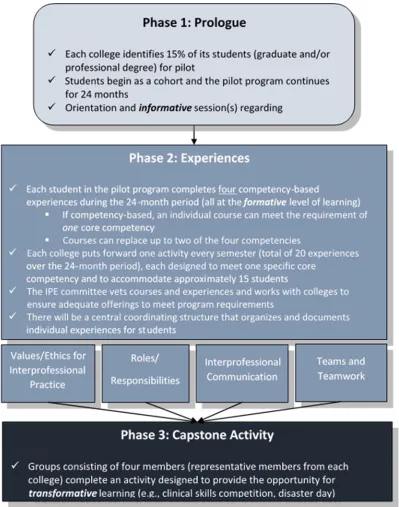
Several months prior to the first retreat of all deans, associate deans, and the Vice President for Health Affairs, a seminal article was published in the Lancet by Dr. Julio Frenk and colleagues (2010) titled, “Health professionals for a newcentury: transforming education to strengthen health systems in an interdependent world.” This timely article provided a foundational influence on the formation of the IPE experience at ETSU. In that article, Dr. Frenk suggested three levels of learning to be considered when designing IPE experiences: informative, formative, and transformative. The objectives within informative experiences include information and skill acquisition; within formative experiences include socialization and awareness of values; within transformative experiences include obtainment of leadership attributes. The projected outcomes for informative, formative, and transformative experiences were becoming experts,
professionals, and change agents, respectively.
Figure 1. ETSU Interprofessional Education Pilot Program (IPEP) Structure
existing courses within current curricula that were designated as interprofessional (more
information on courses can be found under the ‘Experiences’ heading below). To encourage the interaction of professional students beyond what would have been within their given curriculum, no more than two courses were permitted to count toward completion of IPEP. Finally, to respect the need for IPEP to be extra-curricular in nature, it was agreed that the prologue and Capstone experiences would be completed on strategically scheduled Saturdays respecting student curricular issues. Experiences within phase two of IPEP were either accomplished through pre-existing courses or created activities (more information on activities can be found under the ‘Experiences’ heading below) that met at times respectful of curricular structures (often early evening scheduling was utilized).
Prologue (Phase 1)
The IPEP Prologue was created to engage the interprofessional learners at the informative level of learning. The World Health Organization’s (2010) definition of Interprofessional Education – “When students from two or more professions learn about, from and with each other to enable effective collaboration and improve health outcomes” – was considered central to the creation of the Prologue. The goal of the prologue experience was to bring together interprofessional
students from five colleges within the ETSU AHSC, as well as the Department of Psychology, to engage in an introduction to IPE and to learn about, from and with each other.
The prologue schedule can be seen to the right of this paragraph. In keeping with the extra-curricular strategy of IPEP, this all-day event was held early in the fall semester on a Saturday. In preparation for the Prologue experience, students were required to read The Five Dysfunctions of a Team (Lencioni, 2002) as well as view a webcast by Julio Frenk outlining his article published in Lancet in 2010. It was hoped this preliminary work would set the stage for the prologue experience and provide some important background information on the importance of the IPE.
Upon arrival to the event, all students were randomly assigned to learning groups that included 4-5 students from various colleges and departments within the AHSC at ETSU. The makeup of the groups was not the same
from group to group, but all groups included 4-5 students from uniquely different professional programs at ETSU. Student groups were provided with a brief welcome and overview of IPEP at the beginning of prologue experience. A simple icebreaker activity followed to help the
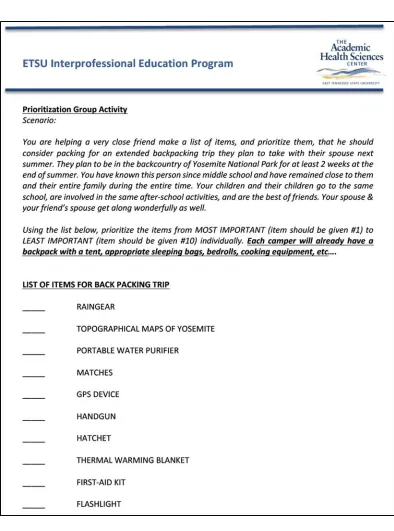
interprofessional learners begin to know each member of their assigned learning groups. This was followed by two “prioritization activities” to engage the learners at a deeper level and to begin to create debate within the groups to stimulate the need for the learning teams to work together toward a common goal. The prioritization activities can be seen in Figures 2 and 3. The first prioritization activity was not healthcare related and was simply used to create opportunities for the learning groups to come to common ground regarding and issue in which they had no vested interest – prioritizing importance of items to be included in a backpacking trip (see Figure
Prologue Schedule:
- Welcome & Overview - Ice-breaker group activity - Prioritization activity #1 &
debrief
- Prioritization activity #2 & debrief
- Lunch and “Box of Stuff” time
- “Box of Stuff” group presentations
2). This exercise began to show the groups the importance of communication and respect when working toward a common goal – the prioritization list. This session ended with a debrief activity wherein the student groups discussed what techniques were used to help them accomplish their common goal as well as discussing opportunities to improve the process of working together as a team in the future. That led into the second prioritization activity in which student learning teams were asked to create a priority list of responsible parties for a patient’s problem with pain management issues (see Figure 3). This second prioritization activity used the principles gained in the first activity, but maximized the potential for disagreement within the learning groups (by design) in order to further engage the interprofessional student learners in a topic that was more professionally relevant. As with the initial prioritization activity, students were asked to create an individual priority list first, then to create a team-based priority list second. It was in the creation of this second team-based priority list that the students were able to see how communication, conviction, passion, professional background, life experiences, and many other issues shaped how the team worked together (not always functionally) to resolve a commonly seen problem in the current healthcare system.
The morning session of the IPE Prologue experience ended with each interprofessional learning group being given a box with the contents of a children’s 300-piece Erector™ set (including various metal parts, gears, and 2 tools), a roll of duct tape, and no directions. They were told to create a new device that could help to solve a problem within the current US health system during their 90-minute lunch break. Each learning group was required to provide a presentation to the entire collective of faculty and students gathered for the Prologue experience in the afternoon. All members of each group were required to participate in the presentation of their learning group. Learning groups were incentivized with gift cards to a local restaurant to be provided to the winning learning group. This activity was designed to further create
Figure 3. Prologue Prioritization Activity #2
Experiences (Phase 2)
Phase 2 (see Figure 1) of IPEP sought to expose students to each of the four core competencies for interprofessional collaborative practice by way of formative coursework and/or
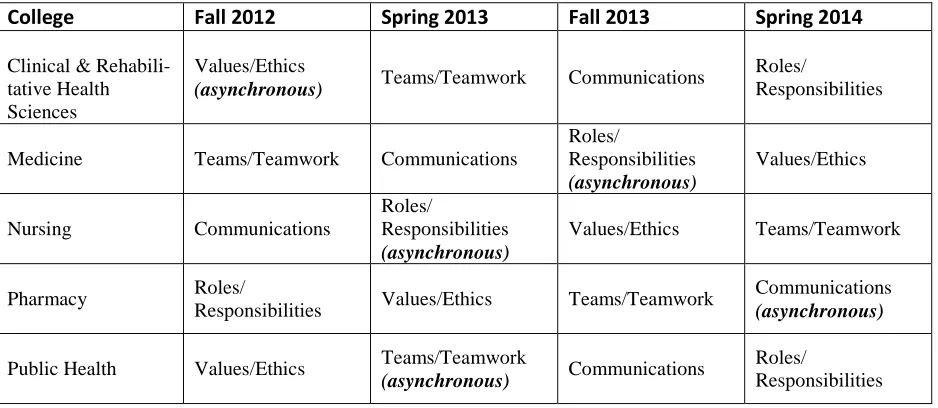
first tasked with identifying courses that met IPEP inclusion criteria (i.e., proposed courses had to include both faculty and student representation from at least two professions), and a sub-committee of IPEC then vetted those courses. Additionally, on a rotating basis, each college was assigned a core competency for which to seek extracurricular activity proposals from faculty each fall and spring semester. See Table 1 for the 2012 – 2014 semester activity assignments by college. Also note efforts made to accommodate distance learning students by assigning and offering asynchronous, online activities in each of the four core competency areas. Interested faculty completed an activity proposal form and submitted the proposal to the IPEC vetting sub-committee. Activities meeting the IPEP criteria (i.e., proposed activities had to include faculty representation from at least two professions and be applicable and made available to any student enrolled in IPEP irrespective of profession) were made available to students each semester through a catalog posted to the program’s Desire 2 Learn (D2L) website. From the D2L link, students were asked to sign up for an activity based on interest, availability and need. After the completion of each course or extracurricular activity, faculty were responsible for reporting students’ participation to IPEC in order to track IPEP completion.
Table 1. Semester Activities by College and Competency, 2012 – 2014
College Fall 2012 Spring 2013 Fall 2013 Spring 2014
Clinical & Rehabili-tative Health Sciences
Values/Ethics
(asynchronous) Teams/Teamwork Communications
Roles/
Responsibilities
Medicine Teams/Teamwork Communications
Roles/ Responsibilities (asynchronous) Values/Ethics Nursing Communications Roles/ Responsibilities (asynchronous)
Values/Ethics Teams/Teamwork
Pharmacy Roles/
Responsibilities Values/Ethics Teams/Teamwork
Communications
(asynchronous)
Public Health Values/Ethics Teams/Teamwork
(asynchronous) Communications
Roles/
Responsibilities
Teamwork). Most of the activities required students to complete a short reading assignment before the activity, participate in approximately 3 hours of face-to-face or online viewing work, and submit a final written reflection. More details on post-activity data collection and evaluation is provided in the ‘Program Assessment and Evaluation’ section below.
Capstone (Phase 3)
The IPEP Capstone event was designed to provide opportunities for education at the transformational level of learning. In keeping with the extra-curricular strategy of IPEP, this event was held late in the spring semester on a Saturday for 8 hours. The event was held at a remote, off-campus location to provide a more unique environment for the day-long experience. It was a simulated refugee camp experience, wherein the interprofessional learners were tasked with the
preparation of an area of land for providing service/care to a group of refugees (students were told to prepare for approximately 100 people to be coming to the camp).
The schedule for the Capstone experience can be seen at the right of this paragraph.
The day began with a brief introduction of the scenario and what the learners’ expectations were. Over breakfast, the students began to organize; first coming together as the entire group to create a list of priorities that would need to be accomplished in order to prepare the area of land to welcome 100 projected refugees. Several students from different colleges within the AHSC quickly stepped to the front of the group and began to facilitate the discussion to help create the priority list. This priority list with individual items became separate working groups that were each tasked with creating various parts of the refugee camp. Supplies were provided to the students near the land area designated to be the refugee camp site. Students were responsible for matching needed supplies with the previously created priority list as not all supplies provided were necessarily needed for the creation of the refugee camp. The working groups created
various stations that the entire student group had prioritized earlier in the morning. These stations included such subjects as sanitation, housing, meal preparation, security/intake/tracking of
refugees, and medical/health-related issues.
The interprofessional learners began creating the aforementioned stations on the land area designated for the refugee camp. They were told to expect refugees to begin arriving around lunch time, as that would give them time to create the camp with the organized stations as described above. However, approximately 2 hours prior to the expected arrival of the simulated refugees simulated problems (both medical & psychosocial) began happening that caused the student teams to reprioritize the work of the smaller working groups. Multiple simulated medical psychosocial problems were presented to the group such as a simulated femur fracture from a worker within the camp due to a tree falling on him, a pregnant woman giving birth, a mother trying to confiscate antibiotics for a child in a nearby village, local tribal leaders presenting to the camp explaining that the refugee camp could not be located where the students had planned, multiple patients with gastroenteritis, and a child separated from her mother, among others. Faculty members were stationed throughout the simulated refugee camp and texted photographs
Capstone Schedule:
- Welcome & Overview
- Student group planning session - Student group preparing area for refugees entering camp
- Student group addresses challenges created by refugees & workers
of examples of interprofessional issues to a common phone number that were all used during the debriefing session at the end of the day. The simulated problems were designed to challenge the students’ abilities to engage the four core competencies of interprofessional education. At the end of the day all students were gathered in a common area for a debriefing session to discuss important interprofessional accomplishments as well as areas for improvement for the
experience.
Program Evaluation and Assessment
The IPEP program included an experimental component. As is recommended for evaluation of the initial stages of IPE programs, we started with self-assessment of learners’ reactions to the learning experience, their attitudes toward interprofessional education and practices, and acquisition of knowledge and skills (Freeth et al., 2005; Reeves, 2010). The questions of the experimental arm of IPEP focused on whether the students’ attitudes, knowledge and skills changed as a result of participating in the program as a whole and the activities more specifically.
Experimental Method
Participants. All students from the two IPEP cohorts were asked if they were interested in volunteering to participate in the experimental arm of the program. Students who indicated interest reviewed an informed consent approved by ETSU’s Institutional Review Board, and those who consented were included in the program. At the beginning of the program, 103 students completed a demographic questionnaire. There were 71 females, 31 males (1 no response); 65% were 20-25 years, 21.4% were 26-30 years, 5.8% were 31-40 years; 3.9% were 41-50 years, and 1% was 51-55 years (3 no response). Of the 99% of participants who reported race and ethnicity, 87.4% were White, 4.9% were Asian, 2.9% were Black, 2.9% identified as other, and 1% was Hispanic. Of the 97.1% of students who responded to a question about their socio-economic background, 48.5% indicated upper middle class, 32% lower middle class, 14.6% working class and 1.9% poor. Of the 99% who reported on residency, 50.5% were urban, 35.9% were from a small town, and 12.6% were rural. In reporting college affiliation, 29.1% were from the College of Pharmacy; 26.2% were from the College of Clinical and Rehabilitative Sciences, representing audiology, speech-language pathology, nutrition and physical therapy; 18.4% were from the College of Medicine; 10.7% were from the College of Nursing, 8.7% were from the Department of Psychology, and 6.8% were from the College of Public Health. Of the 88.3% of students who reported their year of study, 40.8% were in first year, 47.6% were in second year, and 1% was in third year.
the original survey that did not associate. The responses for these questions were excluded from the analyses. A brief description of each survey follows.
1. Attitudes Toward Health Care Teams Scale (ATHCTS; Heinemann, Schmitt, Farrell & Brallier, 1999; Hyer, Fairchild, Abraham, Mezey, & Fulmer, 2000). We included 21 questions that contributed to the constructs of Team Value/Quality of Care, Team Efficiency/Costs of Team Care, and Shared Leadership/Physician Centrality. Participants rated statements on a 5-point scale from strongly disagree to strongly agree.
2. Interdisciplinary Education Perception Scale (IEPS; McFadyen, Maclaren & Webster, 2007; Luecht, Madsen, Taugher, & Petterson, 1990). We included 18 questions that contributed to the constructs of Competency and Autonomy, Perceived Need for Cooperation, and Perception of Actual Cooperation. Students rated statements on a 6-point scale from strongly disagree to strongly agree.
3. Readiness for Interprofessional Learning Scale (RILS; Parsell & Bligh, 1999; McFayden, Webster, Strachan, Figgins, Brown, & McKechnie, 2005). We included 19 questions that contributed to the constructs of Team-work and Collaboration, Professional Identity: Positive and Negative, and Roles and Responsibilities. Students rated statements on a 5-point scale, from strongly disagree to strongly agree.
In addition, to study acquisition of knowledge and skills from the students’ perspective based on their activity experiences, a Core Competency and Proficiency Survey (CCPS) was developed. It was based on the framework of Hanley (1994) and included each of the specific competency components within the four core competencies identified by IPEC (2011). This yielded nine specific competency questions for Roles and Responsibilities, 10 for Values & Ethics, 8 for Interprofessional Communication and 11 for Teams and Teamwork. Each of the specific competencies was made into a statement prefaced with I know..., to measure knowledge, I practice... to measure skills, and I value... to measure attitude at the activity level. Students rated each of the resultant 114 statements on a 5-point scale from “I have no or little idea” to “I can
teach this to someone else”.
There was attrition in the voluntary completion of post-program surveys. Not all of the students who completed a pre-program survey attended the Capstone experience, which is when the post-program surveys were completed. Attempts to solicit completion of the surveys of those who did not attend met with moderate success.
Table 2. Number of Participants Who Completed Study Instruments Before and After Participation in the IPEP Program or an Activity
Instrument Pre IPEP or
Activity
Post IPEP or Activity
ATHCTS 103 73
IEPS 102 70
RILS 102 71
Roles & Responsibilities 34 21
Values & Ethics 40 23
Communication 18 14
Teams & Teamwork 26 20
Design and Analyses. Mean ratings on each survey comprised the dependent variables for comparison. Analysis of these ratings was conducted using a t-test for repeated measures. The study was designed to answer four key questions. The questions and data related to attitudes will be presented first, followed by the questions and data related to knowledge and skills.
Attitudes. When examining students’ attitudes, the first question was: Do the students’ ratings of the constructs within each survey differ? To answer this question we compared ratings of the constructs within each survey pre-program and then again post-program. The second question was: Do the students’ ratings of the constructs within each survey change pre- to post-program? To answer this question, we compared pre- to post-program ratings of the constructs within each survey (i.e., ATHCTS, IEPS, RILS). As well, we compared pre- to post-activity ratings of the value questions on the CCPS.
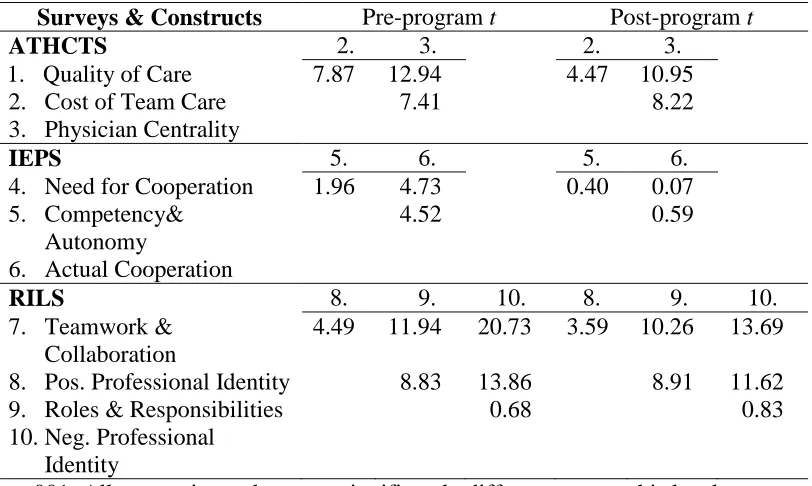
On the ATHCTS, students rated Quality of Care highest, then Costs of Team Care, with
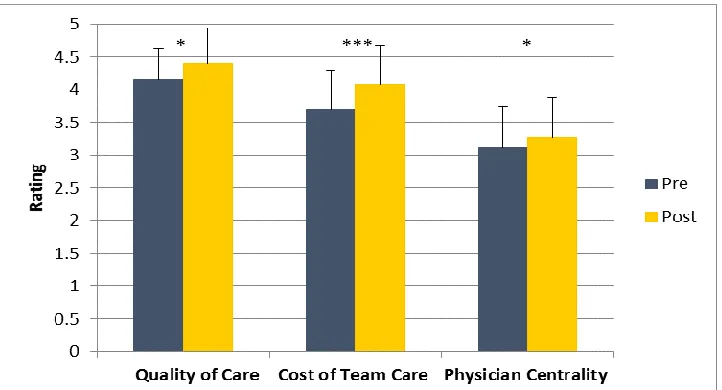
Physician Centrality the lowest, with significant differences in ratings between each construct at both pre- and post-program (see Table 3). The ratings for all constructs improved at statistically reliable levels pre- to post-program (see Figure 4).
Table 3. Comparison of Differences in Students’ Ratings for Survey Constructs
Surveys & Constructs Pre-program t Post-program t
ATHCTS 2. 3. 2. 3.
1. Quality of Care 7.87 12.94 4.47 10.95
2. Cost of Team Care 7.41 8.22
3. Physician Centrality
IEPS 5. 6. 5. 6.
4. Need for Cooperation 1.96 4.73 0.40 0.07 5. Competency&
Autonomy
4.52 0.59
6. Actual Cooperation
RILS 8. 9. 10. 8. 9. 10.
7. Teamwork & Collaboration
4.49 11.94 20.73 3.59 10.26 13.69
8. Pos. Professional Identity 8.83 13.86 8.91 11.62
9. Roles & Responsibilities 0.68 0.83
10.Neg. Professional Identity
p<.001; All comparisons that were significantly different were at this level.
On the IEPS, students rated Perceived Actual Cooperation significantly lower than Perceived Need for Cooperation and Perceived Competency and Autonomy before IPEP. Following their participation in the program, there were no significant differences between construct ratings (see Table 3). This is a reflection of the statistically reliable increase in ratings in Perception of Actual Cooperation from pre-to post-program, while the ratings for the other constructs did not significantly change (see Figure 5).
On the RILS, both pre- and post-program, students rated Teamwork and Collaboration significantly higher than all other constructs Positive Professional Identity was next and also reliably higher than the remaining constructs. Negative Professional Identity and Roles and Responsibilities ratings followed and did not differ from one another. None of the students’ ratings changed significantly from pre- to post-program (see Figure 6).
Figure 5. Comparison of student’s ratings of constructs on the IEPS
Figure 6. Comparison of student’s ratings of constructs on the RILS
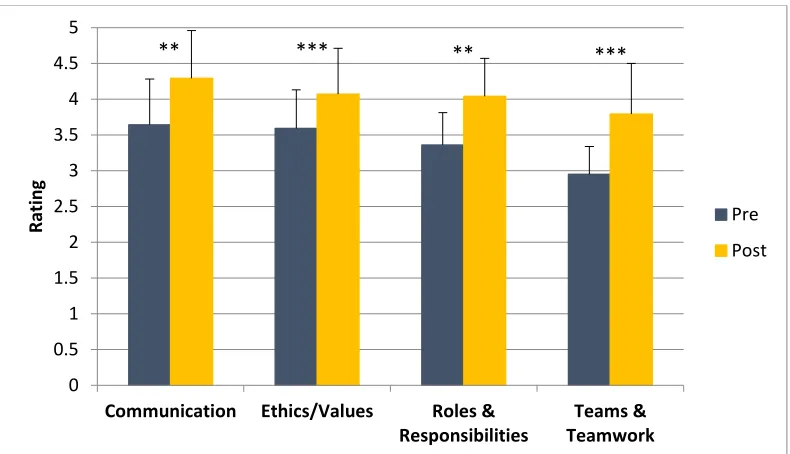
Knowledge and Skills. In examining students’ acquisition of knowledge and skills using the CCPS, the third study question was: Do the students’ ratings of their knowledge, skills and values of the four core competencies change pre- to post-activity? To answer this question, a composite of the specific competencies within each core competency ratings, including knowledge, skills, and values ratings for were compared pre- to post-activity. The students
significantly increased their ratings for all four core competencies following participation in targeted activities (see Figure 7).
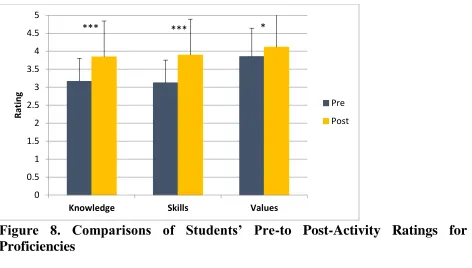
The final study question was: Do the students’ ratings of knowledge and skills change pre- to post-activity? To answer this question, we compared pre- to post-activity composite proficiency ratings for knowledge and for skills each proficiency. The students significantly increased their ratings for both knowledge and skills following participation in targeted activities (see Figure 8).
Figure 7. Comparison of Students’ Pre- to Post-Activity Ratings for Core
Competencies
0 0.5 1 1.5 2 2.5 3 3.5 4 4.5 5
Communication Ethics/Values Roles & Responsibilities
Teams & Teamwork
R
ating Pre
Post
Figure 8. Comparisons of Students’ Pre-to Post-Activity Ratings for
Proficiencies
Discussion
Overall, students entered IPEP with positive attitudes about interprofessional practice and education. On average, they “agreed” to “strongly agreed” with positive statements. Following participation in the program there was a numerical increase in ratings on 9 out of 10 constructs, with 4 being statistically reliable. While it may be that the lack of statistically significant change was due to compressed room for growth, there were indications that this is not entirely the case. On the ATHCTS, the construct of Physician Centrality, which measures team members’ attitudes toward physicians’ authority in teams and their control over information about patients, the students averaged a “neutral” rating and though it changed significantly, it remained “neutral”. On the RILS, students’ ratings of Negative Professional Identity, which measures the value of learning with students from other professions, and Roles and Responsibilities, which examines supportive attitudes about roles in professional practice and academic training, were in the “neutral” to “agree” range and did not change as a result of participation in IPEP. Finally, on an individual basis, at both pre- and post-test there were students who averaged “strongly
disagreed” to “disagreed” on particular constructs.
At the activity level, the outcomes were more encouraging. On average, students made
significant gains in their own estimation from “neutral” to “agreed” of their knowledge, skills, and values, on all of the core competencies. When students engaged together in competency-focused activities in smaller groups, greater improvement was seen.
New Measurements. The measures used in IPEP, thus far involve the evaluation of learners’ reactions to IPEP, and self-assessment of their attitudes, knowledge and skills. These will continue to be examined as part of the next iteration of the program as they revealed important
0 0.5 1 1.5 2 2.5 3 3.5 4 4.5 5
Knowledge Skills Values
R
ating Pre
Post
insights, including areas of need. As well, repetition of these measures will provide an opportunity for comparison. The next step in a progressive path toward measurement of outcomes in IPE includes objective measures of acquisition of knowledge and skills (Freeth et al., 2002; Reeves, 2010). ETSU-IPEC is currently adding these to its experimental arm of the program.
Lessons Learned From First ETSU IPE Pilot Program (IPEP)
1. Purposefully assign students to interprofessional teams with which to move through the program, as opposed to individual, autonomous tracks;
2. Host one IPE Day per semester, as opposed to offering the prologue and Capstone events on Saturdays and offering extra-curricular activities in the evening;
3. An IPE program at a diverse AHSC must meet the needs of multiple kinds of students (on-ground, on-line, blended);
4. Structured schedules across all colleges within the AHSC are imperative for a successful IPE program;
5. Purposeful and continuous faculty development is essential for a successful IPE program; 6. All phases of an effective IPE program must have clear relationships with one another that
build one upon another; and
7. Participation by faculty within a growing IPE program must be valued by administration of colleges within the AHSC in the form of promotion and tenure.
References
Freeth, D., Reeves, S. Koppel, I., Hammick, M., & Barr, H. (2005). Evaluating
interprofessional education: A self-help guide. London, UK: The Higher Education Academy.
Frenk, J., Chen, L., Bhutta, Z.A., Cohen, J., Crisp, N., Evans, T…. Zurayk, H. (2010). Health professionals for a new century: transforming education to strengthen health systems in an interdependent world. The Lancet, 376(9756), 1923 – 1958. DOI:
http://dx.doi.org/10.1016/S0140-6736(10)61854-5
Hanley, M. S. (1994). Training for interprofessional collaboration project. Seattle, WA: University of Washington.
Heinemann, G. D., Schmitt, M. H., Farrell, M. P., & Brallier, S. A. (1999). Development of an attitudes toward health care teams scale. Evaluation & the Health Professions, 22(1), 123-142.
Hyer, K., Fairchild, S., Abraham, I., Mezey, M., & Fulmer, T. (2000). Measuring attitudes related to interdisciplinary training: revisiting the Heinemann, Schmitt and Farrell attitudes toward health care teams’ scale. Journal of Interprofessional Care, 14(3), 249- 258.
Interprofessional Collaborative Practice: Report of an Expert Panel. Washington, DC: Interprofessional Education Collaborative.
Lencioni P. (2002). The five dysfunctions of a team. San Francisco, CA: Jossey-Bass.
Luecht, R. M., Madsen, M. K., Taugher, M. P., & Petterson, B. J., (1990). Assessing professional perceptions: Design and validation of an interdisciplinary education perception scale.
Journal of Allied Health, 19(2), 181-191.
McFadyen, A. K., Maclaren, W. M., & Webster, V. S. (2007). The interprofessional education perception scale (IEPS): An alternative remodeled sub-scale structure and its reliability.
Journal of Interprofessional Care, 21(4), 433-443.
McFadyen, A.K., Webster, V., Strachan, K., Figgins, E., Brown, H., & McKechnie, J. (2005). Readiness for interprofessional learning scales: A possible more stable sub-scale model for the original version of RIPLS. Journal of Interprofessional Care, 19(6), 595-603. Parsell, G., & Bligh, J. (1999). The development of a questionnaire to assess the readiness of
healthcare students for interprofessional learning (RIPLS). Medical Education, 33, 95- 100.
Reeves, S. (2010). Evaluating interprofessional education. Toronto, ON, Canada: Centre for Interprofessional Education. Retrieved from:
http://www.ipe.utoront.ca/educators/evaluation.html.
World Health Organization: Framework for action on Interprofessional Education and Collaborative Practice. 2010, WHO; Geneva. Retrieved from: