Corporate Structure and Globalization: an
Inspection of a Multinational
∗
Tatu Westling
†October 30, 2012
Abstract
This empirical study investigates corporate structures: hierarchical forms, cross-function and multi-site management responsibilities, wage structure and assortative matching among global teams. Complementing a detailed employee-level personnel data of a European manufacturing multinational with Google Maps location data, global hierarchies are re-covered by mapping all employees and managerial relationships geograph-ically. The findings show, first, that production functions have flatter hier-archies and much more organizational depth than support functions. Sec-ond, cross-functional reporting relationships narrow yet multi-site respon-sibilities widen spans of control. Third, the spatial spread of subordinates increases along hierarchy, and hence communication technology is likely to have a disproportionate impact on executives. Fourth, global teams evidence assortative matching as agents seem to sort by skill. Given the within-firm empirical setting, unobserved heterogeneity relating to tech-nology, market competition, management practices or internal processes can not drive the results. Additionally, unique descriptive evidence of the internal organization of production in a multinational enterprise is presented.
Keywords: organization, hierarchy, span of control, matching, tasks, wage
structure, supply chain
JEL Classification: L22, J31, J21
∗Financial support is provided by University of Helsinki Funds.
†Address: University of Helsinki and HECER, Arkadiankatu 7, 00014, Finland. Email:
1
Introduction
Corporate hierarchies have been re-shaped by multiple forces during the last two decades. Increased competition, cheaper information technology and new management practices have transformed organizational fabrics flatter and shal-lower. Spans of control among CEOs have almost doubled and management layers significantly eliminated since the 1980s [Rajan & Wulf, 2006]. Central-ization of corporate support processes has introduced cross-functional teams at the top executive level [Guadalupe et al., 2012]. Hierarchies have changed not only at the executive level but in the middle, and Plant Managers are granted more decision authority [Bloom et al., 2009]. Yet whether corporations have overall centralized or decentralized their decision making, is ambiguous [Wulf, 2012]. In short, there is considerable amount of empirical evidence that the very
fabrics of corporations have changed rather considerably.1
Corporate structures are not insulated from globalization. Due to interna-tionalization of supply chains, globalized teams must transmit tasks and match across borders. Matrix structures, necessitated by more efficient use of resources and shorter market access, have introduced complexity in communication, mon-itoring and incentive provision. In modern firms managers must increasingly lead cross-functional teams across borders [Roberts, 2004]. Moreover, compen-sation is not invariant to changing management patterns and globalization of internal corporate hierarchies. Consequently economic research is increasingly interested in the internal structures of firms. By thoroughly inspecting ManuCo, a European industry multinational, this study provides a holistic account of the organization of production in a modern, global corporation.
As documented in Chandler [1992], modern corporation is a relatively new invention, dating back to 1850s. Until the interwar years large corporations operated in a U-form hierarchy. In these functional organizations tasks were relegated to highly departmentalized silos. Multi-divisional structure emerged as a solution to the coordination and monitoring problems of product market diversification or geographic expansion. This M-form organization suited the diversified companies of the 1960s. Hybrid structures emerged after the Second
World War, following Philips’ introduction of a matrix organization.2 Matrices
are now common among large corporations. For instance, to increase flexibility and local adaptation ABB shifted to a matrix where each frontline manager reports to both region and business heads [Bartlett & Ghoshal, 1995]. Rather typical a practice is to organize corporate support functions [e.g. finance, HR 1Broadly, these themes are also studied in Baker et al. [1994]; Colombo & Delmastro [1999];
Acemoglu et al. [2007]; Bloom & Reenen [2007]; Guadalupe & Wulf [2010]; Caliendo et al. [2012].
and IT] in a matrix and decentralize production functions [operations, logistics
and maintenance] in business units.3 Support functions are hence superimposed
on business units, which themselves can be organized by region, product and/or market. By standardization this centralization of core processes can yield scale economies. However, simultaneously agency and coordination problems appear as well [Alonso et al., 2008; Dessein et al., 2010]. Matrices also require lateral communication and dual-reporting, further exacerbating alignment challenges.
Almost every multinational corporation consist of production and corporate support functions [Mintzberg et al., 2002]. They differ in multiple dimensions which introduces heterogeneity within firms. First, production functions have multiple hierarchical levels, support functions only a few. The between-function variation in hierarchical depth is therefore considerable but this partly reflects differences in personnel sizes. Second, they vary by managerial spans of control, a more size-free measure of hierarchy. Production functions have flat, support typically narrow hierarchies. Third, in contrast to production support functions produce intermediate inputs and are largely insulated from external competi-tion. Given that unobserved heterogeneity in technology and management prac-tices are subdued within firms, this rich spectrum of hierarchical outcomes is rather perplexing: Why is logistics function flat but R&D narrow? Theoretical models such as Garicano [2000] and Garicano & Rossi-Hansberg [2006] suggest that firm hierarchies are shaped by information and communication technology [ICT], and tasks. Given that multinationals typically operate company-wide Enterprise Resource Planning [ERP] systems and communication networks, the within-firm differences in ICT are often negligible. Consequently the variation in hierarchical structures within firms can largely not be attributed on technol-ogy, internal processes or management practices. This study argues that tasks and team complexity matters, and that the hierarchical differences between pro-duction and support functions might reflect limited competition in the latter.
Organization of production is not invariant to globalization. Teams increas-ingly transcend national borders, and theory suggests that the matching process
is skill-biased [Antr`as et al., 2006]. Moreover, as firms reorganize as matrices
and adopt a regional dimension, global reporting relationships become necessary and cascade down. In regional multi-division corporation only the CEO might lead an international team. In a matrix organizations global reporting relation-ships feature already among senior managers. Since geographic spread of teams necessitates communication, the particular way ICT reshapes hierarchies might be very sensitive to the specific organizational form.
Guided and motivated by the insights in theoretical literature, this study 3One well-documented case of functional centralization is IBM. See Guadalupe & Wulf
explores empirically the issues highlighted above: flatness of hierarchy, cross-function and multi-site management responsibilities, wage structure and assor-tative matching among global teams. The key dependent variable here is the managerial span of control since it captures the shape of the hierarchy. Wages are also studied, but mostly to the degree that they help to unearth patterns of assortative matching. Broadly, the hypotheses build on the theoretical insights in Garicano [2000], Garicano & Rossi-Hansberg [2006], Antr`as et al. [2006] and Dessein et al. [2010]. The objective is to refine the picture of multinational organization.
This study utilizes a uniquely detailed employee-level data of ManuCo. The cross-sectional personnel and organization data is very comprehensive. First, it covers all 23970 employees from the factory operators to the CEO and all 44 countries. Second, in addition to function, job title, site location, business unit and wage it contains reporting line information for each employee. This last fea-ture is very crucial since it allows the recovery of the whole corporate hierarchy: number of levels, managerial spans and cross-functional reporting relationships for all managers across business units and functions. Making novel use of Google Maps, city-level site location data is utilized to add a spatial dimension to the analysis. Global team formation and multi-site responsibilities can then be in-vestigated. Third, to complement the quantitative data organization charts are at disposal. By depicting matrix-relationships the organograms can refine the hierarchical picture. Although the data are cross-sectional, the within-firm empirical setting eliminates a substantial amount of unobserved heterogeneity.
Thematically related studies include Baker et al. [1994], Acemoglu et al. [2007], Smeets & Warzynski [2008], Bloom et al. [2009], Guadalupe et al. [2012]
and Caliendo et al. [2012].4 One difference is the granularity and coverage of
data. Here the data is very detailed, multi-country and include the firm’s whole personnel. On the other hand, it is single-firm and cross-sectional. Hierarchical evolution is unfortunately beyond the scope. The key difference is the addressed questions. By exploring international team formation, this study also explores topics discussed in the global matching literature. This holistic approach is very attractive as many pertinent issues regarding multinationals can here be studied simultaneously: complexity of managerial accountabilities, globalization of teams and matching. Some of these are truly novel, and represent uncharted avenues of research in empirical economics of organization literature. All the results are derived from within-firm variation.
Case studies are susceptible to firm-specific shocks and can therefore evi-dence idiosyncrasy. Their appeal is also diminished by the significant between-4Studies related to hierarchies and wages also include Ort´ın- ´Angel & Salas-Fum´as [2002],
firm heterogeneity in range of management and organizational practices [Bloom & Reenen, 2007]. Hence any generalizations beyond manufacturing sector must be treated with strong reservations.
Notwithstanding few caveats the findings reverberate with theories. First, production functions have flatter hierarchies than corporate support functions. Complex and non-repetitive tasks in the latter tend to limit team size. Lower spans in corporate support could also reflect subdued competitive pressures. Second, globalization of teams does not affect spans yet somewhat unexpectedly managers with multi-site responsibilities lead larger teams. This study also finds that the average distance between managers and subordinates declines along the hierarchical levels: from around 1000 kilometres among Executive Team to only 1.5 among First-line Supervisors. Communication technology is hence likely to have a disproportionate impact on top management hierarchies, especially below the CEO. Third, cross-functional reporting yields smaller teams. This is consis-tent with the idea that heterogeneity among subordinates tightens managerial time constraints, and could imply that matrices compress spans. Fourth, corpo-rate structures vary substantially within firms. In ManuCo’s case the number of hierarchical levels range from 2 to 6 in support functions. Pertaining partly mechanically to their size, production hierarchies are deeper: up to 10 levels are observed here. Finally, globalization affects matching. Managers of global teams command higher wages, as do employees within teams which are foreign-lead. Provided that individual wage residuals capture unobserved skills, this would testify of assortative sorting: managers match with high-skilled individ-uals abroad.
These results are rather robust since the variation in technology, market competition, management practices and internal processes are limited within the firm. Moreover, ManuCo has centralized and harmonized many though not all business processes and policies, further alleviating the problem of unobserved
heterogeneity.5 In short, it takes considerable imagination to come up with any
unobservables which could drive these results. This study contributes to the literature in several ways. First, detailed empirical studies of multinationals are scarce. In particular global hierarchies and complex team formation have not been studied so far. Second, the substantial within-firm hierarchy varia-tion suggests that multinavaria-tionals’ internal structures should be studied more carefully. In so far as these can drive unobserved cross-firm variation, this is very important. Finally, this study presents valuable descriptive information of multinational hierarchy formation. At a stylized level the evidence probably reflects other manufacturing corporations as well.
5The author has had multiple discussions with ManuCo’s management and consulting
This paper is organized as follows. Section (2) briefly illustrates related theoretical literature. Section (3) describes ManuCo and the dataset. Section (4) describes the empirical investigation. Section (5) presents and (6) discusses the results. Section (7) concludes. Tables and figures are in the Appendix.
2
Theoretical literature
Extensive amount of theoretical work is devoted to economics of organizations. Already in the early 20th century economists concerned the nature of firms. In particular the literature discussed the relative merits of markets and hierarchies. Coase [1937], for instance, argued the importance of internal versus external transactions costs. A fall in the former expands firm boundaries, and results in internalization of tasks. Since transactions within firms are typically mediated through hierarchies, the role of market diminishes.
An another strand of literature, initiated in Alchian & Demsetz [1972], in-terpreted firm as a particular form of team production. They postulate firm as a contractual device where the central agent co-ordinates the joint activities of various inputs. Due to non-separability in inputs, team production entails efficiencies but also introduces metering and moral hazard problems. The cen-tral agent as the residual claimant has an incentive to alleviate these problems. Moreover, the central agent possess superior means to meter its inputs compared to arms-length market transactions. The firm then emerges as a contracting structure to facilitate efficient team production. One key insight of theirs is that no authority or disciplinary actions is needed to support the hierarchy. However, Williamson [1973] criticized the approach since it required a technical consideration, the assumption of non-separability, as a necessary condition for hierarchies to emerge. The framework of Alchian & Demsetz was therefore ill-suited to explain the emergence of complex organizations such as multinationals with many separable units.
M-form corporations need to align the activities of their divisions. This gives rise to a trade-off between adaptation and coordination: when local adaptation is required, decision making is decentralized. Conversely, centralization results when divisions are highly interdependent. Alonso et al. [2008] challenge this tra-ditional view by showing that decentralization can be optimal under significant
divisional interdependencies. The coordination problems between functional
and business unit managers associated with hybrid organizations are studied in Dessein et al. [2010]. Importantly, they show that hybrid structures can en-dogenously give rise to incentive conflicts. Due to interdependencies, matrices therefore require more elaborate incentives than pyramidal organizations.
information processors [Radner, 1993] or knowledge hierarchies [Garicano, 2000; Garicano & Rossi-Hansberg, 2006; Antr`as et al., 2006]. Different perspectives these strands though reflect, they are bind together by one salient idea: that internal organization of firms necessitates specialization, hence managers and workers. In knowledge hierarchy models managers are time-constrained, which limits the maximum span. As higher-skilled subordinates require help less fre-quently, managers can leverage themselves on larger teams. Economies of skill ensue. Global teams become optimal since higher-skilled subordinates have an incentive to match across borders. Moreover, the models also predict that aver-age task or problem complexity decreases spans. Intuitively, the more manaver-agers must guide their subordinates, the smaller teams can be.
In short, theoretical literature yield many testable predictions of which some are here put to data. Given that similar predictions can result from very different sets of assumptions, discrimination of theories by empirical research is littered with caveats. This reservation applies here as well.
3
Data
3.1
Summary of ManuCo
To set a proper context this section provides a brief description of ManuCo.6
By the industry typology of Woodward [1965], the firm’s mode of operation can be traced to continuous process production, or mass production using the product-process matrix [Mintzberg et al., 2002]. It hence embraces routiniza-tion, scale and utilization. Since its establishment in the 19th century growth has taken place through mergers and acquisitions but also organically by estab-lishing factories and foreign sales offices. Especially international expansion has taken place through acquisitions. The firm operates in 44 countries yet most do not have productive activities. ManuCo has not ventured beyond its sector extensively. However, it has expanded to certain commercial activities adjacent to its core business. The maturity of different businesses vary within the firm: few units are emerging yet substantial share of the revenue comes from mature businesses at their plateau. Internalization of the ‘upstream’ supply chain to secure critical intermediate inputs has been one salient feature of its expansion. ‘Downstream’ integration has been more subdued and depended on the particu-lar product and/or market. ManuCo’s revenues are around 10 billion euros and the company is publicly owned.
Conforming to typical patterns in manufacturing, ManuCo has evidenced a 6To maintain confidentiality and anonymity of ManuCo this section is rather vague.
gradual decline in its workforce during the last two decades. Over one-third of employees have been laid-off, lost through divestures or outsourced. Revenue has contemporaneously increased albeit at a modest pace. Notwithstanding the movements in capital, labor or total factor productivity has hence increased. Pertaining to factory closures it is likely that some of the increased efficiencies result from shifts in the low extensive productive margin. Intensive margin improvements – productivity gains within factories – have also contributed to increased efficiencies.7 As in most industrial sectors, unionization is high among its employees. The capital per employee ratio of 0.5 million euros makes ManuCo capital intensive.
[Insert Table (1) approximately here]
ManuCo workforce amounts to 23970 of which 2448 are supervisors, man-agers and executives [henceforth simply manman-agers]. Horizontally they are orga-nized in 26 functions of which four are engaged in directly productive activi-ties. The rest comprise of support functions like HR, IT and R&D. Descriptive statistics of production and corporate support functions are given in Table (1). Production functions employ 81% of personnel. As is typical in firms of similar size, corporate support functions operate in a global matrix. For instance, HR operates across business units with only smaller departments within the units.
Vertically ManuCo is rather deep: it is organized on 12 hierarchical levels but
many functions are substantially shallower.8 No single function itself contains
12 levels since most do not report to the CEO. Certain small corporate support functions contain only two levels. The vast majority of employees are between
levels 1 to 10. Levels 11 and 12 represent few small teams in one specific
production function.
Businesses are grouped into three divisions which then contain multiple busi-ness units. The divisions operate in matrix as certain market-specific functions intersect divisions’ business units. ManuCo hence contains matrices at two lev-els: global functions across divisions, market-specific functions across business units within divisions. Executive Vice Presidents of corporate support functions and divisions form the Executive Team at level 2. Business unit managers mostly reside on level 3 and hence report directly to the Executive Team. Business units further subdivide into multiple subunits which are distinct legal entities. These can have profit and loss [P&L] responsibility. On average subunit managers 7These have been mostly verified from public press releases following factory closures or
investments.
8Levels are here in reverse order. CEO resides on level 1, his direct reports [Executive
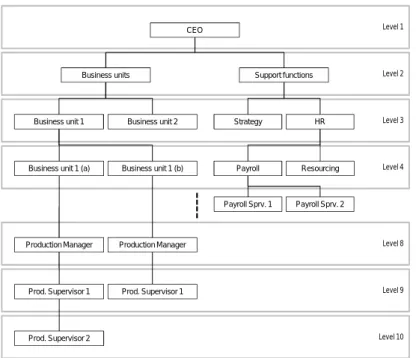
Team] on 2 and the rest on subsequent ones. An example of a generic hierarchical structure is presented in Figure (1). It clearly shows how different functions and/or business units reside on different levels within hierarchies.
reside on level 5 and are hence 4 levels below the CEO. Chains of command from the Executive Team level can be quite long.
To further clarify the context, it is instructive to briefly describe the changing role of factories. The last major reorganization occurred almost two decades ago. In the pre-reorganization context factories were independent business units with internalized sourcing, sales and related functions. Some of the factories acquired by or merged to ManuCo were completely independent in 1980s and even 1990s,
and in some cases Plant Managers were effectively General Managers. The
reorganization relegated factories to production units by centralizing business functions at the corporate or business unit level. This transfer of responsibilities
diminished factoriesvis-a`-vis headquarters. Plant Managers were relegated to
hierarchy level 4. A minor reorganization occurred in 2008: as a result of the centralization of the manufacturing operations, one additional level was added between Plant Managers and the Executive Team. The formers now reside on level 5. Although production decisions are now done on level 5 instead of 4,
the change hardly represents a downward shift in autonomy.9 In conclusion,
during the last two decades the factories have receded their P&L responsibility and relegated to cost centres. The centralization at ManuCu exemplifies the industry-wide tendency to gain economies of scale in activities like supply chain and sales.
Although some corporations are mere holding companies and very decentral-ized, ManuCo’s business units are rather integrated and centrally coordinated. This is important as it reduces heterogeneity within the company. Through careful reading of background material no firm-specific shocks can be identified in its recent history.
3.2
Dataset
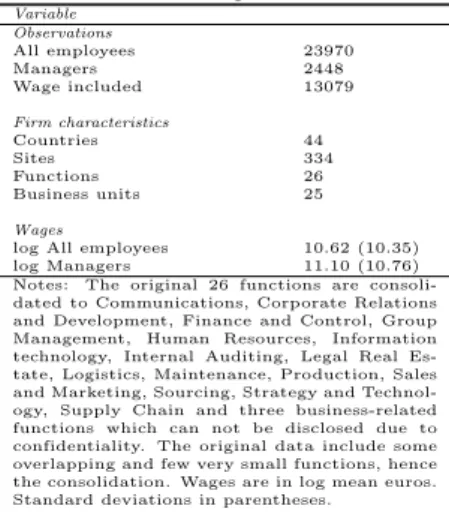
The data are based on ManuCo’s personnel records in its Human Resource In-formation System [HRIS]. After minor clean-up the cross-section data include 23790 employee observations. The number of managers is 2448 and hence the average managerial span equals 8.8 which is typical in its industry. The data con-tain detailed information on functions, job titles, geographic locations, business units, wages and reporting-lines. This information is available for all employees, including managers and executives, although wage data is partially absent for blue-collar workers. Descriptive statistics are provided in Table 2.
[Insert Table 2 approximately here]
9This also highlights the difficulty of clarifying between centralization and decentralization
Two measures are important to explore corporate structures: span of control and hierarchical levels. The former refers to direct subordinates of managers and reflects the flatness or narrowness of the hierarchy. The latter refers to the number of levels in the hierarchy below the CEO, and captures the depth of the structure. It also reflects the chain of command, namely the vertical distance between the CEO and its indirect subordinates. A very unique feature of this data is that reporting-line information is available for all employees. This allows the recovery of the whole hierarchy, and is crucial since multinationals
typically consist of 8 to 12 levels.10 Furthermore, the data enable hierarchies
to be disaggregated by function which is important due to significant structural variation within corporations. The data do not contain secondary reporting lines or dotted-line responsibilities for those working in a matrix.
Another interesting feature of the data is the geographical location of pro-duction sites and offices. Put simply, the data tell where each employee works geographically. It is reported at city-level, and the number of different locations
amounts to 334.11 They are spread across 44 countries and all continents.
Us-ing Google Maps the latitude and longitude of different locations are obtained. Then, applying Haversine formula, the great-circle distance between any two locations can be computed. This gives rise to another novel feature of the data: the geographical distances between managers and all their subordinates can be calculated. This allows the investigation of three pertinent issues in the eco-nomic organization literature. First, how globalization affects team or corporate structure. Second, do globalized teams engage in assortative matching. Third,
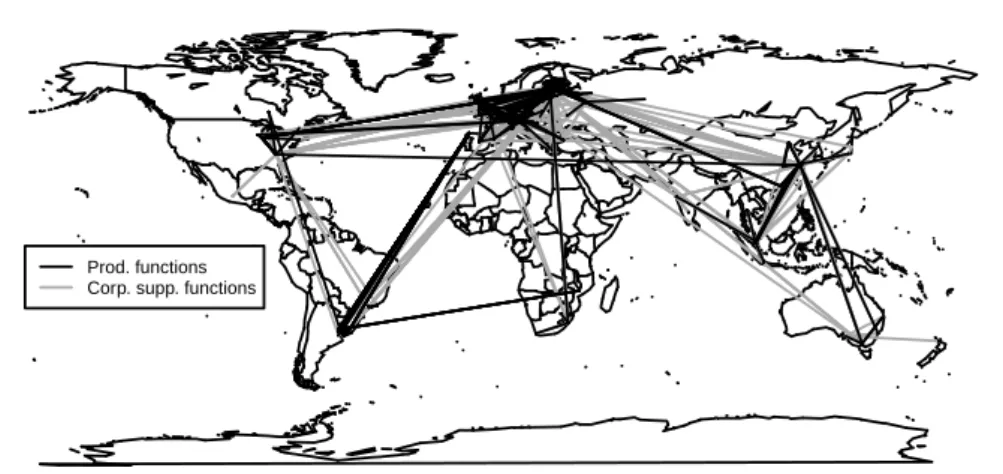
how multi-site reporting affect spans and wages.12 Figures (3) and 4 show the
global management relationships at ManuCo between all managers and their immediate subordinates. These already indicate the importance of exploring cross-border team formation.
[Insert Figures 3 and 4 approximately here]
Each employee is assigned to a function, which in total number 26. They capture the horizontal dimension of an organization. At superficial level they also reflect the nature of tasks undertaken. Functions are further grouped in
production and corporate support functions.13 Functional information is used
10Most related studies focus on the CEO and/or Division Manager level [Rajan & Wulf,
2006; Bloom et al., 2009; Guadalupe & Wulf, 2010] yet some [Baker et al., 1994; Caliendo et al., 2012] also explore the lower ladders.
11Few cities have multiple sites. Since in practice these are often co-located or represent
different parts of the largest factories, location is measured at city-level.
12Only managers whose subordinates span cities engage in multi-site reporting. Conversely,
managers with subordinates within multiple sites within a location have single-site responsi-bilities.
13For the purposes of this study two major function groups suffice. By Mintzberg et al. [2002]
for two purposes. First, in regressions function controls reveal how managerial spans vary by the processes and tasks performed. The proposition that produc-tion funcproduc-tions have higher spans can be tested. Second, funcproduc-tional informaproduc-tion allows to extract any cross-functional reporting relationships between managers and subordinates. This is a critical piece of information since already ona priori grounds functionally diverse teams should be smaller due to managerial time constraints. Managers simply have to process information of higher variety. Al-though the variable does not directly capture matrix relationships, it provides some indication how hybrid structures could affect spans. The data also contain business [sub]units, which are used as controls.
Wages of employees are included in respective local currencies. They are con-verted to euros by using exchange rates effective on July 11th, 2012. Information about incentive pay or non-pecuniary compensation is absent. Nevertheless, the base pay information is sufficient to investigate relationships between hierarchi-cal parameters and compensation. In total 13079 observations contain pay data since many mostly blue-collar observations lack it. The data also include age, experience and gender which are merely used as controls.
In conclusion, the data used in most regressions includes 2448 manager ob-servations. For each are determined its hierarchical level and managerial span of control. Geographical spread of teams is captured by the average distance of direct subordinates from the given manager. Multi-site responsibility is a dummy variable. It takes the value one whenever the average distance exceeds
one kilometre.14 Cross-functional reporting is the share of subordinates in
dif-ferent functions than the manager. As said, demographic and wage data are available for the vast majority of manager observations.
4
Empirical strategy
The empirical estimation is based on OLS. Two regression specifications are used. The first is used to analyze hierarchical forms, namely managerial spans of control. The second specification concerns wages, and how they interplay with hierarchy. Both regressions are based on cross-sectional data. The standard errors in all specifications are corrected for heteroscedasticity.
The baseline specification to estimate the determinants of managerial spans of control takes the form
the ‘operating core’.
1480% of managers lead single-site teams. Average distances among multi-site managers are
always relatively high since in these cases reporting relationships span cities and/or countries. Hence the distance threshold is of minor relevance and robustness checks with different cut-off values are conducted.
ln[si] =ηli+γvi+θdi+Xiβ+i (1)
wheresi denotes the span of control,li is hierarchical level andvi captures the
share of cross-functional reporting relationships. Average geographical distance
between managers and subordinates are indi. Controls for functions, business
units and countries are in Xi. Average geographical distance is obtained by
locating sites using Google Maps, and applying Haversine formula to compute the great-circle distances. The site locations are reported at city-level. In large cities this could cause measurement error of few kilometres since especially pro-duction sites are typically not located in the city center. However, as multi-site reporting here by definition refers to between-city reporting, this error is of neg-ligible significance: any error in mapping is an order of magnitude smaller than the average distance between the cities.
The baseline specification to estimate the determinants of wages takes the form
ln[wi] =φsi+ηli+γvi+θdi+Xiβ+i (2)
where wi denotes the wage level. Other variables are as in (1) but here Xi
also includes age, experience in the company and gender. Wages do not in-clude incentive pay or non-pecuniary compensation. Since these are typically prevalent among executives, the respective hierarchy level coefficients represent lower bounds. With incentives the pay profile with respect to hierarchical levels would be much steeper. In one specification the wage ratio between managers and their direct subordinates is used as the dependent variable.
Cross-sectional analysis is prone to endogeneity since covariation between the
error termiand regressors can not be ruled out. This might potentially render
estimates biased. However, endogeneity is much less pronounced in within-firm than in conventional cross-firm setting since substantial portion of unobserved variation is parcelled away. This is especially true for four important parameters: technology, market competition, internal processes and management practices.
First, the within-firm variation in ICT related technologies is limited. The firm runs a company-wide ERP system and has hence an integrated IT platform for functions and business units. Although some legacy systems are common-place in any company, the ERP largely cancels away IT variation within the firm. Communication devices, teleconferencing and intranets are also used through-out. In conclusion, given the negligible within-firm variation in ICT, unobserved heterogeneity is unlikely in technology. Second, product market competition and economic shocks might vary slightly across business units. Since both specifi-cations include [sub]unit controls, any errors are limited in magnitude.
More-over, the setting obviously absorbs any firm-specific shocks. Third, unobserved within-firm heterogeneity could result from variation in internal processes. As many functions operate in matrix and many processes are harmonized and cen-tralized, heterogeneity is limited. Fourth, management and HR practices are rather uniform across the firm. By the criteria of World Management Survey,
ManuCo is rather well managed.15 For instance, employee development
discus-sions and performance management and titling policies adhere to global rules. Uniformity of management practices can hence be expected.
Multi-site and cross-function variables are unlikely to suffer from serious en-dogeneity. First, the spatial structure of ManuCo has been decades in making. It reflects numerous acquisitions, and many locations are dictated by the avail-ability of key raw materials or intermediate inputs. Sales units locate close to markets and customers. These forces are clearly exogenous to hierarchy forma-tion, and reflect either the operational environment or strategic decisions long past. Second, cross-function reporting lines are largely governed by productive considerations or legal requirements. For instance, in some countries an Envi-ronment Manager must report to Plant Manager by law. A Sourcing Director might manage supply chain, IT and purchasing employees as those disciplines and tasks are needed for efficient operation of the unit. In short, both multi-site and cross-function reporting lines largely reflect some very fundamental pro-duction function primitives. Regarding these two key variables, the case for exogeneity is hence rather robust.
To conclusively infer causal patterns, cross-sectional studies should exploit exogenous variation in the variables of interest. As Wulf [2012] points out, finding suitable instruments in organizational context is difficult. This is true particularly at individual-level. Due to communication’s salient role in hierar-chy formation, its costs is used as an instrument in Bloom et al. [2009]. How-ever, ManuCo’s networked structure renders such instrument problematic in the withfirm context. Furthermore, without interacting any country-specific in-strument would naturally only vary between countries, not between individuals. It is also questionable whether such instruments would legitimately satisfy ex-clusion restrictions. As said, these problems are rather typical in this strand of literature.
In short, it takes considerable creativity to come up with compelling argu-ments against the empirical setup since the setting automatically deals with any firm-specific unobservables. Moreover, as the data come from HRIS and is reinforced by organization charts and other supplemental material, measure-15See Bloom & Reenen [2007] or http://www.worldmanagementsurvey.com/ for details of
ment and coding errors are unlikely.16 Yet case studies typically have to trade generality for reliability. This is true here as well. Hence the concern is not in the unbiasedness of the coefficients but in their applicability outside the manu-facturing sector.
5
Results
This study explores salient topics in economics of organization. Regarding cor-porate structures, the focus is on two organizational design parameters: hierar-chical levels and managerial spans. The former is analyzed rather descriptively, the interest being the cross-functional variation. Managerial spans are investi-gated thoroughly since they govern the flatness or narrowness of the hierarchy. Particular interest lays in cross-functional and multi-site responsibilities. They seek to capture the effects of complex, geographically dispersed teams. The interplay between wages and hierarchies has generated substantial amount of theoretical results. Here the focus is how span of control, complex team forma-tion and global leadership responsibilities affect wages. Finally global matching is analysed. Of particular interest is the possibility that higher-skilled engage in global teams.
5.1
Hierarchy
Hierarchical levels vary substantially between functions. Somewhat mechani-cally larger functions by headcount are also deeper. Production, for instance, at 10 levels has more depth than support functions which have around 6. Yet given depth, the hierarchical distance to the CEO vary. Some functions do not even report to the Executive Team. Looking from business unit perspective especially subunits can be quite far from the CEO. The chain-of-command from the CEO to these typically P&L responsible entities could be 7 levels but is generally 4 to 5. These findings, although very descriptive in nature, already imply that variation in economic organization is substantial even within firms. Indeed it is questionable whether multinational corporations should be even considered singular. The differences in tasks, hierarchies and organizational ob-jectives between production and support functions are of such magnitude, that they should probably be analyzed separately in empirical and even theoretical work.
[Insert Table 3 approximately here]
Managerial span of control captures the flatness or narrowness of hierarchy and it directly interplays with levels. Given headcount, higher spans require less levels. Moreover, spans are higher lower down the hierarchy – executives lead smaller teams than supervisors. This regularity is already noticeable in Table (1): spans are materially higher at hierarchy levels 7 to 9 than at executive positions. As Table (3) shows, the regression results corroborate this finding. The coefficients of hierarchical levels on span of control are positive at conven-tional significance levels. For example, Column [3] implies that a unit increase in level expands spans by .04. Importantly, it is robust to function controls. The positive association is rather expected. It is also consistent with the idea that tasks are more variable and complex in management positions, hence their lower spans and smaller teams. However, there is one caveat. Careful inspection of Table (1) reveals a ‘hourglass’ organization [Couto et al., 2003]: spans are lowest among middle managers, and highest among top executives and supervi-sors. Due to the small number of executive observations, this effect vanishes in regressions with a linear level variable. If levels are included as fixed effects, the ‘hourglass’ shape becomes noticeable. Hence the notion that task complexity or variability alone determines spans is too simplistic.
Functions are not invariant to hierarchical forms. As Table (3) makes clear, production functions have higher spans. Again this reflects the nature of tasks. In corporate support functions tasks are typically more varied and prone to exceptions. Supervision costs hence more time, and teams are of size of 3 to 6 employees. Conversely, production functions and operations management in general typically standardize tasks and activities, eliminate exceptions and in-troduce repetitive processes [Slack et al., 2010]. In this context flat organizations with spans of 15 are feasible. Importantly, the finding is robust to the geograph-ical and functional complexity of team composition. Another interpretation is the lack of competition within firms. As support functions are insulated from external market pressures, lower spans could reflect their lesser need for stream-line.
Cross-functional reporting lines measure the share of subordinates in dif-ferent function than the given manager. It therefore captures the functional complexity of managerial responsibilities. By a similar logic as above, the prior sign of this coefficient is negative. Intriguingly, the empirical findings here fit this exactly. As Column [3] in Table (3) shows, for example an increase of 25% in the share of cross-functional responsibilities decreases spans by .21. This finding is also significant across specifications. Given that modern organiza-tions increasingly run matrices, other non-pyramidal structures and/or lateral reporting lines, this is of major importance. Increased cross-functional complex-ity is bound to increase the relative share of managers in the workforce, and can
hence has a significant impact of the fabric of corporate hierarchies.
Somewhat unexpectedly, globalization of teams does not affect managerial spans. Although the average distance between a manager and its subordinates does have statistically significant positive effect, closer inspection reveals that it is driven by multi-site responsibilities, not the distance itself.17 The coefficient of multi-site responsibilities is positive across specifications. It is not entirely
clear what might cause this since on a priori grounds a negative association
would be expected. One somewhat tautological explanation might be that the probability of having subordinates outside own site is increasing in their number. For instance, a Quality Manager might be located in a large factory and manage a single Quality Engineer. Should the team grow, any subsequent engineers are more probably located at different sites across the region, giving rise to the observed relationship.
5.2
Managerial wages
Corroborating with existing empirical and theoretical literature, managerial wages at ManuCo increase along hierarchy. This can be seen in Table (4). Since hierarchical levels are in reverse order [CEO=1], the respective coefficients in Columns [1] to [3] are negative. This finding is robust across specifications and invariant to the particular set of controls. Tests with quadratic level terms imply that the wage profile is convex. This is actually apparent in Column [4] which shows that the manager–subordinate wage gap is increasing along the hierarchy, confirming the convexity. In short, very expectedly managerial wages are higher in executive than in supervisory positions.
[Insert Table (4) approximately here]
Knowledge hierarchy and tournament literature postulate a positive asso-ciation between span of control and manager wage. The empirical evidence is somewhat ambiguous. As Table (4) shows, managerial wage levels are negative associated with spans of control. Team size hence decreases pay, contrasting the theoretical predictions. Although functions are controlled, this likely reflects variation in subordinates human capital and task composition. Large teams are indicative of low task complexity. For example, in HR Payroll Managers supervise large teams of Payroll Clerks, who typically perform rather routine tasks. Talent Managers, despite residing in the same function and likely on even hierarchical level, oversee a small cadre of high-skilled specialists. Should the latter command higher pay, a negative span–wage association would result. To 17Dropping managers with single-site responsibilities [average distance<1 kilometre]
alleviate this unobserved heterogeneity in subordinate types it is more plausible to explore the manager–subordinate wage gaps. Indeed in Column [4] the span coefficient is .003 and significant at .01 level. Although this reconciles with tour-nament and knowledge hierarchy theories, attributing the association to either is more problematic as discussed further below.
Managers engaged in cross-functional teams have to lead subordinates of multiple disciplines. For example, in addition to Production Engineers a Pro-duction Manager might have to lead a team of Logistics and Maintenance En-gineers. Invariably this adds to managerial complexity and – due to higher skills required – should be reflected in wages. Hence the expected association between wages and cross-functional reporting relationships is positive.
Encour-agingly, this is exactly what is shown in Table (4). The coefficient .156 in
Column [2] is positive at .5 level. It is important to note that, as before, since hierarchical levels are controlled for the association is not caused by the higher prevalence of cross-functional reporting among executives. Yet the exact causal channel for this finding is somewhat unclear. It could reflect higher skills or wage policies which explicitly compensate for cross-functional teams. However, an examination of ManuCo’s wage policies reveals that they can account at most a small part of the observed premium. The majority should hence reflect higher skills. This observation is empirically important. Given that corporations have been increasingly adopting hybrid forms over functional organization structures
[Dessein et al., 2010], cross-functional teams are on ascendancy.18 Further
or-ganizational transformation should yield managerial positions which are both more complex and better compensated.
By a largely similar logic as before, multi-site reporting should increase pay. Table (4) confirms this expectation. Managers engaged in multi-site reporting earn .20 more than comparable single-site managers. Although the measure does not differentiate between domestic and foreign multi-site responsibilities, geographical spread of teams across long distances seems to influence manage-rial pay. This can be seen in Column [3] which includes the average great-circle distance of subordinates in 1000 kilometres as a regressor. The coefficient is positive and significant. However, when both multi-site reporting and distance is included in the specification the latter’s significance drops to .2. This sug-gest that global leadership responsibilities might have a small if statistically insignificant impact on managerial pay.
5.3
Global matching and teams
One pertinent issue in economics of organization is the matching of teams across countries, especially between poor and developed countries. Namely, do global-ized hierarchies lead to assortative matching and result in high-skilled workers in poor countries to be managed by the high-skilled of the developed nations? Moreover, allowing for skill-complementarities, does this assortative matching yield higher within-group inequality across countries? Theoretical results in
trade and organization literature [Garicano & Rossi-Hansberg, 2006; Antr`as
et al., 2006] broadly suggest so.
Since ManuCo mostly operates in mid- to high-income countries, the analysis here must abstain from analysis of hierarchy formation between very heteroge-neous countries. Instead the focus here is on hierarchical matching in general: does participation in global team entail higher skill? To investigate this proposi-tion, the wages of all employees – both managers and workers – are regressed on a vast set of controls including a dummy for a foreign-based manager. Should the higher-skilled be matched with foreign managers, the coefficient were
posi-tive.19 The results of this regression are shown in Column [5] of Table (4). As
can be observed, working in a foreign-lead team is associated with higher pay. The coefficient of .274 is significant at .01 level and of practically important magnitude. Very encouragingly the data support the notion that higher-skilled engage in global teams. Furthermore, in the previous analysis managerial pay is found to be at least weakly increasing in geographical distance. Together these could testify of positive assortative matching. Better managers are matched with higher-skilled employees.
An alternative explanation could be that wage policies explicitly and me-chanically compensate for participation in international teams. Indeed ManuCo’s job evaluation system measures complexity in which internationalization is one
additive subcomponent.20 However, the mechanical effect of this subcomponent
on job size and hence pay is materially smaller than the coefficients. Hence the majority of the global team effect can not be attributed on wage policies.
The importance of this finding should not be overlooked. In addition to ad-dressing an important theoretical question, it has practical consequences: as cor-porations globalize relentlessly, the fabrics of organizations change in both do-mestically and abroad. Globalization seems to create inequality at least within countries.
19It should be noted that both managers and workers can work under foreign supervision.
Moreover, it is assumed that a positive residual in wage equation captures some of the unob-served skill.
5.4
Robustness
Despite being cross-sectional, substantial sources of unobserved heterogeneity are parcelled away by the within-firm empirical context. In particular, hetero-geneity with respect to four important factors – technology, market competi-tion, internal processes and management practices – is necessarily limited within
most corporations.21 This is crucial since empirical research shows these to be
of major importance [Bloom & Reenen, 2007; Bloom et al., 2009; Guadalupe & Wulf, 2010; Guadalupe et al., 2012]. Unobserved variation in these is unlikely to compromise the robustness of the results.
The data represent personnel records in HRIS. Despite, measurement er-rors can not be exclusively ruled out. A critical source of error could be the
reporting lines. Since organization charts are available, senior management
and executive level spans can be verified. They are found consistent with the data. Organograms of lower hierarchy and especially factory floor operations are unavailable. Encouragingly the data evidence very small number of potential outliers. Of the 2448 managers, only 3 [23] have spans above 100 [50] thresh-olds. Although team size of 50 to 100 are not impossible, robustness checks with sub-samples are conducted. Unsurprisingly the results are unchanged.
Rather paradoxically consistent coding of reporting lines can yield minor errors at the top hierarchy as executives’ Personal Assistants are included as direct reports. Though nominally subordinates, their roles are unlike typical direct reports’. In principle Personal Assistants could be removed from the data but here they are left in place. The reported spans at CEO and Executive Team level can hence be slightly overstated. In fact this reinforces the finding that spans are higher lower down the hierarchy.
As most multinational corporations, ManuCo outsources certain processes. The external organizations are not included in the data. This can cause some measurement error on spans of control since ManuCo’s outsourced personnel can be managed by its employees. However, the adverse effect is minor for three reasons. First, the amount of outsourced processes is limited. Second, even relatively large outsourced organizations might incur very minor cumulative measurement errors on spans. For example, the head of an outsourced IT sub-function would report to Chief Information Officer [CIO]. Although the external contractor might employ significant amount of personnel, the measurement error incurred on the whole data would be the one missing direct report for the CIO. Third, outsourced operations are typically subject to strict contractual agreements. It is therefore questionable, do the subordinations qualify as true 21Holding companies, conglomerates and very decentralized multi-divisional firms are
ex-ceptions. In these cases internal heterogeneity can be substantial. However, ManuCo does not fall into any of these categories.
delegation relationships in the first place.
Incentive pay is omitted from the data. Since these can account for a sub-stantial share of total earnings in executive positions, the steepness of the wage
profile is clearly underestimated. The coefficient η in wage regressions
repre-sent lower bounds. Furthermore, wages are available for 13079 observations, slightly more than half of employees. Especially blue-collars lack them. This is unlikely to compromize the findings with respect to global team formation since blue-collars typically work within plants.
In short, given high-quality data, comprehensive sample and partially inde-pendent evidence [organization charts], measurement errors are minor at worst. Moreover, the within-firm setting parcels away variation in technology, market competition, internal processes and management practices. These are probably the most important candidates for serious unobserved heterogeneity, and their effects on organizations are indisputable.
6
Discussion
Guided by insights in theoretical literature, this study explores the determi-nants of hierarchical forms and global matching. The objective is to examine how globalization and complex reporting relationships affect key hierarchical variables. These are discussed in turn.
First, hierarchical levels and functions influence spans of control. Theoretical results in Garicano [2000] and Garicano & Rossi-Hansberg [2006] suggest that complexity of tasks is inversely proportional to spans. Empirical findings here align with these results. Importantly, given ManuCo’s negligible within-firm variation in technology, the findings imply that in knowledge hierarchy
mod-els the fundamental driver might be tasks, not ICT.22 As most multinationals
run company-wide ERPs, the between-firm differentials in technology levels are levelling off – both within- and between-firm differentials in technology must hence be rather limited. Given the substantial within-firm variation in spans – not only between production and support functions but also across individual teams – the observed organizational between-firm variation attributed to ICT could actually reflect unobserved within-firm compositional variation in pro-duction and support functions. Put simply, from hierarchy perspective tasks are likely vastly more pivotal than technology. This finding partially echoes Guadalupe et al. [2012] who find that many organizational variables are sensi-tive to managers’ type, e.g. tasks. An alternasensi-tive explanation could be that in 22Variation in ICT is not a necessary condition for substantial hierarchical differences in
knowledge hierarchy models. Given ICT, task variation is sufficient to generate span differen-tials.
support functions managers also lead processes – in corporate parlance they act as ‘process owners’. Their work would hence be less managerial and more pro-fessional. Rather than from more complex tasks the observed span differentials would then result from tighter time constraints among functional managers. Another interpretation is competition. Competition flattens hierarchies across firms [Acemoglu et al., 2007; Guadalupe & Wulf, 2010]. As corporate support functions are more insulated from outside competition than production, there is less pressure to flatten hierarchies. The absence of competitive exposure would hence drive bureaucratization of corporate support functions. The same mecha-nism that apply across firms would then explain patterns within them. However, the proposition that competition flattens hierarchies within firms should be ex-amined in further detail.
Second, cross-functional reporting lines affect spans negatively as any inter-pretation of theory would suggest. Although the observed variable does not directly correspond to matrix management, it could indicate that matrices are prone to lower spans. As corporations increasingly adopt hybrid forms, the overall managerial ranks could actually expand. This finding is of practical im-portance as overall staff ratios are quite sensitive to changes in middle hierarchy. Multi-site reporting seems to increase spans. This finding is somewhat puzzling. The effect could be mechanical or reflect higher unobserved autonomy. This study also documents that the average distance between manager and subordi-nates declines along the hierarchical levels: from around 1000 kilometres among executives to only 1.5 among first-line supervisors. Communication technology is hence likely to have disproportionate impact on top management hierarchies, especially on the few immediate levels below CEOs. Correspondingly the shop-floor teams are insulated from advances in communication technology. Already the patterns in Figure (3) should convince any reader of the importance of analysing global hierarchy formation. The difference between production and support functions are also noticeable. With an average subordinate distance of 50 kilometres production teams are geographically much less spread and com-plex than support teams, with on average 400 kilometres. This further reinforces the notion that firms nest two very different hierarchical entities.
Third, knowledge hierarchy and tournament theory suggest that spans and
managerial wages covary positively.23 Corroborating with other studies [see e.g.
Ort´ın- ´Angel & Salas-Fum´as, 2002; Smeets & Warzynski, 2008] higher spans have a positive effect on manager–subordinate wage gap. Although this is consistent with tournament theory, the magnitude of the association could not rational-23In knowledge hierarchy theory the positive covariation results from the skill-leverage of
managers. Tournament theory stresses incentives: wider spans decrease the expected value of promotion, hence higher prizes in terms of managerial wages are required to incentivize sufficient effort.
ize explanations based on promotion probabilities and prizes. Put simply, the increase in prize [manager wage] is negligible compared to the reduction in ex-pected value of promotion resulting from higher spans. It is also well known that marginal productivity narratives yield the same predictions with more par-simonious assumptions. Moreover, institutional reasons could explain the asso-ciation as job evaluation systems typically put positive emphasis on managerial accountabilities, especially the number of direct subordinates.
Fourth, cross-function and multi-site reporting increase pay. As this reflect higher managerial complexity, the effect is expected. Finally, Garicano &
Rossi-Hansberg [2006] and Antr`as et al. [2006] postulate that globalized hierarchies
and teams feature assortative matching between skill groups. The findings here are supportive of this notion as the higher skilled seem to engage in global teams. Consequently globalization is likely to increase at least within-country inequality.
Finally, a slight detour to semantical issues is in order. At a very stylized level the long-run reorganization of ManuCo provides an interesting venue to discuss the problems pertaining to the concepts of centralization and decen-tralization. This illustrative example shows how the definitions are actually somewhat contradictory. Some studies [see e.g. Acemoglu et al., 2007] argue that a decent proxy for decentralization is P&L responsibility. If Business Units [BU] are responsible for both revenue and costs, then they have more autonomy and the organization is decentralized. Another widely-used measure of decen-tralization is span of control: high spans typically imply decendecen-tralization but literature has identified caveats in this interpretation [Rajan & Wulf, 2006; Wulf, 2012]. Nevertheless, the situation depicted in Pane a) of Figure (2) represents a decentralized structure. In traditional M-form fashion every BU is responsible for production, sales and support. The managers of BUs are hence effectively General Managers [GM] since they oversee all business processes. The Division Manager’s [DM] span of control is four since the GMs are its direct reports. After reorganization, the four BUs are relegated to cost center status, only re-sponsible for production. This situation is depicted in Pane b) of Figure (2). Sales and support processes are superimposed in a matrix overlay across the BUs and are no longer managed by the GMs. The DM’s span of control ex-pand to six since in addition to the GMs, Sales and Support Managers now
report directly to the DM.24By the first definition this reorganization amounts
to centralization since the BUs lose P&L responsibility. However, observation of DM spans only would yield the opposing conclusion: increasing spans imply decentralization. Even more perplexingly, one could argue that nothing has 24All else equal GM spans decline since only production-related subordinates continue to
happened: all decisions before and after the reorganization are made at level three, below the DM. In short, depending on the nature of observations and data
very different conclusions could be drawn from the same reorganization.25 It
should also be noted that such reorganizations are rather typical when functions are put in a matrix. Yet most importantly the discussion above highlights three issues. First, more granular data is needed to make meaningful inferences about centralization. Second, matrices can make the centralization/decentralization analysis much more complicated. Third, P&L responsibility might proxy but can not be necessarily equated with decentralization.
In short, the study can put many pertinent theoretical insights in the litera-ture on data. By novel use of Google Maps, few previously untested propositions
are investigated.26 Moreover, already the descriptive analysis here shows that
differences in tasks, hierarchies and organizational objectives between produc-tion and support funcproduc-tions are vast. Subsequent empirical work should perhaps put more emphasis on this perplexing hierarchical heterogeneity within firms.
Although there is little concern for the robustness of the results, their gen-erality offers less comfort. Plainly, it is not certain which findings reflect firm-specific idiosyncrasies. The applicability beyond manufacturing is also question-able. Although sectoral demarcations lines are disappearing, the findings might not carry over to other industries and much less to services.
7
Conclusions
Economic organization literature postulates that technology, market competi-tion and management practices shape corporate fabrics. Indeed empirical evi-dence in Acemoglu et al. [2007], Bloom & Reenen [2007], Bloom et al. [2009], Guadalupe & Wulf [2010] support this notion. As theoretical research argues, factors internal to firms have a due role as well. This study shows that tasks, cross-functional reporting lines and the spatial spread of teams are also integral to hierarchies. Managerial wages intertwine with hierarchy and team formation. Cross-functional and multi-site reporting lines, which invariably add to manage-ment complexity, lead to higher compensation. By exploring global team forma-tion, tentative evidence of assortatitive matching is found. Higher-skilled seem to engage in international teams. Already Figures (3) and (4) should convince anyone of the importance of global hierarchy formation within multinationals.
Encouragingly, given the within-firm setting, external factors such as tech-nology, market competition and management practices can not explain the pat-25Somewhat related arguments regarding centralization and decentralization are made in
Wulf [2012].
26The author is not aware of attempts to empirically study global team formation or
terns found in this study. Hence unobserved firm-level heterogeneity is unlikely to drive the results. As is typical in case studies, the cost of empirical robustness is limited generality. Whether the findings reflect firm-specific idiosyncrasies, remains somewhat unclear. Another limitation is the lack of longitudinal data. Although hierarchies can evolve very gradually [Baker et al., 1994; Colombo & Delmastro, 1999], time-variation could be used to deal with any remaining unobserved heterogeneity. In the absence of decision autonomy data, discussion pertaining to centralization or decentralization is largely omitted. As central-ization comes in many forms [Mintzberg et al., 2002] and is conceptually rather elusive [Wulf, 2012], the current empirical setting would render any indirect references to these topics rather suspect.
This study makes three contributions. First, it empirically corroborates few salient but previously untested theoretical predictions in economics of orga-nization literature. In particular this concerns multi-site reporting and global matching among teams. Second, it argues that corporate hierarchies might be as much dictated by tasks as they are by technology. The great divide lies between production and support functions, and in some sense multinationals nest two highly dissimilar entities. Empirical research should perhaps acknowledge this demarcation more forcefully. Third, modern firms are characterized by cross-functional teams [Roberts, 2004]. An analysis of their various impacts is timely hence. In short, these findings refine the picture of multinational organization – its hierarchy, rewards and skill composition.
References
D. Acemoglu, et al. (2007). ‘Technology, Information and the Decentralization
of the Firm’. The Quarterly Journal of Economics122(4).
A. Alchian & H. Demsetz (1972). ‘Production, Information Costs, and Economic
Organization’. The American Economic Review62(5).
R. Alonso, et al. (2008). ‘When Does Coordination Require Centralization?’.
American Economic Review 98(1).
P. Antr`as, et al. (2006). ‘Offshoring in a Knowledge Economy’. The Quarterly
Journal of Economics121(1).
G. Baker, et al. (1994). ‘The Internal Economics of the Firm: Evidence from
Personnel Data’. The Quarterly Journal of Economics109(4).
C. Bartlett & S. Ghoshal (1995). ‘Changing the Role of Top Management:
Beyond Strategy to Processes’. Harvard Business Review73(1).
N. Bloom, et al. (2009). The Distinct Effects of Information Technology and
Communication Technology on Firm Organization. No. 14975. National
Bu-reau of Economic Research.
N. Bloom & J. V. Reenen (2007). ‘Measuring and Explaining Management
Prac-tices Across Firms and Countries’. Quarterly Journal of Economics122(4).
L. Caliendo, et al. (2012). ‘The Anatomy of French Production Hierarchies’. Unpublished manuscript.
A. Chandler (1992). ‘Corporate Strategy, Structure and Control Methods in the
United States During the 20th Century*’. Industrial and Corporate Change
1(2).
R. Coase (1937). ‘The Nature of the Firm’. Economica4(16).
M. Colombo & M. Delmastro (1999). ‘Some Stylized Facts on Organization and
its Evolution’. Journal of Economic Behavior & Organization40(3).
V. Couto, et al. (2003). ‘Management Spans and Layers: Streamlining the Out-of-Shape Organization’. Booz Allen Hamilton.
W. Dessein, et al. (2010). ‘Organizing for Synergies’. American Economic
Journal: Microeconomics4(2).
L. Garicano (2000). ‘Hierarchies and the Organization of Knowledge in
L. Garicano & E. Rossi-Hansberg (2006). ‘Organization and Inequality in a
Knowledge Economy’. The Quarterly Journal of Economics121(4).
M. Guadalupe, et al. (2012). ‘Who Lives in the C-Suite? Organizational Struc-ture and the Division of Labor in Top Management’. Harvard Business School Working Paper #12-059.
M. Guadalupe & J. Wulf (2010). ‘The Flattening Firm and Product Market
Competition: The Effect of Trade Liberalization’. American Economic
Jour-nal: Applied Economics2(4).
E. Lazear & S. Rosen (1981). ‘Rank-Order Tournaments as Optimum Labor
Contracts’. The Journal of Political Economy89(5).
H. Mintzberg, et al. (2002). The Strategy Process: Concepts, Context, Cases.
Prentice Hall.
P. Ort´ın- ´Angel & V. Salas-Fum´as (2002). ‘Compensation and Span of Control
in Hierarchical Organizations’. Journal of Labor Economics20(4).
R. Radner (1993). ‘The Organization of Decentralized Information Processing’.
Econometrica61(5).
R. Rajan & J. Wulf (2006). ‘The flattening firm: Evidence from panel data on
the changing nature of corporate hierarchies’. The Review of Economics and
Statistics4(88).
J. Roberts (2004). The Modern Firm: Organizational Design for Performance
and Growth. Oxford University Press.
N. Slack, et al. (2010). Operations Management. Pearson Education, tenth edn.
V. Smeets & F. Warzynski (2008). ‘Too many theories, too few facts? What the data tell us about the link between span of control, compensation and career
dynamics’. Labour Economics 15(4).
O. Williamson (1973). ‘Markets and Hierarchies: Some Elementary
Considera-tions’. The American Economic Review63(2).
J. Woodward (1965). Industrial Organization: Theory and Practice. Oxford
University Press.
J. Wulf (2012). ‘The Flattened Firm – Not as Advertised’. Harvard Business School Working Paper #12-087.
A
Tables and figures
Table 1: Key variables by hierarchy level
Employees Managerial spans Average distance Cross. func. resp. Hierarchy level All. func. Corp. func. Prod. func. Corp. func. Prod. func. Corp. func. Prod. func.
1 1 10.00 144.4 0.50 2 10 7.20 1042.2 0.33 3 72 6.20 5.67 829.6 711.7 0.17 0.16 4 282 4.51 9.42 702.2 468.4 0.12 0.09 5 888 6.41 7.78 467.7 245.7 0.08 0.08 6 2514 4.95 8.39 214.4 61.6 0.06 0.03 7 4287 4.10 10.46 189.7 9.9 0.05 0.02 8 5129 10.25 11.99 52.9 6.2 0.00 0.00 9 6261 4.00 8.92 0.0 1.6 0.00 0.00 10 1716 2.13 16.1 0.00 11 17 4.00 48.2 0.00 12 20 Average 5.42 9.97 420.0 50.0 0.09 0.02 Observations 708 1740 708 1740 708 1740
Notes: managerial span denote the number of subordinates per manager. Average distance measures the great-circle distance between managers and their subordinates in kilometres. Cross function responsibility denotes the share of subordinates in different function than the given manager. Corporate support functions include Communications, Corporate Relations and Development, Finance and Control, Group Management, Human Resources, Information technology, Internal auditing, Legal Real Estate, Sales and Marketing, Sourc-ing, Strategy and Technology. Production functions include Logistics, Production, Maintenance, Supply Chain and three business-related functions which can not be disclosed due to confidentiality. Some very small func-tions are also combined in the list above.
Table 2: Descriptive statistics
Variable Observations All employees 23970 Managers 2448 Wage included 13079 Firm characteristics Countries 44 Sites 334 Functions 26 Business units 25 Wages
log All employees 10.62 (10.35) log Managers 11.10 (10.76) Notes: The original 26 functions are consoli-dated to Communications, Corporate Relations and Development, Finance and Control, Group Management, Human Resources, Information technology, Internal Auditing, Legal Real Es-tate, Logistics, Maintenance, Production, Sales and Marketing, Sourcing, Strategy and Technol-ogy, Supply Chain and three business-related functions which can not be disclosed due to confidentiality. The original data include some overlapping and few very small functions, hence the consolidation. Wages are in log mean euros. Standard deviations in parentheses.