Problem Context and the Generation of Alternatives Within the IRP Process
Faye Anderson and Benedykt Dziegielewski
SIUC Water Group, Department of GeographySouthern Illinois University-Carbondale
Need for Improving IRP Decisions
Emerging from its use in the energy industry since the late seventies, Integrated Resource Planning (IRP) is presently being modified and tai lored to the wat er industry’s needs (Beecher, 1995). However, for IRP’s methods and analyses to become widely accepted, this inn ovative plannin g approach must earn a reputat ion for providing sound decision making support. In attempting to develop this approach and build such a reput ation , we must pay particular atten tion to all of the plann ing stages, and be concerned with consensus building and learning throughout the entire planning process. While recognizing the unity and dyn amic nature of decision making, this pap er focuses on the in itial pl anni ng stages relating to problem context (problem identification, acceptance, and representa tion) and the gener ation of alternatives. These phases are important considerations as they set the entire stage for planning. The management science literature on decision making contains a number of findings which have direct relevance for the IRP process. By reviewing these findings and contrast ing them with the experiences of IRP applications, we attempt to point out some important issues in the IRP process relating to these two critical decision stages.
The Meta-Decision of Planning Approaches
A sound process is a necessary conditi on for g ood decisi on maki ng and ca n im prove the li kelih oods of attaining effective planni ng outcomes. Wa ter resour ces planners and every other profession must deal with meta-decisions, i.e., decisions about how to make decisions. John son and Payne (1985) found that the decision making rules and processes that tend to be adopted are those that can strike a good balance between effort expended and expected d ecision qual ity within a given problem envir onmen t. Th e meta -choice of decision making approaches is usual ly conditioned by problem contexts, decision maker characteristics, available resources, and legitimation criteria for both process and outcomes.
Cur rently, the agen cies who cond uct th e IRP pr ocess ha ve to search for answers as they are going through the process, thus running the risk of undermining the confidence of the participants and various stakeholders in both the process and it outcomes.
Issues i n Proble m Context
Problem context is important as the decision scien ces literature has long shown that the longer and more difficult this pr edecision stag e, the gr eater the cog nitive dissonan ce that emerges after alternatives are chosen (e.g. Festinger 1964). This cognitive dissonance and postdecision regr et can have crucial implications for the impl ement ation process and the even tual achi evement of the objectives a nd goa ls. As chosen alter nat ives can have the tendency to change during implementation, this is an important consideration.
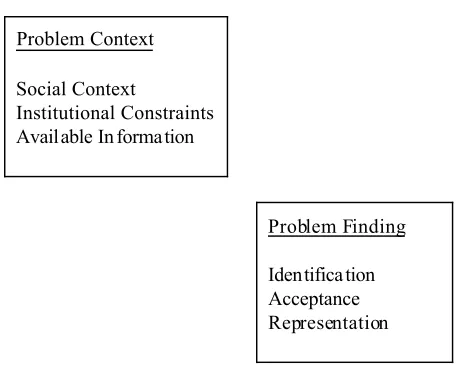
At the core of any useful planning model is the embodiment of trig gers t o sign al th e exist ence of a problem or need and to help define problem status (see Figur e 1). T hrou ghout water resources planning history, the tri gger of "adequate suppl y" has domin ated planning processes. The decision making environment has predominantly been mon itored for cues of deviations from reference poi nts r elati ng to a dequa te water suppl y or related measu res. As problem acceptance ha s centered almost exclusively on this aspect, our planning models have been unidimensional in nature.
Problem Context Social Context
Institutional Constraints Avail able In forma tion
Problem Finding Identifica tion Acceptance Representation
Figure 1. Problem Context and Problem Finding
Documen tati on of the previous and ongoing applications of IRP contains very little information on the ana lysis of problem context other than the projection of potential shortag es of water in the future. Infor mati on on the baseline conditions of a water supply system and the nature of demands to be met is minim al at best. In cases when problems other than the ex pected futur e shor tage of water in supply sources are recognized, they ar e not investiga ted to pinpoint the actual causes of the problem. For example, a problem of in sufficient capa city to meet maximum-day demands is rarely defined in terms of the sources of peak demands or their distribution in time and space. The l ack of detailed definition of the problem may preclude plan ners from i dent ifying such a lter nat ive solutions as "shedding peak demands" in parts of the distribution system or providin g distri bution system storage. Similarly, the unknown distribution of peak demands in time may prevent any considerations of the options which would shift peaks of short durations to off-peak periods.
Miltroff and Kil man (19 78) have iden tified thr ee types of errors associated with problem acceptance: (1) detecting a problem when no problem exists, (2) not detecting a problem when there is one, and (3) detecting the wrong problem or a less imp ortant pr oblem. Obviously, there are costs associat ed with each of these errors a nd water resources managemen t has incur red many of these costs in various contexts. The first type of error is common in planning for urban water supply where the financial resources which are available to ur ban economies allowed many municipalities to expand the capacity of their supplies beyond the level of any foreseeable need. This type of error is very costly and in variably leads t o higher than n ecessary cost of water supply to urban consumers. The instances of nondetection of the problem are often equated with poor management of the agency and the resour ces und er it s purview. Fina lly, a g ood exam ple of the misdiagnosis problem can be found in the recent history of water suppl y planing for the Boston area. The system was reaching its safe yield thus pointing to the need for new sources of supply. However, a new management of the system under the Massachusetts Water Resources Authority revealed significa nt system losses which in combination with pricing and other demand management measures produced a significant drop in water demand well below the historical safe yield of the supply sources.
approaches has emerged. Many author s have addr essed the reluctan ce of water professionals to accept any new triggers, problem definitions, and alternatives (Vickers, 1996; Beecher, 1996; Viessman, 1996). This reluctan ce then extends to IRP as well. Th is nar row problem acceptance (of what is/needs to be solved) may be related to nonexistent triggers, myopic triggers, improper evaluat ion of triggers, resistance or fear of accepting multiple objectives, and la ck of confidence tha t newer problem definitions can be adequately resolved. An industry wide discussion of objectives and goals and their detailed clarification may help contribute to the acceptance of, and the eventual resolving of, the more “correct” problems facing water decision m akers. The "open and participatory" nature of the IRP process is an important step toward th e improvemen t of problem contexts. For example, individu al water users who participate in the IRP process may see water problems in a way that is radica lly different from that of utility planner s. A remote possibility of "system failure" during a low-probability droug ht even t may n ot be considered as a problem worth the planning effort. Thus, the discus sion of problem contexts must adequately address the “for whom” question, that of stakeholders and relationships between these various groups. This could shed furth er li ght on the conflicts between vari ous roles and the underlying values that give rise to them. IRP researchers can help develop tools to focus the industry’s attention on appropriate signals and infor mati on to help avoid or minimize these three types of errors related to problem structure. The more accurately the IRP model and process reflects what is achievable and what the status quo actually is, the more likely water resource decision makers are to accept problems that are both r eal an d imp ortant. How the IRP process helps to structure the problem context is important. The values an d goals tha t trigg er problem finding are then the most likely guides to the eventual definition of when we assess that the problem is resolved, or at least ameliora ted. The representation of the problem ha s a strong influence on the resultin g problem solving activities and its frami ng can h ave a strong effect on the alternatives considered as well.
Issues in Generation of Alternatives
Altern atives are typically generated with particular problems, objectives and goals in mind. Given the rela tive nar rownes s of problem definition (as well as the
sets of goals and objectives), we can think of the historical generat ion of altern atives in wat er resources planning as having been gui ded by a type of bounded rationality. This bound ed ration ality has been constrained by a myopic focus on a given set of supply side alter nat ives an d has served to screen out the complexity of the planning problem, and perhaps opportuni ties for learning as well. The predom ina nce of preferred alternatives have been close to the existi ng set of alternat ives, i.e., the immediate d ecision neighborh ood and in this sense water resources decision making has been conservative (while perhaps n ot in the fiscal sense given the costs associated with the traditional supply augmenta tion alternatives). Thus, the existing position has been th e primar y determ ina nt of the set of feasible alternat ives and it also influenced the sa tisfaction of the water community with the tra ditiona l set of alternatives. Often, the constraints on feasibility of solutions are intr oduced at an ear ly stage of the search for altern atives thus excluding any unconventional set of options from the initial set.
Overall, new altern ative g ener ation has h istor icall y not been a prior ity in the decision maki ng pr ocess. Yet , we know that the process of identification of alternatives is of the utmost importa nce in the decision making process. The need for decision making stems from the la ck of an obvious or ideal alternative and the decision making process is intended to create one. Significantly, decision-makers often form a “model” of a desirable ideal alter nat ive while in the early stages of the planning process. The distance from the status quo to this alter nat ive gives us some measur e of the conflict embedded in the problem. Indeed, the purpose of this decision-making is to solve this essential underlying conflict thr ough t he identi ficati on of alternatives (as opposed to removing the apparent conflict through advocacy or other means). This desirable ideal alter nat ive becomes a point of referen ce against which choices are measur ed again st our objectives and val ues (Festinger, 1964). However, the usefulness of the concept of such an ideal solution will depend on its discriminatory power, how well it aids the decision-maker in distinguishing amon g alt ernatives. It is p rogr ess or movement towards this ideal that brings about the instrumentality and expressibility of these values. The establishment of an ideal can also stimulate the gener ation process for new alternatives and provide direction to this process.
with the current situation is both recognized and accepted, i.e., a thr eshold level of di ssati sfacti on must be reached. Factors both internal and external to the decisi on maker will affect the attainment of this threshold level. In par ticular localized r egions th is thr eshold level has clear ly been at tain ed. It must eventu ally be recognized by the water industry as a whole for the widespread diffusi on of a wider, more compreh ensive set of alternatives. There is a role for researchers and professional organizations to study variables related to this diffusion process, both the factors that act as barriers to acceptance and factors inducing acceptance. In this way, the social context within which decisions are made in the water resources profession can be changed so as to encourage the consideration of a wider set of feasible alternatives.
The nonavailability of suitable alternatives or more specifica lly, the infeasibili ty of an ideal alt ernat ive, often trigger s the conflict t hat moti vates the sear ch for a meta structure for decision m akin g to “solve” the problem. Thus, the conflict can be traced to the set of available alter natives. In this way, alternat ives, or more precisely a set of feasible altern atives, lie at the heart of any decision-making process. Objectives will only be achieved in reference to a given set of alternatives. Yet, a set of alternat ives is rarely prescribed or given, most often, making a decision requi res inven ting n ew alternat ives. Esp ecially under the com plex r egime of water resources decision -makin g contexts descr ibed above, alternat ives rarely present themselves as n icely ordered and clearly differentiated options. Within some problem contexts, th e creative generation of new altern atives can be even more critical than the careful evalua tion of those already existing . And it is the level and type of conflict that motiva te the intensity of the search for new alternatives. In some sense, the overall aim of the process is to find an alternative(s) that will reduce the conflict to some acceptable level. T herefore, any alternat ive can be viewed as a particularly realizable configuration of the relationship between the means and ends of the decision maki ng process, i .e., th e objectives and the outcomes.
One of the premiss es of IRP is the recognition that the agreement on the ideal solution can rarely be found. Accord ingly, the IRP process r ecognizes the need to consider multiple and often conflicting objectives where each objective i s aligned with a different set of alternat ives. Within th e outcomes of IRP, the best alternative is replaced by best a lter nat ive(s) for each of the multiple objectives and the information on explicit
tradeoffs between competing objectives. A classic example is the tr adeoff between the a ffordabi lity (or cost) of water suppl y and its rel iabil ity. In term s of alternat ives, those that are most affordable are rarely the same as those that maximize the reli ability of water sup ply. However, the abi lity of decisi on maker s would be severely constrai ned if the set of working altern atives excluded those that did not meet some high standard of reliabi lity. A good exa mple h ere is the ex clusion of demand-side measures on the basis of the low reliability of projected water sa vings. Even when water conser vation is included it rarely receives a statu s of a fully fledged alternative. Instead, it is includ ed as a goal for demand reduction and the expected savings are deducted from the projected demands thus preventing evaluation of a true mix of supply-side and demand-side alternat ives. The hist ory of water resources planning and management and its shortcomings can be studied from this viewpoint of alternative identification and selection.
The insufficiency of alternatives is at least as important as the incomp atibi lity of objectives. The aim of utilizing the IRP process critically highlights the importance of alter nat ive identification and generation in water resources decision ma king. T he impor tan t quest ion for IRP is: How to effectively evolve the initial set of feasible decisi on alternat ives? This is an impor tan t quest ion because a poor initial set of altern atives will: (1 ) hamper and perh aps even stall the start of the decision-making process, (2) bias the evaluation of alternatives, (3) constrain the effect iveness of planning outcomes, and (4) subvert meeting the pla nnin g objectives.
The importa nce of generat ing new al terna tives is related to the distan ce of present alt ernat ives to the ideal altern ative. Yu (1977) and others have shown that the process of successful generation of new alternatives is facilitated by: (1) introducing new strategies, (2) searching for an ideal solution with all constraints relaxed, (3) breaking individual and institutional constraints on creativity, (4) learni ng how to in vent new options, (5) modifying exi sting st rategies i n order to achi eve new goals, (6) introducing new goals or criteria, or new levels of aspiration with respect to existing goals, (7) incor poration of new technical, organizational, and other areas of knowledge, (8) willin gness to accept id ea of new alternatives during an ongoing plan ning pr ocess, and (9) open and unbia sed explor ation of th eir feasibility. In the process of alternative gener ation, i t becomes readily apparent to participants that the alternative(s) and criteria are interd ependent and t hus unfold jointly. A new alter nat ive can render some previously unimportant attribute impor tan t or could lea d to th e modifi cation of some other criteria. And these criteria could then shed light on our existi ng set of alternatives. Thus, changes in the set of feasible altern atives affect the crit eria set whi ch in turn affect the alternatives and so on. Fu rther more, after length y considerations of alternatives, the participants may come to the realization that there is no separ ation of ends and means, i.e., between our altern atives and objectives. We do not generate altern atives withou t having some not ion of our objectives and goals in mind. And we ca nnot determine our criteria without having some notion of what is avai lable. Objectives evolve on the basis of our set of available alternat ives, which in turn are manipulated and regenerated in light of existing objectives and so on.
Exampl es of new alterna tive genera tion in water resources planning include some applications of the IRP process which led to the unconventional solutions to water supply problems. Th e most promin ent new altern atives are the demand-side options for balancing supply and demand. The universe of those options is constantly growing and inclu des ma ny very creative solutions. Many new alternatives which are usually termed as "supply man agement have been devised through a process of successful alternative generation. Dual water distribution systems, groundwater recharge and recovery, nonperpetual transfers of water rights and water marketi ng are g ood examples of new altern atives of this type.
The process of new alternative generation leads to the issue of when to stop in vesting in the creat ion of new altern atives as well. The decision sciences literature suggest looking for signals that eit her the creation of any new alternative is unlikely to be productive and/or the new alternatives generated are not sufficiently different from already existing ones (Zeleny, 1982).
Development of Planning Alternatives
Once the set of alt ernatives is gen erat ed, each al tern ative must be formulated to permit its evaluation during the IRP process. While it is rel ativel y easy to prepare a list of alternat ives, the avail abili ty of infor mati on on individual altern atives is likely to vary. As one should expect, the new and unconventional solutions are those that contain the least amoun ts of in forma tion that is needed in evaluation. On the other hand, the traditional supply side altern atives are most likel y to have been aroun d for a long time and have been the subject of detailed engineering investigations. It should not be surprising that the availability of informati on about these alternatives can bias the plann ers' decisions in favor of those altern atives that have been well researched. In addition to the availability of information on th e traditiona l alterna tives, the agencies who conduct the IRP process and many participants have much experience with implementing them. As a result, the odds against unconventional altern atives are st acked fa irly high . Their i nclu sion in the list of alternatives under consideration is likely to have minim al impa ct on the fin al choice unless adequate resources are devoted to formulating them to a level of detail that is on par with the available information on the more traditi onal options.
safeguards exist to prevent elimination of unconventional alternatives when they are not well developed.
Another important consideration in the formu lati on of altern atives relates to their relationship to each other. Ideally, the planners would wish tha t all al terna tives are formulated as in depen dent enti ties wh ich can be combined into mix es or sequences for meeting the objectives. This rarely happens in the real world. Almost all alternatives can be staged (or scaled) thus making them mutually exclusive. Oth er al tern atives which are not subject to scaling may not be truly independent as their implementation would require a simul tan eous use of some other alternative. Because the screening and detail evalua tion looks at alter natives independently, the existing linkag es between altern atives can complicate the process. We need to learn how to identify and formulate altern atives which could serve as "building blocks" for constructing resource sequences and strategies. Some practical methods for classifying alternatives and mapping out their interrelation ships are needed to facilitate decision maki ng within the IRP process.
Conclusions
The water resour ces profession has a long h istor y of experiences concerning the traditional supply side planning appr oach. Exper iences with IRP ar e new and just being implemented. Additionally, IRP is coming into the profession at a time when not everyone had even fully in practice bought into the requirement s of the least cost planning approach. This opens the door for those supporting more innovative planning approach es, such as IRP, to advocate for these approaches. This advocacy will requi re concentr ated i nformation dissem ina tion efforts about the im plementa tion of the appr oach (how to) and evaluation s of the processes and outcomes (how well did it work).
A significant opport unity exits for the dissemination of infor mati on about lessons lear ned fr om IRP about “new” altern atives and combinations of alternatives (Anderson, forthcoming 1997). This would aid decision makers in defining a wider set of feasible altern atives, disp el commonly held biases against newer alternatives, and provide benchmar k type in forma tion. This in forma tion should allow decision makers to effectively incorporate new viewpoints and challenge existing assumptions and is critical to more effective alternative generation. Systematic research will help to unlock decision makers
and inst itut ions fr om their past experi ences with pr oblem solving (Kaufman 1991).
Are there ways to encourage and reward creativity and vigilan ce in the IRP process with respect to the gener ation of alternatives? Are there methods to organizationally and institutionally reward the expan sion of the set of feasible altern atives? What new or impr oved tools and techniques can be provided to aid in this endea vor as well? IRP pr oponen ts mus t be concerned with the rate of acceptance of alternatives as it presents a significant barrier to effective decision making and to the adopt ion of IRP or any other innovative planning approaches. The i mproved qua lity of water resource planning outcomes depends upon the effectiveness of our procedures for esta blish ing goals and objectives, generating new alternatives and developing data on all alternat ives.
References
AWWA. 1994. White Paper on Integrated Water Resources Planning in the Water Industry. Denver, CO: American Water Works Association.
Beecher, J.A. 1996 (this issue). “Avoided Cost: An Essential Concept For Integrated Resource Planning.”
Water Resources Update.
Beecher, J.A. 1995. “Integrated Resource Planning Fundamentals.” Journa l AWWA. 87(6):34-48.
Beecher, J.A. and P.C. Mann. 1990. Cost Allocation and Rate Design for Water Utilities. Columbus, OH: The Nationa l Regulatory Research Institu te.
Festinger, L. 1964. Conflict, Decision, and Dissonance. London: Travistock.
John son E.J. and J.W. Payne. 1985. “Effort and Accuracy in Choice.” Management Science. 31(4):395-414.
Kaufman, G. 1991. “Problem Solving and Creativity” in
Creative Management by J. Henry. New York: Sage Publications.
Kleindorfer, P.R., H.C. Kunreuther, and P.J.H. Schoemaker. 1993. Decision Scie nces: An Integrative Perspective. Cambridge Universit y Press.
Mitr off, I.I and R. Kilman. 1978. Methodological Approaches to the Social Sciences. San Fr ancisco: Jossey-Bass.
Vickers, A. 1996. “What Makes a True Conservation Measure?” AWWA Opflow. 22(6):8-9.
Vickers. A. 1996 (this issue). “IRP’s Conservation Component: What Water Managers Need To Know.”
Water Resources Update.
Viessman Jr, W. 1996. “Integrated Water Management” in UCOWR ‘96 Annual Meeting Proceedings. 4-13. Yu, P.L. 1977. “Decision Dynamics” in Multiple Criteria Decision Making by Starr and Zeleny. Amsterdam: North Holland Publishing.
Zeleny, M. 1982. Multiple Criteria Decision Making. New Y ork : McGraw-Hill Book Company.
THE AUTHORS
Faye Anderson is a Lect urer in the Department of Geography at Southern Illinois University-Carbondale where she teaches Environmental Economics, Environmental Impact Assessment, and Environmental Phil osophy. She is curr entl y writing h er dissert ation on Integrated Resource Plan ning in water resources.