1
ISSN 1751-8229
Volume Nine, Number One
Third Line
2
Project Description
the Thing that eludes
our grasp and the distorting
screen that makes us miss
Installation view from the 2014 International Žižek Studies Conference: Parallax Future(s) in Art and Design, Ideology, and Philosophy, Cincinnati, Ohio.
Third Line is a collaborative installation of video projections and selected
artefacts, presented at the 2014 International Žižek Studies Conference: Parallax
Future(s) in Art and Design, Ideology, and Philosophy with the support of the Ontario
Arts Council. Our project is a self-referential account of its own materialization,
incor-porating ephemera such as found objects, textures and process sketches, collected
throughout the development of video sequences and our parallax system of projection.
We collected items and images as a way of mapping and documenting experiences of
habit and circumstance, which are wrought with fragmented instances of ideological
entrapment. Our objective was to confront our material experience of ideology as a kind
3
the painful, reflexive acknowledgment of personal entanglement in the symbolic orderand the world at large (Morton, 2013, p. 27-37).
A small sample from a quote taken from Slavoj Žižek’s writing instigates the visual and literary root of our project (our italics) (Žižek, 2008, p.37):
While we are bombarded by the heart-warming news of a debt cancellation or a
big humanitarian campaign to eradicate a dangerous epidemic just move the
postcard a little to catch a glimpse of the obscene figure of the liberal communist
at work.
The postcard Žižek was referring to is a paper novelty item engraved to reflect
simultaneously from two angles, a secondary image appearing as the page is turned,
revealing a smutty joke. We examined such engraved and holographic postcards and
determined that we could create a projection system based on this concept – projecting two video images onto a ‘holographic’ screen. Folded in ridges the screen mimicked the sharp 45° groove of the engraver’s tool. Content was created and assembled once our ‘parallax video system’ proved possible.
4
We pointed two projectors diagonally at 45° angles toward a screen, which wefashioned in a vertical accordion-fold pattern to receive the projected imagery from two
angles. If the viewer stood facing the screen from the vantage point of either projector,
the image from this vantage point was clearly visible while the other projection was
obscured from view by the folds in the screen. If the viewer stood between the two
projectors facing the screen from the middle, both of the projected videos were visible in
a fragmented, striped pattern.
5
Detail of the projection screen from the middle vantage point.
6
Models of various scale and complexity were built in the process of developingthe idea. The appropriate material for the making of the screen proved to be simple
drawing paper that was large and pliable enough to withstand the eighty or so folds
required. Projectors were purchased, DVD players were acquired and random discs
served as stand-in content for proof of concept prototypes.
The project’s title refers to Žižek’s explanation of the haiku structure, where
the third line of a haiku is the momentary event of bodiless affect when reality loses
its substantial mass. The final line of pure affect is expressed by the sequential collision
between the first line (material situation) and the second line (the motion of an event)
(Žižek, 2012). The objective was to create a visual experience that affiliates the haiku
structure with an experiential system of visual perception.
Through the use of projected text haiku poems, Third Line addresses the idea of ‘parallax' in Žižek’s discussion of haiku itself, meant to emulate the structure of a haiku,
such as in this 17th century poem by Bashō (Lowenstein, 2007, p.55):
Already I can see
my own wind bleached bones.
A cold wind cuts me.
To create our animated haiku text and image video we appropriated phrases
extracted from Žižek’s writings, forming metaphrasms - prose text that is altered or cast
into a different form - in the template of a 5-7-5 syllable structure. While some of our
found haiku are necessarily more successful than others, none were chosen by any
means of poetic discrimination. Rather, they all obey close adherence to classical haiku
syllable structure and narrative form.
just move the postcard
a little to catch a glimpse
of the obscene figure
The haikus are not cited in reference to their source texts, which was our
7
ontological associations. In many cases the phrases carry a distorted poetic meaningthat is not necessarily in line with Slavoj Žižek’s sequence of thought, and so we
deliberately decided not to keep track of the citations and to appropriate the phrases
as found items entirely isolated from their original context, selected for their incidental
linguistic and quantifiable attributes.
View of the folded projection screen from the vantage point of the right projector.
Animating approximately 70 haiku meant that the viewer could be in attendance
for five minutes before encountering textual repetition. There was no beginning point or
end to the image/haiku loop. As background to the text, printed color and typography on
discarded packaging and media appears in melting snow, often appearing conversely as
melted forms on a white page or screen. Scanning through Žižek’s texts at random in
search of incidental haiku patterns and counting syllables in a process of trial and error
was not unlike our habitual, happenstance process of collecting trash and performing
8
Documentation of haiku extraction process.
9
View of the folded projection screen from the vantage point of the right projector.
Image sequences in sets of three were paired with comparable or contrasting
lines as they appeared consecutively, in numerical reference to the three-line haiku
structure as well as the triad alignment of optical interference. Transition speed
heightened a sense of visual limitation and increased the demand for attention. These
were projected onto the screen from the right side.
The left side projection is a cross-dissolved loop between a small, flaming object
and a metal fragment dissolving in acid. These images were originally created for
dif-ferent applications, but here they become found video loops as they lose their former
associations. They are purposefully unclear and the long dissolve transition between
10
View of the folded projection screen from the vantage point of the left projector.
As the viewer moved across the installation, the two projections appeared to
come together or fall apart depending on the vantage point. As the right screen side
showed the sequence of haiku texts laid over photographs of found textures, objects
and debris, the left projector revealed an alternation between two simple ambient
chemical events.
For us, flow of transition and formal consistency was of great consideration from
one texture to the next. The content of the photo imagery consists predominantly of
roadside detritus and cultural trash, however it is not only the content’s allusion to
ideo-logical excess that defines the viewing experience. We hoped to aesthetically and
mathematically find a momentary collapse of the symbolic order through perceptual
combinations. Žižek notes in the film Examined Life (2008):
... We should develop … a much more terrifying new abstract materialism, a kind
of mathematical universe where there is nothing, there are just formulas,
11
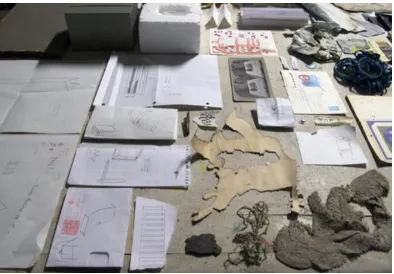
Using the idea of trash as an aesthetic medium and given our ongoing interestin useless, ‘melancholic’ objects, we spent four months prior to the installation selecting
found materials that we would re-contextualize on a surface in a gallery setting. This
table included such items as sketches, found objects and materials that had been
photographed for the production of the video, and other items of coincidence and habit.
Detail view of the table display.
Formally and perceptually, this tableau is an entirely separate viewing
experi-ence, however it follows the same principles of selection and distribution as the haiku
video. The artefacts are arranged evenly on the entire surface of the table with spacing
and formal flow of colour, texture, shape and size, much in the same way as the
back-ground photography in the haiku video was timed with transitions to not give specific,
hierarchical emphasis to any one image.
Instead of negotiating subjective aesthetic choices, it was the materials – whether substantial or representational – that were the actualization of haiku objects
incorporated into the installation. In whole, the installation was an assemblage of
fragments without value-based categorization. The process of transaction with the
12
of immateriality. The installation was perceptually calculated to invite an aestheticexperience of collapse and reformation of the material present.
Detail view of the table display.
Detail view of the table display.
For us, the installation was a study of interference through the optical function of
patterns of light. The point of interference was physically separated by the screen into
13
two separate fields. This paradoxical segmentation of optical interference was intendedto allow the viewer to perceive and absorb a conceptual interference of thought between
the content and its temporal arrangement. The viewer was presented with fragmented
information in oscillating increments.
14
Bibliography
Lowenstein, E. (ed.) (2007) Classic Haiku. New York: Sterling Publishing.
Morton, T. (2013) Hyperobjects: Philosophy and Ecology after the End of the World. Minneapolis: University of Minnesota Press.
Examined Life. (2008) Film. Directed by Astra Taylor. [DVD]. Canada: Zeitgeist Films.