V
ol
ume 2
, Issue 2
, 2013
EU – FROM MEDIA DISCOURSE
TO CITIZENS’ INTERPERSONAL CONVERSATION AGENDAS
Oana Ştefăniţă1
Abstract: The paper addresses the role of media in the Europeanization process, in determining the transition from a Romanian public sphere to a Europeanized Romanian public sphere, by analyzing the influence of media coverage of European topics on people’s discussions about the European Union. The Europeanization of media discourse is an essential step in the construction of a Europeanized public sphere (Koopmans & Erbe, 2003; Brüggemann & Königslöw, 2009), and a key element of the theoretical frame of the realist model that guides the analysis (de Vreese, 2007). However, a Europeanized media communication model does not necessarily ensure the interest of citizens or their involvement in discussions regarding EU topics. For an accurate analysis of the Europeanization process of the national public sphere, both levels should be considered. Therefore, the research consisted in a comparative approach between media coverage of the EU topics and their reflections on citizens’ conversations and attitudes towards EU.
In order to analyze the Europeanization process at the level of media discourse a
quantitative research⃰ was conducted which consisted in a content analysis of a corpus of
6626 news from March 2013 on the two main online news portals in Romania, ziare.com and hotnews.ro (according to the ranking on trafic.ro). We aimed to see how visible and prominent are the news on EU topics as compared to other types of news in the online Romanian media; which are the most visible actors in the European news and whether the EU topics are presented from a European or a national perspective.
To analyze the short-term media effects, the transition of EU subjects and perspectives from media to citizens’ interpersonal conversation agenda, 20 interviews were conducted at the end of March 2013 among Romanian master students to see how young and educated people relate to EU topics and get involved in discussions. The research questions that guided the analysis were: Which are the European topics that raised people’s interest or determined them to enter discussions, and to what extent the topics match those covered in the media?; To what actors they refer mostly when discussing EU topics as compared to the most visible actors at the news level?; Which is the contextualization of the EU topics within discussions and to what extent it corresponds to the one prevailing in the news?
The results indicate a lack of real connectivity to the European Union as a whole both at the level of media coverage, and at the level of citizens’ interest since the Europeanization of the national public sphere is in its early stages. The aspects that have a national impact or a direct relevance for personal activities are still the main ones that stimulate the interest in EU topics and the involvement in discussions.
1 Ph.D. Candidate, College of Communication and Public Relations, National University of
Political Studies and Public Administration, Bucharest/Romania, [email protected]
⃰ The data reported in this article were collected within the research project – “EU – from
Vol
u
me 2, Issue
2
, 2013
Keywords: public sphere; Europeanization; Europeanized national public spheres; media coverage; citizens’ agenda; EU visibility; EU prominence; EU actors; contextualization; people’s interest.
Theoretical background
The European Public Sphere – models and perspectives
The concept of European public sphere appeared as a necessity to favor the Europeanization process, the integration at all levels within the EU, from an economic to a political level. According to the “White Paper on a European Communication Policy”, there is a gap between the European Union and its citizens and the solution consists in using communication in the service of citizens. Thus, the paper emphasizes the need for a “European dimension”, for a “European public sphere” where the European debate can unfold. 2
The concept of public sphere was defined by Jürgen Habermas as “a realm of our social life in which something approaching public opinion can be formed. Access is guaranteed to all citizens. A portion of the public sphere comes into being in every conversation in which private individuals assemble to form a public body.”3 In the trans-national multi-lingual context, the concept of public sphere becomes very communication-centered4 and media have a central role in sustaining the communication flow.5 Furthermore, the classical theory of the public sphere as an area for the communicative generation of public opinion is linked to the concepts of nation-state and sovereign power, but in the context of interdependency among states, the concept of public sphere should be perceived as “discursive arenas that overflow the bounds of both nations and states”.6
Regarding the European public sphere, we can relate to three models – the utopian, the elitist and the realist models. In the utopian perspective, the European public sphere is perceived as a singular, supra-national, pan-European public sphere, a communicative space which requires a shared identity, a transnational media system and a common language.7 From the elitist perspective, we only relate
2 The White Paper on a European Communication Policy. (2006) 3-5. Web, March. 2012.
Available: http://eur-lex.europa.eu/LexUriServ/LexUriServ.do?uri=COM:2006:0035:FIN:EN:PDF.
3
Jürgen Habermas, The Public Sphere: An Encyclopedia Article (1964) 49. Web, April. 2012. Available: http://www.socpol.unimi.it/docenti/barisione/documenti/File/2008-09/Habermas%20(1964)%20-%20The%20Public%20Sphere.pdf.
4 Nancy Fraser, “Transnationalizing the Public Sphere. On the Legitimacy and Efficacy of
Public Opinion in a Post-Westphalian World”, Theory, Culture & Society 24/4 (2007) 7. 5 John Crowley and Liana Giorgi, “Introduction: the political sociology of the European
public sphere”, Democracy in the European Union. Towards the emergence of a public
sphere, eds. Liana Giorgi, Ingmar von Homeyer, and Wayne Parsons (London/ New York:
Routledge, 2006) 5. 6 Fraser 7.
7 Claes H. de Vreese, The EU as a public sphere (2007) 9. Web, April. 2012. Available:
Vol
u
me 2, Issue 2
, 2013
to segmented transnational public spheres, which are based on communicative spaces at national levels on a specific subject, determined by media with global or European outreach, and thus involving mainly elites in the politic or economic fields.8 The realist model relates to the Europeanization of the national public spheres and includes an increased coverage of European subjects and an evaluation of those issues that transcend the interests of one country.9
Therefore, a European, supra-national public sphere implies discussing the same themes, at the same time, at similar levels of attention across national public spheres and media; using similar frames of reference and patterns of interpretation, having a transnational community of communication, and citizens observing each other across national spaces, but perceiving EU as an issue of common concern for them.10 A European public sphere requires the same conditions as a national public sphere, a common language, a European-wide media system, citizens developing an increased interest in the EU issues and a feeling of European identity, simultaneous reporting and discussion of European issues seen in a European perspective and perceived within a shared frame of relevance.11
However, the criteria for a European public sphere are mostly missing as there is no real common interest for EU issues, no political uniformity, no official common language, no common tradition or culture and no significant European media. Although the infrastructure of a general public sphere in EU is not completely missing and English can substitute the common language, it does not seem sufficient to determine a collective interest or a feeling of collective identity.12 Furthermore, there is a lack of a real connection between institutional debates and a general public debate. The EU is even confronted with the lack of a European public as this is sectoral, socially highly selective and it might include actors that are not located within the EU official borders.13 Therefore, as the criteria for a European public are not yet achieved, more researchers turn to the process of Europeanization of the national public spheres also called the “realist model”14 , and especially to the media-driven ways of supporting the Europeanization process, this being also the pattern that guided the present research. To support the Europeanization process, the media have to cover the EU topics from a European
8 Idem.
9
Ibidem, 10-11.
10 Thomas Risse and Marianne Van de Steeg, An Emerging European Public Sphere?
Empirical Evidence and Theoretical Clarifications (2003) 2. Web, April. 2012. Available:
http://userpage.fu-berlin.de/~atasp/texte/030624_europeanpublicsphere.pdf . 11
Jostein Gripsrud, “Television and the European Public Sphere”, European Journal of
Communication 22/4 (2007) 483.
12 Erik Oddvar Eriksen, “An Emerging European Public Sphere”, European Journal of
Social Theory 8/3 (2005) 350.
13
Olivier Baisnée, “The European Public Sphere Does Not Exist (At Least It’s Worth Wondering . . .)”, European Journal of Communication 22/4 (2007) 495.
14 Claes H. de Vreese, The EU as a public sphere (2007) 10. Web, April. 2012. Available:
Vol
u
me 2, Issue
2
, 2013
view by asserting the European sources, perspectives and interests over the national or global ones.15
Overall, the Europeanization of the national public spheres can represent the solution in bridging the gap between the national level and the European level and reduce the democratic deficit of the EU. Media have a central role within the realist model and they can increase citizens’ support and involvement in European debates through ensuring the informational basis for deliberation. Moreover, growing citizens’ interest and spreading a European perspective when covering or debating European topics are also part of the conditions. The Europeanization of the national public spheres is an essential step for developing the political dimension of the Union and thus, for consolidating and developing the European project.
Media discourse – from national to European
Media are an essential factor in the Europeanization process as they increase the level of understanding for the European issues by providing information and enhance the level of accessibility, by urging debates, by attracting the public support for the EU projects, and by raising citizens’ interest and involvement. The main tools are the agenda setting and the coverage perspective whereby they can ensure the visibility of the European topics and provide a European perspective detrimental to the national interests and perspectives.
According to the media type and media involvement in the Europeanization process, three phenomena can occur: the emergence of a supranational European
public sphere (this implies interaction among European institutions and actors on
European topics through the means of a European-wide media); vertical
Europeanization (implies communicative linkages between the European level and
the national one); horizontal Europeanization (implies communicative linkages between different member states).16 By mixing the vertical and horizontal dimensions, four types of Europeanization resulted: comprehensive
Europeanization – the vertical and horizontal levels of Europeanization are present; segmented Europeanization –the vertical level prevails, an increased attention is
paid to EU as an entity, and not to member states; Europeanization aloof from the
EU – the horizontal level prevails, the communicative exchanges among
member-states; a parochial public sphere – neither a vertical, nor a horizontal Europeanization is present in the national media.17
15
John Downey and Thomas Koenig, “Is There a European Public Sphere? The Berlusconi & Schulz Case”, European Journal of Communication 21/2 (2006) 167.
16 Ruud Koopmans and Jessica Erbe, Towards a European Public Sphere? Vertical and
Horizontal Dimensions of Europeanized Political Communication (2004) 6-7. Web, April.
2012. Available: http://europeangovernance.livingreviews.org/Articles/lreg-2007-3/ download/ lreg-2007-3Color.pdf.
17 Michael Brüggemann and Katharina Kleinen-von Königslöw, “`Let's Talk about Europe':
Why Europeanization Shows a Different Face in Different Newspapers”, European
Vol
u
me 2, Issue 2
, 2013
Therefore, the Europeanization process can be supported by an increased coverage of European topics in national media. Some indicators of an Europeanized communication can be that EU officials are starting to debate with protagonists from other places, different actors from EU member states take part in debates on common issues and agree upon solutions, similar topics are discussed simultaneously in the media of several EU states, EU protagonists from different states interact through national media inquiries, Brussels’ policies are present on the media agenda from EU member states.18 However, by simply providing an increased visibility of the EU topics, we cannot speak about a Europeanized communication system or about a European public, especially if the messages remain attached to national viewpoints. A Europeanized communication implies spreading a European perspective on issues that transcend the national interests or the national impact.19 Another limit is given by the citizens’ lack of interest in European topics, since a Europeanized public sphere implies the citizens’ interest in EU issues caused by a frequent need for information.20
In conclusion, a Europeanized media discourse serves to ensure information and knowledge so as to provide the necessary support for people to discuss, participate and form opinions. Media should grow the appetite and interest for EU topics beyond the national interests and the national impact of the EU issues by providing a European perspective. Thus, a Europeanized media discourse can make a major contribution in developing the Europeanization process and in accomplishing the steps that lead towards a Europeanized national pubic sphere through enabling an open deliberative communicative space.
Methodology
The research addresses the role of media in the Europeanization of the national public sphere by analyzing the influence of media coverage of European topics on people’s discussions. Therefore, the approach consisted in a comparative approach between media coverage of the EU topics and their reflections at the level of citizens’ interest and discussions.
The research questions guiding the analysis were:
RQ1: How visible and prominent are the European topics compared to other issues?
RQ2: Who are the most visible actors in the European topics and what is the prevailing coverage perspective (national or European)?
18 Marcel Machill, Markus Beiler, and Corinna Fischer, “Europe-Topics in Europe’s Media.
The Debate about the European Public Sphere: A Meta-Analysis of Media Content Analyses”, European Journal of Communication 21/1 (2006), 63-64.
19 Marianne van de Steeg, “Rethinking the Conditions for a Public Sphere in the European
Union”, European Journal of Social Theory 5/4 (2002) 500.
20 Marju Lauristin, “The European Public Sphere and the Social Imaginary of the 'New
Vol
u
me 2, Issue
2
, 2013
RQ3: Which are the European topics that raised people’s interest or persuaded them to enter discussions, and to what extent did the topics match those covered in the media?
RQ4: To what actors do citizens refer mostly when discussing EU topics as compared to the most visible actors in the media?
RQ5: What is the contextualization of the EU topics in discussions and to what extent does it correspond to the one prevailing in the news?
In order to analyze the Europeanization process at the level of media discourse a quantitative research was conducted. The approach consisted in a content analysis of a corpus of 6626 articles from March 2013 and published on the two main online news portals in Romania, ziare.com and hotnews.ro.21 The analyzed period included important events for EU such as the rejection of the 2014-2020 EU budget; the severe crisis in Cyprus; discussions on the UK’s proposal to leave EU as a reaction to the imposed bonus regime; and the rejection of Romania’s and Bulgaria’s request to join the Schengen area at the JHA Council. To analyze the short-term media effects, the transition of EU topics and perspectives from media to citizens’ interpersonal conversation agenda, 20 interviews were conducted at the end of March 2013 among Romanian master students to see how young and educated people relate to EU topics and get involved in discussions. The students were asked about the European topics that raised their interest or persuaded them to engage in discussions about aspects related to media consumption, about their perspective on the most visible actors in the media and about those they refer to in conversations, and about the contextualization of EU topics in discussions. To determine the influence of media coverage of European topics on people’s interest and discussions about the European Union we compared the content analysis data with the data from the interviews.
Findings
The visibility and prominence of the European topics
The content analysis included 6626 news published on March 2013, 64.7% on ziare.com and 35.3% on hotnews.ro. In terms of visibility, the EU issues represented only 12.9%. Considering the data resulted from previous research, the visibility level from March 2013 is still under the European level, which is around 20%.22 The most visible EU topics were the Euro crisis – 27.7%, Romania and Bulgaria’s adhesion to the Schengen area – 25.6%, and subjects related to society 18.8%.
21 The portals are on the sixth position - ziare.com and eleventh position - hotnews.ro at the
news section, the other ranks being held by the online versions of newspapers, according to the ranking published by trafic.ro. March, 2013.
22 Andreas R.T. Schuck et. all, “Party contestation and Europe on the news agenda: The
Vol
u
me 2, Issue 2
, 2013
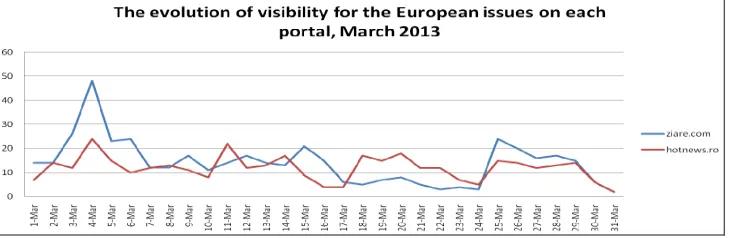
In what concerns the visibility progress of the European topics, two visibility peaks were registered. On 3-6 March with the highest visibility peak on 4 March since in this period Romania and Bulgaria’s request to join the Schengen area was rejected at the JHA Council. Following the declaration of the German minister for internal affairs in which he announced Germany’s opposition regarding the admission of the two countries, several European leaders and Romanian politicians started heated discussions over the issue. The second visibility peak was on 25-26 March and concerned the crisis in Cyprus, the consequences of the euro crisis and the discussions over the possibility that Cyprus might leave the eurozone. The consequences of the crisis were also felt in Romania through the closing of some Cypriot banks in our country. Therefore, the high visibility of the topics was also due to the national impact.
Fig. 1 - The evolution of visibility for the European issues on each portal, March 2013
Overall, regarding the visibility of European issues, we cannot state that media have allocated an important number of articles and editorials to cover these topics. Additionally, even the most important EU issues were covered from a national perspective with references to the local context and to internal economic consequences, or with references to other member states and to their actions, but not to EU as a single entity.
The analysis on the prominence of European topics shows the number of registered views in favor of European issues as compared to other topics, and the number of comments. The number of views and comments are variables that can offer information regarding the citizens’ interest and their availability to get involved in debates with other online readers. The average number of views for the European topics is 4142.7, while the average for the other topics is 2754.6. In what concerns the number of comments, the average for the European topics is 14.0, while for other topics is 7.0. The European topics were mostly from the political field and this area attracts a large number of comments. Furthermore, the events that took place in March 2013 as the rejection of Romania and Bulgaria’s adhesion to the Schengen area, the crisis in Cyprus that lead to the closing of some bank subsidiaries in Romania had a national impact.
Vol
u
me 2, Issue
2
, 2013
adhesion so the citizens’ interest and involvement in discussions was given by the national impact. Furthermore, the perspective from which these subjects were covered was a national one and the most visible actors were the national ones as well.
The coverage perspective and the presence of actors in the European topics
Regarding the analysis of the actors, we aimed at identifying the types of actors that are present in the European topics, to see if the most visible ones are European actors, national ones, European institutions or the leaders of the member states. The most visible actors are the countries – 51.8%, the national actors – 15.3% and European institutions 8.7%. There are no major differences between the two portals, but hotnews.ro focuses more on European institutions and actors from EU member states, while ziare.com on countries and national actors.
Fig. 2 - The presence of actors in the European topics, March 2013
For a better representation of the actors, we grouped them into national actors, European actors and non-EU international actors. The European actors represented only 56.6% of the actors mentioned in the European topics. By grouping the actors in countries, institutions and persons, we could observe that the countries are the most prominent – 51.7%. Considering the distribution of the actors featuring in the European topics, the EU actors prevail, although they are represented mostly by countries and the difference between them and the national actors is reduced.
Vol
u
me 2, Issue 2
, 2013
The European topics at the level of citizens’ conversation agendas
To analyze the media effects, the transition of the EU topics and perspectives from media to the citizens, we conducted 20 interviews with Romanian master students to see how young, educated students relate to the EU issues. Regarding the interest for European topics, the interviewees are interested in what happens at the EU level, but especially concerning the national effects of the European issues (9 out of 20) and the important events that are highly visible in the media or have an impact on their work (7 out of 20). Four interviewees are not interested in the European topics.
“I am not particularly interested, but if there is an important and interesting issue that is internationally or nationally debated and it has an echo in the media, then yes.” (O.D., 24)
„I don’t watch EU topics or look at talk-shows on the EU issues; they don’t represent a point of interest for me.” (C.U., 24)
If we relate to March 2013, only 8 out of 20 respondents watched EU topics in this period either to keep up to date with the EU events and decisions, or to look for useful information in their working field. The interviewees watched and remembered mostly subjects related to the euro crisis, especially the crisis in Cyprus (9 out of 20), and the rejection of Romania and Bulgaria’s adhesion to the Schengen area (6 out of 20).
Regarding the citizens’ discussions on EU topics, most interviewees discuss very little (8 out of 20) and only if there is something important and very visible in the media or if the issue has a great influence on Romania or on their lives. Seven interviewees do not discuss at all on EU topics, while five try to discuss especially with persons from whom they might learn something.
“(I discuss) Only if it seems to have an impact on us (on the country), on me, if it could potentially influence my future.” (I.M., 24)
“I don’t discuss at all on topics related to EU and I don’t comment in general. They don’t constitute the topic of my discussions with my friends or my family.” (C.U., 24)
Vol
u
me 2, Issue
2
, 2013
Regarding the perceived contextualization in the media, the interviewees clearly indicated the national perspective, the national impact approach (18 out of 20). Only two said that the European perspective prevails when presenting the EU related issues. When discussing about European topics, the interviewees opt for the same perspectives as the ones perceived in the media so the national approach prevails.
“National (perspective), clearly. For the general view, there is the tendency to explain and show the effects, the impact of the European actions on us. In the end, this is what interests us. If some prices rise in Europe, they will rise here for sure too, and not the other way around. The national impact seems very important to me.” (O.D., 24)
“The national impact. How it is for us, how it affects us and that’s it. I rarely happen to see an article that also talks about something else.” (O.A., 23)
Overall, people’s interests and involvement in discussions about the EU are influenced by the subjects approached in the media as they relate and discuss on the most visible media topics. The citizens take up the most prominent issues and actors in their discussions about EU topics and they use the prevailing media perspectives in evaluating the European issues. However, the citizens’ interest in the EU is mostly related to issues that might affect the country or their work and not to subjects that concern the EU as a whole.
Discussions and conclusion
In the context of the European crisis and considering the deficits of democracy and legitimacy, the European Union needs an increased communication with its citizens. Without taking into account the citizens’ voice, without the Europeanization of the national public spheres, without a sense of affiliation to a European identity, the EU cannot develop its political dimensions to become a federation.
Media have an essential role in sustaining the Europeanization process so they can bridge the gap between the EU and its citizens and can increase the general involvement and the cohesion among member states. Therefore, to analyze the influence of media coverage of European topics on people’s discussions, we conducted a comparative research between the media visibility and prominence of the European issues and their reflections on citizens’ perspectives.
Vol
u
me 2, Issue 2
, 2013
severe crisis led also to the closure of some Cypriot bank subsidiaries in Romania. Therefore, the most visible subjects had national implications and their main coverage perspective was a national one.
In what regards the prominence of the EU topics, the most commented issues and the most visualized ones were about the Schengen case, respectively the rejection of Romania and Bulgaria’s’ adhesion. Therefore, the citizens’ interest and involvement in discussions was given by the national impact. Furthermore, the national actors had a high presence in the European topics. In what concerns the contextualization of the European topics, the predominant perspective is still the national one so we could say that the Europeanization process is not effectively supported by the media discourse.
If we consider the most visible and prominent EU topics, and the issues mentioned by the citizens as points of interest and discussions, we can see that the two plans are almost similar. The issues that are highly visible in the media and those that may affect the national plan or their work, are those that capture the citizens’ interest. Media influences their agenda as well as their perspectives. The actors they mention the most are those that were visible in the news. However, they refer mostly to leaders of the other member states and to national actors, this indicating that the Europeanization process is reduced and it has more elements of horizontal Europeanization than elements of the vertical dimension. Furthermore, the citizens are interested in topics that approach the national consequences and not in issues that regard the EU as a single entity. The prevailing contextualization both in the media and in citizens’ discussion is the national one. Without a European perspective, the Europeanization process is practically obstructed.
Overall, the citizens’ interest in European topics is either related to the most visible topics in the media, or to those issues that affect the national plan or their activities. Moreover, they discuss very little about European issues and their conversations agenda contains topics with high level of media visibility or with a direct impact on their personal plan. Therefore, the Europeanization process requires more support at the level of media discourse through increased media coverage of EU topics and a European perspective.
In conclusion, the Europeanization of the national public sphere is a shy process as debate is almost missing and the media coverage of EU topics still does not succeed in transcending the national interests and perspectives. National media should commit to developing a comprehensive Europeanization process through a Europeanized discourse since so far they favored the Europeanization aloof the EU. Since information is the base for involvement and debate, a Europeanized communication will increase the interest of the citizens without which a Europeanized public sphere is not possible.
WORKS CITED
Vol
u
me 2, Issue
2
, 2013
Brüggemann, Michael, and Katharina Kleinen-von Königslöw. “`Let's Talk about Europe': Why Europeanization Shows a Different Face in Different Newspapers”. European Journal of Communication. 2009, 24(1): 27–48. Print.
Crowley, John, and Liana Giorgi. “Introduction: the political sociology of the European public sphere”. Democracy in the European Union. Towards the
emergence of a public sphere. Giorgi, Liana, Ingmar von Homeyer, and
Wayne Parsons eds. London/ New York: Routledge, 2006. Print.
De Vreese, Claes H. The EU as a public sphere. 2007. Web. April. 2012.
<http://europeangovernance.livingreviews.org/Articles/lreg-2007-3/download/lreg-2007-3Color.pdf>.
Downey, John, and Thomas Koenig. “Is There a European Public Sphere? The Berlusconi & Schulz Case”. European Journal of Communication. 2006, 21(2): 165–187. Print.
Eriksen, Erik Oddvar. “An Emerging European Public Sphere”. European Journal
of Social Theory. 2005, 8(3): 350. Print.
Fraser, Nancy. “Transnationalizing the Public Sphere. On the Legitimacy and Efficacy of Public Opinion in a Post-Westphalian World”. Theory, Culture
& Society. 2007, 24(4): 7-30. Print.
Gripsrud, Jostein. “Television and the European Public Sphere”. European Journal
of Communication. 2007, 22(4): 479–492. Print.
Habermas, Jürgen. The Public Sphere: An Encyclopedia Article. 1964. Web. April. 2012. <http://www.socpol.unimi.it/docenti/barisione/documenti/File/2008-09/Habermas%20(1964)%20-%20The%20Public%20Sphere.pdf>.
Koopmans, Ruud, and Jessica Erbe. Towards a European Public Sphere? Vertical
and Horizontal Dimensions of Europeanized Political Communication.
2004. Web. April. 2012. <http://europeangovernance.livingreviews. org/Articles/lreg-2007-3/download/lreg-2007-3Color.pdf>.
Lauristin, Marju. “The European Public Sphere and the Social Imaginary of the 'New Europe'”. European Journal of Communication. 2007, 22(4): 397– 412. Print.
Machill, Marcel, Markus Beiler, and Corinna Fischer, “Europe-Topics in Europe’s Media. The Debate about the European Public Sphere: A Meta-Analysis of Media Content Analyses”. European Journal of Communication. 2006, 21(1): 57-88. Print.
Risse, Thomas, and Marianne Van de Steeg. An Emerging European Public
Sphere? Empirical Evidence and Theoretical Clarifications. 2003.
Web, April. 2012. <http://userpage.fu-berlin.de/~atasp/texte/030624_ europeanpublicsphere.pdf >.
Vol
u
me 2, Issue 2
, 2013
Van de Steeg, Marianne. “Rethinking the Conditions for a Public Sphere in the European Union”. European Journal of Social Theory. 2002, 5(4): 499–519. Print.
***
The White Paper on a European Communication Policy. 2006. Web. March. 2012.
<http://eur-lex.europa.eu/LexUriServ/LexUriServ.do?uri=COM:2006: 0035:FIN:EN:PDF>.
***