Open Access
Software
Balance algorithm for cluster randomized trials
Ben R Carter* and Kerenza Hood
Address: South East Wales Trials Unit, Neuadd Meirionnydd, School of Medicine, Heath Park Campus, Cardiff University, CF14 4XN
Email: Ben R Carter* - [email protected]; Kerenza Hood - [email protected] * Corresponding author
Abstract
Background: Within cluster randomized trials no algorithms exist to generate a full enumeration of a block randomization, balancing for covariates across treatment arms. Furthermore, often for practical reasons multiple blocks are required to fully randomize a study, which may not have been well balanced within blocks.
Results: We present a convenient and easy to use randomization tool to undertake allocation concealed block randomization. Our algorithm highlights allocations that minimize imbalance between treatment groups across multiple baseline covariates.
We demonstrate the algorithm using a cluster randomized trial in primary care (the PRE-EMPT Study) and show that the software incorporates a trade off between independent random allocations that were likely to be imbalanced, and predictable deterministic approaches that would minimise imbalance. We extend the methodology of single block randomization to allocate to multiple blocks conditioning on previous allocations.
Conclusion: The algorithm is included as Additional file 1 and we advocate its use for robust randomization within cluster randomized trials.
Background
An essential part of a randomized controlled trial (RCT) is the process of allocating units to treatment or intervention groups (arms). This is defined as randomization and is carried out to ensure that systematic bias is minimized during the selection stage [1-3] and that randomized rather than model based inference can be used for analy-sis. Randomization is carried out so that any differences found between the treatment arms can be argued as a gen-uine effect or due to chance. The key principles of rand-omization are to ensure each unit is allocated randomly and that future allocations are concealed. This ensures that knowledge of previous allocations does not allow prediction of those in the future. There are many ways to undertake randomization, with the most straightforward
rolling an unbiased die with the treatment groups equally represented. However, in this simple example nothing prevents a heavy imbalance in terms of absolute number or baseline covariates to one of the treatment arms.
A solution to minimize the potential imbalance between treatment groups was originally reviewed by Box [4] then extended independently by Taves [5] and Pocock and Simon [6]. These authors detailed the steps implementing methods that dynamically randomized patients to ment group, minimizing the imbalance between treat-ment baseline characteristics, rather than by chance. After minimization was introduced further authors introduced methods that were published but were felt to be subopti-mal for the application [7,8]. Since then, the majority of
Published: 9 October 2008
BMC Medical Research Methodology 2008, 8:65 doi:10.1186/1471-2288-8-65
Received: 2 June 2008 Accepted: 9 October 2008
This article is available from: http://www.biomedcentral.com/1471-2288/8/65
© 2008 Carter and Hood; licensee BioMed Central Ltd.
views expressed have been in favour of widespread incor-poration of minimization [9-11]. International guidance for the pharmaceutical industry has been the most nota-ble critic of minimization and highlighted the lack of con-cealment [12], whereas other authors argue that in an RCT setting it is an additional administrative burden [13]. The Committee for Propriety Medicinal Products (CPMP) and at the International Conference on Harmonisation (ICH) for statistical principles in clinical trials it was advised that deterministic designs should be avoided and a random element included [12]. Many authors who have expressed reservation about minimization acknowledge that in set-tings where few units are needed to be randomized it can offer substantial benefits. Therefore minimization is an important consideration for cluster randomized trials where randomization occurs at the centre, rather than at the subject level. However, the key to minimization being accepted is the introduction of randomness to minimize the predictive power of those involved in a trial. This can be by masking and concealment to reduce the risk of allo-cations being known prior to randomization [14].
Cluster randomized trials may recruit all units prior to randomization which would allow baseline characteris-tics to be used to calculate the imbalance between treat-ment arms for each allocation allowing minimization with complete knowledge of baseline characteristics across the sample. Raab and Butcher introduced two crite-ria to evaluate randomization methods in cluster rand-omized trials across baseline covariates and in doing so described a simple imbalance measure between treatment arms [15]. Using this measure they generated allocations through randomization block designs which have been criticized for advance sequential randomization [16-18]. However, by delaying the allocation until all units within a block have been enrolled adequately deals with the issue of concealment [2,19,20]. Since the initial work of Raab and Butcher was reported other studies have used the methodology [21-23]. In a primary care study randomised by practice, this would mean all practices being identified and enrolled prior to randomization.
A natural extension of this is to consider blocks of units as they are enrolled. For a study in primary care this may mean practices which rapidly take up the offer of taking part in a study (and for whom the local ethical and gov-ernance arrangements are completed) for a first block, then those who take longer forming a second. With blocks structured pragmatically, it is important to balance between blocks as well as within.
At present no public domain software has been made available to calculate a within and between block imbal-ance measure using baseline covariate information. Our software is freely available through the R Software [24].
Implementation
Randomization of a single block of units
Where all units are fully identified in advance, a single block can be used for the study. The algorithm carries out a complete enumeration of all allocations in a two-treat-ment arm study. When the number of units within a block to be allocated is even, an equal number of units would be allocated into each of the treatment arms. For cases with an odd number of units within block a near equal alloca-tion is generated between the two treatment arms. Once the set of possible enumerations has been generated the imbalance statistic is calculated using the baseline covari-ates for each allocation across the two treatment arms.
It should be remembered that allocating units within a two arm study design incurs a natural symmetry. Since the algorithm does not assign treatment arm, only 0 or 1 as a treatment arm code, these can be interpreted as either treatment arm. Thus, a design with the first half of units allocated to treatment arm 0 and subsequent allocated to 1 would be identical to the first half of units allocated to treatment arm 1 and latter to 0. Therefore, for single block designs the software always allocates the first unit into group 1.
The imbalance measure as calculated by Raab and Butcher [15] was coded -1 and 1 for the two treatment group, here it is equivalently coded within block using 0 and 1 calcu-lated using: xij which is a matrix of 0, and 1's denoting allocation to treatment arm for each unit (i) and alloca-tion (k); and the matrix of equally weighted z-scores for the baseline factors noted as wij; and can be written as:
where xik is the ith unit of the kth allocation, w
ij is the ith unit
of the jth baseline covariate, n
1 is the number of units
allo-cated to the first block and M is the number of baseline factors.
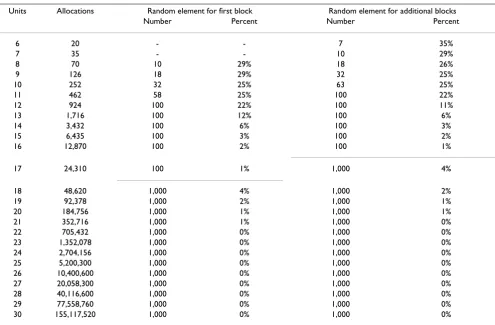
The algorithm will provide a set of optimal allocations depending on the number of units to be randomized. In accordance with the principles of the ICH guidance on randomness it is recommended that the final design is sampled from a set of optimal allocations [12,14]. We have offered guidance to the minimum size of the sets required in Table 1. We use the 25% most optimal alloca-tions for blocks with between 8 to 11 units or the optimal
Balance x w
i n j ik ij i n j = ⎛
(
)
⎝ ⎜ ⎜ ⎞ ⎠ ⎟ ⎟ = = = =∑
∑
1 1 21 1 1 2 1 2 M M , ,... , , ,... ,, , ,... ,
k=1 2 2n1
100 allocations for blocks between 12 and 17 units and for larger block sizes with greater than 17 units we use the top 1,000 allocations. The size of the block affects the level of predictability and concealment, with smaller block sizes more susceptible to bias [25].
Once the final allocated has been selected the choice of which group becomes intervention or control should be allocated randomly.
Randomization of multiple blocks of units
As described above there are often practical reasons for using a number of blocks. Therefore, there is a desire to randomize smaller blocks as they become availbale. Com-putationally the enumeration of 20 practices balanced into a two arm design would lead to 184,756 possible allocations. Beyond 20 units the total number of enumer-ated allocations quickly becomes a computationally intensive problem, where the maximum number of units able to be randomized is dependent upon the amount of available RAM (Table 2). Therefore, it may be prudent to randomize in blocks to overcome these two difficulties. Smaller block sizes have a increased chance of selection bias through inadequate concealment, or inquisitive
investigators [26], however if all units are enrolled prior to randomisation and informed at the same time of their allocation this is unlikely to be an issue.
Second and subsequent blocks should be allocated using the selected design of earlier blocks. The structure of the input allocation from earlier blocks includes the same header with a single row of 0 and 1's allocating units into the two treatment arms.
For an even block size the allocation will be equally split between the two treatment arms (regardless of previous blocks). For odd block sizes the previous blocks alloca-tions will be considered, since if previous blocks had equal number of units within each treatment arm, then a Table 1: The number of units, total allocation permutations and size of random component that the final design is selected from, partitioned into first and additional blocks
Units Allocations Random element for first block Random element for additional blocks
Number Percent Number Percent
6 20 - - 7 35%
7 35 - - 10 29%
8 70 10 29% 18 26%
9 126 18 29% 32 25%
10 252 32 25% 63 25%
11 462 58 25% 100 22%
12 924 100 22% 100 11%
13 1,716 100 12% 100 6%
14 3,432 100 6% 100 3%
15 6,435 100 3% 100 2%
16 12,870 100 2% 100 1%
17 24,310 100 1% 1,000 4%
18 48,620 1,000 4% 1,000 2%
19 92,378 1,000 2% 1,000 1%
20 184,756 1,000 1% 1,000 1%
21 352,716 1,000 1% 1,000 0%
22 705,432 1,000 0% 1,000 0%
23 1,352,078 1,000 0% 1,000 0%
24 2,704,156 1,000 0% 1,000 0%
25 5,200,300 1,000 0% 1,000 0%
26 10,400,600 1,000 0% 1,000 0%
27 20,058,300 1,000 0% 1,000 0%
28 40,116,600 1,000 0% 1,000 0%
29 77,558,760 1,000 0% 1,000 0%
30 155,117,520 1,000 0% 1,000 0%
Table 2: The maximum number of units able to be allocated, dependent on RAM specification and block number.
RAM First block Additional blocks
256 Mb 22 20
512 Mb 22 20
1024 Mb 24 22
random number generator would allocate the greater number units to one of the arms. However, if the two arms had already been allocated a different number of units then the greater number of units would be automatically allocated to the lesser recruited treatment arm. For exam-ple, if block one allocated 13 units with 6 in arm 0 and 7 in arm 1, and block two were to allocate 15 units then 8 would be allocated to arm 0 and 7 to arm 1.
For each additional block the balance measure is condi-tional on the selected allocation of the first block, where
wij is the within block z-scores and the balance measure
becomes:
where: n2 is the number of units allocated to the addi-tional block.
The output provided from multiple block designs is simi-lar a single block design. The differences in methodology between the allocation of the first and additional blocks are the following:
• if the block size is odd, the allocation of the larger number of units will depend on previous block alloca-tions,
• the symmetry which existed in the first block, no longer exists in additional blocks, since the treatment arm code has already been allocated. This changes the number of units able to be allocated within a block (Table 1).
The baseline covariate data
Numerical covariate information can be used directly in 'covariate_csv'. However, categorical data should be coded as below:
• If the factor has a natural ordering and would be deemed ordinal categorical then ordered scores should be consid-ered for example: None, mild, moderate and severe dis-ease levels could be coded within the data as 0,1,2,3. However, depending on the extent of the difference between the ordinal categories these might be coded alter-natively on the log2 scale i.e. 0,1,2,4. We advise you to
seek statistical and clinical advice for guidance before pro-ceeding with these [26].
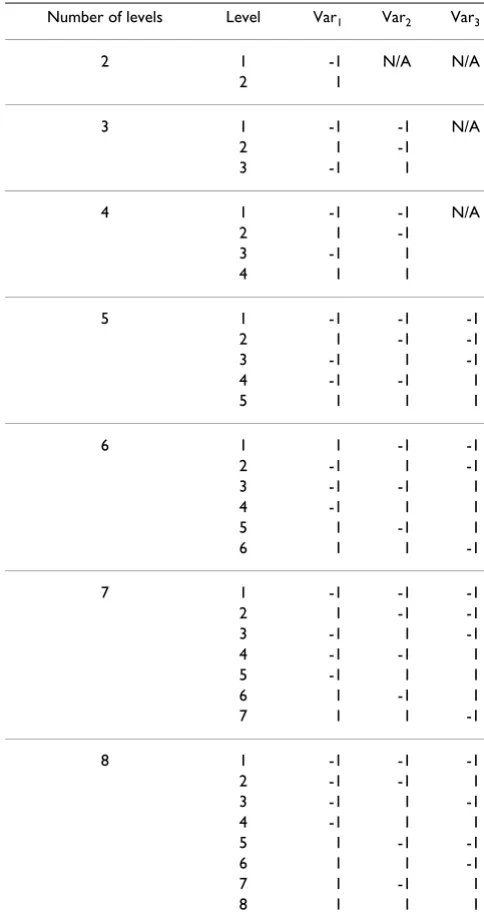
• If the factor lacks a natural ordering and is considered nominal categorical then the number of levels within the factor will need to be considered. Nominal categorical fac-tors can be coded using orthogonal dummy variables which identify individual factor levels (Table 3).
• It should be remembered that units should be equally allocated amongst each of the levels of each factor. There-fore, it would be recommended to include factors with few levels and few factors with greater than two levels, this can often be achieved by aggregating related levels. How-ever to code a factor with three of four levels can be carried out by implementing two variables in the covariates data sheet, or with 5 to 8 levels with 3 variables (see Table 3). To code a nominal factor called 'type of health profes-sional' with three factors levels 'GP', 'Nurse' and 'Other' could be coded as the following: 'GP' (var1 = -1, var2 = -1), 'Nurse' (var1 = 1, var2 = -1) and 'Other' (var1 = -1, var2 = 1).
Additional Block Balance zjk z x w j
jk ik ij i n
since
M
= =
(
)
= = +
∑
21 1
,
1
1 1
2 1
n
ik ij i n
x w
∑
∑
(
)
=
,
(2)
Table 3: Orthogonal coding of dummy variables for nominal categorical factor levels using a single variable for 2 levels, two variables for 3 to 4 levels and three variables for 5 to 8 levels
Number of levels Level Var1 Var2 Var3
2 1 -1 N/A N/A
2 1
3 1 -1 -1 N/A
2 1 -1
3 -1 1
4 1 -1 -1 N/A
2 1 -1
3 -1 1
4 1 1
5 1 -1 -1 -1
2 1 -1 -1
3 -1 1 -1
4 -1 -1 1
5 1 1 1
6 1 1 -1 -1
2 -1 1 -1
3 -1 -1 1
4 -1 1 1
5 1 -1 1
6 1 1 -1
7 1 -1 -1 -1
2 1 -1 -1
3 -1 1 -1
4 -1 -1 1
5 -1 1 1
6 1 -1 1
7 1 1 -1
8 1 -1 -1 -1
2 -1 -1 1
3 -1 1 -1
4 -1 1 1
5 1 -1 -1
6 1 1 -1
7 1 -1 1
Results
The software has been used within the PRE-EMPT study [27]. This is a study to evaluate the impact of training pri-mary care health professionals in behaviour change coun-selling. The study was randomized at the practice level and recruited patients prior to their appointment with a GP or nurse and followed up 3 months later. Practices within block were all enrolled into the study, then rand-omized and then informed of their allocation. Two blocks of 14 and 15 were used respectively, to allow for differing rates of response from practices and approvals being gained.
Here we present data of 29 general practice surgeries where the first 14 (rows) were allocated in block 1, and the remaining 15 allocated to block 2 using 'covariate.csv' as the baseline covariates data. The baseline data included two covariates, the first general practice list size (the number of patients registered at that practice) and the Townsend deprivation index aggregated to the general practice level [28-30]. The allocations for block two was conditional on block one has been included as 'block_one_allocation.csv'.
To implement the randomization algorithm carry out the following:
1, check the system requirements in the availability and requirements section, ensuring that you have installed R version 2.4, or later,
2, create a main folder and a subsequent subfolder within this called 'rcode',
3, save "Example_Allocation_Execution_Code.R" and "covariate.csv" within the main folder, then "randomisa-tion.R" and "randomisation 2.R" within the subfolder,
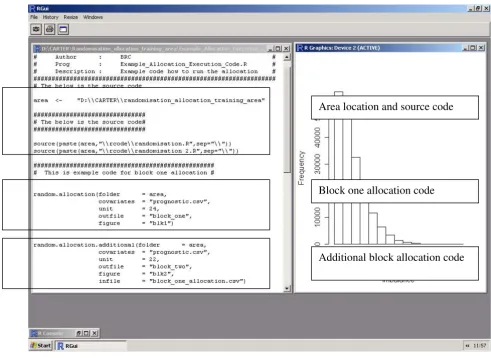
4, open R and update the location of the 'area', highlight and submit the area and source code (Figure 1)
5, to run the algorithm on block one, update the data within the block one allocation code and submit. Inversely to run later block allocations, update the data within the later block allocation code and submit this. Where the following variables are required (Figure 1):
folder, the location of the data, typically the same as the 'area';
covariates, the file containing the baseline covariate infor-mation;
unit, the number of units within the block;
outfile, the file produced containing the optimal set of enumerated allocations ordered by the imbalance statis-tic;
figure, the figure of the distribution of imbalance statistics across all enumeration allocations;
infile, the previously allocated block data (only required for blocks two or later).
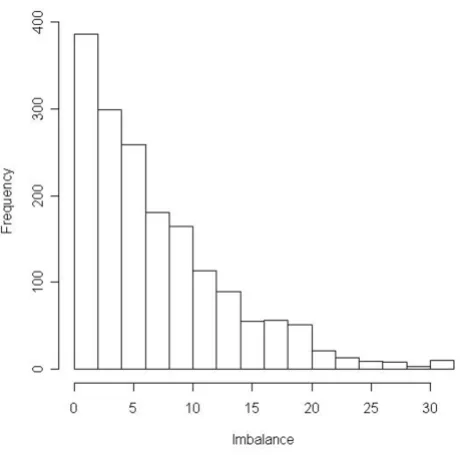
This will generate a file with the set of optimally balanced allocations ordered by the imbalance statistic called 'block_one.csv', where the rows are the allocations and the columns are the general practices as taken from the covariate file. A histogram that visualises the distribution of the imbalance statistics calculated from all allocations is shown in Figure 2.
From 'block_one.csv' one allocation was selected at ran-dom and treatment arm codes 0 and 1 were allocated to control and intervention arms (highlighted in 'block_one.csv'). Later the second block final allocation was selected and can be found as 'block_two.csv' (high-lighted again). Final allocations for both blocks were ran-dom selectly by the independent statistician on the Trial Steering Committee.
Table 4 presents summary statistics for the two baseline covariates including the number randomized into each arm (n), the mean and standard deviation (sd) within block and across blocks. This shows that the two arms exhibit minimal evidence to suggest imbalance either within or between blocks.
Discussion
The allocation of the first block involves the full enumer-ation of each design. These are used to calculate an imbal-ance measure between treatment arm [Equation 1]. Each additional block was randomized conditional on the pre-viously allocated design as a fixed starting point [Equation 2]. In doing so the algorithm not only provides access to software but extends the work of Raab and Butcher [15] by allowing multiple blocks to be randomized and ensures that allocations are balanced between the two treatment arms.
We advocate the allocation is selected at random from the set of allocations with the smallest imbalance statistic. Typically when using larger block sizes a random sample should be made from the 1,000 optimally balanced designed. However, for smaller block sizes fewer alloca-tions should be used to randomly select from (Table 1). The set sizes were determined pragmatically and depend-ent on block size, but we recommend that further work is carried out to quantify their effect, as we recognise these will effect the degree of randomness introduced.
It would be envisaged that these algorithms are not only used by statisticians, but allow medical researchers with minimal access to a statistician an invaluable tool to help randomize their trials in a robust way. In the primary care setting these algorithms have already been used to rand-omize centres within cluster randrand-omized trials. In future the algorithms could be extended to incorporate improved efficiency to deal with larger block sizes. Fur-thermore, we will weight the balance measure by practice
recruitment for those recruited practices to deal with under recruiting practices and examine the impact on future block allocations.
For details of a wide range of alternative randomization software algorithms see Professor Martin Bland's rand-omization software services pages [31].
Conclusion
The software is important for multi disciplinary teams needing to address the issues surrounding randomization. It allows the inclusion of information from baseline cov-ariates to influence the allocation of the units to treatment groups, without disclosing or causing untoward doubt to the concealment.
It is intended these algorithms are an easy to use and con-venient tool to be used by researchers who wish to mini-mize imbalance between treatment arms across multiple
A screen dump from 'Example_Allocation_Execution_Code.R'
Figure 1
A screen dump from 'Example_Allocation_Execution_Code.R'. To allocate, change the area and submit the R-script.
Area location and source code
Block one allocation code
baseline stratification variables ensuring that ICH guid-ance is adhered to.
Competing interests
The authors declare that they have no competing interests.
Authors' contributions
BC undertook the literature review, extended the method-ology, wrote the R-scripts and drafted the manuscript. KH carried out the original randomization work within the trials unit and reviewed the manuscript. Both authors have seen and approved the final manuscript.
Availability and requirements
Project name: : Cluster randomization allocation algo-rithm,
Operating system(s) : Windows 95, Windows 2000/ME or Windows XP (Vista untested),
Programming language : R,
License : Scripts provided free for non-commercial use, with absolutely no warranty,
Other requirements : R 2.4.0 (Released 3rd of October,
2006),
: R 2.6.1 is free to download and install [24],
: Minimum 256 Mb RAM (Table 2),
: 100 Mb Hard-disk space,
Restrictions : Commercial organisations should contact the author prior to use.
Additional material
Acknowledgements
We wish to thank the PRE-EMPT chief investigator Professor Chris Butler, the project team and the independent statistician Amanda Farrin (Leeds Clinical Trials Research Unit), Professor David Fone (Cardiff University) and Nathan Lester (National Public Health Service for Wales). We also wish to thank the two referees for improving this manuscript.
References
1. Fisher RA: The Design of Experiments. Edinburgh: Oliva and Boyd; 1935.
2. Beller EM, Gebski V, Keech AC: Randomization in clinical trials. MJA 2002, 177:565-567.
3. Burger VW, Christophi CA: Randomization Technique, Alloca-tion Concealment, Masking, And Suspectibility Of Trials To Selection Bias. JMASM 2003, 2:80-86.
4. Box GEP, Guttman I: Some aspects of randomization. RSS Series B 1966, 28:543-558.
5. Taves DR: Minimization: a new method of assigning patients to treatment and control groups. Clinical Pharmacology and Ther-apeutics 1974, 15:443-453.
6. Pocock SJ, Simon R: Sequential treatment assignment with bal-ancing for prognostic factors in the controlled clinical trial. Biometrics 1975, 31:103-115.
7. Klotz JH: Maximum entropy constrained balance for clinical trials. Biometrics 1978, 34:283-287.
Additional File 1
Cluster randomization allocation algorithm version 1. Algorithms scripted in R to provide robust cluster randomization.
Click here for file
[http://www.biomedcentral.com/content/supplementary/1471-2288-8-65-S1.zip]
The distribution of imbalance statistics across each of the generated allocations for block one
Figure 2
The distribution of imbalance statistics across each of the generated allocations for block one.
Table 4: Summarised baseline information from the randomised general practice surgeries for the two covariates partitioned into treatment group
List-Size Townsend Deprivation Index
(n) mean sd Mean sd
Block 1
Control 7 1,483 970 0.9 2.87
Intervention 7 1,504 570 1.1 1.70
Block 2
Control 7 2,080 929 1.5 3.58
Intervention 8 1,843 1112 0.7 5.26
Block 1 & 2
Control 14 1,781 964 1.2 3.13
Publish with BioMed Central and every scientist can read your work free of charge
"BioMed Central will be the most significant development for disseminating the results of biomedical researc h in our lifetime."
Sir Paul Nurse, Cancer Research UK
Your research papers will be:
available free of charge to the entire biomedical community
peer reviewed and published immediately upon acceptance
cited in PubMed and archived on PubMed Central
yours — you keep the copyright
Submit your manuscript here:
http://www.biomedcentral.com/info/publishing_adv.asp
BioMedcentral
8. Atkinson AC: Optimal biased coin designs for sequential clini-cal trials with prognostic factors. Biometrics 1982, 69:61-67. 9. Senn S: Randomization. Statistical issues in drug development. Wiley
1997:77-81.
10. Scott NW, McPherson GC, Ramsay CR, Campbell MK: The method of minimization for allocation to clinical trials: a review. Con-trolled Clinical Trials 2002, 23:662-674.
11. Altman DG, Bland MJ: Treatment allocation by minimisation. BMJ 2005, 330:843.
12. ICH E9(1) Expert working group: ICH – Harmonised Tripartite guidelines: Statistical principles for clinical trials. Statistics in Medicine 1999, 18:1905-1942.
13. Green H, McEntegart DJ, Byrom B, Ghani , Shepherd S: Minimiza-tion in crossover trials with non-prognostic strata: theory and practical application. Clinical Pharmacology and Therapeutics
2001, 26:121-128.
14. Berger VW, Ivanova A, Knoll MD: Minimizing predictability while retaining balance through the use of less restrictive randomization procedures. Statist Med 2003, 22:3017-3028. 15. Raab GM, Butcher I: Balance in cluster randomized trials.
Sta-tistics in Medicine 2001, 20:351-365.
16. Berger VW: Do not use blocked randomization. Headache 2006,
46:343-345.
17. Berger VW: Misguided precedent is not a reason to use per-muted blocks. Headache 2006, 46:1210-1212.
18. Berger VW: Varying the block size does not conceal the allo-cation. Journal of Critical Care 2006, 21:229-230.
19. Schulz KF, Chalmers I, Hayes RJ, Altman DG: Empirical evidence of bias. Dimensions of methodology quality associated with estimates of treatment effects in controlled trials. JAMA 1995,
273:408-412.
20. Schulz KF, Grimes DA: Allocation concealment in randomized trials:defending against deciphering. The Lancet 2002,
359:614-618.
21. Moore H, Summerbell CD, Greenwood DC, Tovey P, Griffiths J, Henderson M, Hesketh K, Woolgar S, Adamson AJ: Improving Management of obesity in primary care: cluster randomised trial. BMJ 2003, 327:1085-1090.
22. Raab GM, Butcher I: Randomization inference for balanced cluster randomized trials. Clin Trials 2005, 2:130-140.
23. Glynn RJ, Brookhart MA, Stedman M, Avorn J, Soloman DH: Design of cluster-randomized trials of quality improvement inter-ventions aimed at medical care providers. Medical Care
2007:38-43.
24. R Development Core Team: R: A Language and Environment for Statistical Computing. R Foundation for Statistical Computing
2007 [http://www.R-project.org]. Vienna Austria
25. Berger VW: Quantifying the magnitude of baseline covariate imbalances resulting from selection bias in randomized clin-ical trials. Biometrical Journal 2005, 2:119-127.
26. The Cochrane Collaboration: Cochrane Handbook for System-atic Reviews of Interventions 4.2.6. The Cochrane Collection
2006:107-108.
27. The Pre-Empt Project Team: Preventing disease through oppor-tunistic, Rapid EngagEMent by Primary care Teams using behaviour change counselling. (PRE-EMPT). South East Wales Trials Unit 2006 [http://www.cardiff.ac.uk/medic/subsites/sewtu/what wedo/preempt-study.html].
28. Townsend P: Deprivation. Journal of Social Policy 1987, 16:125-46. 29. Fone DL, Dunstan F: Mental health, places and people: A
mul-tilevel analysis of economic inactivity and social deprivation. Health and Place 2006:332-344.
30. The Quality and Outcomes Framework, National Public Health Service for Wales [http://www.wales.nhs.uk/sites3/ page.cfm?orgid=480&pid=17050]
31. University of York, directory of randomisation software and services [http://www-users.york.ac.uk/~mb55/guide/randsery.htm]
Pre-publication history
The pre-publication history for this paper can be accessed here: