261
Copyright © 2016. Vandana Publications. All Rights Reserved.
Volume-6, Issue-6, November-December 2016
International Journal of Engineering and Management Research
Page Number: 261-266
CFD Analysis of Solar Air Heater Duct Artificially Roughned Absorber
Plate with Triangular Cross-Sectional Ribs
Mithun Siloriya1, Sanjiv Yadav2
1Post Graduation student of Technocrats Institute of Technology, Bhopal, INDIA 2
Assistant Professor of Mechanical Department Technocrats Institute of Technology, Bhopal, INDIA
ABSTRACT
In a computational fluid dynamics, trails have been conducted on the heat transfer and friction factor for a solar air heater duct with triangular cross-sectional ribs without symmetric gaps. In the CFD investigation, it was assured that the height is 2mm, the pitch (p) of the ribs is 20, the relative roughness pitch (p/e) is 10mm and the angle of attack taken was 60o. This investigation was carried out on a Reynolds Number (Re) ranging within 4000-12000.Results of this analysis is compared with experimental results of Rajesh maithani and j.s. saini for solar air heater with absorber plate having triangular cross section ribs and absorber plate having v-shaped circular cross section ribs with symmetrical gaps at optimum designed value of ribs .
Keywords— CFD analysis, FLUENT, GAMBIT, Solar Duct, Friction factor
I.
INTRODUCTION
1.1 Overview:
In the recent years demand of energy is increase continuously, to meet the current demand of energy conventional sources of energy is not sufficient also the stock of conventional sources of energy is limited in future we needs alternate sources of energy, one of the most promising sources of energy which never end found by the energy researcher is non-conventional source of energy. Some of the non-conventional source of energy are solar energy, wind energy, ocean thermal energy, tidal energy, this are also called as natural sources of energy. Out of this solar energy is called as primary source of energy because the other energy like wind energy, ocean thermal energy are derived from the solar energy.
1.2 Current analysis: -
This research is also carried out on solar air heater in which air is heated by flowing it forcefully though the duct and absorber plate is place on the top wall,
for research purpose we give heat flux of 1000 w/m2 instead of solar energy in the absorber plate.
1.3 Analysis aim:
The main of the analysis is to increase the net gain in thermal energy with minimum drop in pressure while flowing across the absorber plate. For this roughness element shape and its dimension like height, pitch, and angle through which air strikes the roughness element should be such that it offer optimum amount heat transfer with minimum loss of pressure. To achieved this task research of various researcher in this field is study and found various design of absorber plate which have its own advantage and disadvantage, also selecting a particular design required an experimental checking of its performances in term net heat gain and pressure drop, this experimentally checking is time consuming and economically it is not affordable .in order to avoid this experimental work CFD analysis of a solar air heater is best option.
II.
LITERATURE SURVEY
K.R. Aharwal,B.K.Gandhi,J.S. Saini, [1]
researched in the year 2008, author used square inclined ribs with gaps in it, and found friction factor and Nusslet number increases in air by an amount as compare to flow of air in smooth duct for Reynolds number ranging from 3X10³ to 18X103with rib geometry having 600 angle of inclination .
V.S. Hans, R.P. Saini, J.S. Saini [2] researched in the year 2009, author used roughness in the form of multiple V-ribs having circular cross section and found enhancement in Nusslet number and friction factor in air as compared to flow of air in smooth duct when angle of attack is 600 for Reynolds number ranging from 2X10³to 20X103
262
Copyright © 2016. Vandana Publications. All Rights Reserved.
efficiency in a solar duct by using cylindrical metal grits roughness in the absorber and concluded that gain in thermal energy increases with increasing in the Reynolds numbers but it is not same in the case net gain thermal energy because increase in Reynolds number increases pumping power for the flow of air as compared to gain in thermal energy , this analysis also concluded that at high value of isolation the optimum condition for net gain in thermal energy shift towards high value of Reynolds number .
M.K. Gupta, S.C.Kaushik [4] researched in the year 2009,for the performance of solar by using metal mesh as an roughened element on absorber plate in heater, in terms of energy augmentation ratio [EAR], and concluded that effectively energy augmentation considering pressure drop [EXAR] is increase with increasing ratio of rib height /equivalent hydraulic diameter of collector duct keeping the other parameters of metal mesh constant for low Reynolds number however for high Reynolds number this trend is opposite because more pumping power is requires as compare to effective thermal energy gain by the air from the absorber plate .
Also this research show that EXAR increase with increase in the length of ratio of short way mesh/rib height keeping the other parameters constant for low range of Reynolds number and again for high Reynolds number this trend again reverse, finally this research concluded that maximum value of net energy augmentation ratio is obtained at s/e=25 by keeping ratio of intensity of radiation to height of grit constant.
SantoshB.Bopche, MadhukarS.Tandale [5]
researched in the year 2009, on solar air heater by taking collector plate with inverted U type roughness element in the absorber plate and check the effect of this roughness element, on the behalf of his experimental work they concluded that there is an enhancement in heat transfer coefficients and friction factor even at low Reynolds number as compared to smooth duct. In his experimental work they find that pitch and height of the roughness element strongly affect the heat transfer in duct and found maximum enhancements of heat transfer from collector to air is occur at pitch of 10 mm and height of rib is 1.5 mm Arvind kumar, J.L balgoria, R.M.sarviya [6] research in the year 2009 on the solar air by taking absorber plate having discrete W-ribs and concluded the following points in his experimental study.
Keeping the relative roughness height constant i.e. ratio of rib height to the hydraulic diameter of the duct , Nusslet number vary with the variations in Reynolds number and the value of Nusslet number for each Reynolds number at this geometry of ribs is higher than the Nusslet number of smooth duct .
Keeping the relative roughness height constant friction factor decreases for each increase in Reynolds number but the value of friction factor at this geometry of ribs is higher than the friction factor of smooth duct.
At higher value of relative roughness at this geometry the net heat transfer in air is less with the increase in Reynolds number.
Keeping the roughness height constant maximum value of Nusslet number and friction is obtained at an angle of attack of 600
Giovanni Tanda [7] researched in the year 2011, on the solar air heater by taking absorber plate with continuous 450 inclined ribs, transverse continuous rib, and transverse broken ribs, discreet v-ribs out of this four configuration of absorber plate he found in his study that maximum enhancements in heat transfer to air is occur in transverse broken rib and the maximum value of friction factor is found in the same type of rib. The net efficiency of transverse broken ribs at solar intensity 1000 w/m2 and for a fixed value e/De i.e. ratio of rib height to hydraulic diameter of duct is more than the other type of rib.
III.
NUSSLET NUMBER
Nusslet number is calculate from the relation h*D (hydraulic diameter )/K, here also the value of D and K are constant where the value of h is taken from the contour of surface heat transfer coefficient at different Reynolds number .
Nusslet number at Reynolds No.4X103 for triangular ribs Nusslet number =h*D (hydraulic diameter)/K
D (hydraulic diameter) =.0332 m, K = .0242 kg/m3, h=(63+60+57+53+50+47+43+40+37+33+29+25+22+18+ 14+10+7+5+3+2+0)/21, h = 30
Figure 1 contour of surface heat transfer coefficient across the triangular shaped ribs absorber
Nusslet number = (30*.0332)/.0242 Nussle number = 41.15
263
Copyright © 2016. Vandana Publications. All Rights Reserved.
Figure 2 contour of surface heat transfer coefficientsacross the triangular shaped ribs absorber plate
h=(210+202+191+185+177+166+157+148+137+125+112 +92+83+74+61+40+28+17+9+4+0)/21
h=105.61
Nusslet number = (105*.0332)/.0242 Nusslet number = 144.89
Nusslet number at Reynolds No.12X103 for triangular ribs
Figure 3 contour of surface heat transfer coefficients across the triangular shaped ribs absorber plate
h=(255+245+226+210+196+183+172+158+145+131+106 +102+90+78+64+50+33 +20+12+6+0)/ 21
h=118.66
Nusslet number = (118.66*.0332)/.0242 Nusslet number =162.78
IV. FRICTION FACTOR
Friction factor across the triangular cross section V-ribs is calculate with the help of dracy-weisbach relation, fs = (.5*∆P*D (hydraulic diameter))/ (ρ*L*V
2
) Here, ∆P = pressure drop across the triangular cross – section ribs in solar duct
V= velocity of air across the triangular cross –section ribs in solar duct, Also ρ = 1.225 kg/m3, L=1m
Value of ∆P and V is calculated from the contour obtained from the analysis at Reynolds no 4X10³, 8X10³, 12X103.
Friction factor at Re 4X10³
Figure 4 contour of pressure at the inlet of test plate
Figure 5 contour of pressure at the outlet of test plate
fs = (.5*∆P*Dhydraulic diameter)/(ρ*L*V2)
Pressure drop across the testing plate in solar duct (∆P) =101328-101324=4N/m2, Plate length (L) =1m
Density (ρ) =1.225kg/m3
,
Velocity across the testing plate =1.22m/s2 fs = (.5*4*.0332)/(1.225*1*1.222), fs = .036
264
Copyright © 2016. Vandana Publications. All Rights Reserved.
Figure 7 contour of pressure at the inlet of test plateFigure 8 contour of pressure at the outlet of test plate
fs =(.5*∆P*Dhydraulic diameter )/ (ρ*L*V 2
)
Pressure drop across the testing plate in solar duct (∆P)=101334-101320=14N/m2
Velocity across the testing plate =2.35m/s2 Plate length (L) =1m
Density (ρ) =1.225kg/m3
fs = (.5*14*.0332)/(1.225*1*2.352),fs = .034
Figure 9 contour of velocity across the test plate
Friction factor at Re 12X103
Figure 10 contour of pressure at the inlet of test plate
Figure 11 contour of pressure at the outlet of test plate
fs = (.5*∆P*Dhydraulic diameter)/(ρ*L*V 2
)
pressure drop across the testing plate in solar duct (∆P)=101338-101312=26N/m2
Plate length (L) =1m Density (ρ) =1.225kg/m3
Velocity across the testing plate =3.44m/s2 fs = (.5*26*.0332)/(1.225*1*3.442), fs = .0298
265
Copyright © 2016. Vandana Publications. All Rights Reserved.
V.
COMPARISON OF NUSSLET
NUMBER AND FRICTION FACTOR IN
BETWEEN TRIANGULAR CROSS
SECTION RIBS AND CIRCULAR CROSS
SECTION V-SHAPED RIBS WITH
SYMMETRICAL GAP
friction factor and Nusslet numbers [8] in which author is taken absorber plate having V-shaped circular cross section ribs with symmetrical gap, author in his experiments work find out that maximum value of Nusslet number and friction factor is obtained for a geometry which have maximum no gap 3,angle of attack is 600,gap to height of rib ratio is 4, pitch to height of rib ratio is 10.so at different Reynolds numbers the value of friction factor and Nusslet number for this geometry is tabulate below
Table 1 values of friction factor and Nusslet number for circular ribs at different Reynolds number
Friction factor and Nusslet number for triangular ribs at different Reynolds number is tabulate below
Table 2 value of friction factor for triangular ribs at different Reynolds number
Percentage variance in friction factor and Nusslet number between triangular and circular ribs are tabulate below.
Table 3 Percentage variance in friction factor
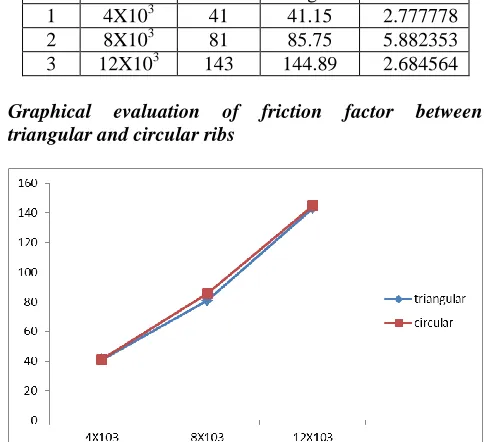
Graphical evaluation of friction factor between triangular and circular ribs
Figure 13 graph between triangular ribs friction factor and circular ribs friction factor
S.no Reynolds number
Nusslet number circular
Nusslet number triangular
Percentage difference
1 4X10³ 41 41.15 2.777778
2 8X10³ 81 85.75 5.882353
3 12X103 143 144.89 2.684564
Graphical evaluation of friction factor between triangular and circular ribs
Figure 14 graph between triangular ribs friction factor and circular ribs friction factor
VI.
CONCULSION
Effect on Nusslet number
(a) At Reynolds number four thousand Nusslet numbers of triangular cross section ribs is 1% higher than experimental work of Rajesh maithani and j.s. saini for absorber plate which is V in shaped and circular in cross section having symmetrical gap.
(b) At Reynolds number eight thousand Nusslet number of triangular cross section ribs is 5.5% more than the author ribs
(c) At Reynolds number twelve thousand Nusslet number is 1.3% higher than the author ribs
266
Copyright © 2016. Vandana Publications. All Rights Reserved.
also triangular cross section ribs provided between aerodynamic as compared to circular cross section ribs this two factor increases the heat transfer solar air heater with triangular cross section ribs.
Effect on friction factor
(a) At Reynolds number four thousand friction factor of triangular cross section ribs is 2.7% higher than experimental work of Rajesh maithani and j.s. Saini for absorber plate which is V in shaped and circular in cross section having symmetrical gap
(b) At Reynolds number eight thousand friction factor of triangular cross section ribs is 6% higher than author ribs. (c) At Reynolds number twelve thousand friction factor of triangular cross section ribs is 2.7% higher than author ribs.
This increase in friction factor for triangular ribs for each Reynolds number is because triangular ribs are continues, so it provided more surface area to the air result in higher value of pressure drop and velocity as compare to author ribs for same optimum dimension.
REFERENCES
[1] Renewable Energy 33 (2008) 585–596 K.R. Aharwal, B.K.Gandhi, J.S. Saini, Experimental investigation on heat-transfer enhancement due to a gap, in an inclined continuous rib arrangement in a rectangular duct of solar Air heater.
[2] Solar Energy 84 (2010) 898–911 V.S. Hans, R.P. Saini J.S. Saini, Heat transfer and friction factor correlations for a solar air heater duct roughened artificially with multiple v-ribs
[3] Solar Energy 83 (2009) 6–13 S.V. Karmare, A.N. Tikekar, Experimental investigation of optimum thermo hydraulic performance of solar air heaters with metal rib grits roughness
[4] International Journal of Thermal Sciences 48 (2009) 1007–1016, M.K. Gupta, S.C.Kaushik, Performance evaluation of solar air heater having expanded metal mesh as artificial roughness on absorber plate.
[5] International Journal of Heat and Mass Transfer 52 (2009) 2834–2848, Santosh B. Bopche, Madhukar S. Tandale, Experimental investigations on heat transfer and frictional characteristics of a tabulator roughened solar air heater duct
[6] Energy Conversion and Management 50 (2009) 2106– 2117, Arvind Kumar,J.L. Bhagoria, R.M. Sarviya, Heat transfer and friction correlations for artificially roughened solar air heater duct with discrete W-shaped ribs.
[7] Energy 36(2011) 6651-6660, Giovanni Tanda, Performance of solar air heater ducts with different types of ribs on the absorber plate.